Geological and Earth Sciences/Geosciences, Other: Degree Guide
A practical guide to comparing broad geosciences programs, weighing hands-on learning and costs, and connecting your interests with career and graduate-study options.
By David Slack · Staff Writer Assessment.com · Published October 25, 2026 · Last updated November 5, 2026
The title Geological and Earth Sciences/Geosciences, Other describes a broad program category, not a fixed major with a standard course list. One college may emphasize geology, while another may organize study around geophysics, water resources, climate, or a blend of Earth science disciplines. For prospective students and parents, the key task is to uncover what a particular program teaches and where its training could lead. Compare actual courses, research and field opportunities, costs, and the qualifications tied to careers you want to explore before deciding that a program is the right fit.
Degree & Program Decision Insights
Explore your personal fit, education requirements, career potential and next steps.
01Motivational Fit
Discover whether this program fits you
Explore your preferences against the focus of Geological and Earth Sciences/Geosciences, Other. These prompts are not personal MAPP results.
Subject curiosity. Would you choose to explore “geological and related sciences not listed above” in depth? Ask for a sample learning activity to test that interest.
Choosing a learning environment. Compare actual Geological and Earth Sciences/Geosciences, Other offerings. Would their reading, projects or practical work suit how you prefer to learn? Confirm the format rather than assuming one from the field name.
Work reality. Related work can involve this task: “Plan or direct research, development, or production activities.” Would you want that activity to be a regular responsibility?
Interest in studying a field can differ from enjoying its related work.
Which part would you want to do repeatedly, and what would you try before deciding?
Discover Your Personal Program Fit
Before investing your time and money in your education, discover how this program aligns with your natural motivations, work preferences and career goals.
Typical occupational entry: bachelor's degree (BLS). BLS lists 5 years or more of related work experience as typical for this occupation; this programme is not a direct promise of entry.
U.S. occupational wages are not guaranteed graduate earnings; OEWS excludes self-employed workers.
Projected openings include replacements as well as growth.
U.S. national estimates. A crosswalk does not establish entry-level eligibility; advanced, management and teaching roles can require further qualifications.
Compare the focus and route of these distinct instructional fields; their credentials and admission requirements are not interchangeable.
Geology/Earth Science, GeneralCIP 40.0601. Compare its emphasis on historical geology and geomorphology with this program’s focus.
Geophysics and SeismologyCIP 40.0603. Compare its emphasis on gravimetric and seismology with this program’s focus.
Oceanography, Chemical and PhysicalCIP 40.0607. Compare its emphasis on material inputs and outputs and chemical and biochemical transformations in marine systems with this program’s focus.
Explore your motivations. Use MAPP as a starting point for reflecting on your interest in “geological and related sciences not listed above”, then test that interest against a sample learning task.
Examine the work. Compare Natural Sciences Managers and Geoscientists, Except Hydrologists and Geographers on daily work and entry qualifications, as well as pay. Explore Natural Sciences Managers.
Compare actual providers. Ask for the exact credential, course sequence and assessment methods. Compare how each provider teaches “Geological and Earth Sciences/Geosciences, Other”, its entry criteria and its itemized costs.
Check the evidence before applying. Confirm prerequisites and any recognition or professional requirements for your intended route; ask for applicable rules and published outcome definitions in writing.
Verify the institution’s current offering, admissions requirements and outcomes; a search result does not establish your eligibility.
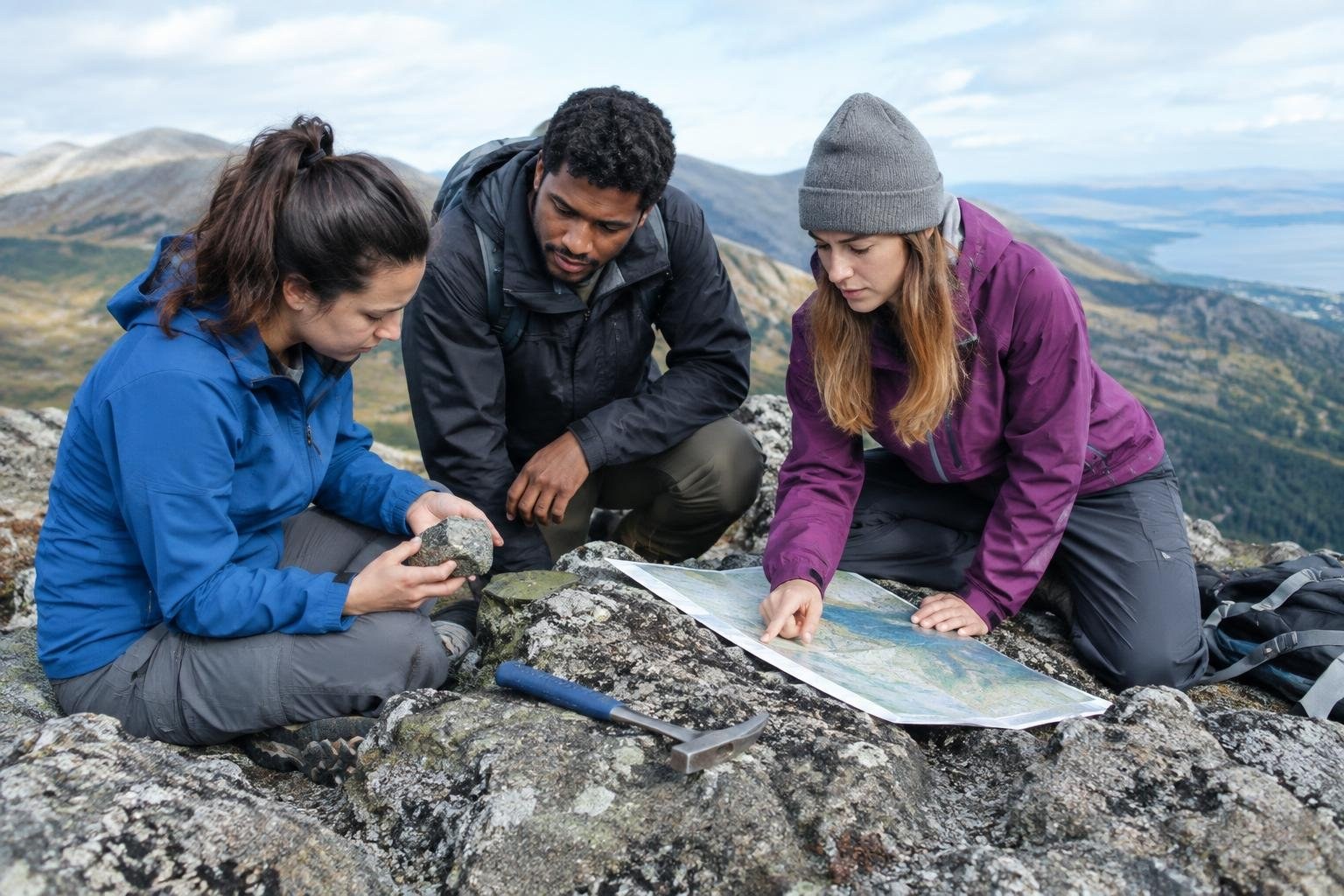
Geoscience students working with rocks, maps, or field observations
Start With the Curriculum, Not the Label
Think of this category as a label for programs that fall outside more specific geological and related science groupings, not as a promise of a shared curriculum. Colleges can house these programs in geology, Earth science, or geosciences departments and give them different academic identities.
The range is visible in university offerings. The University of Arkansas describes geosciences as drawing on geography, geology, Earth science, and geographic information science. At the University of Texas at Austin, the geosciences B.S. offers five named majors: General Geology, Geophysics, Hydrology and Water Resources, Climate System Science, and Geosciences. These examples show why the course catalog is more useful than the title alone.
Start your comparison by asking: What systems or questions does the program focus on? What methods do students practice? Which electives allow specialization? Those answers reveal the actual academic experience.
Read the Course Map as a Learning Plan
Instead of expecting a standard list of classes, trace a program’s sequence from introductory courses to advanced work. A geology-centered plan may ask students to interpret rocks and Earth history. A geophysics emphasis may turn attention toward Earth structure and measurement. Hydrology and water-resource study centers a different set of questions, while a climate focus frames Earth systems another way.
University program descriptions provide examples of this variety. Penn State frames geosciences around Earth processes and the planet’s evolutionary history. Texas separates several subject emphases within one undergraduate degree. Use the required courses and electives to see how those broad descriptions become a student’s week-to-week study.
When you review a course list, look for the work behind each title. Ask whether a class includes data interpretation, physical samples, computing, research, field activities, or a substantial project. Do not assume an experience is required or available until the department confirms it. A useful program comparison includes the course sequence, choice of electives, and a clear description of how students practice applying what they learn.
Look for the Methods Behind the Major
Geoscience learning can combine observations about Earth with interpretation of measurements and data. The specific mix depends on the subject area. A student working on Earth materials may ask different questions from one studying geophysics or water systems, even when both are developing evidence-based scientific habits.
Technical preparation is worth checking separately from the degree title. Arizona State University’s graduate program description highlights coding and numerical modeling, alongside measurement and analysis of data about Earth and planetary systems. Missouri University of Science and Technology’s faculty areas include exploration geophysics, digital signal processing, seismic hazards, remote sensing, and Earth data. These examples illustrate possible areas of emphasis, not a guarantee that every student will receive the same training.
Ask which tools appear in required courses and whether students use them in projects. If you are drawn to spatial data or computational work, compare actual course content and project opportunities. Keep a record of the methods you practice; being able to describe a project and your contribution can make your preparation easier to explain.
Test Your Interest Against the Work
Students who enjoy asking how Earth works may find this subject engaging, especially if they like building an explanation from observations rather than accepting a first impression. The work can connect broad questions about Earth processes with detailed analysis of rocks, fluids, structures, or data. Penn State and Angelo State describe geoscience in relation to Earth processes, physical characteristics, geological history, or materials, though each program’s design differs.
Use the program’s actual activities to test your interest. Would you enjoy reading data, doing quantitative work, examining samples, or working on a sustained research question? Are you more interested in field observation, laboratory work, computing, or a combination? These are prompts for comparing curricula, not assumptions about every major.
Interest and working preferences matter alongside admission preparation and cost. Assessment.com’s MAPP career assessment can help you reflect on career and degree options. Treat any assessment as one input, then compare your reactions with course descriptions, conversations with faculty, and the kind of work you hope to do.
Verify Entry Rules, Time, and Research Commitments
Admission and completion details belong to the individual institution, not to this broad category. A program’s current admissions page and catalog should be your reference for prerequisites, application materials, transfer credit, and degree requirements. Ask both admissions staff and the academic department questions that affect your plan: the first can clarify application rules, while the second can explain what preparation will help you follow the coursework.
There is also no universal time-to-completion figure for a category that spans different credentials and institutions. Request a term-by-term degree map and ask how transfer courses are evaluated, how often required classes are offered, and whether research or a thesis is expected.
Graduate pathways show why the details matter. Penn State describes M.S. and Ph.D. study with intensive research and a formal thesis. Southern Illinois University lists geology master’s options with and without a thesis, alongside a post-baccalaureate Earth Science certificate and a Geosciences Ph.D. Compare the exact credential and research commitment before applying.
Check the Full Delivery Format
A course being online does not by itself establish that a complete geosciences credential can be earned remotely. The format and requirements are set by each institution and program. Ask the department to identify which required courses are online, which require campus attendance, and whether research or field activities occur at particular times or locations.
Get practical details before you commit: Are any applied experiences mandatory? How are lab activities delivered? Is travel required, and are associated expenses included in the college’s estimate? Can a required experience be completed near home, if relevant? The answer should come from the program’s official materials or department, not from a general description of online learning.
Compare the full schedule with your work, caregiving, transportation, and accessibility needs. If a program offers multiple formats, ask whether they lead to the same credential and satisfy the same degree requirements.
Build a Cost Comparison You Can Trust
Build a comparison from each institution’s estimate for your likely course plan. Include tuition, mandatory fees, books, equipment, technology, and any travel or other expenses the college confirms are tied to required experiences. A per-credit figure alone may not show the likely total.
Ask how the estimate changes with transfer credits, part-time study, or a longer completion plan. Compare grants and scholarships with the full expected cost, and ask the financial aid office how eligibility relates to your enrollment. If you are considering a certificate or staged route, request written confirmation of which credits apply to the intended degree.
To evaluate affordability, compare programs on the same basis: credential, expected course load, fees, aid, and any additional costs identified by the college. Do not assume that credits will transfer or that a shorter advertised plan will fit your academic requirements.
Explore Careers by Matching Work to Preparation
Career exploration should begin with the work, not a promise attached to a degree name. Penn State describes geoscience in relation to Earth processes, Earth history, natural resources, and environmental problems. Angelo State describes geologists and hydrologists studying Earth’s physical aspects and analyzing rocks and fluids. These areas provide useful starting points for identifying roles to investigate, but they do not establish eligibility for a specific position.
Potential directions to explore include geologists, geophysicists, and hydrologists. A role’s requirements depend on the employer and work. Compare job postings with the courses, methods, and experience offered by a program. Research roles may involve further study; Penn State’s graduate programs, for example, emphasize intensive research and thesis preparation.
Before choosing a concentration, write down two or three occupations that interest you. Note required education, technical methods, and experience in current postings, then ask a department how its curriculum relates to those requirements. Do not treat a degree title as a guarantee of employment or a particular salary.
Turn Coursework Into Evidence of Preparation
To make a future application easier to explain, connect experience to a specific piece of work. A class project, research activity, or field experience can show how you approached a question, handled evidence, and communicated what you found. The opportunities available depend on the institution and should be confirmed before enrollment.
Technical depth can also help clarify what you have learned. Arizona State University identifies coding and numerical modeling as skills that can translate across domains. Missouri University of Science and Technology lists faculty interests such as remote sensing, signal processing, seismic hazards, and Earth data. Ask which methods are taught in required courses and whether students have opportunities to use them in supervised work.
Keep examples of your projects and record your role, methods, and results. Look at job postings early to see what employers request, then discuss gaps with faculty or advisers. Requirements for credentials depend on the intended occupation and location, so verify any professional rules with the appropriate authority.
Decide Whether Further Study Serves Your Goal
Further study makes sense when it serves a defined academic or career purpose. It can offer deeper subject preparation or a sustained research experience, but the credential and expectations differ across departments. Before applying, decide whether your goal is research training, a particular specialization, or a credential requested by employers in a role you have identified.
Program structures provide concrete contrasts. Penn State describes M.S. and Ph.D. study as involving intensive research culminating in a formal thesis. Southern Illinois lists both thesis and non-thesis geology master’s paths, a post-baccalaureate Earth Science certificate, and a doctorate in Geosciences. These examples are not a complete inventory of national options; they show why degree names alone are insufficient for comparison.
Ask about prerequisites, research expectations, funding, and how students choose or develop a research topic. Compare requirements with your intended next step, and avoid committing to a longer credential until you understand what it adds.
Compare Adjacent Fields by Their Questions
Nearby degree names can describe distinct learning priorities. Texas’s geosciences B.S. separates General Geology, Geophysics, Hydrology and Water Resources, Climate System Science, and Geosciences. That within-one-program comparison is a useful reminder: examine course requirements and concentrations, not just the word “Earth” or “environment” in a title.
Compare geology or geological sciences when you want coursework centered on geological materials, processes, or history.
Compare geophysics when measurement and analysis of Earth structure or dynamics interests you.
Compare hydrology and water resources if water-related questions are your priority.
Compare climate system science if you want a curriculum explicitly organized around climate systems.
Explore environmental science or forestry as different areas of study, then compare their actual requirements with geosciences.
For each option, identify the courses you would take, the methods you would practice, and the later study or occupations you might pursue. A related field is not automatically a better fit; the best comparison is grounded in your interests and the published curriculum.
Weigh the Flexibility Against the Unknowns
What may appeal: Geosciences can connect questions about Earth with evidence drawn from observations, materials, and data. Some programs offer several subject emphases, which can help students compare areas before choosing a focus. Technical work such as coding or numerical modeling may also be relevant to more than one domain, as noted in Arizona State University’s graduate program information.
What needs scrutiny: A broad title makes it difficult to predict coursework without consulting the catalog. Programs differ in available concentrations, applied experiences, and research demands. Some goals may call for graduate study, and required in-person or field activities can affect time and cost if a particular program includes them.
There is no universal answer to whether the degree is worth its cost. Compare the full price and time commitment with the specific education or career path you are considering. Verify the curriculum, ask about experience opportunities, and check job requirements before making a decision.
Use a Program Comparison Checklist
Compare programs using evidence that affects your daily study and next step. First, collect the catalog and degree map. Then ask the department to clarify details the documents leave open. A short list of answers is more useful than a general impression of a college’s geosciences offering.
Focus: Which courses and concentrations are required or available?
Learning methods: What research, lab, field, computing, or project work is part of the plan?
Access: Are opportunities limited by prerequisites, space, timing, or location?
Progression: What is the term-by-term sequence, and how are transfer credits applied?
Cost: What is the total estimate for the intended schedule after aid?
Next steps: Which qualifications do target jobs or graduate programs request?
Texas and Arkansas illustrate that geosciences programs can draw different boundaries around the field. Use official catalog information to verify each college’s current structure. For broader exploration, Assessment.com provides degree resources and an assessment for reflecting on career and education preferences.
Plan Backward From a Role You Want to Explore
A useful pathway plan starts with a destination and works backward. Choose a role or research area that interests you, find the education and experience it asks for, and compare those requirements with the program. This approach is more reliable than assuming that one degree title leads to a particular outcome.
Earth materials or processes: Compare geology-focused courses with entry requirements for the roles you are considering.
Earth structure or geophysical data: Look for relevant quantitative preparation and methods, then check role-specific requirements.
Water systems: Compare hydrology and water-resource coursework with the preparation requested for target positions.
Research: Ask whether undergraduate research is available and what graduate study may involve. Penn State describes intensive research and a thesis in its M.S. and Ph.D. programs.
These are planning prompts, not guaranteed sequences from degree to job. Angelo State and Penn State describe areas of geoscience work, while individual employers set their own hiring requirements. Check current postings and speak with a department before treating a pathway as realistic.
Ask Questions That Change Your Decision
Bring specific questions to admissions, faculty, financial aid staff, and current students. Ask questions that can be answered for the exact campus and credential you are considering:
Which concentration and courses would appear on my degree plan?
What preparation or prerequisites are expected before the first major courses?
How will my previous credits count toward this program?
Which projects, field activities, lab courses, or research opportunities are available, and what do they cost?
Which technical methods are taught and where will I practice them?
What is the estimated total cost for my likely schedule after aid?
Does the program’s format require campus visits, travel, or attendance at set times?
What do the job postings or graduate programs I care about require?
What research commitment is expected for a graduate credential?
Request written clarification about transfer credit, course sequencing, costs, and required experiences. Program examples differ, including in the graduate research and thesis structures described by Penn State and Southern Illinois, so confirm the details for your own choice.
Make the Decision With a Specific Program in View
Before deciding, describe the program in your own words without relying on its title. Identify the questions its courses address, the methods students practice, and the next steps that interest you. If you cannot answer those points from the college catalog, contact the department and ask for a course map or a conversation with an adviser.
Then test the match against your practical needs: total cost, course availability, required experiences, and the time needed to complete the credential. Compare at least one adjacent field if your interests span more than one area. The University of Texas examples show how related geoscience emphases can differ even within one degree program.
Assessment.com’s MAPP career assessment offers another way to explore career and degree options. Use it as a reflection tool alongside official program details, not as a substitute for investigating coursework and requirements.
Frequently asked questions
What does Geological and Earth Sciences/Geosciences, Other include?
There is no single course plan for this broad category. A college may focus on geology, geophysics, water resources, climate, or another geoscience area. Check the catalog and required courses to see what a specific program covers.
Is a geosciences program difficult?
Difficulty depends on the course sequence and concentration. Programs may require scientific reasoning and data analysis, while some add specialized quantitative or computational work. Review prerequisites and ask departments about academic support and sample coursework.
What careers can a geosciences degree lead to?
Possible directions include work related to geoscience, geophysics, water resources, or research. A degree does not guarantee eligibility for a particular role. Compare your coursework and experience with current requirements for the specific jobs you are considering.
How much do geosciences graduates earn?
There is no single salary for this broad field of study. Pay depends on the occupation, location, employer, experience, and qualifications. Research the exact career and region rather than using the degree category as a salary estimate.
Can I study geosciences online?
Availability and requirements vary by institution. Ask whether required laboratories, research, or field experiences are offered remotely or require campus attendance or travel. Confirm the format for the full degree plan before enrolling.
How much math is involved in geosciences?
The amount and type of quantitative work depend on the curriculum. Review required mathematics, physics, statistics, computing, and modeling courses. If you are concerned about preparation, ask the department about prerequisites and academic support.
Do geoscientists need a graduate degree?
Not for every role. Some research-focused or specialized paths may value or require advanced study. Compare the education requirements in job postings with the degree level and research experience offered by the programs you are considering.
Does a geosciences degree lead to a professional license?
Requirements depend on the occupation and may vary by location or employer. The broad degree classification does not establish one certification or license for all graduates. Verify rules with the relevant authority for your intended role.
People Also Ask
What does Geological and Earth Sciences/Geosciences, Other mean?
It is a broad category for geological and related science programs not captured by a more specific listed category. Institutions can shape their curricula differently, so use the college catalog rather than the category name to understand the major.
What subjects might a geosciences student study?
Programs may draw on geology, geography, Earth science, and other geoscience areas. Specific curricula can be organized around geology, geophysics, hydrology and water resources, climate system science, or broader geosciences.
Which degree levels are offered in geosciences?
There is no single level available everywhere. The supplied university examples include undergraduate programs and graduate degrees, as well as a post-baccalaureate certificate. Check each college’s current catalog for its credentials.
How can I compare geosciences programs?
Compare course requirements, focus areas, applied or research experiences, technical preparation, total costs, and how the curriculum relates to your intended career or further study. Ask the department to explain how students gain access to available opportunities.
Can geosciences courses be completed remotely?
Delivery formats depend on the institution and course. Ask whether laboratories, research, or field experiences require in-person attendance or travel, even if some lectures are online.
What jobs can geosciences graduates explore?
Possible paths to explore include geoscience, geophysics, water-resource specialties, and research. The right preparation depends on the particular role, so compare employer requirements with the program’s courses and experience opportunities.
A geosciences program is best judged by what students actually do: the Earth systems they study, the evidence and tools they use, and the depth of research or applied work they can pursue. Because this category covers varied programs, compare course maps, hands-on opportunities, total cost, and the qualifications needed for careers that interest you. Explore related degree and career options, then use Assessment.com’s MAPP assessment as one input when reflecting on personal fit.
Find out which Career or College Major is right for you!
We use cookies to offer you a better browsing experience, analyze site traffic and personalize content.
Read about how we use cookies and how you can control them in our
Privacy Policy.
If you continue to use this site, you consent to our use of cookies.
×
Exciting News!
Be one of the first to Beta Test the new AI-Powered Assessment.com Platform.