Geology and Earth Science Degree Guide: Courses, Careers, Costs, and Fit
Learn what geology and general earth science students study, what credentials and experiences programs offer, how to compare costs and formats, and which career paths may follow.
By David Slack · Staff Writer Assessment.com · Published November 1, 2026 · Last updated November 5, 2026
A geology or general earth science degree is a program of study focused on Earth: its materials, history, processes, and the forces that shape its land, water, and atmosphere. Students learn to examine rocks and soils, interpret evidence, and connect observations to questions about resources, hazards, and environmental change. Programs vary from two-year associate degrees to bachelor's and graduate study. Coursework may combine science, math, laboratory work, mapping, research, and field experience. Graduates may pursue technician roles or continue toward specialized professional, research, or teaching work; the right option depends on the job and its requirements. Not sure whether geology fits you? Take the Free MAPP Career Assessment to explore how your motivations, interests, and preferences may align with related study and work. Use the results as one input alongside course plans, job requirements, and conversations with program advisors.
Degree & Program Decision Insights
Explore your personal fit, education requirements, career potential and next steps.
01Motivational Fit
Discover whether this program fits you
Explore your preferences against the focus of Geology/Earth Science, General. These prompts are not personal MAPP results.
Scientific investigation. Would you enjoy investigating historical geology and explaining your conclusions from evidence?
Breadth of interest. Consider the place of “geomorphology” in this field. Is this another part you would choose to explore, or mainly a requirement you would tolerate?
Work reality. Related work can involve this task: “Collaborate with colleagues to address teaching and research issues.” Would you want that activity to be a regular responsibility?
Interest in studying a field can differ from enjoying its related work.
Which part would you want to do repeatedly, and what would you try before deciding?
Discover Your Personal Program Fit
Before investing your time and money in your education, discover how this program aligns with your natural motivations, work preferences and career goals.
Explore these official instructional-field associations. They describe possible occupational routes, not measured outcomes of this program.
Atmospheric, Earth, Marine, and Space Sciences Teachers, PostsecondarySOC 25-1051 · O*NET 25-1051.00$103,170/year median (May 2025); +2.4% projected change (2025–2035); 800 projected openings/year.
Typical occupational entry: doctoral or professional degree (BLS). Postsecondary teaching is a separate appointment and may require advanced study; this programme alone is not a promise of a teaching post.
Typical occupational entry: bachelor's degree (BLS). BLS lists 5 years or more of related work experience as typical for this occupation; this programme is not a direct promise of entry.
U.S. occupational wages are not guaranteed graduate earnings; OEWS excludes self-employed workers.
Projected openings include replacements as well as growth.
U.S. national estimates. A crosswalk does not establish entry-level eligibility; advanced, management and teaching roles can require further qualifications.
Compare the focus and route of these distinct instructional fields; their credentials and admission requirements are not interchangeable.
Geological/Geophysical EngineeringCIP 14.3901. Compare the official Geological/Geophysical Engineering field description and actual course requirements; confirm which parts support your intended specialization.
Oceanography, Chemical and PhysicalCIP 40.0607. Compare its emphasis on material inputs and outputs and chemical and biochemical transformations in marine systems with this program’s focus.
Explore your motivations. Use MAPP as a starting point for reflecting on your interest in “historical geology”, then test that interest against a sample learning task.
Examine the work. Compare Atmospheric, Earth, Marine, and Space Sciences Teachers, Postsecondary and Natural Sciences Managers on daily work and entry qualifications, as well as pay.
Compare actual providers. Ask for the exact credential, course sequence and assessment methods. Compare how each provider teaches “geomorphology”, its entry criteria and its itemized costs.
Check the evidence before applying. Confirm prerequisites and any recognition or professional requirements for your intended route; ask for applicable rules and published outcome definitions in writing.
Verify the institution’s current offering, admissions requirements and outcomes; a search result does not establish your eligibility.
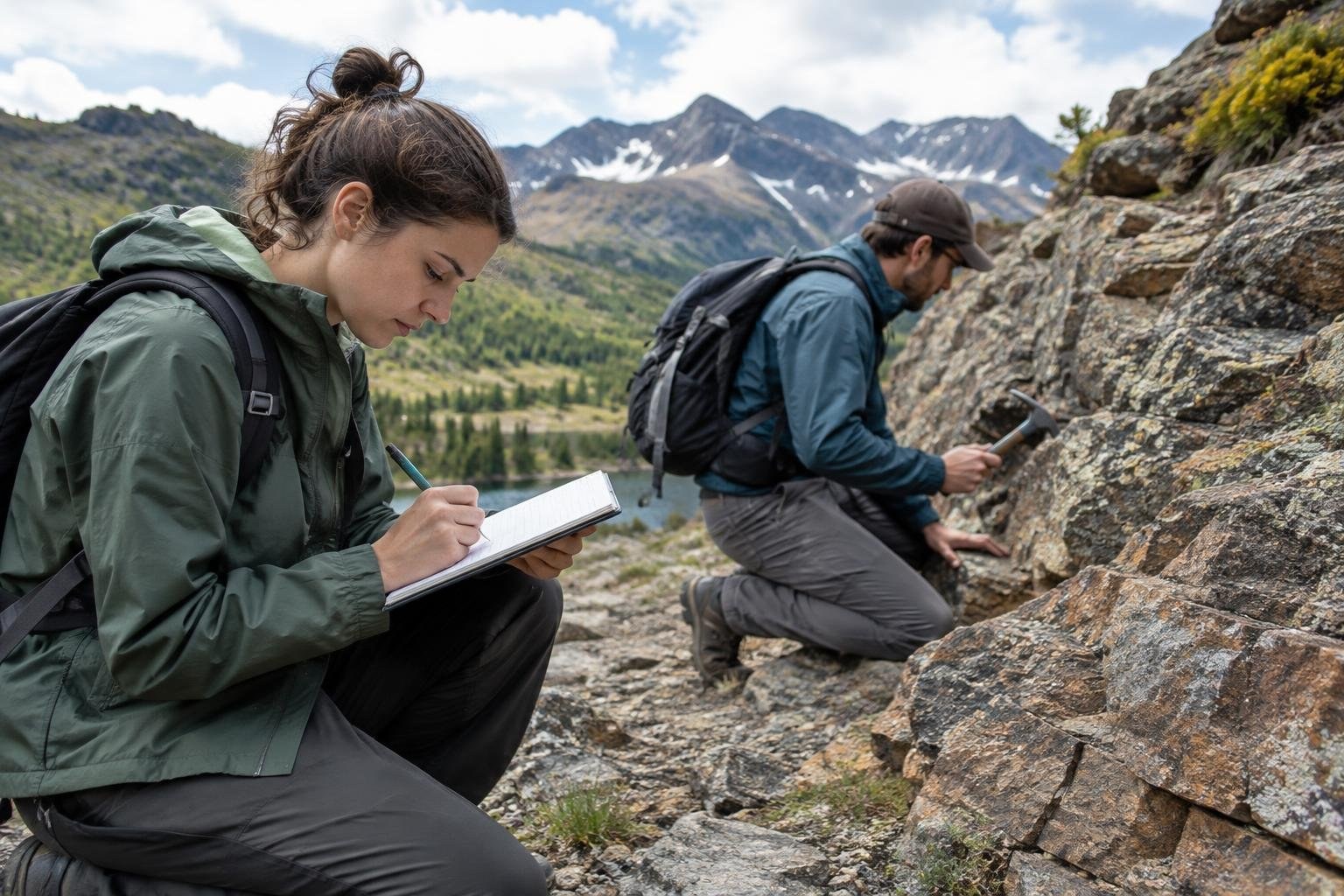
Students practicing field observation and geological note-taking
What Is a Geology or Earth Science Degree?
Geology and general earth science examine the planet's materials, structure, history, and processes. The federal Classification of Instructional Programs describes this area as the scientific study of Earth, the forces acting on it, and the solids, liquids, and gases that make it up. Its subject areas include geomorphology, sedimentology, mineralogy, petrology, and geophysical principles. See the National Center for Education Statistics program description.
At colleges, related titles can include geology, earth science, geological sciences, or geosciences. The exact scope depends on the department. Some programs emphasize rocks and Earth's history; others connect geology to water, resources, hazards, climate, or environmental questions. Review the required courses and learning experiences to understand what a particular major actually covers.
Credential names also signal different stages of study. An associate degree may serve as a foundation or transfer route; a bachelor's degree provides broader and more advanced undergraduate study; graduate degrees support deeper specialization, research, or academic work. Certificate options exist at some institutions, but availability and purpose are institution-specific.
What Do Geology Majors Study?
Students commonly build from introductory Earth science into courses that examine Earth materials, landforms, layers, and physical processes. Topics may include mineralogy, sedimentology, stratigraphy, petrology, geophysics, and the chemistry of rocks and soils. A bachelor's curriculum can offer a broad view of geology while giving substantial attention to traditional subfields such as mineralogy and igneous, metamorphic, and sedimentary petrology. The University of Arkansas catalog describes this broad-subdiscipline approach.
Depending on the program, students may also study water, mineral or energy resources, environmental problems, land use, natural hazards, and past or present climate. For example, UC Davis describes geology study related to minerals, oil and water, hazards, polluted groundwater, land-use planning, and climate change in its geology degree catalog.
Expect more than lectures. Labs can develop skills in identifying materials and interpreting data. Field courses may ask students to observe, record, map, and explain what they see outdoors. Some students pursue faculty-directed research or a capstone project. These requirements vary, so ask for a sample degree plan and course descriptions before choosing a school.
Skills You Can Develop
Earth science students practice turning observations into evidence-based explanations. Depending on their curriculum, they may develop the ability to describe rocks and soils, interpret maps and measurements, evaluate scientific data, and communicate findings in written reports or presentations. Field and lab experiences can connect concepts from class to actual samples, landforms, or research questions.
Those skills can be useful in technician work, environmental and resource projects, water-related work, or further scientific study. A geology technician, for instance, may support field or laboratory tasks; a student continuing toward professional geology may need deeper subject knowledge and additional experience. Build a portfolio of course projects, field notes, maps, data work, and research where your program permits it.
Who Is This Degree Best For?
Geology may suit students who enjoy asking how landscapes formed, what materials are beneath the surface, or how water and other processes affect a place. It can appeal to people who like combining scientific reasoning with close observation and are open to some outdoor or laboratory work. Interest in Earth systems matters, but there is no single personality type needed to succeed.
Be realistic about the work. Some programs include quantitative science, detailed documentation, field travel, or long periods of analysis. Others may place more emphasis on environmental applications or research. If you prefer policy, ecosystems, mapping, or engineering design over Earth materials and processes, a related major may be a better match.
Does geology match you?
Salary expectations, a school's reputation, and general claims about job growth should not be the only reasons to choose a major. Consider whether you want to spend time observing, analyzing, writing, and learning about Earth's systems. Assessment.com's MAPP career assessment can be one tool for exploring interests and motivations. Pair it with major-selection guidance, conversations with faculty, and a review of real job requirements.
Admissions, Program Length, and Academic Demands
Admission rules are set by each institution and can differ by credential, applicant type, and program. Ask about secondary-school preparation, science and math prerequisites, minimum academic standards, placement requirements, transfer-credit review, application materials, and any department-specific expectations. Graduate programs may ask for prior subject coursework or evidence of research readiness; verify details directly with the department.
Time to completion depends on the credential, course load, transfer credits, and whether a student attends full or part time. A community-college associate program may be designed as the first two years of a four-year curriculum, as the Maricopa geology emphasis explains. Individual completion plans can differ, especially when prerequisites or scheduling affect course sequences.
The academic demands may include scientific reading, quantitative problem-solving, lab reports, and field assignments. To prepare, strengthen foundational math and science, practice clear technical writing, and ask how students get support in challenging courses. Request an official degree map and confirm how often required field or lab courses are offered.
Online, Hybrid, and On-Campus Study
Online, hybrid, and campus formats depend on the institution and the specific courses required. Online learning may work well for some lectures or data-based coursework, but field methods and laboratory study may involve in-person participation. Do not assume that a program advertised as online can be completed remotely from any location.
Before applying, ask which courses are fully online, whether labs or field sessions require travel, where required activities take place, and whether participation is scheduled at specific times. Also confirm any residency, internship, or on-campus expectations in writing. A format that looks flexible at first can still require travel or fixed-term field experiences.
Tuition, Costs, and Financial Aid
There is no single tuition figure for a geology degree. Your total budget depends on the institution, residency classification, credential, enrollment pace, delivery format, and the charges attached to labs, field courses, equipment, transportation, books, and housing. Request a program-specific estimate for the full time you expect to attend, not just the advertised tuition rate.
Ask the financial aid office to explain grants, scholarships, work-study, loans, payment plans, and eligibility deadlines. Some graduate departments may offer assistantships or other support: the University of South Florida's geology graduate program describes assistantships, scholarships, and fellowships for graduate students. Availability and eligibility are not guaranteed, so verify current terms directly with each institution.
To compare affordability, calculate the net amount you would need to pay after confirmed aid, and consider whether work, travel, or equipment costs fit your budget. A lower-cost transfer route may be worth exploring, but only after confirming in writing which credits will apply to the intended bachelor's degree.
Careers, Jobs, and Employment Considerations
Geology can lead toward several kinds of work, but a degree does not guarantee a particular job. The program sources describe technician work connected with environmental geology, mining, petroleum exploration, geological engineering, forestry, conservation, and hydrology; UC Davis also connects geology study with resources, hazards, groundwater, and land-use topics.
Career direction
How geology study may apply
What to verify
Geological or field technician
Supports research, field, or laboratory tasks involving geological materials and observations.
Check whether local postings accept an associate degree, bachelor's degree, or relevant experience.
Environmental geology work
Applies Earth materials and processes to questions involving land, water, or environmental conditions.
Review the employer's requirements for degree level, field skills, and related experience.
Mining or petroleum exploration support
Uses geological understanding of subsurface materials and resources.
Compare actual job duties, travel expectations, and required technical preparation.
Hydrology-related work
Connects Earth science foundations with water systems and related observations.
Check the education and quantitative skills requested for the specific role.
Professional geologist or geoscientist
Builds on deeper geology coursework and may involve specialized practice.
Verify degree, experience, and state-specific licensing requirements where applicable.
Researcher or postsecondary instructor
May grow from undergraduate research into advanced study and specialization.
Ask departments and employers about graduate credentials and research experience.
For a particular occupation, check current government labor-market information and local job postings for pay and projected openings. Figures differ by occupation and geography, and a broad major does not have one representative salary or outlook. Assessment.com has guides to geologist, hydrologist, and geophysicist career paths.
Field Experience, Internships, and Building a Strong Profile
Field or lab experience can help students understand what day-to-day scientific work involves and give them examples to discuss with employers. Ask about faculty research, supervised field courses, internships, co-ops, capstone projects, student organizations, and opportunities to present or document project work. Availability differs by college; compare what students can actually access, not only what a department hopes to offer.
How to stand out to employers
Keep examples of field notes, maps, lab work, data analysis, and written reports when you are allowed to share them.
Explain your contribution to group projects and what evidence informed your conclusions.
Seek relevant practical experience and ask instructors or advisors how to find it.
Learn the software and instruments used in your desired roles by checking job postings and asking program faculty.
Build clear communication skills alongside technical knowledge.
Experience can strengthen an application, but it does not replace required education, licensing, or employer qualifications. Confirm the requirements for each job you target.
Accreditation, Licensure, and Professional Credentials
Professional requirements vary by occupation and state. A geology degree is an academic credential; it does not automatically confer a professional license or certify that a graduate meets every employer's requirements. If you intend to offer regulated services, ask the program how its curriculum relates to the rules in the state where you plan to work, then verify those rules with the relevant state authority.
Some employers may prefer additional experience, specialized study, or a particular credential. Do not rely on a general statement that a program is career-ready. Ask which specific requirements it prepares students for, what remains after graduation, and whether graduates have to complete additional supervised work or examinations for their intended roles.
Graduate School and Advanced Credentials
Graduate study can make sense for students who want advanced specialization, research, or academic careers, or whose target roles require a higher credential. Options in geology and geosciences include master's and doctoral degrees, and some schools offer graduate certificates. Southern Illinois University's graduate catalog, for example, lists geology master's options, a post-baccalaureate earth science certificate, and a geosciences doctorate. Program structures differ, so compare thesis expectations, research focus, prerequisites, funding, and career purpose.
A graduate degree is not automatically the best next step after a bachelor's. First identify jobs you want, check their minimum requirements, and talk with faculty or working professionals about whether additional study is valued for that work. If you pursue a graduate program, investigate funding and the full opportunity cost as well as the subject matter.
Related Degrees and Alternatives
Related majors can lead to overlapping questions but differ in their center of attention. Compare sample degree plans and required courses before deciding:
Environmental science: Consider this if you want a broader focus on environmental systems and applied environmental questions. See the environmental science degree guide.
Environmental studies: Consider this if you want to explore environmental issues through a broader or more interdisciplinary lens. See the environmental studies degree guide.
Forestry: Consider this if your main interest is forest resources, management, or conservation. See the forestry degree guide.
Geography or GIS: Consider this if spatial patterns, mapping, or location-based data are more appealing than Earth materials and geological processes.
Environmental engineering: Consider this if you want an engineering curriculum centered on designing or evaluating technical solutions. Review its math and engineering prerequisites.
Oceanography: Consider this if you want to focus on ocean systems and marine processes rather than a general Earth science curriculum.
Geology bachelor's programs can prepare students for professional geology or continued geological study, while broader environmental programs may emphasize different combinations of science, policy, and applied work. Compare the career requirements that matter to you rather than assuming similarly named degrees are interchangeable.
How to Choose the Right Geology Program
Before committing, compare more than a college's name or the major title. Look at the actual course sequence, field and lab requirements, faculty research areas, class availability, transfer rules, learning format, and support for students preparing for careers or graduate school. Ask for information about completion and outcomes, and find out how the school defines and measures those results.
Check institutional and program accreditation through authoritative sources and confirm whether any professional pathway you want has separate requirements. Request a complete cost estimate and compare financial aid offers on the same basis. If you are transferring, ask both institutions which credits apply to the geology major, not merely whether they transfer as electives.
Useful questions include: Are field courses required? How often are core courses offered? What equipment or travel might add cost? Can students join research projects? Does the program prepare students for the roles I have identified? What support is available for math, science, and writing? Assessment.com's major-choice resource and college guidance information can help structure further exploration.
From Degree to Career: Possible Pathways
Career progression is not automatic, but a student can use a degree to build toward different goals. Examples include:
Associate study → geological technician role → field or lab experience → focused technical work. Check whether the program transfers to a bachelor's degree if you may want to continue.
Bachelor's in geology → entry-level geology or environmental role → applied experience → specialized geoscience work. Confirm degree and licensing requirements for your location and target role.
Bachelor's study → research experience → master's or doctorate → research or postsecondary teaching path. Graduate study and research preparation may be important for these goals; requirements vary by employer and institution.
Use job descriptions to test each pathway. A career title can cover varied duties, and employers may ask for credentials or experience that a degree alone does not provide.
Questions to Ask Before Enrolling
Use this checklist with a parent, counselor, or academic advisor when comparing programs:
What credential will I earn, and what courses are required?
Are fieldwork, labs, internships, or research included, and what additional costs or travel might they involve?
What is my estimated total cost after confirmed grants and scholarships?
Which credits will transfer into the specific degree plan I want?
What careers am I considering, and what education or license do their employers or states require?
How are required courses scheduled, and can I complete them in my planned format and timeframe?
What academic advising, tutoring, career services, and faculty mentoring can I use?
What evidence can the school provide about completion, further study, and employment outcomes?
Have I compared this major with environmental science, environmental studies, or another pathway that may fit my interests?
Have I considered whether the day-to-day study and work align with what motivates me?
Compare responses in writing and follow up on unclear claims before paying a deposit or accepting an offer.
Frequently asked questions
Is a geology or earth science degree hard?
Geology can be challenging because it combines scientific concepts with quantitative work, detailed observation, and interpreting evidence. Courses may involve chemistry, physics, mathematics, maps, laboratory activities, and fieldwork. The challenge varies by program and by a student's preparation. Ask programs about prerequisites, tutoring, field-course expectations, and how much of the curriculum involves quantitative analysis before deciding.
What do you study in a geology major?
Students study Earth materials, processes, history, and systems, with topics such as mineralogy, sedimentology, geomorphology, stratigraphy, and geophysics. Programs may also cover water, natural resources, hazards, soils, climate, and field methods. The exact balance depends on the institution and the chosen emphasis.
What jobs can I get with a geology degree?
Possible paths include geological or field technician work, environmental and resource-related work, and further study toward professional geology or research. The specific jobs available depend on the credential, experience, employer, location, and any applicable licensing rules. Review job postings in your target area and compare their stated requirements with the program curriculum.
How much can you make with a geology degree?
There is no single salary for geology graduates. Pay varies by occupation, education, experience, employer, industry, and location. Compare current government occupational data for the specific roles you are considering, and distinguish occupational median wages from starting pay or the earnings of graduates from a particular college.
Can you earn a geology degree online?
Some coursework may be available online, but field geology and laboratory learning can require in-person activities. Check the program's exact course delivery and whether field trips, labs, internships, or other required experiences take place on campus or at a separate location. Confirm that the format works for your schedule before enrolling.
Does geology require a lot of math?
Many geology programs involve mathematics and quantitative reasoning, especially when students work with measurements, maps, geophysics, statistics, or scientific data. The specific math prerequisites and course sequence differ. Ask each department for its degree plan and placement requirements, and plan to seek academic support early if you need to strengthen your math preparation.
Do you need a graduate degree to become a geologist?
Not every geology job requires graduate school. A two-year credential may prepare students for some technician-oriented routes, while a bachelor's degree is a common path for students seeking professional geology work or graduate study. Research, university teaching, and specialized roles may call for graduate education. Check requirements for your intended occupation and state rather than assuming one rule applies to every job.
Do geologists need a license or certification?
Licensing and credential rules depend on the work and the state. A degree by itself should not be treated as proof that a person meets every professional requirement. Before choosing a program, ask the department what licensure preparation it provides and verify current requirements with the relevant state authority for the kind of work you plan to do.
People Also Ask
What is the difference between geology and earth science?
Geology focuses on Earth materials, structure, history, and physical processes. Earth science is often used as a broader label that can include geology alongside related study of water, climate, and other Earth systems. Colleges use program names differently, so compare required courses rather than relying on the title alone.
Is an associate degree in geology useful?
A geology associate degree may provide a foundation for further study or prepare students for certain technician-oriented work. A bachelor's degree offers more advanced coursework and is a pathway for students aiming at professional geology or graduate education. Confirm how credits transfer and whether the associate program aligns with the four-year degree you may want.
What do geology students do in fieldwork?
Fieldwork may include observing and describing landforms and rock exposures, taking measurements, recording locations, and connecting field evidence with maps or laboratory findings. Requirements vary by program, so ask whether field courses are mandatory, where they take place, and what travel, equipment, or scheduling students should expect.
Is geology more chemistry or physics?
Geology involves quantitative work, but the amount and type depend on the program and specialization. Students may need math and science foundations to work with measurements, spatial information, statistics, or physical processes. Review prerequisite and degree requirements with an academic advisor before applying.
What degree is similar to geology?
Compare geology with environmental science, environmental studies, geography, and related natural-resource programs by looking at required sciences, field methods, data work, and career preparation. Geology is a strong option for students drawn to Earth's materials and processes; other programs may better match interests in ecosystems, policy, spatial analysis, or resource management.
How do I choose a geology college program?
Before enrolling, check the curriculum, field and lab requirements, transfer policies, full program cost, aid options, and student support. Then compare those details with several job postings for careers you may want. A program's name alone does not guarantee that its courses satisfy a specific employer's or state's requirements.
A geology or general earth science degree can be a strong fit if you want to investigate how Earth works and are comfortable combining science, data, and hands-on observation. The right path depends on the work you want to do: a two-year program may provide a foundation or technician preparation, while professional geology and many research or teaching paths call for further study. Compare actual course plans, field experiences, total cost, and career requirements before enrolling. If you are still deciding, use Assessment.com’s career and degree exploration tools to consider whether the subject and its possible work settings fit your interests.
Find out which Career or College Major is right for you!
We use cookies to offer you a better browsing experience, analyze site traffic and personalize content.
Read about how we use cookies and how you can control them in our
Privacy Policy.
If you continue to use this site, you consent to our use of cookies.
×
Exciting News!
Be one of the first to Beta Test the new AI-Powered Assessment.com Platform.