Acoustics Degree Guide: Courses, Careers, Online Options, and Program Fit
An acoustics program studies sound and acoustic waves, combining physics and engineering concepts with applications in areas such as audio, architecture, medicine, and underwater research. Learn what to study, how to compare programs, and which careers may connect to this field.
By Tome Fierre · Staff Writer Assessment.com · Published October 9, 2026 · Last updated November 5, 2026
An acoustics degree focuses on the science of sound: how acoustic waves form, move, interact with materials, and create vibration. Students build a foundation in physics and quantitative reasoning, then may apply those concepts to areas such as audio, architecture, medicine, electronics, music, geology, or underwater research. Acoustics programs sit at the intersection of science and engineering, though a school may emphasize theory, applications, or a particular specialty. Credential offerings and admissions requirements differ by institution. For students and parents, the key decision is not simply whether sound is interesting. It is whether the required science and mathematics, the available program, and the career path are a realistic match. Before choosing a school, compare the actual curriculum, format, costs, and preparation for the work you hope to do.
Degree & Program Decision Insights
Explore your personal fit, education requirements, career potential and next steps.
01Motivational Fit
Discover whether this program fits you
Explore your preferences against the focus of Acoustics. These prompts are not personal MAPP results.
Subject curiosity. Would you choose to explore “wave theory” in depth? Ask for a sample learning activity to test that interest.
Breadth of interest. Consider the place of “the acoustic wave equation” in this field. Is this another part you would choose to explore, or mainly a requirement you would tolerate?
Work reality. Related work can involve this task: “Analyze data from research conducted to detect and measure physical phenomena.” Would you want that activity to be a regular responsibility?
Interest in studying a field can differ from enjoying its related work.
Which part would you want to do repeatedly, and what would you try before deciding?
Discover Your Personal Program Fit
Before investing your time and money in your education, discover how this program aligns with your natural motivations, work preferences and career goals.
Typical occupational entry: bachelor's degree (BLS). BLS lists 5 years or more of related work experience as typical for this occupation; this programme is not a direct promise of entry.
U.S. occupational wages are not guaranteed graduate earnings; OEWS excludes self-employed workers.
Projected openings include replacements as well as growth.
U.S. national estimates. A crosswalk does not establish entry-level eligibility; advanced, management and teaching roles can require further qualifications.
Explore your motivations. Use MAPP as a starting point for reflecting on your interest in “wave theory”, then test that interest against a sample learning task.
Examine the work. Compare Physicists and Natural Sciences Managers on daily work and entry qualifications, as well as pay. Explore Physicists.
Compare actual providers. Ask for the exact credential, course sequence and assessment methods. Compare how each provider teaches “the acoustic wave equation”, its entry criteria and its itemized costs.
Check the evidence before applying. Confirm prerequisites and any recognition or professional requirements for your intended route; ask for applicable rules and published outcome definitions in writing.
Verify the institution’s current offering, admissions requirements and outcomes; a search result does not establish your eligibility.
Illustrated sound-wave behavior, including reflection, transmission, vibration, and scattering
What Is an Acoustics Degree?
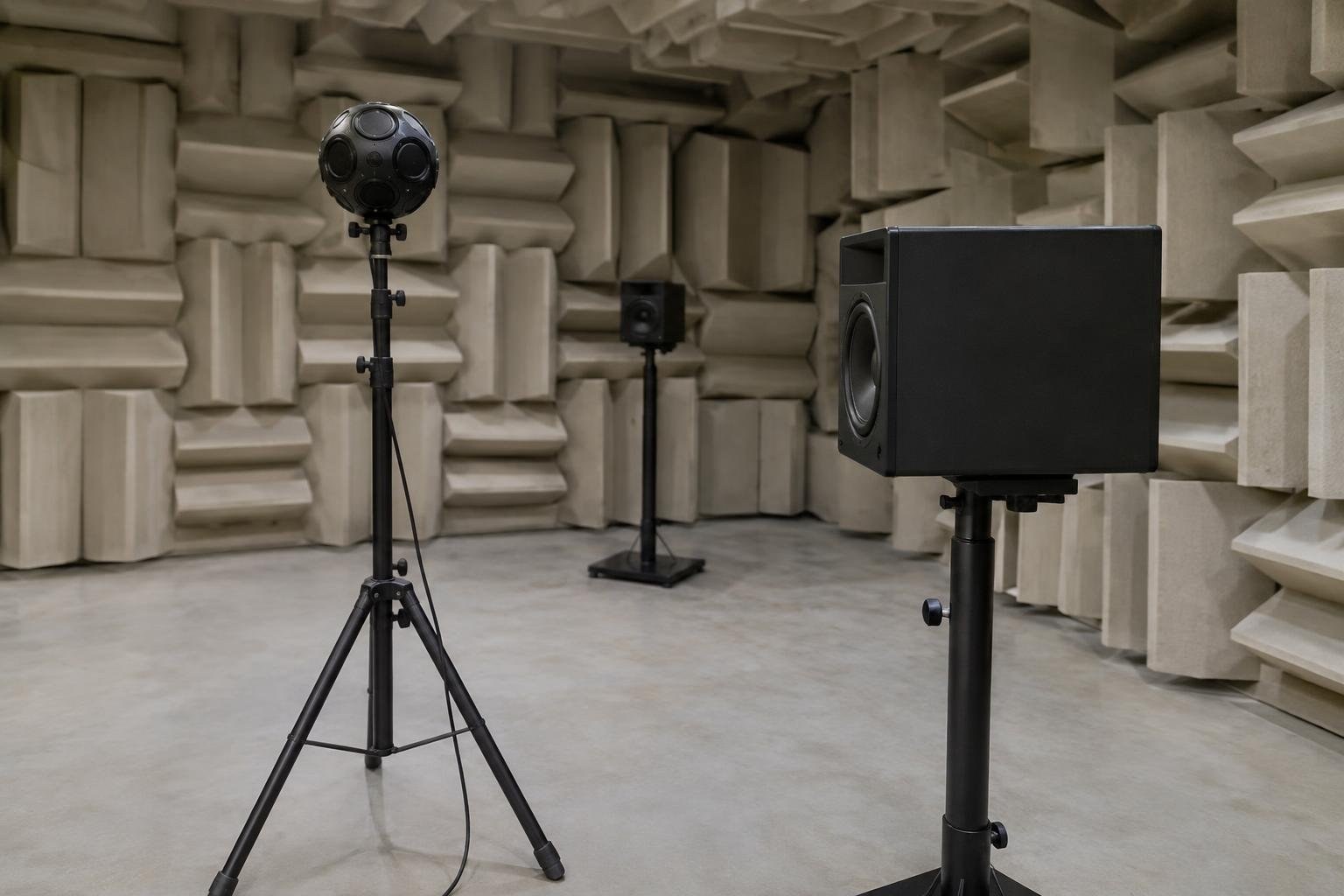
Acoustics is the branch of physics concerned with the properties of sound. An acoustics program examines sound and acoustic-wave behavior under different conditions, then connects scientific concepts to applications. The field has links to music, medicine, architecture, industrial production, and environmental questions. Sound can also be studied in contexts such as underwater acoustics and health diagnostics.
Program names and academic homes vary. Acoustics may be offered through physics, engineering, or an interdisciplinary department. A course of study may lean toward physical theory, applied engineering, or a specialized area. Look beyond the title: read course descriptions, faculty research topics, and program requirements to see what a school actually teaches.
Acoustics overlaps with physics, audio engineering, and architectural design, but is not identical to any one of them. Its central subject is sound and its behavior. Related programs may devote more time to building design, electronics, music production, or broader physics. Compare required courses rather than relying on labels.
For a concise overview of the discipline and its range of applications, see the University of New Hampshire's acoustics program description.
What Do You Study in an Acoustics Program?
Acoustics coursework uses physics and mathematics to explain how sound behaves. The exact sequence depends on the institution and credential. Students should expect to build concepts step by step, from foundational science toward more specialized or applied study.
Topics and learning activities
Wave theory and acoustic behavior: Learn how waves travel and how their behavior changes in different settings.
Vibration: Study vibrating objects and systems, and how vibration relates to sound.
Reflection and transmission: Examine how sound interacts with boundaries and materials.
Signals and analysis: Some programs include random signals and systems or mathematical analysis.
Applied specialties: Depending on the curriculum, students may encounter underwater acoustics or applications in audio, medicine, architecture, geology, or electronics.
At UMass Dartmouth, the listed graduate certificate courses include fundamentals of acoustics, random signals and systems, and underwater acoustics. Penn State describes its graduate program as integrating acoustical science with engineering applications. These examples show why comparing actual course lists matters: a program's emphasis may be quite different from another school's.
Ask whether the curriculum includes laboratory measurement, research, design projects, or a capstone. The available evidence and program descriptions do not establish that every acoustics degree requires the same lab, internship, or thesis. Confirm those details directly with the department.
See the UMass Dartmouth certificate curriculum and Penn State's description of graduate study in acoustics.
Skills You Can Develop
Students develop a combination of scientific reasoning and practical communication. The mix depends on courses, projects, and any research or field experience available.
Technical reasoning: Connect physical ideas about waves and vibration to observed behavior.
Quantitative analysis: Work with mathematical concepts and, in some advanced programs, mathematical analysis software.
Measurement and interpretation: If the program includes applied projects or research, students may practice collecting, analyzing, and explaining sound-related data. Confirm what hands-on opportunities are actually required or available.
Scientific communication: Explain methods, results, and technical ideas to classmates, colleagues, or non-specialists.
Interdisciplinary problem-solving: Apply acoustics in settings that may involve engineering, physics, medicine, architecture, music, or geology.
These skills can support technical, research, and communication-focused work, but a degree does not by itself guarantee qualification for a specific job. Check job descriptions for required degrees, tools, experience, and credentials.
Who Is an Acoustics Degree Best For?
Acoustics may appeal to students who are curious about sound and enjoy explaining how physical systems work. It can be a good direction to investigate if you like careful analysis, scientific questions, and the possibility of applying theory to real situations.
There is no single personality type required. Students may be drawn to the field through music, building design, medical applications, engineering, or basic science. What matters is whether the daily academic work sounds engaging: quantitative reasoning, physics, and sustained technical problem-solving are important considerations.
For high school students, useful preparation includes taking available mathematics and science courses seriously and asking a counselor about prerequisites for physics or engineering programs. For adult learners and career changers, compare your prior coursework with admission requirements before assuming that credits will transfer or prerequisites will be waived.
Does acoustics match your goals?
Salary, reputation, and broad career claims are not enough to decide whether a major fits. Consider the work you want to do, the subjects you are willing to study, and the additional education you may need. Assessment.com's college guidance resources and major-selection guide can help students and parents structure that conversation. Use assessment results as one input, alongside coursework, career research, and advice from educators.
Admissions, Prerequisites, and Academic Difficulty
Admission rules depend on the credential and institution. Undergraduate programs commonly set their own entry requirements; the supplied program information does not establish one universal GPA, test, essay, or portfolio rule for acoustics degrees. Review each school's current admissions page and ask how it evaluates prior science and mathematics preparation.
Graduate study can require relevant prior coursework. Penn State's physical acoustics graduate certificate, for example, expects undergraduate preparation in statics and dynamics, linear algebra, and electronic circuit analysis, as well as the ability to use mathematical analysis software. Its published criteria also describe a 3.00 junior/senior average and a B+ or better average in mathematics, physical science, and engineering courses for applicants considered for admission. These are program-specific criteria, not a universal standard.
Before applying, map your transcripts against prerequisites. Ask whether missing courses can be completed before enrollment, whether credits from another institution may count, and what academic support is available. For graduate applicants, contact the department if your preparation comes from a different but related discipline.
Review the Penn State graduate certificate admission information for one concrete example.
Credential Levels, Program Length, and Online Study
Credential availability in acoustics spans certificates, associate and bachelor's degrees, graduate certificates, master's degrees, and doctorates as a field-wide range; a specific institution may offer only some of these. Do not assume that every level is widely available or that credentials are interchangeable.
Completion time depends on the credential, course load, transfer credit, and whether classes run on a semester, quarter, or other schedule. The supplied program information does not support one standard timeline or credit total. Ask each institution for a degree map showing required courses and a realistic part-time and full-time completion plan.
Online options exist at the graduate level. Penn State World Campus lists an online master's degree in acoustics engineering and an online physical acoustics graduate certificate. Online delivery can be useful for students balancing work, family, and study, but verify whether any course, examination, research, or other requirement must be completed in person. Also ask about course availability and expected weekly workload.
For an example, consult the official pages for the online acoustics engineering master's and online physical acoustics graduate certificate.
Acoustics Degree Costs and Financial Aid
The total cost of an acoustics degree depends on the institution, credential, residency classification, online or campus format, course fees, and time to completion. Programs with specialized equipment or laboratory work may have additional costs, but students should verify those charges in the school's published cost information rather than assume they apply.
Ask for a written estimate that includes tuition, mandatory fees, books, equipment or software, travel for any in-person requirements, and living expenses if you would relocate. Compare the full cost of completing the credential, not just the advertised price per credit or first-term bill.
Ways to make the plan more affordable
Complete the Free Application for Federal Student Aid and review aid eligibility with the institution's financial aid office.
Compare public and private schools, in-state and out-of-state rates, and online or campus charges using the same assumptions.
Ask whether previously completed mathematics, physics, or engineering coursework can transfer.
Check for institutional scholarships, assistantships, employer tuition support, and payment plans; eligibility and availability differ.
Consider studying part time only after comparing the effect on total tuition, aid, and time to completion.
Because tuition and aid rules vary by school and year, get current figures directly from each institution before making a decision.
Careers and Jobs Related to Acoustics
Acoustics education can connect to several fields, but job titles and entry requirements differ. Penn State identifies possible areas for acoustics preparation that include audio, biology, medicine, geology, electronics, physics, music, and architecture. Those are areas of application, not promises of a particular job or salary.
Career direction
How acoustics may apply
What to verify
Audio or sound technology
Understanding sound behavior can inform work around audio systems and sound production.
Check whether employers request electronics, production, or equipment experience.
Architecture and built environments
Acoustical concepts can be relevant to sound in buildings and designed spaces.
Ask whether the role expects an engineering, architecture, or specialized acoustics credential.
Medical or diagnostic applications
Acoustics may connect with research or applications involving health diagnostics.
Separate research roles from licensed clinical occupations; confirm credential requirements.
Underwater acoustics
Specialized study may address sound in underwater settings.
Review the technical focus, research experience, and employer qualifications for the particular role.
Physics or acoustics research
Advanced study can build toward scientific investigation of sound and waves.
Research positions may require graduate education and relevant research experience.
Teaching physics
Strong subject knowledge can be relevant to teaching, especially at the postsecondary level.
Check the education and hiring expectations for the school or institution.
Related pathways to explore include physicists, postsecondary physics teachers, sound engineering technicians, and audio and video equipment technicians. These are related directions, not occupations guaranteed by an acoustics credential. No supported, current salary or employment-outlook figures are available in the cited program material, so use current labor-market data and local job postings when comparing options.
Experience, Certifications, and Licensure
Acoustics study is not the same as professional licensure. The supplied program descriptions do not establish a general acoustics license or one certification required for every acoustics-related job. Requirements depend on the occupation, employer, state, and the work being performed.
Before enrolling, identify several real job postings that interest you. Note the requested degree, major, software or equipment skills, experience, and any license or certification. If a program advertises preparation for an occupation regulated by a state board or professional body, ask for the name of the credential and verify the current requirement with that authority.
Practical experience may help a student show how they use classroom knowledge. Ask about faculty research, supervised projects, internships, laboratory access, and opportunities to present work. The presence of any particular experience opportunity should be confirmed with the program.
How to stand out to employers
Build a clear record of relevant coursework, projects, research, or measurement work.
Explain the problem, method, and result for each project in plain language.
Develop communication skills alongside technical work so you can present findings to different audiences.
Use informational interviews and faculty connections to learn what local employers actually request.
Graduate School Options
Graduate study can deepen a student's technical focus and may be important for specialized research or advanced scientific work. Acoustics programs include graduate certificates, master's degrees, and doctoral-level study, though an institution's available options vary. Penn State describes a graduate program that integrates acoustical science and engineering applications; its World Campus also lists a master's program and a physical acoustics graduate certificate.
A graduate certificate may add targeted study for someone who already has relevant science or engineering preparation. A master's degree may offer broader or more advanced subject study. Doctoral education is a possible route for students pursuing sustained research or academic work, but the supplied sources do not define universal admission or career rules for doctoral pathways.
Choose additional education for a reason. Compare the roles you want with their stated requirements, and ask whether the likely work justifies the added tuition and time. An advanced credential should solve a clear career or learning need, not be an automatic next step.
Related Degrees and Alternatives
Related degrees can lead to overlapping applications while placing different emphasis on the curriculum. Use course requirements and intended work, rather than the program name alone, to compare options.
Physics: Consider this instead if you want broader study of physical principles, rather than concentrating on sound.
Engineering: Consider this instead if you want a wider design and engineering foundation; compare the specific discipline and its acoustics offerings.
Electrical engineering: Consider this instead if circuits and electronic systems are central to your interest.
Audio engineering or audio production: Consider this instead if your primary goal is recording, mixing, production, or sound-system practice rather than the broader science of sound.
Architecture: Consider this instead if building design is your main interest and acoustics is one part of that work.
Music technology: Consider this instead if you want a program built around musical tools and production.
Geophysics or ocean science: Consider this instead if your strongest interest is earth or ocean systems and sound is one method or topic among several.
Biomedical engineering: Consider this instead if your focus is designing or evaluating medical technologies, while checking the required engineering and biology coursework.
These are decision prompts, not claims that every institution offers these exact pathways. Review official catalogs and compare mathematics, physics, design, lab work, and applied courses. For an overview of related career categories, explore Assessment.com's architecture and engineering careers and life, physical, and social science careers.
How to Choose an Acoustics Program
Program quality is more than a school's name or a broad accreditation statement. First confirm that the institution is appropriately accredited for your needs. Then ask whether the specific program has specialized accreditation or professional recognition relevant to your goals. Do not assume that acoustics programs share one required programmatic accreditor; verify any claim with the accrediting organization and the institution.
Compare the curriculum and faculty expertise with the applications that interest you. Ask what opportunities students have for research, practical measurement, projects, and connections with employers. If you plan to transfer, request a written credit evaluation before enrolling. If you may pursue graduate school, confirm that your planned course sequence will meet likely prerequisites.
For online programs, investigate course schedules, student support, access to instructors, and any in-person requirements. For campus programs, consider access to relevant facilities and the practical cost of attending. Ask for clear information on program completion, student outcomes, and career support; request definitions and time periods for any outcomes the school reports.
Assessment.com's degree resources can support exploration, but final program details should be confirmed in official school materials.
From Degree to Career: Possible Pathways
An acoustics pathway is not a guaranteed ladder. A student might complete relevant undergraduate science or engineering coursework, pursue an entry-level technical or research-support role, then build experience in a specialty. Another student may continue to a master's degree or doctorate before seeking advanced research or teaching work. The best route depends on the student's preparation, program, interests, and the qualifications employers request.
Applied sound: acoustics study → project or technical experience → work related to audio systems → deeper specialization based on employer needs.
Scientific research: physics or acoustics study → research experience → graduate education where required → specialized research role.
Teaching: relevant science education → teaching preparation appropriate to the setting → further subject or graduate study if required by the institution.
Use these examples to ask better questions, not as promised outcomes. The university sources describe acoustics applications across fields, but do not guarantee employment or a particular progression.
Questions to Ask Before Enrolling
Students and parents can use this checklist when comparing programs:
Is the institution accredited, and does the program make any specific accreditation claims I can verify?
Which courses are required, and how much physics, mathematics, engineering, or applied acoustics do they include?
What is the full estimated cost, including fees, materials, technology, travel, and living expenses where applicable?
Which scholarships, grants, assistantships, employer benefits, or payment options could apply to me?
What research, lab, project, internship, or other practical experience is available, and is it required?
Is the program online, hybrid, or campus-based, and are there in-person requirements?
How long would completion take at my intended course load, and which transfer credits can the school confirm?
What are the published student outcomes, how are they defined, and what time period do they cover?
What career advising, employer connections, and alumni information can the department provide?
Which qualifications do employers request for the roles I want, and does this curriculum help me meet them?
Ask for answers in writing where possible. A careful comparison helps families distinguish a program's broad promises from the courses, costs, and opportunities a student can actually expect.
Frequently asked questions
What is an acoustics degree?
Acoustics is the scientific study of sound and its behavior. An acoustics program may cover wave theory, vibration, sound reflection and transmission, and applications in areas such as audio, architecture, medicine, and underwater research. Specific courses and credential options vary by institution and degree level.
Is acoustics a difficult major?
It can be challenging if you are not comfortable with physics, mathematics, and quantitative problem-solving. Acoustics coursework may involve wave behavior, vibration, and mathematical analysis. The exact demands depend on the program and level. Review required courses and prerequisites, and ask programs about tutoring or other academic support before enrolling.
Is an acoustics degree worth it?
Acoustics is a specialized field, so the value of a degree depends on your career goal, program cost, and the level of technical preparation employers or graduate programs require. Acoustics knowledge can be relevant to areas including audio, medicine, geology, electronics, physics, music, and architecture. Compare the curriculum and actual job requirements before deciding whether the investment makes sense for you.
What can you do with an acoustics degree?
Possible directions connected to acoustics include audio, architectural acoustics, medical or diagnostic applications, underwater acoustics, research, and teaching. The degree alone does not guarantee eligibility for a specific occupation. Some roles require graduate education, relevant engineering or science preparation, experience, or additional credentials. Check job postings and program outcomes to understand typical requirements.
Can you study acoustics online?
Yes, some acoustics graduate study is available online. Penn State World Campus lists an online master's degree in acoustics engineering and an online physical acoustics graduate certificate. Online availability does not mean every program or course is fully remote, so confirm delivery format, course schedule, and any in-person requirements directly with the institution.
Does an acoustics program require math?
Mathematics is important in technical acoustics study because acoustic waves are described and analyzed quantitatively. One Penn State graduate certificate listing expects preparation that includes linear algebra and the ability to use mathematical analysis software. Requirements differ by program, but prospective students should review mathematics prerequisites and course descriptions before applying.
Do you need graduate school to work in acoustics?
Not every acoustics-related job requires a doctorate. However, advanced research and some specialized scientific roles may require graduate education. Programs in the field include graduate certificates, master's study, and doctoral education, but credential availability and career requirements vary. Look at job descriptions for the roles you want and map their stated qualifications to a degree pathway.
How is acoustics different from audio engineering?
Acoustics and audio engineering overlap in their attention to sound, but acoustics focuses broadly on the science and behavior of sound, while audio engineering often emphasizes recording, production, or sound-system practice. The distinction varies by school and program. Compare required physics and mathematics courses with hands-on audio production, signal, and equipment coursework to see which curriculum fits your goals.
People Also Ask
What does acoustics study?
Acoustics studies sound as a physical phenomenon, including how sound waves travel, reflect, transmit, scatter, and produce vibration. The field connects physics to practical settings such as buildings, audio, medicine, and underwater research.
What degree levels are available in acoustics?
Acoustics programs may be listed at several credential levels, including certificates, associate degrees, bachelor's degrees, graduate certificates, master's degrees, and doctorates. Not every school offers every level. Check each institution's official catalog for current offerings and requirements.
What courses are included in an acoustics program?
Coursework can include the fundamentals of acoustics, wave behavior, vibration, and applied topics. The UMass Dartmouth graduate certificate, for example, lists fundamentals of acoustics, random signals and systems, and underwater acoustics. Course content varies by program and concentration.
Are acoustics degrees available online?
Some graduate study in acoustics is available online. Penn State World Campus lists an online acoustics engineering master's degree and an online physical acoustics graduate certificate. Applicants should confirm whether all coursework is remote and whether any program requirements involve in-person participation.
Which industries use acoustics?
Programs may prepare students for work or further study connected to audio, biology, medicine, geology, electronics, physics, music, architecture, or other applications. The degree's relevance depends on the job's requirements and the student's specific training, experience, and education level.
Can I earn an acoustics certificate after another degree?
A graduate certificate may help a student add focused acoustics coursework to an existing science or engineering background. For example, Penn State's physical acoustics certificate lists expectations for prior study in statics and dynamics, linear algebra, and electronic circuit analysis. Verify prerequisites and admissions criteria for each program.
How should I choose an acoustics program?
Compare the required physics and mathematics, available specializations, laboratory or research opportunities, delivery format, total cost, and the credential's relevance to your target jobs. Ask the program how students gain applied experience and what graduates typically do, then check those answers against real job postings.
An acoustics degree may suit students who want to understand sound through physics, mathematics, measurement, and applications such as audio, buildings, medicine, or underwater research. The right education pathway depends on how technical a role you want, whether you need graduate study, what programs are actually available, and what you can afford. Compare curricula and costs, speak with faculty and current students, and test your interest in the subject before committing. A strong fit between your interests and the work matters alongside career possibilities.
Find out which Career or College Major is right for you!
We use cookies to offer you a better browsing experience, analyze site traffic and personalize content.
Read about how we use cookies and how you can control them in our
Privacy Policy.
If you continue to use this site, you consent to our use of cookies.
×
Exciting News!
Be one of the first to Beta Test the new AI-Powered Assessment.com Platform.