Elementary Particle Physics Degree Guide: Courses, Careers, Costs, and Fit
Explore what elementary particle physics programs teach, how they relate to physics degrees, how to compare costs and program formats, and what career routes may involve.
By Kieth Nelson · Staff Writer Assessment.com · Published October 26, 2026 · Last updated November 5, 2026
Elementary particle physics is the study of the basic constituents of matter and energy, along with the forces and interactions that shape them. It draws on physics and mathematics to investigate questions that cannot be answered by observing everyday objects alone. Students typically build a foundation in physics before taking advanced courses or joining research related to particles. Topics can include quantum theory, scattering, field theory, and how researchers detect and interpret particle interactions. The exact path varies by school, and the specialty may be offered within a broader physics degree rather than as a separate major. This guide is for prospective students and parents weighing the subject’s academic demands, long-term study, costs, and career possibilities. Not sure whether physics fits your motivations and interests? Assessment.com’s MAPP assessment can help you explore career and degree options before choosing a program.
Degree & Program Decision Insights
Explore your personal fit, education requirements, career potential and next steps.
01Motivational Fit
Discover whether this program fits you
Explore your preferences against the focus of Elementary Particle Physics. These prompts are not personal MAPP results.
Subject curiosity. Would you choose to explore “quantum theory” in depth? Ask for a sample learning activity to test that interest.
Breadth of interest. Consider the place of “field theory” in this field. Is this another part you would choose to explore, or mainly a requirement you would tolerate?
Work reality. Related work can involve this task: “Perform peer reviews of scientific papers.” Would you want that activity to be a regular responsibility?
Interest in studying a field can differ from enjoying its related work.
Which part would you want to do repeatedly, and what would you try before deciding?
Discover Your Personal Program Fit
Before investing your time and money in your education, discover how this program aligns with your natural motivations, work preferences and career goals.
Typical occupational entry: doctoral or professional degree (BLS). Postsecondary teaching is a separate appointment and may require advanced study; this programme alone is not a promise of a teaching post.
U.S. occupational wages are not guaranteed graduate earnings; OEWS excludes self-employed workers.
Projected openings include replacements as well as growth.
U.S. national estimates. A crosswalk does not establish entry-level eligibility; advanced, management and teaching roles can require further qualifications.
Explore your motivations. Use MAPP as a starting point for reflecting on your interest in “quantum theory”, then test that interest against a sample learning task.
Examine the work. Compare Physicists and Physics Teachers, Postsecondary on daily work and entry qualifications, as well as pay. Explore Physicists.
Compare actual providers. Ask for the exact credential, course sequence and assessment methods. Compare how each provider teaches “field theory”, its entry criteria and its itemized costs.
Check the evidence before applying. Confirm prerequisites and any recognition or professional requirements for your intended route; ask for applicable rules and published outcome definitions in writing.
Verify the institution’s current offering, admissions requirements and outcomes; a search result does not establish your eligibility.
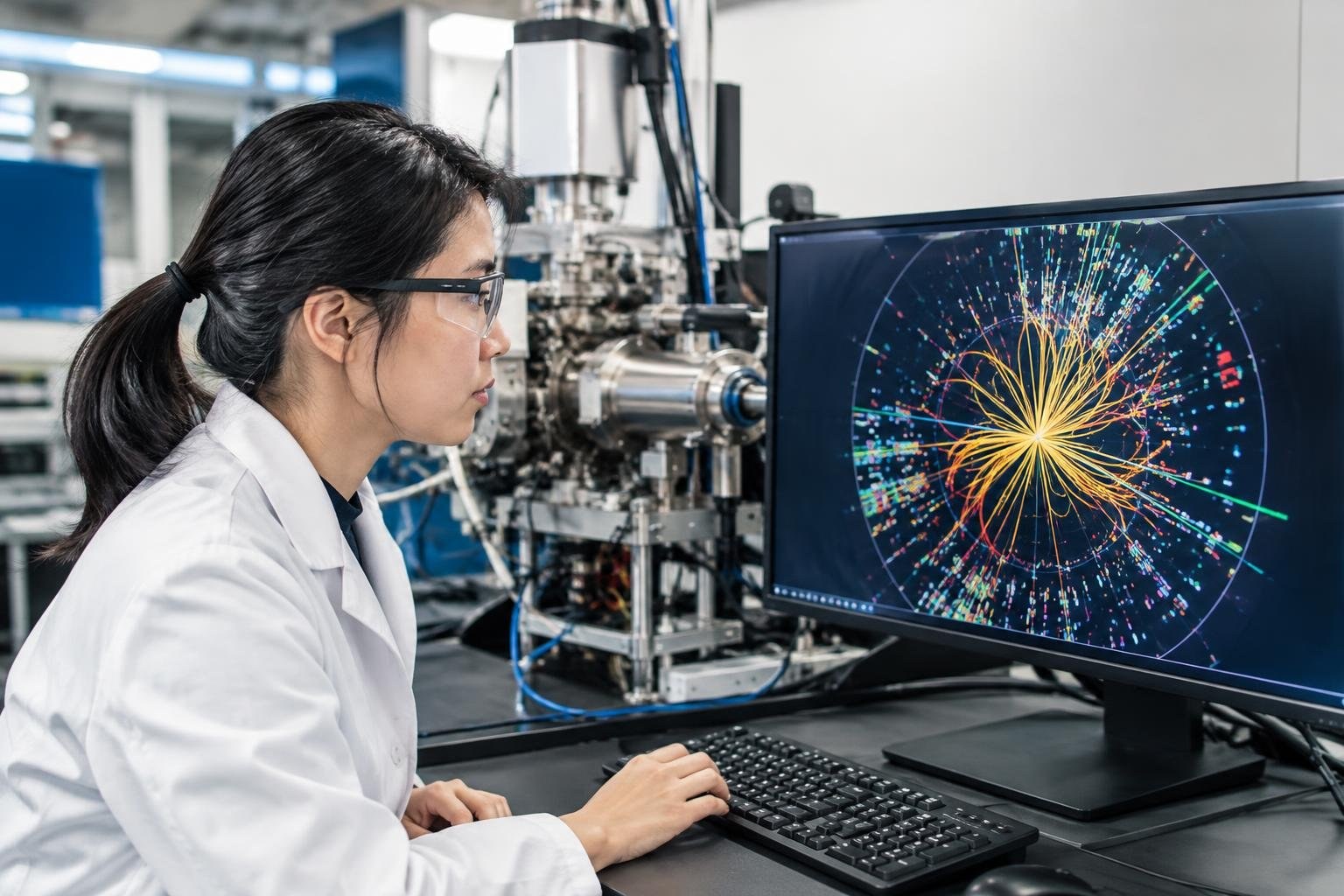
Educational illustration of particles, interactions, and fundamental forces
What Is an Elementary Particle Physics Degree?
Elementary particle physics investigates the basic constituents of matter and energy and the forces behind fundamental processes. The field draws on theory, mathematical modeling, and experimental evidence to ask how particles interact and what those interactions reveal about the physical universe. The University of Michigan describes its theoretical particle-physics research as examining fundamental forces and the structure of matter, energy, and space-time.
In college catalogs, the subject may appear as a course, research area, concentration, or specialization within physics. A program description can refer to quantum theory, field theory, scattering, particle systems, symmetry, and methods for detecting particle emission and absorption. Those topics are advanced; students generally need a broader physics foundation first.
Do not assume a program title alone tells you what you will study. Check the degree name, official catalog, required courses, faculty research areas, and whether the department supports experimental, theoretical, or both kinds of work.
Read the University of Michigan overview of theoretical particle physics research.
What Do You Study in Particle Physics?
Course sequences differ by school, but students should expect foundational physics and mathematics before advanced particle topics. A physics curriculum may first develop mechanics and other core ideas. MIT’s catalog, for example, describes advanced mechanics topics such as particle dynamics, conservation laws, energy, and rotational dynamics for students with prior mechanics experience.
Later study may include quantum mechanics, identical particles, perturbation theory, scattering, and the quantum theory of radiation. MIT identifies these subjects in its physics catalog, which also describes a one-term introduction to quantum field theory developed through applications including elementary particle physics.
At the graduate level, course offerings can become more specialized. Caltech’s physics doctorate requirements list courses including introductory particle physics, relativistic quantum field theory, the Standard Model, and elementary particle theory. Michigan State’s graduate course listings include topics such as scattering, nuclear reactions, particle production, and quark-gluon plasma.
Some students pursue theoretical questions using mathematical models; others are interested in experimental work and the interpretation of detector data. Ask which courses are currently offered, how often they run, what preparation they require, and whether undergraduates can join research projects.
Review an example of advanced mechanics topics, and see examples of quantum and field-theory coursework.
Skills You Can Develop
Physics students develop a toolkit for expressing a question precisely, building a model, checking assumptions, and interpreting results. Particle-focused study puts particular emphasis on mathematical reasoning and abstract systems. It also calls for persistence: research questions may require repeated testing, careful recordkeeping, and explaining technical conclusions to people with different backgrounds.
Depending on coursework and experience, students may learn to work with equations, scientific data, computational tools, and specialized research equipment. The specific software, instruments, and technical methods vary, so ask departments which skills students practice rather than assuming every program teaches the same tools.
These abilities can transfer to research, technical, education, and data-oriented work. A degree does not by itself guarantee qualification for any particular role. Pair academic preparation with projects, internships, communication practice, and experience relevant to the jobs you plan to pursue.
Who Is This Degree Best For?
This field may suit students who are curious about how nature works at a fundamental level and who enjoy solving difficult, abstract problems. It can appeal to people who like mathematics, careful reasoning, and learning through evidence, whether their interests lean toward theory, experiment, computation, or a mix.
No single personality type is required. But be realistic about the academic work: particle physics relies on mathematical ideas and builds on previous physics courses. If you are drawn to the questions but unsure about the daily work, try an introductory physics course, attend a department seminar, or ask a teacher or college adviser to help you compare degree plans.
Does Elementary Particle Physics Match You?
Salary, prestige, or headlines about scientific discoveries are not enough to establish fit. Consider whether you would enjoy the actual coursework, the long-term research process, and the career options available where you hope to live. Assessment.com’s MAPP assessment can be one input as you explore motivations and interests; use it alongside course research and conversations with people in relevant fields.
Use Assessment.com’s guide to choosing college majors to structure that comparison.
Admissions, Program Length, and Academic Difficulty
Entry requirements are set by individual institutions, so check each program’s admissions page and course prerequisites. For a physics pathway, useful questions include whether applicants need prior coursework in mathematics or physics, how transfer credit is evaluated, and whether research placements have separate selection steps. Do not infer a school’s GPA, test, essay, or interview rules from another institution.
Completion time depends on the credential, full- or part-time enrollment, prior credits, and course availability. A certificate or graduate certificate is not interchangeable with a bachelor’s or doctoral degree, and the available credential levels differ across schools. Graduate study also requires an appropriate prior degree and preparation, as described by the institution.
The academic challenge tends to increase as students move from foundational mechanics toward quantum and field-theory topics. MIT and Caltech course examples show how advanced study builds on earlier physics. Students can prepare by strengthening mathematics, asking for help early, and checking prerequisites before registering for upper-level courses.
When comparing timelines, ask for a term-by-term course map, expected credit load, transfer evaluation, and policies for courses offered only periodically. A promised duration is useful only if the required courses are available in the sequence you need.
Online, Hybrid, and On-Campus Study
Some physics learning can be delivered online, but whether a particle-physics pathway is fully remote depends on the institution and the specific curriculum. Advanced research may depend on in-person laboratories, equipment, collaboration, or access to a research group. Ask the department what is online, what is hybrid, and what must be completed on campus.
Online format should not be confused with an easier or shorter program. Before enrolling, confirm how students access faculty, participate in research, complete any required laboratory work, and receive technical support. If a program advertises a concentration, check that its relevant courses are actually offered in the delivery format you need.
Tuition, Costs, and Financial Aid
Compare the full cost of attendance rather than tuition alone. Ask each institution for a written estimate covering tuition, mandatory fees, books or course materials, equipment or technology needs, and any travel or housing costs connected with campus or research participation. Charges and aid depend on the school, enrollment status, residency classification, and individual circumstances.
Review grants, scholarships, work-study, employer support, and federal or state aid eligibility with the institution’s financial-aid office. For graduate study, ask whether assistantships or research support are available, what they cover, and what duties or conditions apply. Do not assume funding is guaranteed or that one student’s award will apply to another.
To control costs, compare public and private institutions, investigate transfer-credit policies before taking classes elsewhere, and check whether changing majors or extending enrollment could add terms. Ask for the net price after grants and scholarships, the expected borrowing, and the cost of completing the full credential.
Careers, Jobs, and Employment Outlook
Use career titles as starting points for research, not as promises of employment. A physics background may connect to research, teaching, technical, or data-focused work, but the required credential depends on the position. Research in elementary particle physics is represented within university physics departments, and graduate catalogs list advanced particle theory and related coursework. That evidence supports a research pathway, not a guarantee of a particular job.
Career direction
Education to investigate
How physics study may apply
Physicist or research scientist
Review job postings and graduate program expectations; specialized research commonly requires advanced preparation.
Physics theory, mathematical methods, research practice, and data interpretation.
University or college physics educator
Check the institution and level of teaching; postsecondary roles may require graduate education.
Physics knowledge, clear explanation, and teaching or research experience.
Research or laboratory support role
Requirements vary by employer and duties; look for the exact technical skills requested.
Scientific reasoning, data work, and relevant equipment or computational experience.
Data or computational work
Build demonstrated programming, statistics, or data skills relevant to the employer.
Quantitative problem-solving and modeling can complement technical preparation.
Potential employers to investigate include universities, research groups, and organizations that hire for broader physics or technical work. Before choosing a program, search current openings in your preferred region and note the degrees, experience, and tools they request. Career paths can also evolve: a first role may be broader than the research specialty you studied.
Do not use a single salary estimate as a proxy for particle-physics pay. Pay and outlook depend on the occupation, employer, location, education, and experience. Compare current government labor-market data for each specific occupation when making financial plans. Automation and AI tools may change research workflows, but they do not remove the need to understand assumptions, validate results, and communicate scientific conclusions.
Assessment.com has related guides to physicist careers and postsecondary physics teaching.
Find out which Career or College Major is right for you!
For this academic field, the most important program checks are the institution’s recognized institutional accreditation, the department’s curriculum, and how well the degree supports your next step. Verify accreditation through official institutional and education resources, and ask the school directly about program-specific recognition where applicable. Do not assume a course or department is separately accredited just because the college is.
Elementary particle physics study is not itself a professional license. If you plan to teach in a regulated school setting or pursue another licensed occupation, confirm the requirements with the relevant state authority and determine whether the program prepares you for them. Research and technical jobs may have employer-specific expectations instead of a single field-wide credential.
Ask departments which research groups and equipment students can access, whether undergraduates can participate, and how faculty supervise projects. Course titles alone do not show how much hands-on research or mentoring a student will receive.
Research Experience, Internships, and Credentials
Relevant experience can help students connect abstract coursework to research practice. Ask about undergraduate research, faculty projects, summer opportunities, department seminars, student physics organizations, and internships or co-ops related to instrumentation, computing, or science communication. Availability varies, so verify opportunities with the department rather than assuming every student has access.
How to Stand Out to Employers
Keep a clear record of research or class projects, including your role, methods, and results.
Practice explaining technical work to non-specialists as well as peers.
Build computational, data, laboratory, or teaching experience aligned with actual job postings.
Ask faculty and advisers for feedback on a resume and career plan before graduation.
A certificate or degree confirms coursework; it does not automatically establish professional licensure or make a student qualified for every physics job. Match credentials and experience to the specific requirements of the role.
Graduate School Options
Graduate study can deepen preparation in theoretical or experimental physics and provide a route toward research-centered work. Options may include a master’s degree, doctoral study, or a graduate certificate, depending on the school and the student’s prior preparation. Caltech’s physics doctorate requirements list particle-physics and quantum-field-theory coursework, while MIT’s catalog describes quantum field theory through applications including elementary particle physics.
Before committing, ask what research areas are active, how students find advisers, how long students typically take to complete the requirements, and what funding or teaching arrangements may be available. Compare graduate programs by faculty research and actual course offerings, not only by the word “particle” in a program title.
Related Degrees and Alternatives
Related paths can share physics foundations while emphasizing different questions or applications. Compare course sequences and research groups to find the right distinction for you.
Physics: Consider this instead if you want a broad foundation before choosing a specialization.
Nuclear physics: Consider this if you are more interested in atomic nuclei, nuclear reactions, or related matter.
Astrophysics: Consider this if your main questions concern astronomical objects and the universe.
Applied physics: Consider this if you want to connect physics concepts more directly with practical technologies or applications.
Engineering: Consider this if you prefer designing and building systems to studying fundamental physical questions.
Mathematics or computational science: Consider these if mathematical modeling or computation interests you more than laboratory or theory questions in physics.
These are broad comparisons, not fixed boundaries: departments differ, and research can cross disciplines. The Wisconsin physics certificate description notes that physics can inform multiple disciplines and technological understanding. Compare prerequisites, upper-level courses, research options, and graduate-school implications for each alternative.
Advantages, Drawbacks, and Is It Worth It?
There is no universal answer to whether an elementary particle physics degree is worth it. The decision depends on the cost and time required, your academic interests, the kinds of work you want, and whether you are willing to pursue further study if your target role calls for it.
Potential advantages: a focused route into fundamental questions, strong training in quantitative reasoning, and opportunities to connect theory, computation, or experiment through physics study.
Potential drawbacks: advanced preparation can take significant time; a narrow specialty may not map directly to an entry-level job title; and the cost of additional study needs to be considered before committing to a research career.
For a realistic value check, compare total program cost with your likely borrowing, investigate several job descriptions, and identify alternative paths that use similar skills. Talk through the decision with a college adviser, family, and faculty members. A degree can be intellectually valuable even when a student later chooses a different career, but the financial and personal tradeoffs should be deliberate.
How to Choose the Right Program
Compare programs using evidence you can verify, not just marketing language. Review each institution’s catalog and speak with the department and financial-aid office.
Accreditation: Confirm the institution’s current recognized accreditation and ask what recognition applies to the program.
Curriculum: Check prerequisites, core physics and math courses, advanced electives, and how often specialized classes run.
Research access: Ask about faculty areas, undergraduate participation, facilities, mentoring, and the availability of projects.
Cost and aid: Request a full cost estimate and compare grants, scholarships, aid, and likely borrowing.
Format and schedule: Confirm which courses are in person, online, or hybrid and whether research or lab work requires campus attendance.
Completion and transfer: Ask for a degree map and written review of transfer credits.
Career preparation: Ask about internships, career services, graduate advising, employer connections, and graduate-school placement information the program can substantiate.
For broader academic exploration, browse Assessment.com degree resources. Use the MAPP assessment as one part of your personal-fit process, not as a replacement for checking academic requirements and program details.
From Degree to Career
Progression is not automatic, but these examples show how study and experience might connect:
Physics bachelor’s degree → research or laboratory support role → deeper technical experience → specialized research work or graduate study.
Physics bachelor’s degree → tutoring or teaching-support experience → teacher preparation where required → physics teaching career.
Physics coursework plus computing projects → junior data or technical role → expanded programming and data responsibilities → specialized computational work.
These are illustrative pathways, not promised outcomes. Check current job requirements and relevant licensing rules before selecting a program or planning to enter a regulated occupation.
Questions to Ask Before Enrolling
Before applying or paying a deposit, use this checklist with a parent, adviser, or counselor:
Is the institution accredited, and what does that accreditation cover?
What is the complete estimated cost, including fees and likely living or travel costs?
Which grants, scholarships, and other aid could apply to my circumstances?
What courses are required, and when are advanced courses offered?
Can I access faculty research, mentoring, and relevant facilities?
What does the program offer for internships, career advising, and graduate-school preparation?
Does the delivery format fit my schedule, and are any required activities in person?
How will transfer credits be evaluated, and can I see a completion plan?
What credentials and experience do employers request for the roles I want?
How much additional education might those roles require?
Would I enjoy the mathematical and theoretical work as well as the big questions?
Consider how your motivations and interests align with the academic and career options. Assessment.com’s MAPP assessment can help you explore career and degree options as you compare the evidence.
Frequently asked questions
What is elementary particle physics?
Elementary particle physics studies the fundamental constituents of matter and energy and the forces and interactions that govern them. Students build on physics and mathematics before studying topics such as quantum theory, particle interactions, scattering, and research methods. The subject is often pursued through physics coursework or research specialization rather than as a widely available standalone undergraduate major, so check each institution’s current catalog.
Is elementary particle physics hard to study?
It can be challenging because advanced study relies on a sequence of mathematics and physics courses, including quantum mechanics and mathematical methods. Graduate-level work may include quantum field theory, scattering theory, and research. Students who enjoy sustained problem-solving and are willing to strengthen foundational skills may find the challenge worthwhile; preparation and support matter more than assuming you must already know everything.
What degree do you need to become a particle physicist?
The focused field of particle physics is commonly a specialization within physics. An undergraduate physics degree can provide a foundation, while research roles generally call for advanced study and research experience. Exact requirements depend on the position, employer, and whether the work is theoretical, experimental, technical, or educational.
Can you study elementary particle physics online?
Physics programs may be available at multiple credential levels, but elementary-particle-physics coursework and research options differ by institution. Confirm whether a school offers relevant advanced courses, faculty research, and a suitable degree pathway. Do not assume a certificate or undergraduate program provides the same preparation as graduate physics study.
Does particle physics require a lot of math?
Expect substantial mathematics. The field uses mathematical models to describe motion, interactions, and quantum systems, and advanced coursework may include perturbation and scattering theory. Review the specific program’s math prerequisites and course sequence, then compare them with your preparation before enrolling.
Do you need a PhD to work in particle physics?
For a research career focused on fundamental particle theory, plan to investigate graduate physics study and research training. Some related technical, education, or support roles may have different requirements. Read job descriptions in the area that interests you and compare their qualifications with the program’s outcomes before deciding how far to study.
How is particle physics different from nuclear physics or astrophysics?
Particle physics focuses on subatomic particles and fundamental interactions. Astrophysics applies physics to astronomical objects and the universe; nuclear physics focuses on atomic nuclei and related processes. The fields share physics foundations, but their research questions, methods, and advanced courses can differ. Compare actual curricula and faculty research rather than relying on degree labels alone.
How much do particle physicists earn?
Do not assume one salary figure represents particle physics careers. Earnings depend on the occupation, education, employer, location, and experience, and job titles such as physicist or teacher cover work beyond particle physics. Identify occupations you may pursue and check current, occupation-specific government labor data before making financial plans.
People Also Ask
What does elementary particle physics study?
Elementary particle physics studies fundamental particles and interactions, using physics and mathematics to explain matter and energy at very small scales.
Is elementary particle physics a major?
Many students study the subject through a physics degree, advanced electives, and research. Standalone degree availability varies, so check each university catalog.
What classes are in a particle physics program?
Programs build on foundational physics and mathematics, then may cover quantum mechanics, scattering, field theory, particle theory, or experimental methods.
Is particle physics difficult?
The specialty demands advanced mathematical reasoning and a long sequence of physics concepts. Review prerequisites and course plans to judge your preparation.
What jobs can you get with a particle physics degree?
A bachelor’s degree in physics may lead toward technical or support work, but specialized research roles often require advanced study and research experience.
How do I choose a particle physics program?
Compare total tuition and fees, required course sequence, research access, transfer policies, financial aid, and whether the degree supports your intended career.
Can particle physics be studied remotely?
Online options depend on the school and the courses involved. Ask whether research, laboratory, or equipment-based work requires in-person participation.
What is the salary for a particle physicist?
There is no single particle-physics salary figure that applies to every role. Compare current pay data for specific occupations and account for education, location, and experience.
Elementary particle physics may be a strong fit if you want to use advanced mathematics and physics to investigate the smallest known building blocks of matter and the forces between them. The pathway can involve years of study, especially for research careers, and jobs specifically focused on particle physics are a narrower target than physics-related roles generally. Compare course plans, research opportunities, total cost, and the qualifications expected for jobs you actually want. Assessment.com’s MAPP assessment can help you explore how your interests and motivations relate to physics and other degree and career options.
Want to see your options? Try our comprehensive Degree, Program & College Search tool
We use cookies to offer you a better browsing experience, analyze site traffic and personalize content.
Read about how we use cookies and how you can control them in our
Privacy Policy.
If you continue to use this site, you consent to our use of cookies.
×
Exciting News!
Be one of the first to Beta Test the new AI-Powered Assessment.com Platform.