Degree Library
Architectural Design Degree Guide: Programs, Careers, and How to Choose
Explore what architectural design programs teach, how degree options differ, potential career paths, and what to compare before choosing a college program.
An architectural design program teaches students to explore, develop, and communicate ideas for buildings and other spaces. Depending on the credential and school, study may emphasize design studios, technical skills, research, or preparation for further architecture education. Program names do not always signal the same curriculum or professional pathway, so prospective students should examine course plans and graduate outcomes closely. This guide explains common credential options, what to compare in a program, and career directions associated with architecture education. It also distinguishes architectural design and architectural studies from a professional architecture degree: those labels can represent different preparation, and a degree title alone does not establish eligibility for professional practice.
Millions of people Take the MAPP Career assessment to see which Degrees are the best Match!
You can too,
What Is an Architectural Design Degree?
An architectural design degree is a college credential focused on design concepts and the study of buildings or spaces. In practice, the name may describe different kinds of preparation: a design-focused major, a pre-professional architecture degree, or a program that prepares students for graduate study. Do not assume every program called architectural design is a professional architecture degree.
Architecture-related study is offered at multiple credential levels, including associate, bachelor's, master's, certificates, and doctoral study. The College Factual overview identifies degree programs across associate, bachelor's, master's, and doctorate levels; the exact award and program purpose depend on the institution. Related names include architectural studies, architecture, architectural technology, and environmental design. Read the official degree requirements to see what students actually learn.
Architectural studies may be a broader academic route. Arizona State University says graduates of its architectural studies bachelor's program are prepared for graduate school as well as a range of design-related careers. That example is not a promise that every similarly named degree has the same outcomes.
What You Study: Design, Technical Skills, and Projects
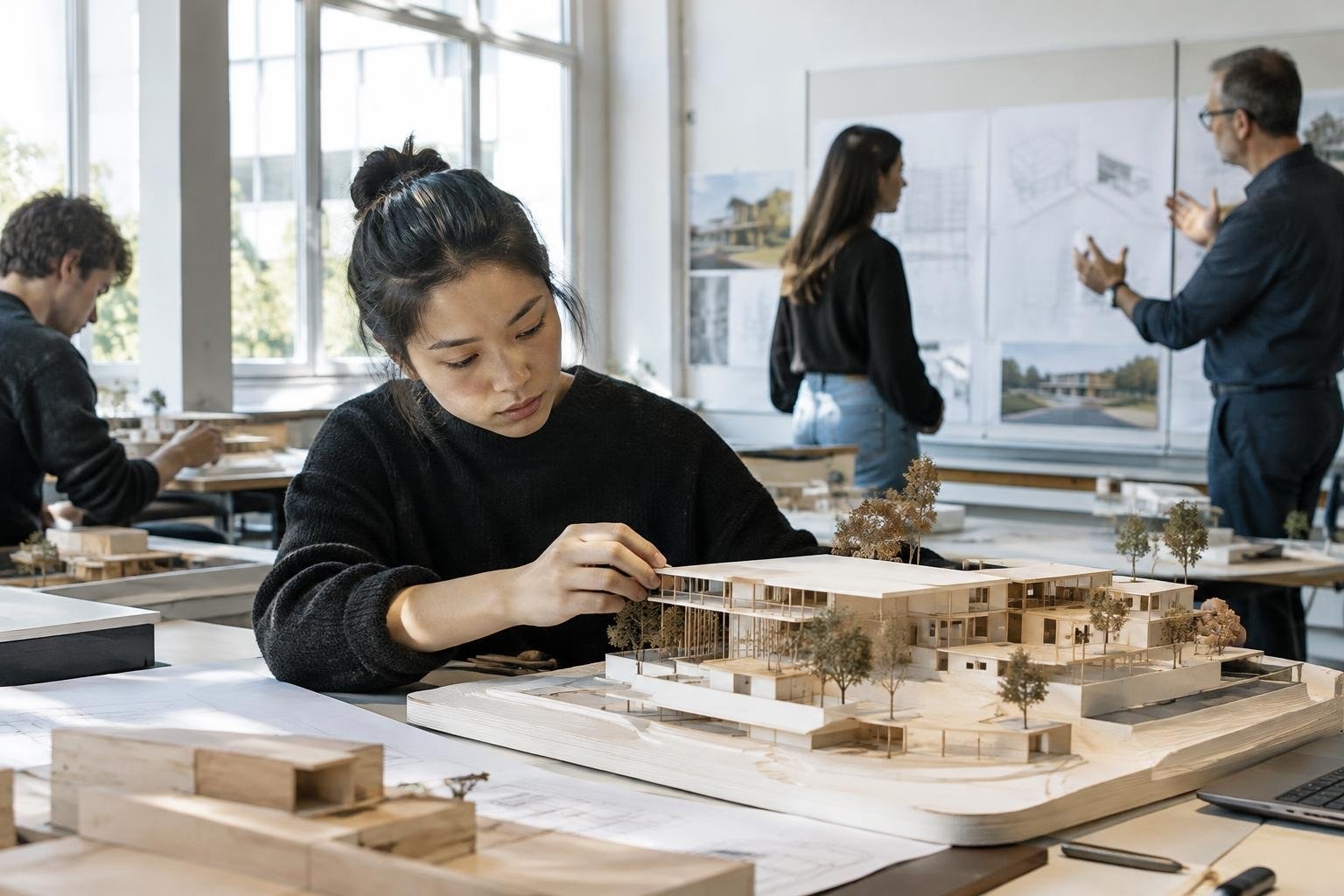
Coursework depends on the program's emphasis, but architecture education can combine design practice with technical learning, research, and critical thinking. A studio-based course typically asks students to develop and communicate a design proposal. The University at Buffalo program described in the supplied source emphasizes thinking through making in a studio-based curriculum. This illustrates why applicants should inspect the balance between project work and classroom instruction.
Look for opportunities to build skills through progressively challenging assignments, feedback, and a portfolio. Academy of Art University describes its architecture students as developing design, technical, research, and critical-thinking skills and graduating with a portfolio. Ask how projects are assessed, whether students present work to peers or reviewers, and what examples of completed student work the department can share.
Course names alone are not enough to evaluate a program. Compare course descriptions, sample project briefs, software or equipment expectations, and final-year work. Ask whether internships, research, or other applied experiences are required, optional, or unavailable.
Skills You Can Develop
Architecture-related programs can help students practice translating an idea into a design proposal and explaining the reasoning behind it. Design and visual communication are relevant to presenting concepts; technical learning and research support informed decisions; critical thinking helps students evaluate competing possibilities. The balance of these skills depends on the curriculum and the work students complete.
Ask to see a portfolio or sample project from the program. Look for evidence of how students frame a problem, explore alternatives, explain design decisions, and respond to feedback. These examples can tell you more about the program's approach than a broad claim about career readiness.
Some architecture-related pathways also connect design with areas such as sustainable and resilient design, historic preservation, healthcare environments, urban design, and real estate development. The University of Miami lists these among graduate certificate or concentration areas. Treat them as possible specializations, not guaranteed parts of every degree. Check whether the program you are considering offers courses or projects in your areas of interest.
Who Might Be a Good Fit?
Architectural design may interest students who enjoy visual problem-solving, want to understand the built environment, and are willing to revise ideas as a project develops. It can appeal to people who like both creative exploration and careful analysis. There is no single personality profile that guarantees success; programs differ, and students bring different strengths to design work.
Before applying, consider whether you want to spend time developing projects, receiving critique, and explaining your choices. Ask current students how studio work is organized and how much independent project time is expected. If you are more interested in construction technology, planning, history, or development than design itself, compare programs in those areas rather than choosing based only on the word “architecture.”
Does Architectural Design Match You?
Salary, reputation, or a field's perceived status should not be the only reasons to choose a major. Think about the work you want to do each week and whether the program's learning style motivates you. A career assessment can help you reflect on your interests and preferences; then compare those results with degree and career options. Use assessment results as one input, alongside course plans, conversations with advisors, and your own goals.
Admission, Completion Time, and Academic Challenge
Admission rules are set by each college and can differ by degree level. Review the current application page for prerequisites, transcripts, essays, portfolios, interviews, and any other requested materials. Do not assume that a portfolio, test, or particular high-school course is required unless the school lists it. If you are a transfer student or an adult learner, ask how previous coursework is evaluated and whether it can apply to the program.
Time to completion depends on the credential, required credits, course availability, transfer credit, and whether you attend full time or part time. The available sources confirm that architecture-related education spans multiple credential levels but do not establish standard credit totals or completion times. Request a degree map and ask for realistic schedules for students with your attendance plans.
Design study may ask students to combine creative work with technical and research tasks. A practical way to prepare is to review sample assignments, ask about feedback and workload, and confirm what materials or technology students must provide. Ask the program how students get support when a project or course becomes challenging.
Online, Hybrid, and On-Campus Study
Delivery format is a program-level detail, not something to infer from the degree name. Ask whether all required classes are online, whether some activities are scheduled on campus, and how students complete design assignments and receive feedback at a distance. The supplied program examples include an on-campus studio-based bachelor's program at the University at Buffalo and architecture education with portfolio-oriented work at Academy of Art University; they do not establish that all schools offer the same formats.
Before choosing an online or hybrid option, request a term-by-term schedule and confirm access to software, equipment, studio critiques, and any required in-person work. Ask whether remote students receive the same access to faculty feedback, project reviews, career services, and internship support as campus students. If an internship or other experiential activity matters to you, clarify whether you must find the placement yourself and whether it can be completed near where you live.
Tuition, Other Costs, and Financial Aid
There is no single reliable price for an architectural design degree. Total cost depends on the institution, credential, location, attendance format, and your individual expenses. Ask each school for a current cost-of-attendance estimate and separate tuition from fees, course materials, technology, housing, transportation, and other expenses that apply to you. Design-related materials or equipment may affect a student's budget, so ask the department what it expects students to provide.
For affordability, compare net cost rather than tuition alone. Contact the financial-aid office about grants, scholarships, work-study, loans, and payment plans for which you may qualify. Ask whether awards continue in later years and what academic or enrollment conditions apply. Students changing schools should also ask how transfer credit affects both time to completion and total cost.
Compare more than one pathway. A less expensive starting point is not necessarily cheaper overall if credits do not transfer or if it adds time before graduation. Request written estimates from the schools you are considering and make sure the estimates reflect your likely enrollment pattern.
Careers, Jobs, and Employment Outlook
Architecture-related education can connect to design-related work, but job titles, qualifications, and hiring expectations vary. Sources in the research identify architectural designer as a possible role and also mention project architect, project manager, architect, and senior designer as roles associated with architecture education. These titles should not be treated as immediate outcomes for every graduate: some positions may require additional education, professional experience, or other qualifications.
Architectural studies can also support preparation for graduate study and a range of design-related careers, according to Arizona State University. Potential areas of further specialization include historic preservation, sustainable and resilient design, healthcare design, urban design, and real estate development, as listed by the University of Miami. These are areas to investigate, not a guarantee of local openings or hiring demand.
The research available for this guide does not provide current occupational salary or employment-outlook figures. Rather than relying on unsourced estimates, compare current job postings in the regions where you may work. Record the titles employers use, the credentials and experience they request, and the tools or portfolio evidence they seek. This gives you a more relevant picture of entry-level opportunities than a broad program label.
Find out which Career or College Major is right for you!
Take the MAPP free today!Accreditation, Professional Preparation, and Licensure
Do not assume that completing an architecture-related degree automatically qualifies you for professional practice as an architect. The Academy of Art University source describes a Bachelor of Architecture as the most direct path to licensure for students without a prior degree. That distinction makes it important to ask whether a program is professional or pre-professional and what additional education or steps may be needed for your goal.
Before enrolling, ask the college to explain how the program relates to professional architecture education and what its graduates do next. Verify any accreditation claims directly with the recognized accrediting organization and confirm current licensure requirements with the relevant state licensing authority.
Short certificates and graduate specializations can add focused learning, but a certificate should not be confused with a professional license. The University of Miami describes graduate concentrations in areas such as historic preservation and sustainable and resilient design. Check what a credential represents and whether employers or licensing authorities recognize it for your intended purpose.
Experience, Portfolio, and Ways to Stand Out
Use projects to learn whether the field suits you and to build evidence of your work. Ask whether the program includes studio projects, internships, research, or portfolio development, and whether those opportunities are required or optional. The Academy of Art University describes students developing a portfolio that demonstrates their work. Confirm what a portfolio from your prospective program typically contains and how it is used in career preparation.
To stand out when applying for internships or entry-level roles, keep selected work organized and be ready to explain the problem, your contribution, the decisions you made, and what changed after feedback. Seek specific guidance from instructors and career staff about presenting work to employers. If you are considering a specialization, ask how to pursue relevant projects or graduate coursework; the University of Miami, for example, lists several architecture concentration areas.
Do not assume that any particular certification is mandatory or valuable for every role. Ask employers and program advisors which credentials are relevant to the work you want, and distinguish optional professional development from a legal requirement.
Graduate Study and Related Pathways
Graduate study may make sense if you want advanced education in architecture or a defined specialization. The supplied sources describe doctoral study as addressing theoretical and practical concepts related to architectural research and identify graduate interests such as historic preservation, healthcare design, sustainable and resilient design, urban design, and real estate development.
Architectural studies can also serve as preparation for graduate school; Arizona State University explicitly identifies graduate study as one possible direction for its bachelor's graduates. Before choosing a bachelor's degree, check whether the graduate programs you may want accept it and what prerequisites they require. Ask whether a pre-professional degree leaves you needing additional coursework or a different program sequence.
Other pathways may include architectural technology, environmental design, planning, or construction-related study. Compare the work each program emphasizes. If you are more interested in technical building systems, community planning, conservation, or development than in design proposals, investigate those alternatives directly instead of expecting one architecture program to cover them all.
Related Degrees: Which Path Should You Compare?
- Architecture: Consider this if you want a program explicitly focused on architecture and want to investigate its professional preparation and licensure relationship.
- Architectural studies: Consider this if you want a broader academic foundation and may pursue graduate school or design-related work.
- Architectural technology: Consider this if you are more interested in technical aspects of buildings than in a broad design-centered curriculum.
- Urban or regional planning: Consider this if your interests center on how communities and places are organized rather than on an individual building proposal.
- Environmental design: Consider this if you want to explore design in relation to environmental concerns; check the program's actual focus because titles vary.
- Historic preservation: Consider this if you want to focus on the history, conservation, or continued use of buildings and places.
- Real estate development: Consider this if you are more drawn to the development and investment side of the built environment.
These comparisons are starting points, not claims that every school defines programs identically. Compare course lists, projects, graduate routes, and job requirements. The University of Miami lists several of these themes as graduate concentration areas, while Arizona State describes architectural studies as preparation for graduate study and design-related careers.
Advantages, Tradeoffs, and Whether the Degree Is Worth It
A potential advantage of architectural design study is the chance to combine design, technical learning, research, and critical thinking. Studio and portfolio work can help students show how they develop and communicate ideas. Related pathways also allow students to explore specializations ranging from preservation to sustainable design and urban design.
Tradeoffs include the time and cost of a multi-year education, differences between degree titles, and the possibility that a design-focused credential may not be the pathway you need for professional licensure. Some students may need graduate education or additional preparation for their preferred role. Do not judge value by a program's name alone or assume that a degree guarantees a particular salary or job.
Assess value against your actual goals: total cost after aid, time to finish, likelihood of completing the program, opportunities to develop a portfolio, professional preparation, and the jobs available where you may want to work. A program may be worthwhile for one student and a poor fit for another. Compare alternatives before committing.
How to Choose a Program: Questions to Ask
Compare the program you would actually attend, not just its title or promotional summary. Request a degree map, sample assignments, and examples of student work. If you want professional architecture preparation, ask directly how the degree relates to that goal and verify any accreditation information independently.
- What credential does the program award, and what is its stated purpose?
- What courses and design projects are required, and can I review sample student work?
- What are the full costs and aid options for my enrollment plan?
- What are the current admission requirements, including any portfolio expectations?
- Can I complete the program online, on campus, or in a hybrid format?
- What internships, research, or portfolio support are available?
- How do transfer credits affect my time and total cost?
- What do graduates do next, and what education or experience do those roles require?
- How does the degree relate to professional study, accreditation, or state licensure?
Speak with an academic advisor and, where possible, current students or graduates. Ask for concrete examples rather than general assurances. Assessment.com degree and career matching resources can be one part of comparing options, but they should complement, not replace, program research and personal conversations.
From Degree to Career: Possible Routes
Career development is not automatic, and these examples are possibilities rather than guaranteed progressions. The education and experience required depend on the employer, role, and professional rules that apply.
- Architectural studies bachelor's → design-related entry-level opportunity or further study → build a portfolio and relevant experience → pursue a focused graduate pathway such as urban design or sustainable design.
- Professional architecture education → architecture-related work → gain experience and complete any applicable professional steps → pursue a more advanced design or project role.
- Architecture-related study → project or design support role → develop relevant experience and communication skills → explore project management or a specialization aligned with employer needs.
Sources identify design-related careers and roles such as architectural designer, project architect, project manager, architect, and senior designer, but do not establish a universal sequence or guarantee eligibility at graduation. Check job postings and professional requirements for the roles you are targeting.
Questions to Ask Before You Enroll
Use this checklist with parents, counselors, program advisors, and financial-aid staff. Keep written answers so you can compare schools fairly.
- What is the exact degree or certificate, and is it professional or pre-professional?
- What is the total estimated cost for my likely schedule, including fees and materials?
- What grants, scholarships, employer support, or payment options could apply to me?
- What projects will I complete, and how will the program help me build a portfolio?
- Are internships, studio sessions, or other activities required in person?
- What do graduates commonly do next, and how can I verify those outcomes?
- What credentials, further education, or licensure steps might my career goal require?
- Will my prior coursework transfer, and how will that affect completion time?
- What career services and employer connections can students use?
- Can I speak with current students or see recent examples of student work?
If the school cannot answer a question clearly, contact the relevant academic, financial-aid, or licensing authority before making a decision.
Frequently asked questions
What do you study in an architectural design program?
Architectural design programs explore how buildings and spaces are planned and represented. Depending on the program, students may develop design, technical, research, and critical-thinking skills through coursework and studio projects. Curricula differ, so compare course requirements and student work rather than relying on a program title alone.
Does an architectural design degree qualify you to become an architect?
Some architecture programs are designed as a direct route toward professional licensure, while architectural studies and related degrees may prepare students for further study or design-related work. The Academy of Art University describes the B.Arch as the most direct path to licensure for students without a prior degree. Check the program and relevant state requirements before enrolling.
What jobs can you get with an architectural design degree?
Potential roles associated with architecture education include architectural designer and, with suitable education and experience, project architect or project manager. A degree does not guarantee a job or a particular title. Review employers' requirements and distinguish entry-level design work from roles that call for additional education, experience, or professional credentials.
How much does an architectural design degree cost?
Program cost depends on the institution, credential, attendance format, location, and individual expenses. Compare the full cost of attendance, including tuition, fees, required materials, technology, and living expenses where applicable.
Can you study architectural design online?
Online availability and hands-on requirements vary by institution and program. Ask whether design studios, critiques, software access, model-making, internships, or other activities require campus attendance. Request a sample schedule and confirm how students receive feedback on projects before choosing an online or hybrid option.
What is the difference between architecture and architectural studies?
Architectural studies can be a useful alternative for students interested in design and the built environment who want a broader academic route or expect to pursue graduate study. Arizona State University describes its architectural studies bachelor's graduates as prepared for graduate school and a range of design-related careers. Compare the course plans and professional goals of each program.
People Also Ask
What is architectural design in college?
Architectural design study focuses on developing and communicating ideas for buildings or spaces. Depending on the program, coursework may include design studios, technical learning, research, and critical analysis. Review each school's course list and student work because titles and emphases vary.
How long does it take to study architectural design?
Program lengths and credit requirements depend on the credential and school. Architecture-related study is available at several levels, including associate, bachelor's, master's, certificate, and doctoral programs. Ask schools for the published credit total and a realistic full-time and part-time completion plan.
Does architectural design require math?
Check the admissions prerequisites and required curriculum at each college, including any quantitative, technical, or science courses. If you are concerned, ask an advisor what preparation is recommended before the first term.
Do you need a portfolio to apply for an architectural design program?
Portfolio rules vary by institution and credential. Some programs may request work samples as part of admission, while others may not. Confirm the current application requirements with admissions and ask what kinds of work are accepted; do not assume that a portfolio is required or unnecessary based on another school's policy.
Is a pre-professional architecture degree the same as a professional degree?
A pre-professional bachelor's program can provide design preparation, but its relationship to later professional study varies. The University at Buffalo source describes its architecture bachelor's as pre-professional and studio-based. Compare the degree's stated purpose and graduate pathways with the requirements of professional programs you may want to pursue.
What specializations are available in architecture?
Architecture-related programs can include specializations such as historic preservation, sustainable and resilient design, urban design, healthcare design, and real estate development. The University of Miami lists these among areas of graduate concentration. Availability differs by school, so verify that a program offers the specialization and coursework you want.
Architectural design may suit students who want to explore how buildings and spaces work, combine creative thinking with technical decisions, and communicate ideas through visual and written work. The right program depends on whether you want a broad design education, a technical pathway, or preparation for professional architecture study. Compare the actual curriculum, total cost, portfolio expectations, and career outcomes before enrolling. If you are unsure which direction fits, use career and degree matching tools alongside conversations with program advisors and working professionals.
Want to see your options? Try our comprehensive Degree, Program & College Search tool
College Search ToolSources & Official Resources
- Degrees in architecture and related services conferred by postsecondary institutions, by level of degree and sex of student: Selected years, 1949-50 through 2015-16
- Architectural Studies - BSD | Degree Details | ASU Degree Search
- School of Architecture - Academy of Art University
- Certificates | School of Architecture | University of Miami