Atomic and Molecular Physics Degree Guide: Courses, Careers, Costs, and Fit
Explore atomic and molecular physics programs, what students study, possible careers, degree requirements, costs, and how to decide whether this specialized physics field fits your goals.
By Kieth Nelson · Staff Writer Assessment.com · Published October 9, 2026 · Last updated November 5, 2026
Atomic and molecular physics is the study of matter and energy at the scale of atoms and molecules. Students learn how these small systems are structured, how they interact with radiation, and how physical principles can explain their behavior. The field connects core physics with specialized topics such as atomic structure, molecular bonding, quantum theory, and magnetic resonance. Programs may be offered as a focus within physics rather than as a standalone major. Depending on the institution and credential, study can lead toward laboratory support, research, technical communication, teaching, or advanced scientific work. Many research-oriented positions require graduate education, so it is important to connect the program you choose with the jobs you hope to pursue. Not sure whether atomic and molecular physics fits you? Take the Free MAPP Career Assessment to explore how your motivations, interests, and natural preferences may align with this area of study and related careers.
Degree & Program Decision Insights
Explore your personal fit, education requirements, career potential and next steps.
01Motivational Fit
Discover whether this program fits you
Explore your preferences against the focus of Atomic/Molecular Physics. These prompts are not personal MAPP results.
Scientific investigation. Would you enjoy investigating chemical physics and explaining your conclusions from evidence?
Breadth of interest. Consider the place of “atomic forces and structure” in this field. Is this another part you would choose to explore, or mainly a requirement you would tolerate?
Work reality. Related work can involve this task: “Teach physics to students.” Would you want that activity to be a regular responsibility?
Interest in studying a field can differ from enjoying its related work.
Which part would you want to do repeatedly, and what would you try before deciding?
Discover Your Personal Program Fit
Before investing your time and money in your education, discover how this program aligns with your natural motivations, work preferences and career goals.
Typical occupational entry: doctoral or professional degree (BLS). Postsecondary teaching is a separate appointment and may require advanced study; this programme alone is not a promise of a teaching post.
U.S. occupational wages are not guaranteed graduate earnings; OEWS excludes self-employed workers.
Projected openings include replacements as well as growth.
U.S. national estimates. A crosswalk does not establish entry-level eligibility; advanced, management and teaching roles can require further qualifications.
Explore your motivations. Use MAPP as a starting point for reflecting on your interest in “chemical physics”, then test that interest against a sample learning task.
Examine the work. Compare Physicists and Physics Teachers, Postsecondary on daily work and entry qualifications, as well as pay. Explore Physicists.
Compare actual providers. Ask for the exact credential, course sequence and assessment methods. Compare how each provider teaches “atomic forces and structure”, its entry criteria and its itemized costs.
Check the evidence before applying. Confirm prerequisites and any recognition or professional requirements for your intended route; ask for applicable rules and published outcome definitions in writing.
Verify the institution’s current offering, admissions requirements and outcomes; a search result does not establish your eligibility.
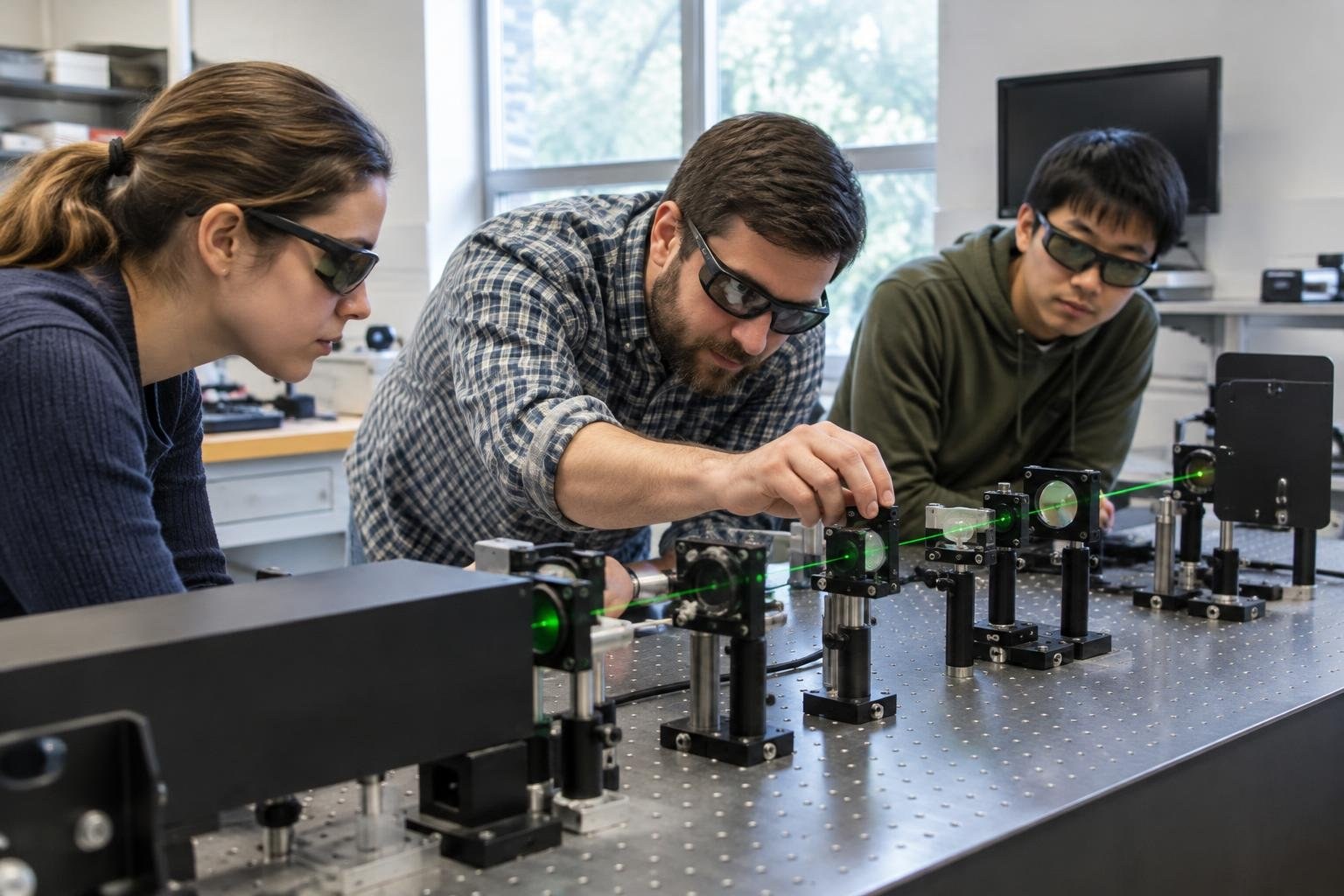
Students and faculty aligning optics equipment for a teaching or research demonstration
What Is an Atomic and Molecular Physics Degree?
Atomic and molecular physics is a specialized area of physics concerned with how atoms and molecules behave, interact, and respond to energy and radiation. It can examine atomic structure and forces, molecular bonding and orbitals, magnetic resonance, phase behavior, and quantum descriptions of matter. In the federal Classification of Instructional Programs, Atomic/Molecular Physics is identified as CIP 40.0802.
The subject sits at the intersection of physics and chemistry, but its central approach is physical: using models, measurement, and mathematical reasoning to explain matter-energy phenomena. A department may offer it as a named concentration, research focus, course cluster, or area within a general physics degree. Program titles and availability vary; the title alone does not tell you how much specialized study a student will receive.
For comparison, Oregon State University’s physics catalog identifies atomic, molecular, and optical physics as one of several subfields alongside nuclear and particle physics and solid-state physics. That illustrates why prospective students should inspect course lists and research options rather than assume every “physics” program provides the same specialization.
Sources: Oregon State University physics catalog.
What Do You Study? Courses, Labs, and Research
Students generally begin with broad physics and mathematics before moving into advanced topics and focused research. The program description for Atomic/Molecular Physics names chemical physics, atomic forces and structure, molecular orbital theory, magnetic resonance, molecular bonding, phase equilibria, quantum theory of solids, and applications to elements and compounds. Not every program will include every topic under the same course name.
A representative course sequence may include foundational mechanics, electricity and magnetism, thermodynamics, and introductory modern or quantum physics, followed by advanced coursework tied to a department’s strengths. Anne Arundel Community College describes physics broadly as the mathematical study of fundamental forces and lists atomic physics and quantum mechanics among the subject areas across physics. At the graduate level, a student might pursue experimental, computational, or theoretical research in AMO physics.
What laboratory and research work may involve
Laboratory classes teach students to collect observations, use scientific instruments, assess uncertainty, and compare results with a physical model. Advanced projects may involve designing or adapting an experiment, analyzing data, writing a report, and presenting conclusions. Graduate programs can include thesis research; Oregon State University describes thesis research opportunities in experimental, computational, or theoretical AMO physics.
Ask departments for sample degree plans and examples of recent undergraduate projects. Those details reveal whether the major offers hands-on preparation or is primarily organized around classroom instruction.
Sources: Anne Arundel Community College physical sciences; Oregon State University graduate physics programs.
Skills You Can Develop
Students develop a combination of scientific, technical, and communication skills. Coursework and research can strengthen the ability to translate a physical question into a mathematical model, interpret measurements, identify sources of uncertainty, and explain what the results do and do not establish.
Quantitative reasoning: applying mathematics to describe physical systems and test predictions.
Experimental practice: following procedures, working with instruments, documenting observations, and assessing data quality.
Computational and analytical thinking: organizing data, evaluating models, and reasoning through complex problems. Specific software depends on the institution and project.
Scientific communication: writing reports, presenting findings, and explaining technical ideas to people with different backgrounds.
Collaboration and professional judgment: coordinating research tasks, following lab protocols, and recognizing when evidence is inconclusive.
These abilities can be useful in research teams, laboratory support, technical writing, and science education. Students should seek course projects, research placements, or internships that let them demonstrate these capabilities, not just list them on a résumé.
Who Is This Program For? Interests and Entry Requirements
This field may appeal to students who are curious about the small-scale structure of matter and enjoy asking how evidence supports a scientific explanation. It can be a good academic match for people who are willing to work through abstract concepts, use mathematics regularly, and refine an answer through careful analysis rather than relying on quick intuition.
You do not need to arrive with a particular personality type. Some students are drawn to experimental work and instruments; others prefer theory, computation, or interpreting data. Programs and research groups differ in the balance among these approaches. Talk with faculty and current students about what a typical week looks like before deciding.
Entry preparation and admissions
Admission requirements are set by each institution. Check the school’s stated prerequisites, academic records, application deadlines, and any requirements for transfer students or graduate applicants. For a physics pathway, review whether you are ready for the mathematics and introductory physics sequence, and ask about tutoring or bridge coursework if you need a refresher. A department should confirm which prerequisites are required rather than relying on assumptions based on the program title.
Parents and counselors can help students compare interest with day-to-day academic demands. A strong interest in space or science is a useful starting point, but it is also worth trying physics coursework, a lab, or a research activity to see whether the work itself is engaging.
Credential Levels, Format, and How Long It Takes
The field can appear at several credential levels, but a specific college may not offer every level or a separately named Atomic/Molecular Physics award. The program context identifies certificate, associate, bachelor’s, graduate certificate, master’s, and doctoral credentials as possible levels in the field; verify the actual award, curriculum, and admission pathway with each institution.
An associate program may provide foundational physics coursework or a transfer route. A bachelor’s program can provide broader preparation and opportunities for advanced classes or undergraduate research. Graduate study permits more focused research and specialization. Oregon State University lists MA, MS, and PhD physics routes with thesis research in AMO and other physics areas.
Completion time depends on credential level, enrollment pace, transferred coursework, and program sequencing. Ask which courses are offered every term: a required course offered only periodically can affect completion.
Online, Hybrid, or On Campus?
Physics programs can include lecture courses, laboratory instruction, collaborative problem-solving, and research. Ask how online students access equipment, research supervision, and any required in-person components.
Compare more than the format label. Find out whether labs are virtual, conducted with equipment supplied to students, or completed on campus; whether research opportunities are open to distance learners; and whether the final credential and courses appear on the transcript as expected. If your goal is a research position or graduate admission, ask whether the format offers the lab and faculty research experience you need.
Tuition, Costs, and Financial Aid
The total cost depends on the college, location, residency classification, credential, enrollment pace, and expenses beyond tuition. For a lab-based science pathway, also ask about course fees, equipment or technology needs, travel to campus, and the cost of research participation. No single tuition figure applies to all programs in this field.
Use each school’s official cost information to compare the full period of study, not just a per-credit rate. Include tuition, mandatory fees, books, housing and transportation where relevant, and any additional costs stated by the department. Then compare grants, scholarships, work-study eligibility, employer support, and federal or state aid through the appropriate official channels.
Students considering a two-year transfer path should confirm in writing which courses will count toward the intended bachelor’s degree. A lower-cost start can lose value if credits do not transfer or if prerequisite sequences must be repeated. Ask financial-aid and academic advisers to review the plan before enrolling.
Careers, Jobs, and Employment Considerations
Physics study can lead toward several kinds of work, but a degree title does not guarantee a particular job or salary. A physics program catalog lists laboratory technician, research assistant, technical writer, physicist, and instructor among possible roles, with preparation varying by position. Many research or applied physicist roles and college teaching jobs require graduate-level education.
Possible workplaces include laboratories, colleges, university research groups, and other employers seeking technical or quantitative skills. The specific openings and qualifications depend on the employer. Check current requirements and pay for each job title using authoritative labor-market information.
Career direction
Preparation to investigate
How physics study may apply
Laboratory technician
Requirements vary; associate or bachelor’s study may be relevant.
Measurement, laboratory practice, and documentation.
Research assistant
Requirements vary by employer and project.
Data collection, analysis, and research-team collaboration.
Technical writer
Employers may seek technical knowledge and strong writing.
Explaining scientific ideas and documenting methods or results.
Physicist or applied physicist
Many research-oriented roles call for graduate-level education.
Specialized theoretical, experimental, or computational study.
Postsecondary physics instructor
Requirements vary by institution; advanced study is common.
Subject knowledge, teaching, and sometimes research experience.
Explore Assessment.com’s guides to physicists, postsecondary physics teachers, and technical writers. The career directory can help you explore related fields. Check current role requirements before choosing a program or credential.
Accreditation, Licensure, and Certifications
A physics degree and a professional license are not the same thing. The supplied program information describes academic study and research but does not establish a field-wide professional license or a universal certification requirement for atomic and molecular physics. Requirements depend on the occupation and employer, so verify them for the exact role and location you have in mind.
For research work, supervised experience, technical skills, and evidence of project contributions may matter alongside the credential. For teaching, state or institutional requirements can differ by school level and employer. Do not assume that completing a physics major automatically qualifies you for a regulated occupation in another field.
Before committing, ask the department whether its curriculum prepares students for any credential they are considering and confirm requirements with the organization or public authority responsible for that credential.
Research, Internships, and Building Experience
Research experience can help students test their interests and show how they apply classroom knowledge. Ask about faculty projects, undergraduate research, lab assistant roles, summer work, and opportunities to present a poster or explain a project to a general audience. At graduate level, thesis research may be experimental, computational, or theoretical.
How to stand out to employers
Keep a concise portfolio of projects, reports, presentations, or code where appropriate and permitted.
Describe your contribution precisely: the question, methods, tools, and result, without overstating your role.
Practice explaining technical work to someone outside your specialty.
Seek references from faculty or supervisors who know your work.
Compare job postings and build relevant skills rather than collecting credentials without a clear purpose.
Professional organizations, campus seminars, and faculty office hours can also help students understand research areas and make informed decisions about further study. Confirm which activities are available to undergraduates and whether they require prior coursework or selection.
Graduate School and Advanced Study
Graduate study is a logical next step for students seeking deeper specialization, thesis research, or many research and postsecondary teaching careers. Possible routes include a physics master’s degree or PhD, with study centered on experimental, computational, or theoretical AMO physics. Some students may pursue a related field if their interests shift toward a particular application.
Oregon State University describes master’s and doctoral physics pathways that include research options in AMO physics. Penn State’s graduate physics information also lists atomic and molecular physics among its instruction and research areas. Those examples show the kinds of options students can look for; they do not mean every university offers the same research group or admissions structure.
Before applying, compare research advisers, thesis expectations, funding details, coursework, and the placement outcomes the department can document. Discuss with faculty whether a master’s or doctorate is necessary for your intended work and whether the likely time and cost fit your circumstances.
Related Degrees and Alternatives
Related subjects can lead to different curricula and work styles. Consider these alternatives alongside an atomic and molecular physics focus:
General physics: Consider this instead if you want broad coverage across several physics subfields before selecting a specialty.
Chemistry: Consider this instead if you are more interested in chemical reactions, compounds, and laboratory chemistry than physical models of atomic and molecular behavior.
Chemical physics: Consider this instead if you want a closer blend of chemical questions and physical theory or methods.
Materials science or materials physics: Consider this instead if you want to study the properties and behavior of materials and their applications.
Optics or optical sciences: Consider this instead if light, optical systems, and related technologies are your main interest.
Astronomy or astrophysics: Consider this instead if you want to apply physics to celestial objects, the universe, or cosmic phenomena.
Engineering: Consider this instead if you prefer designing and building systems or products using scientific principles.
Applied mathematics or computational science: Consider this instead if you prefer modeling, numerical methods, and data analysis across scientific problems.
Compare required courses, lab access, the amount of mathematics, and graduate-school prerequisites. A general physics degree can still provide a route into atomic and molecular research if students take suitable electives and build relevant research experience.
Is an Atomic and Molecular Physics Degree Worth It?
Related subjects can lead to different curricula and work styles. General physics offers broader coverage before or alongside specialization. Chemistry emphasizes chemical questions and laboratory work; chemical physics combines chemical topics with physical theory or methods. Materials science, optics, astronomy, engineering, and applied mathematics offer other directions depending on the questions and methods that interest you.
Compare required courses, mathematics, laboratory access, and research opportunities. A general physics degree may still provide a route toward atomic and molecular research when students take relevant electives and build research experience. Browse Assessment.com’s degree directory and college major guidance to explore related options.
How to Choose the Right Program
When comparing programs, look for a clear match between the advertised specialization and the courses, faculty research, and student opportunities actually available. A general physics department may offer AMO research without awarding a degree specifically named atomic and molecular physics; another school may use a concentration or elective cluster.
Review the catalog and course schedule, including prerequisites and how often advanced courses run.
Ask whether undergraduate students can join research groups and what preparation is expected.
Check the laboratory facilities, safety training, and research supervision available to students.
Compare total cost, financial aid, transfer rules, and the time needed to finish required sequences.
For online or hybrid study, confirm how lab and research requirements are met.
Ask for documented information about student outcomes and career services, and distinguish verified outcomes from promotional claims.
Verify institutional accreditation and any occupation-specific credential requirements through the relevant authoritative bodies.
Use Assessment.com’s college major guidance and college guidance resources as starting points for organizing questions. Matching tools can help clarify personal preferences, but they should complement program research and conversations with advisers.
From Degree to Career: Example Pathways
Career paths vary by a student’s education, experience, and interests. These examples are possibilities, not guaranteed progressions:
Associate physics study → laboratory support role → build instrumentation and measurement experience → pursue further physics coursework or a specialized technical role.
Bachelor’s in physics → research assistant or laboratory role → gain experience with a research team → consider graduate study in experimental, computational, or theoretical AMO physics.
Bachelor’s plus strong communication skills → technical communication or writing role → develop subject-area expertise → move toward more specialized scientific communication.
Graduate physics study → research or teaching role → develop a specialty and publication or teaching experience → pursue more advanced research or academic responsibilities.
Each employer defines its own qualifications. Review current job postings and talk to program advisers before treating any pathway as a plan.
Questions to Ask Before Enrolling
Use this checklist with family members, advisers, and program representatives before making a deposit:
What is the exact credential and specialization on the official program record?
Which required courses are available each term, and what is the expected sequence?
What is the total estimated cost for my likely completion period, including fees and lab expenses?
Which grants, scholarships, aid programs, or employer benefits could apply?
Can I transfer credits, and can the receiving institution confirm their use toward the degree?
What laboratory, internship, or research opportunities are open to students at my level?
Can online or part-time students access the same required instruction and research?
What additional education do graduates pursue for the jobs I am considering?
What career support and documented outcomes does the department provide?
Which credential or licensing rules apply to my intended occupation and location?
Write down the answers and compare them across institutions. If an answer affects total cost, graduation timing, or career eligibility, ask the school to provide the relevant policy or requirement in writing.
Frequently asked questions
What is atomic and molecular physics?
Atomic and molecular physics studies the behavior of atoms and molecules and their interactions with matter and radiation. Programs may offer the subject as a focus within a broader physics degree.
Is atomic and molecular physics hard?
It can be challenging because physics study involves mathematics, abstract models, and sustained problem-solving. Course sequences and preparation requirements vary by institution, so review the degree plan and ask about prerequisites and academic support.
What jobs can I get with an atomic and molecular physics degree?
Possible physics-related roles include laboratory technician, research assistant, technical writer, physicist, and postsecondary instructor. Preparation varies by employer, and many research and college teaching positions require graduate-level study.
How much can you make with a physics degree?
Pay depends on the occupation, education, experience, employer, and location. Use current U.S. Bureau of Labor Statistics information to check median pay for each job you are considering; a physics degree does not guarantee a particular salary.
Can I earn an atomic and molecular physics degree online?
Some physics coursework may be available online, but research programs can involve laboratory equipment, faculty supervision, or in-person work. Ask each department which components must be completed on campus and whether distance learners can access relevant research opportunities.
Does atomic and molecular physics require a lot of math?
Expect substantial mathematics in physics study. Review each program’s required math and physics courses, prerequisites, and recommended preparation before enrolling.
Do I need a graduate degree to work in atomic and molecular physics?
Not every physics-related role requires graduate study. Requirements vary by employer and position; advanced research and many postsecondary teaching roles commonly call for graduate-level education.
How is atomic and molecular physics different from a general physics degree?
A general physics program covers a broader range of physics areas. Atomic and molecular physics focuses more closely on atoms and molecules, often through electives, a research focus, or graduate study within a physics department.
People Also Ask
What does atomic and molecular physics study?
Atomic and molecular physics investigates atoms, molecules, and how they interact with matter and radiation. It uses physics and mathematical models to study structures and behavior at very small scales.
What courses are in an atomic and molecular physics program?
A program may include advanced physics, mathematical methods, laboratory work, and a research project. Students may encounter topics such as atomic structure, molecular theory, quantum physics, and optical physics, depending on the curriculum and specialization.
How long does it take to study atomic and molecular physics?
Program length depends on the credential, course load, transfer credit, and whether the specialization is part of a broader physics degree. Check the official degree plan for the number of credits and expected completion sequence.
What degree levels are available in atomic and molecular physics?
The field can be pursued within physics programs at different credential levels, but specific certificate, associate, bachelor’s, master’s, or doctoral offerings vary by institution. Verify the exact award and specialization with the school.
Can physics research be studied fully online?
Many research-focused physics programs rely on laboratories and direct work with faculty or equipment. Online coursework may be possible, but students should ask whether the program offers the in-person research and lab access needed for their goals.
What can you do after a bachelor’s degree in physics?
A bachelor’s degree can support some laboratory or research support opportunities, depending on employer requirements. Advanced research and many university teaching positions generally involve graduate-level study, so identify the target job before deciding how far to continue.
Should I choose physics or atomic and molecular physics?
An atomic and molecular physics focus emphasizes atoms and molecules, while a broader physics major covers a wider set of areas. Compare required courses, research options, and the preparation each path offers for your intended graduate program or occupation.
Atomic and molecular physics can be a strong fit if you enjoy mathematics, careful investigation, and understanding matter at small scales. Compare program coursework, research access, total cost, and the education required for your preferred roles. Use Assessment.com to explore related careers and degree options, then confirm program and job requirements with the relevant institutions and employers.
Find out which Career or College Major is right for you!
We use cookies to offer you a better browsing experience, analyze site traffic and personalize content.
Read about how we use cookies and how you can control them in our
Privacy Policy.
If you continue to use this site, you consent to our use of cookies.
×
Exciting News!
Be one of the first to Beta Test the new AI-Powered Assessment.com Platform.