Optics and Optical Sciences: A Guide to Study and Career Fit
A practical guide to optics and optical sciences study: what programs cover, which credentials to compare, and how to assess cost, format, and career fit.
By Tome Fierre · Staff Writer Assessment.com · Published October 12, 2026 · Last updated November 5, 2026
Optics turns a broad question, how does light behave, into a focused area of scientific and technical study. Students explore the principles behind light and may apply them to optical systems, engineering problems, or research. The decision for a prospective student is less about choosing a compelling program name and more about checking the route behind it: which courses are required, what preparation is expected, and whether the credential matches a realistic next step. The examples here include graduate programs and certificates, not a promise that each institution offers every degree level. Use them to build a comparison checklist, then confirm the details with each school.
Degree & Program Decision Insights
Explore your personal fit, education requirements, career potential and next steps.
01Motivational Fit
Discover whether this program fits you
Explore your preferences against the focus of Optics/Optical Sciences. These prompts are not personal MAPP results.
Subject curiosity. Would you choose to explore “wave theory” in depth? Ask for a sample learning activity to test that interest.
Breadth of interest. Consider the place of “wave mechanics” in this field. Is this another part you would choose to explore, or mainly a requirement you would tolerate?
Work reality. Related work can involve this task: “Develop innovative technology or train staff for its implementation.” Would you want that activity to be a regular responsibility?
Interest in studying a field can differ from enjoying its related work.
Which part would you want to do repeatedly, and what would you try before deciding?
Discover Your Personal Program Fit
Before investing your time and money in your education, discover how this program aligns with your natural motivations, work preferences and career goals.
Typical occupational entry: bachelor's degree (BLS). BLS lists 5 years or more of related work experience as typical for this occupation; this programme is not a direct promise of entry.
Typical occupational entry: doctoral or professional degree (BLS).
U.S. occupational wages are not guaranteed graduate earnings; OEWS excludes self-employed workers.
Projected openings include replacements as well as growth.
U.S. national estimates. A crosswalk does not establish entry-level eligibility; advanced, management and teaching roles can require further qualifications.
Compare the focus and route of these distinct instructional fields; their credentials and admission requirements are not interchangeable.
Laser and Optical EngineeringCIP 14.1003. Compare its emphasis on wave theory and mechanics and electromagnetic applications with this program’s focus.
AcousticsCIP 40.0809. Compare its emphasis on the acoustic wave equation and energy transformation with this program’s focus.
Physics, GeneralCIP 40.0801. Compare its emphasis on classical and modern physics and electricity and magnetism with this program’s focus.
Explore your motivations. Use MAPP as a starting point for reflecting on your interest in “wave theory”, then test that interest against a sample learning task.
Examine the work. Compare Natural Sciences Managers and Physicists on daily work and entry qualifications, as well as pay. Explore Natural Sciences Managers.
Compare actual providers. Ask for the exact credential, course sequence and assessment methods. Compare how each provider teaches “wave mechanics”, its entry criteria and its itemized costs.
Check the evidence before applying. Confirm prerequisites and any recognition or professional requirements for your intended route; ask for applicable rules and published outcome definitions in writing.
Verify the institution’s current offering, admissions requirements and outcomes; a search result does not establish your eligibility.
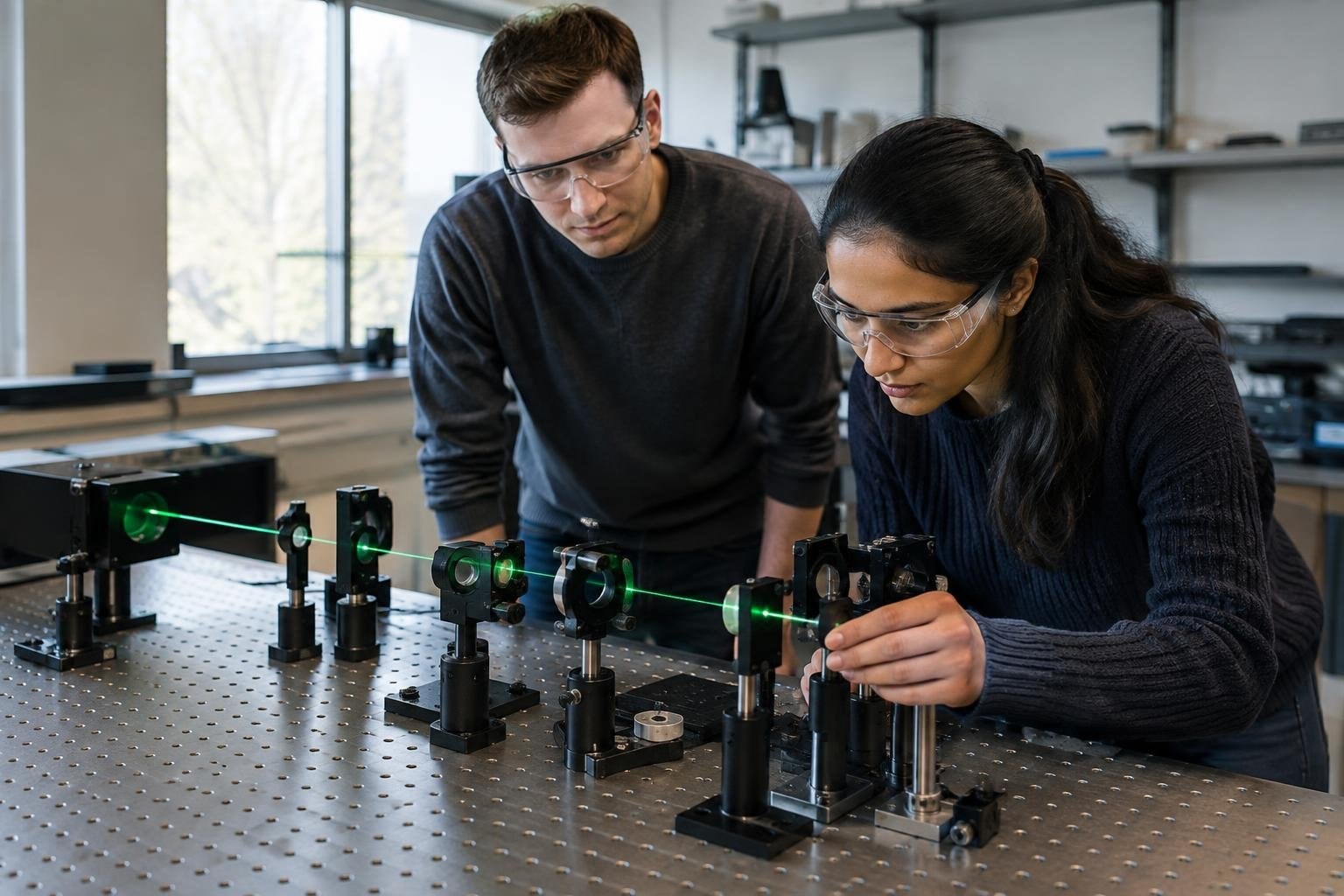
An optical bench illustrating experimental learning in optics
Start With the Field and the Credential
Think of optics as a specialty defined by its central subject: light. Programs may examine how light behaves and how scientific principles can be applied to optical systems and engineering problems. Names differ, so a course list is more informative than a title alone. You may see optics, optical sciences, optics and photonics, or optical science and engineering; related study may sit within a physics or engineering department.
Do not assume one school’s graduate offering represents the options available to all students. Begin by identifying the level you need, then check whether the institution offers that credential and whether its requirements fit your educational background.
Read the Curriculum as a Map
Use the curriculum to judge what a program actually teaches. The field can include wave theory, electromagnetic theory, physical and geometric optics, quantum theory of light, lasers, photon detection, and optical systems. A school may emphasize a subset of this subject matter or organize it around a particular concentration.
For example, the University of New Mexico describes its master’s program as having two objectives and concentration-dependent core courses. The University of Central Florida’s CREOL master’s lists optics, photonics, and general optics and photonics tracks. These examples show why comparing required courses and electives is more useful than comparing program names alone.
Before applying, ask for a current course plan and identify which requirements are shared and which depend on a concentration. If hands-on or research experience matters to you, ask how it appears in the curriculum rather than assuming it is included.
Match Learning Opportunities to Skills
Instead of treating skills as a generic checklist, connect each one to evidence you can look for in a course plan. A program grounded in optical science may ask students to use mathematical and physical ideas to analyze light. Applications may connect that foundation to engineering problems, optics, or photonics.
Modeling: Look for coursework that develops the quantitative foundations you need.
Application: Check whether the program links scientific ideas to optical systems or engineering problems.
Specialization: Compare options such as optomechanical engineering or quantum information science and engineering when offered.
Communication: Ask how students present technical work in courses or research settings.
Facilities, instruments, and project opportunities are school-specific. Ask departments what students actually use and whether those experiences are required or optional. For occupational exploration, Assessment.com has pages on photonics technicians and physicists.
Test Your Fit Before Applying
Interest in light is a useful starting point, but the day-to-day academic work matters too. Consider whether you want to investigate physical principles, apply them to technical problems, or pursue a combination. Students who want a broad science foundation can compare optics with physics; students more drawn to system design can look closely at the engineering content and projects.
Preparation is part of fit. UCF says its CREOL master’s is intended for applicants with a bachelor’s degree in optics, electrical engineering, physics, or a closely related field. Other programs set their own requirements. Compare your coursework with the official admissions criteria and ask about prerequisites before paying application fees.
For a structured reflection on interests and education choices, Assessment.com’s college major exploration resource and MAPP assessment can be used alongside course research and conversations with advisers.
Choose a Credential That Serves Your Next Step
Credential labels describe different commitments, not interchangeable versions of the same program. A certificate may provide focused formal coursework; a master’s is a graduate degree; doctoral study is a further route for students whose goals call for advanced study or research preparation. The available level and requirements are set by each institution.
UCF’s CREOL master’s program lists three options and requires 30 graduate credits. That is a program-specific detail, not a general measure of the time or credits needed elsewhere. Ask each school for a completion plan for your intended enrollment pace, including when required courses are offered.
Use the credential as a planning question: what does your next step require, and does this program supply the necessary coursework? Confirm transfer credit or later progression with the institution rather than assuming a certificate will count toward a degree.
Check What the Program Format Means in Practice
Online, campus, and hybrid labels do not tell you everything about the learning experience. The supplied examples include an online University of Arizona graduate certificate and an online optical sciences master’s. Each offering has its own structure, so verify how instruction and required activities are delivered.
Ask whether classes are scheduled or flexible, whether any project or lab activity requires in-person attendance, and how online students access advising and faculty. If regular access to facilities is important to you, confirm what the program provides rather than inferring it from the institution or degree name.
For an online student, a practical comparison is: what can I complete remotely, what participation is expected, and what support is available? For a campus student, ask how the curriculum connects classes with any research or project opportunities.
Build a Cost Comparison You Can Trust
The supplied program information does not provide a common price for comparing optics degrees. Build a school-specific estimate instead. Ask for tuition and mandatory fees based on your residency and enrollment status, then identify any other required expenses the institution lists. Request a total for the credential you plan to complete, not just a per-course figure.
Ask the financial aid office which grants, scholarships, assistantships, employer benefits, or payment arrangements may apply to you, and confirm eligibility directly. If you are weighing a certificate against a degree, compare the total cost and ask whether credits could later apply to a degree. Do not treat that transfer as assured unless the school confirms it.
A useful decision tool is a side-by-side sheet with total estimated cost, expected course sequence, and confirmed aid. Keep estimates separate from confirmed awards, and update the comparison when an institution provides new information.
Work Backward From the Jobs You Want to Explore
Career planning should start with tasks and qualifications, not a promise attached to a degree title. The University of Arizona describes its optical sciences master’s as preparation for industry careers or continued doctoral study. Its online master’s page identifies possible directions such as engineer, designer, or technical manager. These are examples of program direction, not guarantees of employment.
Choose several job titles that interest you and read actual employer requirements. Note the requested degree level, technical focus, and experience, then check whether a program offers a plausible way to build those qualifications. The Assessment.com pages for photonics technicians, physicists, and materials scientists can help you compare adjacent interests.
No salary figure for a specific optics occupation is established by the supplied research. Use current occupation-level evidence for salary questions and avoid reading career possibilities as promised outcomes.
Separate the Academic Credential From Job Requirements
An academic certificate or degree is not, by itself, proof that a particular occupation has no additional requirements. The supplied program pages describe academic credentials, not a universal professional license for optics graduates. If a role appears to require a license, certification, or other qualification, verify it with the relevant employer and applicable authority.
Arizona describes its professional graduate certificate as formal coursework for working professionals seeking to supplement practical knowledge. Before enrolling in a certificate, ask what courses it includes, who may apply, and whether it supports your goal. Verify any claims about accreditation or credit transfer directly with the institution and the named organization.
When comparing programs, distinguish three questions: what credential will I earn, what experience can I demonstrate, and what additional qualifications do target employers request? This prevents the program label from standing in for a career plan.
Decide Whether Further Study Adds Value for You
A master’s can be a stopping point for some students and a bridge to further study for others. The University of Arizona describes its master’s as a possible route to industry work or doctoral study, and lists optomechanical engineering and quantum information science and engineering among its specialization options. Choose a concentration by comparing its courses with the work you hope to do.
A doctorate is a separate commitment. Arizona’s graduate program information includes a Ph.D. in optical sciences, but that does not make doctoral study necessary for every role in the field. Ask prospective advisers about research expectations and review the job qualifications you are targeting before deciding whether the additional degree is relevant.
For working professionals, a graduate certificate may offer a more focused coursework option. Compare the certificate’s content and entry requirements with the master’s before deciding which better matches your current experience and next goal.
Compare Optics With Neighboring Fields
Related fields can be useful alternatives, but the best comparison is between actual course requirements. Physics may provide a broader foundation in physical principles; electrical engineering may offer a wider engineering curriculum; optics and photonics programs may concentrate on light-related technologies. Department names alone do not establish how much overlap there is.
Compare the mathematics and physics sequence, required technical courses, and the kind of work students complete. If you are unsure whether you want to focus on light, investigate broader options before committing to a narrow specialization. Assessment.com’s degree resources provide a starting point for exploring study areas. For adjacent career interests, compare materials scientists with physicists.
Keep choices open by asking whether students can take relevant electives or move between departments, and get any transfer or course-substitution decision confirmed by the school.
A Practical Checklist for Comparing Programs
Evaluate a program by asking for evidence that answers your own priorities. First, compare the required curriculum with the work you want to explore. Next, check admissions requirements and whether your previous degree and coursework meet them. Then confirm the format, course schedule, completion plan, and complete cost for your situation.
Ask what project, research, or practical opportunities are actually available and whether they are required. Request details about graduate next steps and ask how the department tracks those outcomes. If a decision depends on accreditation, transfer credit, or a particular qualification, seek written confirmation from the institution or the relevant organization.
Use a simple comparison table with each program as a column and your decision factors as rows. Score only information you have verified; mark unanswered questions for follow-up. Assessment.com’s college counselor resources can support exploration, while a school adviser can confirm its specific requirements.
Frequently asked questions
What does an optics or optical sciences program cover?
Optics and optical sciences focus on light and the ways it can be studied and applied. A program may cover topics such as physical and geometric optics, lasers, and optical systems. Course plans and credentials vary by institution, so compare published requirements rather than relying on a program title.
How much math and physics should I expect to study?
Expect a substantial physics and mathematics component. The amount and level depend on the credential and curriculum. Before applying, compare stated prerequisites with your previous coursework and ask the department what preparation it expects.
Can I study optical sciences online?
Some programs provide online study, including the University of Arizona examples of an optical sciences graduate certificate and master’s degree. Check each program’s delivery details and requirements directly, rather than assuming every course or activity is remote.
How does an optics certificate differ from a master’s degree?
A certificate offers formal coursework with a narrower commitment than a full degree, while a master’s is a graduate degree that can support further study or industry-oriented goals. Compare courses, prerequisites, and how each credential fits your plan. Arizona describes its professional graduate certificate as coursework for working professionals.
Do I need a Ph.D. to work in optics?
A Ph.D. is not presented as a requirement for every optics career. The University of Arizona describes its master’s as a possible path to industry work or continued doctoral study. Look at the education requirements for roles you are considering before choosing a credential.
How can I compare the cost of optics programs?
Program prices are institution- and enrollment-specific, and the supplied program information does not give a comparable total cost. Ask schools for a complete estimate for your situation, including required fees, and confirm any aid or payment details with the institution.
What salary can I expect with an optical sciences degree?
There is no single salary tied to an optics degree in the supplied research. Pay depends on the occupation and the qualifications employers require. Compare current information for specific job titles rather than treating a degree title as a salary estimate.
What careers can follow an optical sciences degree?
The University of Arizona identifies possible master’s-level directions such as engineer, designer, or technical manager, and describes doctoral study as another path. These are possible directions, not guaranteed outcomes. Review job postings and employer requirements for your own targets.
People Also Ask
What subjects are taught in optical sciences?
A program may include wave theory, electromagnetic theory, physical and geometric optics, lasers, photon detection, and optical systems. The mix depends on the school and credential, so use the published curriculum to see how it balances foundations and applications.
Which degree levels can you study in optics?
Credential availability is specific to each school. The supplied examples include graduate certificates, master’s degrees, and doctoral study. Check whether a school offers undergraduate optics itself or a related route through physics or engineering.
Are there online optics programs?
Yes. Examples include an online graduate certificate and an online optical sciences master’s from the University of Arizona. Verify the delivery format and any participation requirements with the institution before applying.
How is optics different from physics and engineering?
Optical sciences focuses on light and optical systems. Physics is a broader field, while engineering programs may emphasize a wider set of designed systems. Compare required courses and projects to understand how a particular program differs.
Should I choose a master’s degree or a Ph.D. in optics?
A master’s may support industry-oriented work or continued doctoral study, according to University of Arizona program information. A Ph.D. may suit a student pursuing research or academic work. Decide by comparing your target roles with their stated requirements.
Optics is a focused way to study light and the systems built around it, but the best route depends on the kind of work and learning you want. Compare required courses, program format, total cost, and how a credential connects to your next step. Use Assessment.com’s degree and career resources to explore possibilities, then verify program details with the institutions themselves.
Find out which Career or College Major is right for you!
We use cookies to offer you a better browsing experience, analyze site traffic and personalize content.
Read about how we use cookies and how you can control them in our
Privacy Policy.
If you continue to use this site, you consent to our use of cookies.
×
Exciting News!
Be one of the first to Beta Test the new AI-Powered Assessment.com Platform.