Radiation Therapy Degree Guide: Courses, Credentials and Career Fit
A practical guide to radiation therapy study: compare coursework, clinical training, credential routes, costs, and career fit before choosing a program.
By David Slack · Staff Writer Assessment.com · Published October 12, 2026 · Last updated November 5, 2026
Choosing a radiation therapy program is not just a question of which college offers the subject. Students and families need to connect three decisions: whether the daily work suits the student, whether the program supports the intended credential route, and whether the schedule and total cost are manageable. Radiation therapists administer prescribed treatment and work with patients receiving it; diagnostic radiologic technologists, by contrast, focus on producing images. Program names and credential levels can be confusing, so compare actual curricula and eligibility requirements rather than relying on a broad field label. Use this guide as a set of decision checks, then verify current details with schools and credentialing authorities.
Degree & Program Decision Insights
Explore your personal fit, education requirements, career potential and next steps.
01Motivational Fit
Discover whether this program fits you
Explore your preferences against the focus of Medical Radiologic Technology/Science - Radiation Therapist. These prompts are not personal MAPP results.
Scientific investigation. Would you enjoy investigating radiation biology and explaining your conclusions from evidence?
Breadth of interest. Consider the place of “applied anatomy and physiology” in this field. Is this another part you would choose to explore, or mainly a requirement you would tolerate?
Work reality. Related work can involve this task: “Schedule patients for treatment times.” Would you want that activity to be a regular responsibility?
Interest in studying a field can differ from enjoying its related work.
Which part would you want to do repeatedly, and what would you try before deciding?
Discover Your Personal Program Fit
Before investing your time and money in your education, discover how this program aligns with your natural motivations, work preferences and career goals.
Typical occupational entry: associate's degree (BLS). Check the exact professional credential and jurisdiction requirements for this occupation; the classification association alone does not establish eligibility.
Radiologic Technologists and TechniciansSOC 29-2034 · O*NET 29-2034.00$80,110/year median (May 2025); +5% projected change (2025–2035); 13,000 projected openings/year.
Typical occupational entry: associate's degree (BLS). Check the exact professional credential and jurisdiction requirements for this occupation; the classification association alone does not establish eligibility.
U.S. occupational wages are not guaranteed graduate earnings; OEWS excludes self-employed workers.
Projected openings include replacements as well as growth.
U.S. national estimates. A crosswalk does not establish entry-level eligibility; advanced, management and teaching roles can require further qualifications.
Mammography Technology/TechnicianCIP 51.0919. Compare its emphasis on anatomy and physiology and mammography instrumentation with this program’s focus.
Respiratory Care Therapy/TherapistCIP 51.0908. Compare its emphasis on the applied basic biomedical sciences and anatomy, physiology, and pathology of the respiratory system with this program’s focus.
Explore your motivations. Use MAPP as a starting point for reflecting on your interest in “applied anatomy and physiology”, then test that interest against a sample learning task.
Examine the work. Compare Radiation Therapists and Radiologic Technologists and Technicians on daily work and entry qualifications, as well as pay. Explore Radiation Therapists.
Compare actual providers. Ask for the exact credential, course sequence and assessment methods. Compare how each provider teaches “oncologic pathology”, its entry criteria and its itemized costs.
Check the evidence before applying. Confirm prerequisites and any recognition or professional requirements for your intended route; ask for applicable rules and published outcome definitions in writing.
Verify the institution’s current offering, admissions requirements and outcomes; a search result does not establish your eligibility.
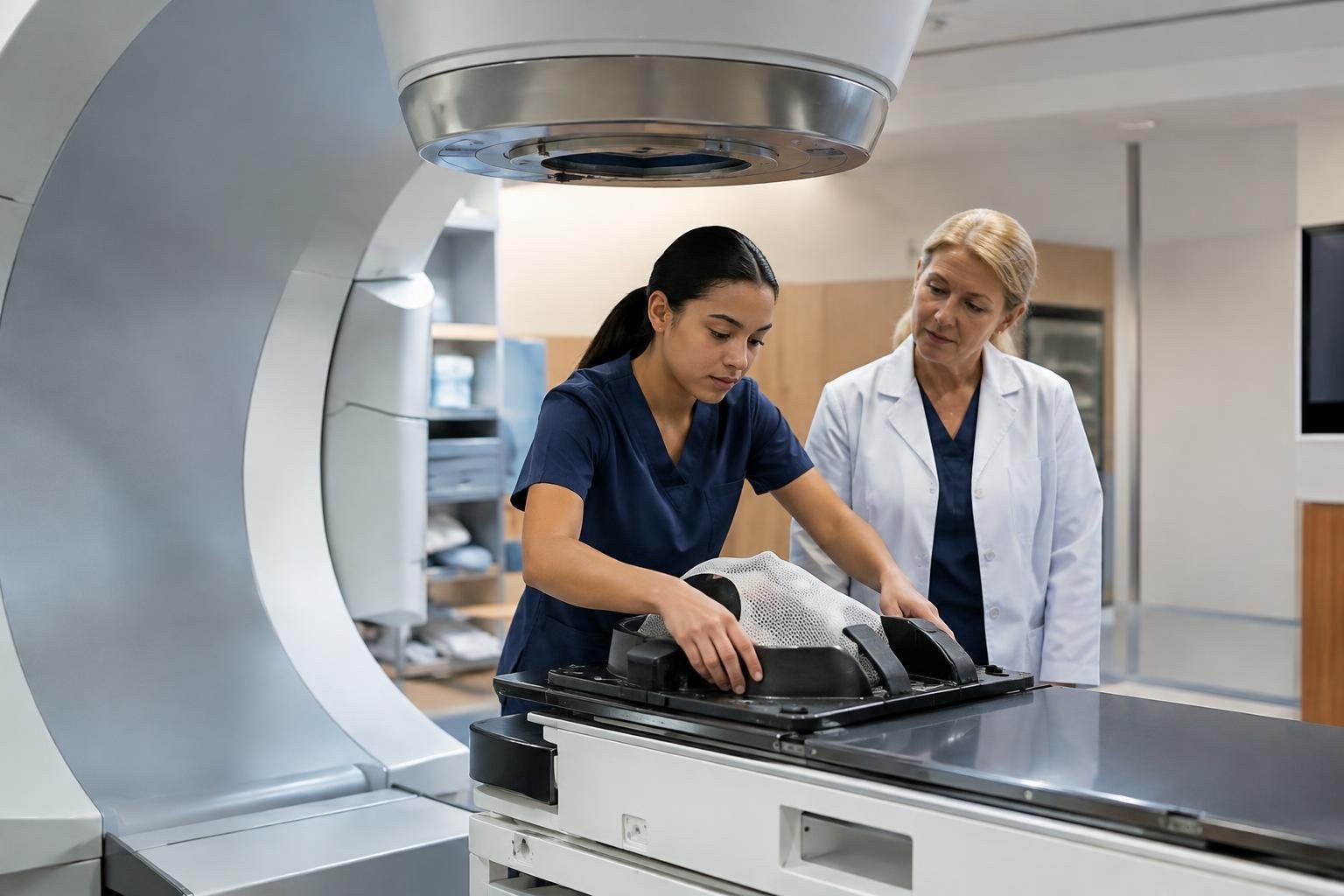
Student learning radiation therapy equipment setup in a supervised clinical education environment
Start With the Work the Program Prepares You to Do
Think of this field as preparation for a particular kind of care, not simply a general imaging degree. The program description centers on carrying out prescribed courses of treatment, managing patient interactions, and documenting relevant information. Its study areas include applied anatomy and physiology, oncologic pathology, radiation biology, treatment procedures, dosimetry, tumor localization, planning, communication, and record-keeping.
That treatment purpose distinguishes radiation therapy from diagnostic radiologic technology, which is oriented toward creating images used in care. Similar words in program names do not make the occupations interchangeable. Compare the practical work each program prepares students to do. A field classification may list several credential levels, but that does not establish that a particular college offers each one or that every award qualifies graduates for practice.
For a broad view of the field description, consult the Medical Radiologic Technology/Science program description.
Read the Curriculum as a Learning Sequence
Rather than judging a curriculum by impressive-sounding course names, trace how it moves from concepts to supervised practice. Foundational work may address anatomy, disease, radiation science, and protection; later study connects those ideas with treatment procedures, dosimetry, tumor localization, planning, communication, and documentation. These subjects relate to how treatment is organized and how patient care is recorded.
Clinical learning is a key comparison point. Southern Illinois University describes a program that combines coursework, hands-on labs, and clinical experience, alongside treatment methods and patient care. Use that as one institutional example, not a template for every school. Ask prospective programs when practical learning begins, what students are expected to demonstrate, how supervision works, and whether placements are arranged by the school.
Request the current course sequence and identify any extra costs or travel attached to hands-on requirements. See the SIU radiation therapy program overview.
Test Career Fit Against the Actual Work
For a prospective student, the useful question is not whether they possess a fixed set of traits. It is whether they can see themselves combining technical procedure work with recurring patient contact. The field description includes treatment, patient management, and records; the SIU overview describes clinical learning that includes patient care.
Use a realistic-fit check: Is the student curious about applied health science? Can they stay engaged with careful, stepwise work? Are they willing to communicate with people who are receiving treatment? Which part feels energizing, and which part raises concerns? A conversation with a program adviser can clarify how students encounter those demands during training.
Assessment.com’s MAPP career assessment can help students explore motivations and career directions. Treat it as a prompt for further research, not a substitute for reviewing the curriculum or formal requirements.
Check Entry Requirements and the Student's Readiness
Admissions details are institution-specific, so do not make a plan from a generic checklist or assume that admission to a broad health program guarantees entry to its radiation therapy pathway. Ask for requirements for the exact program and term: prerequisites, prior education, application steps, and any conditions for clinical participation.
Then compare the academic sequence with the student’s current preparation. Identify science or math topics that may need review, how the school provides academic support, and what happens if a course must be repeated or a clinical schedule is interrupted. These questions help families evaluate the plan without deciding career fit on the student’s behalf.
Before applying, ask the student to describe the work in their own words, explain why it interests them, and identify the practical challenges they have considered. That discussion can reveal whether the choice is based on the role itself or only on a degree title.
Match the Credential Route to Prior Education
Credential route and calendar length depend on prior education and the institution. Undergraduate study and post-baccalaureate certificates are different entry points, so a student should first establish what education they already have and what the intended pathway requires. A broad classification of a field is not a catalog of awards available at every college.
Published examples show why school-specific verification matters. Suffolk describes a post-baccalaureate certificate that may take as little as two years full-time. The University of Nebraska Medical Center catalog describes a 12-month post-baccalaureate professional certificate curriculum of 42 semester hours. Neither example establishes a standard duration for other programs. Ask for the schedule that applies to your own prerequisites, transfer credits, and enrollment pace.
For each school, request a term-by-term plan and confirm which labs and clinical experiences require in-person attendance. Review the Suffolk program details and the UNMC catalog entry for their respective program contexts.
Build a Full Cost and Logistics Comparison
Build a full-program budget before comparing schools. Tuition alone does not show the likely commitment: request a written estimate that lists mandatory fees, books, supplies, and any charges associated with labs or clinical learning. Ask whether the quoted figure assumes full-time study without delays and whether a repeated course or extended enrollment changes it.
Also test the logistics behind the estimate. If the school requires travel or a change in housing for clinical learning, include that possibility in the family’s planning. Ask the financial aid office which grants, scholarships, or loans may apply to the student and what conditions govern renewal or repayment. Eligibility and amounts are individual, so confirm them with the institution rather than relying on a general estimate.
Compare schools using the same cost categories and the same expected time to completion. This makes a low initial tuition figure less likely to distract from other costs or an unsuitable schedule.
Verify Eligibility Before Comparing Convenience
Program choice should begin with the credential goal, then work backward to the education that supports it. The University of Wisconsin’s healthcare careers guidance describes a route involving an associate degree or higher, an ARRT-approved radiation therapy program, an ethics requirement, and a certification exam. Current requirements and state rules should be verified directly before enrollment.
Ask each school to identify the exact award, any program approval relevant to eligibility, and the route graduates are prepared to pursue. Do not treat general institutional accreditation, program recognition, and certification eligibility as interchangeable terms. Request the current clinical placement process, supervision details, total completion estimate, and written cost information. Then confirm credential rules with the relevant authority rather than relying solely on recruitment material.
The University of Wisconsin radiation therapy guidance is a starting reference for its described pathway, not a substitute for current official verification.
Compare the Destination Career, Not Just the Degree Name
Use the intended job as the anchor for career research. Radiation therapist is the direct connection described for this program: administering prescribed treatment, managing patient interactions, and keeping relevant records. The broader field context also names radiologic technologists, neurodiagnostic technologists, ophthalmic medical technologists, patient representatives, and postsecondary health specialties teachers. Those are different roles, not automatic outcomes of one degree.
Diagnostic radiologic technology is a useful contrast when choosing between treatment and imaging work. The Bureau of Labor Statistics overview of radiologic and MRI technologists describes their education and coursework, while Nebraska Methodist College presents radiologic technology as a program preparing students to take X-rays. Compare that training with the treatment-centered radiation therapy curriculum rather than assuming one route qualifies a graduate for both.
For job duties and qualifications, browse the occupation-specific O*NET radiation therapist information. Assessment.com also has published pages for radiation therapists and radiologic technologists for further career exploration.
Investigate Clinical Placement Before You Commit
Clinical education can shape the practical demands of a program as much as the classroom plan. Before enrolling, find out whether students are matched to sites, who coordinates placements, how far students may travel, and how the program handles a delayed placement. Ask what supervision looks like and how clinical learning is documented.
Use those answers to assess whether the schedule fits the student’s responsibilities and whether the school has a clear plan if circumstances change. During training, students can use feedback to improve accuracy, communication, and readiness to follow established procedures. Volunteering or related work may help someone learn about healthcare settings, but it should not be mistaken for a substitute for required education or credentials.
Keep degree completion separate from professional eligibility. The pathway described in the Wisconsin guidance includes education, an ethics requirement, and an examination. Check the current requirements with the credentialing organization and the state where the graduate expects to work.
Consider Further Study Only After Naming the Goal
Further education makes sense when it connects to a defined next role, not simply as a default continuation after a degree. If the student is considering teaching, research, leadership, or another specialty, first identify the target position and review its stated qualifications. The supplied program information includes a field context that names postsecondary health specialties teaching, but it does not establish one universal graduate pathway into that work.
Before applying to another program, ask whether the target role expects professional experience, a particular academic background, or separate credentials. Compare that requirement with the student’s current plan and identify the specific gap additional study would address. This avoids investing in a credential without a clear occupational purpose.
Compare Alternatives by the Workday You Want
When radiation therapy is not an obvious fit, compare alternatives by the kind of work the student wants to do. Diagnostic imaging is a different direction from administering treatment; the Bureau of Labor Statistics and Nebraska Methodist College describe radiologic technology education and image-focused work. For other interests, Assessment.com’s published career pages can help students explore registered nursing, nuclear medicine technology, and ophthalmic medical technology. For patient-support work, see the patient representative career page.
These comparisons are for exploration, not claims that the programs share credentials. For each option, check typical tasks, patient contact, required education, practical training, credential rules, and the student’s preferred learning environment. Browse Assessment.com’s career directory and degree directory to widen the search.
Decide Whether the Commitment Fits the Goal
Whether this degree is worth pursuing depends on the student’s goal and the actual program offer. A focused route may be sensible for someone committed to radiation therapy and able to complete its clinical education. The same focus may be a poor match for someone who wants diagnostic imaging, broad health studies, or more time to explore occupations.
Make the decision concrete. Compare expected borrowing and other costs, time to completion, placement logistics, credential eligibility, and the work the student hopes to do. Weigh those against a realistic alternative, not an abstract idea of a healthcare career. Without current, occupation-specific earnings and local employment evidence, a financial return should not be promised.
Parents can help check assumptions, ask questions, and review costs while letting the student judge whether the work itself feels worthwhile.
Take a Comparable Question List to Every School
Use the following questions to turn a school conversation into a comparable record:
What credential does this exact program award, and what prior education does it require?
What current credential route does it prepare students to pursue?
Which approval or recognition matters for eligibility, and how can I verify it independently?
When does clinical education begin, who arranges placements, and what travel may be required?
What is the written total-cost estimate through completion?
What happens to cost and schedule if a course or placement is delayed?
Which courses or experiences must be completed in person?
How do transfer credits change the actual term-by-term plan?
What academic advising and student support are available?
What other career or degree would I consider if this role is not a match?
For help broadening the conversation, use Assessment.com’s major-selection guidance or explore college guidance resources.
Plan the Route in Verifiable Checkpoints
Plan the route in checkpoints rather than assuming that graduation alone settles every next step. First, select a program whose curriculum and clinical arrangements fit the student. Next, confirm that its education route aligns with the intended credential requirements. Then complete the program and verify any remaining eligibility steps before applying for work.
Some students may enter an undergraduate pathway; others may already hold a degree and investigate a post-baccalaureate certificate. The supplied examples from Suffolk and UNMC illustrate that certificate structures and schedules differ. Do not treat either example as a promise of employment, certification, or a typical time to completion.
For formal eligibility questions, ask the school and relevant credentialing authority. For career exploration beyond the immediate role, use Assessment.com to compare occupations and education options. The MAPP assessment can be one input to that exploration, not a guarantee of a particular outcome.
From Degree to Career: Possible Pathways
Career paths are not guaranteed, and the next step depends on education, credential eligibility, clinical learning, employer needs, and experience. Examples of possible sequences include:
Radiation therapy program → eligible entry-level radiation therapist role → clinical experience → deeper expertise in treatment workflows or patient support.
Undergraduate health sciences study → post-baccalaureate radiation therapy certificate → required certification steps → radiation therapy practice.
Radiation therapy education → work experience → further study or teaching preparation → a health specialties education role, if qualifications and employer expectations are met.
Use these as planning examples, not promised outcomes. Confirm program eligibility, credential requirements, and job qualifications before selecting an education route. A career assessment can help expand possibilities, while program advisers and credentialing authorities answer formal eligibility questions.
Assessment.com helps students explore careers, degrees, and related options. Use the MAPP career assessment as one tool for thinking through fit, then validate the education and employment details with institutions and official occupational resources.
Frequently asked questions
What makes radiation therapy study challenging?
The workload combines science courses, technical subjects, and supervised clinical learning. Ask each school for its course sequence, prerequisite list, clinical schedule, and student support options so you can judge the demands against your own preparation.
What career is most directly connected to this degree?
The program is most directly connected to radiation therapist work. Other healthcare technology or patient-support jobs may have separate training and credential requirements, so treat them as distinct career choices rather than automatic alternatives.
What education and certification steps should I verify?
The route depends on your prior education and the program. The University of Wisconsin guidance describes an associate degree or higher, an ARRT-approved radiation therapy program, an ethics requirement, and a certification exam. Confirm current requirements with the credentialing organization and state authority before enrolling.
How long can a radiation therapy program take?
Program duration varies by institution and prior education. Suffolk describes a post-baccalaureate certificate that may take as little as two years full-time, while the University of Nebraska Medical Center catalog describes a 12-month, 42-semester-hour post-baccalaureate certificate. These are program examples, not a general completion-time guarantee.
Can radiation therapy training be completed entirely online?
Do not assume that online coursework replaces practical learning. SIU describes coursework, hands-on labs, and clinical experience in its program. Ask each institution which components are in person, how placements are arranged, and where students complete them.
How should I compare the cost of programs?
Compare the complete cost, not just tuition or a per-credit figure. Ask for a written estimate covering required fees and supplies, and check whether travel, housing, or a longer completion schedule could change your budget. Confirm aid terms with the institution.
People Also Ask
Which subjects are included in radiation therapy education?
Study commonly spans health science and therapeutic procedures. The program description includes anatomy and physiology, oncologic pathology, radiation biology, procedures, dosimetry, tumor localization, treatment planning, communication, and records. SIU also describes coursework with hands-on labs and clinical experience. School curricula differ, so request the exact course and clinical sequence.
What affects the time needed to complete radiation therapy training?
There is no single duration for all students. Prior education, credential type, enrollment pace, and institution affect the schedule. Suffolk and the University of Nebraska Medical Center publish different timelines for post-baccalaureate options. Ask a school for a term-by-term plan and confirm what assumptions its timeline uses.
What should I verify about radiation therapist certification?
The University of Wisconsin guidance describes an associate degree or higher, completion of an ARRT-approved radiation therapy program, an ethics requirement, and a certification exam. Verify current certification and state requirements directly before selecting a program.
What should families compare when choosing a program?
Start with the exact role and credential you want, then check program eligibility, clinical arrangements, prerequisites, total cost, and completion schedule. Ask for written answers and compare the same information across schools. A program label alone does not establish certification eligibility.
How is radiation therapy different from diagnostic imaging?
No. Radiation therapy centers on delivering prescribed treatment, while diagnostic radiologic technology focuses on producing images. Some foundational subjects may overlap, but their purposes and education routes differ. SIU’s overview describes treatment-focused learning; diagnostic imaging program information describes image production and patient sensitivity.
How can a student assess whether radiation therapy fits?
Consider whether you are prepared for science learning, detailed technical procedures, patient communication, and supervised clinical education. These are useful considerations for exploring fit, not personality rules or guarantees of success. Ask programs what students do in labs and clinical settings.
Choose this path by checking the work, the training route, and the practical demands together. Confirm program-specific eligibility for the credential you plan to pursue, map clinical training and total cost, and compare the role with other healthcare careers before applying. Explore career and degree options with Assessment.com’s MAPP career assessment.
Find out which Career or College Major is right for you!
We use cookies to offer you a better browsing experience, analyze site traffic and personalize content.
Read about how we use cookies and how you can control them in our
Privacy Policy.
If you continue to use this site, you consent to our use of cookies.
×
Exciting News!
Be one of the first to Beta Test the new AI-Powered Assessment.com Platform.