Mammography Technology Degree Guide: Programs, Careers, Credentials, and Fit
Learn what mammography technology programs teach, who can enroll, how certificates fit radiologic technology training, and how to compare cost, format, credentials, and career options.
By Tome Fierre · Staff Writer Assessment.com · Published October 12, 2026 · Last updated November 5, 2026
Mammography technology is specialized medical imaging focused on breast imaging. A mammography program teaches students how to use mammography equipment, position patients, follow imaging procedures, and support image quality. It is often an advanced step for people who have already studied radiologic technology, not necessarily a stand-alone first credential for someone entering healthcare. Programs differ in eligibility, credential awarded, course format, and practical training. Some are certificates for radiologic technologists; others may admit students preparing to complete an eligible radiologic technology program. Before comparing schools, find out what you must already have, what the program prepares you to do, and which certification or licensing steps remain outside the classroom. Not sure whether mammography technology fits you? Consider the daily work as well as the subject: it combines technical procedures, attention to detail, and patient interaction. The MAPP career assessment can help you explore career and degree options alongside your own preferences.
Degree & Program Decision Insights
Explore your personal fit, education requirements, career potential and next steps.
01Motivational Fit
Discover whether this program fits you
Explore your preferences against the focus of Mammography Technology/Technician. These prompts are not personal MAPP results.
Subject curiosity. Would you choose to explore “anatomy and physiology” in depth? Ask for a sample learning activity to test that interest.
Breadth of interest. Consider the place of “mammography instrumentation” in this field. Is this another part you would choose to explore, or mainly a requirement you would tolerate?
Work reality. Related work can involve this task: “Record, process, and maintain patient data or treatment records and prepare reports.” Would you want that activity to be a regular responsibility?
Interest in studying a field can differ from enjoying its related work.
Which part would you want to do repeatedly, and what would you try before deciding?
Discover Your Personal Program Fit
Before investing your time and money in your education, discover how this program aligns with your natural motivations, work preferences and career goals.
Explore these official instructional-field associations. They describe possible occupational routes, not measured outcomes of this program.
Radiologic Technologists and TechniciansSOC 29-2034 · O*NET 29-2034.00$80,110/year median (May 2025); +5% projected change (2025–2035); 13,000 projected openings/year.
Typical occupational entry: associate's degree (BLS). Check the exact professional credential and jurisdiction requirements for this occupation; the classification association alone does not establish eligibility.
Health Specialties Teachers, PostsecondarySOC 25-1071 · O*NET 25-1071.00$107,310/year median (May 2025); +17.9% projected change (2025–2035); 24,900 projected openings/year.
Typical occupational entry: doctoral or professional degree (BLS). BLS lists less than 5 years of related work experience as typical for this occupation; this programme is not a direct promise of entry. Postsecondary teaching is a separate appointment and may require advanced study; this programme alone is not a promise of a teaching post.
U.S. occupational wages are not guaranteed graduate earnings; OEWS excludes self-employed workers.
Projected openings include replacements as well as growth.
U.S. national estimates. A crosswalk does not establish entry-level eligibility; advanced, management and teaching roles can require further qualifications.
Electrocardiograph Technology/TechnicianCIP 51.0902. Compare its emphasis on basic anatomy and physiology and the cardiovascular system with this program’s focus.
Explore your motivations. Use MAPP as a starting point for reflecting on your interest in “anatomy and physiology”, then test that interest against a sample learning task.
Examine the work. Compare Radiologic Technologists and Technicians and Health Specialties Teachers, Postsecondary on daily work and entry qualifications, as well as pay. Explore Radiologic Technologists and Technicians.
Compare actual providers. Ask for the exact credential, course sequence and assessment methods. Compare how each provider teaches “mammography instrumentation”, its entry criteria and its itemized costs.
Check the evidence before applying. Confirm prerequisites and any recognition or professional requirements for your intended route; ask for applicable rules and published outcome definitions in writing.
Verify the institution’s current offering, admissions requirements and outcomes; a search result does not establish your eligibility.
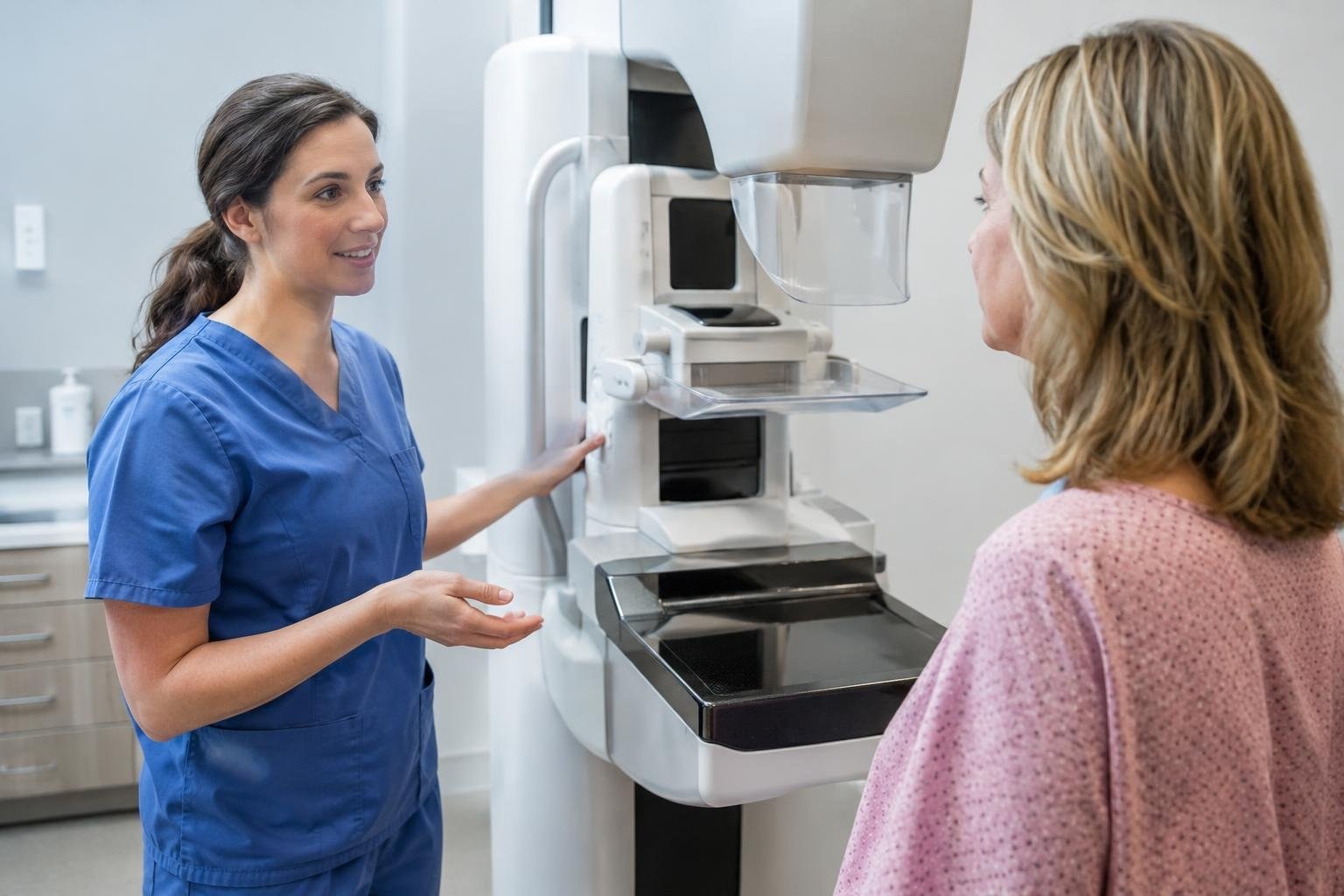
A mammography technologist preparing imaging equipment and explaining a procedure to a patient
What Is a Mammography Technology Program?
Mammography technology is a specialized area of medical imaging. The field focuses on using mammography equipment and procedures to produce breast images that support clinical evaluation. The federal Classification of Instructional Programs description for this area identifies training for registered radiographers who are preparing to become registered mammographers, with topics including anatomy and physiology, instrumentation, positioning, procedures, and quality assurance.
Program titles include mammography technology, mammography technician, mammography certificate, and diagnostic mammography. A title alone does not tell you the credential level or who can enroll. Some colleges offer an advanced technical certificate or undergraduate certificate for people who already have radiologic technology preparation. Compare the catalog description and admission requirements, not just the name.
This specialty is distinct from an initial radiologic technology program. The latter provides broader imaging preparation; mammography training adds focused knowledge and skills. The exact sequence and credential options vary by institution.
For example, Kent State’s catalog describes its undergraduate mammography certificate as training in digital mammography. Broward College describes an advanced technical certificate for radiologic technologists.
What Do You Study in Mammography Technology?
Expect a focused curriculum that connects image-making technique with patient care and quality. Topics named in the program description include anatomy and physiology, mammography instrumentation, positioning, procedures, and quality assurance. Students learn how these areas work together: equipment knowledge supports correct use of the imaging system, positioning helps produce the intended views, and quality checks support consistent imaging practice.
Individual courses and practical experiences differ. One college may organize study around digital imaging and procedure technique, while another may emphasize preparation for applicable quality standards. Ask for a current course list and clarify which elements are classroom-based, online, lab-based, or supervised in a clinical setting.
Hands-on readiness matters. Before applying, ask how students practice positioning and equipment use, how competency is evaluated, and whether clinical or in-person work is required. Do not assume that an online course means every part of training is remote.
Skills You Develop
Mammography training builds on technical and interpersonal abilities. The program’s subject areas point to skills in imaging equipment, patient positioning, anatomy, procedure execution, and quality assurance. These skills are used in mammography work, where a technologist must operate imaging equipment while helping patients understand and complete an examination.
Technical accuracy: Use specialized equipment and follow defined imaging procedures.
Applied anatomy: Connect knowledge of anatomy with positioning and imaging views.
Attention to quality: Follow quality-assurance practices and check work carefully.
Patient communication: Explain instructions clearly and interact respectfully during a sensitive imaging procedure.
Professional judgment: Follow the program’s clinical and safety expectations, and seek guidance when a situation falls outside your training.
Ask programs how they teach and assess both technical competence and patient interaction. Course titles alone may not reveal how much supervised practice students receive.
Who Is This Program Best For?
This pathway may appeal to students who are interested in healthcare imaging, comfortable learning technical procedures, and motivated by work that combines equipment use with direct patient interaction. It can suit people who like precise, repeatable tasks and understand that a patient-facing role also requires tact, clear communication, and respect.
You do not need to fit one personality type to consider the field. Instead, picture the work: a technologist follows imaging procedures, positions patients, operates specialized equipment, and pays close attention to image quality. Consider whether you want a practical clinical role rather than a primarily classroom, research, or administrative path.
Does Mammography Technology Match You?
Salary, reputation, and broad employment trends cannot tell you whether the day-to-day work will feel right. Compare the work setting, patient contact, technical demands, and length of training with your motivations and preferences. Assessment.com’s MAPP career assessment is one resource for exploring career and degree options; use it as a starting point for reflection, not as a substitute for program research or career counseling.
Who Can Enroll? Admissions and Prerequisites
Admissions requirements depend on the school and the certificate. Many mammography certificates are intended for people who have already completed radiologic technology preparation, hold a relevant credential, or are close to completing an eligible radiologic technology program. For example, Harper College describes its mammography certificate as designed for registered radiologic technologists. Orangeburg-Calhoun Technical College describes its certificate as intended for registered technologists or students preparing to graduate from an accredited radiology associate degree program.
Before applying, confirm whether the program requires current registration or licensure, a specific degree, completed coursework, clinical experience, or proof of eligibility. Ask whether students can begin before finishing their initial radiologic technology program and what conditions apply. Do not rely on a general program description to determine your individual eligibility.
Admission may also involve transcripts, application materials, deadlines, or other school-specific steps. Use the current catalog and speak with an advisor to confirm every requirement.
Credential Levels, Format, and Completion Time
There is no single duration or credential structure for every mammography program. Some options are short post-primary certificates for people who already have radiologic technology education. Orangeburg-Calhoun Technical College lists a one-semester online certificate worth 16 semester hours. Broward College describes an Advanced Technical Certificate. These are examples, not a promise that another school offers the same schedule or credit total.
Students who do not yet have radiologic technology preparation must account for that earlier education as well. Full-time or part-time enrollment, transfer credits, course sequencing, and access to a required clinical site can affect the total time.
Ask the college to map your likely path from your current education to program completion, including prerequisites, clinical work, certification application steps, and any delays that can arise if required placements are limited.
Online vs. On-Campus Mammography Programs
Online, hybrid, and campus-based options may be available, but the format is not the whole story. Orangeburg-Calhoun Technical College lists an online certificate. Other programs may combine online instruction with campus activities or practical learning. Because mammography involves positioning and specialized equipment, ask where students complete hands-on learning and how the school confirms competence.
Questions to ask include: Are any lab sessions required in person? Does the program arrange clinical training, or must students find an approved site? Are there scheduled campus visits? What travel, scheduling, or equipment costs could arise? Can the school support students who live outside its local service area?
Get answers in writing before enrolling, particularly if you need a fully remote schedule or plan to study while working.
Tuition, Costs, and Financial Aid
Program costs depend on the college, tuition rate, residency classification, fees, course materials, and any clinical or travel expenses. The available program examples do not establish a single national tuition price. Ask each school for a complete estimate for your circumstances, including charges beyond tuition and whether fees are assessed by credit, term, or program.
Look at the total cost of the full pathway, not only the specialty certificate. If you still need radiologic technology education, include that earlier program, books, equipment, transportation, and time away from paid work in your planning.
Ways to Plan for Affordability
Ask the financial aid office which grants, scholarships, or payment options apply to your credential and enrollment status.
Check whether your current healthcare employer offers tuition assistance or professional-development funding.
Ask how accepted transfer credits could affect your remaining tuition and time.
Confirm whether clinical travel, uniforms, books, technology, or other program costs are additional.
Compare net cost and completion requirements across schools rather than choosing on tuition alone.
Financial aid availability and eligibility vary. Confirm details directly with the college before making a budget.
Careers, Jobs, and Employment Outlook
Mammography training is designed to prepare learners for specialized imaging work, often after radiologic technology education. A direct career connection is work as a mammography technologist or mammographer. Broader radiologic technologist roles may also be relevant to people who have completed the necessary initial education and meet applicable requirements.
Program descriptions connect training with preparation to pursue mammography-related registration or certification, but a school certificate is not automatically the same as professional certification or a state license. Requirements, eligibility, and permitted duties can depend on the credentialing body and state. Confirm them with the organization and state authority that govern your intended work.
The sources available for this guide do not provide comparable current salary or employment-outlook figures. Do not treat the credential title as a pay guarantee. For a realistic career decision, research current wage and employment data for the exact occupation and location where you plan to work, then compare those figures with total education cost and the jobs available in your area.
Potential workplaces and job titles should be confirmed with employers and current occupation resources. You can explore Assessment.com’s radiologic technologist career guide and broader healthcare practitioner and technical careers for adjacent roles.
Find out which Career or College Major is right for you!
Accreditation, program completion, professional certification, and state licensure are separate questions. A college may describe a course as including initial Mammography Quality Standards Act training or say that it is intended to prepare students to pursue an ARRT credential. Those statements do not establish that every graduate is eligible for certification or authorized to practice in every state.
City Colleges of Chicago describes curriculum aligned with American Society of Radiologic Technologists standards and American Registry of Radiologic Technologists guidelines, including initial MQSA education requirements. Its catalog describes a mammography basic certificate for licensed radiologic technologists and links the program to preparation for ARRT certification. Treat this as that institution’s program description, not a universal guarantee.
Ask the school to identify the credential it awards, the certification pathway it supports, the eligibility requirements students must meet, and any state-specific requirements that remain. Verify the information with the relevant credentialing organization and state regulator before enrolling.
Related Degrees, Pathways, and Alternatives
A certificate may provide a focused next step for a radiologic technologist who wants mammography training. It may be less appropriate for someone who has not yet completed the prerequisite imaging education. In that case, compare the full radiologic technology pathway, including program costs and the credential requirements needed before specializing.
Choose a mammography certificate if you meet its prerequisites and want concentrated specialty training.
Begin with radiologic technology education if you are entering imaging and do not yet meet the specialty program’s requirements.
Compare another imaging specialty if your interest is in medical imaging but not specifically breast imaging or the patient interaction associated with mammography.
Consider a broader healthcare path if you are still deciding between imaging, direct care, and other clinical roles.
Assessment.com’s degree resources and college-major decision guidance can help you explore alternatives. Confirm program and career requirements with schools and relevant credentialing bodies.
How to Choose the Right Mammography Program
A school’s name or a program’s certificate title is not enough to judge its value. Compare the details that affect your eligibility, learning, cost, and next step:
Admissions fit: Does the program accept your current education and credentials?
Curriculum: Does it cover anatomy, instrumentation, positioning, procedures, and quality assurance?
Practical preparation: Where do students practice, and what supervision or assessment is included?
Credential pathway: What certification or licensing steps does the college say the program supports, and what remains your responsibility?
Format and schedule: Are required campus or clinical activities workable for you?
Total cost: What are tuition, fees, supplies, and travel expenses for your complete path?
Student support: Who advises students on prerequisites, clinical placement, certification eligibility, and career planning?
Request the current catalog, course sequence, written cost estimate, and an explanation of outcomes. Check claims about accreditation and eligibility against the relevant official organization rather than relying only on promotional language.
Clinical Experience and Preparing for Work
Hands-on learning and professional relationships can help students connect coursework with the work they hope to do. Ask whether the program includes supervised practice, clinical experience, or a structured way to demonstrate positioning and equipment skills. If an internship, clinical placement, or other experience is part of the program, find out who arranges it and whether students must meet additional site requirements.
Build a record of completed coursework and competencies, seek feedback from instructors, and practice explaining technical steps in clear, respectful language. If you are already employed in healthcare, ask whether your employer offers relevant training support or opportunities to observe imaging work. Do not describe yourself as certified or licensed until you have met the applicable requirements.
How to Stand Out to Employers
Be ready to explain your preparation and the scope of your credential accurately.
Highlight attention to detail, patient communication, and quality-focused practice with specific examples from supervised learning.
Ask instructors or clinical supervisors for guidance on professional expectations in your area.
Keep credentials and required documentation current according to the relevant organization or employer.
Further Education and Graduate Study
A mammography certificate is generally a focused specialty credential, not a substitute for an initial professional education pathway. Students may choose further study to expand their imaging education or pursue a different career goal, but the appropriate next step depends on their existing credentials, employer expectations, and applicable professional requirements.
Before planning for a bachelor’s, graduate, or other credential, ask what role you want it to support. Confirm whether the credential is required, preferred, or unrelated to the work you intend to do. The program descriptions available here do not establish that a particular advanced degree is necessary for mammography practice.
From Education to a Mammography Career
Map a realistic progression before paying a deposit. A possible sequence is:
New to medical imaging: Compare eligible radiologic technology programs and their admissions, clinical, and credential pathways.
Radiologic technology student: Check whether a mammography certificate will accept you before graduation or only after you meet specified requirements.
Qualified radiologic technologist: Compare specialty certificates, their curriculum, practical requirements, and preparation for relevant credentialing.
After specialty training: Verify certification and state requirements, then apply for roles whose qualifications match your education and credentials.
This is a planning framework, not a guaranteed career ladder. Program availability, eligibility, employer requirements, and state rules can differ. Use the college guidance resources as you discuss options with your family or advisor, and confirm details with the school and credentialing organizations.
Questions to Ask Before Enrolling
Before applying, use this checklist with a college advisor, program director, or family member:
What education, registration, or license do I need before admission?
What credential will I earn, and what professional credential may I separately apply for?
What does the program say about MQSA education and certification preparation?
Are practical labs or clinical experiences required, and who arranges them?
Can I complete the schedule while working or managing family responsibilities?
What is the complete cost, including fees, supplies, and travel?
Which financial aid or employer funding options might apply to me?
How will the school help me understand certification and state-specific requirements?
What outcomes can the school document, and how recent are the figures?
What other imaging or healthcare paths should I compare before deciding?
Write down answers and compare programs side by side. If a school cannot clearly explain prerequisites, practical training, total cost, or credential steps, pause and request clarification before committing.
Frequently asked questions
What is a mammography technology program?
Mammography technology is specialized medical imaging focused on breast imaging. Programs commonly teach anatomy, mammography equipment, patient positioning, imaging procedures, and quality assurance. Many certificates are designed for people who already have radiologic technology education or credentials, so applicants should check program-specific requirements before applying.
How long does a mammography technology certificate take?
It depends on the student’s starting point and the program. Some certificate options are advanced training for radiologic technologists, with one cited college catalog describing a one-semester, 16-semester-hour online certificate. That is not a standard duration for every school. A student who still needs an initial radiologic technology education will need to complete that pathway first.
Can you study mammography technology online?
Some programs offer online coursework, but online availability does not automatically mean the entire pathway can be completed remotely. Mammography is hands-on imaging work, and students should ask whether the program includes supervised practice, clinical requirements, or in-person competency assessments. Confirm where and when any practical learning takes place before enrolling.
Do you need to be a radiologic technologist before studying mammography?
Many mammography certificates are intended for registered or licensed radiologic technologists, or for students nearing completion of an eligible radiologic technology program. Requirements differ by school. Check the admissions page and catalog for required credentials, prior coursework, clinical experience, and any conditions that must be met before beginning the mammography component.
What is the difference between radiologic technology and mammography technology?
A mammography program focuses on specialized breast imaging, while radiologic technology education prepares students for a broader foundation in medical imaging. Some schools describe mammography as advanced training for people with prior radiologic technology education. If you are new to the field, confirm whether you need to complete an initial radiologic technology program first.
How much does a mammography technology program cost?
Costs depend on the college, residency status, tuition structure, fees, books, equipment, and any clinical or travel expenses. The available program information does not provide a reliable national price range. Ask each school for a written estimate of the full cost and check whether grants, scholarships, employer support, or payment plans may apply to your circumstances.
Does a mammography certificate qualify you for certification?
Program completion and professional credentials are not the same thing. Some program descriptions discuss training related to Mammography Quality Standards Act requirements and eligibility to pursue an ARRT credential, but individual eligibility and certification requirements must be verified with the relevant organization and your state. Ask the program to explain exactly what its curriculum qualifies you to apply for.
Is mammography technology difficult to study?
Mammography programs teach technical material and precise positioning, as well as communication with patients. The difficulty depends on your preparation and the demands of the specific program. Students may find it challenging to combine imaging procedures, image-quality expectations, patient care, and detailed safety or quality-assurance practices. Review course expectations and ask about academic support before enrolling.
Do you need a bachelor’s degree to become a mammographer?
A bachelor’s degree is not automatically required for every mammography specialty certificate. Several cited certificates are designed for radiologic technologists with prior education or credentials. Requirements vary by school and by the professional pathway you pursue, so verify the credential level needed for admission and for your intended role rather than assuming that every program has the same rules.
How should I choose a mammography program?
Compare whether you meet admission requirements, the credential and clinical preparation offered, total cost, delivery format, and the program’s explanation of certification or licensing pathways. Also consider whether you want to work directly with patients, perform specialized imaging procedures, and maintain careful attention to positioning and quality. Career and degree matching can help you examine whether that work fits your interests.
People Also Ask
What do you learn in mammography technology?
Mammography programs teach specialized breast-imaging knowledge and skills, including anatomy, equipment, positioning, procedures, and quality assurance. The exact curriculum depends on the college and credential.
Who can apply to a mammography certificate program?
Often, applicants need prior radiologic technology education or credentials. Some certificate programs also consider students nearing graduation from an eligible radiologic technology associate degree. Verify each school’s rules.
Are mammography programs fully online?
Some schools offer online mammography certificate coursework. Prospective students should ask whether they must complete clinical practice or other in-person requirements and arrange an approved site.
What certification do mammography technologists need?
A certificate may add specialty training, but it does not by itself prove that a student meets every professional or state requirement. Confirm the program’s credential pathway and eligibility conditions directly with the relevant certification organization and state authority.
How long does it take to become a mammography technologist?
The required time depends on whether you already have radiologic technology training. A mammography certificate may be a short advanced program, while students entering healthcare need to complete the initial imaging pathway first.
Is mammography technology the same as radiologic technology?
Mammography is a focused breast-imaging specialty. Radiologic technology education provides a broader initial foundation in medical imaging, which is why many mammography certificates expect prior radiologic technology preparation.
What should I budget for a mammography certificate?
Tuition and additional expenses vary by school, residency, fees, equipment, and clinical arrangements. Request a complete program cost estimate and review available student aid or employer education support before committing.
Mammography technology may suit students who want to build on radiologic imaging skills and focus on breast imaging, patient interaction, careful positioning, and image quality. In many programs, mammography is an advanced specialization for radiologic technologists rather than a first step into healthcare, so confirm entry requirements and credential pathways before enrolling. Compare the full cost and clinical expectations, then weigh the work itself alongside career goals. Explore career and degree options with the MAPP career assessment.
Want to see your options? Try our comprehensive Degree, Program & College Search tool
We use cookies to offer you a better browsing experience, analyze site traffic and personalize content.
Read about how we use cookies and how you can control them in our
Privacy Policy.
If you continue to use this site, you consent to our use of cookies.
×
Exciting News!
Be one of the first to Beta Test the new AI-Powered Assessment.com Platform.