Emergency Medical Technology/Technician (EMT Paramedic) Degree Guide
An Emergency Medical Technology/Technician (EMT Paramedic) program teaches emergency assessment and prehospital patient care through coursework, skills practice, and, in some programs, clinical and field experiences. Learn how credentials, admissions, costs, and career fit differ by school.
By Tome Fierre · Staff Writer Assessment.com · Published October 26, 2026 · Last updated November 5, 2026
Emergency Medical Technology/Technician (EMT Paramedic) is a field of study focused on recognizing medical emergencies and providing patient care in prehospital settings. Programs teach emergency assessment, patient stabilization, medical procedures, equipment use, communication, and professional standards. Depending on the school and credential, students may also complete skills labs, simulations, clinical practice, or field internships. Students considering this path often want active, practical work helping people in urgent situations. Programs can lead to different credentials, and completing a course of study is not necessarily the same as meeting every examination, certification, or state licensing requirement. Compare program details and confirm the steps for your intended work location. If you are weighing this path against other healthcare careers, Assessment.com’s MAPP assessment can help you explore career and degree options in relation to your interests and preferences.
Degree & Program Decision Insights
Explore your personal fit, education requirements, career potential and next steps.
01Motivational Fit
Discover whether this program fits you
Explore your preferences against the focus of Emergency Medical Technology/Technician (EMT Paramedic). These prompts are not personal MAPP results.
Subject curiosity. Would you choose to explore “basic, intermediate, and advanced EMT procedures” in depth? Ask for a sample learning activity to test that interest.
Breadth of interest. Consider the place of “emergency surgical procedures” in this field. Is this another part you would choose to explore, or mainly a requirement you would tolerate?
Work reality. Related work can involve this task: “Comfort and reassure patients.” Would you want that activity to be a regular responsibility?
Interest in studying a field can differ from enjoying its related work.
Which part would you want to do repeatedly, and what would you try before deciding?
Discover Your Personal Program Fit
Before investing your time and money in your education, discover how this program aligns with your natural motivations, work preferences and career goals.
Typical occupational entry: postsecondary nondegree award (BLS). BLS lists less than 5 years of related work experience as typical for this occupation; this programme is not a direct promise of entry. Check the exact professional credential and jurisdiction requirements for this occupation; the classification association alone does not establish eligibility.
Emergency Medical TechniciansSOC 29-2042 · O*NET 29-2042.00$44,470/year median (May 2025); +5.8% projected change (2025–2035); 13,800 projected openings/year.
Typical occupational entry: postsecondary nondegree award (BLS). Check the exact professional credential and jurisdiction requirements for this occupation; the classification association alone does not establish eligibility.
U.S. occupational wages are not guaranteed graduate earnings; OEWS excludes self-employed workers.
Projected openings include replacements as well as growth.
U.S. national estimates. A crosswalk does not establish entry-level eligibility; advanced, management and teaching roles can require further qualifications.
Compare the focus and route of these distinct instructional fields; their credentials and admission requirements are not interchangeable.
Emergency Care Attendant (EMT Ambulance)CIP 51.0810. Compare its emphasis on first aid and emergency medicine field techniques and patient stabilization and care with this program’s focus.
Electrocardiograph Technology/TechnicianCIP 51.0902. Compare its emphasis on basic anatomy and physiology and the cardiovascular system with this program’s focus.
Orthopedic Technology/TechnicianCIP 51.0923. Compare its emphasis on patient assessment and casting, splinting, and orthopedic appliances with this program’s focus.
Explore your motivations. Use MAPP as a starting point for reflecting on your interest in “basic, intermediate, and advanced EMT procedures”, then test that interest against a sample learning task.
Examine the work. Compare Paramedics and Emergency Medical Technicians on daily work and entry qualifications, as well as pay. Explore Paramedics.
Compare actual providers. Ask for the exact credential, course sequence and assessment methods. Compare how each provider teaches “emergency surgical procedures”, its entry criteria and its itemized costs.
Check the evidence before applying. Confirm prerequisites and any recognition or professional requirements for your intended route; ask for applicable rules and published outcome definitions in writing.
Verify the institution’s current offering, admissions requirements and outcomes; a search result does not establish your eligibility.
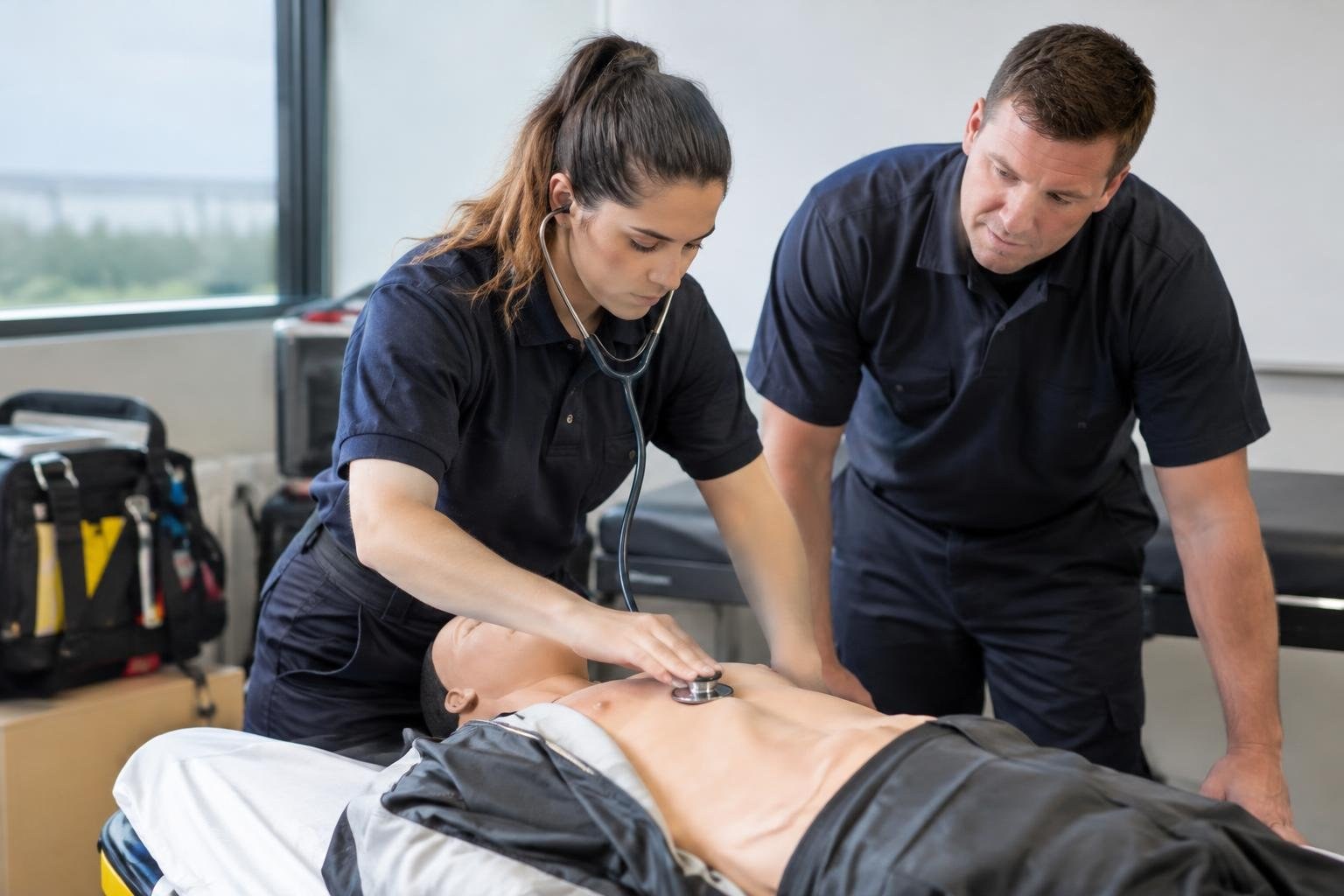
A paramedic student practicing assessment skills with an instructor
What Is an EMT Paramedic Program?
Emergency Medical Technology/Technician (EMT Paramedic) is the federal program classification used for courses of study preparing people to recognize, assess, and manage emergencies in prehospital settings. The field combines medical knowledge with practical action: students learn to evaluate a patient, make decisions under pressure, provide appropriate care, and communicate with other responders and medical professionals.
The program description spans basic, intermediate, and advanced EMT procedures, along with triage, rescue operations, crisis-scene management, equipment operation, patient monitoring, medication administration, anatomy, physiology, pathology, toxicology, and professional standards. Not every college includes every topic at the same depth, so inspect the course plan and credential outcome. The classification code associated with this field is CIP 51.0904.
Schools use titles such as EMT certificate, paramedic certificate, emergency medical technology, or paramedic associate degree. A program title alone does not establish the exact level of training, examination eligibility, or work authorization. Compare the credential awarded and the steps graduates must take after completing it.
What Do You Study in EMT Paramedic School?
Expect a mix of classroom learning and applied practice. Foundational subjects give students a working understanding of the human body and common types of illness and injury. Emergency-care instruction applies that knowledge to assessment, triage, stabilization, monitoring, and care before a patient reaches a hospital. Programs may also teach medication procedures, communication, equipment operation, rescue response, scene management, and professional responsibilities.
Practical learning matters because emergency response is not just a written test. A student may need to demonstrate a sequence of skills, communicate clearly, and adapt to a changing scenario. Erie Community College, for example, describes a paramedic certificate and associate degree with skills labs, case-based simulation, clinical experiences, and field internships. That example illustrates why applicants should ask schools to name the practical components and explain how students complete them.
Course titles, sequencing, and the balance between classroom and field learning vary. Ask for a term-by-term plan, a list of clinical and field requirements, and an explanation of how practical skills are evaluated. Do not assume two programs with similar names offer identical preparation.
Skills You Can Develop
EMT paramedic study builds medical, practical, and interpersonal abilities. Students learn to gather information, identify urgent concerns, select appropriate procedures within their training, and monitor a patient’s condition. Repeated practice can strengthen attention to detail, sound judgment, calm communication, and teamwork.
Clinical reasoning: connect observed signs and patient information to assessment and care decisions.
Hands-on skills: practice emergency procedures, patient stabilization, and use of equipment.
Communication: explain actions, gather information, and relay concise details to a team.
Professional practice: understand standards, regulations, and responsibilities in emergency care.
Scene awareness: consider patient needs, team coordination, and the demands of a response setting.
These skills are most directly connected to emergency medical services roles. They may also help graduates explore related health or public-safety work, but a credential does not automatically qualify someone for unrelated clinical occupations. For each career, check required education and authorization separately.
Who Is This Program Best For?
This program may suit students who want applied healthcare learning, enjoy solving immediate problems, and are motivated by serving people in urgent situations. It can appeal to learners who prefer a combination of scientific concepts, structured procedures, practical skills, teamwork, and direct interaction with patients.
There is no single personality type required. Some students are naturally comfortable taking initiative; others build confidence through careful practice and feedback. What matters is willingness to learn procedures precisely, communicate respectfully, respond to changing information, and take responsibility for preparation. Consider whether you are comfortable with hands-on training and the possibility of emotionally demanding situations before committing.
Does EMT Paramedic Study Match You?
Pay, job availability, and the appeal of a respected service role are not enough to determine fit. Think about what kind of problems you want to solve, whether practical and time-sensitive work energizes you, and how you respond to team responsibilities. Assessment.com’s MAPP assessment can help you explore how your motivations and preferences relate to career and degree options. Treat assessment results as one input alongside conversations with program staff, current students, and people working in the field.
Admissions, Credentials, Length, and Academic Demands
Admission requirements are set by each college and may differ between an EMT certificate and a paramedic or associate-degree program. Before applying, ask for the current admissions checklist, prerequisite courses, academic standards, application dates, and any requirements tied to clinical or field participation. Do not rely on informal summaries when a requirement could affect eligibility.
Training can be offered as a stand-alone certificate or as part of an associate degree. Colleges may require completion of one level before a student enters the next, or may design a pathway that combines coursework. Northwood Technical College describes a route from EMT preparation into a paramedic technician associate degree. The college also states a minimum grade condition for eligibility to take the paramedic-level National Registry examinations, which illustrates why students should read individual program rules closely.
Time to completion depends on the program plan, prerequisites, course availability, study pace, and required practical placements. Ask whether courses run every term, how clinical or field hours are scheduled, and how transfer credit is evaluated. Part-time attendance may extend the timeline if required courses are offered in sequence.
Online, Hybrid, and On-Campus Training
Online and hybrid options may make lecture content more accessible, but practical emergency-care training requires students to demonstrate skills. One college describes a program built around hands-on skills labs, simulation, clinical training, and field internships. Those elements require students to clarify where and when attendance is expected, even if some instruction can be completed remotely.
Ask whether skills practice occurs on campus, whether clinical and field placements are arranged by the school, and whether travel is required. Find out if the program offers evening or weekend sessions and how it handles missed practical work. For any online offering, request the full delivery plan, not just the online course list. A format that works for general education classes may not describe the format for essential lab or field components.
Also ask what happens if a placement site is unavailable or a student needs to repeat a skills assessment. These details can affect scheduling and completion time, especially for students balancing work, family, and study.
Tuition, Costs, and Financial Aid
Program cost depends on the institution, residency classification, credential, number of required credits, and whether the student must pay separate lab or clinical fees. Books, uniforms or required equipment, transportation to practice sites, background or health documentation, and examination-related expenses may add to the published tuition figure. These expenses are school- and location-specific, so request a written estimate of the full program cost.
When comparing prices, separate tuition from additional fees and ask what is included. Check the college’s financial-aid office for current grant, scholarship, work-study, and loan eligibility, and ask whether payment plans or employer assistance are available. Eligibility depends on the student, program, institution, and funding rules. Do not assume that a particular certificate or course qualifies for every form of aid.
Potential ways to reduce the bill include comparing public and private institutions, checking whether prior coursework can transfer, and considering a lower-cost college pathway when it meets the same education and credential goals. Confirm transfer arrangements before enrolling; a transfer agreement does not guarantee that every course will count toward the next program.
Careers, Jobs, and Employment Considerations
The most direct career connection is to emergency medical services. Program materials describe preparation for EMT or paramedic-level work, including assessment and care in prehospital settings. The exact job a graduate can pursue depends on the credential earned, examination results, state or local requirements, and employer conditions.
Some students begin with an EMT-level certificate and later pursue paramedic education. One college says EMT program coursework may be considered for credit toward its paramedic associate occupational science program. Another describes an EMT-to-paramedic associate-degree pathway. These are institution-specific examples, not a promise that credits will transfer elsewhere.
Further options may include advanced study, supervisory work, or teaching in an appropriate setting, but each can require additional education, experience, or qualifications. The program’s broad credential classification includes multiple education levels, yet that does not mean every college offers each one. Ask the school which credentials it actually awards and what additional preparation is expected for a longer-term goal.
Do not make an enrollment decision using a salary estimate or job-growth headline alone. Compare current information for the specific occupation and geographic area you have in mind, then weigh it against training costs, schedules, and the work itself.
Certification, Licensure, and Program Approval
A program may prepare students for an examination, but course completion, certification, and permission to work are distinct matters. A school’s published statement may specify that graduates are eligible to apply for an examination at a particular level. For example, one EMT certificate page describes eligibility to apply for the National Registry EMT-level examination. A different program describes eligibility for paramedic-level examinations after students meet its academic conditions.
These examples should not be treated as universal rules. Certification and state or local licensure requirements can depend on the jurisdiction, the level of practice, and current regulations. Before enrolling, ask the program which examination its graduates are prepared to take, what eligibility conditions apply, and what steps remain after graduation. Confirm requirements with the relevant state EMS authority or credentialing body for the place where you intend to work.
Also ask whether the program’s accreditation or approval status meets the requirements for your intended pathway. Request the name of the accrediting or approving body and verify the status directly with that organization. A school’s general institutional standing does not automatically answer whether a particular program meets professional or transfer requirements.
Practical Experience and Preparing for Employment
Useful preparation is specific to the program and the type of role you want. Ask about observational opportunities, volunteering, campus EMS groups, community first-aid activities, and ways to learn about emergency medical work without exceeding your training or authority. If the program includes clinical or field experience, find out how placements are assigned and what students must do to remain eligible.
Build a record of reliable participation: attend skills practice, respond to instructor feedback, keep required course records organized, and be prepared to explain what you learned from simulations and team exercises. Professional communication and sound judgment are important alongside practical ability. Follow school, placement-site, and privacy rules when discussing training experiences; never share identifiable patient information.
How to Stand Out to Employers
First meet the credential and examination requirements for the job. Then show evidence of careful preparation, teamwork, dependable communication, and continued learning. Ask program staff about employer relationships, interview preparation, and graduate support, but evaluate those claims by requesting details about services and outcomes rather than relying on broad promotional language.
Further Education and Longer-Term Pathways
An associate degree may be a useful next step for students who want a broader college credential or a planned route into additional education. Some colleges publish pathways from EMT preparation to a paramedic associate degree, and some describe transfer agreements toward bachelor’s-level study. Those arrangements are specific to the institutions involved.
Possible longer-term education plans may include completing a bachelor’s degree, pursuing advanced study in a related subject, or preparing for teaching roles. The best route depends on the exact job, its educational requirements, and the courses a receiving institution will accept. Postsecondary health teaching should not be assumed to be an immediate outcome of an EMT certificate; check the qualifications required for the particular teaching position.
Before selecting an entry-level program, consider whether its credits apply to a likely next step. Ask for transfer equivalencies from the receiving college, not only assurances from the college where you start. Also verify that the next credential advances your career goal rather than adding time and cost without a clear purpose.
Related Programs and Alternatives
Nursing: consider nursing if you want a different patient-care role and are prepared to meet its separate education and licensure requirements.
Respiratory therapy: consider it if breathing and respiratory care is the focus that interests you; investigate the profession’s distinct program and credential requirements.
Radiologic technology: consider it if diagnostic imaging and technical work in a clinical setting appeal more than emergency response.
Medical assisting: consider it if you prefer a healthcare support role that may involve routine clinical and administrative tasks rather than prehospital emergency response.
Fire science or emergency management: consider these areas if public safety, prevention, planning, or incident coordination interests you more than direct patient assessment.
Public health: consider it if you are more interested in community-level health programs and prevention than hands-on emergency care.
Health specialties education: consider further education in this direction if teaching healthcare subjects is a longer-term goal.
These alternatives lead to different curricula and qualifications. Compare daily work, required education, licensing, cost, and the degree of patient contact before deciding. A matching career category is a starting point for exploration, not a statement that an EMT credential qualifies someone for another profession.
How to Choose an EMT Paramedic Program
Program selection should start with the outcome you need, not the closest campus or the lowest advertised tuition. Compare certificate and associate-degree plans, the level of emergency-care preparation, the amount of practical training, and the stated examination eligibility after graduation.
Credential and curriculum: request a course list and confirm the credential awarded.
Hands-on learning: ask about labs, simulations, clinicals, and field internships, including where they occur.
Rules and approval: verify program status and examine any jurisdictional requirements relevant to your goal.
Total price: include tuition, fees, equipment, transport, and examination-related costs.
Schedule and support: confirm course availability, placement scheduling, academic help, and career services.
Transfer options: obtain written transfer information from the college receiving your credits.
Outcomes: ask how the school measures completion and what information it can provide about graduates.
Assessment.com’s education and career resources can help you explore pathways and personal fit, but the college and relevant authorities remain the source for program-specific rules and requirements.
Questions to Ask Before Enrolling
Use this checklist when speaking with admissions advisers, program faculty, and financial-aid staff:
What exact credential will I receive, and what level of training does it represent?
What prerequisites, application steps, academic standards, or participation conditions apply?
What is the full estimated cost, including fees, equipment, transportation, and required testing?
Which skills labs, simulations, clinical placements, and field internships are required?
Where do practical placements take place, and who arranges and supervises them?
Which examination may graduates apply to take, and what conditions must they meet?
What state or local requirements should I verify for my intended work location?
Can prior coursework transfer, and will it count toward a specific future degree?
What financial aid, scholarships, payment plans, or employer assistance may apply?
What career services, employer connections, and graduate outcome information can the school document?
Take written answers home and compare them across schools. This helps families distinguish an attractive program description from a pathway that fits the student’s education plans, schedule, and budget.
From Program to Career: Example Pathways
Possible routes vary by employer, location, and individual preparation. A student might complete an EMT certificate, meet the requirements to pursue an EMT-level examination, and then gain experience before deciding whether to continue into paramedic training. Another student may enter a college’s combined or sequential pathway toward a paramedic certificate or associate degree. A graduate who later pursues supervision, advanced education, or teaching will need to meet the additional requirements for that specific role.
These are examples of possible education sequences, not guaranteed promotions or job offers. For each step, confirm prerequisites, examination eligibility, transfer credit, and any additional credentials. Ask what would need to happen before you could move from one stage to the next.
Frequently asked questions
What is an Emergency Medical Technology/Technician (EMT Paramedic) program?
Emergency Medical Technology/Technician (EMT Paramedic) programs prepare students to recognize and assess emergencies and provide care before a patient reaches a hospital. Depending on the program, study may include anatomy, emergency procedures, triage, patient stabilization, communication, equipment use, and supervised practical training. Programs vary, so compare the specific credential and curriculum rather than relying on the title alone.
Is an EMT paramedic program difficult?
The program includes medical science and practical skills, such as learning to assess patients and apply emergency procedures. Students should expect structured skills practice and may complete clinical or field experiences, depending on the program. Review course prerequisites, attendance expectations, physical skills requirements, and the amount of supervised practice before enrolling.
How long does EMT paramedic training take?
Some colleges offer a certificate, while others offer an associate degree or both. The length depends on the school’s course sequence, prior credit, enrollment pace, and clinical or field requirements. Ask each program for its published completion plan, including prerequisites and any required certification steps, before estimating how long your own path will take.
Can I earn an EMT paramedic credential online?
Yes, some classroom material may be delivered online or in a hybrid format, but emergency medical skills require practical preparation. At least some programs include hands-on skills labs, simulations, clinical work, or field internships. Confirm which parts require campus attendance or in-person participation before choosing an online option.
Does an EMT paramedic program require math?
Emergency medical technology programs may include anatomy, physiology, and medication-related material, so students need to work with measurements and follow protocols accurately. The supplied program descriptions do not establish one standard math prerequisite for every college. Check the target program’s admissions page and course requirements for the exact preparation expected.
Does completing an EMT paramedic program make me a paramedic?
Graduating from a program and receiving permission to work are separate steps. Certification examination eligibility, state licensing, and employer conditions depend on the credential and the applicable rules. For example, one program states that graduates may apply to take the National Registry EMT-level exam, while another describes eligibility for paramedic-level examinations after program completion and specified academic performance. Confirm the applicable pathway with the program and relevant authority.
What is the difference between an EMT paramedic certificate and an associate degree?
A certificate may provide focused preparation, while an associate degree adds a broader college credential and may provide a platform for further study. The best fit depends on the education required for your intended role, your academic plans, transfer opportunities, and the program’s practical experiences. Compare the actual curriculum and outcomes rather than assuming one credential is always better.
How much do EMTs and paramedics make?
Pay depends on occupation, employer, location, experience, and other factors, so a program title alone cannot predict your earnings. Compare current pay information for the specific job you plan to pursue and the location where you intend to work. Also consider tuition, fees, travel to clinical sites, and the time required to complete the credential.
People Also Ask
What do you learn in an EMT paramedic program?
Programs teach emergency assessment and prehospital care. Coursework may cover anatomy, physiology, triage, patient stabilization, emergency procedures, equipment, medications, communication, and professional standards. Practical training can include skills labs, simulation, clinical placements, and field internships, depending on the college.
What types of EMT paramedic programs are available?
Some schools offer EMT certificates, paramedic certificates, or associate degrees. The program description and credential title can differ, so check what level the curriculum prepares you for and which examination eligibility the school documents. Confirm the exact pathway with the college and the applicable state or credentialing authority.
What are the admission requirements for paramedic school?
Program prerequisites and admission steps are set by each college. Review required prior coursework, application deadlines, academic standards, placement or health requirements, and any background or participation conditions directly with the program. Ask for requirements in writing before paying an application or enrollment fee.
Can I earn an associate degree in paramedicine?
Some programs offer certificate study and some include an associate degree. Program availability and the time to completion are school-specific. Compare the published degree plan, prerequisites, course sequence, and practical placement schedule to see how the options fit your existing credits and timeline.
Are EMT certification and paramedic certification the same?
Not necessarily. Programs differ in their curriculum, credential, and exam eligibility statements. One college’s EMT certificate, for example, identifies eligibility to apply for an EMT-level National Registry examination, while a separate paramedic program may describe a paramedic-level examination pathway. Verify the credential and examination level with the school and relevant authority.
What should I look for in an EMT paramedic program?
Check for practical training details, such as how skills labs, simulations, clinical experiences, and field internships are organized. Ask where placements occur, who supervises them, what attendance is required, and whether students must travel. A remote lecture schedule does not by itself mean all program requirements can be completed online.
Can paramedic credits transfer to a bachelor’s degree?
An associate degree may support transfer or further education when a college has relevant agreements, but transfer is not automatic. Confirm which credits another institution will accept, whether they apply to the intended degree, and whether any certification or professional requirements remain separate.
An Emergency Medical Technology/Technician (EMT Paramedic) program can be a direct route toward emergency medical services training, with classroom learning reinforced by practical skills and supervised field experience where included. The right choice depends on the credential you need, state and employer expectations, the program’s hands-on components, total cost, and whether emergency response work fits your interests and preferences. Compare programs carefully, confirm certification and licensing steps with the relevant authorities, and consider how the education connects to the work you want to do. Assessment.com’s MAPP assessment can help you explore career and degree options alongside that research.
Find out which Career or College Major is right for you!
We use cookies to offer you a better browsing experience, analyze site traffic and personalize content.
Read about how we use cookies and how you can control them in our
Privacy Policy.
If you continue to use this site, you consent to our use of cookies.
×
Exciting News!
Be one of the first to Beta Test the new AI-Powered Assessment.com Platform.