Brewery Operations Degree Guide: Courses, Careers and Program Fit
Explore what Brewery/Brewpub Operations/Management programs teach, compare certificates and degrees, understand hands-on training, and assess career options before choosing a college program.
By Kieth Nelson · Staff Writer Assessment.com · Published October 26, 2026 · Last updated November 5, 2026
A Brewery/Brewpub Operations/Management program prepares students to understand how brewing and hospitality businesses work, from production processes and equipment to management, marketing, and service. Programs can focus on hands-on brewing, business operations, or a blend of both, and may award certificates, associate degrees, bachelor’s degrees, or graduate credentials. Students consider this field for varied reasons: some want to work in brewing production, while others are interested in quality, hospitality, distribution, or managing a brewery or brewpub. The credential alone does not promise a specific job. Course content, practical experience, employer needs, and fit with the work all matter. Students and parents should compare the program’s actual curriculum and total cost with the career options it supports.
Degree & Program Decision Insights
Explore your personal fit, education requirements, career potential and next steps.
01Motivational Fit
Discover whether this program fits you
Explore your preferences against the focus of Brewery/Brewpub Operations/Management. These prompts are not personal MAPP results.
Subject curiosity. Would you choose to explore “brewing science” in depth? Ask for a sample learning activity to test that interest.
Breadth of interest. Consider the place of “food services management” in this field. Is this another part you would choose to explore, or mainly a requirement you would tolerate?
Work reality. Related work can involve this task: “Establish standards for personnel performance and customer service.” Would you want that activity to be a regular responsibility?
Interest in studying a field can differ from enjoying its related work.
Which part would you want to do repeatedly, and what would you try before deciding?
Discover Your Personal Program Fit
Before investing your time and money in your education, discover how this program aligns with your natural motivations, work preferences and career goals.
Explore these official instructional-field associations. They describe possible occupational routes, not measured outcomes of this program.
Food Service ManagersSOC 11-9051 · O*NET 11-9051.00$69,390/year median (May 2025); +5.8% projected change (2025–2035); 38,800 projected openings/year.
Typical occupational entry: high school diploma or equivalent (BLS). BLS lists less than 5 years of related work experience as typical for this occupation; this programme is not a direct promise of entry. BLS lists short-term on-the-job training as typical occupational training.
U.S. occupational wages are not guaranteed graduate earnings; OEWS excludes self-employed workers.
Projected openings include replacements as well as growth.
U.S. national estimates. A crosswalk does not establish entry-level eligibility; advanced, management and teaching roles can require further qualifications.
Compare the focus and route of these distinct instructional fields; their credentials and admission requirements are not interchangeable.
Brewing ScienceCIP 01.1003. Compare its emphasis on biology and biochemistry with this program’s focus.
Zymology/Fermentation ScienceCIP 01.1005. Compare its emphasis on biology and biochemistry with this program’s focus.
Restaurant/Food Services ManagementCIP 52.0905. Compare its emphasis on hospitality administration and wholesale logistics and distribution with this program’s focus.
Explore your motivations. Use MAPP as a starting point for reflecting on your interest in “brewing science”, then test that interest against a sample learning task.
Examine the work. Compare Food Service Managers on daily work and entry qualifications, as well as pay. Explore Food Service Managers.
Compare actual providers. Ask for the exact credential, course sequence and assessment methods. Compare how each provider teaches “food services management”, its entry criteria and its itemized costs.
Check the evidence before applying. Confirm prerequisites and any recognition or professional requirements for your intended route; ask for applicable rules and published outcome definitions in writing.
Verify the institution’s current offering, admissions requirements and outcomes; a search result does not establish your eligibility.
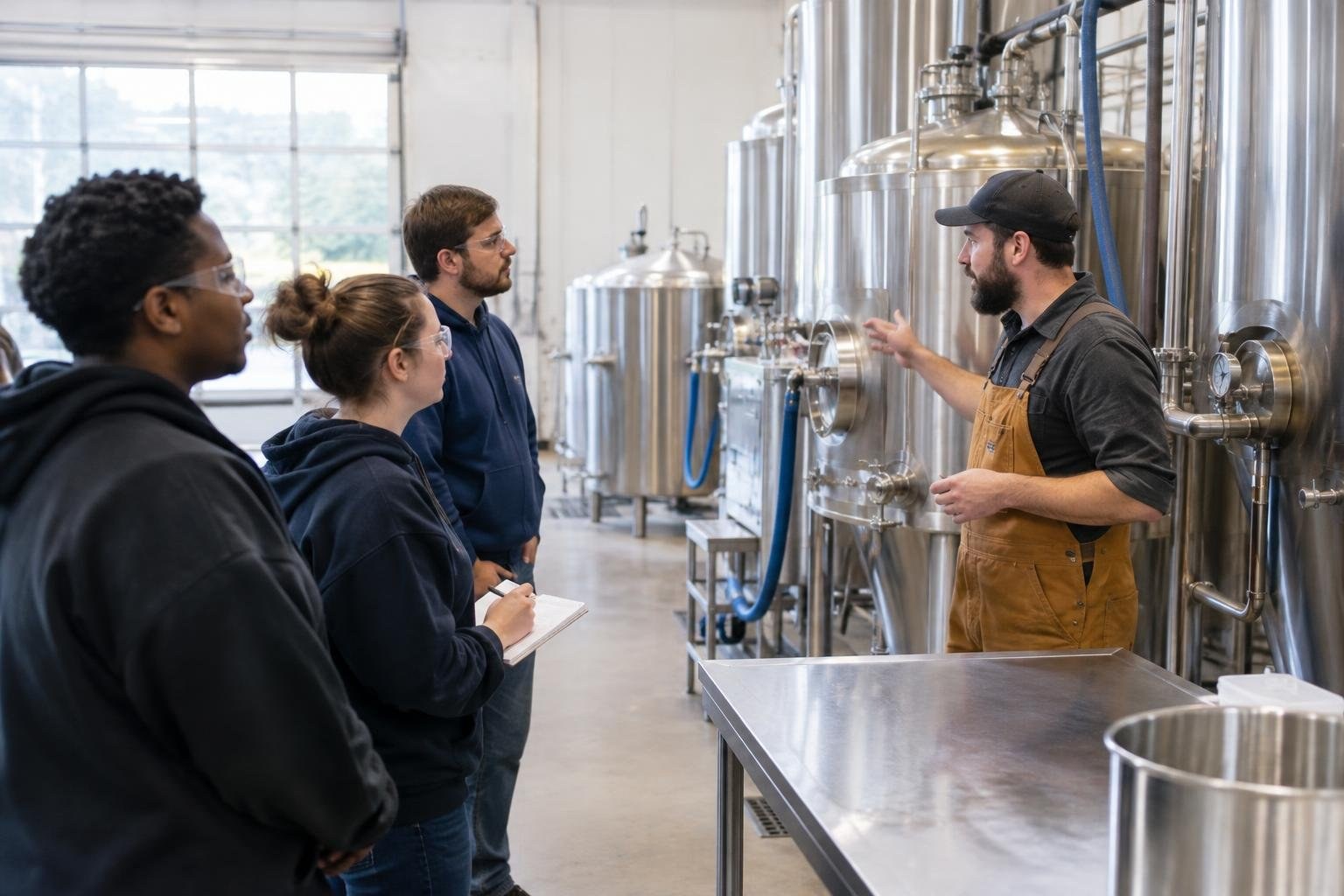
Brewing equipment used in an educational or training setting
What Is a Brewery/Brewpub Operations/Management Program?
Brewery/Brewpub Operations/Management is a specialized area of study focused on the production and operation of brewing businesses. Programs may connect brewing science and equipment with hospitality, business planning, marketing, finance, personnel, and distribution. The topic description for this field includes alcohol-related law and ethics as possible areas of instruction, but an individual college may not cover every subject.
Names vary. A school might call its offering brewing science, brewing operations, craft brewing, brewery operations, or a brewing certificate. The credential and curriculum matter more than the label. For example, programs in the supplied college information range from an undergraduate certificate and an associate of applied science degree to a bachelor’s program and graduate study.
This is not simply a general business major with a beer-related title. A brewing-focused program can include technical production and equipment learning; a hospitality or business program may offer a broader service or management perspective. Compare course lists to find the emphasis that matches the work you are considering.
Rowan University’s brewing science certificate description explains that its design and operations study combines theory and application. MSU Denver’s Brewery Operations major describes learning across beer science, process, business, and service.
What Do You Study? Brewing, Business and Hands-On Learning
Coursework varies by school, but a student should expect some combination of brewing science, production methods, equipment, operations, business, and hospitality. In practical terms, brewing science helps students understand processes behind beer production; equipment and layout study helps them think about how a production space functions; business courses address how an organization plans and operates.
Some programs explicitly combine classroom theory with application. Rowan’s certificate description focuses on brewery process, equipment, and layout, while Whitworth describes a science-based curriculum supported by an on-site brewing facility. Allegany College of Maryland describes a one-year program that combines brewing science and business with hands-on production experience in a regional brewery.
That range is important. A course called “brewing operations” may not provide the same facility access or field experience at every school. Ask whether practical work is part of required courses, how often students use equipment, and whether the experience is in a college facility or an outside brewery. Then examine which business subjects are included if management is your goal.
Useful skills can include following process steps, understanding equipment and production layout, communicating with coworkers, and applying business concepts to operational decisions. The exact software, lab work, capstone requirements, and internship opportunities are program-specific; do not assume they are included unless the college confirms them in writing.
Who Is This Program For? Admissions and Preparation
This program may suit students who want a focused connection between production and business, enjoy learning how processes and equipment work, or are interested in hospitality and managing a service-oriented organization. Brewing work can involve both practical tasks and careful planning. Management-oriented study can also require communication, teamwork, and attention to operational details.
No single personality profile is required. Students may be drawn to hands-on production, quality checks, customer service, business planning, or team leadership. Those interests point toward different roles, so use them to evaluate course choices rather than treating the degree name as a career decision by itself.
Admission and academic expectations
Admission rules are set by each college. The research available for this guide does not establish shared entrance requirements, GPA thresholds, standardized tests, essays, or prerequisites across programs. Ask an admissions office for the current checklist and whether prior coursework or industry experience can be considered. One program catalog says students must earn at least a C in each required course, but this is a program-specific academic standard, not a universal rule.
Before applying, request the degree plan, prerequisites, practical training schedule, and policies for maintaining academic standing. If you are a parent helping a student, encourage them to speak with faculty and, where possible, learn what daily brewery or brewpub work involves.
Credential Levels, Completion Time and Learning Format
There is no single completion time for this field. The clearest specific example in the supplied program information is Allegany College of Maryland’s Brewing Operations Certificate: the college describes it as a one-year, 33-credit program. Other certificates and degrees may take a different number of terms and credits. A bachelor’s or graduate credential should not be assumed to follow the same schedule as that certificate.
Ask schools for the published credit total, course rotation, and expected time to finish for full-time and part-time students. Also check whether required practical experiences are offered every term and whether credits from previous study can transfer. These details can change the real completion timeline.
Program delivery also differs. A campus facility can support practical learning, and one source describes brewery experience in a regional brewery. The supplied information does not establish that these programs are available fully online. If considering online or hybrid study, verify where required equipment-based practice occurs and whether travel, scheduled labs, or outside placements are part of the plan.
Tuition, Total Cost and Financial Aid
Program price depends on the institution and student circumstances. Compare the complete cost, not tuition alone: ask about mandatory fees, course materials, equipment or lab charges, travel to practical training, and housing or transportation if the program requires an in-person experience. The programs cited here do not provide a common tuition basis that would support a reliable national price comparison.
Request a written estimate for the credential you intend to earn, showing tuition by term and all required fees. Ask the financial aid office about grants, scholarships, work-study if available, payment plans, and how transfer credits may affect the total. Students who are already employed can also ask whether an employer offers education assistance, without assuming that benefit is available.
To compare affordability, calculate the cost of the complete program and identify which expenses are fixed, optional, or dependent on location. A shorter credential may take less time, but its value depends on whether the curriculum and experience align with the roles you want. Avoid choosing on advertised tuition alone before confirming that the quoted amount includes required practical work and fees.
Careers, Jobs, Pay and Employment Outlook
Programs in this area can lead toward production, equipment operation, quality assurance, cellar work, and management. The role examples below are drawn from college program descriptions, not a promise of employment or a complete list of jobs. Actual responsibilities, education expectations, experience requirements, and pay are set by employers and can vary.
Career direction
How the program may apply
Education and experience to verify
Pay and outlook
Assistant brewer or brewer
Brewing science, process, and equipment learning can relate to production work.
Check employer postings for practical experience and role-specific requirements.
Varies by employer and location; compare current local postings.
Brewing equipment operator
Equipment and operations coursework may relate to production tasks.
Confirm expected equipment skills and any on-the-job training.
Varies; no single figure applies across employers.
Quality assurance technician
Relevant where the curriculum includes appropriate production and quality preparation.
Ask employers which testing or documentation skills they expect.
Varies by employer, location, and experience.
Cellar manager
Brewing operations knowledge may support cellar work and coordination.
Ask whether employers expect prior production experience or supervisory ability.
Varies; compare job descriptions in the intended region.
Brewery or brewpub manager
Business, service, and operations coursework may support management preparation.
Check employer expectations for relevant experience and business skills.
Varies by role and business; evaluate current local evidence.
Food service manager
Hospitality and management topics may be relevant to a brewpub setting.
Review the job’s service, staffing, and operations requirements.
Varies; consult current occupational and local employer information.
Cincinnati State identifies brewer or assistant brewer, cellar manager, and brewery manager as possible craft beverage employment areas for its program graduates. Allegany College lists assistant brewer, brewing equipment operator, and quality assurance technician as prospective job titles. These examples show why students should compare a curriculum with specific role requirements rather than assuming all programs lead to the same outcomes.
To assess earnings and outlook, look up the exact occupation in current U.S. Bureau of Labor Statistics information and compare it with job postings where you plan to work. Brewery businesses may combine production, retail, and hospitality needs; responsibilities can differ substantially between a small operation and a larger employer.
Find out which Career or College Major is right for you!
Accreditation, Alcohol Regulations and Credentials
A credential is evidence of education, not the same thing as permission to operate a regulated business or perform every role. The supplied program information describes coursework that may cover alcohol and liquor law and regulations, but requirements can depend on the activity and jurisdiction. Graduates and future business owners should verify current rules with the appropriate state and local authorities.
Ask a college whether the curriculum addresses the regulatory topics relevant to your goals, and whether students receive guidance on where to find official rules. Do not assume that completing a certificate or degree automatically satisfies licensing, permit, or certification requirements. If an employer names a credential, verify it with the issuing organization before paying for it.
When comparing schools, check institutional accreditation through official college and education resources, and ask whether credits will transfer to your next intended program. The sources supplied for this guide establish program offerings and curriculum examples, not a shared specialized accreditation or professional license for all brewery operations programs.
Practical Experience, Certifications and Employer Preparation
Practical experience can help students test whether they prefer production, hospitality, or business operations. Look for required or optional brewery placements, hands-on facility work, projects, or opportunities to observe operations. Allegany describes production experience in a regional brewery, and Whitworth describes an on-site facility used alongside coursework. Those are program examples, not features guaranteed at every institution.
How to stand out to employers
Choose practical courses that align with your intended role, then describe the work and skills accurately on a resume.
Ask instructors about relevant projects, facility access, and connections to employers or industry organizations.
Build experience in the type of setting you are targeting, whether production, service, sales, or operations.
Practice explaining how brewing knowledge connects to safety, quality, teamwork, and business needs, using examples from actual coursework or employment.
Review job postings regularly and note which qualifications recur in your target area.
Be careful with short courses or certificates advertised as substitutes for a full program. Compare learning objectives, practical access, recognition by employers, total fees, and whether the credential is actually requested for the positions you want.
Related Degrees and Alternative Pathways
Related routes include general business management, hospitality management, food service management, marketing, supply chain or logistics, and food science or brewing science. Consider a broader business or hospitality path if you want options beyond brewing; consider a more technical science route if production science is your priority. The right alternative depends on course content and the job you want, not just the major name.
Hospitality management: Consider this instead if guest experience and service operations matter more than brewing production.
Business management: Consider this instead if you want broader business preparation across industries.
Food service management: Consider this instead if your main interest is operating restaurants or other food-service businesses.
Marketing: Consider this instead if brand building, promotion, or customer research is your primary interest.
Logistics or supply chain: Consider this instead if distribution, purchasing, and movement of products are your main focus.
Food science or brewing science: Consider this instead if you want more emphasis on scientific processes and product quality.
Program titles do not reliably show how much time is devoted to each subject. Compare required courses and hands-on work. A focused brewing credential may provide industry-specific learning; a broader major may offer more flexibility if your interests change. A graduate pathway is also available in the field: Auburn lists a master’s degree in Brewing Science and Operations and a graduate certificate. Confirm current admission requirements and program details directly with the institution.
How to Choose the Right Brewery Operations Program
Evaluate programs by asking what you will be able to do at completion, not only what the credential is called. A strong comparison should include curriculum, facilities, faculty experience, required practical learning, total cost, format, and how the college describes graduate outcomes. Ask for evidence of outcomes and clarify whether figures refer to the exact program and a recent graduating class.
Curriculum: Which courses cover production, business, service, management, marketing, and regulations?
Practical learning: Is equipment use required? Is brewery experience guaranteed, optional, or arranged individually?
Credential and transfer: How many credits are required, and will they apply to a future degree?
Cost and aid: What is the complete estimated cost, including fees and practical learning expenses?
Format and schedule: Are courses online, hybrid, or campus-based? Can required labs fit your schedule?
Career preparation: What roles do graduates pursue, and what support is available for internships, resumes, and employer connections?
Regulatory preparation: How does the school address relevant rules, and what must students verify separately?
Explore Assessment.com’s college major guidance and education resources as you compare possible directions. The MAPP assessment can be one input as you reflect on interests and work preferences; use it alongside conversations with advisers, program research, and direct experience.
Questions to Ask Before Enrolling
Use these questions with an admissions adviser, program director, and financial aid office before committing:
What is the exact credential, total credit requirement, and expected completion schedule?
What are the current admission prerequisites and academic-standing rules?
What is the full cost, including fees, materials, equipment, travel, and housing where relevant?
Which courses include hands-on brewing, and where does that instruction take place?
Are placements or internships required, and who arranges them?
What portion of the program is online, hybrid, or in person?
Can previously earned credits transfer, and will the credential support further study?
What career services, employer contacts, and graduate outcome information are available?
Does the program prepare students for a specific credential or regulatory requirement, and who verifies that requirement?
Which grants, scholarships, and other aid options could apply to my circumstances?
Keep written answers and compare schools using the same questions. If a college cannot explain how practical learning works or what the quoted cost includes, seek clarification before enrolling.
From Education to Career: Possible Pathways
A possible pathway might look like this: a brewing operations certificate or associate degree, followed by an entry-level production or equipment role, then experience in a brewery, and later a move toward quality, cellar coordination, or management. Another student might choose a bachelor’s degree with business and service coursework and pursue operations or brewpub management after building relevant experience. These are examples, not guaranteed career ladders.
Before choosing a route, search for real job postings in the regions where you could work. Identify typical duties, experience expectations, schedule, and any credentials named by employers. Then compare those details with the program’s courses and practical opportunities. A degree can organize learning and offer access to practice, but individual outcomes also depend on job availability, experience, and employer needs.
For students who are not yet sure whether production, hospitality, or management fits best, compare related roles and reflect on the tasks involved. Assessment.com provides Food Service Manager career information and broader career exploration resources. A career assessment can help structure reflection, but should not replace program research or conversations with people working in the field.
Is Brewery/Brewpub Operations/Management Right for You?
This field may be a good fit if you are genuinely interested in how brewing production and business operations intersect, and you are willing to compare specific curricula, costs, and experience requirements. It may be less suitable if you want a broad business credential, prefer a science program with deeper laboratory focus, or are not sure you want work connected with brewing or hospitality. In those cases, related majors may offer a better match.
For students and parents, the decision is strongest when it includes both career research and personal fit. Review the required courses, speak with a college adviser, look at local job postings, and consider whether the day-to-day tasks sound engaging. Assessment.com’s MAPP career assessment is another resource for exploring motivations, interests, and possible career directions.
Frequently asked questions
What is a Brewery/Brewpub Operations/Management degree?
Brewery/Brewpub Operations/Management is a specialized field of study that combines brewing science and production with business, hospitality, and brewery operations. Depending on the program, students may study equipment and processes, quality practices, management, marketing, distribution, and customer service. The exact curriculum and credential differ by institution, so compare official program requirements rather than relying on a degree title alone.
Is a brewery operations program hard?
It can be demanding because students may need to connect technical brewing concepts with practical production and business decisions. Some programs use hands-on brewing facilities or brewery experience, while others emphasize different combinations of theory and application. Before enrolling, review course prerequisites, lab expectations, and the time required for practical work. Students should also ask how the program assesses progress and what academic standards apply.
What jobs can I get with a brewery operations degree?
Potential roles include assistant brewer, brewing equipment operator, quality assurance technician, cellar manager, and brewery manager. These titles appear in program descriptions, but a degree does not guarantee access to a particular position. Responsibilities and employer requirements can differ. Ask each college what work experience its students complete and compare course content with the qualifications listed in current job postings.
How much does a brewery operations program cost?
Costs depend on the institution, credential, residency, format, and any fees for equipment, laboratory work, or practical experiences. The supplied program information does not establish a comparable national tuition figure. Ask colleges for the full estimated cost of attendance and a term-by-term fee breakdown, then compare grants, scholarships, transfer credits, and payment options before deciding.
Can I earn a brewery operations degree online?
Some brewing courses or parts of a program may be available online, but practical brewing instruction can require access to equipment or an industry setting. Confirm whether the specific program is fully online, hybrid, or campus-based, and ask whether any labs, brewery experiences, or assessments must be completed in person. Do not assume an online course includes hands-on production experience.
Does brewery management require a lot of math?
Brewing coursework can involve measurements, process control, and business calculations, but the amount and level of math vary by curriculum. Review the published course list and ask an adviser what math preparation is expected before admission. If you are concerned, ask whether the school offers prerequisite support and how quantitative concepts are taught in brewing and business courses.
Do I need a graduate degree to work in a brewery?
Not necessarily for every entry-level production or operations role. Requirements depend on the position and employer. Graduate study may be an option for advanced education in brewing science and operations; Auburn lists a graduate certificate and a master’s program in the field. Consider further study only after checking the roles you want and whether their employers value or require it.
Do brewery operations graduates need a license?
Alcohol-related laws and business requirements can depend on where a business operates and what activities it performs. Ask the college how its courses address applicable regulations, and verify any required permits or credentials with the relevant state and local authorities before starting a role or business.
People Also Ask
What do you learn in a brewery operations program?
Brewery operations programs combine brewing science, production processes, equipment knowledge, and business or hospitality topics. The balance varies by college and credential, so review the curriculum and practical requirements for each program.
Are brewery operations programs hands-on?
Program formats vary. Some include dedicated brewing facilities or practical experience in a regional brewery, while other offerings emphasize theory and operations. Confirm in writing whether a specific program requires on-campus labs or an external placement.
How long does a brewing operations certificate take?
No single completion time applies to every program. Allegany College of Maryland describes its Brewing Operations Certificate as a one-year, 33-credit program. Other schools and credentials may have different requirements, so check the official catalog and account for transfer credits and course availability.
Should I choose a brewing certificate or degree?
A brewing certificate may provide focused training, while an associate or bachelor’s degree can provide a broader or more extended course of study. The right choice depends on course content, experience, career goals, transfer plans, and cost. Compare actual program requirements, not credential names alone.
What entry-level jobs are available in brewing?
Potential roles named by program sources include assistant brewer, brewing equipment operator, quality assurance technician, cellar manager, and brewery manager. Employment depends on employer requirements and a graduate’s preparation and experience; the program title does not guarantee a role.
Can a brewery management degree help me run a brewpub?
Some curricula include business planning, finance, marketing, hospitality, or operations alongside brewing science. Whether a specific program covers these subjects, and how deeply, depends on the college. Check the course catalog if you are interested in management or opening a business.
Can brewing science be studied online?
Online availability is institution-specific. Brewing theory may be taught in different formats, but students should verify how practical production instruction is delivered. Ask about facility access, scheduled labs, brewery placements, and any in-person assessments before enrolling.
A Brewery/Brewpub Operations/Management program can be a practical route into brewing production, brewery operations, hospitality, or business management. The right credential depends on the work you want to do, the experience you already have, and whether a program offers relevant hands-on learning. Compare total costs and course requirements with actual entry-level job postings, and ask schools how their training connects to employers. A degree does not guarantee a particular job or salary, so weigh career options alongside your interest in the day-to-day work. Assessment.com’s career and education resources can help you consider how different paths fit your interests and goals.
Want to see your options? Try our comprehensive Degree, Program & College Search tool
We use cookies to offer you a better browsing experience, analyze site traffic and personalize content.
Read about how we use cookies and how you can control them in our
Privacy Policy.
If you continue to use this site, you consent to our use of cookies.
×
Exciting News!
Be one of the first to Beta Test the new AI-Powered Assessment.com Platform.