Paleontology Degree Guide: Courses, Careers, Costs, and Program Fit
Explore what a paleontology program teaches, how students prepare for the field, related career paths, graduate study, program costs, and questions to ask before choosing a college.
By Tome Fierre · Staff Writer Assessment.com · Published November 1, 2026 · Last updated November 5, 2026
Paleontology is the scientific study of ancient life through fossils and the geological evidence around them. A paleontology degree connects biology and earth science to help students investigate extinct organisms, past ecosystems, and the processes that shaped life through time. Students may study fossil formation, evolution, paleoecology, paleoclimatology, and field and laboratory research. The path can lead toward research, education, museum work, or careers that use geological knowledge. Many research and university teaching roles require graduate education, so a bachelor’s degree is often a starting point rather than the end of preparation. Not sure whether paleontology fits you? Take the Free MAPP Career Assessment to explore how your motivations, interests, and preferences align with this field and related careers.
Degree & Program Decision Insights
Explore your personal fit, education requirements, career potential and next steps.
01Motivational Fit
Discover whether this program fits you
Explore your preferences against the focus of Paleontology. These prompts are not personal MAPP results.
Scientific investigation. Would you enjoy investigating fossil chemistry and explaining your conclusions from evidence?
Breadth of interest. Consider the place of “sedimentation and fossilization processes” in this field. Is this another part you would choose to explore, or mainly a requirement you would tolerate?
Work reality. Related work can involve this task: “Develop applied software for the analysis and interpretation of geological data.” Would you want that activity to be a regular responsibility?
Interest in studying a field can differ from enjoying its related work.
Which part would you want to do repeatedly, and what would you try before deciding?
Discover Your Personal Program Fit
Before investing your time and money in your education, discover how this program aligns with your natural motivations, work preferences and career goals.
Typical occupational entry: bachelor's degree (BLS). BLS lists 5 years or more of related work experience as typical for this occupation; this programme is not a direct promise of entry.
U.S. occupational wages are not guaranteed graduate earnings; OEWS excludes self-employed workers.
Projected openings include replacements as well as growth.
U.S. national estimates. A crosswalk does not establish entry-level eligibility; advanced, management and teaching roles can require further qualifications.
Explore your motivations. Use MAPP as a starting point for reflecting on your interest in “sedimentation and fossilization processes”, then test that interest against a sample learning task.
Compare actual providers. Ask for the exact credential, course sequence and assessment methods. Compare how each provider teaches “fossil chemistry”, its entry criteria and its itemized costs.
Check the evidence before applying. Confirm prerequisites and any recognition or professional requirements for your intended route; ask for applicable rules and published outcome definitions in writing.
Verify the institution’s current offering, admissions requirements and outcomes; a search result does not establish your eligibility.
Paleontology investigates extinct life and fossil remains, then uses evidence from rocks, fossils, and related scientific methods to reconstruct ancient organisms, ecosystems, and geological processes. It draws on both biology and earth science rather than standing apart from them.
The field spans fossil formation and chemistry, evolutionary biology, paleoecology, paleoclimatology, trace fossils, micropaleontology, invertebrate and vertebrate paleontology, and paleobotany. Students may encounter paleontology as a named major, a degree option within earth sciences or biology, or a specialization connected to a broader department. The program description associated with this field covers certificates through doctoral study, but availability must be checked with each institution.
That variation matters: the department granting the credential may shape whether a program emphasizes biological questions, geological methods, or both. At Berkeley, for example, the Museum provides collections and expertise to graduate students but does not grant degrees; degrees with paleontology emphasis are earned through academic departments. Berkeley’s paleontology education information illustrates why students should identify the degree-granting department, not just the museum or research center.
What Do Paleontology Students Study?
Expect a mix of scientific foundations and focused study. Programs commonly build connections among geology, biology, and the evidence preserved in fossils. Topics may include how remains become fossils, how to interpret fossil chemistry, how organisms evolved, and how to reconstruct former environments.
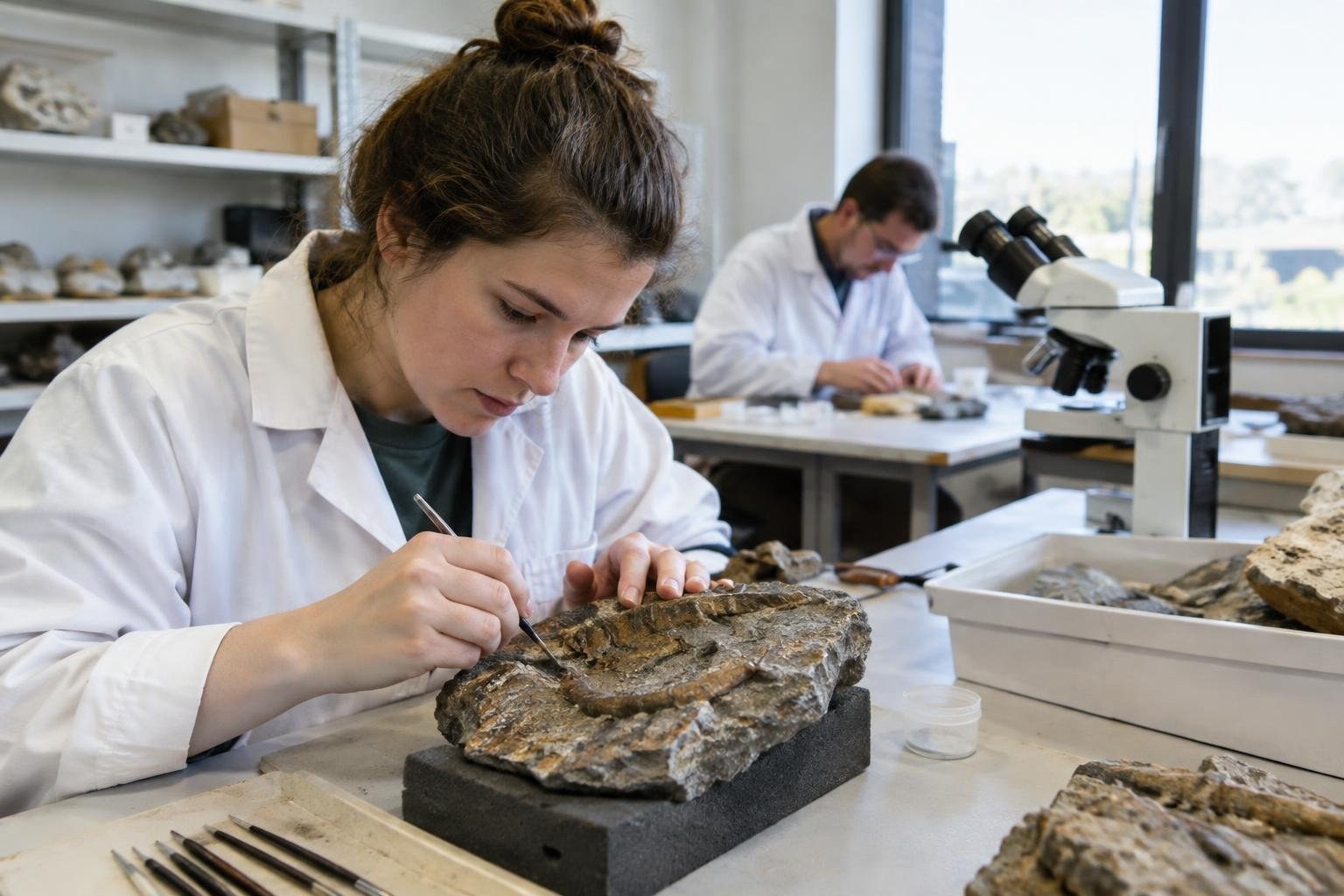
Advanced courses can focus on particular fossil groups or questions, such as vertebrate paleontology, fossil plants, trace fossils, or microscopic fossils. Field methods teach students to observe geological context and record evidence systematically. Laboratory work may involve studying, preparing, documenting, or conserving fossil material and evaluating research evidence.
Research projects, seminars, and a culminating thesis or capstone may be part of advanced study, but students should not assume every program includes the same requirements. Compare course catalogs, sample degree plans, field opportunities, lab access, and faculty research. Montana State describes its paleontology option as combining geology and paleontology training, a model that connects specialization with a broader earth-science foundation.
Skills You Can Develop
Students develop more than facts about fossils. They learn to interpret evidence in context, connect biological observations with geological history, and explain how conclusions follow from data. Research practice also calls for careful recordkeeping, attention to specimen condition, and the patience to revisit an interpretation when evidence is incomplete.
Scientific reasoning: form a question, compare evidence, and distinguish observation from interpretation.
Earth-science literacy: connect rock layers, sedimentation, and fossil evidence to past environments.
Biological understanding: relate fossils to organism structure, evolution, and ecological relationships.
Research communication: present results in writing, discussion, and visual formats for scientific or public audiences.
Practical methods: follow field and laboratory procedures for documenting and studying material.
These capabilities can apply to research, education, and occupations that use geological knowledge. A college program’s specific software, instrumentation, and technical training should be confirmed with its department; do not assume every paleontology curriculum teaches the same tools.
Who Is This Degree Best For?
Paleontology may appeal to students who enjoy asking how life and environments changed over long periods, examining physical evidence, and combining ideas from different sciences. The work can involve both focused observation and larger questions about evolution, ecology, and geological history. It is not only outdoor fossil hunting: lab study, reading, data interpretation, and careful writing are important parts of scientific work.
There is no single personality type required. Some students are drawn to hands-on fieldwork; others prefer specimen analysis, research, teaching, or communicating science. Consider how you feel about detailed work, uncertain answers, collaborative projects, and a career path that may require more education than a bachelor’s degree.
Does Paleontology Match You?
Pay, prestige, or enthusiasm for dinosaurs alone cannot tell you whether a degree is a good fit. Think about the daily activities involved, the amount of schooling you are willing to pursue, and the kinds of questions that hold your attention. Assessment.com’s MAPP career assessment can be one input as you reflect on interests and motivations. Use it alongside conversations with students, faculty, and professionals rather than as a substitute for reviewing program requirements.
Admissions, Completion Time, and Academic Difficulty
Admission rules are set by individual colleges. Undergraduate applicants should check general admission requirements and whether the department recommends or requires preparation in science and mathematics. Transfer applicants should ask how prior coursework applies to major requirements, especially lab and field courses.
Graduate programs may review prior academic work, research interests, relevant experience, and a student’s potential fit with faculty research. Exact requirements, tests, essays, interviews, and funding vary. Ask the department for current, written application criteria rather than relying on a general description of paleontology.
Timelines also depend on credential level, enrollment pace, transfer credits, and research expectations. A certificate, undergraduate degree, master’s program, and doctorate are distinct commitments; no single completion time applies to all of them. Check the published credit requirements and whether field courses or thesis work are scheduled only in certain terms.
Students often find the interdisciplinary demands challenging. Strong preparation in biology, geology, chemistry, quantitative reasoning, and scientific writing can help. If one subject feels unfamiliar, ask about prerequisite courses and academic support before enrolling.
Online, Hybrid, and On-Campus Study
Online, hybrid, and campus options depend on the school and the type of credential. Some theory-based courses may be delivered remotely, but paleontology can also require field methods, lab access, specimen study, or close research supervision. A distance-learning listing does not by itself establish that students receive the practical training needed for a particular goal.
Before choosing an online or hybrid program, ask what activities must be completed in person, where students access collections and equipment, how field experience is arranged, and whether a thesis or research project has an on-site component. If you cannot travel, confirm that the program’s delivery format still meets your academic and career objectives.
For campus programs, compare field access and lab facilities as well as course titles. Ask how often students participate in supervised research and whether undergraduates can contribute to faculty projects.
Tuition, Program Costs, and Financial Aid
Your actual cost depends on the institution, residency classification, credential, course load, fees, and whether fieldwork, lab materials, travel, or housing are required. Request an institution-specific estimate for the full program rather than comparing tuition alone.
Include mandatory fees, books and supplies, transportation to field sites, equipment, and living costs where relevant. Ask whether research or teaching positions, assistantships, scholarships, grants, or employer assistance are available and what eligibility rules apply. A funding offer should be evaluated by its amount, duration, obligations, and renewal conditions.
For affordability, compare public and private institutions, transfer pathways, and the cost of completing prerequisites before transfer. Confirm transfer-credit decisions in writing. Do not assume online delivery means lower total cost if travel, equipment, or required in-person sessions remain part of the program.
Careers, Jobs, Pay, and Employment Outlook
Paleontology programs can prepare students for more than one kind of work, but the degree is not a guarantee of a particular job. Relevant paths may include scientific research, education, museum or collection-related work, and occupations that use geological knowledge. Some positions require graduate education, specialized experience, or a separate qualification.
Career direction
Typical preparation to investigate
How paleontology connects
Pay and outlook
Geoscientist or geologist
Relevant earth-science study; role-specific experience or credentials may apply
Geological context, field observation, and interpretation of earth materials
Varies by occupation, employer, and location; consult current official occupational data
Paleontology researcher
Graduate study is common for independent research roles
Specialized fossil, evolutionary, or paleoecological research
Depends on position and institution; no single paleontology wage applies
Postsecondary science teacher
Graduate education is typically relevant to college teaching and research
Subject expertise and research experience can support teaching
Varies by institution, rank, field, and location
Museum or collections work
Requirements depend on role; practical specimen and research experience can matter
Fossil documentation, interpretation, conservation, and public education
Varies by job title and employer
Natural sciences manager
Typically a longer-term direction requiring relevant professional experience
Scientific background may support management of research activity
Varies by organization and responsibilities
Montana State notes that its earth-science structure can prepare students for work requiring geological knowledge, including in the petroleum industry. Treat that as an example of a related application, not a promise of employment. Berkeley’s academic structure and the KU graduate program also show that paleontology training may sit within degree-granting biology, earth-science, or related departments.
For career planning, separate roles potentially accessible after a bachelor’s degree from research or university teaching goals that usually involve more education. Ask employers and academic departments what qualifications are expected for the exact position. Automation and digital tools may change how scientists organize and analyze data, but field judgment, specimen context, and sound interpretation remain important considerations; avoid choosing a program based on claims that any occupation is either immune to or certain to be replaced by AI.
Find out which Career or College Major is right for you!
Hands-on experience can help students test whether they enjoy the real work behind the subject. Ask about field courses, faculty research, museum or collection access, lab projects, and opportunities to present findings. A class project that documents evidence carefully can help demonstrate research habits even when a formal internship is not available.
How to Stand Out to Employers
Keep a record of field, laboratory, research, and science-communication projects.
Practice explaining what a project investigated, what evidence you used, and what you learned.
Ask faculty about supervised research and opportunities to contribute consistently.
Build related skills, such as geological field methods or data handling, when they fit your goals.
Check job descriptions for role-specific experience and credentials before paying for extra training.
Degree completion and professional qualification are not always the same thing. The supplied program information does not identify one universal paleontology license or certification. Confirm requirements for the particular job and state, if applicable, with the employer or responsible public authority.
Graduate School Options and Research Preparation
Graduate study can deepen specialization and build research independence. A master’s degree may be relevant for some research positions; doctoral study is commonly associated with academic teaching and research careers. Montana State’s catalog describes research-oriented students as normally pursuing a master’s degree and teaching or research students as typically pursuing a doctorate. Requirements still vary by position and institution.
Possible routes include graduate programs in biology, earth and planetary science, geography, or another department with paleontology faculty and research. Berkeley notes that its museum supports graduate students but does not award degrees; the degree is earned through a participating academic department. KU’s vertebrate paleontology graduate education is affiliated with a department offering M.A. and Ph.D. degrees. Confirm the actual degree title, advisor arrangement, funding, and research facilities before applying.
A graduate degree is a substantial commitment. Compare the research question you want to pursue, faculty availability, funding terms, completion expectations, and career requirements. Do not enroll solely because graduate study sounds like the default next step.
Related Degrees and Alternatives
Paleontology overlaps with several majors, but the best alternative depends on whether you want to emphasize fossils, organisms, Earth processes, or applied environmental questions.
Geology or earth science: consider this if you want a wider focus on Earth materials, structures, and processes, with the option to add paleontology coursework.
Biology: consider this if your central interest is organisms, evolution, and living systems, with fewer required geology courses.
Ecology or evolutionary biology: consider this if you are most interested in species, ecosystems, and change over time.
Environmental science: consider this if you want to study current environmental systems and applied environmental questions.
Geography or geographic information science: consider this if spatial analysis, mapping, or place-based questions appeal more than fossil specialization.
Museum studies or science communication: consider this if public interpretation, exhibits, or collections outreach is your primary goal; check whether additional subject expertise is expected.
Compare degree plans rather than relying on program names. Montana State offers paleontology as an earth-science option alongside other options, illustrating how a broader major can preserve flexibility. For students still exploring, Assessment.com’s environmental science degree guide and major-selection resource can help frame alternatives.
How to Choose a Paleontology Program
First, identify the academic department that awards the credential. A museum, institute, or research collection may provide facilities and expertise without granting degrees. Ask which institution and department appear on the diploma and whether the program’s academic home aligns with your intended path.
Then compare the curriculum and student experience:
Does the course plan combine biology and geology in the balance you want?
Are field methods, lab work, research, and specimen access clearly described?
Can students work with faculty whose research interests match theirs?
Are expectations for transfer credits, capstones, theses, and time to completion written down?
What is the full estimated cost, including travel, fees, equipment, and living expenses?
Does the format provide the in-person experience your goals require?
Can the department explain typical graduate-school or employment pathways without promising outcomes?
Accreditation and credential recognition should be checked at the institution and program level using authoritative information. Do not assume a program has specialized accreditation simply because it is offered by a university. For careers with licensing or certification requirements, verify those separately with the relevant authority; paleontology sources here do not establish a universal professional license.
Ask to speak with current students or faculty, review a sample schedule, and compare written offers of financial support. Assessment.com’s college guidance information and degree resources can support your broader exploration.
Questions to Ask Before Enrolling
Use this checklist with a parent, counselor, or academic advisor before accepting an offer:
Which department grants the degree, and what credential will I earn?
What is the total expected cost, including field travel and required fees?
Which courses, field experiences, labs, and research projects are required?
How are online or hybrid students provided hands-on training?
How will transfer credits apply, and can that decision be confirmed in writing?
What career or graduate-school outcomes can the department document?
What further education is typical for the jobs I want?
Are any licenses or certifications required for my intended occupation?
What scholarships, grants, assistantships, or other aid can I apply for?
Can I speak with a current student and review a sample degree plan?
Map the path realistically: paleontology study can lead to additional specialization, research experience, or related geological work, but progression depends on qualifications, opportunities, and individual choices. One possible sequence is undergraduate earth science with a paleontology focus, followed by supervised research, graduate study for a research role, and later responsibility for projects or teams. It is an example, not a guaranteed career ladder.
Frequently asked questions
What is paleontology?
Paleontology is the scientific study of ancient life through fossils and related evidence. Students connect fossil remains with geology and biological processes to investigate how organisms and ecosystems changed over time. Programs may include field methods, fossil preparation and conservation, laboratory research, and subjects such as vertebrate paleontology, micropaleontology, and paleobotany.
Is a paleontology degree hard?
It can be challenging because it combines scientific reading, evidence-based writing, biological concepts, geological context, and practical research. Field and laboratory work can also require patience and careful documentation. The demands vary by program and specialization. Students can prepare by building a foundation in biology, chemistry, geology, and quantitative reasoning and by asking colleges about tutoring and research opportunities.
What jobs can you get with a paleontology degree?
A paleontology degree may support paths in research, education, museums, and work that uses geological knowledge. The actual job title and entry requirements depend on the employer and role. A Montana State University program describes preparation that can also apply to jobs requiring geological knowledge. Research and university teaching commonly call for graduate education, so check requirements for a specific role before choosing a degree.
How much can you make with a paleontology degree?
There is no single salary for paleontology graduates because job titles, education levels, employers, and locations differ. Paleontology itself is a field of study rather than one occupation with one pay scale. Compare current wage data for the exact job you are considering, and look at required education and local opportunities alongside salary.
Can you earn a paleontology degree online?
Some paleontology coursework can be taught online, but the format depends on the institution and the program. Field methods, specimen work, lab research, or in-person advising may require campus or field participation. Before enrolling in a distance program, ask how it provides practical experience, access to collections and equipment, and research supervision.
Does paleontology require a lot of math?
Paleontology programs are interdisciplinary and can include science coursework that uses quantitative reasoning. The balance depends on the curriculum and focus, such as fossil chemistry, paleoclimatology, or geological methods. Review course requirements and ask departments which mathematics, statistics, chemistry, and geology courses students take before selecting a program.
Do you need a graduate degree to become a paleontologist?
Graduate school is common for students aiming for research or university teaching in paleontology, but it is not required for every job connected to the field. Montana State University notes that students pursuing research often continue to a master’s degree and teaching or research typically involves doctoral study. Check the qualifications for specific jobs and programs.
Do paleontologists need a license or certification?
The sources available here do not identify a universal professional license or certification required for paleontologists. Requirements can depend on the actual occupation and employer. Ask the department and prospective employers whether a role expects specialized training, field experience, safety qualifications, or credentials beyond the degree.
People Also Ask
What does a paleontology major study?
Paleontology studies ancient life using fossils and their geological context. The field examines fossil formation, extinct organisms, ancient ecosystems, and the history of life.
How long does it take to get a paleontology degree?
Program lengths differ by credential and school. A bachelor’s degree is typically a multi-year undergraduate commitment; graduate study adds time, especially when research is required. Check each institution’s degree plan and transfer-credit rules.
What is the difference between paleontology and geology?
Paleontology combines geology and biology, while geology focuses more broadly on Earth materials, structures, and processes. A paleontology program or option may include more fossil, evolution, and ancient ecosystem study. Review actual course plans because program names alone do not show the full difference.
What degree do you need to be a paleontologist?
For research-focused paleontology, students often continue to graduate school. Montana State University describes research preparation as normally involving a master’s degree and teaching or research as typically involving a doctorate. Requirements vary by institution and position.
Is paleontology a hands-on major?
Paleontology programs can include field research and laboratory research, but their format varies. Online coursework does not automatically provide practical access to specimens, collections, fieldwork, or lab equipment. Ask programs how required hands-on learning is delivered.
What can you do with a paleontology degree besides research?
Potential pathways include paleontology research and education, museum-related work, and jobs that use geological knowledge. The degree alone does not guarantee a particular role; experience, specialization, and graduate qualifications may matter.
Paleontology can suit students who want to investigate ancient life by combining biological evidence, geological context, field observation, and careful lab or research work. The path often requires advanced study for research and university teaching, so compare the full education commitment with your career goals and budget. Explore Assessment.com’s degree and career resources, and use the MAPP assessment to reflect on whether the work and study style fit you.
Want to see your options? Try our comprehensive Degree, Program & College Search tool
We use cookies to offer you a better browsing experience, analyze site traffic and personalize content.
Read about how we use cookies and how you can control them in our
Privacy Policy.
If you continue to use this site, you consent to our use of cookies.
×
Exciting News!
Be one of the first to Beta Test the new AI-Powered Assessment.com Platform.