Geochemistry and Petrology Degree Guide: Courses, Careers, and Program Fit
Explore what geochemistry and petrology programs teach, how to compare degree options, what research and preparation may involve, and which career directions may connect with the field.
By Tome Fierre · Staff Writer Assessment.com · Published October 26, 2026 · Last updated November 5, 2026
Geochemistry and petrology programs study how rocks, minerals, fluids, and chemical processes shape the Earth. Students learn to connect what they observe in samples and geological settings with the processes that formed or altered them. Depending on the program, study may include mineralogy, crystallography, petrology, geochemical reactions, economic geology, laboratory analysis, fieldwork, and research. Oregon State University, for example, describes geology study that includes petrology, plate tectonics, mineralogy, and geomorphology; graduate programs may offer narrower specializations in petrology and geochemistry. Students considering this field often enjoy chemistry and Earth science, want to understand how natural systems work, and are comfortable with careful observation and quantitative problem-solving. Possible directions include geoscience, mineral-resource research, environmental work, and teaching or research after further education. Career options depend on the credential, experience, specialization, and specific employer requirements, not the degree name alone.
Degree & Program Decision Insights
Explore your personal fit, education requirements, career potential and next steps.
01Motivational Fit
Discover whether this program fits you
Explore your preferences against the focus of Geochemistry and Petrology. These prompts are not personal MAPP results.
Scientific investigation. Would you enjoy investigating economic geology and explaining your conclusions from evidence?
Breadth of interest. Consider the place of “mineralogy” in this field. Is this another part you would choose to explore, or mainly a requirement you would tolerate?
Work reality. Related work can involve this task: “Identify deposits of construction materials suitable for use as concrete aggregates, road fill, or other applications.” Would you want that activity to be a regular responsibility?
Interest in studying a field can differ from enjoying its related work.
Which part would you want to do repeatedly, and what would you try before deciding?
Discover Your Personal Program Fit
Before investing your time and money in your education, discover how this program aligns with your natural motivations, work preferences and career goals.
Typical occupational entry: bachelor's degree (BLS). BLS lists 5 years or more of related work experience as typical for this occupation; this programme is not a direct promise of entry.
U.S. occupational wages are not guaranteed graduate earnings; OEWS excludes self-employed workers.
Projected openings include replacements as well as growth.
U.S. national estimates. A crosswalk does not establish entry-level eligibility; advanced, management and teaching roles can require further qualifications.
Explore your motivations. Use MAPP as a starting point for reflecting on your interest in “mineralogy”, then test that interest against a sample learning task.
Compare actual providers. Ask for the exact credential, course sequence and assessment methods. Compare how each provider teaches “crystallography”, its entry criteria and its itemized costs.
Check the evidence before applying. Confirm prerequisites and any recognition or professional requirements for your intended route; ask for applicable rules and published outcome definitions in writing.
Verify the institution’s current offering, admissions requirements and outcomes; a search result does not establish your eligibility.
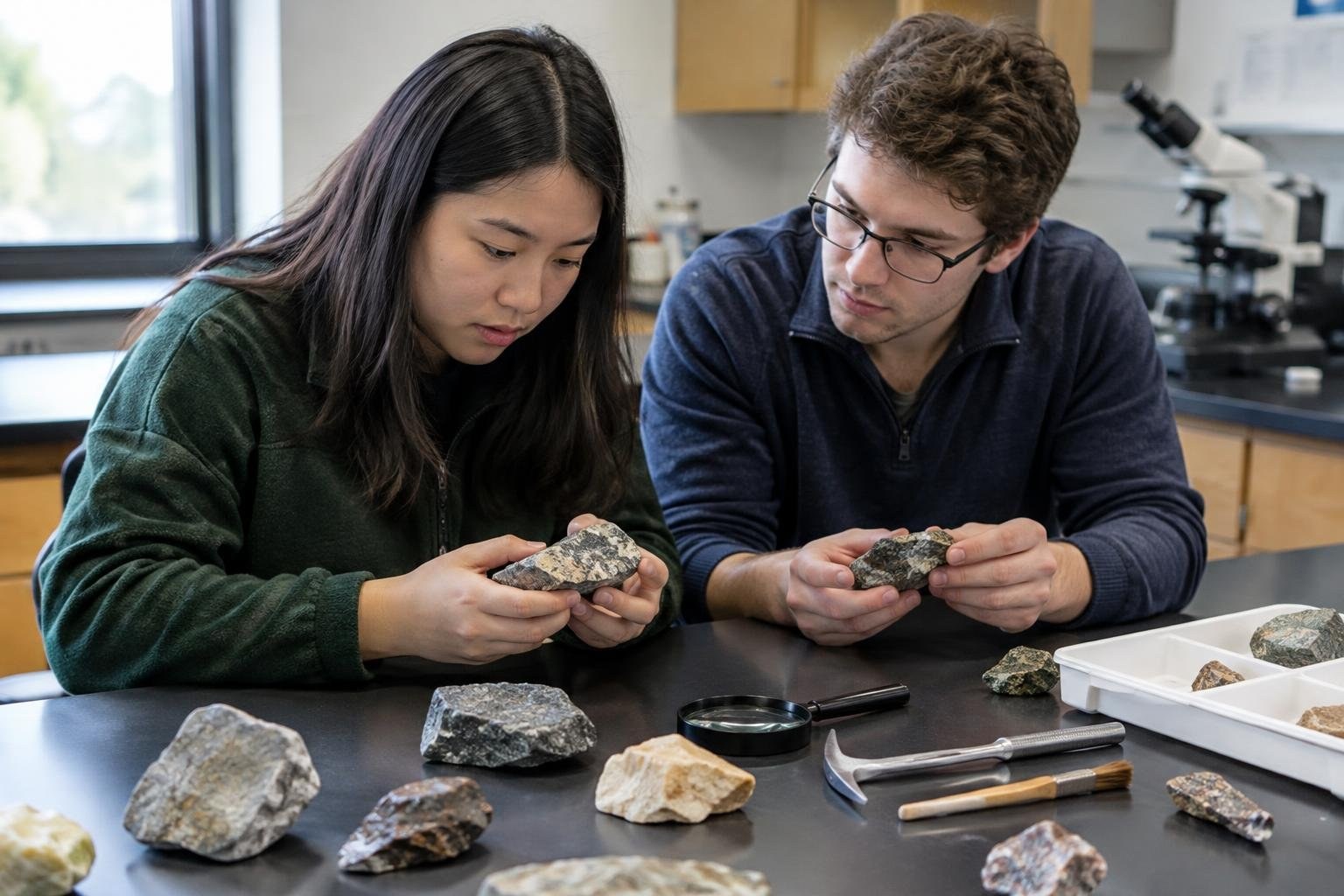
Students comparing mineral and rock samples with laboratory tools
What Is a Geochemistry and Petrology Degree?
Geochemistry examines chemical elements, compounds, and reactions in Earth materials and systems. Petrology examines rocks, how they form, and the processes that change them. A combined program explores the overlap: how chemical processes and geological conditions produce minerals, rocks, fluids, and deposits.
The field connects classroom science with material evidence. Students may study how rock composition reflects its formation, how fluids interact with rock, or how mineral deposits develop. The University of Arkansas catalog, for example, describes coursework connecting the geology and geochemistry of mineral deposits with the distribution of ores and energy resources. Program names and emphasis vary, so use the published curriculum rather than the title alone to understand what a college teaches.
Some colleges place this subject within geology, geoscience, earth science, or a chemistry department. Related program names do not guarantee identical course requirements. Compare courses, faculty interests, research options, and the amount of field and laboratory work.
Oregon State University’s academic program descriptions illustrate how petrology can sit alongside broader geology topics. The University of Arkansas geology catalog gives an example of mineral-deposit coursework.
What Do Students Study?
Expect a foundation in Earth science and chemistry before moving into specialized classes. The exact sequence is set by each college, but programs may draw on mineralogy, crystallography, petrology, volcanology, economic geology, geochemical reactions, and laboratory study. Geology curricula can also include plate tectonics and geomorphology.
From samples to processes
In a mineralogy or petrology course, students learn to describe Earth materials and interpret what their characteristics reveal about formation. Geochemistry adds chemical explanations, including how materials interact, transform, or become concentrated. Economic geology examines deposits that people use as resources. The Arkansas catalog describes a course introducing mineral deposits and relating their distribution to plate tectonics.
Laboratory, field, and computer-based learning
Practical work may involve describing samples, analyzing data, using research instruments, mapping, or studying geological settings. Fieldwork and lab expectations differ considerably. Ask whether a course includes required trips, equipment use, lab fees, or extended field sessions before registering.
Advanced work and research
At graduate level, specialization can address magmatic systems, oceanic lithosphere, convergent margins, environmental geochemistry, ore deposits, or other research areas. Some master’s programs require a thesis based on original research; doctoral study typically involves an original contribution to the science. Confirm the exact degree requirements with the department and thesis committee policies.
Examples of advanced study are described by Utah State University’s geology graduate program and the Colorado School of Mines geochemistry catalog.
Who Might Enjoy This Field, and What Preparation Is Needed?
This field may suit students who like explaining physical evidence, asking how a natural process happened, and combining chemical and geological ideas. It can reward patience: samples and datasets rarely answer every question at a glance, and observations need to be recorded and interpreted carefully.
Different work styles can fit. Some students prefer field observation; others enjoy laboratory analysis, mathematical models, computing, or sustained research. There is no single personality type required. The practical question is whether you are willing to build strength in the parts of the curriculum that are less familiar.
Entry preparation
Admissions rules are institution-specific. Undergraduate programs set their own requirements. Graduate geochemistry programs may expect prior science coursework: Montana Tech describes preparation in chemistry and geology, including analytical and physical chemistry, petrology, and mineralogy, while noting that some background courses may be completed during the first graduate year depending on a student’s preparation. Check the current admissions page for prerequisites, GPA expectations, application materials, and whether prerequisite gaps can be addressed.
To test your interest, read course descriptions, attend an open house, speak with faculty or current students, and ask to see examples of field or laboratory assignments. Assessment.com’s college-major guidance can also help families structure a comparison of academic interests and future work.
Credential Levels, Time to Completion, and Program Format
A geochemistry and petrology credential may be offered within a larger geology or geoscience pathway. The field’s listed credential levels can include undergraduate and graduate options, but availability depends on the institution. A certificate, bachelor’s degree, master’s degree, and doctorate are not interchangeable: each represents a different scope of study and may lead to different eligibility for jobs or further study.
Undergraduate study usually builds broad science foundations before specialization. Graduate programs may focus on a particular research area. For example, graduate catalogs at Utah State University and Missouri S&T describe specialist research and study options in petrology, geochemistry, and related areas. The Colorado School of Mines catalog describes a thesis requirement for its master’s geochemistry track.
Time and delivery format
Completion time depends on the credential, full- or part-time enrollment, transfer credit, course availability, and research requirements. Do not rely on a generic program-length estimate: ask the department for a sample plan showing prerequisites, course rotation, field requirements, and thesis milestones. Online or hybrid options should be checked carefully because laboratories, field activity, and instrument access may require in-person arrangements.
Before enrolling, ask which classes are offered every term, whether field courses run seasonally, how research is supervised, and what happens if a required course is not offered on schedule.
Skills You Can Develop
Geochemistry and petrology build a toolkit that combines scientific knowledge with practical ways to investigate evidence. Depending on the program, students may strengthen:
Earth-material knowledge: describing minerals and rocks and relating them to geological settings.
Chemical reasoning: interpreting chemical processes and material transformations.
Quantitative analysis: organizing measurements, evaluating patterns, and explaining uncertainty.
Research practice: developing a question, selecting an approach, documenting methods, and communicating results.
Technical communication: presenting findings in writing, figures, maps, or briefings.
Teamwork and safety awareness: coordinating field or laboratory tasks and following established procedures.
Research and course opportunities can include GIS, remote sensing, mapping, environmental geochemistry, and laboratory investigations, although availability depends on faculty, facilities, and program design. Southern Illinois University’s graduate catalog lists examples of these areas. Ask what software and instruments students actually use instead of assuming every program offers the same tools.
Career Directions, Jobs, and Employment Research
Potential directions include geoscience, environmental or resource-related work, research, and teaching. These are broad career areas, not guaranteed outcomes. Job titles may not match a major’s name, and employers can set specific requirements for education, field experience, technical skills, or work authorization.
Career direction
How the subject may apply
What to verify
Geoscientist or geologist
Study Earth materials, geological history, and processes.
Degree level, field experience, and the exact duties of the role.
Environmental geochemistry work
Apply geochemical knowledge to environmental questions and data.
Employer-specific technical methods and any state requirements.
Mineral-resource or economic geology work
Investigate mineral deposits and their geological formation.
Relevant industry experience and the work setting.
Research specialist
Conduct focused studies in petrology, geochemistry, or related areas.
Research experience and whether a master’s or doctorate is expected.
Postsecondary instructor or researcher
Teach or conduct research in Earth, marine, or related sciences.
Institution type, degree requirements, and teaching expectations.
Science management
Coordinate scientific projects or teams after developing relevant experience.
Leadership experience and role-specific qualifications.
Some students may qualify for technician or research-support work before graduate school, but job requirements vary. Advanced research and many faculty roles may require graduate training. The supplied university program descriptions identify research areas, not guaranteed placement, pay, or employment growth. For salary and outlook, look up each precise job title in current U.S. Bureau of Labor Statistics information and compare it with real employer postings in your target region.
Explore Assessment.com’s career pages for geologists, geophysicists, environmental scientists, and water resource specialists as starting points for comparison.
Tuition, Costs, and Financial Aid
To compare cost responsibly, request the full cost of attendance for your specific program and schedule. Tuition is only one part of the decision. Ask about required fees, lab and field costs, equipment, travel, housing, and whether a thesis or research period changes the number of terms you will pay for.
Build a net-cost estimate
Compare tuition by residency status and whether online students pay a different rate.
Include mandatory student, laboratory, field-course, and technology fees where applicable.
Estimate books, sample-related supplies, travel, and living expenses using the school’s figures.
Subtract grants and scholarships from total charges; keep loans separate because they must be repaid.
Ask whether assistantships, paid research, employer support, or transfer credit are available and what conditions apply.
Graduate students should ask whether a research or teaching assistantship is guaranteed, how long funding lasts, and whether it covers fees as well as tuition. Do not compare offers using a scholarship headline alone. Request a written estimate of the amount you would owe each term and the conditions for keeping aid.
Accreditation, Licensure, and Certifications
Most geochemistry and petrology occupations do not follow one universal licensing route. Requirements depend on the role, employer, and state or jurisdiction. Do not assume that completing a degree itself grants a professional license or certification.
Start with job postings for the work you want. If they repeatedly request a credential, ask the employer or the relevant state authority how it applies. For graduate research, check the department’s formal thesis and examination policies. A master’s thesis, for example, may require an approved proposal and original research; Colorado School of Mines specifies these elements for its geochemistry track.
When evaluating a college, check its institutional accreditation through official education sources and determine whether any professional recognition is required for your intended work. The available program information here does not establish a single specialized accreditation or credential that applies to every geochemistry or petrology program.
Experience, Research, and Building an Employer-Ready Profile
Internships, research placements, field courses, and substantial class projects can help turn academic knowledge into evidence of practical skills. Ask when undergraduates can join research groups, whether students can present work, how field placements are arranged, and whether career staff help students find relevant employers.
Ways to stand out
Keep a concise record of projects, methods, instruments, and your specific contribution.
Practice explaining a technical result to someone outside the specialty.
Seek supervised research or field experience that aligns with the roles you are considering.
Build relationships with faculty, laboratory staff, alumni, and professional communities.
Learn software or analytical methods that appear repeatedly in target job descriptions, using training provided by the program where possible.
Research catalogs describe possible work in areas such as mining geology, environmental geochemistry, remote sensing, GIS, and petrology. Availability is not assured at every school. Ask faculty which projects are currently active and what preparation a student needs to participate.
Related Degrees and Alternatives
Compare geochemistry and petrology with adjacent fields by asking what you want to investigate and what kind of work you want to do. Course names can overlap, so use the required curriculum and available research areas as your evidence.
Geology or geoscience: consider a broader program if you want a wider foundation across Earth systems before choosing a specialty.
Geophysics: consider it if you are more drawn to physical measurements, subsurface structure, or mathematical analysis.
Environmental science: consider it if your primary interest is environmental systems and applied environmental questions across disciplines.
Chemistry: consider it if you want deeper chemical theory and laboratory work with less emphasis on geological context.
Materials science: consider it if you are more interested in engineered materials and their properties than natural geological formations.
Mining or geological engineering: consider an engineering pathway if you want design and applied engineering work tied to resources or extraction.
Oceanography: consider it if marine systems are your main focus, while checking whether the program emphasizes chemical, physical, or biological study.
These are comparison prompts, not claims that one degree automatically qualifies you for a particular occupation. Review prerequisites, required courses, field or lab time, internships, and graduate-school pathways side by side. Use the Assessment.com degree directory to continue exploring available degree guides.
How to Choose a Program and Questions to Ask
Before choosing a program, compare more than its name or a single advertised career outcome. Use these questions with a parent, counselor, or academic advisor:
Is the college institutionally accredited, and can you verify that status through an official source?
Do the required courses cover the chemistry, geology, lab, field, and quantitative topics you want?
Are faculty actively working in areas that interest you, and can students join their projects?
What field trips, lab sessions, equipment, or research milestones are required?
What is the estimated total cost after aid, including program-specific expenses?
Can the schedule work for you if you need part-time study, online classes, or transfer credit?
How often are required courses offered, and what is the typical path through them?
What career services, internship connections, and alumni contacts are available?
Do employers or licensing authorities require additional education or credentials for your target roles?
Can the department provide recent, clearly defined outcome information and explain how it was measured?
Ask for answers in writing when they affect cost, time, or graduation plans. A program is a better match when its day-to-day learning, practical requirements, and likely next steps suit both the student and the family’s budget. Assessment.com’s college guidance resources provide another place to explore education decisions.
Frequently asked questions
What is geochemistry and petrology?
Geochemistry studies the chemical composition and processes of Earth materials. Petrology studies rocks, including how they form, change, and relate to geological settings. Programs may combine the subjects through courses and research on minerals, rocks, fluids, magmatic systems, and mineral deposits. The exact balance depends on the college and specialization.
Is a geochemistry and petrology degree hard?
It can be demanding because it brings together chemistry, geology, laboratory work, and quantitative analysis. Students may need to connect observations from rock or mineral samples with chemical and geological processes. Preparation in chemistry, mathematics, and introductory earth science can help, but course sequencing and support differ by program.
What do you study in a geochemistry and petrology program?
Coursework may include mineralogy, crystallography, petrology, geochemical processes, economic geology, and laboratory or computer-based study. Research programs can add specialized topics such as igneous and metamorphic petrology, ore deposits, environmental geochemistry, and remote sensing. Review a program’s actual course list because titles and requirements vary.
What jobs can you get with geochemistry and petrology?
Potentially related work includes geoscience roles, research support, and other positions involving Earth materials or environmental and resource questions. The best fit depends on the job duties and the education and experience employers request. A specialized graduate degree and research experience may be important for some research or advanced technical positions.
How much can geochemistry and petrology graduates earn?
Pay depends on the occupation, employer, location, degree level, and experience, so the major alone does not determine a salary. Compare current U.S. Bureau of Labor Statistics data for the specific job title you are considering, then review employer postings in the region where you hope to work. Do not treat a program’s advertised salary claim as a guaranteed outcome.
Can you study geochemistry and petrology online?
Some lectures or theory courses may be available online, but geology and geochemistry programs can require laboratory, field, or research work that is difficult to complete entirely at a distance. Ask each college how it handles sample analysis, field requirements, instrument access, and thesis or project supervision before enrolling online.
Do you need graduate school for geochemistry careers?
A master’s degree is a common path for advanced specialization and thesis-based research; doctoral study is generally associated with independent research and some academic or research careers. Requirements differ by employer and job. Decide whether graduate study is needed by checking the specific roles you want and the entry qualifications listed by employers.
What certifications or licenses do geochemists need?
There is no single credential that applies to every geochemistry or petrology job. Requirements depend on the work, employer, and state rules where applicable. Before paying for a certificate, check job postings and relevant state requirements, and ask prospective programs which credentials their graduates pursue and why.
What is the difference between geochemistry and petrology?
Geochemistry emphasizes chemical processes and the composition of Earth materials; petrology emphasizes rocks and their origin, history, and transformation. The subjects overlap in many programs and research projects. Compare required chemistry courses, field and laboratory work, and faculty research areas to see which program’s day-to-day learning better matches your interests.
People Also Ask
What is geochemistry and petrology?
Geochemistry focuses on the chemical composition and processes of Earth materials. Petrology examines rocks, their origins, and the geological processes that transform them. Many programs combine both.
What courses are in a geochemistry major?
Programs may cover mineralogy, crystallography, petrology, geochemical reactions, economic geology, laboratory methods, and field or research work. Course offerings vary by institution and degree level.
What can you do with a geochemistry degree?
A geochemistry or petrology program may support paths in geoscience, environmental work, resource analysis, and research. Specific job eligibility depends on employer requirements and education level.
Does geochemistry require a lot of math and chemistry?
The subject can involve chemistry, mathematics, geology, data interpretation, and laboratory or field work. Students should review course prerequisites and available academic support before enrolling.
Is a master's degree required to become a geochemist?
Graduate study is useful or required for some specialized research and academic roles, but requirements differ by job. Compare employer postings for the careers you want before deciding how far to study.
Are geochemistry degrees available online?
Fully online study may be limited by fieldwork, lab access, instrumentation, or supervised research. Ask whether required practical components can be completed locally or require campus attendance.
How much does a geochemistry degree cost?
Costs vary with institution, residency, course format, fees, living expenses, and the need for laboratory or field materials. Request a full estimated cost of attendance and compare aid offers before choosing.
Geochemistry and petrology can be a strong choice for students who want to investigate how Earth materials form, change, and concentrate into mineral deposits. The work combines chemistry, geology, quantitative reasoning, laboratory or field experience, and often research. Career options depend on the level of education, practical experience, specialization, and local employer needs, so compare actual program requirements and job postings before committing. If you enjoy the subject but are unsure about the day-to-day work, use career exploration and personal-fit information to compare it with neighboring fields.
Find out which Career or College Major is right for you!
We use cookies to offer you a better browsing experience, analyze site traffic and personalize content.
Read about how we use cookies and how you can control them in our
Privacy Policy.
If you continue to use this site, you consent to our use of cookies.
×
Exciting News!
Be one of the first to Beta Test the new AI-Powered Assessment.com Platform.