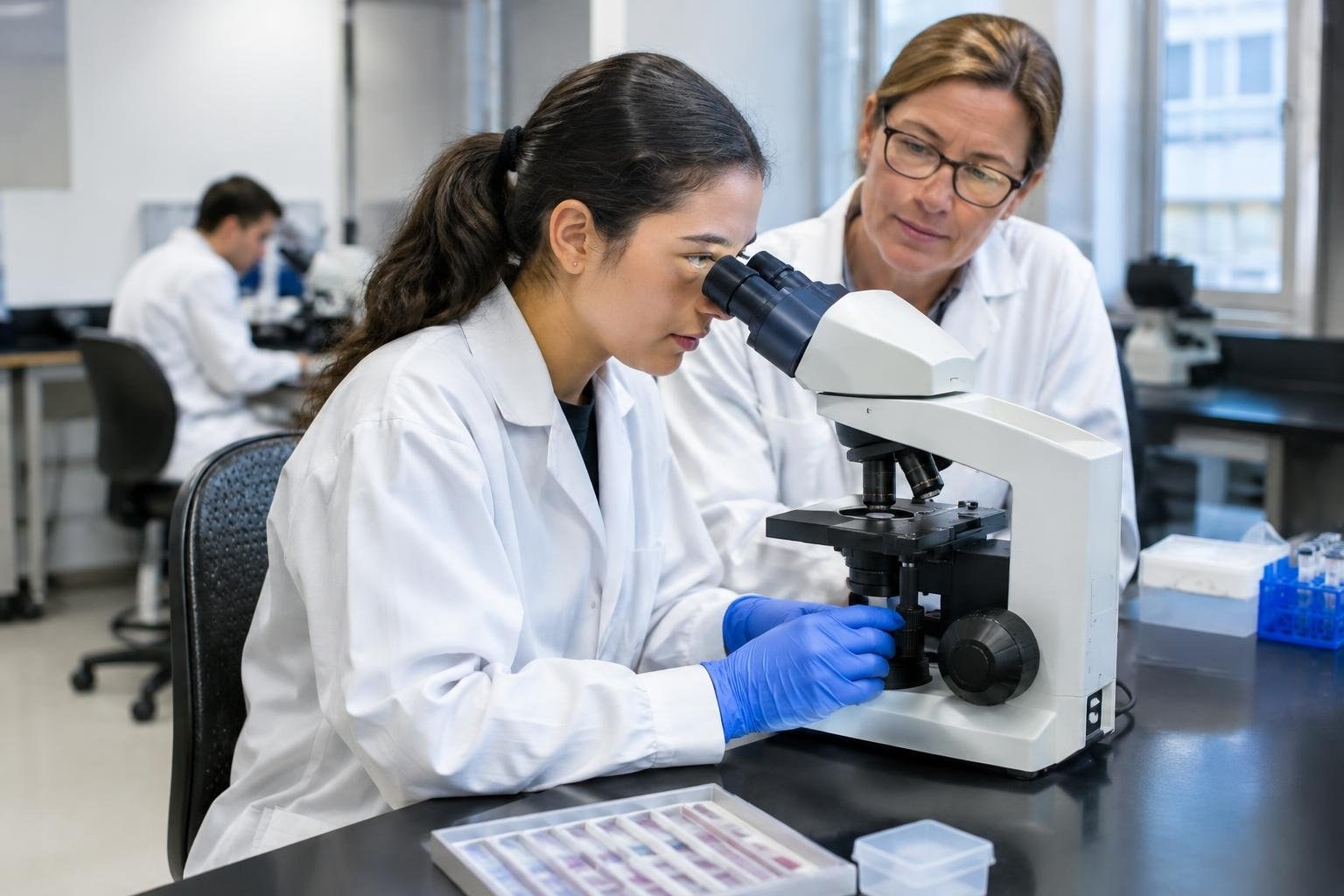
Pathologists’ Assistant Degree Guide: Training, Careers, Requirements, and Fit
Learn what pathologists’ assistant programs teach, how graduate training and state requirements work, and what to compare before choosing a program.
By David Slack · Staff Writer Assessment.com · Published October 12, 2026 · Last updated November 5, 2026
A pathologists’ assistant degree prepares students to support pathologists in anatomic pathology. The work can include examining and processing surgical specimens and assisting with gross autopsy dissection under a pathologist’s supervision. It is a specialized allied-health role, not a medical degree and not a route to becoming a physician pathologist. Programs typically build on prior college science education and combine advanced study with supervised practical experience. Graduates may work in pathology laboratories and related settings, with duties and legal requirements shaped by the employer and state. For students and parents, the key decision is whether the training, work environment, and commitment fit the student’s interests. Compare programs carefully: awards, admissions prerequisites, clinical arrangements, and licensing rules can differ.
Degree & Program Decision Insights
Explore your personal fit, education requirements, career potential and next steps.
01Motivational Fit
Discover whether this program fits you
Explore your preferences against the focus of Pathology/Pathologist Assistant. These prompts are not personal MAPP results.
Subject curiosity. Would you choose to explore “anatomy” in depth? Ask for a sample learning activity to test that interest.
Breadth of interest. Consider the place of “physiology” in this field. Is this another part you would choose to explore, or mainly a requirement you would tolerate?
Work reality. Related work can involve this task: “Maintain a proper sterile field during surgical procedures.” Would you want that activity to be a regular responsibility?
Interest in studying a field can differ from enjoying its related work.
Which part would you want to do repeatedly, and what would you try before deciding?
Discover Your Personal Program Fit
Before investing your time and money in your education, discover how this program aligns with your natural motivations, work preferences and career goals.
Typical occupational entry: postsecondary nondegree award (BLS). Check the exact professional credential and jurisdiction requirements for this occupation; the classification association alone does not establish eligibility.
U.S. occupational wages are not guaranteed graduate earnings; OEWS excludes self-employed workers.
Projected openings include replacements as well as growth.
U.S. national estimates. A crosswalk does not establish entry-level eligibility; advanced, management and teaching roles can require further qualifications.
Explore your motivations. Use MAPP as a starting point for reflecting on your interest in “anatomy”, then test that interest against a sample learning task.
Examine the work. Compare Surgical Technologists on daily work and entry qualifications, as well as pay.
Compare actual providers. Ask for the exact credential, course sequence and assessment methods. Compare how each provider teaches “physiology”, its entry criteria and its itemized costs.
Check the evidence before applying. Confirm prerequisites and any recognition or professional requirements for your intended route; ask for applicable rules and published outcome definitions in writing.
Verify the institution’s current offering, admissions requirements and outcomes; a search result does not establish your eligibility.
A pathologists’ assistant is an allied-health professional who works under a pathologist’s supervision. The role supports anatomic pathology, the area concerned with examining tissue and organs. Pathologists’ assistants may participate in examining, dissecting, and processing tissue specimens and in gross autopsy dissection. Their work contributes to the pathology process but does not make them physicians or independent diagnosing pathologists.
The study area is classified under health professions and related programs as Pathology/Pathologist Assistant, CIP 51.0811. Program names and awards vary. Examples include a Master of Science, a Master of Health Sciences concentration, and a Master of Health Science paired with a professional certificate. Do not infer a program’s availability or credential from a broad catalog category; confirm the specific program with the school.
For a comparison point, the University of Maryland program overview describes the assistant’s role in tissue examination, processing, and autopsy dissection. Old Dominion University describes surgical, autopsy, and forensic pathology services under a board-certified pathologist’s guidance.
What Do You Study in a Pathologists’ Assistant Program?
Programs prepare students for work involving both pathology knowledge and careful technical practice. The field’s instructional scope includes anatomy, physiology, medical terminology, general and systemic pathology, forensic and pediatric pathology, autopsy procedures, surgical technique, tissue preparation, medical photography, record keeping, laboratory administration, interpersonal skills, and relevant standards. Course titles and sequencing differ by school, so review a current curriculum rather than assuming every program teaches the same material in the same way.
Expect the learning to move beyond lectures. A professional program may include practical instruction and supervised experience in pathology settings, where students develop familiarity with specimen handling, documentation, and communication with clinical colleagues. Ask admissions staff for a course map and for clear information about where and how practical experience is completed.
Compare what students actually do in labs and placements, not just the number of courses. Ask whether students receive structured feedback, how competence is assessed, and what happens if a clinical placement changes. The Duke program description illustrates the intensive graduate nature of this education, including graduate credit and a required oral seminar presentation.
Skills You Develop and Why They Matter
Students develop a blend of scientific, practical, and communication skills. Coursework in anatomy, physiology, pathology, and medical terminology provides a foundation for understanding specimens and the context of pathology procedures. Practical training develops procedural awareness, careful handling, and reliable record keeping. Exact competencies should be confirmed in the program’s published curriculum and clinical learning objectives.
Scientific reasoning: connect anatomical structures and pathology concepts to the task at hand.
Precision and documentation: follow procedures and maintain clear, accurate records.
Communication: interact professionally with pathologists and other clinicians.
Professional judgment: recognize the limits of the assistant role and follow applicable standards and supervision.
Technical readiness: learn the processes and equipment used in specimen and laboratory work.
These abilities are relevant to supervised pathologists’ assistant work in surgical, autopsy, and forensic pathology services, as described by Old Dominion University. They are not a substitute for the clinical judgment or physician training of a pathologist.
Who Is This Program Best For?
This program may appeal to students who are curious about anatomy and disease, comfortable with detailed work, and interested in contributing to diagnosis through laboratory-based healthcare. It may also suit learners who prefer structured procedures and focused technical responsibilities to frequent, ongoing patient-facing care. Roles and workplaces differ, so use program visits, information sessions, and conversations with faculty to understand what the work feels like in practice.
Students and families should discuss the realities of pathology work early, including exposure to human tissue and autopsy-related procedures. The goal is not to decide based on a stereotype or a single personality test. Consider the student’s interests, academic preparation, tolerance for close procedural work, communication style, and comfort with a supervised team environment.
Does Pathologists’ Assistant Work Match You?
Salary, reputation, and general claims about demand should not outweigh whether the work and training are a good personal fit. The Free MAPP career assessment can be one starting point for exploring motivations and related career directions; treat it as a discussion aid, not an admissions or employment guarantee. You can also explore college-major decision guidance with a parent, counselor, or coach.
Admissions, Prerequisites, Time, and Academic Demands
Admissions standards are set by each institution. Because the professional training is graduate-level at the programs cited here, applicants should check whether a bachelor’s degree is required, which prerequisite courses must be completed, how science coursework is evaluated, and whether the program requires an interview, references, or other application materials. Do not assume that a particular major, GPA, test score, or experience requirement applies everywhere.
Prepare by gathering transcripts and asking admissions staff to review prerequisite courses before applying. If a school expects relevant laboratory or clinical exposure, ask what types of experience count and whether applicants can meet the requirement after submitting an application.
Program length is also school-specific. Touro describes an intensive, full-time, two-year master’s program; that example should not be treated as a universal timeline. Part-time, transfer, or online availability should be confirmed directly with each school, especially where practical placements are involved.
The academic challenge is concentrated science learning combined with procedural training and professional standards. Students can prepare by strengthening study habits, reviewing foundational biology and anatomy, managing deadlines, and seeking help early when course material or practical expectations are unclear.
Online vs. On-Campus Pathologists’ Assistant Programs
Online, hybrid, and on-campus formats are program-specific. Some lectures may be delivered remotely, but students should not assume a pathologists’ assistant program can be completed entirely online. The work described by universities includes specimen examination, processing, and autopsy-related procedures, so ask how the curriculum teaches and evaluates practical skills.
Before applying, get direct answers to these questions: Which courses require campus attendance? Where are practical placements held? Does the school arrange placements, or must students secure them? Are there required clinical hours, travel, or relocation? What happens if a site cannot take a student? What equipment, health documentation, or onboarding costs are required?
For families comparing offers, a nominally flexible format may still involve significant in-person commitments. Include those obligations in scheduling, transportation, and housing plans. Ask the program to provide its current delivery schedule and written placement policies.
Tuition, Costs, and Financial Aid
There is no single reliable price for this degree across U.S. institutions. Total cost depends on the school, tuition rate, fees, program duration, and practical-training arrangements. Build a complete estimate that includes tuition, mandatory fees, books, supplies, transportation, housing, and any costs associated with required in-person learning. If the program is intensive or full time, consider how reduced work hours could affect the family budget.
Ask each financial aid office for a written cost-of-attendance estimate and clarify whether it covers the entire program. Compare the total borrowing needed to complete the degree, not just the first semester’s bill. Ask whether institutional scholarships, need-based aid, federal aid eligibility, payment plans, or employer assistance may apply; eligibility and availability vary.
To improve affordability, compare public and private options, investigate transfer-credit rules before enrolling in prerequisite courses, and avoid paying for repeated coursework when a program confirms equivalent credit in writing. Never assume that credits or a prior credential will transfer without approval.
How to Choose a Pathologists’ Assistant Program
Pathologists’ assistant education is specialized, so evaluate programs by professional preparation rather than by name recognition alone. Start with the exact degree and certificate awarded, the curriculum, admission requirements, practical training, and graduate outcomes. Then compare the full cost and the amount of relocation or travel required.
Program status: identify the accrediting or state-recognized route and verify it with the relevant organization or licensing authority.
Curriculum: check how anatomy, pathology, specimen work, autopsy procedures, and professional responsibilities are taught.
Practical experience: learn how placements are arranged, supervised, and assessed.
Certification and state preparation: ask whether the program meets the requirements where you intend to work.
Student support: ask about advising, remediation, career services, and placement contingency plans.
Outcomes: request recent completion, certification eligibility, and employment information, including how each number is calculated.
University pages can describe a program’s mission and award, but families should also request current catalogs and written answers. Explore Assessment.com degree guides to consider other study directions alongside the school-level research.
Careers, Jobs, and Employment Outlook
The profession is a focused career path. Program descriptions point to settings and services involving surgical, autopsy, and forensic pathology, performed under a pathologist’s guidance. The most direct career target is pathologists’ assistant, but hiring requirements, job titles, duties, and work settings vary by employer and state.
Career planning should distinguish entry qualification from longer-term options. Certification, state licensure, and employer requirements may affect eligibility even after graduation. Ask programs for verified graduate outcomes and check job postings from employers in the regions where you may want to work. Avoid treating general statements about demand as a promise of a position.
There is not enough occupation-specific salary or employment-outlook information in the supplied program references to give a responsible national median-pay figure or growth rate here. For a useful comparison, request recent program-reported outcomes, examine relevant public labor-market data, and consider local employers and geographic mobility. The BLS and O*NET are appropriate places to research occupations, but be sure the occupational category truly matches this specialized role.
Related healthcare careers may share laboratory or surgical environments without having the same education or scope. For example, medical and clinical laboratory technologist careers and pathologist careers are distinct paths. Compare responsibilities and credentials instead of relying on similar job titles.
Find out which Career or College Major is right for you!
Graduating from a program, qualifying for professional certification, and meeting a state’s licensure rules are different milestones. Mayo Clinic’s career overview describes eligibility for the ASCP certification exam as requiring a bachelor’s degree and completion of an accredited pathologists’ assistant program within a specified period. It also notes continuing education for maintaining certification. Applicants should confirm current exam rules with the certifying organization before relying on a summary.
State requirements can be separate. New York’s Office of the Professions describes an education route involving a bachelor’s or higher degree and a qualifying program, including a NAACLS-accredited pathologists’ assistant program or an equivalent route. This is a state-specific example, not a nationwide rule. Check the licensing authority in the state where you plan to practice and ask the program how it supports students pursuing requirements there.
Accreditation matters because it may affect certification or licensure eligibility. Verify the program’s current status directly with the accreditor and relevant state authority; do not rely only on promotional language.
Experience, Professional Readiness, and Employer Preparation
Before the first semester, look for ways to understand the profession and strengthen your application. Ask program faculty whether prospective students can attend an information session, speak with current students, or learn about the work environment. If you pursue volunteer, research, or laboratory experience, verify that it is appropriate and permitted; experience should never involve handling specimens or performing duties without proper supervision and authorization.
During training, build a record of dependable academic and practical work. Keep track of coursework, feedback, professional development, and completed projects that can be discussed appropriately in interviews. Join relevant campus or professional activities if available, and ask faculty about networking opportunities and career resources.
How to Stand Out to Employers
Emphasize the capabilities employers can assess: careful documentation, communication, professionalism, and a clear understanding of supervised practice. Ask career services how graduates prepare for interviews and how the program shares employment outcomes. Certification can be relevant, but it does not guarantee a job, and licensure requirements vary by state.
Related Degrees, Pathways, and Alternatives
Related options depend on what the student wants from healthcare work. A bachelor’s degree in biology or another science can provide undergraduate preparation before applying to professional programs, but it is not itself the same credential as pathologists’ assistant training. A medical laboratory science or medical and clinical laboratory technology pathway may appeal to a student more interested in laboratory testing. Surgical technology may be worth investigating for someone drawn to the operating-room environment. Medical school is the separate route for students whose goal is to become a physician pathologist.
These alternatives have different curricula, admission standards, career scopes, and credentials. Confirm the specifics with official program and licensing sources. Do not assume that credits, certification, or job eligibility transfer between paths. Start with the work the student wants to do, then compare the required education and time commitment.
Biology or biomedical science: consider this for broad science study or preparation for later professional education.
Medical laboratory science: investigate if laboratory testing is the main interest.
Surgical technology: compare if the student prefers a surgical-care team setting.
Medicine and pathology: explore if the goal is physician diagnosis and medical practice.
Forensic science: consider if evidence analysis and forensic work are the stronger interest.
Advantages, Drawbacks, and Is the Degree Worth It?
There are meaningful advantages to this focused path: it connects specialized science study with practical healthcare work, supports pathologists’ services, and can lead toward a clearly defined professional role. For students who enjoy anatomy and detailed laboratory procedures, that focus may be more appealing than a broader academic degree.
The tradeoffs deserve equal attention. The pathway can require substantial prior education, intensive graduate study, and supervised practical training. It may involve exposure to autopsy procedures, a specific work environment, and state-by-state credential checks. A narrowly focused program may offer less flexibility if the student later decides the daily work is not a good fit.
Whether the degree is worth it depends on total cost, financing, program quality, completion likelihood, geographic flexibility, and realistic career outcomes. Ask schools for data and assumptions in writing. Compare the expected debt with earnings information from reliable, current sources rather than relying on general claims about demand. Discuss whether the student would still value the education if the first preferred job is not immediately available.
From Degree to Career: Plan the Next Steps
Career development is not automatic, but a student can map realistic steps and confirm them with program advisers. One possible sequence is: undergraduate science preparation → pathologists’ assistant graduate program → supervised entry into a pathology workplace → added experience in a service area such as surgical, autopsy, or forensic pathology → expanded responsibilities where the employer and applicable rules allow.
Each transition depends on completing the relevant education, meeting certification or state requirements, finding an appropriate position, and developing experience. Ask employers and program alumni what advancement looks like in their settings. Do not assume a graduate credential guarantees a specific title, salary, or promotion.
Before choosing, ask yourself and the school:
Have I observed or learned enough about pathology work to understand its daily demands?
What exact bachelor’s-level coursework and experience do I need to apply?
What is the program’s total estimated cost, including practical training?
Where will placements occur, and who arranges them?
Does the program meet certification and state requirements where I may work?
What are recent completion, certification, and employment outcomes, and how are they measured?
What support exists if I struggle academically or a placement is delayed?
Will credits transfer if I change plans?
Frequently asked questions
What is a pathologists’ assistant degree?
A pathologists’ assistant program prepares students to support pathologists with anatomic pathology services, including examining and processing tissue specimens and assisting with autopsy work. The profession is distinct from becoming a pathologist, who is a physician. Many programs are graduate-level and combine classroom instruction with practical training. Confirm the exact award, prerequisites, clinical experience, and any state rules with each institution and licensing authority.
Is a pathologists’ assistant program hard?
The work is best suited to people who are comfortable with detailed anatomy and tissue-based laboratory work, can follow procedures carefully, and communicate clearly with clinicians and colleagues. Some responsibilities involve autopsy procedures and handling human tissue, so students should learn what the practical work entails before applying. A particular personality type is not required; careful attention, emotional readiness, and genuine interest in the work matter more than a label.
How long does it take to become a pathologists’ assistant?
Pathologists’ assistant training is generally a focused professional pathway rather than a common undergraduate major. The program examples in this guide are master’s programs, including a full-time, two-year option. Applicants commonly prepare with a bachelor’s degree and relevant science coursework, but exact admissions requirements differ. Check each program’s current catalog and admissions materials for prerequisites, deadlines, and clinical requirements.
Do you need a bachelor’s degree to become a pathologists’ assistant?
Many students pursue a bachelor’s degree before applying to a graduate pathologists’ assistant program. Requirements differ by institution, so ask whether the program requires specific biology, anatomy, chemistry, or other prerequisite courses, and how it evaluates prior clinical or laboratory experience. A bachelor’s degree alone does not necessarily qualify someone for professional certification or state licensure.
Can you earn a pathologists’ assistant degree online?
Online coursework may be possible in some programs, but the profession involves practical pathology services, so applicants should expect to verify whether hands-on instruction, clinical placements, or other in-person requirements apply. Do not assume a program can be completed fully online. Ask the program where practical training occurs, whether students must relocate or travel, and how clinical placements are assigned.
How much does pathologists’ assistant school cost?
Costs vary by institution, residency, program length, fees, and the location and format of required practical training. Compare the full cost of attendance, not tuition alone: include housing or travel for clinical work, supplies, health requirements, and lost income if full-time study limits employment. Ask financial aid offices about grants, scholarships, loans, and payment options, then compare the estimated debt with verified program outcomes.
Do pathologists’ assistants need a license or certification?
Certification and state authorization are separate questions. Mayo Clinic’s career overview describes eligibility for the ASCP pathologists’ assistant certification exam as requiring a bachelor’s degree and completion of an accredited program within the stated time window, and notes continuing education requirements for maintaining certification. State rules can add separate requirements. Check current ASCP eligibility information and the licensing authority in the state where you plan to work.
What is the difference between a pathologists’ assistant and a surgical technologist?
The pathologists’ assistant works under a pathologist’s supervision and supports anatomic pathology services, including tissue examination and processing and gross autopsy dissection. A surgical technologist supports the surgical setting and is a different career path. Compare the work environment, patient contact, training pathway, and state credential requirements for each before choosing; the titles are not interchangeable.
People Also Ask
What does a pathologists’ assistant do?
Pathologists’ assistants work under a pathologist’s supervision, supporting anatomic pathology tasks that can include tissue examination and processing and gross autopsy dissection. They are allied-health professionals, not physicians.
What degree do you need before pathologists’ assistant school?
Many pathologists’ assistant applicants complete a bachelor’s degree before graduate training. Individual programs set their own academic prerequisites and admissions standards, so check current institution requirements rather than relying on a general list.
What should families include when budgeting for this degree?
Program cost depends on the institution, tuition classification, required fees, and the practical-training arrangement. Also budget for housing, transportation, equipment, and any costs associated with in-person placements.
Are pathologists’ assistant programs fully online?
A classroom-only online format may not prepare students for hands-on pathology responsibilities. Ask whether coursework is online, hybrid, or in person and how students complete required practical training.
How can I check a state’s pathologists’ assistant requirements?
Check the state where you plan to work for licensure rules and confirm the program’s accreditation and certification-exam eligibility. New York’s Office of the Professions, for example, describes specific education routes for state licensure.
Is a pathologists’ assistant a doctor?
Training focuses on supporting pathology services, while a pathologist is a physician. Pathologists’ assistants do not become pathologists by completing this program; medical education and physician training are separate pathways.
Pathologists’ assistant education can suit students drawn to anatomy, careful specimen work, and behind-the-scenes contributions to diagnosis. The usual path requires substantial science preparation followed by a focused graduate program, supervised practical training, and attention to state rules and certification eligibility. Compare program accreditation, clinical placements, total cost, and graduate outcomes before enrolling. Most importantly, consider whether the day-to-day work and training fit your interests as well as your career goals.
Want to see your options? Try our comprehensive Degree, Program & College Search tool
We use cookies to offer you a better browsing experience, analyze site traffic and personalize content.
Read about how we use cookies and how you can control them in our
Privacy Policy.
If you continue to use this site, you consent to our use of cookies.
×
Exciting News!
Be one of the first to Beta Test the new AI-Powered Assessment.com Platform.