Medical/Clinical Assistant Programs: Courses, Careers, Cost, and Fit
Learn what Medical/Clinical Assistant programs teach, how certificates and associate degrees differ, what to check before enrolling, and how graduates can prepare for medical assistant work.
By Kieth Nelson · Staff Writer Assessment.com · Published October 12, 2026 · Last updated November 5, 2026
A Medical/Clinical Assistant program prepares students for work that combines medical-office support with clinical tasks performed under physician supervision. Students may learn to support patient intake, routine recording and diagnostic procedures, examination preparation, and office workflows. Coursework can cover anatomy and physiology, medical terminology, medical law and ethics, communication, and clinical procedures, though requirements vary by college. Programs may award a certificate or form part of a longer degree pathway. The credential alone does not establish that every graduate is eligible for every certification or job; program accreditation, hands-on requirements, and employer expectations matter. Prospective students and parents should compare the curriculum, total cost, schedule, and next-step options before choosing a school.
Degree & Program Decision Insights
Explore your personal fit, education requirements, career potential and next steps.
01Motivational Fit
Discover whether this program fits you
Explore your preferences against the focus of Medical/Clinical Assistant. These prompts are not personal MAPP results.
Reasoning and public responsibility. Does studying medical law and ethics interest you enough to examine competing interpretations and explain a careful conclusion?
Understanding people and societies. Would you enjoy investigating patient psychology and communications, comparing perspectives rather than expecting a single simple explanation?
Work reality. Related work can involve this task: “Prepare and administer medications as directed by a physician.” Would you want that activity to be a regular responsibility?
Interest in studying a field can differ from enjoying its related work.
Which part would you want to do repeatedly, and what would you try before deciding?
Discover Your Personal Program Fit
Before investing your time and money in your education, discover how this program aligns with your natural motivations, work preferences and career goals.
Explore these official instructional-field associations. They describe possible occupational routes, not measured outcomes of this program.
Medical AssistantsSOC 31-9092 · O*NET 31-9092.00$45,690/year median (May 2025); +12.9% projected change (2025–2035); 109,700 projected openings/year.
Typical occupational entry: postsecondary nondegree award (BLS).
Health Specialties Teachers, PostsecondarySOC 25-1071 · O*NET 25-1071.00$107,310/year median (May 2025); +17.9% projected change (2025–2035); 24,900 projected openings/year.
Typical occupational entry: doctoral or professional degree (BLS). BLS lists less than 5 years of related work experience as typical for this occupation; this programme is not a direct promise of entry. Postsecondary teaching is a separate appointment and may require advanced study; this programme alone is not a promise of a teaching post.
U.S. occupational wages are not guaranteed graduate earnings; OEWS excludes self-employed workers.
Projected openings include replacements as well as growth.
U.S. national estimates. A crosswalk does not establish entry-level eligibility; advanced, management and teaching roles can require further qualifications.
Compare the focus and route of these distinct instructional fields; their credentials and admission requirements are not interchangeable.
Clinical/Medical Laboratory AssistantCIP 51.0802. Compare its emphasis on clinical procedures and various laboratory tests with this program’s focus.
Anesthesiologist AssistantCIP 51.0809. Compare its emphasis on patient data collection and catheter insertion with this program’s focus.
Chiropractic Technician/AssistantCIP 51.0813. Compare its emphasis on the principles and procedures of chiropractic and radiographic X-Ray procedures and techniques with this program’s focus.
Explore your motivations. Use MAPP as a starting point for reflecting on your interest in “basic anatomy and physiology”, then test that interest against a sample learning task.
Examine the work. Compare Medical Assistants and Health Specialties Teachers, Postsecondary on daily work and entry qualifications, as well as pay. Explore Medical Assistants.
Compare actual providers. Ask for the exact credential, course sequence and assessment methods. Compare how each provider teaches “medical terminology”, its entry criteria and its itemized costs.
Check the evidence before applying. Confirm prerequisites and any recognition or professional requirements for your intended route; ask for applicable rules and published outcome definitions in writing.
Verify the institution’s current offering, admissions requirements and outcomes; a search result does not establish your eligibility.
Medical/Clinical Assistant is the Classification of Instructional Programs (CIP) field 51.0801. The program description covers preparation for medical-office administrative services and clinical duties under physician supervision. Those duties may include patient intake, routine diagnostic and recording procedures, preparing for examinations, assisting during examinations, and support with medications and first aid as allowed by the setting and applicable rules.
The field brings together two kinds of work: keeping patient visits and office processes organized, and assisting with routine clinical procedures. Program names vary, including Medical Assistant, Medical/Clinical Assistant, and Medical Assisting. A program’s name does not tell you by itself which skills, credential, or certification preparation it includes. Review its official catalog and course sequence. The U.S. Department of Education CIP code is a field classification, not a guarantee that every credential level is available at every school.
For a sense of the stated scope, compare the Pennsylvania program description for CIP 51.0801 with the details published by colleges offering this subject.
What Students Study and Practice
Expect a blend of classroom learning and applied practice, with the exact balance set by the program. The field description identifies several core areas: basic anatomy and physiology, medical terminology, medical law and ethics, patient psychology and communication, office procedures, and clinical diagnostic, examination, testing, and treatment procedures.
Health foundations: Learn basic body systems and vocabulary used to understand instructions and communicate accurately.
Communication and professional practice: Study patient interaction, privacy-minded conduct, and legal and ethical topics relevant to the role.
Office work: Build familiarity with medical-office procedures and the organized handling of information and appointments.
Clinical support: Practice routine tasks such as intake, recording information, and assisting with preparation for examinations, as included in the curriculum.
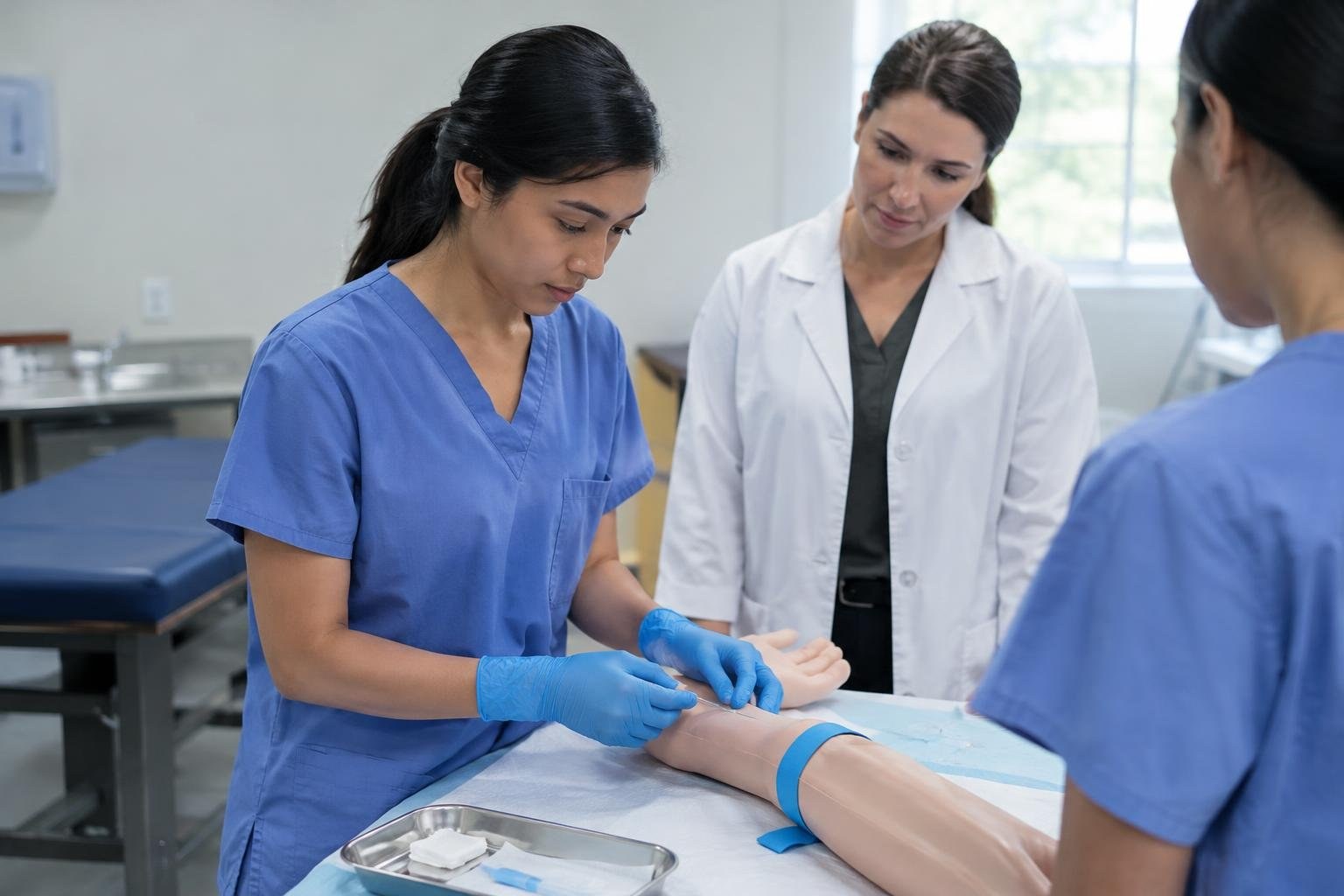
Ask whether the program includes supervised skills practice, a practicum, or an outside clinical placement. Do not assume that a course title means a particular procedure is taught or that students will perform it in a workplace. A college should be able to explain what students practice, how they are evaluated, and which activities are required in person. Quincy College describes its certificate as including hands-on training; that is a program-specific example, not a promise about all programs.
See the Quincy College certificate description and compare it with the published plan at each school you are considering.
Who Might Choose This Program? Fit and Entry Requirements
This field can appeal to students interested in healthcare who also like organized office work and frequent communication. The work described for the program includes patient intake and care support, recording routine information, helping prepare for examinations, and medical-office services. Students should consider whether they are comfortable learning health terminology, following detailed procedures, communicating respectfully, and switching between administrative and clinical tasks.
No single personality type is required. A prospective student might prefer direct patient contact, predictable routines, practical skill-building, or a mix of people-focused and detail-focused tasks. The important question is whether the actual duties and working environment sound sustainable and interesting, not whether the title feels appealing.
Common entry requirements
Admissions prerequisites are institution-specific. Check the current admissions page for school completion requirements, placement steps, background or health documentation if applicable, course prerequisites, and any selection process. Do not rely on general assumptions about GPA, tests, interviews, or health clearances; ask the college what applies to the exact cohort and program. If you are a parent helping a student, have them speak directly with an advisor and review the catalog together.
Before applying, use Assessment.com’s college-major decision guide as a starting point for comparing personal interests with program expectations.
Credential Levels, Format, and Time to Completion
There is no single completion time for every Medical/Clinical Assistant program. The credential, required courses, course availability, attendance pattern, transfer credit, and any practical component affect the schedule. Certificate programs are often designed as focused preparation, while an associate-degree option involves a broader credential plan, but students should compare actual institutional plans rather than infer duration from the award name.
Ask for the number of courses and terms required, whether classes are offered in the evening or during summer, and what happens if a required course is not offered when expected. A New Jersey workforce listing identifies one training option as offering evening courses, illustrating that schedules can differ by provider; it should not be treated as a standard feature of all programs.
Online, hybrid, and campus availability also varies. Confirm which lessons are remote, whether skills work or clinical experiences require travel, and whether the school arranges placement or expects students to do so. Get the total timeline in writing, including any prerequisites that must be completed before the core program.
Tuition, Total Cost, and Financial Aid
Program prices depend on the institution and the student’s circumstances. Before comparing offers, request a complete estimate covering tuition, mandatory fees, books, equipment or supplies, technology, transportation, and any costs connected with in-person practice. Ask whether the quoted figure is for the full program or only one term. The supplied college program pages establish that certificate options exist but do not provide a consistent national price, so compare current official cost pages directly.
For affordability, consider public and private colleges, in-state and out-of-state rates where relevant, part-time study, transfer credit, and whether an employer offers education assistance. Contact the school’s financial aid office to ask about grants, scholarships, payment plans, and aid eligibility. Do not assume that an advertised aid amount is a grant or that a short program qualifies for every form of aid.
Compare net cost, not just tuition. A program with a lower per-credit price may still require additional travel or materials. Ask what happens financially if a student must repeat a course, extend the program, or complete a placement farther from home.
Careers, Jobs, and Employment Outlook
A certificate or associate degree in this field most directly relates to medical assistant employment. The program description also connects training to office services and clinical support, but job titles and assigned duties vary by employer. A graduate may seek positions in medical offices and similar care settings, then build experience in a specialty or take on additional responsibilities when qualified.
The research available for this guide does not establish current salary or national job-growth estimates. Do not use a school’s promotional wage claim as a substitute for occupational data. Compare current U.S. Bureau of Labor Statistics information, state labor-market resources, and job postings in the locations where you could work. Pay and hiring needs can vary by area, employer, experience, and credentials.
Medical assistant is the direct career connection. Postsecondary teaching in health specialties is a separate, longer-term path: a short medical assistant credential should not be read as sufficient qualification to teach at a college. Review the requirements for a particular teaching role and institution.
Explore Assessment.com’s medical assistant career guide and browse healthcare support careers for related roles.
Find out which Career or College Major is right for you!
Program accreditation and professional certification are separate checks. Western Technical College states that its Medical/Clinical Assistant program has programmatic accreditation from the Commission on Accreditation of Allied Health Education Programs (CAAHEP), on the recommendation of the Medical Assisting Education Review Board (MAERB). That statement applies to that named program; it does not establish the accreditation status of another school or campus.
Ask a college for the exact program name and location covered by its accreditation, the accrediting organization, and the current status. Verify the claim with the accreditor rather than relying only on a general college statement. Separately, ask which certification examinations the curriculum is designed to support and what eligibility conditions apply. A certificate of completion is not automatically professional certification.
Rules and scope of practice can differ by state and setting. Before enrolling, confirm requirements with the relevant state authority and prospective employers, especially if your intended duties include tasks that may be regulated. Pennsylvania’s CIP resource includes a certification-related classification note, but it should not be treated as a nationwide licensing rule.
Read the school’s Western Technical College program accreditation statement and the Pennsylvania CIP document as examples of program- and jurisdiction-specific information.
Certification, Practical Experience, and Employer Preparation
Certification may help clarify a student’s preparation, but its relevance depends on the credential, eligibility rules, and employer expectations. A New Jersey workforce listing associates a training option with Certified Clinical Medical Assistant preparation and includes job-placement assistance among its listed features. Those are details of that specific listing, not universal benefits or requirements.
Ask the program to identify certification examinations by their exact names, explain what coursework or experience is needed to qualify, and state whether exam fees are included. Confirm this information with the certification body and compare current local job postings to see which credentials employers request. Also ask whether the school provides supervised practical experience and how students document competencies.
To strengthen applications, keep a clear record of completed coursework and practical skills, request references from instructors or placement supervisors, and practice explaining how your training relates to the tasks in a job posting. Never claim competence in a procedure you have not been trained and authorized to perform.
Related Degrees, Transfer Paths, and Alternatives
Some students use a focused certificate as a first step and later continue their education. Community College of Philadelphia states that courses in its Medical Assistant proficiency certificate can be used toward an Associate Degree in Health Care Studies. Aims Community College describes a route from its certificate to an Allied Health Professional associate degree while working. These are examples of named institutional pathways, not a promise that credits will transfer between unrelated schools.
Before choosing a certificate, ask whether it is stackable into a specific associate degree, which courses count, whether grades or time limits apply, and whether the agreement could change. Get a written transfer evaluation from the receiving institution. Students seeking management, teaching, or another clinical profession should identify that target first and map its separate education and credential requirements instead of assuming an assistant program automatically leads there.
See the Community College of Philadelphia’s certificate pathway information and Aims Community College’s certificate and associate-degree options.
How to Choose a Medical/Clinical Assistant Program
Use a short list of programs and compare the same details for each. Accreditation and certification preparation matter, but they are only part of the decision. Check course content, supervised practice, schedule, location, total cost, student support, and any transfer agreement.
Curriculum: Does the course plan cover office work and the clinical skills you expect to learn?
Hands-on preparation: What practice or placement is required, who arranges it, and how are skills assessed?
Credential and progression: Is the award a certificate or degree, and are there confirmed options to continue?
Accreditation and certification: Can you verify program status and the exact certification pathways?
Schedule and access: Are required classes offered at times and locations you can manage?
Cost and completion: What is the full estimated price and realistic term-by-term timeline?
Outcomes and support: What placement support, advising, and career services are available, and how are outcomes measured?
Request answers in writing, especially for promises about employment, credit transfer, certification eligibility, and clinical placements. Compare official catalogs and school cost pages rather than relying on a general search result or verbal estimate. For questions about how a program aligns with interests, Assessment.com offers a MAPP career assessment as one input to career and education exploration, not as a substitute for program research.
Questions to Ask Before Enrolling
Before paying a deposit, prospective students and parents can work through this checklist together:
What exact credential will I earn, and what courses are required?
What are the admission prerequisites and any health, background, or placement requirements?
What is the total estimated cost, including fees, supplies, travel, and possible exam expenses?
Is the specific program accredited, and how can I verify its current status?
What practical training is required, and who arranges it?
Which certification examinations does the program prepare students to pursue, and what are the eligibility rules?
Can courses be completed online, and which requirements must be completed in person?
Can credits apply to a named next credential, confirmed in writing by the receiving school?
What career services and employer connections are available, and what outcome data does the college publish?
What financial aid, scholarships, employer assistance, or payment options should I investigate?
Then compare your answers against the day-to-day work you want. Medical assisting involves both support for patients and detail-oriented office or clinical tasks. A good education choice should make sense academically, financially, and personally.
From Program to Career: Example Pathways
Possible progression depends on the student’s choices, employer needs, and additional qualifications. One realistic example is: Medical/Clinical Assistant certificate → entry-level medical assistant position → workplace experience and additional training → a focused role or further education. Another is: certificate with confirmed transfer credit → associate degree in a related field → a broader set of healthcare-support or administrative opportunities, depending on the degree and employer requirements.
These are planning examples, not guaranteed promotions or employment outcomes. A college credential does not guarantee a job, a particular salary, credit transfer, or permission to perform every clinical task. Before choosing a route, verify the next credential’s entry requirements and ask employers in your area what they look for.
Frequently asked questions
What is a Medical/Clinical Assistant program?
Medical/Clinical Assistant programs prepare students for a blend of medical-office administration and clinical support under physician supervision. Common subject areas include anatomy and physiology, medical terminology, medical law and ethics, communication, office procedures, and clinical procedures. Specific classes, credentials, and hands-on requirements differ by institution, so compare official program plans before applying.
How long does it take to become a medical assistant?
Programs may be offered as certificates or as part of a longer associate-degree path. The time to completion depends on the school’s course sequence, credential, attendance schedule, and any transfer credit. Check the published program map and ask the college for a term-by-term plan rather than assuming every certificate takes the same amount of time.
Can you earn a Medical/Clinical Assistant certificate online?
Yes, some medical assistant education is available online or in a hybrid format. However, online delivery does not necessarily mean every requirement can be completed remotely. Ask whether skills practice, clinical experience, examinations, or other required activities take place in person, and where those activities can be completed.
Does a Medical/Clinical Assistant program require math or science?
Coursework may include basic anatomy and physiology, routine diagnostic and recording procedures, and clinical examination or testing topics. That means students should expect to learn some health-science concepts and use measurements or numerical information in context. Review the course descriptions and ask about tutoring or prerequisite preparation if science or math is a concern.
Do medical assistants need certification after completing a program?
Certification is separate from earning a school credential. The certification examinations a program prepares students for, eligibility rules, and the value employers place on a credential can vary. Before enrolling, ask the school which certification pathways its curriculum supports and confirm current eligibility directly with the certification organization and prospective employers.
How much do medical assistants make, and what is the job outlook?
The available research supports Medical/Clinical Assistant education as preparation for medical assistant work, but does not provide current national salary or job-growth figures. Pay and opportunities depend on factors such as location, employer, experience, and credentials. Compare current occupation data from the U.S. Bureau of Labor Statistics and local job postings before making a financial decision.
Is a medical assistant certificate better than an associate degree?
A certificate can provide a focused route into the field, while an associate degree may include a broader course plan or support continued study. The exact difference depends on each college. Some institutions describe certificate courses that can be applied toward further study, but transfer is never automatic; get written confirmation of how credits apply to the specific next program.
Is a Medical/Clinical Assistant program worth it?
A program can be worth considering if its total cost, length, practical preparation, and certification pathway fit your plans. Do not judge value by the credential name alone. Check accreditation, hands-on learning, transfer options, local employer expectations, and realistic entry-level opportunities, then compare those benefits with your tuition and other expenses.
People Also Ask
What do you learn in a Medical/Clinical Assistant program?
A Medical/Clinical Assistant program teaches a combination of medical-office procedures and clinical support skills. Coursework commonly covers anatomy and physiology, terminology, law and ethics, patient communication, intake, and routine procedures. Confirm course and hands-on requirements in each school’s current program catalog.
How long is a medical assistant course or degree?
Program duration depends on the credential and institution. Certificate and associate-degree plans can have different course sequences, and part-time schedules or transfer credits may change the timeline. Ask each school for its normal completion plan and the actual schedule available to you.
Are Medical/Clinical Assistant programs fully online?
Students may find online or hybrid coursework, but practical training requirements can still involve in-person activities. Ask whether the program includes supervised skills practice or clinical experience, how those components are arranged, and whether students must find a placement themselves.
How much does it cost to study medical assisting?
Program costs vary by college, residency, course format, and required materials or fees. Compare each program’s complete published cost rather than tuition alone. Ask financial aid offices about grants, scholarships, payment options, and whether prior credits may apply.
What jobs can you get with a medical assistant certificate?
Graduates most directly prepare for medical assistant roles. A Medical/Clinical Assistant curriculum covers both office and clinical support, but it does not by itself qualify someone as a nurse, physician assistant, or other separately trained and regulated professional. Explore each career’s distinct education requirements before choosing a pathway.
Is certification required after a medical assistant program?
Not necessarily. Certification is distinct from completing a certificate or degree, and requirements differ by credential and jurisdiction. Check the exact certification examination, eligibility conditions, and employer expectations that apply to your planned program and location.
Can a medical assistant certificate transfer to an associate degree?
Some colleges describe certificate credits as a route toward additional study, including an associate degree. That possibility depends on the institution and the specific agreement or course evaluation. Request written confirmation before counting on credits transferring to another college or program.
A Medical/Clinical Assistant program can suit students who want practical preparation for a mix of patient-facing clinical tasks and medical-office work. The right credential, course plan, and hands-on experience depend on the role you want and the requirements of employers and the state where you plan to work. Compare the full cost and program outcomes, check accreditation and certification eligibility, and consider whether the day-to-day work matches your interests before enrolling. For help exploring personal fit, use Assessment.com’s MAPP career assessment to examine how your motivations and preferences relate to healthcare careers and education options.
Want to see your options? Try our comprehensive Degree, Program & College Search tool
We use cookies to offer you a better browsing experience, analyze site traffic and personalize content.
Read about how we use cookies and how you can control them in our
Privacy Policy.
If you continue to use this site, you consent to our use of cookies.
×
Exciting News!
Be one of the first to Beta Test the new AI-Powered Assessment.com Platform.