Radiologist Assistant Guide: Programs, Clinical Training, Careers, and Fit
A radiologist assistant works under a radiologist’s supervision and may perform selected imaging procedures and patient-care duties. Learn about program pathways, clinical training, costs, credentials, and career fit.
By Tome Fierre · Staff Writer Assessment.com · Published October 26, 2026 · Last updated November 5, 2026
A radiologist assistant is an advanced radiologic imaging professional who works under a radiologist’s supervision. The role combines patient assessment and management with selected imaging procedures and initial observations of diagnostic images. Education typically builds on radiography preparation, and the programs described by universities include both advanced coursework and clinical learning. This is a focused healthcare pathway for people interested in imaging technology, direct patient care, anatomy, and team-based clinical work. It is not the same as becoming a radiologist, which is a physician career, or entering the field as a radiologic technologist. Program availability, admission criteria, clinical arrangements, and credential rules must be confirmed with each school. Not sure whether this path fits you? Take the Free MAPP Career Assessment to explore how your motivations and preferences may align with healthcare careers and educational pathways.
Degree & Program Decision Insights
Explore your personal fit, education requirements, career potential and next steps.
01Motivational Fit
Discover whether this program fits you
Explore your preferences against the focus of Radiologist Assistant. These prompts are not personal MAPP results.
Care and responsibility. Would you want to develop the skills involved in patient assessment, while taking the other person’s needs and professional boundaries seriously?
Breadth of interest. Consider the place of “radiologic procedures and techniques” in this field. Is this another part you would choose to explore, or mainly a requirement you would tolerate?
Work reality. What would an actual workday connected with Radiologist Assistant involve? Investigate the setting and entry requirements separately from your interest in studying the field.
Interest in studying a field can differ from enjoying its related work.
Which part would you want to do repeatedly, and what would you try before deciding?
Discover Your Personal Program Fit
Before investing your time and money in your education, discover how this program aligns with your natural motivations, work preferences and career goals.
Explore these official instructional-field associations. They describe possible occupational routes, not measured outcomes of this program.
Health Technologists and Technicians, All OtherSOC 29-2099
The official crosswalk associates this instructional field with the broad Health Technologists and Technicians, All Other group. It does not establish a particular detailed specialty or a direct programme-to-job outcome.
U.S. SOC 29-2099 Health Technologists and Technicians, All Other is a broad occupational group. Its statistics are not estimates for a particular specialty, starting role or this programme’s graduates.
Typical occupational entry: postsecondary nondegree award (BLS). Check the exact professional credential and jurisdiction requirements for this occupation; the classification association alone does not establish eligibility.
Healthcare Support Workers, All OtherSOC 31-9099
The official crosswalk associates this instructional field with the broad Healthcare Support Workers, All Other group. It does not establish a particular detailed specialty or a direct programme-to-job outcome.
U.S. SOC 31-9099 Healthcare Support Workers, All Other is a broad occupational group. Its statistics are not estimates for a particular specialty, starting role or this programme’s graduates.
Typical occupational entry: high school diploma or equivalent (BLS).
U.S. occupational wages are not guaranteed graduate earnings; OEWS excludes self-employed workers.
Projected openings include replacements as well as growth.
U.S. national estimates. A crosswalk does not establish entry-level eligibility; advanced, management and teaching roles can require further qualifications.
Compare the focus and route of these distinct instructional fields; their credentials and admission requirements are not interchangeable.
Respiratory Therapy Technician/AssistantCIP 51.0812. Compare its emphasis on patient data collection and monitoring and airway management with this program’s focus.
Speech-Language Pathology AssistantCIP 51.0816. Compare its emphasis on speech and language development and phonetics with this program’s focus.
Medical/Clinical AssistantCIP 51.0801. Compare its emphasis on basic anatomy and physiology and medical terminology with this program’s focus.
Explore your motivations. Use MAPP as a starting point for reflecting on your interest in “radiologic procedures and techniques”, then test that interest against a sample learning task.
Examine the work. Compare Health Technologists and Technicians, All Other and Healthcare Support Workers, All Other on daily work and entry qualifications, as well as pay.
Compare actual providers. Ask for the exact credential, course sequence and assessment methods. Compare how each provider teaches “cross sectional anatomy”, its entry criteria and its itemized costs.
Check the evidence before applying. Confirm prerequisites and any recognition or professional requirements for your intended route; ask for applicable rules and published outcome definitions in writing.
Verify the institution’s current offering, admissions requirements and outcomes; a search result does not establish your eligibility.
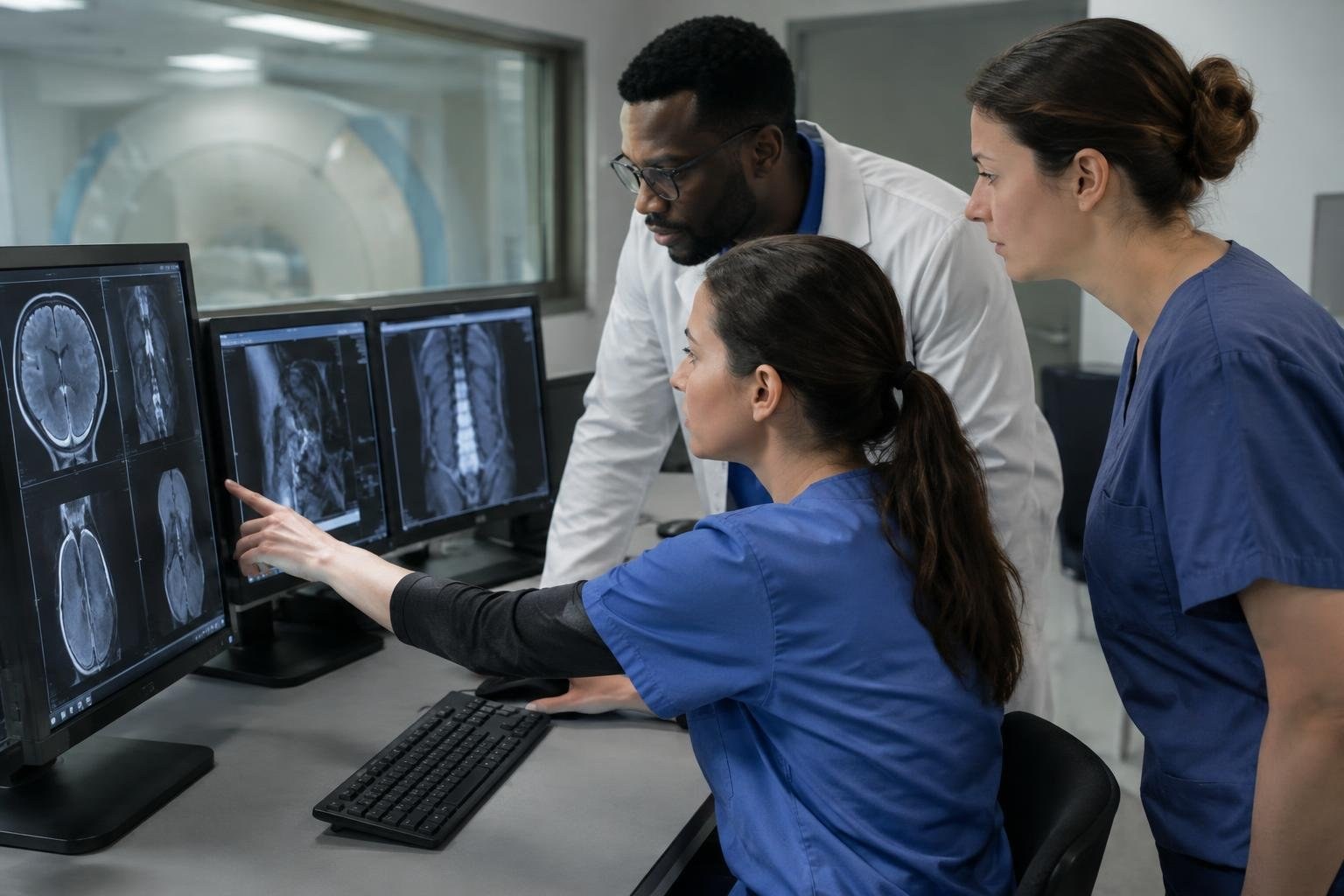
A supervised medical imaging team reviewing diagnostic images
What Is a Radiologist Assistant Program?
A radiologist assistant (RA) is a healthcare professional who works under a radiologist’s supervision. The role may include patient assessment and management, selected imaging procedures, and initial observations of diagnostic images. The program description for this field includes radiologic procedures, cross-sectional anatomy, pharmacology, pathophysiology, patient care, and radiation biology.
The title can be confusing. A radiologist is a physician, while a radiologic technologist is trained to perform imaging examinations. Radiologist assistant education is a specialized advanced pathway related to radiography, not a substitute for medical school or an introductory radiography program.
Program names and credential levels vary. University examples include master’s-level radiologist assistant study, while some students may first complete a bachelor’s pathway or additional preparation. A catalog listing of possible credential levels for a field does not prove that every institution offers every level.
What Do You Study in a Radiologist Assistant Program?
Radiologist assistant study combines clinical science with advanced imaging knowledge. Core topics commonly include cross-sectional anatomy, radiologic procedures and techniques, pharmacology, pathophysiology, radiation biology, patient assessment, and patient care management. The goal is to understand how imaging procedures relate to anatomy and patient needs, and how to work appropriately within physician supervision.
Coursework may use cases and discussion to connect theory with clinical decisions. Loma Linda’s program description refers to discussion, projects, case studies, web-based learning, and clinical mentoring across neonatal, pediatric, adult, and geriatric populations. That mix gives applicants a useful question to ask: how much of the curriculum is classroom learning, and how much is applied in supervised clinical settings?
Expect hands-on learning to matter. The University of North Carolina describes a radiologist-directed clinical preceptorship completed off campus. Loma Linda’s catalog says students are responsible for finding their own clinical site, so placement responsibilities can differ significantly between programs. Confirm these details before accepting an offer.
Skills You Build
Students develop knowledge of imaging procedures, anatomy, radiation biology, patient care, and clinical workflows. They also practice communicating with patients and collaborating with physicians and other members of a healthcare team. During clinical education, the challenge is to apply classroom knowledge carefully and professionally in real patient-care situations.
Useful skills include attention to detail, clear communication, situational awareness, professional judgment, and the ability to follow established procedures. Patient-facing work also calls for respect, calm explanations, and sensitivity to people who may be anxious or unwell. Technical knowledge matters, but a student should also consider whether the pace and interpersonal demands of clinical work feel appropriate.
Specific equipment, software, and competency expectations depend on the school and clinical site. Ask which imaging environments students experience and how faculty assess practical skills, feedback, and readiness for supervised responsibilities.
Who Is This Path Best For?
This pathway may appeal to people who are interested in anatomy and imaging, enjoy learning how technology supports diagnosis, and want substantial interaction with patients. It also requires comfort with clinical responsibility, careful teamwork, and a role whose scope is defined by physician supervision and applicable rules.
You do not need to fit one personality profile to consider this career. Instead, think about the work itself: Would you like learning detailed anatomy? Can you stay attentive to procedures and patient needs? Are you comfortable asking for guidance, working within a team, and receiving feedback during clinical practice?
Does this program match you?
Salary, prestige, and general healthcare demand do not tell you whether the day-to-day work will suit you. Compare the actual duties, required education, clinical environment, and personal tradeoffs. The Free MAPP Career Assessment can help you explore interests and preferences alongside degree and career options. Treat an assessment as one input, then verify your conclusions by speaking with program advisors and professionals.
Admissions, Prerequisites, and Academic Difficulty
Admissions requirements are program-specific. A route described by Rutgers is designed for ARRT-certified radiologic technologists who graduated from an accredited radiography program and earned an associate degree; the track includes completion of a B.S. in Health Sciences while preparing for the M.S. Radiologist Assistant program. This is an example of one pathway, not a universal checklist for every school.
Before applying, ask whether you need prior radiography education, certification, clinical experience, prerequisite science courses, a particular degree, or an active credential. Also check application deadlines, transcripts, references, interviews, background checks, and health documentation directly with the institution. Requirements can change, and an old catalog page may not reflect current admissions practice.
Academic challenges may include advanced anatomy and pathophysiology, connecting medication knowledge with patient care, and meeting the demands of clinical learning. Prepare by reviewing prerequisite expectations early and making a realistic plan for coursework, work, family responsibilities, and clinical scheduling.
Credential Pathways, Program Format, and Time to Completion
Radiologist assistant pathways can involve more than one credential stage. Some students first complete radiography education and earn professional certification; an advanced program may then build on that preparation. Rutgers describes a health sciences bachelor’s track for eligible radiologic technologists preparing for a master’s-level program. Midwestern State University lists a Master of Science in Radiologic Sciences for Radiologist Assistant.
Completion time depends on prior credits and the specific program. The University of North Carolina describes a 24-month RA program that combines distance education and web-based instruction with a radiologist-directed clinical preceptorship. That is one institution’s design, not a promise that every student or program will take the same time.
Online coursework does not mean a fully remote clinical education. Ask whether clinical practice is required, where it takes place, whether the student finds the site, how many hours are expected, and what travel or scheduling demands may apply.
Tuition, Total Cost, and Financial Aid
Tuition varies by institution, residency status, degree level, enrollment pace, and whether clinical or laboratory fees apply. A realistic budget should include more than tuition: application costs, books, equipment, transportation to clinical placements, housing if relocation is needed, and time away from paid work may affect the total commitment.
Compare each school’s current tuition schedule and published cost of attendance. Ask whether tuition is charged by credit, term, or program; whether clinical fees are separate; and whether required travel or site arrangements create additional expenses. Avoid comparing a short tuition quote from one school with another school’s full program estimate.
For aid, speak with the financial aid office about eligibility for federal and institutional aid, scholarships, payment plans, and employer tuition support. If you are advancing from radiography training, check how previously earned credits transfer and whether the pathway requires repeating coursework. Get any transfer-credit decision in writing before relying on it.
Affordability: Compare the Full Investment
There is no single price or financial return that applies to every radiologist assistant program. To evaluate affordability, compare the full cost of completing the pathway with your existing education, expected time out of the workforce, likely borrowing, and the careers you are actually prepared to pursue. Do not assume that a higher credential automatically produces a particular salary or job offer.
Practical ways to manage the cost
Request a written, term-by-term estimate that includes fees and clinical expenses.
Ask whether part-time study is possible and how it affects program length and total charges.
Check employer assistance and scholarship deadlines before committing.
Confirm transfer credits and prerequisite requirements before paying for courses.
Compare local living and transportation costs if clinical training is off campus.
A lower tuition figure may not be the lowest total cost if a student must travel, relocate, or extend the program to secure a clinical placement.
Careers, Job Options, and Employment Outlook
Radiologist assistant education is intended to prepare graduates for advanced work under radiologist supervision. Potential work settings include imaging services and clinical environments where radiologists and radiologic technologists collaborate. Loma Linda describes the role as helping with patient care and supporting radiologists’ workload, but job availability and duties depend on employer needs, credential status, and applicable rules.
Do not treat related healthcare jobs as automatic outcomes of an RA degree. The brief’s related career possibilities include endoscopy technician, neurodiagnostic technologist, ophthalmic medical technologist, patient representative, and speech-language pathology assistant, but each has its own training and employer requirements. If considering a different job, check whether the education actually satisfies that occupation’s entry requirements.
Reliable salary and employment projections should be checked by occupation and location using current labor-market data. Pay can differ by employer, geography, experience, and credentials. A degree title alone cannot guarantee employment or a specific wage.
Career pathway example
Radiography education and credential preparation → eligible advanced RA program → supervised clinical training → application to appropriate radiologist assistant roles. This is a possible sequence, not guaranteed placement or promotion. A different student might build on imaging experience toward another healthcare specialty instead.
Find out which Career or College Major is right for you!
Accreditation, Certification, and Scope of Practice
Credential requirements depend on the role and the organization setting them. A VA qualification standard references an ARRT-approved radiologist assistant program and a minimum bachelor’s degree for the position covered by that standard. Read that as a qualification standard for its stated context, not as a complete summary of every state law, employer rule, or professional credential pathway.
Before enrollment, ask the program which credentials its curriculum is designed to support, what prerequisites are necessary, and whether graduates are eligible to apply for the relevant examination or credential. Confirm current requirements directly with the credentialing organization and check the rules that apply where you plan to work.
Graduating from a program and being authorized or eligible to perform a particular professional role are separate questions. Request clear written explanations from admissions and program leadership rather than relying on a broad label such as “radiology assistant.”
Related Degrees and Career Alternatives
Radiologist assistant study is specialized, so compare it with nearby pathways before you commit. A radiologic technology or radiography program is a more direct route into imaging technologist work; an RA pathway is advanced preparation that may require previous radiography education. A radiologist career is a physician pathway with medical education and physician training, not an alternative title for the assistant role.
Radiography or radiologic technology: Consider this if you want to begin in imaging and do not yet have the professional background required by an advanced RA program.
Radiologist (physician): Consider this if your goal is to diagnose and treat patients as a physician and you are prepared for medical education and physician training.
Other allied health programs: Consider these if your preferred work centers on another type of diagnostic testing, treatment, or patient support.
Patient-facing support roles: Consider these if you want healthcare contact but prefer a different scope of technical or clinical responsibility.
Compare prerequisites, length, clinical exposure, total cost, licensing or certification steps, and the tasks you would perform after graduation. Assessment.com’s degree and career resources can help you explore alternatives, but confirm program details with schools and credentialing organizations.
How to Choose a Qualified Program
Program quality is not established by a title or a polished website. Check the institution’s accreditation status through recognized official channels, then ask whether the specific program meets the requirements relevant to your target credential and employer. Program-level and institution-level accreditation are not interchangeable.
Compare the published curriculum, faculty access, clinical hours, mentoring, clinical-site responsibilities, and how student performance is evaluated. The University of North Carolina specifies a minimum of 1,792 clinical hours in its described preceptorship, while Loma Linda’s catalog says students are responsible for finding their own clinical site. These details show why two programs with similar names may require different planning.
Also check current enrollment status. Quinnipiac’s catalog page states that its MHS in Radiologist Assistant program is not accepting new applications at this time. Verify the status directly before planning an application or assuming a program is available.
Questions to Ask Before Enrolling
Before applying, ask the admissions office and program director these questions. Keep the answers and cost estimates in writing so you can compare schools fairly.
Is the program accepting applications for my intended start term?
What prior degree, radiography education, certification, experience, and prerequisites are required?
Which accreditation or credentialing requirements does the program meet, and how can I verify them?
What is the complete estimated cost, including fees, books, clinical expenses, and travel?
How many clinical hours are required, where are placements, and who secures the site?
Is coursework online, hybrid, or campus-based, and which activities require in-person attendance?
How long does the program typically take for students with my prior credits?
What financial aid, scholarships, employer benefits, or payment options may apply?
How are completion, credential eligibility, and graduate outcomes reported?
What career advising and employer connections are available to students?
These questions can reveal practical barriers early, especially clinical placement, program availability, and total cost.
Next Steps: Check Your Fit and Verify the Pathway
Start by determining whether you are exploring radiography for the first time or already have the education and credential background that an advanced RA pathway may require. Then compare live program admissions pages, clinical placement arrangements, costs, and credential eligibility. Speak with an advisor at each institution and, if possible, someone familiar with the actual work setting.
For parents and students making this decision together, discuss the full time and financial commitment as well as the work environment. Assessment.com’s degree resources and healthcare career pages can help you compare directions. The Free MAPP Career Assessment is another way to reflect on interests and preferences before choosing a program.
Frequently asked questions
Is becoming a radiologist assistant difficult?
A radiologist assistant program can be academically demanding because it combines advanced imaging knowledge with patient care and supervised clinical practice. The pathway may also require prior radiography education and professional experience, depending on the program. Before applying, check prerequisites and clinical placement requirements, and ask how the program supports students in balancing coursework with clinical responsibilities.
What do you study in a radiologist assistant program?
Radiologist assistant programs teach advanced radiologic procedures, cross-sectional anatomy, pharmacology, pathophysiology, radiation biology, patient assessment, and patient management. Students also need supervised clinical learning to apply classroom concepts in patient-care settings. The exact curriculum and clinical requirements differ by institution.
What are the requirements for a radiologist assistant program?
Radiologist assistant education is a specialized pathway, not a general entry-level imaging degree. A university pathway described by Rutgers is intended for ARRT-certified radiologic technologists who graduated from an accredited radiography program and hold an associate degree. Check the current admissions page for each program because eligibility and availability vary.
Can you earn a radiologist assistant degree online?
Some radiologist assistant programs blend distance learning with required clinical education. For example, the University of North Carolina’s program page describes a 24-month program with web-based instruction and an off-campus, radiologist-directed clinical preceptorship of at least 1,792 hours. Online coursework does not remove the need to confirm in-person clinical arrangements.
How long does radiologist assistant school take?
Training time depends on the pathway and the student’s previous education. One University of North Carolina program describes a 24-month course of study, but that is a program-specific example, not a universal duration. Ask schools how transfer credit, clinical scheduling, and prerequisites affect your expected completion date.
What is the difference between a radiologist assistant and a radiologic technologist?
Radiologist assistants work under physician supervision and have advanced responsibilities related to patient assessment, patient management, and selected imaging procedures. Radiologic technologists are a related but distinct career pathway. Do not assume that a radiologist assistant program is interchangeable with radiography training or that completing one credential automatically qualifies you for another role.
Does a radiologist assistant program require math?
The program material describes a curriculum that includes pharmacology, pathophysiology, anatomy, patient assessment, and radiation biology. It does not specify a single mathematics prerequisite for all schools. Review each program’s admissions checklist and course sequence, and ask an advisor whether your prior math or science coursework meets its requirements.
Do radiologist assistants need certification or a specific degree?
Certification, education, and employment requirements should be checked with the specific program and the relevant credentialing body. A VA qualification standard references an ARRT-approved radiologist assistant program and at least a bachelor’s degree for the position covered by that standard. That is not a substitute for checking current credential rules or state and employer requirements.
People Also Ask
What does a radiologist assistant do?
A radiologist assistant is an advanced imaging professional who works under a radiologist’s supervision. The role can include patient assessment and management, selected imaging procedures, and initial observations of diagnostic images. Scope and qualifications depend on the credential, employer, and applicable rules.
What degree do you need to become a radiologist assistant?
Radiologist assistant programs may be graduate-level pathways for radiologic technologists with prior education and certification. Rutgers describes a track for ARRT-certified technologists with an associate degree from an accredited radiography program, while a VA qualification standard references a bachelor’s degree and an ARRT-approved program for the position it covers. Requirements are not uniform across every context.
Are radiologist assistant programs currently accepting students?
Not every program accepts applications at all times. Quinnipiac’s catalog page states that its MHS in Radiologist Assistant program is not accepting new applications at this time. Check each institution’s current catalog or admissions office before making plans.
How many clinical hours does a radiologist assistant need?
Clinical experience is a central part of this pathway. The University of North Carolina describes an off-campus clinical preceptorship directed by a radiologist, with at least 1,792 clinical hours in its 24-month program. Other schools may set different requirements and placement processes.
Are radiologist assistant programs fully online?
Some programs use distance education for academic coursework while requiring in-person clinical training. The University of North Carolina program description is one example. Ask where clinical work takes place, who secures the site, and whether travel or relocation could be needed.
Is a radiologist assistant a doctor?
Radiologist assistants and radiologists are different professions. A radiologist is a physician; the assistant role is performed under physician supervision and focuses on delegated patient-care and imaging responsibilities. The assistant pathway does not replace medical school and physician training.
What classes are in a radiologist assistant program?
The curriculum can include cross-sectional anatomy, pharmacology, pathophysiology, radiation biology, radiologic procedures, patient assessment, and patient management. Programs may add case-based learning and clinical mentoring. Review the current course plan at each institution rather than relying only on a program title.
A radiologist assistant path may suit students who want advanced, hands-on work in medical imaging and are prepared for substantial clinical training, close physician supervision, and a career-specific education pathway. It is not the same as becoming a radiologist or starting as a radiologic technologist, and the graduate programs described here are not necessarily open to every applicant. Compare current program status, entry requirements, clinical placement arrangements, total cost, and credential eligibility before enrolling. If you are weighing this against other healthcare programs, use Assessment.com’s education and career resources to explore alternatives and consider whether the daily work matches your interests and preferences.
Want to see your options? Try our comprehensive Degree, Program & College Search tool
We use cookies to offer you a better browsing experience, analyze site traffic and personalize content.
Read about how we use cookies and how you can control them in our
Privacy Policy.
If you continue to use this site, you consent to our use of cookies.
×
Exciting News!
Be one of the first to Beta Test the new AI-Powered Assessment.com Platform.