Hydrology and Water Resources Science Degree Guide: Courses, Careers and Fit
Learn what Hydrology and Water Resources Science programs teach, the math and science involved, possible career pathways, program formats, costs to compare, and questions to ask before enrolling.
By Kieth Nelson · Staff Writer Assessment.com · Published October 26, 2026 · Last updated November 5, 2026
Hydrology and Water Resources Science is the study of water: where it is found, how it moves, what physical and chemical properties it has, and how it interacts with Earth’s environment. Students connect water-cycle science with topics such as groundwater, surface water, geology, fluid mechanics, environmental science, and mathematical analysis. Programs may prepare students for work related to hydrology and water resources, or for advanced study and research. The subject combines science with practical questions about water systems, but the courses, credential level, and career preparation differ by school. Before enrolling, compare the actual degree plan and experience opportunities, not just the program name. Not sure whether this field fits your interests? Use Assessment.com’s MAPP career assessment to explore how your motivations and preferences may connect with career and degree options.
Degree & Program Decision Insights
Explore your personal fit, education requirements, career potential and next steps.
01Motivational Fit
Discover whether this program fits you
Explore your preferences against the focus of Hydrology and Water Resources Science. These prompts are not personal MAPP results.
Scientific investigation. Would you enjoy investigating chemical physics and explaining your conclusions from evidence?
Breadth of interest. Consider the place of “geophysics” in this field. Is this another part you would choose to explore, or mainly a requirement you would tolerate?
Work reality. Related work can involve this task: “Design or coordinate successive phases of problem analysis, solution proposals, or testing.” Would you want that activity to be a regular responsibility?
Interest in studying a field can differ from enjoying its related work.
Which part would you want to do repeatedly, and what would you try before deciding?
Discover Your Personal Program Fit
Before investing your time and money in your education, discover how this program aligns with your natural motivations, work preferences and career goals.
Typical occupational entry: bachelor's degree (BLS). BLS lists 5 years or more of related work experience as typical for this occupation; this programme is not a direct promise of entry.
U.S. occupational wages are not guaranteed graduate earnings; OEWS excludes self-employed workers.
Projected openings include replacements as well as growth.
U.S. national estimates. A crosswalk does not establish entry-level eligibility; advanced, management and teaching roles can require further qualifications.
Compare the focus and route of these distinct instructional fields; their credentials and admission requirements are not interchangeable.
Water Resources EngineeringCIP 14.0805. Compare the official Water Resources Engineering field description and actual course requirements; confirm which parts support your intended specialization.
Explore your motivations. Use MAPP as a starting point for reflecting on your interest in “geophysics”, then test that interest against a sample learning task.
Examine the work. Compare Natural Sciences Managers and Hydrologists on daily work and entry qualifications, as well as pay. Explore Natural Sciences Managers.
Compare actual providers. Ask for the exact credential, course sequence and assessment methods. Compare how each provider teaches “thermodynamics”, its entry criteria and its itemized costs.
Check the evidence before applying. Confirm prerequisites and any recognition or professional requirements for your intended route; ask for applicable rules and published outcome definitions in writing.
Verify the institution’s current offering, admissions requirements and outcomes; a search result does not establish your eligibility.
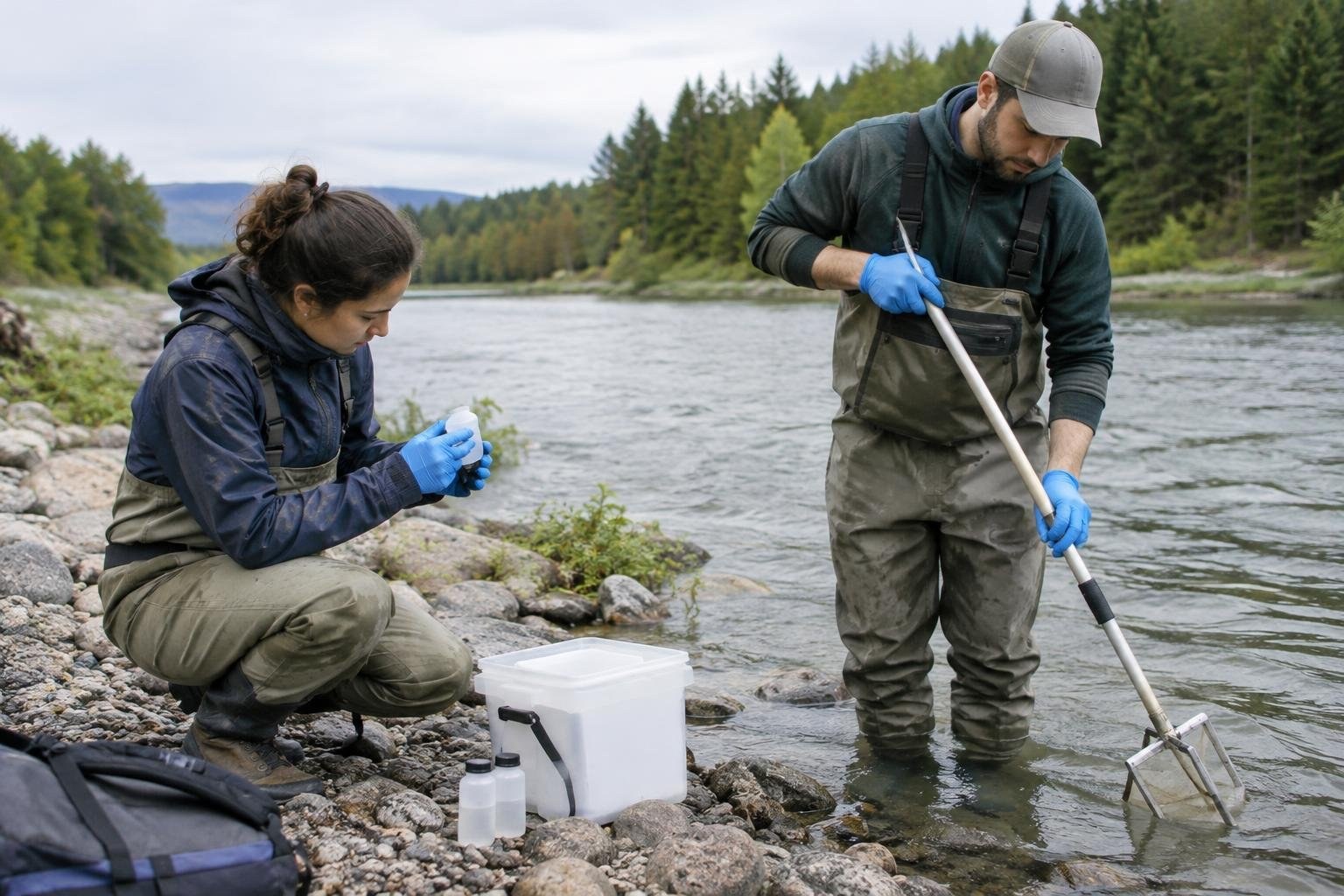
Hydrology students sampling surface water in a field setting
What Is a Hydrology and Water Resources Science Degree?
Hydrology and Water Resources Science is a physical-science field focused on water in Earth systems. It examines where water occurs, how it circulates and is distributed, its chemical and physical properties, and its interactions with the environment, including surface water and groundwater. The U.S. Department of Education’s program description for CIP 40.0605 includes topics such as fluid mechanics, geomorphology, mathematical modeling, hydrologic analysis, water processes, and environmental science.
The title is not standardized across every school. Related program names may emphasize hydrology, water resources, or hydrologic sciences. A label alone does not tell you whether a curriculum leans toward research, engineering applications, environmental analysis, or resource planning. Read required courses and department descriptions before deciding that two programs are equivalent.
For an example of an undergraduate program’s stated focus, see the University of Texas at Austin’s Hydrology and Water Resources major.
What Do You Study in a Hydrology Major?
Expect an interdisciplinary science curriculum rather than a narrow study of water alone. A student needs to understand how water behaves and how to interpret evidence about it. The University of California, Davis describes a hydrology bachelor’s curriculum with foundations in physics, mathematics, chemistry, and biology, plus exposure to ecology, geology, engineering, policy, and law.
Depending on the program, course topics can include fluid mechanics, hydraulic engineering, water-resource systems, groundwater, hydrologic analysis, modeling, and the physical and chemical processes of the water cycle. Graduate study may reach further into geologic, atmospheric, oceanic, biological, and chemical processes that affect water and solutes.
Courses are only part of the preparation. Look for opportunities to apply ideas through laboratory work, field activities, internships, research, or projects. These experiences help students connect a model or data set to real water systems. The specific mix is program-dependent, so ask which are required and which are optional.
Review the UC Davis hydrology bachelor’s catalog description and the university’s graduate Hydrologic Sciences overview for examples at different levels.
Skills You Can Develop
Students build the ability to interpret water-related evidence using scientific concepts and quantitative reasoning. Depending on coursework and experience, that can mean analyzing how water moves, considering chemical and physical processes, working with models, or explaining how environmental conditions affect water systems.
Scientific reasoning: connect observations with physical, chemical, biological, and geologic processes.
Quantitative analysis: work with mathematical ideas used in hydrologic analysis and modeling.
Systems thinking: consider how water relates to land, atmosphere, ecosystems, and human decisions.
Communication: explain technical findings clearly to scientific teams and people involved in water planning.
Interdisciplinary collaboration: engage with perspectives from engineering, ecology, policy, and law.
Employers and graduate programs may look for evidence that you can apply these skills. Projects, field experience, internships, research, and clear writing samples can help demonstrate what you know. A course list alone is a less complete picture of preparation.
Who Is This Degree Best For?
This field may appeal to students who are curious about natural systems and willing to work through quantitative science. It can be a good subject to explore if you want to understand groundwater, rivers, water cycles, environmental interactions, or how scientific analysis informs resource questions. You do not need to arrive with a fixed career goal, but you should be willing to test your interest through introductory courses and conversations with faculty or working professionals.
There is no single personality profile required. Some students are drawn to field observation; others enjoy mathematical modeling, laboratory questions, or research. The degree may involve both conceptual science and detailed analysis. If your main interest is building water infrastructure, compare hydrology with engineering programs. If your focus is a broad environmental curriculum, compare environmental science and related majors.
Does Hydrology and Water Resources Science Match You?
Salary, job titles, and projected demand matter, but they do not tell you whether you will enjoy the work involved in earning the degree or doing the job. Consider your interest in math and science, your patience with complex evidence, and whether you prefer field, lab, computer-based, or policy-related work. Assessment.com’s MAPP career assessment can support reflection on interests and motivations; use it as one input alongside course review, advising, and career research.
See Assessment.com’s guide to choosing a college major for another way to think through fit.
Admissions, Program Length and Academic Difficulty
Entry requirements are set by each institution and credential. A student entering an undergraduate major should review the school’s admission rules and the prerequisites for science and mathematics courses. For graduate programs and certificates, check whether prior coursework or a related background is expected. The sources linked in this guide describe curricula and selected programs, not universal admission standards.
Completion time depends on the credential, transfer credit, enrollment pace, and course sequence. Hydrology and water resources study appears at multiple levels in the program examples, including undergraduate study, graduate study, and a graduate certificate. That does not mean every school offers every level or allows an identical progression. Ask for a written degree plan and check how often required courses are offered.
The main academic challenge is integrating quantitative methods with several sciences. Students who need a refresher can ask about tutoring, math placement, introductory chemistry or physics, and academic support before the first term. A realistic course load can be especially important when working or caring for family.
Online vs. On-Campus Hydrology Programs
Online, hybrid, and campus formats vary by institution and program. A graduate certificate in hydrology and water resources is offered online by the University of Arizona, but that example should not be taken as proof that every course or credential can be completed remotely.
Before choosing an online option, ask how the program handles laboratory, field, internship, and research components. Find out whether any activities require travel, whether remote students can access the same faculty and advising, and how applied experience is arranged. If you are comparing online and campus programs, compare learning outcomes and total participation requirements as carefully as convenience.
For adult learners, a flexible format may help fit study around work, but verify course schedules and expected weekly workload. Do not assume that online means self-paced or that an in-person component is unnecessary.
See the University of Arizona’s online graduate certificate description for a program-specific example.
Tuition, Costs and Financial Aid
Total cost depends on the institution, residency classification, credential, enrollment pace, delivery format, and required fees or materials. Hydrology coursework may include science and applied components, so ask whether lab, field, technology, travel, or project expenses are separate from tuition. Compare the full estimated cost of completing the credential, not just a per-credit price.
Ask each school for a term-by-term cost estimate and identify what it includes. Review financial aid eligibility, institutional scholarships, assistantships for graduate students where available, employer education support, and transfer-credit policies directly with the institution. Confirm deadlines and renewal conditions in writing. A lower advertised tuition may not produce the lower overall cost if completion takes longer or required experiences add expenses.
Families can also compare the cost of starting at one institution and transferring, but should confirm in advance which credits will count toward the intended major. Never assume that a course will transfer based only on its title.
Careers, Jobs and Employment Outlook
Hydrology and water resources science may connect to careers in hydrology, water-resource work, research, and teaching. Oregon State University describes its Water Resources Science graduate program as broad training paired with an intellectual affiliation to a secondary field, and identifies hydrologist certification coursework as part of that program’s preparation.
Possible employers or settings depend on the specialty and job requirements. Explore public agencies, research settings, consulting, education, and organizations involved in water systems as avenues to investigate, not guaranteed destinations. Ask programs for examples of recent graduate roles and how those graduates developed relevant experience.
This research set does not provide verified current median pay or employment projections for these occupations. Do not treat a degree title as a salary forecast. Before deciding, check current U.S. Bureau of Labor Statistics occupational information and job postings in locations where you could realistically work. Compare entry-level roles separately from research, management, or teaching positions that may require graduate education or experience.
Explore Assessment.com’s career guides for hydrologists and water resource specialists.
Find out which Career or College Major is right for you!
Credential Levels, Accreditation and Certification
Different credentials serve different purposes. A bachelor’s degree can establish a broad scientific foundation; graduate certificates, master’s degrees, and doctoral study may offer further specialization or research preparation. The available program examples include undergraduate hydrology, graduate hydrologic sciences, and a graduate certificate. Verify current availability and admission requirements with each institution.
Oregon State states that students completing its Water Resources Science degree program meet coursework requirements to attain Professional Hydrologist certification. That is a program-specific statement, not a universal promise that a degree alone grants certification. Check the current requirements of the relevant certifying body, including any education, experience, examination, or application criteria, before relying on a credential for a career plan.
Also distinguish academic accreditation from professional certification. Ask what institution or program accreditation applies, whether it is recognized for your goals, and whether a credential is needed for the specific job or location you have in mind. No single certification rule applies to every hydrology-related position.
Review the Oregon State Water Resources Science program description and confirm certification details with the appropriate organization.
Related Degrees and Alternatives
Hydrology overlaps with several disciplines, but the best alternative depends on the work you want to do. Compare required courses, field and laboratory experience, quantitative depth, and the kinds of roles graduates pursue.
Environmental science: consider this if you want a broader environmental curriculum rather than a focus centered on water systems.
Geology or geoscience: consider this if Earth materials and processes interest you more broadly, with water as one possible area of study.
Civil or environmental engineering: consider this if you want a more engineering-centered route to designing or analyzing infrastructure and systems.
Atmospheric science: consider this if your main interest is weather, climate, and atmospheric processes affecting water.
Oceanography: consider this if you want to focus on ocean systems and their physical or chemical processes.
Environmental policy: consider this if regulation, planning, or public decision-making is a stronger draw than physical-science analysis.
These are comparison directions, not interchangeable degrees. Check prerequisites and graduate-school implications for specific occupations before changing majors.
For a related career comparison, see Assessment.com’s guides to environmental scientists and geologists.
Internships, Research and Ways to Build Experience
Experience can help make a broad science degree more legible to employers or graduate admissions committees. Ask faculty about research projects, field activities, internships, and capstone work. If the curriculum does not include an internship, look for relevant summer roles, volunteer research, or projects that build water-analysis and communication skills.
How to Stand Out to Employers
Build a clear record of projects, research, fieldwork, or data analysis completed during study.
Keep concise notes on your contribution, methods, and what you learned from each project.
Practice explaining technical findings to a non-specialist audience.
Ask instructors and career services which skills appear in local job descriptions.
Develop professional relationships through faculty, student organizations, and relevant events.
Do not assume that a degree itself supplies every credential an employer may request. Match your experience and coursework to actual job requirements, and confirm licensing or certification rules where they apply.
Advantages, Drawbacks and Is the Degree Worth It?
Hydrology may be worth pursuing when the coursework, likely career directions, and cost align with the student’s goals. It may be a less suitable choice if the student strongly dislikes quantitative science or wants a credential tied to a specific occupation that this curriculum does not prepare them for. A degree’s value is personal and depends on completion cost, additional education, location, and the kinds of work a graduate hopes to do.
Families should compare written program plans and realistic financing scenarios rather than assuming that a science degree guarantees a particular job or income. Ask for available graduate outcome information, how it is measured, and which students it represents. If the school cannot answer, use independent occupational research and conversations with working professionals to fill out the picture.
How to Choose the Right Hydrology Program
Use the same checklist for every school so that comparisons are fair. Program marketing should not replace a close look at the required courses and total commitment.
Is the institution appropriately accredited, and can the school explain what accreditation applies?
Which courses are required, and how much mathematics, physics, chemistry, geology, and modeling are included?
Are fieldwork, laboratory work, internships, or research available and how are they arranged?
What is the full estimated cost, including fees and required experience-related expenses?
Can credits transfer, and will the school confirm transfer decisions before enrollment?
What is the delivery format, and are any activities in person?
What career services, faculty advising, or employer connections can students access?
Does the curriculum cover the academic requirements relevant to a certification or next degree you may pursue?
How does the program define and report graduation or graduate outcomes?
Ask for answers in writing when they affect cost, transfer, or career eligibility. Assessment.com’s college guidance resource can be another starting point for discussing education fit.
From Degree to Career: Example Pathways
Career progression varies by employer, additional education, and individual experience. Treat these as possible pathways to investigate, not guaranteed sequences.
Hydrology coursework → junior water or environmental role → applied project experience → specialized water analysis.
Bachelor’s study → research assistant or related entry role → graduate study → research or advanced technical work.
Water resources graduate program → work in a related technical setting → pursue relevant certification if eligible and useful for the role.
Check the education and experience requirements in actual postings at each stage. Some advanced research, teaching, or management roles may call for more than an undergraduate degree, but requirements depend on the position.
Questions to Ask Before Enrolling
Before submitting an application or deposit, use this checklist with a parent, counselor, or advisor:
What is the complete program name and credential level?
Which science and math prerequisites must I complete, and in what order?
What is the estimated total cost for my likely pace of study?
Which financial aid, scholarships, or employer support options can I verify?
How much field, lab, internship, or research experience is included?
Can I complete the program online, and what in-person work remains?
Which credits will transfer, confirmed in writing?
What roles have recent graduates pursued, and how are those outcomes measured?
Does the program meet coursework requirements relevant to any certification I am considering?
What academic advising and career support will I be able to use?
Talk with faculty and current students if possible, and ask about the less visible parts of the program: course scheduling, field expectations, and support when quantitative courses become difficult. Explore your interests and career fit alongside these practical checks before making a commitment.
Assessment.com offers a MAPP career assessment for exploring career and degree options.
Frequently asked questions
What is Hydrology and Water Resources Science?
Hydrology and Water Resources Science is the study of water’s occurrence, movement, distribution, properties, and interactions with the environment. Programs may examine surface water and groundwater through physical and chemical science, geoscience, engineering concepts, environmental science, and quantitative analysis. A particular program’s emphasis depends on its curriculum and department.
Is a Hydrology and Water Resources Science degree hard?
It can be challenging for students who are not prepared for quantitative science. Hydrology programs may include mathematics, physics, chemistry, fluid mechanics, modeling, and analysis of water systems. The difficulty depends on the student’s preparation, course sequence, and program design. Ask departments about prerequisites, tutoring, lab or field expectations, and how students build up to advanced coursework.
What jobs can I get with a hydrology degree?
Potential directions include hydrology, water-resource analysis, environmental or geoscience work, research, and teaching. A degree does not guarantee a particular position, and job requirements vary. Some professional roles may expect graduate study, relevant experience, or certification. Review current job postings and official occupational information alongside the courses and experience offered by a program.
How much can you make with a hydrology degree?
Pay depends on the occupation, employer, location, experience, and education level. The available program information does not provide a reliable current salary figure for hydrology graduates, so avoid treating a single number as a degree-wide expectation. For a useful estimate, compare current U.S. Bureau of Labor Statistics data for specific occupations and local job postings before choosing a program.
Can I earn a hydrology degree online?
Online study may be possible for some courses or credentials, but delivery varies by program. Ask whether fieldwork, laboratory work, research, or other experiential learning is required in person, and how remote students complete those activities. A program’s advertised online format does not by itself show whether it provides the practical experience you want.
Does hydrology require a lot of math?
Expect quantitative work. Hydrology draws on mathematics and physical sciences, and coursework may include fluid mechanics, hydrologic analysis, and mathematical modeling. The amount and level of mathematics vary by school and credential. Ask for the degree plan and course prerequisites, and review sample syllabi if you want to understand the pace and types of calculations involved.
Do you need graduate school to work in hydrology?
Not always. Some entry-level roles may be accessible with an undergraduate background and relevant experience, while research, advanced technical work, and postsecondary teaching can call for further education. The right level depends on the role and employer. Check requirements for actual jobs you may want, then choose a program that supports the next step rather than assuming every career needs a doctorate.
Are there certifications for hydrologists?
Certification and licensure are not the same as earning a degree, and requirements depend on the role and jurisdiction. Oregon State University describes coursework in its Water Resources Science graduate program that meets requirements for Professional Hydrologist certification. That statement is program-specific; confirm current certification criteria with the certifying organization and ask each school what its curriculum covers.
People Also Ask
What is the difference between hydrology and water resources science?
Hydrology studies water’s movement and properties, including surface water and groundwater. Water resources science applies that understanding to water systems and related environmental and management questions. Programs may combine hydrology with geology, chemistry, physics, engineering concepts, and quantitative methods; their balance depends on the school.
How long does it take to earn a hydrology degree?
The time depends on the credential, transfer credits, course load, and program structure. A bachelor’s program generally takes longer than a certificate, but no single duration applies across all hydrology programs. Confirm the published degree plan, course availability, and any field or research requirements directly with the institution.
How do I choose a hydrology program?
Begin with the program’s required courses and prerequisites. Compare its coverage of groundwater, surface water, quantitative methods, environmental and geoscience topics, and any field, internship, or research experience. Then check total cost, delivery format, transfer policies, and whether the program fits the career direction you are considering.
Can I get a certificate in hydrology instead of a degree?
The available examples show both undergraduate and graduate study, along with a graduate certificate. Credential availability varies by institution, so check the school’s current catalog. A certificate can serve a different purpose from a full degree; review its learning goals and whether credits may apply to another program before relying on that pathway.
Is hydrology part of environmental science?
Yes, water-resource study can overlap with environmental science, geology, engineering, and policy. Hydrology programs may draw on several of these areas, but students should compare course requirements carefully. If you prefer water-system science and quantitative analysis, hydrology may be relevant; if you want a broader or differently applied focus, another major may fit better.
What subjects are included in a hydrology major?
A bachelor’s program may include a mix of core sciences, hydrology, and applied topics. The University of California, Davis describes a broad foundation in physics, mathematics, chemistry, and biology, along with exposure to ecology, geology, engineering, policy, and law. Required courses vary, so use each school’s catalog to see the actual sequence.
Hydrology and Water Resources Science may suit students who want to understand how water moves through Earth systems and apply science to practical resource questions. The path can involve substantial quantitative coursework, field or research experience, and additional study for some research and teaching roles. Compare the specific curriculum, cost, experience opportunities, and career requirements at each school, then consider whether the work itself fits your interests. Assessment.com’s career and education resources can help you explore options and reflect on fit.
Want to see your options? Try our comprehensive Degree, Program & College Search tool
We use cookies to offer you a better browsing experience, analyze site traffic and personalize content.
Read about how we use cookies and how you can control them in our
Privacy Policy.
If you continue to use this site, you consent to our use of cookies.
×
Exciting News!
Be one of the first to Beta Test the new AI-Powered Assessment.com Platform.