Physical Therapy Assistant Degree Guide: Courses, Careers, Costs & Program Fit
A Physical Therapy Assistant program prepares students to support physical therapy treatment under a physical therapist’s supervision. Learn about coursework, hands-on training, admissions questions, costs, career options, and how to compare programs.
By David Slack · Staff Writer Assessment.com · Published October 26, 2026 · Last updated November 5, 2026
A Physical Therapy Assistant (PTA) program prepares students to help carry out physical therapy treatment under the direction and supervision of a physical therapist. Students learn about the human body, movement, therapeutic interventions, communication, and documenting patient progress. The field is classified under CIP code 51.0806, Physical Therapist Assistant. The usual educational route described by the programs reviewed is an associate degree, followed by meeting the applicable requirements to practice. Coursework is paired with practical learning, so prospective students should look beyond course titles to understand labs, clinical experiences, program costs, and state rules. This guide explains what to investigate before choosing a school.
Degree & Program Decision Insights
Explore your personal fit, education requirements, career potential and next steps.
01Motivational Fit
Discover whether this program fits you
Explore your preferences against the focus of Physical Therapy Assistant. These prompts are not personal MAPP results.
Subject curiosity. Would you choose to explore “applied anatomy and physiology” in depth? Ask for a sample learning activity to test that interest.
Breadth of interest. Consider the place of “behavioral sciences” in this field. Is this another part you would choose to explore, or mainly a requirement you would tolerate?
Work reality. Related work can involve this task: “Secure patients into or onto therapy equipment.” Would you want that activity to be a regular responsibility?
Interest in studying a field can differ from enjoying its related work.
Which part would you want to do repeatedly, and what would you try before deciding?
Discover Your Personal Program Fit
Before investing your time and money in your education, discover how this program aligns with your natural motivations, work preferences and career goals.
U.S. occupational wages are not guaranteed graduate earnings; OEWS excludes self-employed workers.
Projected openings include replacements as well as growth.
U.S. national estimates. A crosswalk does not establish entry-level eligibility; advanced, management and teaching roles can require further qualifications.
Compare the focus and route of these distinct instructional fields; their credentials and admission requirements are not interchangeable.
Respiratory Therapy Technician/AssistantCIP 51.0812. Compare its emphasis on patient data collection and monitoring and airway management with this program’s focus.
Radiologist AssistantCIP 51.0814. Compare its emphasis on radiologic procedures and techniques and cross sectional anatomy with this program’s focus.
Anesthesiologist AssistantCIP 51.0809. Compare its emphasis on patient data collection and catheter insertion with this program’s focus.
Explore your motivations. Use MAPP as a starting point for reflecting on your interest in “applied anatomy and physiology”, then test that interest against a sample learning task.
Examine the work. Compare Physical Therapist Assistants on daily work and entry qualifications, as well as pay. Explore Physical Therapist Assistants.
Compare actual providers. Ask for the exact credential, course sequence and assessment methods. Compare how each provider teaches “behavioral sciences”, its entry criteria and its itemized costs.
Check the evidence before applying. Confirm prerequisites and any recognition or professional requirements for your intended route; ask for applicable rules and published outcome definitions in writing.
Verify the institution’s current offering, admissions requirements and outcomes; a search result does not establish your eligibility.
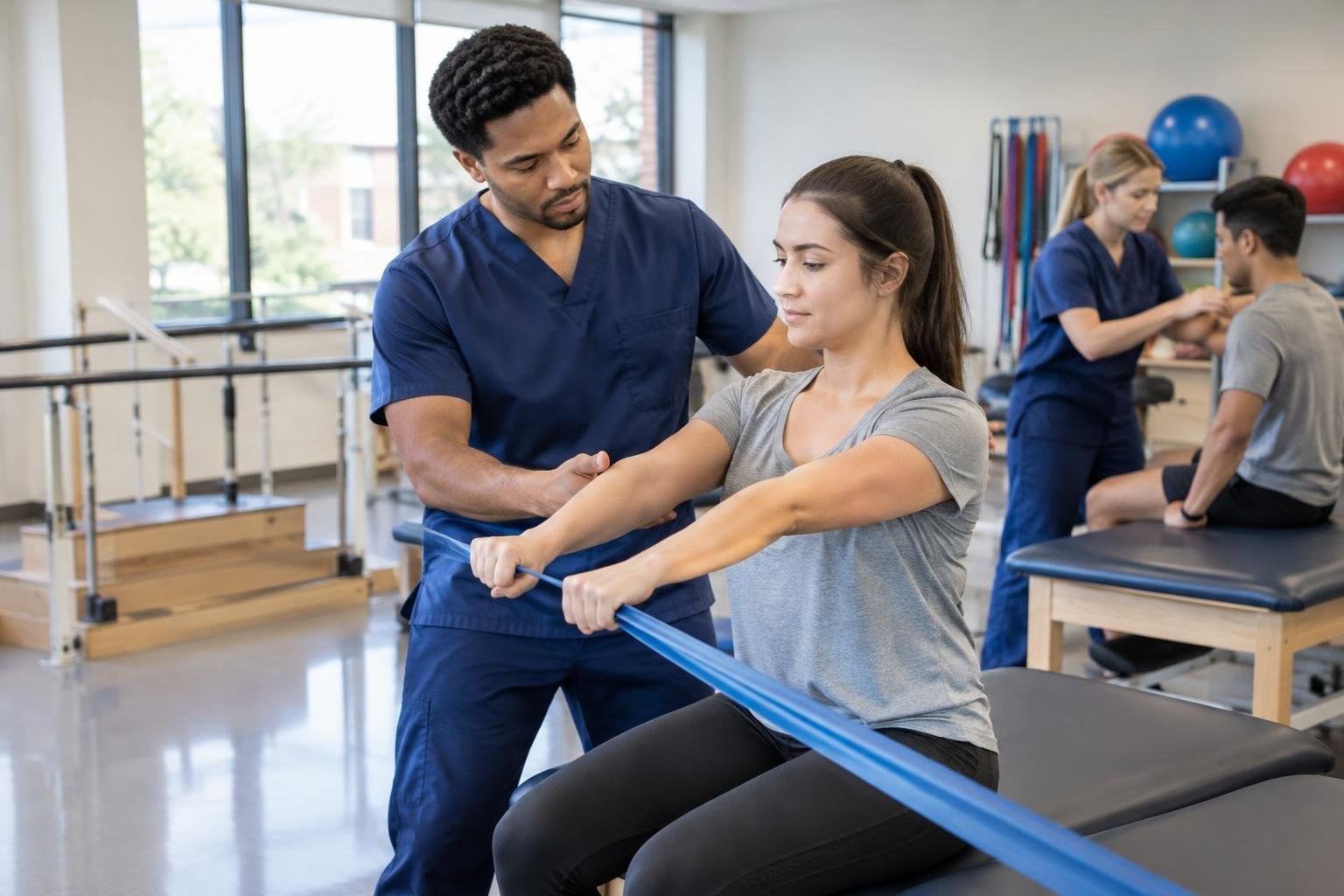
PTA students practicing a movement intervention in a teaching lab
What Is a Physical Therapy Assistant Program?
A Physical Therapy Assistant program teaches students to support a physical therapist’s treatment plan: help patients perform interventions, use appropriate equipment, and observe and record progress. The PTA works under the physical therapist’s supervision rather than independently directing the plan of care. Program descriptions identify anatomy, physiology, movement, communication, and therapy interventions as core areas of preparation. Midlands Technical College describes the PTA role and its associate in applied science program; CIP code 51.0806 is used for Physical Therapist Assistant. Washburn University identifies its PTA program with that CIP code.
Names vary by institution, including Physical Therapist Assistant, Physical Therapy Assistant, and PTA. Focus on the curriculum, credential awarded, and intended role rather than assuming similar names mean identical programs. The sources describing the direct PTA pathway identify associate-degree preparation; the broader credential-level list for a field does not establish that each level is offered as a qualifying PTA program.
What Do You Study in a PTA Program?
Expect a mix of science, applied movement, patient communication, and treatment-related coursework. Programs describe study in anatomy, physiology, and therapy interventions. The broader subject areas for this field include biomechanics, exercise physiology, kinesiology, neuroscience, behavioral sciences, clinical documentation, clinical pathology, communication, and professional standards and ethics. Not every school will use the same course titles or sequence.
Classes are meant to help students connect body systems and movement to safe, purposeful treatment activities. Students must understand why a prescribed intervention is used, follow instructions, notice how a patient responds, and communicate relevant observations. Some programs include instruction in common care plans and how an intervention may be progressed, modified, or discontinued within the supervising therapist’s plan. Penn State’s program description highlights anatomy, physiology, and therapy interventions; the ECPI program description provides a school-specific example of treatment-plan coursework.
Ask to see a current course sequence, lab expectations, and descriptions of clinical learning before applying. A course list alone may not show how much practice students receive or when they are expected to apply skills with patients.
Skills You Can Build
PTA preparation develops skills that combine technical understanding with attentive, respectful patient care. Students learn to work with anatomy and movement concepts, carry out interventions, use equipment, and observe and record changes. Communication matters because treatment takes place in coordination with patients and the supervising physical therapist. Documentation is part of the professional work described in the field’s program content.
Scientific and technical: apply foundational knowledge of anatomy and physiology to movement and treatment activities.
Observation and reasoning: notice a patient’s response and report relevant information rather than independently changing the plan.
Communication: explain and guide activities clearly, listen to patient concerns, and coordinate with the supervising clinician.
Professional practice: follow standards, use equipment appropriately, and keep accurate records.
When evaluating your fit, think about whether you enjoy learning through both science and direct interaction. The work is not only about exercise; it also involves following a care plan carefully and paying attention to each person’s response.
Who Is a Physical Therapy Assistant Program Best For?
This program may appeal to students who want practical healthcare work, enjoy learning how the body moves, and find it meaningful to help people work toward rehabilitation goals. The curriculum combines science with applied skills and communication. Students also need to be comfortable receiving direction, following a treatment plan, and taking careful notes about patient progress.
It may be a less natural fit if you strongly prefer independent clinical decision-making, work with little face-to-face interaction, or a program with few practical requirements. Those preferences do not automatically rule out the field, but they are worth testing through a conversation with a PTA, observation where permitted, or an information session.
Does this degree match you?
Salary, reputation, and broad career claims cannot answer whether the daily tasks suit you. Consider whether you are motivated by patient progress, hands-on problem solving, structured teamwork, and careful execution. Assessment.com’s MAPP assessment is one way to explore career and degree options in relation to your motivations and preferences. Use a result as a prompt for research, not as a substitute for program or career investigation.
Admissions, Prerequisites, and Academic Demands
Admissions rules are set by each college, so do not assume that one program’s prerequisites or GPA standards apply elsewhere. Before applying, request the current admissions checklist and confirm whether you must complete science prerequisites, meet a minimum grade, submit health or background documentation, attend an interview, or complete any observation or experience requirement. The program sources available here do not establish universal thresholds for these items.
Ask when admission to the college differs from admission to the PTA cohort. Some programs may require prerequisite courses before students can begin the professional sequence; the individual institution must confirm the details. If you are transferring credits, get a written evaluation before relying on them to shorten your plan.
To prepare, review introductory biology and anatomy concepts, strengthen study habits for science courses, and practice clear written and spoken communication. These are useful preparation steps, not guarantees of admission or success.
Credential Levels, Completion Time, and Program Format
The program sources describe associate-level PTA preparation, but they do not establish a universal completion time or credit total. One school-specific example requires 73 semester credit hours for its Associate of Applied Science degree. Treat that as an example from one institution, not a standard for every college. Total time depends on prerequisites, course sequencing, enrollment pace, transfer credit, and the schedule for practical or clinical experiences.
Ask for a term-by-term plan for full-time and part-time enrollment, including prerequisite terms and any courses that are offered only once a year. Confirm whether clinical placements can affect the expected graduation date. For online or hybrid options, ask which activities must take place in person and where.
Certificate, bachelor’s, post-bachelor’s, graduate, and first-professional labels may appear in broad field classifications, but the presence of a level in a classification does not prove that a particular school offers it as an entry route to PTA practice. Confirm what credential the school actually awards and what role it prepares students to enter.
Online, Hybrid, and On-Campus Study
Physical Therapy Assistant education is practical as well as academic. When comparing delivery formats, ask how the program teaches hands-on techniques, how often students practice in a lab, and how clinical learning is arranged. A program advertised as online may still require in-person activities or clinical placements; the school should explain the full schedule and location requirements before you commit.
Ask who arranges placements, whether students can request a nearby site, whether travel or relocation could be necessary, and what happens if a planned placement changes. For working students and parents, clinical schedules can be as important as class schedules. Get the expectations in writing, then compare them with transportation, employment, and caregiving responsibilities.
Do not compare online and campus programs by convenience alone. Compare the learning format, access to practice, support, total expense, and feasibility of completing every required experience.
Tuition, Total Costs, and Financial Aid
There is no single tuition figure that applies to every PTA program. Build a school-by-school estimate that includes tuition, mandatory fees, books, equipment, transportation, and any costs tied to labs or clinical experiences. Also consider lost work hours, childcare, and housing if the program’s location or schedule changes your current arrangements. Ask the college for a complete cost estimate for the specific credential and expected course sequence.
Compare the net price you would actually pay, not just the advertised tuition rate. Ask the financial aid office about grants, scholarships, federal or state aid eligibility, payment plans, and employer tuition assistance if relevant. Confirm eligibility rules and deadlines directly; aid options differ by student and institution.
Transfer credit may reduce repeated coursework only when the school accepts it toward the PTA program. Request an official evaluation before making a budget based on assumed transfer savings. A lower starting price is not automatically the least expensive route if it adds terms, travel, or courses that do not apply to the credential.
Careers, Jobs, Pay, and Employment Outlook
The direct career outcome described by these programs is work as a physical therapist assistant. A PTA carries out treatment activities under a physical therapist’s supervision; the role is not the same as being a physical therapist. Program descriptions connect preparation to rehabilitation goals and work to support patient function. Midlands Technical College describes the supervised treatment role, and Pima Medical Institute describes the assistant as working under a licensed PT’s direction.
Career direction
Education or credential to verify
Pay and outlook research
How PTA preparation connects
Physical therapist assistant
Associate-level PTA preparation is described by program sources; verify current state requirements before enrolling.
Check current U.S. Bureau of Labor Statistics data and local postings for dated, location-specific figures.
Programs prepare students to carry out interventions and support treatment under a physical therapist’s direction.
Physical therapist
A separate professional pathway; this PTA degree should not be treated as a physical therapist qualification.
Research the separate occupation and its education route before comparing compensation or outlook.
Related field, but a PTA credential does not establish qualification for the PT role.
Pay and hiring conditions vary by place, employer, and experience. Because estimates change over time, compare current federal occupational information with local employers rather than relying on an undated salary claim. Ask colleges for the source, year, and definition behind any placement or earnings figures they share. Do not read a school’s career pathway language as a promise of employment.
Find out which Career or College Major is right for you!
Accreditation, Licensure, and Certification: What to Verify
Completing the degree and meeting the requirements to practice are separate questions. A university program description notes that an associate degree and license are part of the route to work as a PTA, while the specific rules that apply depend on where you intend to work. Do not rely on a general article or an admissions conversation as the final answer about state requirements.
Ask the program which current standards it follows, what credential or exam preparation it includes, and what steps remain after graduation. Then verify those requirements with the relevant state licensing authority. Request details about application timing, fees, required documentation, and any limits on working while an application is pending. Confirm that a program’s accreditation status and any required professional approvals are current with the official organizations responsible for them; no accreditation status should be assumed from a school’s marketing alone.
Certification, a degree, and a state license are not interchangeable terms. Ask the school to explain precisely which credential it awards and which professional steps it does not control.
How to Choose a PTA Program
Good program comparisons focus on the full pathway, not a single feature. Ask each college for current curriculum details, learning formats, clinical arrangements, student support, and a complete cost estimate. If you are comparing a public community college, a private institution, or a program near home with one farther away, calculate your own total cost for each rather than assuming the category determines value.
What exact degree or credential will I earn?
What prerequisites and selection steps apply to this cohort?
How are labs and clinical experiences scheduled and assigned?
What is the total estimated cost, including fees and travel?
What professional approvals and accreditation apply to the program?
What current completion, exam, and employment outcome data can the school document?
Which credits transfer, and will the receiving program confirm them in writing?
What support is available if I need help with science coursework or clinical preparation?
Compare answers in a spreadsheet and save the source documents. For a practical career-fit check, you can also review questions for choosing a college major and use Assessment.com’s career and education exploration tools.
Affordability: Funding and Planning the Investment
Ways to lower the financial pressure begin with comparing the full net cost and avoiding courses that will not count toward the credential. Before paying for prerequisites elsewhere, ask the target college whether it accepts those courses and what grade or time limits apply. Ask financial aid staff about need-based aid, scholarships, and payment arrangements, and check whether an employer offers education assistance. Eligibility and availability must be confirmed with the institution or provider; do not assume a grant or benefit will cover a specific expense.
Families can also compare commute and housing costs, work schedules, and the financial impact of a full-time versus part-time plan. A slower pace may reduce the need to stop working, but it can also affect how long costs continue. Use the program’s official course schedule to model both options. Avoid choosing solely by the smallest first-term bill; estimate the total from entry through completion.
Related Degrees, Pathways, and Alternatives
PTA education develops a specific clinical support role; related paths may fit better if your preferred work or desired responsibility differs. Compare the day-to-day tasks and education route, not just the shared interest in health or movement.
Physical therapy: consider this route if you want to investigate the distinct physical therapist profession and are prepared to research its separate education pathway.
Occupational therapy: explore if your interest is in a related rehabilitation profession; compare the actual work and credential requirements before deciding.
Athletic training: research if you are drawn to injury-related work in athletic or active settings, then verify the education and credential path independently.
Physical therapist aide: compare this role if you want to investigate support work that may have a different education pathway from PTA preparation.
Other healthcare support roles: broaden your search if hands-on patient support appeals to you but physical therapy is not the right focus.
Exercise or fitness careers: consider alternatives if your strongest interest is movement and exercise outside a clinical treatment role.
These are exploration options, not interchangeable credentials. Use the published Physical Therapist Aide, Occupational Therapist, and Athletic Trainer career pages to start comparing, then confirm requirements from official education and licensing sources.
Experience, Certifications, and Preparing for Work
Practical experience can help you test your interest and connect classroom concepts to patient care. Ask programs whether students complete supervised clinical experiences, how placements are organized, and what preparation or conduct expectations apply. If you can observe a professional, follow the facility’s permission, privacy, and safety rules. Volunteer roles may offer exposure to a care environment, but they should not be treated as substitutes for required training or clinical preparation.
How to stand out to employers
Build evidence of reliability, respectful communication, accurate documentation, and willingness to learn under supervision. In interviews, be ready to describe how you follow instructions, respond to feedback, and communicate concerns. Keep any credentials current only where they are required or useful for the specific position, and confirm employer expectations rather than collecting certificates without a clear purpose.
Technology is part of modern clinical documentation and communication, but software and equipment differ by employer. Ask programs what systems and tools students practice with, and expect to learn employer-specific workflows after hiring.
Graduate Study and Further Education
Some PTA students may later consider further education, but a longer credential is not automatically necessary for the assistant role. One program describes a pathway to continue education through an online bachelor’s program in Physical Therapist Assistant. Treat this as an institution-specific option, not a universal requirement or a guarantee that all prior credits will transfer.
If you may continue studying, ask which courses count toward the next credential, whether the later program is available to graduates of your chosen school, and whether it changes your professional role or eligibility. If your goal is to become a physical therapist, research that profession’s separate education pathway and admissions requirements rather than assuming a PTA-to-PT bridge exists.
From Degree to Career: A Realistic Pathway
Career development is not automatic, but it can be planned as a series of decisions. One possible sequence is: complete a PTA associate program, meet the requirements to enter practice where you intend to work, build supervised experience as a PTA, and later explore additional education or a focused work setting if those options fit your goals. This is an example for discussion, not a guaranteed promotion path.
Before enrolling, ask whether the college documents outcomes for recent cohorts and how it defines completion, exam performance, and employment. Compare that evidence with the total cost and your own fit for patient-facing work. A school’s program page can describe its intended preparation, but your own next steps and opportunities depend on the credential, requirements, and circumstances relevant to you.
Frequently asked questions
Is a Physical Therapy Assistant program hard?
A PTA program can be academically and practically demanding because students must connect anatomy and physiology with movement and treatment techniques, then apply classroom learning in patient-care settings. The work also calls for clear communication, careful observation, and accurate documentation. Reviewing prerequisites and asking about tutoring, lab practice, and clinical scheduling can help you judge whether a specific program’s pace is manageable.
Is a Physical Therapy Assistant degree worth it?
It may be worthwhile if you want a hands-on healthcare role and have compared the program’s full cost, time commitment, practical training, and state-specific requirements with your goals. The degree is designed to prepare students for PTA work under a physical therapist’s direction, but completing a program does not by itself establish that you meet every state’s requirements to practice. Evaluate the complete pathway before enrolling.
What jobs can I get with a Physical Therapy Assistant degree?
The clearest career pathway described by PTA programs is physical therapist assistant. PTAs carry out treatment programs under a physical therapist’s supervision. Related healthcare support roles may have different education and credential requirements, so do not assume that a PTA degree qualifies you for other clinical occupations. Check job descriptions and applicable rules before treating related roles as equivalent options.
How much do physical therapist assistants make?
Pay depends on factors such as location, employer, experience, and work setting. Compare the latest U.S. Bureau of Labor Statistics information for physical therapist assistants with local job postings, and check the year and geography attached to any estimate. The program information available here does not establish a current national median salary or a job-growth rate, so avoid relying on undated figures.
Can I earn a Physical Therapy Assistant degree online?
Some classroom work may be offered online or in a hybrid format, but PTA education includes practical skill development and clinical experience. Ask each institution which courses can be completed remotely, where labs and clinical placements take place, whether those experiences are scheduled at set times, and what happens if a placement is unavailable. Confirm that the program’s format fits your location and schedule.
Does a Physical Therapy Assistant program require science or math?
Expect science coursework, including anatomy and physiology, and study of movement and therapeutic interventions. Programs may also include exercise physiology, kinesiology, neuroscience, communication, documentation, and professional standards. The exact course list differs by institution. Ask for the current curriculum and prerequisites so you can identify the science preparation required before the program begins.
People Also Ask
What courses are in a Physical Therapy Assistant program?
PTA coursework commonly includes anatomy and physiology, movement-related subjects, therapeutic interventions, and communication or documentation. Programs combine academic study with practical skill development. Review the curriculum at each institution because course names, sequencing, and preparation requirements can differ.
What degree do you need to become a physical therapist assistant?
The program context identifies certificate, associate, bachelor’s, post-bachelor’s certificate, graduate certificate, master’s, and first-professional levels across the field of study. That list does not mean every institution offers a PTA credential at each level. The programs described for the PTA role award associate degrees, so verify the credential and its purpose directly with each college.
How long does it take to complete a PTA program?
Program length depends on the number and sequence of required courses, any prerequisites, enrollment pace, and practical or clinical scheduling. One institution’s associate program lists 73 semester credit hours, but that is a school-specific example, not a universal requirement. Ask colleges for a term-by-term plan that includes prerequisites and clinical experiences.
Are Physical Therapy Assistant programs available online?
Programs may offer some online or hybrid coursework, but students should confirm how hands-on training and clinical placements are delivered. Ask where required experiences occur, whether travel is necessary, and whether placement schedules fit work or family commitments. An online label alone does not tell you whether the complete program is feasible from your location.
What is the difference between a physical therapist and a physical therapist assistant?
A physical therapist assistant carries out treatment under a physical therapist’s direction, while a physical therapist is the professional responsible for directing care. They are distinct occupations with different education pathways. If you are comparing them, review the actual role descriptions, required education, and applicable credentialing rules rather than treating the titles as interchangeable.
Do physical therapist assistants need a license?
The degree is a starting point for preparation, not a universal substitute for state-specific practice requirements. Before accepting an offer, ask the program which professional standards and licensing steps it prepares students for, then independently confirm the current rules with the relevant state authority. Request written details about any exams, applications, or other requirements that apply to you.
A Physical Therapy Assistant program may suit students who want a practical, patient-facing healthcare role that combines movement, communication, and careful work under a physical therapist’s direction. It requires a focused investment in classroom learning and supervised, hands-on preparation, and the associate degree alone may not complete every step required to work in a particular state. Before enrolling, compare program requirements, total costs, clinical arrangements, and the relevant state’s credential rules. Consider whether the daily work and learning style fit you, not only whether the career sounds appealing. Assessment.com’s MAPP assessment can help you explore career and degree options in relation to your interests and motivations.
Want to see your options? Try our comprehensive Degree, Program & College Search tool
We use cookies to offer you a better browsing experience, analyze site traffic and personalize content.
Read about how we use cookies and how you can control them in our
Privacy Policy.
If you continue to use this site, you consent to our use of cookies.
×
Exciting News!
Be one of the first to Beta Test the new AI-Powered Assessment.com Platform.