Environmental Science Degree Guide: Courses and Careers
Learn what environmental science majors study, how to compare lab and field training, and what to expect from environmental science careers and job outlook.
By Tome Fierre · Staff Writer Assessment.com · Published October 9, 2026 · Last updated November 6, 2026
An environmental science degree teaches you to use biology, chemistry, geology, and data to study environmental problems. You might collect water samples, map a contaminated site, or evaluate air quality. The quality of a program depends on how often you apply the science through labs, fieldwork, and projects. Take the Free MAPP Career Assessment to explore how your interests and preferences connect with related careers.
Degree & Program Decision Insights
Explore your personal fit, education requirements, career potential and next steps.
01Motivational Fit
Discover whether this program fits you
Explore your preferences against the focus of Environmental Science. These prompts are not personal MAPP results.
Scientific investigation. Would you enjoy investigating biology and explaining your conclusions from evidence?
Breadth of interest. Consider the place of “chemistry” in this field. Is this another part you would choose to explore, or mainly a requirement you would tolerate?
Work reality. Related work can involve this task: “Perform statistical analysis of environmental data.” Would you want that activity to be a regular responsibility?
Interest in studying a field can differ from enjoying its related work.
Which part would you want to do repeatedly, and what would you try before deciding?
Discover Your Personal Program Fit
Before investing your time and money in your education, discover how this program aligns with your natural motivations, work preferences and career goals.
U.S. occupational wages are not guaranteed graduate earnings; OEWS excludes self-employed workers.
Projected openings include replacements as well as growth.
U.S. national estimates. A crosswalk does not establish entry-level eligibility; advanced, management and teaching roles can require further qualifications.
Compare the focus and route of these distinct instructional fields; their credentials and admission requirements are not interchangeable.
Environmental BiologyCIP 26.1305. Compare its emphasis on biodiversity and molecular genetic and genomic evolution with this program’s focus.
Environmental/Environmental Health EngineeringCIP 14.1401. Compare the official Environmental/Environmental Health Engineering field description and actual course requirements; confirm which parts support your intended specialization.
Conservation BiologyCIP 26.1307. Compare its emphasis on ecology and environmental science with this program’s focus.
Explore your motivations. Use MAPP as a starting point for reflecting on your interest in “biology”, then test that interest against a sample learning task.
Examine the work. Compare Environmental Science and Protection Technicians, Including Health and Environmental Scientists and Specialists, Including Health on daily work and entry qualifications, as well as pay.
Compare actual providers. Ask for the exact credential, course sequence and assessment methods. Compare how each provider teaches “chemistry”, its entry criteria and its itemized costs.
Check the evidence before applying. Confirm prerequisites and any recognition or professional requirements for your intended route; ask for applicable rules and published outcome definitions in writing.
Verify the institution’s current offering, admissions requirements and outcomes; a search result does not establish your eligibility.
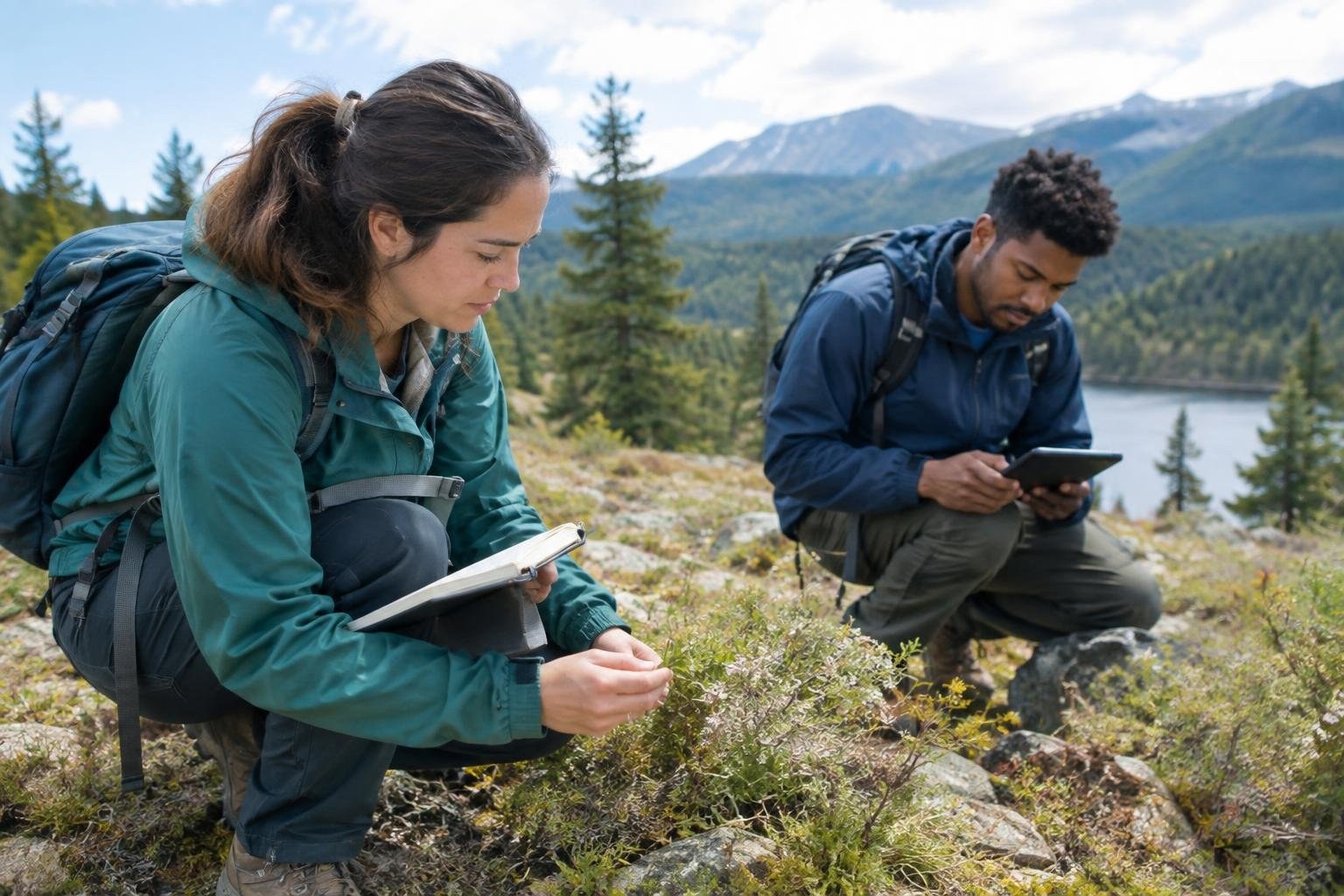
Students collecting field observations in a natural area
What do environmental science majors study?
Environmental science connects natural sciences with decisions about pollution, land use, public health, and conservation. For example, a team investigating algae in a river could measure nutrients and stream conditions, map upstream land use, and explain where the evidence supports a conclusion.
Biology and ecology: species, populations, habitats, and ecosystem processes.
Chemistry and earth science: movement of contaminants, soil and water processes, and the physical setting of a site.
Statistics and GIS: sampling design, uncertainty, spatial patterns, and communicating results.
Field and laboratory methods: safe sampling, calibration, quality control, and traceable records.
The Oregon State University Environmental Sciences catalog illustrates how a program can combine basic science, a common environmental sciences core, specialization, and experiential learning. Compare actual required courses and how often they run.
Labs, fieldwork, and online study
Ask how you would collect, label, store, and analyze a sample in the program. Good field training includes deciding where to sample, recording weather or site conditions, and documenting sources of error. The EPA guide to quality assurance project plans explains how environmental projects plan for credible data. Look for projects that let you use those ideas in practice.
Online programs can suit students who need flexibility. Check how the school delivers labs, whether local field placements are accepted, and whether any on-campus sessions are required. For campus options, ask how students get access to instruments and work with faculty or outside partners.
Admissions, credentials, and cost
For a bachelor’s program, review preparation in mathematics and laboratory science. If you are transferring from an associate program, get a written plan showing which chemistry, biology, and general education credits transfer. Graduate programs are worth comparing if you want deeper research training or a particular specialty, such as toxicology or hydrology.
Compare total tuition and fees alongside travel, field gear, lab supplies, and the cost of required on-site work. Ask whether a paid internship or research placement can count toward program requirements and whether prerequisites can affect your graduation timeline.
Environmental science careers, pay, and outlook
Environmental scientists and specialists may investigate contamination, plan sampling, review monitoring data, or prepare technical reports for agencies, consulting firms, and other employers. Environmental technician work may put more emphasis on sample collection and equipment, while specialist roles often require more interpretation and reporting.
The U.S. Bureau of Labor Statistics lists a bachelor’s degree in a natural science or related field as typical entry preparation for environmental scientists and specialists. It reports a U.S. median annual wage of $82,220 in May 2025 and projects 6% employment growth from 2025 to 2035 for that occupation. Use local job listings to compare actual starting pay and qualifications.
Find out which Career or College Major is right for you!
Compare upper-level lab and field requirements in your intended specialty.
Ask which GIS, statistics, or data tools students use on real projects.
Look for internships, supervised research, or a capstone that produces a technical report.
Review recent job postings before choosing electives. Consulting, monitoring, conservation, and agency roles can emphasize different skills.
Frequently asked questions
How does environmental science differ from environmental studies?
Environmental science generally emphasizes natural sciences and measurement. Environmental studies often includes more policy, society, and ethics. Check the required science and lab credits for any program you are considering.
Do I need graduate school to work in environmental science?
A bachelor’s degree is a common entry credential. Some research and specialty roles ask for graduate training. Read the requirements for the jobs that interest you.
What work samples can I build as a student?
A sampling plan, GIS map, reproducible analysis, and a short technical report are useful ways to show how you collect evidence, interpret it, and communicate uncertainty.
Want to see your options? Try our comprehensive Degree, Program & College Search tool
We use cookies to offer you a better browsing experience, analyze site traffic and personalize content.
Read about how we use cookies and how you can control them in our
Privacy Policy.
If you continue to use this site, you consent to our use of cookies.
×
Exciting News!
Be one of the first to Beta Test the new AI-Powered Assessment.com Platform.