The complete workforce agency guide

MAPP® career navigation for stronger workforce outcomes

A practical operating model for state, county, regional and local workforce agencies—connecting participant discovery to career and education pathways, AI-supported guidance, real-time jobs, employer services and measurable progress.

Use MAPP as decision support—not as a diagnostic, eligibility gate or sole hiring screen.

12.5M+people have taken MAPP
165countries represented
Since 1995career insight at scale
100+assessments in the marketplace

Direct answer

What is MAPP for workforce development agencies?

MAPP is the motivational foundation of a broader career and education platform. It helps a participant understand patterns in what may sustain engagement, then connects that evidence to career matches, occupational information, degree and program pathways, real-time jobs, AI coaching, workforce-readiness tools and a persistent dashboard.

For an agency, the strongest use is not “take a test.” It is a repeatable service pathway: discover → explore → plan → prepare → connect → sustain. Navigators add the human judgment, local labor-market context, supportive services and accountability that make the pathway useful.

Workforce development solutions

A platform for the whole participant journey

Bring assessment, exploration, training research, job preparation and progress into a more coherent experience for participants, navigators and leaders.

MAPP® career assessment

Reveal motivational patterns, interests and work preferences that open a strengths-based career conversation.

Career matching

Compare thousands of occupations, understand why they match and save target, adjacent and bridge roles.

Education pathways

Move from a career goal to matching degrees, programs, institutions, credentials and apprenticeships.

Real-time jobs

Connect career exploration to current openings and MAPP-informed match context.

AI career navigation

Support explanations, IEP drafts, skill translation, training research, resumes and interview practice.

Dashboards and analytics

Give participants continuity and give leaders visibility into reach, engagement, progress and service gaps.

Experience the participant pathway first.Create a free account, complete MAPP and explore careers, education and jobs before designing a cohort rollout.
Start Free

From insight to opportunity

Career, degree, program and job matching in one journey

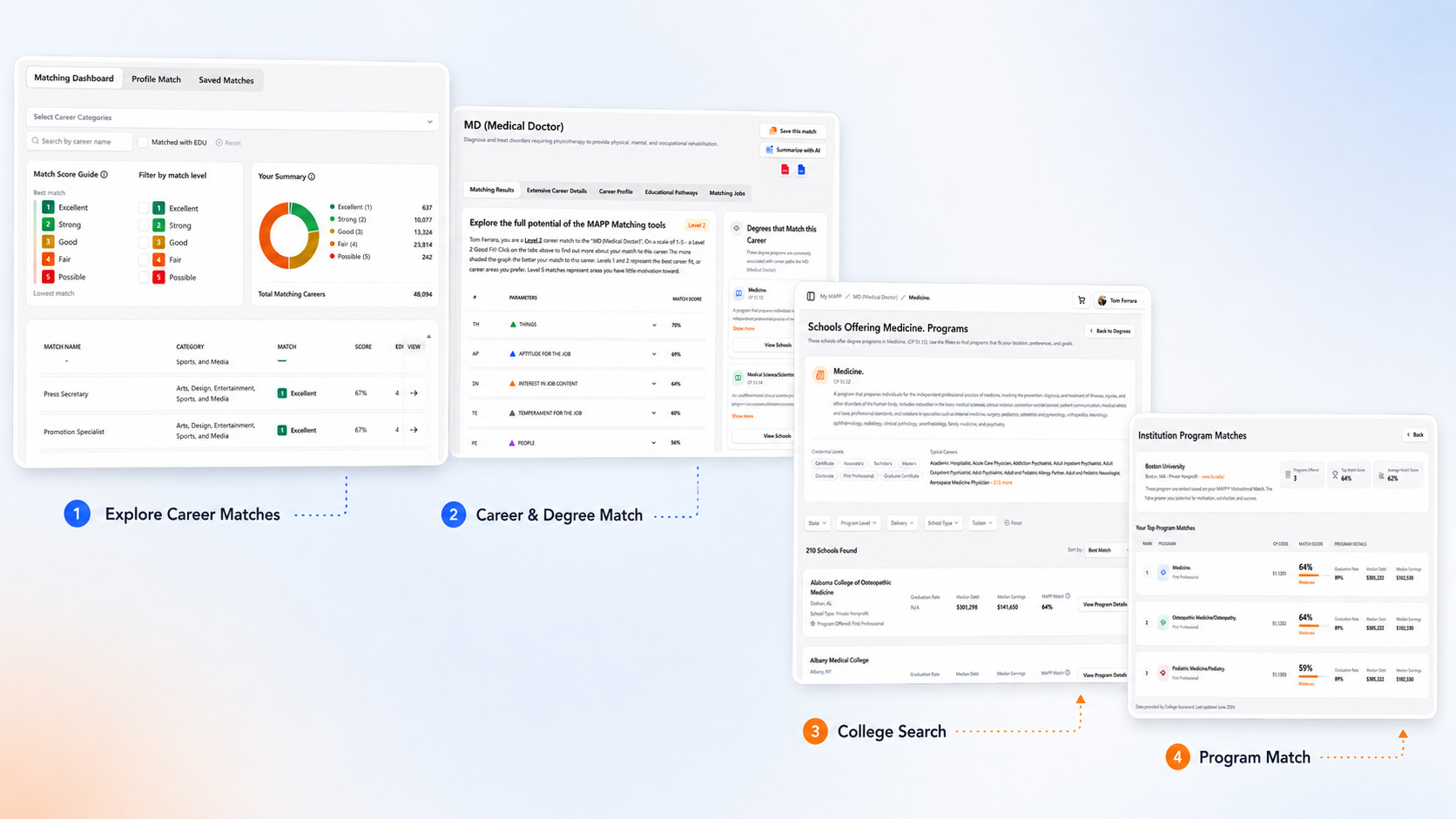
Six-step Assessment.com platform journey showing career matching, career and degree matching, college search, program matching, degree matches with AI risk, and real-time jobs with MAPP match.
Participants can investigate why a career matches, compare educational routes and institutions, examine AI-related task change, and move directly into current job opportunities.

Participant service model

Six stages from intake to retention

Use a common core while varying service intensity for self-service, staff-assisted and high-touch participants.

01

Discover

Complete MAPP and selected readiness activities. Establish strengths, preferences, goals and barriers.

02

Explore

Compare career matches, labor-market evidence, requirements, wages and potential technology change.

03

Plan

Select a goal, an adjacent option and a bridge role. Build an actionable Individual Employment Plan.

04

Prepare

Pursue skills, credentials and work readiness. Build truthful resumes and practice interviews.

05

Connect

Search live opportunities, tailor applications, coordinate referrals and engage employers.

06

Sustain

Follow up after placement, troubleshoot retention and identify advancement or reskilling needs.

Workforce development AI solutions

Scale guidance while keeping consequential decisions human

AI can reduce blank-page work and extend help between appointments. It should explain, draft, compare and practice—not silently decide eligibility, funding, sanctions, referrals or employment.

Explore AI-Supported Career Tools

Explain MAPP results in plain language

Draft target, adjacent and bridge career options

Translate verified experience into transferable skills

Structure Individual Employment Plan milestones

Compare training and credential pathways

Prepare truthful resumes and interview practice

Draft objective progress notes for staff review

Workforce development career assistance

Turn career insight into applications, interviews and placements

Keep the thread from MAPP themes and saved career matches through current openings, job-search materials, employer referrals and retention.

Target

Define role families, geography, schedule, wage floor, work format and bridge options.

Prepare

Close verified skill gaps, choose credentials, build a truthful resume and practice interviews.

Apply

Review real-time jobs, tailor materials, document applications and verify employer destinations.

Sustain

Coordinate employer feedback, early retention support, advancement and future reskilling.

Rapid-response and outplacement pathway

  • Before separation: activate accounts, complete MAPP and inventory transferable skills.
  • First 30 days: career shortlist, resume, live jobs, benefits and training triage.
  • 30–90 days: applications, interviews, credentials, apprenticeships and pivots.
  • 90–365 days: continued search, reskilling, retention and advancement support.

Workforce transitions

Support layoffs, restructuring and career change with immediate, durable assistance

Assessment.com’s outplacement model can give separated employees an annual platform membership with MAPP, assessments, career matching, real jobs, AI coaching and AI Career Risk context. Agencies can add rapid-response intake, unemployment connections, training eligibility and local supportive services.

Explore Outplacement Services

Flexible delivery

Adapt the journey to different populations

Start with the same evidence and navigation backbone, then change facilitation, service intensity, access support and sequencing.

Dislocated workers

Rapid identity transition, transferable skills, adjacent careers, live jobs and a full-year outplacement runway.

Youth and young adults

Guided discovery, exposure to career families, education pathways, credentials and work-based learning.

Veterans and spouses

Translate military experience into civilian skill language and portable career, education and remote-work options.

Justice-involved participants

Fair-chance pathways, realistic sequencing, bridge roles, credentials and supportive-service coordination.

People with disabilities

Accessible delivery, accommodation-aware planning, flexible work design and staff-assisted alternatives.

Career changers

Reframe experience, compare tradeoffs, evaluate AI-related task change and choose a feasible next chapter.

Employer services

Connect talent evidence to demand without turning MAPP into a gate

RoleMatch AI, job profiles, candidate comparison and workforce analytics can strengthen employer conversations and candidate preparation. Keep career-guidance evidence separate from validated employment-selection processes.

Discuss Employer and Agency Needs

01Define roles from real tasks, conditions, skills and advancement—not title alone.

02Separate trainable requirements from true prerequisites.

03Refer participants with consent and a balanced, job-relevant profile.

04Track employer and participant feedback, retention and recurring skill gaps.

Measurement and WIOA alignment

Measure the funnel—not only assessment completion

Platform activity can be useful operational evidence and a set of leading indicators. Official performance reporting remains in approved state systems and definitions.

Outcome layer Suggested indicators
Reach and access Invitations, activations, completion, assisted versus self-service, language and accessibility requests
Engagement MAPP completion, careers saved, education options viewed, AI coaching sessions and return visits
Plan quality Career goal, alternative, evidence reviewed, milestones, supports, dates and navigator sign-off
Preparation Training enrollment, measurable skill gains, credentials, resumes, mock interviews and applications
Connection Referrals, employer contacts, interviews, offers and placements
Durable outcomes Employment Q2/Q4, median earnings, credential attainment, retention and advancement

Measurement caution: A career match, AI-risk score, activity count or satisfaction rating is not a WIOA outcome. Validate how leading indicators relate to placements, earnings, credentials, retention and equity over time.

Minimum trust controls

Purpose, consent and participant alternatives

Data minimization, retention and role-based access

Accessible and multilingual participant journeys

Human review of AI outputs and prohibited uses

Equity monitoring, correction and participant recourse

Security, vendor, incident and change management

Responsible implementation

Make privacy, accessibility, equity and AI governance part of the service design

Build a cross-functional governance group that includes operations, frontline staff, data and IT, accessibility, privacy/legal, procurement, equity expertise and participant voice.

Implementation playbook

A 90-day pilot that produces a real scale decision

Define scale, modify and stop criteria before launch so the pilot produces evidence rather than an open-ended demonstration.

Weeks 1–2

Align

Sponsor, population, sites, baseline, outcomes, workflow, governance and participant voice.

Weeks 3–4

Configure

Roles, branding, invitations, service tiers, accessibility, language, integrations and content.

Weeks 5–6

Prepare

Staff training, dry runs, quality rubrics, data validation, support and escalation.

Weeks 7–10

Launch

Activate the cohort, observe the funnel, resolve issues and gather participant feedback.

Weeks 11–12

Evaluate

Review adoption, plan quality, equity, staff time, downstream action and cost.

Weeks 13

Decide

Scale, modify or stop with an owner, funded roadmap, risk controls and timeline.

Free implementation resource

Download the complete workforce development agency guide

The 25-page guide includes operating models, advisor workflows, population-specific adaptations, WIOA measurement, procurement questions, a 30-minute review script, IEP worksheet, AI prompt bank and 90-day pilot checklist.

Frequently asked questions

What workforce leaders and navigators need to know

What is MAPP for workforce development?+

MAPP is a motivational career assessment used as an evidence layer in career guidance. In a workforce setting, it helps participants and navigators discuss what kinds of work may sustain interest and motivation, then compare those themes with experience, labor-market evidence and feasibility.

Can MAPP be used in an American Job Center?+

Yes. A practical use is to place MAPP early in a guided participant journey: orientation, assessment, interpretation, career exploration, an Individual Employment Plan, training or job-search preparation, employer connection and follow-up.

Is MAPP an eligibility or hiring test?+

No. MAPP should support career conversations and option exploration—not diagnose a condition, determine program eligibility, exclude a participant or serve as the sole basis for an employment decision.

How long does the MAPP assessment take?+

Assessment.com describes MAPP as taking approximately 15 minutes. Agencies should also allow time for orientation, accessibility support and a facilitated results conversation.

Does the platform include real job listings?+

Yes. The individual and workforce platform pages describe real jobs and internships that can be explored alongside career matches. Because listings change, participants should verify every opening at the employer destination.

How does college, degree and program matching support workforce programs?+

Participants can move from a career match to related education pathways, degrees, programs and institutions. This helps navigators compare time, delivery, credential level, cost and available outcome indicators before a training referral.

What is AI Career Risk?+

It is a career-level indicator intended to help users discuss potential AI impact. Agencies should use it as a prompt to examine task change, emerging skills and adaptability—not as a prediction that an occupation will disappear.

What can AI help workforce staff do?+

Within approved policy, AI can help explain results, draft career shortlists and IEPs, translate transferable skills, compare training options, prepare resumes and interviews, and draft objective progress notes. Humans must verify facts and retain control of consequential decisions.

How can agencies support layoffs and career transitions?+

The same platform can support rapid-response and outplacement cohorts through immediate access, MAPP, skill translation, career pivots, live job search, AI coaching, training research and longer-term retention or advancement support.

Can the platform support different participant populations?+

Yes. The common journey can be adapted for dislocated workers, youth, veterans, spouses, justice-involved participants, people with disabilities, English learners, long-term unemployed people and career changers.

How should an agency measure success?+

Track the full funnel from invite and activation through plan quality, preparation, applications, placement and retention. Keep official WIOA reporting in approved state systems, and treat platform activity as operational evidence or leading indicators.

What is the best way to implement the platform?+

Start with a bounded 90-day pilot. Define the population, workflow, service tiers, accessibility and AI controls, baseline and success criteria before launch, then make an evidence-based scale, modify or stop decision.

Build a more connected workforce journey

Start with MAPP. Connect insight to action.

Experience the participant tools, explore the workforce platform or discuss a state, county or regional implementation.

×

Exciting News!

Be one of the first to Beta Test the new
AI-Powered Assessment.com Platform.

Sign Up Now