Sculpture Degree Guide: Courses, Careers, Costs, and Program Fit
A sculpture degree combines studio practice, material techniques, art history, and the development of original three-dimensional work. Compare courses, formats, costs, career paths, and program fit before enrolling.
By David Slack · Staff Writer Assessment.com · Published November 1, 2026 · Last updated November 5, 2026
A sculpture degree is a visual-arts program focused on making and thinking about three-dimensional work. Students learn to explore form, composition, materials, and artistic ideas through studio practice, while building the ability to explain and develop their own work. Depending on the school, sculpture may be a major, a concentration within studio art, or one part of a broader fine-arts program. Prospective students and parents should compare not just the program title but also the studios, instruction, materials, costs, and career pathways available. Not sure whether sculpture fits you? The Free MAPP Career Assessment can help you explore how your motivations, interests, and natural preferences align with creative work and related degree options.
Degree & Program Decision Insights
Explore your personal fit, education requirements, career potential and next steps.
01Motivational Fit
Discover whether this program fits you
Explore your preferences against the focus of Sculpture. These prompts are not personal MAPP results.
Scientific investigation. Would you enjoy investigating modern and experimental methods and explaining your conclusions from evidence?
Breadth of interest. Consider the place of “the analysis of form in space” in this field. Is this another part you would choose to explore, or mainly a requirement you would tolerate?
Work reality. Related work can involve this task: “Study different techniques to learn how to apply them to artistic endeavors.” Would you want that activity to be a regular responsibility?
Interest in studying a field can differ from enjoying its related work.
Which part would you want to do repeatedly, and what would you try before deciding?
Discover Your Personal Program Fit
Before investing your time and money in your education, discover how this program aligns with your natural motivations, work preferences and career goals.
Typical occupational entry: no formal educational credential (BLS). BLS lists long-term on-the-job training as typical occupational training.
U.S. occupational wages are not guaranteed graduate earnings; OEWS excludes self-employed workers.
Projected openings include replacements as well as growth.
U.S. national estimates. A crosswalk does not establish entry-level eligibility; advanced, management and teaching roles can require further qualifications.
Explore your motivations. Use MAPP as a starting point for reflecting on your interest in “the analysis of form in space”, then test that interest against a sample learning task.
Compare actual providers. Ask for the exact credential, course sequence and assessment methods. Compare how each provider teaches “round and relief concepts”, its entry criteria and its itemized costs.
Check the evidence before applying. Confirm prerequisites and any recognition or professional requirements for your intended route; ask for applicable rules and published outcome definitions in writing.
Verify the institution’s current offering, admissions requirements and outcomes; a search result does not establish your eligibility.
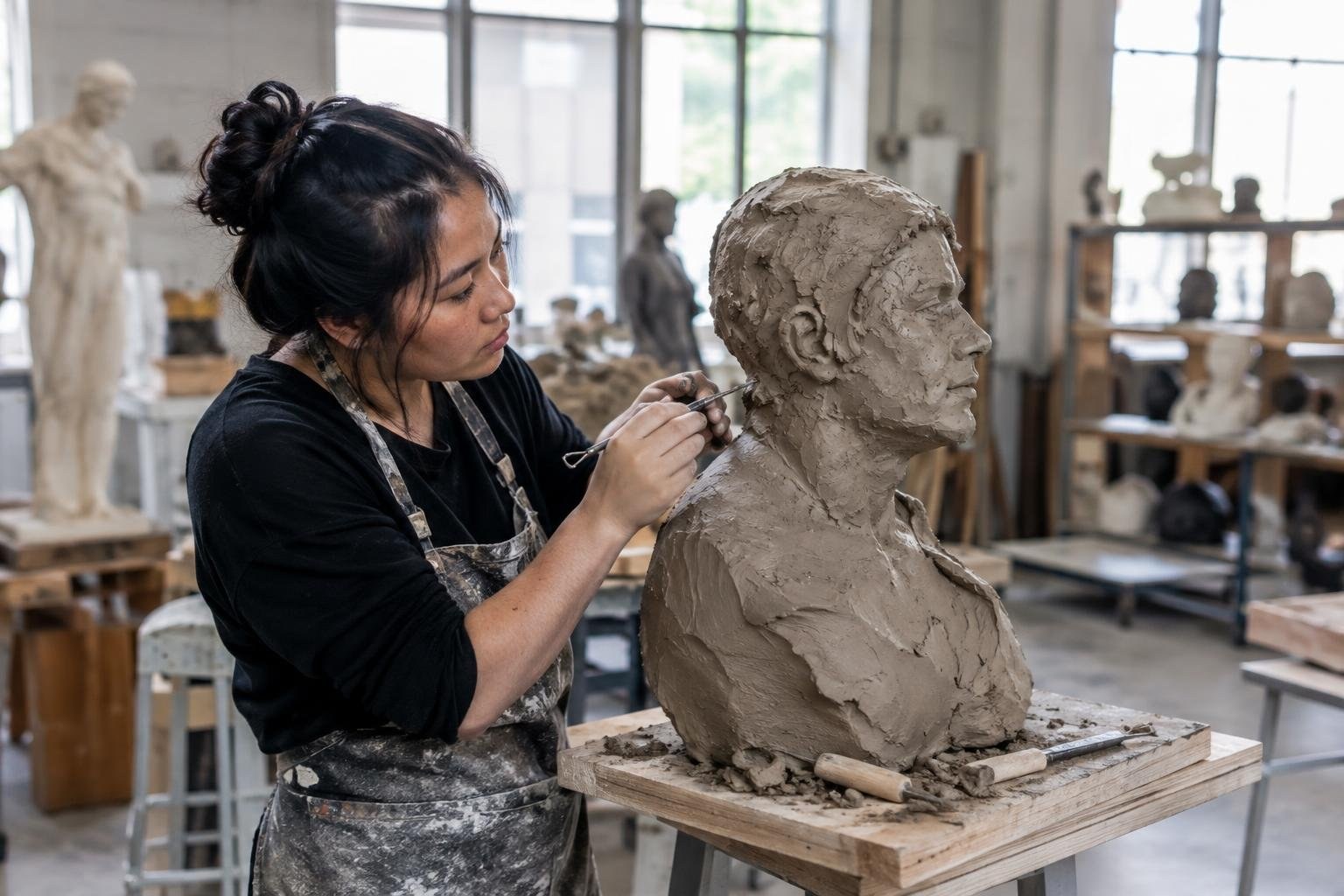
A student working on a three-dimensional sculpture in a supervised college studio
What Is a Sculpture Degree?
Sculpture is the study and practice of creating three-dimensional artworks. Students explore how form occupies space, how a work communicates an idea, and how the choice of material and method shapes the finished piece. The program context for this field includes media such as clay, plaster, wood, stone, and metal, as well as approaches such as modeling, carving, molding, welding, and casting.
Program names and related fields
A school may offer sculpture as a dedicated major, as an emphasis within studio art, or within a broader craft or visual-arts program. Some programs emphasize formal composition; others encourage experimental or interdisciplinary work. Review the actual course plan and facilities rather than relying on the name alone. Sculpture differs from painting and illustration in its primary focus on three-dimensional form, though students may combine media or ideas across disciplines.
What Do You Study in a Sculpture Program?
Expect a mix of studio work, discussion, research, and critique. Early study may build observation, visual analysis, and familiarity with tools and materials. As students advance, they may take on more independent projects and connect their making to artistic ideas and the history of sculpture. Arizona State University describes connecting current work to sculpture’s history and contemporary art, while Texas Tech describes formal and conceptual approaches within its BFA sculpture emphasis.
Studio work is central
Students develop ideas through sketches, models, tests, and finished pieces. They may learn how to select an appropriate material, plan construction, revise a work, and present it for critique. Some programs make room for modern, experimental, or interdisciplinary approaches, including media and technology. Individual assignments and materials differ by course and institution.
Projects and portfolio development
Original work is a significant part of many sculpture programs. Students should ask whether a program includes a capstone, exhibition, portfolio review, internship, or other culminating project. Do not assume every school requires the same sequence or offers the same studios. Confirm course descriptions, equipment access, and project expectations with the department.
Skills You Can Develop
A sculpture program can help students develop a combination of creative, practical, and communication skills. The exact balance depends on curriculum and studio access.
Visual and spatial thinking: judging proportion, balance, scale, volume, and how an object relates to its surroundings.
Material and making skills: testing materials, selecting methods, and developing craft through hands-on practice.
Creative problem-solving: translating an idea into a physical form, then revising it when a design or material behaves differently than expected.
Research and interpretation: placing work in conversation with art history and contemporary practice.
Communication: describing artistic choices, responding to critique, and presenting work to audiences or collaborators.
Project planning: organizing materials, time, and steps for a work of art.
These abilities can support studio practice and related creative roles, but they do not replace the portfolio, experience, or additional qualifications an employer may seek.
Who Is a Sculpture Degree Best For?
Sculpture may suit students who enjoy making objects, experimenting with materials, and solving open-ended visual problems. It can also suit people who like both hands-on work and reflection: a studio project may involve physical construction as well as research, critique, and decisions about meaning. You do not need to arrive with a fixed personal style. A program should give you opportunities to learn and develop one.
Consider the day-to-day work
Ask yourself whether you want to spend substantial time planning, making, testing, and revising original work. Would you enjoy learning a technique that takes practice? Are you comfortable discussing unfinished work and using feedback to revise it? A sculpture major is not only about talent or inspiration; persistence, curiosity, and willingness to learn technical processes matter too.
Does sculpture match you?
Salary, prestige, and job-growth projections matter, but they do not tell you whether you will enjoy the work itself. Compare the actual activities of possible careers with your interests and preferred work style. Assessment.com’s MAPP career assessment and its career and degree exploration tools can help you consider related directions. Treat an assessment as one input alongside course research, conversations with faculty, and firsthand exposure to studio work.
Admissions and Preparation
Admissions rules are set by each college and can differ between certificates, undergraduate degrees, and graduate programs. Common application materials may include academic records; a portfolio or examples of creative work may be requested for some programs, but do not assume that every school has the same requirement. Check the current admissions page and ask the department how it evaluates applicants with limited formal art training.
Questions to ask before applying
Is a portfolio required, and what work should it include?
Are there prerequisite art courses or foundational studio classes?
Are test scores, an interview, or an artist statement part of the application?
What preparation is recommended for applicants new to sculpture?
For transfer students and adults returning to school, ask how previous coursework is reviewed and whether required studio sequences affect time to completion. Requirements vary, so get the answer in writing from the institution rather than relying on another school’s admissions checklist.
Credential Levels and Time to Completion
Sculpture study exists at several credential levels, but the availability and structure of each option vary by institution. A certificate may focus on a narrower set of techniques; an associate or bachelor’s program may combine studio study with broader coursework; a graduate program may expect deeper artistic, technical, and historical knowledge. The Florence Academy of Art describes a three-year certificate program in classical sculpture, while Texas Tech describes a three-year MFA program in sculpture. These are examples, not a universal timeline or standard for all schools.
Plan around the course sequence
Ask each institution for its official degree map, credit requirements, studio sequence, and expected full-time timeline. Part-time study, transfer credits, course availability, and the order of required classes can change how long completion takes. Do not assume a certificate at one school is equivalent to a degree at another.
Graduate programs may expect students to demonstrate substantial prior preparation. Texas Tech’s sculpture-area MFA description, for example, refers to broad sculptural knowledge and fabrication skills alongside in-depth art-history knowledge. Verify requirements directly with every program you consider.
Online, Hybrid, or On Campus?
Sculpture is a hands-on discipline, so the learning format can affect what students can make and how they use equipment. Campus programs can offer access to physical studios and materials. Some schools may offer online courses or hybrid study, but the availability of online sculpture programs and the amount of in-person work differ.
Verify the practical details
Ask whether you must attend campus for studio classes, critiques, equipment training, exhibitions, or project reviews. Find out what tools and workspaces students can use, how materials are supplied, and whether there are limits on project size or storage. For an online or hybrid option, confirm whether students need to source materials and equipment locally and how instructors assess hands-on work. A program’s “online” label alone does not answer these questions.
Cost, Tuition, and Financial Aid
The price of a sculpture degree depends on the institution, credential, residency status, enrollment pace, and length of study. A meaningful comparison should include more than tuition. Ask for a complete cost estimate that covers mandatory fees, materials, studio charges, tools, transportation, housing, and any costs tied to exhibitions or final projects. These expenses are not the same at every school.
Look for financial support and lower-cost routes
Ask the financial aid office about grants, scholarships, work-study, payment plans, and whether awards are available to art students. Check whether scholarships require a portfolio or continued academic standing. Students may also compare public and private institutions, study close to home, review transfer-credit policies, and avoid purchasing specialized equipment before confirming program requirements. Use each school’s current published costs and aid offer to estimate net cost, not a broad national average that may not reflect your circumstances.
Careers, Jobs, Pay, and Employment Outlook
Sculpture can lead toward several kinds of work, but a degree alone does not guarantee a job, sales, or a particular income. Potential directions include independent studio practice, craft work, and arts education. Some graduates combine creative work with teaching, commissions, arts organizations, or other employment. The role and its requirements matter more than the degree title when estimating earnings or opportunities.
Understand salary and outlook by occupation
There is no single “sculpture salary.” Income can depend on the type of work, location, employer, experience, and how an artist earns revenue. Employment projections are also occupation-specific, not degree-specific. Before enrolling, research current official labor-market information for each job you are considering, then compare required education, portfolio expectations, and experience. Postsecondary teaching, for example, may require graduate education depending on the position and employer; check actual job postings and institutional requirements.
Related possibilities named in the program context include craft artists, fine artists, and postsecondary art, drama, or music teachers. Explore the actual tasks and qualifications for each path, rather than assuming every role is directly accessible after graduation.
Find out which Career or College Major is right for you!
Many creative employers and clients want evidence of what an applicant can make and how they approach a project. Build a portfolio that shows finished work as well as thoughtful experimentation. Keep clear records of materials, dimensions, process, and your role in collaborative projects. Seek critique and look for opportunities to exhibit, assist, volunteer, or work on projects related to your interests.
How to stand out to employers or clients
Present a focused, current selection of work rather than every project you have completed.
Include concise descriptions that explain the idea, material, and process.
Show that you can meet a brief, manage practical constraints, and revise work.
Build relationships with faculty, peers, arts organizations, and potential collaborators.
Ask the program whether it supports internships, exhibitions, visiting artists, or other professional experiences.
Certification and licensure should not be assumed to be universal requirements for studio artists. Teaching credentials or other qualifications may apply to particular jobs and jurisdictions. Confirm requirements for the specific occupation and location you want.
Graduate School and the MFA Path
A graduate degree may make sense for students seeking advanced studio development, sustained research, or particular teaching paths. A Master of Fine Arts is one possible next step for artists who want extended graduate-level practice. It is not automatically required for every creative occupation, and the value depends on personal goals, program quality, cost, and the requirements of the jobs a student wants.
Compare before committing
Review each graduate program’s portfolio and admissions expectations, duration, faculty, studio resources, funding, and final-project or exhibition requirements. Texas Tech describes its sculpture MFA as a three-year program and notes expectations for broad sculpture practice, fabrication, and art-history knowledge. Other programs may differ in length and emphasis. Compare graduate study with gaining work experience, developing a portfolio independently, or pursuing a focused certificate.
Related Degrees and Alternatives
Related programs can lead to overlapping creative interests but may differ in the work they emphasize. Compare the course requirements, studio access, media, and likely career direction before choosing.
Studio art: consider this if you want broader exposure to art forms rather than a primary focus on sculpture.
Craft or sculptural practices: consider this if you want a program that combines sculpture with broader craft or material-based work.
Painting: consider this if you prefer two-dimensional image-making and surface-based work.
Illustration: consider this if visual storytelling and image communication interest you more than building three-dimensional objects.
Industrial or product design: consider this if you want to design objects for use, function, or production rather than focus mainly on independent artwork.
Art history: consider this if you are more interested in studying, interpreting, and contextualizing art than making sculpture day to day.
Art education: consider this if teaching and helping others learn art techniques are central goals; check the qualifications required for the age group and location.
These labels are broad. A school’s curriculum may cross boundaries, so compare course catalogs and examples of student work.
Advantages, Drawbacks, and Is It Worth It?
Advantages: sculpture study gives students sustained time to make original work, develop technical skills, explore materials, and connect practice with contemporary art and art history. Some programs also support experimental, interdisciplinary approaches.
Drawbacks to weigh: studio programs may involve materials and equipment expenses, require access to physical workspaces, and demand substantial time for making and revision. A degree does not promise a specific job, sales, or income. Students may need to build experience and a portfolio beyond coursework.
Is the investment worth it?
Consider the total cost against your goals, the quality of the program’s facilities and instruction, the portfolio you expect to develop, and the career paths you are prepared to pursue. Discuss finances openly with family or other supporters. Compare lower-cost pathways and ask schools about aid before making a commitment. The right answer depends on your resources and aims, not on a universal claim that an arts degree is either worthwhile or impractical.
How to Choose the Right Sculpture Program
Look beyond promotional summaries and compare what students actually study and can access. Request the current catalog, degree map, and written answers to questions about studio resources and total cost.
Program comparison checklist
Accreditation: check the institution’s recognized accreditation status and ask how credits transfer. Do not assume a particular sculpture program has specialist accreditation unless the school verifies it.
Curriculum: compare required courses, materials, techniques, art-history study, and room for electives.
Studios and faculty: ask what facilities are available and which faculty teach sculpture or related practices.
Experience: ask about critiques, exhibitions, internships, visiting artists, and portfolio support.
Format and access: clarify where and when students use studios, tools, and equipment.
Cost and outcomes: compare full attendance costs, aid, graduation expectations, and career services.
Transfer and requirements: verify transfer policies, prerequisites, and any career-specific licensure preparation.
Assessment.com’s education and career exploration resources can help you identify questions and related paths. Confirm program facts directly with each college.
From Degree to Career
Career paths are not automatic ladders, but a student can plan for several possible next steps. For example:
Sculpture studies → portfolio assistant or studio support role → more project experience → specialized fabrication or independent studio practice.
Sculpture studies → craft or fine-art practice → exhibitions, commissions, or other documented experience → a more established independent practice.
Sculpture studies → further study and relevant teaching preparation → teaching role, where the employer and jurisdiction’s requirements are met.
Each route depends on work quality, skills, opportunity, professional relationships, finances, and any additional qualifications. Before choosing a program, identify two or three occupations that interest you and check their actual entry requirements. A portfolio and practical experience can be important complements to formal study.
Questions to Ask Before Enrolling
Use these questions when comparing programs with a counselor, parent, admissions adviser, or department representative:
What is the complete estimated cost, including materials, tools, studio fees, and living expenses?
Which studios, equipment, and materials can students use, and when?
What courses and projects are required, and how much work is completed in a studio?
Is an admissions portfolio required, and what should it show?
Can credits transfer, and how will transfer work affect the course sequence?
What scholarships, grants, work-study, or other aid may be available?
What career services, internships, exhibitions, and employer or arts-community connections exist?
What further education, certification, or licensure might be needed for the careers I am considering?
How does the format work in practice, especially for studio access and critique?
What are typical completion requirements and options for part-time students?
Ask for answers in writing and compare them across schools. Families can help by reviewing the budget and making sure the student has a realistic understanding of studio expectations and possible career routes.
Frequently asked questions
Is a sculpture degree hard?
A sculpture degree is studio-focused and can be demanding because students spend substantial time making, revising, and presenting original work. Programs may challenge students conceptually and technically, and working with physical materials requires planning and persistence. The workload and specific expectations vary by school, credential, and medium.
What do you learn in a sculpture degree?
Sculpture programs teach students to create three-dimensional work, explore materials and techniques, and develop an artistic approach. Depending on the program, students may study form, composition, contemporary art, and art history while building a portfolio of original work. Curricula and available facilities differ by institution.
What jobs can I get with a sculpture degree?
Graduates may pursue studio practice, craft work, arts education, or related creative work, depending on their training, portfolio, and experience. A degree does not guarantee employment as a sculptor or teacher. Postsecondary teaching positions may require graduate study, and school teaching can have additional state requirements.
How much can you make with a sculpture degree?
There is no single salary for sculpture graduates. Earnings depend on the job, location, experience, employer, and whether an artist earns income from commissions, sales, teaching, or other work. Compare current occupational data for the specific job you are considering rather than treating a degree-level figure as a forecast.
Can you earn a sculpture degree online?
Some sculpture-related instruction can be offered online, but sculpture is hands-on and many programs rely on studio facilities, tools, materials, critiques, or in-person making. Ask whether a program is fully online, hybrid, or campus-based, and verify how students complete any studio or exhibition requirements.
Does sculpture require math?
Sculpture is not usually defined by a single required level of mathematics, but students may use measurement, scale, spatial reasoning, and practical calculations when planning work. The courses and technical expectations depend on the school and the materials or methods a student chooses.
Do you need an MFA to become a sculptor?
Graduate study is not necessary for every sculpture career. An MFA may be relevant for advanced studio practice or some postsecondary teaching paths, but requirements vary by employer and position. Review job postings and graduate program expectations before deciding whether more school fits your goals.
What is the difference between a sculpture degree and a studio art degree?
A sculpture program may be offered within a BFA or studio-art degree, while a craft or visual-arts program may combine sculpture with other practices. Compare the required studio work, materials, art-history courses, conceptual focus, facilities, and portfolio outcomes. Program names alone do not show how similar two curricula are.
People Also Ask
What is a sculpture degree?
A sculpture program teaches students to make three-dimensional art, explore materials and form, and develop original work. It may also include contemporary art and art-history study, depending on the curriculum.
How long does it take to get a sculpture degree?
Program length varies by credential, school, enrollment pace, and transfer credit. Check the official program plan for the number of terms, studio sequences, and graduation requirements rather than assuming every sculpture program follows the same timeline.
What materials do sculpture students work with?
Sculpture students may work with different materials and methods, and specific offerings vary by school. Ask which studios, equipment, technical instruction, and safety training are available before selecting a program.
What is an MFA in sculpture?
An MFA is a graduate degree in fine arts that may include advanced studio practice, fabrication skills, and art-history study. Requirements differ by program; for example, Texas Tech describes its sculpture-area MFA as a three-year program.
How do I choose a sculpture program?
Look at the required courses, access to studios and equipment, faculty expertise, total cost, critique and exhibition opportunities, and support for building a portfolio. Ask current students how much hands-on studio time the program provides.
Is a sculpture degree worth it for a career?
Sculpture can be a useful foundation for creative work, but career outcomes depend on the role, portfolio, experience, and further qualifications that may be needed. Compare the actual work and requirements for several occupations before judging the degree’s value.
A sculpture degree can help you build artistic judgment, material knowledge, and a body of original work, but it is not a guaranteed route to a particular job or income. The strongest choice is a program whose studio access, teaching, curriculum, cost, and opportunities match the work you want to do. Compare specific programs and career directions, and consider whether the day-to-day process of making three-dimensional work fits your interests and goals. Assessment.com’s MAPP career assessment can help you explore career and degree options alongside that research.
Want to see your options? Try our comprehensive Degree, Program & College Search tool
We use cookies to offer you a better browsing experience, analyze site traffic and personalize content.
Read about how we use cookies and how you can control them in our
Privacy Policy.
If you continue to use this site, you consent to our use of cookies.
×
Exciting News!
Be one of the first to Beta Test the new AI-Powered Assessment.com Platform.