Ceramic Arts and Ceramics Programs: Courses, Careers, Costs, and Fit
Explore ceramic arts and ceramics programs, studio courses, credentials, costs, career possibilities, and the questions students and parents should ask before choosing a school.
By Kieth Nelson · Staff Writer Assessment.com · Published October 12, 2026 · Last updated November 5, 2026
A ceramic arts and ceramics program teaches students to make art and design objects from clay and related materials, combining creative development with practical studio techniques. Students may learn handbuilding, wheel throwing, mold-making, glaze work, decoration, and firing while building a personal body of work. Programs are offered at different credential levels, and their focus and format vary by institution. Graduates may pursue independent studio practice or explore related work in design, education, museums, and other creative settings. For students and parents, the key decision is not simply whether ceramics sounds appealing, but whether the program's facilities, cost, and career preparation fit the student's goals.
Degree & Program Decision Insights
Explore your personal fit, education requirements, career potential and next steps.
01Motivational Fit
Discover whether this program fits you
Explore your preferences against the focus of Ceramic Arts and Ceramics. These prompts are not personal MAPP results.
Subject curiosity. Would you choose to explore “handbuilt and wheelthrown techniques” in depth? Ask for a sample learning activity to test that interest.
Breadth of interest. Consider the place of “molding” in this field. Is this another part you would choose to explore, or mainly a requirement you would tolerate?
Work reality. Related work can involve this task: “Explain and demonstrate artistic techniques.” Would you want that activity to be a regular responsibility?
Interest in studying a field can differ from enjoying its related work.
Which part would you want to do repeatedly, and what would you try before deciding?
Discover Your Personal Program Fit
Before investing your time and money in your education, discover how this program aligns with your natural motivations, work preferences and career goals.
Typical occupational entry: master's degree (BLS). Postsecondary teaching is a separate appointment and may require advanced study; this programme alone is not a promise of a teaching post.
Typical occupational entry: bachelor's degree (BLS). BLS lists long-term on-the-job training as typical occupational training.
U.S. occupational wages are not guaranteed graduate earnings; OEWS excludes self-employed workers.
Projected openings include replacements as well as growth.
U.S. national estimates. A crosswalk does not establish entry-level eligibility; advanced, management and teaching roles can require further qualifications.
Compare the focus and route of these distinct instructional fields; their credentials and admission requirements are not interchangeable.
Ceramic Sciences and EngineeringCIP 14.0601. Compare the official Ceramic Sciences and Engineering field description and actual course requirements; confirm which parts support your intended specialization.
Jewelry ArtsCIP 50.0713. Compare its emphasis on design concepts and electroforming with this program’s focus.
Metal ArtsCIP 50.0714. Compare its emphasis on aesthetics and anodizing with this program’s focus.
Explore your motivations. Use MAPP as a starting point for reflecting on your interest in “handbuilt and wheelthrown techniques”, then test that interest against a sample learning task.
Examine the work. Compare Art, Drama, and Music Teachers, Postsecondary and Fine Artists, Including Painters, Sculptors, and Illustrators on daily work and entry qualifications, as well as pay. Explore Art, Drama, and Music Teachers, Postsecondary.
Compare actual providers. Ask for the exact credential, course sequence and assessment methods. Compare how each provider teaches “molding”, its entry criteria and its itemized costs.
Check the evidence before applying. Confirm prerequisites and any recognition or professional requirements for your intended route; ask for applicable rules and published outcome definitions in writing.
Verify the institution’s current offering, admissions requirements and outcomes; a search result does not establish your eligibility.
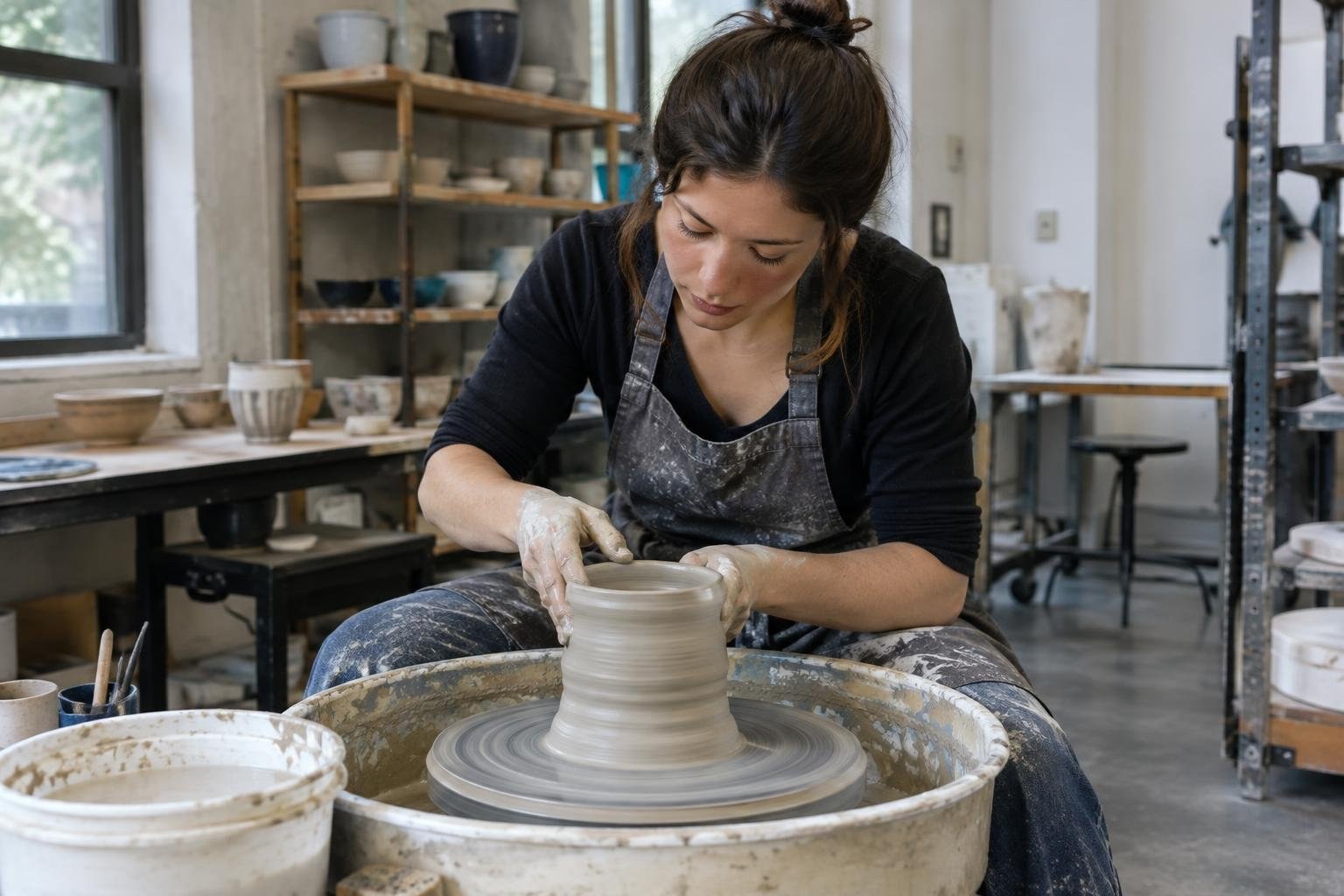
Student practicing wheel throwing in an educational ceramics studio
What Is a Ceramic Arts and Ceramics Program?
Ceramics is a studio art and design field focused on creating work from clay and similar materials. Students develop their own visual ideas while learning processes that affect a piece's form, surface, and finished appearance. Courses can combine practical making with creative problem-solving and the development of a portfolio.
Program labels can include ceramics, ceramic arts, or a ceramics concentration within a broader fine arts degree. Credentials may include certificates, associate or bachelor's degrees, and graduate study, but those levels are not available at every institution. Compare the specific program rather than assuming a title means the same curriculum everywhere. For an example of a bachelor's-level concentration, Kennesaw State describes its ceramics concentration as covering fine art and design or production.
Ceramics differs from a broad visual arts program mainly in its sustained focus on clay and ceramic processes. A wider fine arts course of study may offer more media choices. A ceramics major is a fit to investigate if you want focused studio time with clay; compare requirements to see whether the program is truly specialized or part of a broader curriculum.
What Do You Study in Ceramics?
Students learn both how to make ceramic work and how to make informed choices about the work. Early experiences may introduce handbuilding and wheel throwing, with attention to how a form is constructed and refined. More advanced study can extend to mold-making, slip-casting, glaze and clay formulation, surface treatment, and different firing methods. The precise sequence depends on the institution and the credential.
A strong curriculum should help students connect technique to intention: choosing a process that serves an idea, testing materials, reviewing results, and revising. Students may also develop a personal style and learn to discuss their work. Arizona State University describes ceramics study as developing technical and intellectual skills alongside a student's individual style and specialty.
Ask for a course sequence and examples of student projects. Find out what equipment and firing approaches are available, how studio work is assessed, and whether students receive time for independent projects. A course title alone does not tell you how much access to tools or feedback a student will receive.
Skills You Can Develop
Coursework can build hands-on technique, visual decision-making, experimentation, and the ability to explain a creative process. Students practice translating an idea into a physical object, observing how materials behave, and making revisions when a result differs from the plan. Portfolio development can help organize work so a student can present skills and artistic direction.
These skills can apply to studio practice, ceramic design, and some education or museum-related pathways. Students interested in independent work also benefit from learning how to document projects, communicate with audiences, and plan practical next steps. The exact balance of technical and conceptual study differs by program. Ask faculty what students are expected to demonstrate by graduation and what work is included in critiques or exhibitions.
Students do not need to arrive with a fully formed artistic identity. Curiosity, patience, openness to feedback, and regular practice can help them grow. Consider whether you enjoy working through a problem with your hands as well as thinking and talking about the choices behind the finished piece.
Who Is a Ceramics Program Best For?
Ceramics may suit students who enjoy making, experimentation, visual expression, and learning how materials respond to different techniques. The work can involve both open-ended creative choices and careful technical steps. Students may spend time refining a form, testing a glaze, evaluating a firing result, or developing a consistent body of work.
There is no required personality type. Some students begin with a strong interest in design, while others are drawn to sculpture, craft, or the physical process of working with clay. It helps to be willing to try, assess, and revise rather than expect every attempt to work on the first try. If possible, take an introductory class or visit a student exhibition before committing to a longer program.
Does Ceramics Match You?
Salary, reputation, and job prospects are only part of a college decision. Personal fit matters because students are more likely to stay engaged when the learning and future work connect with their interests and preferred ways of working. Assessment.com's MAPP career assessment can be one input as you explore career and degree options; use results as a starting point for discussion, not as a rule that decides for you.
Admissions, Program Length, and Academic Demands
Admissions requirements are set by each college and credential. Before applying, ask whether the program expects prior studio coursework, a portfolio, an interview, transcripts, or other application materials. Do not assume every ceramics program requires a portfolio, or that a student must already have advanced technical skills. Confirm the current requirements with the admissions office and department.
Time to completion depends on the credential, required credits, course availability, transfer work, and whether a student studies full or part time. For one specific example, Hood College states that its 18-credit Graduate Certificate in Ceramic Arts can be completed in one year. That example does not establish a standard timeline for other certificates or degrees.
Studio study can take sustained time outside scheduled classes. Ask how many hours students typically need in the studio, how the school schedules access, and whether materials or equipment require additional preparation. To prepare, visit a studio if possible, practice basic drawing or making, keep photographs of work, and ask an advisor how previous coursework might transfer.
Online vs. On-Campus Ceramics Study
Online, hybrid, and campus-based options depend on the specific institution and credential. Some parts of study, such as readings, discussion, or critique, may be delivered remotely. Ceramics also involves making physical work, so students should understand how a program handles practical studio learning, equipment, and feedback.
UMass Dartmouth offers an online Graduate Certificate in Artisanry for students who already hold a bachelor's degree and want further study in ceramics. That example confirms that an online option exists, but it does not mean every ceramics program can be completed remotely or that all studio processes are supplied at a distance.
Before enrolling online, ask where you will make work, whether the school requires visits or residencies, how projects are shipped or reviewed, and what materials and tools you must provide. For a campus program, check whether studio access matches your schedule and whether students can use facilities outside class. Choose a format based on the learning experience you will actually receive, not just the word “online” in a listing.
Ceramics Program Costs and Financial Aid
There is no single ceramics tuition figure that applies across U.S. colleges. Total cost depends on the institution, credential, enrollment pattern, and the fees and materials attached to a particular course. Ask each school for a written estimate of tuition and mandatory fees, and clarify whether studio use, clay, glazes, firing, tools, safety equipment, or portfolio expenses are included or billed separately.
Then compare the full cost of attending, not just the advertised tuition rate. For students living away from home, include housing, food, transportation, and other living expenses. For online study, ask which equipment and supplies you must obtain yourself. These questions are especially important when comparing a short certificate with a longer degree program.
Explore federal and state aid eligibility, institutional scholarships, payment plans, and employer tuition assistance where applicable. Ask the financial aid office which aid can be used for the credential you are considering. If transferring from a community college or another program, request a written evaluation of credits before relying on an estimated graduation date or savings.
Careers, Jobs, and Employment Considerations
Ceramics study can lead toward creative work, but the credential by itself does not guarantee a particular job, income, or employment outcome. Maine College of Art & Design describes potential directions including professional artist, ceramicist, designer, educator, curator, conservation specialist, and entrepreneur. These are possible paths to investigate, not assured placements.
Career direction
How ceramics study may apply
What else to check
Craft artist or ceramic artist
Studio practice and a developed body of work can support an independent practice.
How artists in your intended market find commissions, exhibit, or sell work.
Ceramic designer
Material knowledge and design or production study can inform object design.
Portfolio expectations and relevant employer requirements.
Fine artist or sculptor
Three-dimensional work and personal style development can support visual arts practice.
Whether the work is primarily independent, commissioned, or organization-based.
Art educator
Subject knowledge may support teaching or arts education pathways.
Required degree level, teaching credentials, and employer-specific rules.
Curatorial or conservation-related work
Ceramics knowledge may be relevant to collections and material culture.
Specialized study and experience expected for a specific position.
Creative entrepreneur
Making skills can be combined with a self-directed practice or small creative business.
Business planning, sales channels, production capacity, and costs.
Career names and requirements vary, and some jobs may require additional education or experience beyond a ceramics credential. Research current job descriptions in the location where you plan to work. For broader context, Assessment.com has resources on arts and design careers and postsecondary arts teaching. The available program information does not establish current salary figures or employment outlook, so avoid making a financial decision based on an assumed income.
Accreditation, Certification, and Licensure
Before enrolling, confirm the institution's accreditation status and ask which recognized accreditor applies to the school. Institutional accreditation and program-specific recognition are different questions; do not assume a ceramics program has a separate professional accreditation unless the school verifies it. Ask whether the credential will meet the requirements of any future school, employer, or funding source you care about.
The supplied program descriptions do not establish a universal ceramics license or certification. Do not confuse earning a degree or certificate with meeting requirements for a separate profession, such as teaching in a particular school system. If your goal involves teaching, museum work, or conservation, check job postings and applicable state or employer rules for that exact role.
Ask admissions staff to explain how the credential appears on a transcript, whether credits can transfer, and what documentation graduates receive. Get important answers in writing, especially if you expect to continue to another institution or use the credential for a specific job qualification.
How to Choose a Ceramics Program
When comparing programs, look beyond the degree name. Read the required courses and ask how much study is devoted to technique, design, individual projects, and portfolio development. Compare the studio facilities, equipment, firing options, class access, faculty experience, and opportunities to show or discuss completed work. A program's stated focus should match the work you hope to make.
Evaluate how the school helps students connect studio work with next steps. Ask whether students can gain experience through exhibitions, internships, assistantships, community projects, or other opportunities, and whether participation is guaranteed or competitive. Request recent examples of student work and ask how students receive critique and advising.
For costs, compare written estimates across the full credential, including fees and materials. For outcomes, ask what information the institution tracks and how it defines employment or further study. Verify transfer rules, class availability, online requirements, and any admissions portfolio expectations before paying a deposit.
Use Assessment.com's college major decision resource and degree exploration tools to help organize your questions. They can support exploration, but the college remains the source for its curriculum, costs, and admissions decisions.
Related Degrees and Alternative Pathways
Related pathways can help students decide how specialized they want their education to be. Consider these alternatives by comparing actual courses and requirements:
Fine arts: Consider this instead if you want to explore several visual media, not focus mainly on clay.
Sculpture: Consider this instead if three-dimensional form interests you but you want to work across materials.
Art education: Consider this instead if teaching and learning are central goals; verify the education and credential requirements for the setting you want.
Industrial or product design: Consider this instead if you are most interested in designing objects for practical use or production.
Art history or museum studies: Consider this instead if research, collections, interpretation, or curatorial work appeal more than making studio work.
Short ceramics certificate: Consider this instead if you want focused study or skill development without beginning a longer degree, after checking the credential's scope and transferability.
These are broad directions, not interchangeable qualifications. A certificate, a studio art degree, and a program focused on design or education can differ in coursework, admissions, time, and later options. Review the specific curriculum and talk with an advisor before choosing based on the label alone.
Questions to Ask and Next Steps
Possible path one: ceramics certificate or degree → develop studio work and portfolio → pursue independent artist or craft practice → build a specialty and professional relationships → expand into teaching, design, or a small creative business if qualifications and opportunities align.
Possible path two: ceramics study → pursue a role or further preparation in arts education → meet the requirements for the intended employer or school system → gain relevant teaching experience → consider advanced study or leadership work where appropriate.
Possible path three: ceramics degree → seek relevant museum, collections, or conservation experience → add specialized education or training if required → pursue a focused role as opportunities arise.
These examples are planning pathways, not promised outcomes. To evaluate fit, ask yourself and the school: Do I want to make work regularly? Which kinds of work would I be willing to pursue? What is the complete financial commitment? What evidence can the program provide about student work and next steps? Have I checked the actual requirements for the career I have in mind?
Before choosing a major, students and parents can also review Assessment.com's college guidance information. Use career exploration and conversations with advisors to compare interest, coursework, and practical constraints together.
Frequently asked questions
What do you learn in a ceramics degree program?
Ceramics programs teach students to make and develop work using clay and related materials. Coursework may cover handbuilding, wheel throwing, molds, casting, glazes, surface decoration, and firing, along with creative problem-solving and portfolio development. Program content differs by school and credential, so compare course plans and studio access rather than relying on the program title alone.
How long does it take to complete a ceramics program?
There is no single timeline for every ceramics credential. Certificate and degree programs have different credit requirements, and pacing can depend on transfer credits and whether a student attends full or part time. One example is Hood College's 18-credit graduate certificate, which the school says can be completed in one year. Confirm the current program plan directly with each institution.
Can you study ceramics online?
Yes, some ceramics study is available online. UMass Dartmouth, for example, offers a graduate certificate in artisanry for people who already hold a bachelor's degree and want further study in ceramics. Online availability does not mean every course or studio activity is remote, so ask how the program handles making, firing, critiques, and access to equipment.
Is a ceramics major difficult?
Ceramics can be demanding because students need to develop ideas and visual judgment while learning technical processes and revising work through practice. Studio time, material testing, and learning from unsuccessful results can all be part of the experience. The challenge depends on the program and the student; ask current students how much independent studio work is expected.
What jobs can you get with a ceramics degree?
Ceramics study may prepare graduates to pursue work as practicing artists, ceramicists, designers, educators, curators, conservation specialists, or entrepreneurs. These are possible directions, not guaranteed outcomes. Job requirements differ, and some positions may call for additional education, experience, or specialized preparation. A portfolio and practical experience can help students explain their skills to employers or clients.
How much do ceramics majors make?
There is no single salary figure that applies to ceramics graduates. Earnings vary with the role, location, experience, employer, and whether someone works independently or for an organization. Before committing to a program, investigate the specific jobs you are considering and their requirements, then compare likely costs with your financial plan. Do not treat an art degree as a guarantee of a particular income.
Do you need a graduate degree to work in ceramics?
There is no universal requirement for graduate school across ceramics careers. A graduate credential may suit artists who want advanced study, and some teaching or specialist roles may have additional education requirements set by the employer. Check job postings and ask programs what graduates do next before deciding whether an advanced degree fits your goal.
What is the difference between ceramics and fine arts?
Compare the focus and daily work. Ceramics centers on clay and related making processes, while broader fine arts programs may give students a wider range of media. The best choice depends on whether you want sustained studio work with clay or a broader exploration of art forms. Review course requirements and available facilities at each school before deciding.
People Also Ask
What is a ceramic arts degree?
A ceramics program teaches artistic and technical approaches to working with clay. Depending on the school, students may study handbuilding, wheel throwing, molds, slips and glazes, decoration, firing, and the development of a personal style.
What degree levels are available in ceramics?
Some schools offer ceramics certificates and associate or bachelor's-level study; graduate certificates and advanced degrees may also be available. The credential menu varies by institution, so verify that the specific school offers the level you need.
Can you earn a ceramics degree fully online?
Hands-on practice is central to ceramics, so ask a school whether its online or hybrid offering includes studio access, equipment, firing, and feedback on physical work. A fully remote format may not provide the same studio experience as campus study.
What can you do with a ceramics degree?
A ceramics credential may support a path toward independent art practice, ceramic design, education, curatorial work, conservation-related work, or entrepreneurship. Each route has its own hiring expectations, and earning a degree does not guarantee a job.
Do ceramics programs help students build a portfolio?
Some ceramics programs build in portfolio development and creative problem-solving. Ask how often students receive critiques, how work is documented, and whether the program helps students present a cohesive body of work for applications or clients.
What costs should students expect in a ceramics program?
Ceramics programs may include studio access, materials, equipment, and firing as well as tuition and ordinary student expenses. Ask the institution for a full cost estimate that identifies course, studio, material, and equipment charges before comparing offers.
What skills help someone succeed in ceramics?
A ceramics student benefits from curiosity about form and material, patience with hands-on learning, and willingness to revise ideas. There is no single personality type required; students can develop technique and confidence through guided practice.
Ceramic arts and ceramics can be a strong choice for students who want to develop a hands-on studio practice and learn how clay, form, surface, and firing shape finished work. Programs range from short certificates to undergraduate and graduate study, but their names, curricula, and admission expectations vary. Before enrolling, compare the actual studio access, instruction, total cost, portfolio opportunities, and pathways to the work you hope to do. If you are still weighing your options, use the MAPP career assessment to explore how your motivations and preferences may align with creative careers and related degrees.
Find out which Career or College Major is right for you!
We use cookies to offer you a better browsing experience, analyze site traffic and personalize content.
Read about how we use cookies and how you can control them in our
Privacy Policy.
If you continue to use this site, you consent to our use of cookies.
×
Exciting News!
Be one of the first to Beta Test the new AI-Powered Assessment.com Platform.