Printmaking Degree Guide: Courses, Careers, Costs, and Program Fit
A practical guide to printmaking study: compare techniques, studio access, credentials, costs, and creative pathways before choosing a program.
By Tome Fierre · Staff Writer Assessment.com · Published October 12, 2026 · Last updated November 5, 2026
Choosing a printmaking program is less about finding a perfect-sounding major title and more about figuring out what you will make, where you will make it, and what you want the education to lead toward. Some options are certificates; others place printmaking within studio-art degrees or offer graduate study. Compare the actual course sequence, methods taught, studio access, and complete cost before applying. This guide helps prospective students and families turn those details into a useful side-by-side decision.
Degree & Program Decision Insights
Explore your personal fit, education requirements, career potential and next steps.
01Motivational Fit
Discover whether this program fits you
Explore your preferences against the focus of Printmaking. These prompts are not personal MAPP results.
Scientific investigation. Would you enjoy investigating chemistry and explaining your conclusions from evidence?
Breadth of interest. Consider the place of “monochrome and color printing” in this field. Is this another part you would choose to explore, or mainly a requirement you would tolerate?
Work reality. Related work can involve this task: “Develop concepts or creative ideas for craft objects.” Would you want that activity to be a regular responsibility?
Interest in studying a field can differ from enjoying its related work.
Which part would you want to do repeatedly, and what would you try before deciding?
Discover Your Personal Program Fit
Before investing your time and money in your education, discover how this program aligns with your natural motivations, work preferences and career goals.
Typical occupational entry: bachelor's degree (BLS). BLS lists long-term on-the-job training as typical occupational training.
U.S. occupational wages are not guaranteed graduate earnings; OEWS excludes self-employed workers.
Projected openings include replacements as well as growth.
U.S. national estimates. A crosswalk does not establish entry-level eligibility; advanced, management and teaching roles can require further qualifications.
Explore your motivations. Use MAPP as a starting point for reflecting on your interest in “monochrome and color printing”, then test that interest against a sample learning task.
Examine the work. Compare Craft Artists and Fine Artists, Including Painters, Sculptors, and Illustrators on daily work and entry qualifications, as well as pay. Explore Craft Artists.
Compare actual providers. Ask for the exact credential, course sequence and assessment methods. Compare how each provider teaches “tonality”, its entry criteria and its itemized costs.
Check the evidence before applying. Confirm prerequisites and any recognition or professional requirements for your intended route; ask for applicable rules and published outcome definitions in writing.
Verify the institution’s current offering, admissions requirements and outcomes; a search result does not establish your eligibility.
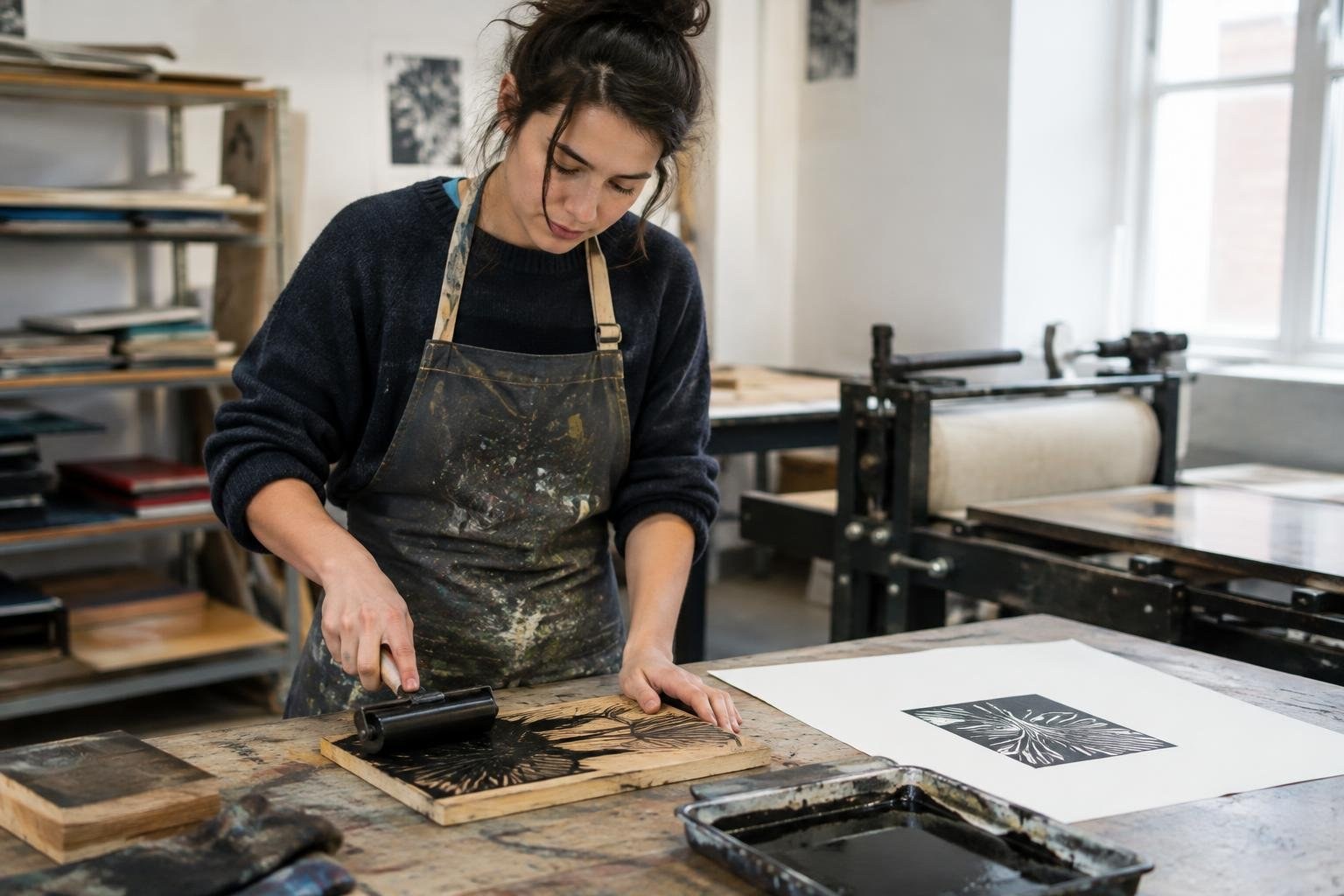
Printmaking student working with a relief block, ink, and paper
Start With the Program Structure
Think of printmaking as a way to translate an idea into an image through a chosen process. Students work with materials and techniques to make prints on paper or other surfaces, while developing their own visual direction. The award is not standardized: Monterey Peninsula College lists a printmaking certificate, while the University of Tennessee describes printmaking within BA, BFA, and MFA Studio Art pathways. These examples show the range of structures, not a complete catalog of programs.
When comparing schools, focus on what the printmaking label means there. Is it a dedicated major, a concentration, or a set of courses within a broader art degree? Review the official catalog and degree map. Then compare student work and the methods available with the kind of practice you hope to build.
Read the Curriculum as a Studio Plan
Course lists are a practical way to see what a program treats as core knowledge. Printmaking may involve relief, intaglio or etching, lithography, monotype, and screen printing. Iowa’s BFA requirements include intaglio, relief, lithography, monotype, paperworks, and foil-stamping; Baylor identifies intaglio or etching, lithography, serigraphy, and woodcut relief. Those examples differ, so a general promise of “printmaking” does not tell you what you will study.
Ask how introductory courses connect to advanced work. Check which methods are required, which depend on electives, and whether the course sequence leaves room for experimentation. Temple describes traditional processes alongside experimental technologies, while Tennessee lists printmaking courses within its Studio Art pathways. Use current catalogs to confirm what is offered during your expected enrollment.
What Technique Choices Mean for Your Work
Technique is not just a list of tools. Each process gives the artist different constraints and choices, so learning several methods can help a student test how an idea changes when translated into print. A program may also encourage work across materials or experimental approaches. Arizona State describes hands-on experience with varied printmaking materials, techniques, and subjects, while Temple highlights both traditional and experimental study.
Look beyond the course names. Ask what students actually make, how often they work in the studio, and how instructors discuss process and finished results. If you want to specialize, find out whether advanced coursework supports that interest. If you are still exploring, compare the breadth of required methods and the room available for independent projects.
Test the Fit Before You Apply
Consider the day-to-day work, not only the image of an artist’s life. Printmaking study involves developing visual ideas, making decisions about materials and process, and assessing the results. Programs may include traditional methods and experimental technologies, but the balance varies. Review sample student work and ask whether the program’s approach looks like the kind of learning you want.
Make a personal fit check: Do you want repeated studio practice? Are you curious about how a process affects the image? Would you rather study several forms of art than focus on printmaking? These questions can help you compare printmaking with broader studio-art options. Assessment.com’s guide to choosing a college major and MAPP assessment can support reflection, but they are starting points, not decisions made for you.
Verify Admissions Requirements Directly
Application instructions belong to the institution, not to printmaking as a field. Check the current admissions page and catalog for each credential, and follow that school’s instructions for any portfolio or other application material. Columbia’s supplied page, for example, identifies visual-arts application materials, but it does not establish a universal requirement for all printmaking programs.
If a portfolio is requested, ask the department what kinds of work it accepts and how to submit it. Do not assume that applicants must already know a particular print process unless the program says so. Before applying, clarify prerequisites, deadlines, and whether the credential has separate entry requirements. Keep a record of answers so you can compare programs accurately.
Check How Studio Learning Works
For a hands-on subject, the learning format affects what you can practice. The university descriptions in this guide identify studio courses and printmaking techniques; they do not establish that printmaking degrees are generally available fully online. Check the delivery format for the actual program and term rather than relying on a broad online-art listing.
Ask how students access equipment, complete studio assignments, and receive feedback. If a school offers hybrid or online courses, find out whether any printmaking work requires in-person attendance and how materials are handled. On a campus visit, request to see the facilities and ask how students access them outside scheduled class time. Make sure the format matches the kind of practical experience you expect.
Build a Full-Cost Estimate
Program descriptions do not provide a current price for your circumstances. Build a personal estimate from each institution’s published tuition and fees, then ask whether course materials, studio charges, or equipment costs are billed separately. Add housing and transportation if they apply. Compare the full credential, not just one term, and check which financial-aid options you may be eligible for with the school’s aid office.
Ask departments what students commonly need to purchase for required courses and whether supplies are included in fees. If comparing a certificate with a longer degree, request written information about credit transfer rather than assuming coursework will count toward another award. The cited program pages describe study options and content, not current cost figures, so use official school information for budgeting.
Match the Credential to Your Next Step
Credential level changes the scope and purpose of study. A certificate may be aimed at studio-arts preparation, continuing education, or personal enrichment; undergraduate printmaking can sit within a broader studio-art degree; graduate study may offer further exploration. Monterey Peninsula College describes a printmaking certificate, the University of Tennessee lists BA, BFA, and MFA Studio Art pathways, and RISD describes a two-year printmaking MFA.
Do not infer that two awards with similar names have the same requirements, or that certificate credits will transfer automatically. Ask each school for the total credits, course sequence, expected completion schedule, and transfer rules. Graduate study is one option, not a mandatory step for every person interested in making prints.
Connect Study to Possible Creative Work
A printmaking credential can help develop technique and a body of work, but it does not guarantee a particular position. Monterey Peninsula College describes its certificate as preparation for studio-arts careers as well as continuing education and personal enrichment. Potential directions to investigate include studio practice, fine art, craft work, and teaching; the preparation required depends on the specific role.
Work backward from your goal. Identify the role or kind of creative practice that interests you, then ask what employers or clients expect and whether further education is relevant. Do not use a single salary estimate as a forecast for all graduates; the program descriptions provided here do not give current pay or job-growth figures. Explore Assessment.com’s arts and design careers, including guides to painters and illustrators and sculptors, to compare related creative paths.
Separate the Degree From Professional Requirements
Do not treat a printmaking degree as proof that you meet the rules for another occupation. The supplied program descriptions explain courses and credentials; they do not establish a universal license or certification for printmakers or artists. If teaching is a goal, first identify the setting and location, then verify requirements with the relevant public agency or prospective employer.
Ask the institution exactly what award it grants and where to verify its accreditation information. If a program makes claims about professional eligibility or approval, request the name of the relevant accreditor or agency and check directly with that organization. A course list alone cannot confirm that a program satisfies requirements for a separate profession.
Compare Printmaking With Nearby Study Paths
Choose an alternative based on the work you want to do. A broader studio-art degree may suit someone who wants to explore multiple media; illustration or graphic design may fit a different kind of image-making or visual communication. These labels do not guarantee a particular course mix, so compare actual requirements and student work.
Use a short comparison: list your preferred media, the courses each program requires, studio resources, degree length, and estimated cost. Then ask which option leaves room for the projects you want to pursue. Assessment.com’s degree resources and arts and design career guides can help you explore adjacent directions while you confirm program details with each school.
Make a Comparison You Can Use
Put programs in a side-by-side table and answer the same questions for each one. Which print methods appear in required courses? How much studio access is described? What exact credential is awarded? What is the total estimated cost, and which expenses may be separate? Are required courses scheduled in a way that fits your plans?
Ask to review current catalogs, course rotations, and examples of student work. If a detail matters to your decision, seek a written answer from the department or financial-aid office. Treat unclear transfer policies, vague studio-access descriptions, and unverified career promises as reasons to ask more questions. For broader decision support, see Assessment.com’s college-major guidance. Once you have comparable information, weigh the program’s actual fit against the full commitment.
Frequently asked questions
What makes printmaking study challenging?
The experience varies by course and technique. Printmaking combines decisions about composition and expression with learning processes that require testing, adjustment, and attention to materials. Ask departments about studio expectations and the kinds of work students make so you can judge the fit for yourself.
How can I decide whether a printmaking degree is worth the cost?
It depends on what you want from college and what a particular program costs. Compare the curriculum, studio access, credential, and chances to develop and present your work against the full financial commitment. A degree or certificate cannot guarantee a specific job or income.
What career paths can printmaking students explore?
Potential directions to investigate include studio arts, fine art, craft practice, and teaching. Monterey Peninsula College describes its certificate as supporting studio-arts career preparation, continuing education, and personal enrichment. Requirements differ by role, so research the specific work you hope to pursue.
What salary can I expect after studying printmaking?
There is no single salary that applies to printmaking graduates. Programs can lead toward different kinds of work, and the available program descriptions do not provide current salary figures. Research the requirements and official labor-market information for a specific occupation before using income estimates in a financial plan.
Can printmaking be studied online?
Do not assume that an online art program includes hands-on printmaking or access to equipment. Ask each institution whether courses are online, hybrid, or on campus, how students make and receive feedback on prints, and whether studio attendance is required. Verify the format for the specific program and term.
Do printmaking programs require advanced math?
Some printmaking courses involve practical measurement and planning, but the supplied program descriptions focus on studio practice and print techniques rather than specifying an advanced-math sequence. Check the official degree plan for general education and major requirements at the school you are considering.
Is an MFA necessary to become a printmaker?
No. Printmaking study is available at multiple credential levels, and a graduate degree is not presented as a universal requirement for studio practice. RISD describes a two-year MFA in printmaking for advanced study. Decide whether graduate school fits your goals and check the requirements of any role you have in mind.
How does printmaking differ from broader studio art?
A printmaking focus centers coursework on making images through print processes, while a broader studio-art program may offer a wider mix of media. Program structures vary: compare required courses, electives, facilities, and student work rather than relying on the degree label alone.
People Also Ask
What subjects are covered in printmaking courses?
Printmaking classes can cover image development, materials, and processes such as intaglio, lithography, relief, monotype, and screen printing. The exact selection depends on the school and degree plan, so compare required courses and electives.
What types of printmaking credentials are available?
There is no single credential called a printmaking degree. Schools may offer a certificate, undergraduate study within a studio-art pathway, or graduate study. Confirm the award and current program structure in the institution’s official catalog.
How long does a printmaking program take?
Time to completion depends on the credential, course requirements, enrollment pace, and any transfer credit. Ask the program for its credit total and a sample schedule, including how often required courses are offered.
Which printmaking methods might I learn?
Examples in the supplied university descriptions include intaglio, lithography, relief, monotype, screen printing, and papermaking. No one program should be assumed to teach every method. Check the school’s current course plan for its specific offerings.
What expenses should I compare for a printmaking degree?
Calculate the full cost using the institution’s current tuition and fees, then ask about material, course, and studio expenses. Include living and transportation costs where relevant, and discuss aid eligibility with the school’s financial-aid office.
What should I look for when comparing printmaking programs?
Start with your preferred methods and goals, then compare course plans, studio access, student work, credential, schedule, and full cost. Ask the department direct questions about how students use facilities and develop a body of work.
Choose printmaking for the work you want to make, not for a degree title alone. Compare actual course plans, print methods, studio access, credential requirements, and full costs, then ask each department how students build and present a body of work. To explore whether creative study fits your interests, use Assessment.com’s career and degree resources and MAPP assessment as starting points for further research.
Find out which Career or College Major is right for you!
We use cookies to offer you a better browsing experience, analyze site traffic and personalize content.
Read about how we use cookies and how you can control them in our
Privacy Policy.
If you continue to use this site, you consent to our use of cookies.
×
Exciting News!
Be one of the first to Beta Test the new AI-Powered Assessment.com Platform.