Microbiology, General Degree Guide: Courses, Careers, Costs, and Fit
Explore what a Microbiology, General degree teaches, the lab work students can expect, possible careers, program formats, costs to compare, and questions to ask before enrolling.
By Tome Fierre · Staff Writer Assessment.com · Published October 9, 2026 · Last updated November 5, 2026
A Microbiology, General degree is a program in the biological sciences focused on microorganisms and their relationships with people, other living things, and the environment. Depending on the college, students may study microbial genetics, cell biology, virology, immunology, environmental microbiology, and laboratory methods. Microbiology is a lab-centered science, so practical work is an important part of comparing programs. Graduates may pursue opportunities in research, biotechnology, clinical diagnostics, public health, government, or private industry. Some continue to graduate or professional study, while others seek employment after undergraduate education. The best route depends on the work you want and the qualifications employers expect. Not sure whether microbiology fits you? Take the Free MAPP Career Assessment to explore how your motivations, interests, and natural preferences may align with this degree and related careers.
Degree & Program Decision Insights
Explore your personal fit, education requirements, career potential and next steps.
01Motivational Fit
Discover whether this program fits you
Explore your preferences against the focus of Microbiology, General. These prompts are not personal MAPP results.
Scientific investigation. Would you enjoy investigating microbial genetics and explaining your conclusions from evidence?
Breadth of interest. Consider the place of “cell biology” in this field. Is this another part you would choose to explore, or mainly a requirement you would tolerate?
Work reality. Related work can involve this task: “Study the structure and function of human, animal, and plant tissues, cells, pathogens, and toxins.” Would you want that activity to be a regular responsibility?
Interest in studying a field can differ from enjoying its related work.
Which part would you want to do repeatedly, and what would you try before deciding?
Discover Your Personal Program Fit
Before investing your time and money in your education, discover how this program aligns with your natural motivations, work preferences and career goals.
Typical occupational entry: associate's degree (BLS). BLS lists moderate-term on-the-job training as typical occupational training.
U.S. occupational wages are not guaranteed graduate earnings; OEWS excludes self-employed workers.
Projected openings include replacements as well as growth.
U.S. national estimates. A crosswalk does not establish entry-level eligibility; advanced, management and teaching roles can require further qualifications.
Compare the focus and route of these distinct instructional fields; their credentials and admission requirements are not interchangeable.
Microbiology and ImmunologyCIP 26.0508. Compare its emphasis on microbiology and molecular virology with this program’s focus.
Medical Microbiology and BacteriologyCIP 26.0503. Compare its emphasis on the pathogenesis of bacterial diseases and bacterial genetics and physiology with this program’s focus.
VirologyCIP 26.0504. Compare its emphasis on virus taxonomy and systematics and viral structures with this program’s focus.
Explore your motivations. Use MAPP as a starting point for reflecting on your interest in “microbial genetics”, then test that interest against a sample learning task.
Examine the work. Compare Microbiologists and Food Science Technicians on daily work and entry qualifications, as well as pay. Explore Microbiologists.
Compare actual providers. Ask for the exact credential, course sequence and assessment methods. Compare how each provider teaches “cell biology”, its entry criteria and its itemized costs.
Check the evidence before applying. Confirm prerequisites and any recognition or professional requirements for your intended route; ask for applicable rules and published outcome definitions in writing.
Verify the institution’s current offering, admissions requirements and outcomes; a search result does not establish your eligibility.
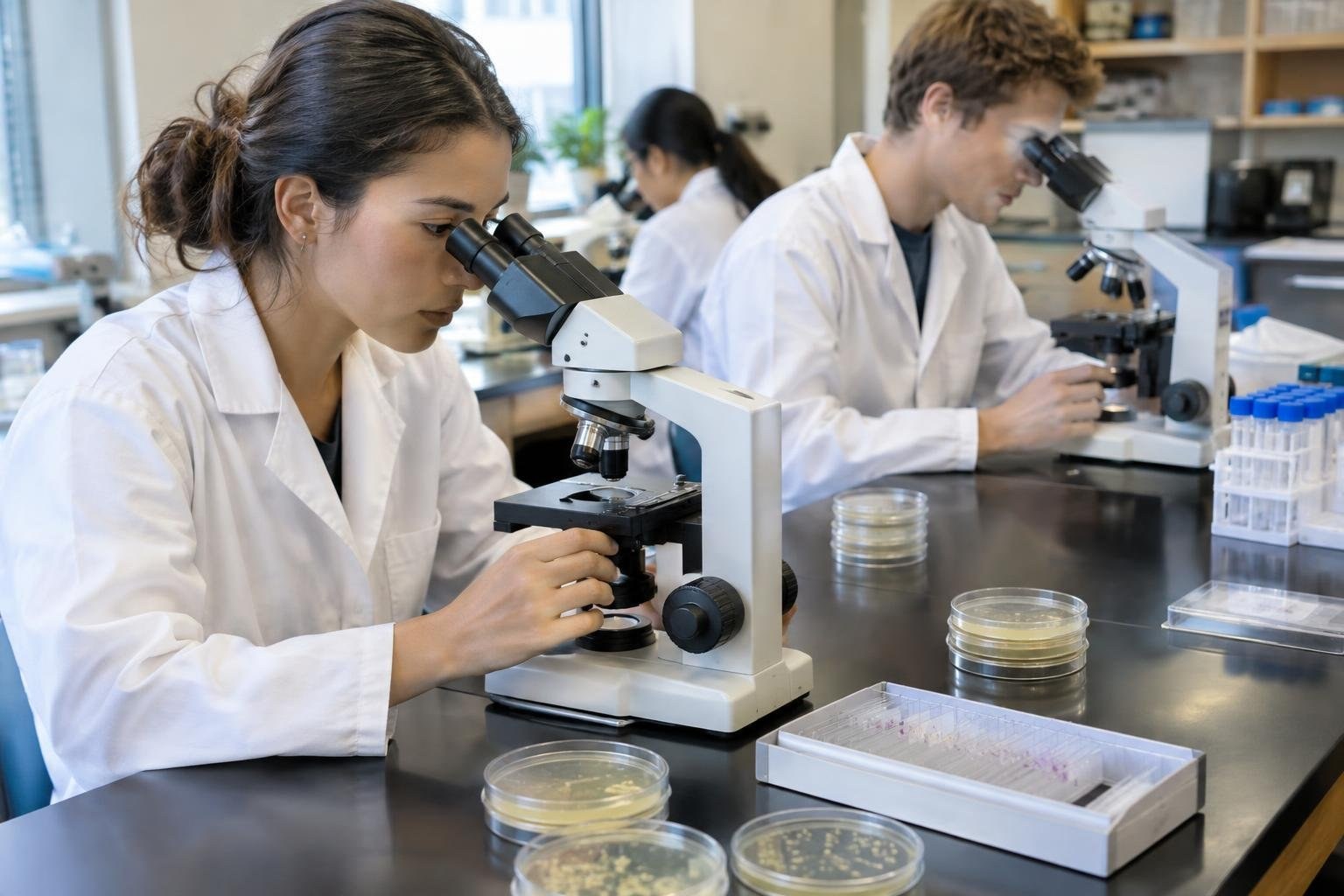
Undergraduate microbiology lab with students, microscopes, and labeled slides
What Is a Microbiology, General Degree?
Microbiology, General is a biological science field centered on microorganisms and their biology. The subject includes organisms such as bacteria, fungi, algae, protozoa, and viruses, and can examine their effects and interactions in human, ecological, and industrial settings. Coursework may include microbial genetics, cell biology, cell physiology, virology, pathogenic microbiology, environmental microbiology, immunology, biostatistics, bioinformatics, and microscopy.
Colleges may call the program microbiology, general microbiology, or use a related departmental or concentration name. A general program can offer breadth across microbial topics, while a concentration may emphasize a particular application. Read the required-course list instead of relying on the major title alone.
Microbiology differs from broader biology by concentrating on microscopic life and microbial processes. It overlaps with immunology, biotechnology, biomedical science, and environmental science, but each program gives those topics different weight. A microbiology degree can support further study in related biological areas, including cell biology, genetics, ecology, neurobiology, and biomedical disciplines.
For a concrete example of program scope, review the North Carolina State University microbiology curriculum and the Mississippi State University microbiology program. They illustrate why students should compare actual curriculum details.
What Do You Study in a Microbiology Major?
Expect a mix of foundational science, focused microbiology courses, and laboratory work. Programs vary, but typical areas of study include:
Foundational biology and chemistry: Learn how cells and chemical processes work, building a base for studying microbes.
Microbial genetics and cell biology: Examine how microorganisms function, reproduce, and pass on biological information.
Virology and pathogenic microbiology: Study viruses and microbes associated with disease, including how research can inform prevention and biomedical work.
Immunology: Explore how biological defense systems relate to infection and health.
Environmental microbiology: Consider microbial life in ecological settings and how microorganisms interact with their surroundings.
Quantitative and computational topics: Some curricula include biostatistics and bioinformatics to help students analyze biological information.
Laboratories are not an optional detail to overlook. Students may practice microscopy and other methods while developing careful technique, recording observations, and interpreting results. At the University of New Hampshire, the medical microbiology option specifies required labs in biology, biochemistry, microbiology, pathogenic microbiology, virology, and immunology. That example demonstrates how extensive lab requirements can be, but it is not a universal course list.
Ask whether courses include supervised lab sessions, how often they meet, what materials are required, and whether any practical work must be completed in person. A research project, internship, or capstone may be offered, but availability and requirements differ by college.
For another specific illustration, see the University of New Hampshire’s medical microbiology option.
Skills You Can Develop
Microbiology coursework can build laboratory, analytical, and communication skills. Practical experience matters because employers and research teams need people who can follow methods carefully, handle information responsibly, and explain what results do and do not show.
Laboratory practice: Work with microscopes and learn course-specific methods under the program’s safety and supervision rules.
Observation and analysis: Record findings systematically and consider how evidence supports an interpretation.
Scientific communication: Explain procedures, results, and limitations in writing or discussion.
Quantitative reasoning: Use statistics or computational approaches where included in the curriculum.
Collaboration and reliability: Coordinate with classmates and research teams, follow protocols, and meet project deadlines.
These skills may be useful in research, biotechnology, clinical diagnostics, public health, or industrial settings. The level of responsibility a graduate can take on depends on the position and its requirements. Build a record of laboratory coursework and supervised projects, and learn to describe your contribution accurately.
Who Is This Degree For? Admissions and Academic Fit
This major may suit students who are curious about small-scale biological systems and enjoy testing questions through evidence. You might find the work engaging if you like careful observation, structured laboratory tasks, health or environmental questions, and learning how biological processes connect to larger systems.
You do not need to arrive with a fixed career plan or a particular personality. Still, you should be willing to work through detailed science material, follow lab procedures, and revise your understanding when results do not match an expectation. If you prefer broad fieldwork, direct patient care, or less laboratory-based study, compare related majors and professional pathways before committing.
Admissions and preparation
Entry requirements are set by each institution. Review application rules, prerequisite science courses, transfer-credit policies, and any placement or advising steps on official college pages. Once admitted, ask which mathematics, chemistry, and biology courses are expected before upper-level microbiology work. If you are a parent or counselor helping a student, focus on the student’s course readiness and interests rather than treating the major as a guaranteed career outcome.
Does microbiology match you?
Salary, reputation, and job prospects are only part of a college decision. Consider whether the questions and day-to-day learning appeal to you, and whether you are comfortable with the time and lab commitment. Assessment.com’s Free MAPP Assessment can help you reflect on motivation and interests; use it alongside program research, conversations with advisers, and college-major planning guidance. A matching tool can support exploration, not replace your judgment.
Credential Levels, Program Format, and Time to Completion
The field includes certificate, associate, bachelor’s, graduate-certificate, master’s, first-professional, and doctoral credential categories, but not every college offers every level in microbiology. Confirm that a specific credential exists at the institution and is designed for your goal.
Completion time depends on credential, enrollment pace, transfer credits, course availability, and required labs. For one specific reference point, California State University, Chico lists 120 units for its bachelor of science in microbiology. That figure is specific to that degree plan and should not be assumed to apply elsewhere.
Full-time, part-time, accelerated, and online or hybrid options differ by institution. Before making a schedule, ask for a term-by-term plan that includes lab courses and prerequisites. For online programs, find out whether required practical work involves campus visits or another approved in-person arrangement.
Online vs. On-Campus Microbiology Programs
Microbiology study is laboratory-centered, so an online label does not tell you whether a program provides the practical experience you need. Some coursework may be suitable for remote delivery, while lab instruction may require scheduled, in-person participation. Ask the department to explain exactly how labs work, where they take place, whether attendance is mandatory, and whether online students follow the same curriculum.
Compare online, hybrid, and campus options for more than convenience. Include travel, schedule flexibility, access to equipment, instructor contact, and the way lab learning is assessed. If you work or have family responsibilities, make sure required lab times and any campus visits fit your actual weekly schedule.
Microbiology Degree Cost and Financial Aid
There is no single tuition price for a microbiology degree. Your total cost depends on the institution, residency status, credential level, time to completion, and expenses beyond tuition. For a realistic comparison, request a full-program estimate rather than looking only at the advertised per-credit rate.
Include required lab fees and materials, books, technology, transportation, and living expenses where applicable. Ask the financial-aid office about grants, scholarships, federal aid eligibility, work-study, and payment plans. Students who already have college credits should request a transfer evaluation before enrolling; accepted credits may affect the number of courses remaining, but confirm the decision in writing.
To judge affordability, compare net cost after grants and scholarships, not just the published price. Find out whether aid is renewable, what academic progress is required, and whether changing to part-time enrollment would affect eligibility. Do not borrow based only on an assumed future salary. Instead, compare likely job pathways and the education they require.
Careers, Jobs, and Employment Pathways
A microbiology degree does not lead to only one occupation. Program materials describe possible connections to biotechnology, research, clinical diagnostics, and public health. Graduates may also pursue employment in government agencies and private industries, or continue into advanced study in biological and biomedical disciplines.
Use the table as a starting point for exploration, not a promise of eligibility. Titles and requirements vary by employer. Check current job postings and ask program faculty what alumni do and what preparation those roles expect.
Career direction
How microbiology may apply
What to verify
Microbiology or biological research
Laboratory coursework and microbial subject knowledge may support research-team work.
Required degree level, research experience, and role-specific methods.
Biotechnology
Microbial biology can be relevant to biotechnology settings.
Employer requirements, practical skills, and any specialized training.
Clinical diagnostics
Microbiology study relates to diagnostic science and laboratory contexts.
Whether the position requires a particular clinical credential, certification, or license.
Public health
Microbial knowledge may inform work connected to disease and prevention.
Whether the role requires additional education, public-health training, or experience.
Food science or food-related laboratories
Microbiology study may be relevant to work involving food and microorganisms.
Employer requirements and any additional quality or laboratory training.
Government or environmental work
Graduates may seek employment in government and private industry; environmental microbiology is one possible study area.
Specific agency or employer qualifications and the balance of lab and field work.
Postsecondary biological science teaching
Microbiology can provide a foundation for further biological study.
Education and experience requirements for the teaching position.
There is no single “microbiology salary.” Pay and outlook belong to individual occupations and vary with employer, region, experience, and education. Compare current official labor data for the exact roles you are considering. Natural-science management or advanced research are longer-term directions, not automatic outcomes of a first degree; additional study or experience may be expected.
Automation and digital tools may change how biological data are produced or analyzed, but they do not remove the need to understand methods, assess evidence, and work responsibly. Ask programs how students gain relevant lab and data experience. Explore microbiologist career information and related science career areas while checking role-specific requirements.
Accreditation, Licensure, and Certification
Before enrolling, check the institution’s accreditation status and whether the program satisfies any requirements tied to your intended career or further education. The sources describing these example programs do not establish a universal microbiology-specific accreditation or license, and requirements can differ by profession and state. Do not assume that completing a degree alone qualifies you for a regulated laboratory or healthcare position.
Ask the department which certifications or licenses graduates pursue, whether the curriculum is designed to prepare students for them, and whether the credential is recognized by employers in your intended location. Verify requirements directly with the relevant employer, state authority, or professional organization before choosing a program.
Internships, Research, and How to Stand Out
Experience can help you understand what microbiology work feels like and build evidence of your skills. Ask about undergraduate research, supervised projects, internships, and laboratory opportunities. A program may offer some of these options, but you should confirm availability, application steps, timing, and whether students receive academic credit.
Keep a concise record of courses, lab methods, project responsibilities, presentations, and any work experience. Describe what you personally did and what you learned without overstating your role. Join relevant student or departmental activities if they are available, and ask faculty how to connect with research opportunities.
How to stand out to employers
Choose lab electives or projects that match the type of work you are exploring.
Practice explaining a procedure, result, and limitation in plain language.
Ask supervisors or faculty for specific feedback on technique and documentation.
Review job postings early and identify repeated skills or credentials.
Build professional connections through department events, research discussions, and internships where available.
These steps do not guarantee a position, but they can help you make a more informed transition from coursework to employment or graduate study.
Graduate School and Further Study
Further study can deepen a microbiology graduate’s expertise or prepare them for a role with higher education requirements. Possible areas include microbiology, cell biology, ecology, genetics, zoology, neurobiology, and biomedical disciplines. Some students may also consider professional study related to health, depending on their prerequisites and goals.
Undergraduate microbiology may provide relevant science preparation, but admission to graduate or professional school is not automatic. Check target programs for prerequisite courses, research expectations, application requirements, and whether your undergraduate curriculum will cover them. Discuss course planning with an adviser before choosing electives.
Related Degrees and Alternatives
Compare microbiology with adjacent subjects by looking at required courses and the work you want to do. A broad biology major may suit students who want more coverage across life sciences. Immunology may better fit a strong interest in immune systems. Biotechnology emphasizes applied biological methods, while environmental biology may provide more attention to organisms and ecological settings. Biomedical science can center more directly on health-related science.
Biology: Consider this instead if you want broad coverage across living systems before choosing a specialty.
Biochemistry and molecular biology: Consider this instead if molecular processes and chemical foundations are your main interest.
Biotechnology: Consider this instead if you want a program oriented toward applied biological processes and industry settings.
Immunology: Consider this instead if immune function is the topic you most want to study.
Biomedical science: Consider this instead if you want a broader health-science emphasis.
Environmental biology: Consider this instead if ecological systems and environmental questions matter more than laboratory study of microbes.
Public health: Consider this instead if population health and prevention are your main focus rather than microbial laboratory science.
Program names are not standardized enough to make a reliable choice on title alone. Compare course lists, lab hours, research options, and prerequisites for the next step you may pursue. Assessment.com’s degree exploration pages can help you browse related fields.
Advantages, Drawbacks, and Is a Microbiology Degree Worth It?
Advantages: Microbiology offers a focused way to study microbes and their relevance to health, research, industry, and the environment. Programs can combine scientific knowledge with hands-on laboratory learning. The major may also support advanced study across multiple biological and biomedical disciplines.
Tradeoffs: Laboratory requirements can make schedules less flexible than students expect. Some career paths may require education or credentials beyond the undergraduate degree. Since program costs and job requirements vary, students should avoid assuming that a major alone guarantees a particular salary or occupation.
Whether microbiology is worth it depends on the cost of the specific program, your ability to complete its science and lab requirements, the work you hope to do, and whether additional study is part of your plan. Compare net cost, transfer credit, practical experience, and actual job requirements. Include fit: a strong career statistic cannot compensate for a curriculum or work setting that does not suit your interests.
How to Choose the Right Microbiology Program
Compare programs using evidence you can verify, not promotional language alone. Review:
Accreditation: Confirm institutional status and investigate any requirements connected with your intended occupation.
Curriculum: Compare required courses, electives, concentrations, and prerequisites against your interests.
Laboratories: Ask what methods students practice, how often labs meet, and whether access is guaranteed.
Research and experience: Find out how undergraduates can participate in projects, internships, or capstones.
Cost and aid: Request a complete cost estimate and compare grants, scholarships, and transfer-credit decisions.
Format and schedule: Confirm how online or hybrid options handle required practical work.
Outcomes and support: Ask what information the department has about graduate study, employment, advising, and career services.
Transferability and preparation: Check how courses apply to later education and whether the degree supports any credentials you may need.
Ask for direct answers in writing, especially about lab participation, transfer credits, and total program costs. Use Assessment.com’s education resources to explore pathways, then verify details with each college.
From Degree to Career: Possible Pathways
Career progress varies; these examples show possible routes, not guaranteed promotions:
Microbiology bachelor’s degree → entry-level research or laboratory role → build supervised experience → specialize in a research area → consider advanced study or research leadership.
Microbiology bachelor’s degree → biotechnology or diagnostic setting → gain experience and identify required credentials → pursue a focused technical or quality role.
Microbiology bachelor’s degree → further biological study → graduate research or advanced training → pursue specialized research or postsecondary teaching where qualifications allow.
North Carolina State University notes that graduates may enter government or private-industry employment or continue to advanced study in biological fields. Ohio Wesleyan University identifies preparation for medical school and biomedical or industrial research as possible directions for its major. These are examples of routes, not predictions about an individual graduate’s outcome.
Questions to Ask Before You Enroll
Take these questions to admissions staff, the department, and financial aid before committing:
What is the full estimated cost, including lab fees, materials, and required travel?
Which credits will transfer, and how will they change my completion plan?
How many laboratory courses are required, and where are they held?
Can I see a term-by-term plan that includes prerequisites and lab schedules?
What research, internship, or project opportunities are open to undergraduates?
What do graduates typically do next, and what education do those roles require?
Does the program meet any credential requirements I may need in my intended location?
How do online students complete laboratory work?
Which financial aid can be renewed, and what conditions apply?
What advising and career services can microbiology students use?
Compare answers across more than one institution. A clear understanding of hands-on learning, total expense, and next-step requirements can prevent costly surprises.
Frequently asked questions
What is a Microbiology, General degree?
Microbiology is the scientific study of microorganisms, including bacteria, fungi, algae, protozoa, and viruses. A general microbiology program may also examine microbial genetics, cell biology, virology, immunology, environmental microbiology, and laboratory methods. Students should review each college’s curriculum because course names, concentrations, and hands-on requirements differ.
Is a microbiology degree hard?
It can be academically demanding because students study complex biological systems and complete laboratory coursework that requires accuracy, careful observation, and clear records. The amount of chemistry, math, and data analysis varies by program. Reviewing required courses and speaking with an adviser can help you assess whether the workload and science prerequisites fit your preparation.
What jobs can I get with a microbiology degree?
Graduates may pursue roles connected with research, biotechnology, clinical diagnostics, public health, food science, or environmental work. The job title and qualifications vary: some positions may be accessible after undergraduate study, while specialized research, teaching, or professional roles may require graduate education or additional credentials. Confirm requirements with employers and relevant institutions before choosing a program.
How much can you make with a microbiology degree?
Pay depends on the occupation, experience, employer, location, and education level, not just the degree name. Compare current wage data for specific jobs you might pursue, such as microbiologist or biological technician, and check the typical education requirements for each. Include likely further education and living costs when considering the financial value of a program.
Can I earn a microbiology degree online?
Some microbiology courses may be offered online, but a lab-focused program requires students to find out how practical laboratory learning is delivered. Ask whether labs are on campus, conducted in scheduled sessions, or arranged through approved local facilities. Verify how any in-person requirements affect attendance, travel, schedule, and total cost before enrolling.
Does microbiology require a lot of math?
Expect science coursework and laboratory learning, and ask each program how much chemistry, math, statistics, and data analysis it requires. Microbiology curricula can include biostatistics and bioinformatics, so quantitative work may be part of the degree. Review prerequisites and course descriptions rather than assuming that every program has the same math requirements.
Do you need graduate school for microbiology?
Not every career requires graduate school. Some graduates seek entry-level roles after a bachelor’s degree, while advanced research and postsecondary teaching may call for further study. The right path depends on the specific job and employer. Check job postings and speak with program faculty about the education typically expected in your intended specialty.
How is microbiology different from a general biology degree?
Microbiology focuses on microorganisms and their biology, while broader biology programs may cover many kinds of organisms and systems. Microbiology degrees commonly include dedicated study and laboratory work related to microbes; the depth depends on the program. Compare required courses, electives, lab experience, and the careers you want before deciding between the majors.
People Also Ask
How much lab work is in a microbiology degree?
Some programs include laboratory courses in biology, biochemistry, microbiology, pathogenic microbiology, virology, and immunology. Specific requirements vary by institution, so check the curriculum and ask how labs are delivered before enrolling.
What can you do with a microbiology major?
Microbiology can connect to research, biotechnology, clinical diagnostics, public health, and industrial work. The specific jobs available depend on the degree level, experience, and employer requirements. Explore actual job descriptions in your preferred setting before selecting a program.
How long does it take to get a microbiology degree?
The number of years depends on the credential, course load, transfer credits, and program structure. A certificate or associate degree is a different commitment from a bachelor’s or graduate degree. Ask colleges for a degree plan showing required credits and a realistic completion schedule for your situation.
How much does a microbiology degree cost?
There is no single price for a microbiology degree. Tuition and total expenses depend on the college, residency classification, program length, and costs such as course fees, lab materials, books, and transportation. Request an itemized estimate for the full program and compare net costs after aid.
Can a microbiology degree prepare me for graduate school?
Yes, microbiology can be a route toward further study in biological and biomedical fields. Some graduates continue into areas such as cell biology, ecology, genetics, neurobiology, or biomedical disciplines. Check prerequisites for the graduate or professional program you may want before choosing undergraduate electives.
Is microbiology a good major for working in healthcare?
Potential paths include research, biotechnology, clinical diagnostics, public health, and industrial or government work. The degree does not guarantee a particular job. Coursework, laboratory experience, internships, location, and the qualifications requested by employers all affect which opportunities are realistic.
Microbiology, General can be a strong choice for students who want to understand microorganisms through science coursework and hands-on laboratory study. The field connects with research, biotechnology, clinical diagnostics, public health, government, and private industry, but your exact career options will depend on your degree level, experience, and any further education or credentials a role requires. Before enrolling, compare program requirements, lab access, total cost, and pathways to the work you want to do. A degree is a major investment; choose one that fits both your academic interests and your practical goals.
Find out which Career or College Major is right for you!
We use cookies to offer you a better browsing experience, analyze site traffic and personalize content.
Read about how we use cookies and how you can control them in our
Privacy Policy.
If you continue to use this site, you consent to our use of cookies.
×
Exciting News!
Be one of the first to Beta Test the new AI-Powered Assessment.com Platform.