Microbiology and Immunology Degree Guide: Courses, Careers, and Fit
Explore what microbiology and immunology students study, how laboratory training shapes the degree, program formats, costs to compare, and career and graduate-study pathways.
By David Slack · Staff Writer Assessment.com · Published October 12, 2026 · Last updated November 5, 2026
A microbiology and immunology degree studies microorganisms and the ways the immune system responds to them. Depending on the program, students learn about bacteria, viruses, fungi, parasites, microbial genetics, infection, and immune processes, combining classroom science with laboratory practice. Programs are offered at different credential levels and may be housed within biology, biomedical science, or a related department. Some focus on medical microbiology and infection; others integrate broader biomedical topics or immune science. Graduates may pursue laboratory and research-support work, clinical research, biotechnology, or further study. The right pathway depends on the career you want, the training employers expect, and whether you enjoy careful, evidence-based investigation.
Degree & Program Decision Insights
Explore your personal fit, education requirements, career potential and next steps.
01Motivational Fit
Discover whether this program fits you
Explore your preferences against the focus of Microbiology and Immunology. These prompts are not personal MAPP results.
Scientific investigation. Would you enjoy investigating microbiology and explaining your conclusions from evidence?
Breadth of interest. Consider the place of “microbial genetics” in this field. Is this another part you would choose to explore, or mainly a requirement you would tolerate?
Work reality. Related work can involve this task: “Study the structure and function of human, animal, and plant tissues, cells, pathogens, and toxins.” Would you want that activity to be a regular responsibility?
Interest in studying a field can differ from enjoying its related work.
Which part would you want to do repeatedly, and what would you try before deciding?
Discover Your Personal Program Fit
Before investing your time and money in your education, discover how this program aligns with your natural motivations, work preferences and career goals.
Medical Scientists, Except EpidemiologistsSOC 19-1042 · O*NET 19-1042.00$103,410/year median (May 2025); +12.6% projected change (2025–2035); 10,500 projected openings/year.
Typical occupational entry: doctoral or professional degree (BLS).
U.S. occupational wages are not guaranteed graduate earnings; OEWS excludes self-employed workers.
Projected openings include replacements as well as growth.
U.S. national estimates. A crosswalk does not establish entry-level eligibility; advanced, management and teaching roles can require further qualifications.
Compare the focus and route of these distinct instructional fields; their credentials and admission requirements are not interchangeable.
Microbiology, GeneralCIP 26.0502. Compare its emphasis on cell biology and cell physiology with this program’s focus.
ImmunologyCIP 26.0507. Compare its emphasis on antigen and antibody structure and function and effector mechanisms with this program’s focus.
Medical Microbiology and BacteriologyCIP 26.0503. Compare its emphasis on the pathogenesis of bacterial diseases and bacterial genetics and physiology with this program’s focus.
Explore your motivations. Use MAPP as a starting point for reflecting on your interest in “microbiology”, then test that interest against a sample learning task.
Examine the work. Compare Microbiologists and Medical Scientists, Except Epidemiologists on daily work and entry qualifications, as well as pay. Explore Microbiologists.
Compare actual providers. Ask for the exact credential, course sequence and assessment methods. Compare how each provider teaches “microbial genetics”, its entry criteria and its itemized costs.
Check the evidence before applying. Confirm prerequisites and any recognition or professional requirements for your intended route; ask for applicable rules and published outcome definitions in writing.
Verify the institution’s current offering, admissions requirements and outcomes; a search result does not establish your eligibility.
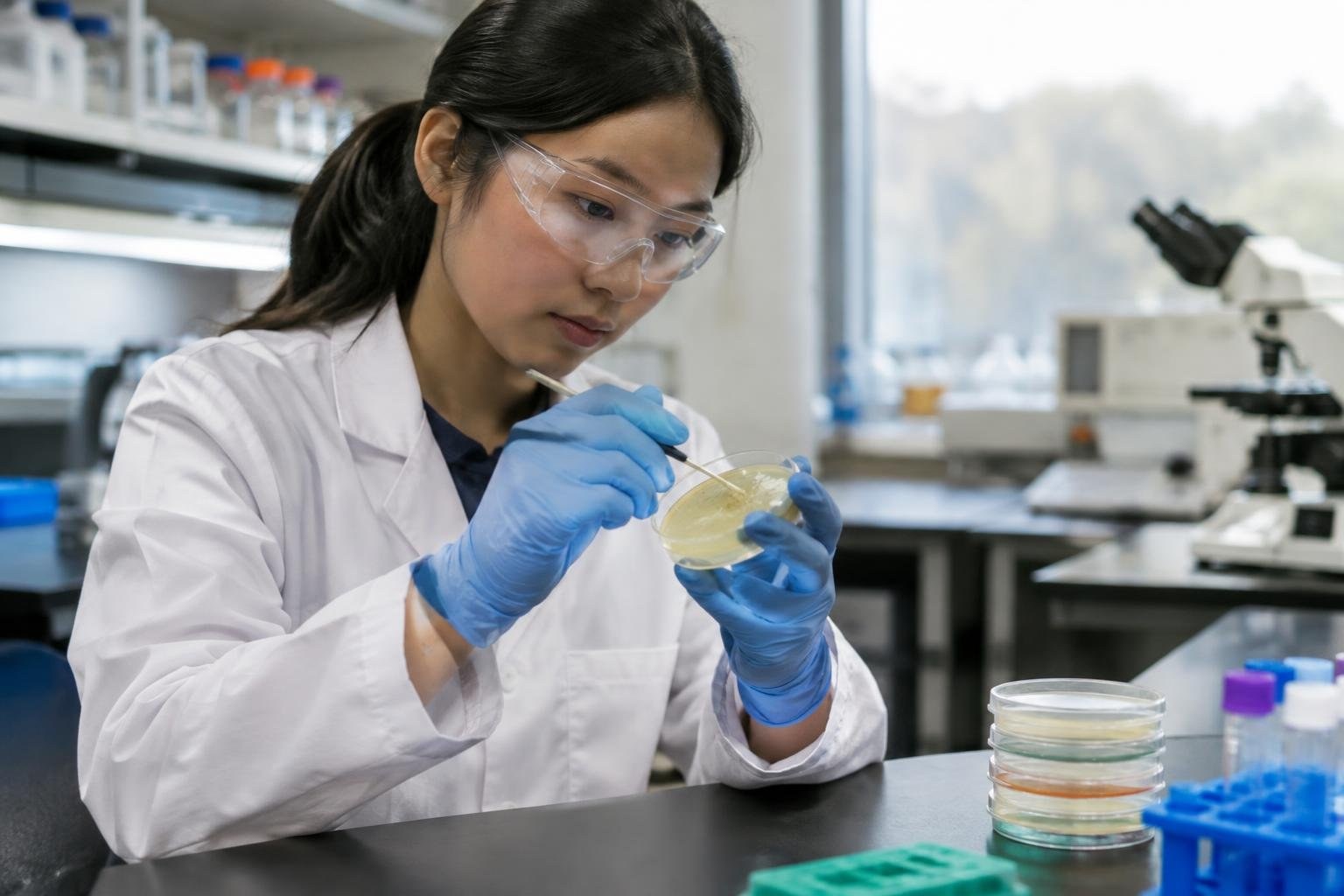
Student working with laboratory materials in an academic microbiology setting
What Is a Microbiology and Immunology Degree?
Microbiology and immunology is the study of microorganisms and the immune system, with particular attention to their interactions in health, infection, and disease. Programs may cover bacteria, viruses, fungi, parasites, microbial genetics, immune responses, and disease mechanisms. The program description for this field also includes immunogenetics, autoimmunity, and bioinformatics.
The name is not used identically everywhere. A college may offer the subject as a standalone major, a medical microbiology option within biomedical science, or a broader biomedical program with a microbiology and infectious-disease concentration. Compare the required courses and lab experiences instead of assuming similar titles mean identical training. For an example of a program option, see the University of New Hampshire’s medical microbiology option.
What Do You Study? Courses, Labs, and Research
Students build a foundation in biology and chemistry before moving into subjects such as microbiology, pathogenic microorganisms, virology, immunology, microbial genetics, and infection. The mix varies: one curriculum may emphasize medical and disease-related topics, while another incorporates a wider biomedical-science base.
Laboratory learning is central in many undergraduate pathways. The University of New Hampshire’s medical microbiology option lists required labs in biology, biochemistry, microbiology, pathogenic microbiology, virology, and immunology. Coursework can involve following procedures carefully, interpreting results, and explaining what evidence does and does not show. Colorado State University’s curriculum describes laboratory methods, bioinformatics, interpretation, and analysis as program skills.
At more advanced levels, students may take specialized courses or complete research, a capstone, or other applied work, depending on the school. Ask for the current course sequence and syllabus details. Do not assume every program includes an internship, clinical placement, thesis, or capstone unless it appears in the degree requirements.
See the Colorado State University concentration description and the UNH program outline as examples of how program structure differs.
Skills You Can Develop
Students develop skills in interpreting biological evidence, conducting laboratory procedures, analyzing results, and communicating what their findings mean. Some curricula also introduce bioinformatics, which can help students work with biological data. The balance between bench work, data, and theory depends on the program.
Scientific reasoning: evaluate questions, methods, and results rather than treating a single observation as proof.
Laboratory practice: follow procedures, document work, and handle samples and equipment according to instruction.
Data interpretation: organize and analyze findings, recognize limitations, and draw conclusions supported by evidence.
Communication: explain methods and results in written reports and discussions with colleagues.
Teamwork and care: contribute reliably to shared lab work and follow applicable safety instructions.
These capabilities can support laboratory, research, clinical research, and biomedical work, but employers may ask for additional technical experience or education. Colorado State’s program outcomes specifically describe microbiological and immunological techniques, bioinformatics, interpretation, and analysis.
Who Is This Degree Best For?
This field may appeal to students who want to understand how tiny organisms affect living systems and how immune defenses respond. It often involves detailed reading, structured lab work, and patience when experiments produce ambiguous or unexpected results. Students can be hands-on, analytical, collaborative, or creative in different ways; no single personality style is required.
Consider whether you are curious about infection, disease prevention, microbial systems, or biomedical research. Also consider whether you are prepared for science prerequisites and repeated practice with technical procedures. A student who prefers immediate, direct patient care may want to compare this major with clinical training programs. A student drawn mainly to coding or mathematical modeling may prefer a more computational pathway, while still considering whether biology and bioinformatics can be combined.
Does Microbiology and Immunology Match You?
Salary, prestige, and job-growth headlines cannot tell you whether you will enjoy the daily work. Compare the tasks you find meaningful with the coursework and roles the degree may lead toward. The Free MAPP Assessment can help you explore career and degree options; use it as one input alongside course catalogs, conversations with faculty, and real job descriptions.
Admissions, Program Length, and Academic Difficulty
Requirements depend on the institution and credential. Undergraduate applicants should check whether the program expects prior biology or chemistry, minimum grades in prerequisite courses, or a separate application to the major. Graduate certificates and degrees may expect previous college-level science preparation or related experience. The supplied university examples illustrate different undergraduate and graduate formats; they do not establish a universal admissions rule.
Ask an admissions adviser for the current prerequisites, application materials, transfer-credit rules, and any minimum GPA or test policies. If you have been away from school, find out whether introductory science courses can be taken before declaring the major. Parents and students should compare the published requirements rather than relying on informal estimates.
How Long Does It Take?
Completion time depends on credential level, course load, transfer credits, prerequisites, and whether required lab classes are offered when you need them. A certificate is not interchangeable with an associate, bachelor’s, master’s, or doctoral degree. Ask for a term-by-term degree map that accounts for lab sequences and your intended pace before estimating a finish date.
What Makes the Coursework Challenging?
Students may need to connect detailed concepts across biology, chemistry, infection, and immune function while learning precise laboratory methods. Preparation includes reviewing prerequisite sciences, building consistent study habits, and asking early about tutoring or faculty office hours. Treat laboratory time as part of the course workload, not an optional add-on.
Online vs. On-Campus Study
Online, hybrid, and campus options exist at different credential levels, but format alone does not tell you how much hands-on experience a program provides. Arizona Online lists a graduate certificate in microbiology and immunity, while the UNH undergraduate medical microbiology option describes multiple required laboratory courses. These examples show why students should verify the details for their intended credential and institution.
Before enrolling in an online or hybrid program, ask which courses require campus attendance, how laboratory skills are taught and assessed, and whether research or other experiential requirements must be completed in person. Confirm whether any planned transfer or future graduate program will accept the credits. Review the Arizona Online certificate description as one example, not a guarantee that all program components are remote.
Tuition, Costs, and Financial Aid
No single tuition estimate applies to microbiology and immunology programs. Total cost depends on the school, credential, residency classification, enrollment pace, and whether you need to relocate or commute. Build a full budget rather than comparing tuition alone.
Request the school’s current tuition and mandatory-fee estimate for your residency and enrollment status.
Ask whether laboratory, course, equipment, technology, or other program fees apply.
Include books, transportation, housing, and income you may give up while studying.
Compare the total remaining cost after grants, scholarships, employer support, and other aid.
Ask how transfer credits or part-time study would change both the price and completion schedule.
Review the official financial-aid information for each institution and submit required applications on time. Ask whether departmental awards, need-based grants, work opportunities, or payment plans are available, and check the conditions carefully. A lower tuition figure is not automatically the least expensive route if it adds semesters or requires extra travel for labs. The program examples in this guide establish course formats, not tuition prices; request current figures directly from schools.
Careers, Jobs, and Employment Pathways
The program description connects the field with work related to medical care, disease prevention, microbial systems, and pollution control. Possible directions include microbiology, biological laboratory support, clinical research, biomedical research, and bioinformatics. A degree title does not guarantee eligibility for a particular job: employers set requirements, and advanced research or academic roles may involve graduate education.
Career direction
How the study may apply
What to verify
Microbiologist
Microbial biology and laboratory methods can relate directly to work with microorganisms.
Check required degree level, lab experience, and employer-specific qualifications.
Biological technician
Laboratory practice and accurate data recording may be relevant to technical support roles.
Compare actual postings for experience and procedural requirements.
Clinical research coordinator
Biomedical subject knowledge may support research-study coordination work.
Check whether employers request clinical research or administrative experience.
Bioinformatics scientist
Biology combined with data analysis or bioinformatics can be relevant.
Confirm the programming, quantitative, and education requirements.
Medical scientist or biomedical researcher
Microbiology and immune-system knowledge can provide subject preparation.
Investigate graduate education and research experience expected for the specific role.
Postsecondary biological science teacher
Subject expertise can be relevant to teaching biology at the college level.
Check the education and research expectations of individual institutions.
Genetics or molecular biology-related work
Microbial genetics and molecular topics can inform related laboratory pathways.
Verify specialization and credentials required by the employer.
Natural sciences management
Scientific training may be useful later in a career with relevant work experience.
Management roles generally require experience; confirm individual qualifications.
No salary or employment-growth figures are included here because they vary by occupation and are not established by the program sources used for this guide. For current comparisons, identify a precise job title and consult official U.S. labor-market information. Assessment.com has profiles for microbiologists, medical scientists, and bioinformatics scientists.
Laboratory automation and computational tools are changing how some research and testing tasks are performed. Students can prepare by building sound scientific reasoning and data skills, while recognizing that instruments and software support rather than replace the need to interpret results responsibly.
Internships, Experience, and Credentials
Look for experience that lets you practice scientific work, not just list coursework. Depending on what your institution offers, this may include a supervised lab project, faculty research, a co-op, an internship, clinical research support, or a class project with a clear report or presentation. Availability and eligibility vary, so ask faculty and career services early.
Keep a concise record of techniques learned, project questions, your role, and how you interpreted results. Do not include confidential or restricted data in a portfolio. Join relevant student groups, seek feedback on scientific writing, and practice explaining technical work to a non-specialist. Where an employer requests a credential or training, confirm that it is recognized for that specific role before paying for it.
How to Stand Out to Employers
Describe the methods you have actually practiced and your level of supervision.
Give a specific example of interpreting results or resolving a technical problem.
Show careful documentation, collaboration, and communication skills.
Tailor applications to the exact requirements in each job posting.
Ask program staff about employer connections, research placements, and alumni pathways.
Graduate School and Further Study
Possible next steps include a master’s program in microbiology, immunology, biomedical sciences, or a related discipline; a doctoral research degree; or a professional program with its own admissions and licensing pathway. A graduate certificate may provide focused coursework, but it is not the same as a graduate degree. Southern Illinois University describes an interdisciplinary biomedical concentration leading to a non-thesis M.S., while the University of Arizona describes graduate-level microbiology and immunity certificate study.
Decide based on the work you want to do. Advanced research, specialized scientific roles, and postsecondary teaching may call for further education, but requirements differ by employer and position. Before committing, check admission prerequisites, whether undergraduate coursework transfers, and the total time and cost. Ask faculty or advisers to help map the route from your current credential to the role you have in mind.
Related Degrees and Alternatives
Related options can share biology courses but lead students toward different questions, techniques, or industries. Compare the actual required curriculum at each school.
General biology: consider this if you want a broader foundation before choosing a specialization.
Biomedical science: consider this if you want a wider medical and biological science mix.
Biochemistry and molecular biology: consider this if you are especially interested in chemical processes and molecular mechanisms.
Biotechnology: consider this if you want to focus on applying biological methods in product or industrial settings.
Bioinformatics: consider this if you want biology paired with computational and data-focused work.
Public health: consider this if your main interest is population-level disease prevention and health systems.
Clinical laboratory science: consider this if you are targeting a defined clinical testing pathway; verify accreditation and certification requirements carefully.
Nursing or another clinical program: consider this if your goal is direct patient care rather than laboratory or research work.
Microbiology and immunology combines study of microbes with immune responses. A program called biomedical science may cover a broader set of subjects, while a bioinformatics path usually places more weight on computing and quantitative work. Explore the available degree guides and major-selection guidance as you compare.
Accreditation, Licensure, and Certification
Programmatic accreditation and professional licensing are not automatically implied by a microbiology and immunology degree title. Requirements depend on the occupation, state, employer, and intended scope of work. The university program examples used here describe academic curricula and certificates; they do not establish a universal professional license or certification requirement.
If you are considering clinical laboratory work or another regulated role, identify the exact job title and state, then verify the applicable rules with the state authority and the relevant recognized professional or accrediting body. Ask the school whether its curriculum meets the requirements you have identified, and request that assurance in writing. Also check institutional accreditation and how credits will transfer if you may continue to another program.
Do not confuse earning a degree with qualifying for a license, certification, or employer-specific credential. Confirm the testing, supervised practice, or education requirements directly before choosing a program.
How to Choose the Right Program
Choose a program by comparing evidence about what students actually do and what the credential prepares them to pursue. Ask admissions staff and faculty:
Is the institution accredited, and will credits transfer to likely next-step schools?
Which courses and labs are required, and how often are they offered?
What research, internship, co-op, or clinical research opportunities are available?
What is the full estimated cost for my residency status and intended pace?
How much of the program is online, hybrid, or on campus?
What are the program’s completion and progression measures, and how are they defined?
What career advising, employer connections, and graduate-school advising are available?
Does the curriculum prepare students for any specific credential I need?
How will previous courses and transfer credits apply to the degree map?
Review a sample schedule and ask to speak with a current student or program adviser. A well-matched program should make its course sequence, lab expectations, costs, and student-support options clear. For broader college-planning resources, visit Assessment.com’s education guidance and explore career options alongside majors.
From Degree to Career: Example Pathways
Career movement depends on the individual’s education, interests, performance, and available opportunities. These examples are possible pathways, not guaranteed promotions or outcomes:
Microbiology coursework → laboratory assistant or biological technician role → additional lab experience → specialized microbiology work.
Undergraduate microbiology and immunology → research-support role → graduate study and research experience → advanced biomedical research.
Microbiology plus computational coursework → data-support experience → additional programming or quantitative training → bioinformatics-focused work.
Biomedical study → clinical research support → experience coordinating studies → broader clinical research responsibilities.
Use job postings to test each pathway. Note the degree level, methods, experience, and credentials employers request. Then ask your college whether students can access the labs, advising, and experience relevant to those requirements.
Questions to Ask Before Enrolling
Before accepting an offer, students and parents can use this checklist to surface important details:
What is the institution’s accreditation status, and will credits transfer?
What is the estimated total cost through completion, including lab and program fees?
How are program outcomes defined, and what information can the school share?
Which courses require campus attendance or scheduled laboratory time?
Are internships, research placements, or supervised projects available?
Does the program prepare students for a credential required by their target job?
What financial aid, scholarships, grants, or employer support could apply?
How do part-time study, transfer credits, or a change of major affect the schedule?
What academic advising, career services, and employer or research connections are available?
Which graduates’ roles and further-study paths most closely match my goals?
Write down the answers and compare schools using the same questions. If the program cannot explain its lab requirements, costs, or transfer policies clearly, pause and request details before making a deposit.
Frequently asked questions
Is a microbiology and immunology degree hard?
Microbiology and immunology can be challenging because students combine detailed biological concepts with laboratory procedures, data interpretation, and scientific writing. The workload depends on the institution and degree level. Before enrolling, review course prerequisites, the number and schedule of required labs, and available academic support. An interest in investigating how microbes and immune responses work can make the subject matter more engaging.
Is a microbiology and immunology degree worth it?
The degree may be worthwhile for students whose goals require a strong background in microorganisms, infection, or immune responses. Its value depends on the program’s total cost, laboratory training, available research or internship experiences, and the education required for the jobs you want. Compare the curriculum and likely next steps with your alternatives rather than assuming that the degree guarantees a particular job or salary.
What jobs can I get with a microbiology and immunology degree?
Possible directions include laboratory and research support, microbiology, biotechnology, clinical research, and further study in biomedical fields. The specific options depend on the degree level, practical experience, and employer requirements. Some research, teaching, and specialist roles may require graduate education. Explore job descriptions for the roles that interest you and check which credentials and skills employers request.
How much can I make with a microbiology and immunology degree?
There is no single salary for this degree. Pay depends on the occupation, education, experience, employer, and location, and many graduates pursue different types of work. To estimate a realistic range, identify specific job titles first and consult current U.S. Bureau of Labor Statistics data for those occupations. Compare entry-level requirements as well as median pay, since the two are not interchangeable.
Can I earn a microbiology and immunology degree online?
Some microbiology and immunity coursework may be available online, including graduate-certificate study. However, laboratory-based undergraduate programs can require substantial in-person lab courses. For example, the University of New Hampshire’s medical microbiology option identifies required laboratories in several biology and biomedical subjects. Confirm with each school which classes, research experiences, or other requirements must be completed in person.
Does microbiology and immunology require math?
Expect biology and chemistry coursework, and check the exact math requirements in each program’s catalog. The supplied program examples emphasize biological and laboratory study, but they do not establish a universal math sequence for all colleges or credential levels. Ask whether statistics, calculus, or quantitative data analysis is required and whether those courses are prerequisites for later classes.
Do you need graduate school for microbiology and immunology careers?
Not necessarily for every job connected to the field. Some students enter laboratory-support or research-support work after undergraduate study, while advanced research, specialized scientific, and postsecondary teaching roles may require graduate education. Requirements vary by employer and position. Look at current job postings and discuss progression with program faculty before deciding whether a master’s, doctoral, or professional degree is part of your plan.
What is the difference between microbiology and immunology?
Microbiology focuses on microorganisms, while immunology examines immune responses. A combined microbiology and immunology program connects these areas, often around infection, host defenses, and related biomedical questions. Compare the required courses and lab work rather than relying on a program title: one school may offer a broad biomedical-science path, while another may emphasize medical microbiology, infectious disease, or immune mechanisms.
People Also Ask
What does a microbiology and immunology major study?
Microbiology and immunology programs examine microorganisms and immune responses, including how microbes cause disease and how hosts respond. Many programs add substantial laboratory learning; course content and emphasis vary by institution and credential level.
How long does a microbiology and immunology degree take?
It depends on the institution and credential. A bachelor’s program typically follows an undergraduate course plan, while certificates, associate degrees, and graduate programs have different requirements. Transfer credits, part-time enrollment, prerequisites, and required laboratory schedules can change completion time. Ask each school for a degree map based on your transcript and enrollment plan.
Are microbiology and immunology programs available online?
Compare the exact laboratory and research experience, not just whether a program says it is online. Ask which labs require campus attendance, whether online courses include hands-on components, and how students access instruments, supervision, and research opportunities. Some theory or certificate coursework may be online even when a full science major requires in-person lab work.
What can you do with a microbiology and immunology degree?
The degree can prepare students for scientific and biomedical pathways, but a major alone does not guarantee a job or a particular salary. Evaluate outcomes by looking at specific job descriptions, education requirements, internships, and the program’s practical training. If a career requires a graduate or professional credential, include that time and cost in your plan.
What is the salary and job outlook for microbiology and immunology graduates?
Start with the occupations that interest you, then check current job postings and official labor-market information for their qualifications and pay. A degree can lead to several different kinds of work, so a single salary figure for the major would be misleading. Consider location, experience, degree level, and whether the job requires a license or further study.
Find out which Career or College Major is right for you!
Microbiology and immunology may suit students who want to understand microbes, infection, and the immune system through scientific study and laboratory work. The degree can lead toward research, clinical laboratory, biotechnology, public health, or further academic pathways, but specific jobs may require additional education, experience, or credentials. Before enrolling, compare each program’s curriculum, lab opportunities, full cost, and the career preparation it provides. Consider how the day-to-day work matches your interests as well as your education and career goals. Assessment.com’s MAPP assessment can help you explore career and degree options as you weigh your next step.
Want to see your options? Try our comprehensive Degree, Program & College Search tool
We use cookies to offer you a better browsing experience, analyze site traffic and personalize content.
Read about how we use cookies and how you can control them in our
Privacy Policy.
If you continue to use this site, you consent to our use of cookies.
×
Exciting News!
Be one of the first to Beta Test the new AI-Powered Assessment.com Platform.