Jewelry Arts Degree Guide: Courses, Careers, Costs, and Program Fit
A practical guide to Jewelry Arts programs, including what students learn, credentials and formats, costs to compare, creative career possibilities, and how to assess fit.
By David Slack · Staff Writer Assessment.com · Published October 12, 2026 · Last updated November 5, 2026
A Jewelry Arts program teaches students to develop designs and turn them into wearable objects using materials and making techniques. Depending on the school and credential, students may study metalsmithing, casting, enameling, gemology, jewelry production, repair, or digital tools alongside visual design. Programs can be offered as certificates, associate degrees, bachelor’s degrees, and graduate study, but the title alone does not tell you how much studio practice or portfolio development is included. Prospective students and parents should compare what students make, what equipment and instruction are available, and how the program connects to work or further study. A college credential can help build technique and a body of work, but it does not guarantee a particular job or income. Not sure whether Jewelry Arts fits you? Consider how you feel about sustained hands-on practice, precise work, experimentation with materials, and developing your own design ideas. Explore career and degree options with the MAPP career assessment.
Degree & Program Decision Insights
Explore your personal fit, education requirements, career potential and next steps.
01Motivational Fit
Discover whether this program fits you
Explore your preferences against the focus of Jewelry Arts. These prompts are not personal MAPP results.
Subject curiosity. Would you choose to explore “design concepts” in depth? Ask for a sample learning activity to test that interest.
Breadth of interest. Consider the place of “electroforming” in this field. Is this another part you would choose to explore, or mainly a requirement you would tolerate?
Work reality. Related work can involve this task: “Explain and demonstrate artistic techniques.” Would you want that activity to be a regular responsibility?
Interest in studying a field can differ from enjoying its related work.
Which part would you want to do repeatedly, and what would you try before deciding?
Discover Your Personal Program Fit
Before investing your time and money in your education, discover how this program aligns with your natural motivations, work preferences and career goals.
Typical occupational entry: master's degree (BLS). Postsecondary teaching is a separate appointment and may require advanced study; this programme alone is not a promise of a teaching post.
Typical occupational entry: no formal educational credential (BLS). BLS lists long-term on-the-job training as typical occupational training.
U.S. occupational wages are not guaranteed graduate earnings; OEWS excludes self-employed workers.
Projected openings include replacements as well as growth.
U.S. national estimates. A crosswalk does not establish entry-level eligibility; advanced, management and teaching roles can require further qualifications.
Compare the focus and route of these distinct instructional fields; their credentials and admission requirements are not interchangeable.
Metal ArtsCIP 50.0714. Compare its emphasis on aesthetics and anodizing with this program’s focus.
Fiber, Textile and Weaving ArtsCIP 50.0712. Compare its emphasis on weaving techniques and loom operation and non-woven techniques such as knitting, coiling, netting, and crocheting with this program’s focus.
Ceramic Arts and CeramicsCIP 50.0711. Compare its emphasis on handbuilt and wheelthrown techniques and molding with this program’s focus.
Explore your motivations. Use MAPP as a starting point for reflecting on your interest in “design concepts”, then test that interest against a sample learning task.
Compare actual providers. Ask for the exact credential, course sequence and assessment methods. Compare how each provider teaches “electroforming”, its entry criteria and its itemized costs.
Check the evidence before applying. Confirm prerequisites and any recognition or professional requirements for your intended route; ask for applicable rules and published outcome definitions in writing.
Verify the institution’s current offering, admissions requirements and outcomes; a search result does not establish your eligibility.
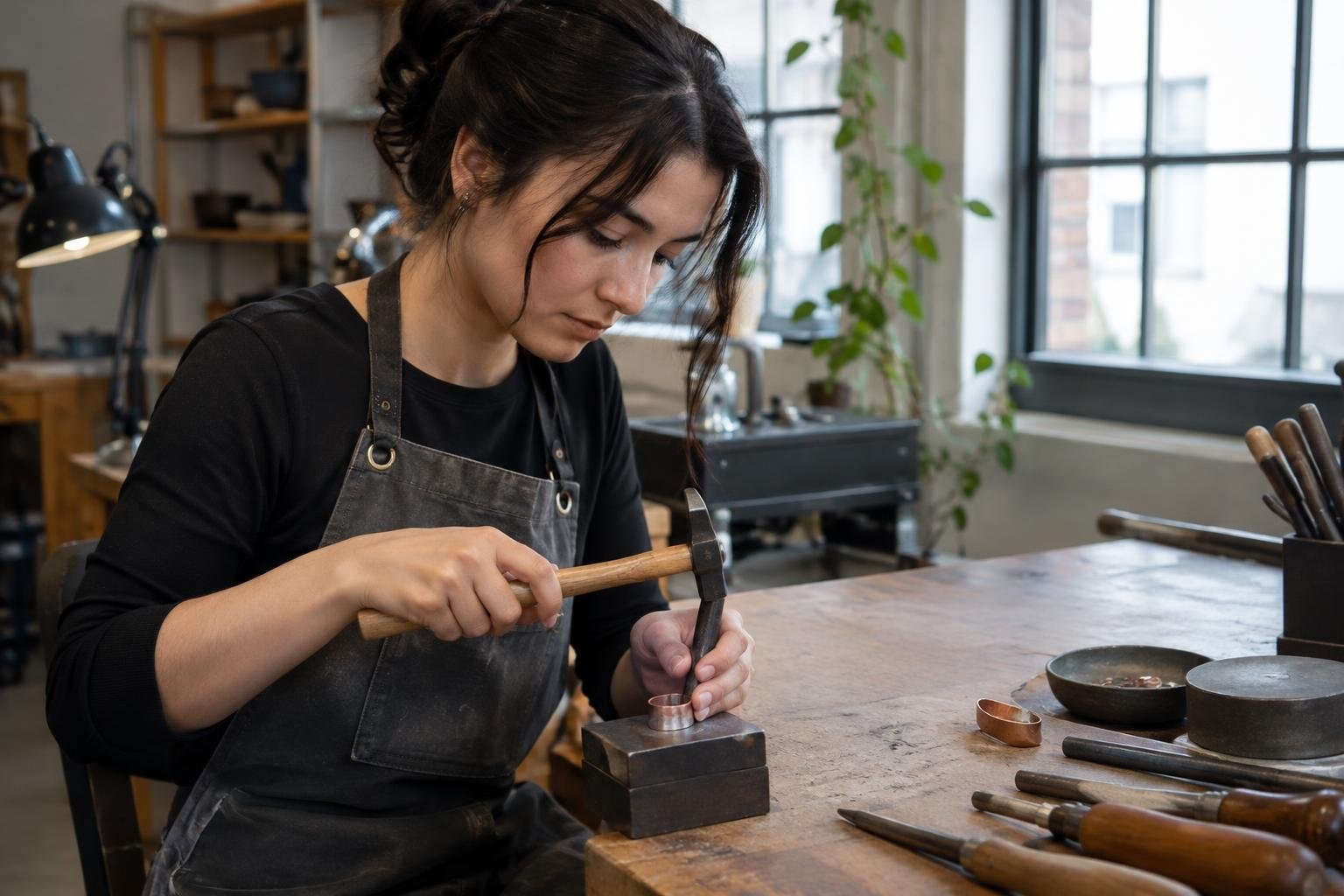
Jewelry Arts student using hand tools to form a metal piece
What Is a Jewelry Arts Program?
Jewelry Arts combines design thinking with practical techniques for making jewelry and related objects. Students learn to move from an idea to a finished piece, making decisions about form, materials, construction, and finish along the way.
The field is identified in the supplied program context with CIP code 50.0713. Schools may use names such as Jewelry Arts, Jewelry Design, Jewelry and Metals, or Jewelry and Metal Arts. These labels are not a promise of identical coursework. Check the degree audit and course descriptions for the actual program.
For example, the Fashion Institute of Technology catalog lists a Jewelry Design associate program, while North Seattle College describes both certificate and associate pathways in jewelry and metals. Those examples illustrate different institutional names and options; they should not be treated as a complete list of programs or as current admission guidance. See the FIT program catalog and North Seattle College certificate pathway.
What Do You Study in Jewelry Arts?
Expect a mix of designing and making. The program description for this field includes design concepts, metalsmithing and finishing, casting and molding, enameling, gemology, lapidary techniques, stone cutting and polishing, and material processes such as electroforming and photo etching. Not every school teaches every technique, and some may emphasize particular materials or methods.
In a studio course, a student might explore a design idea, test a material or construction method, make a piece, and revise it after critique. Technical work can include learning how components fit together and how to finish an object. Depending on the curriculum, students may also practice production and repair or use newer technologies and materials.
Program examples show why course-level comparison matters: Austin Community College describes training in jewelry production and repair, while SCAD promotes study involving new technologies and materials. Academy of Art University describes work ranging from traditional metalwork to laser technology and 3D modeling. These are examples of school-specific offerings, not standard requirements for every Jewelry Arts program. Review the Austin Community College program details, SCAD jewelry study information, and Academy of Art University program overview.
Ask to see a sample course sequence and examples of student work. Course titles alone may not reveal how much time is spent designing, making, revising, or documenting finished projects.
Skills You Can Develop
Jewelry Arts coursework can help students practice visual design, material selection, careful measurement, hands-on problem solving, and attention to detail. Studio assignments may also require patience: a design that looks convincing on paper may need adjustment when a student tests its scale, construction, or finish.
Students can also develop communication skills by explaining design decisions and responding to critique. Portfolio work gives them a way to present concepts and completed pieces. Some programs explicitly describe portfolio development; North Seattle College, for example, presents its associate pathway as supporting a strong jewelry-design portfolio and further study in visual arts.
These skills can be relevant to roles involving jewelry design, making, production, repair, craft practice, or art instruction. The degree itself does not establish that a graduate is qualified for every role. Employers and clients may consider demonstrated technique, portfolio quality, experience, and the demands of the particular position.
Who Is Jewelry Arts For? Admissions and Personal Fit
This area may be worth exploring if you enjoy visual problem solving and want to work with your hands as well as develop ideas. It can appeal to students who are comfortable practicing a technique repeatedly, adjusting a design, and learning from finished results that do not match the first plan.
You do not need to arrive with a fully formed personal style. A useful question is whether you are curious about how materials behave and willing to build control through guided practice. The amount of technical work, conceptual development, and independent design varies by program.
Admissions questions to ask
Entry requirements are set by each institution. Before applying, confirm whether it asks for prior coursework, a portfolio, an essay, an interview, or any particular application materials. Do not assume that a portfolio is either required or unnecessary based on another college’s policy. Ask how applicants without jewelry-making experience can demonstrate interest and readiness.
FIT’s catalog lists an application cycle for its program, but catalog requirements and dates can change. Use the institution’s current admissions materials rather than relying on an archived catalog. Parents and students can also discuss whether the student enjoys the daily process of making, not only the finished objects.
Credentials, Format, and Time to Completion
Jewelry Arts programs may lead to a certificate, associate degree, bachelor’s degree, or graduate study, though availability depends on the institution. A certificate can offer a focused set of courses; Austin Community College says its jewelry certificate courses can be applied toward its associate degree. North Seattle College describes a certificate and an associate pathway that can support further visual-arts study. Verify credit applicability and transfer rules directly with the receiving school.
Completion time depends on award requirements, course sequencing, enrollment pace, and transfer credits. Do not assume every certificate or associate degree follows the same timeline. A bachelor’s or graduate path generally involves a different level and scope of study, but the supplied program examples do not establish a standard number of credits or years across institutions.
Formats also differ. Studio-based making may require equipment and supervised practice that are not interchangeable with ordinary online coursework. If a program advertises online or hybrid options, ask where you will complete fabrication work, whether you must travel for studio sessions, and what tools and materials you must obtain.
Tuition, Costs, and Ways to Fund Your Education
Tuition is only one part of the price of a studio program. When comparing schools, request a complete estimate that separates tuition from mandatory fees and likely expenses for tools, materials, protective equipment, project work, and transportation or housing if applicable. These costs depend on the school, course choices, enrollment status, and where you live; the available program examples do not establish a reliable national price.
Ask whether studio fees are charged per course, whether students must buy specialized tools, and whether any equipment is available for shared use. Find out how much material a typical assignment requires and whether students can budget for project costs across the term. For online study, include equipment and shipping needs where relevant.
Complete the institution’s financial aid forms and ask its financial aid office about grants, scholarships, payment plans, and work opportunities. Students may also compare public and private institutions, transfer options, and a certificate-to-degree route. A lower initial tuition figure may not reflect the total cost if credits do not transfer or required studio resources are not included. Get the net cost and refund policies in writing before committing.
Careers, Jobs, and Employment Prospects
Jewelry Arts can prepare students for a range of creative directions, but program completion does not guarantee a job, a particular salary, or steady demand for a particular kind of work. Possible paths connected to the field include jewelry design, bench work, production, repair, independent craft practice, and further study. The mix of technical training, portfolio development, and business preparation can affect how ready a graduate feels for different opportunities.
Possible direction
How Jewelry Arts study may apply
What to investigate
Jewelry designer
Design development, material exploration, and a portfolio of pieces may help communicate a point of view.
Review employer expectations and the kind of portfolio requested.
Jeweler or production worker
Fabrication, finishing, and production methods may support hands-on work.
Ask whether the program teaches the specific processes used by employers you are considering.
Jewelry repair worker
Programs that teach repair methods may build relevant practical skills.
Check what repair work is taught and how much supervised practice is included.
Craft artist or independent maker
Studio practice and portfolio development may support a body of work.
Consider business, pricing, sales, and the cost of tools and materials as separate needs.
Postsecondary arts teacher
Advanced study and an established practice may be relevant to some teaching pathways.
Verify education and experience requirements for each institution and position.
Some colleges describe further study as one outcome of their pathway. North Seattle College identifies possible progression to visual-arts bachelor’s and master’s study. Such progression depends on admission and transfer decisions at the next institution. For job exploration, start with actual role descriptions and distinguish positions available to new graduates from paths that require experience or further education.
Technology is part of some programs, including examples that describe laser technology and 3D modeling. Treat these as potential tools, not a guarantee that every curriculum or employer uses them. Ask how the program balances digital workflows with hand fabrication and whether students leave with work that demonstrates both, if that matters to your goals.
Accreditation, Certification, and Professional Requirements
Degree completion and professional permission to work are different questions. The supplied program information does not establish a universal jewelry-specific license or certification requirement, so do not assume that a credential is mandatory for every jewelry occupation or that it automatically qualifies you for a regulated activity.
Check the requirements for the exact job, location, and employer you have in mind. Ask colleges whether they prepare students for any named credential and whether that preparation is included in the advertised tuition. If a school makes a credential or accreditation claim, request the name of the accrediting or certifying organization and verify it through that organization’s official information.
For studio learning, also ask about safe equipment use, training before access to tools, and the rules for working with materials. The details are institution-specific, so review the student handbook and speak with program staff.
Related Degrees and Alternative Pathways
Related areas can lead to different kinds of creative work. Consider the actual courses and outcomes rather than deciding from a program title alone.
Jewelry Design: Consider this if you want a program centered on planning and developing wearable pieces.
Jewelry and Metals: Consider this if you want jewelry practice connected with broader metal arts.
Studio Art: Consider this if you want a wider visual-arts education and are comfortable pursuing jewelry as one focus among several.
Fine Arts: Consider this if you want a broader studio foundation and may apply to a later visual-arts degree.
Art History: Consider this if you are more interested in the history and interpretation of art than in making jewelry as your primary practice.
Metal Arts: Consider this if you want to explore metalwork beyond wearable objects.
Gemology: Consider this if your interests lean toward learning about gems and materials rather than concentrating mainly on design and fabrication.
Names do not guarantee a particular emphasis. Academy of Art University’s program information includes jewelry and metal arts, while SCAD presents jewelry degrees and North Seattle College describes jewelry and metals pathways. Compare required courses, studio hours, and work samples to understand how each approach differs.
A focused certificate may be useful for targeted skills or as a step toward an associate pathway when credits apply. A broader visual-arts program may make more sense if you want to keep several studio directions open. For example, North Seattle College describes its associate pathway as supporting further visual-arts study, including bachelor’s and master’s options. Confirm transfer credit and admissions requirements with the destination institution.
Is a Jewelry Arts Degree Worth It? Benefits and Tradeoffs
A college program can help you build technique and a body of work, while also taking time and money. The tradeoff depends on your goals. A focused certificate may be a more direct way to practice production or repair skills if its curriculum matches what you need. A longer program may offer more time for design development and a portfolio, but the added tuition and living expenses need to be weighed against the value of that additional study to you.
Potential benefits
Structured opportunities to practice techniques and receive feedback.
Access to a sequence of courses rather than learning isolated skills.
Portfolio development or a pathway toward further visual-arts education, depending on the program.
Potential tradeoffs
Tools, materials, fees, and studio access can add costs beyond tuition.
A degree title alone cannot promise employment or earnings.
Some career paths may require more experience, a stronger portfolio, or additional education than a student expects.
Before deciding whether a program is worth it, compare its complete cost with the specific outcome you want. If you want to make jewelry professionally, ask how much supervised practice and portfolio feedback are included. If you want a broader creative education, assess whether the program leaves room for other studio interests. If you are uncertain about the work itself, try an introductory class or short project before making a larger commitment.
How to Choose a Jewelry Arts Program
Compare programs by the learning experience and the next step they support. Request written answers to questions such as:
What is the exact credential and which courses are required?
Which techniques are taught, and how much studio practice is included?
What equipment and materials can students use, and what must they buy?
How often do students receive individual feedback or critique?
What portfolio or final project will students complete?
Can credits transfer into a specific next program, and who confirms that decision?
What is the estimated total cost, including fees and supplies?
Is the delivery format campus-based, hybrid, or online, and where does hands-on work happen?
What are the current admissions requirements, deadlines, and application materials?
What support is available for internships, job preparation, or further study?
Visit a studio if possible, or ask for a virtual tour and recent student work. Ask to speak with a program adviser about course sequence and with financial aid staff about net cost. Check whether the program’s public claims can be confirmed in official school materials. Assessment.com’s education resources and major-choice guidance can support the broader decision, while the school must confirm its own requirements and costs.
From Degree to Career: Possible Pathways
Think of career development as a series of choices, not a guaranteed ladder. One possible route is:
Jewelry Arts certificate or associate study → entry-level production, studio, or repair experience → stronger portfolio and more specialized technique → design, independent practice, or further study.
Another route may emphasize education: jewelry and metals associate pathway → admission to a visual-arts bachelor’s program → advanced studio work or graduate study → pursue teaching or another specialized creative path if qualifications and opportunities align. North Seattle College describes its pathway as supporting further visual-arts study, but the next institution makes its own transfer and admissions decisions.
Work samples, practical skill, relationships with instructors and peers, and experience can all shape a graduate’s next steps. Ask each school what career preparation it actually provides, and build a plan for opportunities beyond the classroom.
Questions to Ask Before You Enroll
Before enrolling, use this checklist with a parent, counselor, or adviser:
Have I confirmed the exact award, admissions rules, and current application deadline with the institution?
Do the course descriptions teach the techniques I want to learn?
Have I seen examples of student work and learned how portfolios are reviewed?
Do I understand the full cost of tuition, fees, tools, materials, and transportation or housing?
How will I access studio equipment and complete hands-on work?
Will credits transfer to the next program I might pursue, as confirmed by that receiving school?
What employment, internship, or further-study support is available?
Have I researched the real requirements of the jobs I may want?
Does the day-to-day making process interest me as much as the finished jewelry?
For an additional way to reflect on preferences and possible work directions, take the MAPP assessment. Use any results as one input alongside course research, conversations, studio visits, and financial planning.
Frequently asked questions
What is a Jewelry Arts degree?
Jewelry Arts is a field of study focused on designing and making jewelry and related metal objects. Programs may teach design, fabrication, metalwork, materials, and techniques such as casting or enameling. The precise balance of studio practice, technical training, and academic coursework depends on the school and credential.
Is Jewelry Arts a hard major?
It can be demanding because students must develop ideas and then solve detailed making problems through practice. Depending on the program, that may involve design development, fabrication, material exploration, and building a portfolio. The challenge is not only coming up with a design: students also need to learn how to turn it into a wearable, well-finished piece.
What jobs can I get with a Jewelry Arts degree?
Possible directions include jewelry design and fabrication, jewelry production or repair, craft practice, and further study in the visual arts. A program may build relevant techniques and a portfolio, but a credential does not guarantee a particular job. Look closely at the practical experience and work samples a program helps you develop.
How much can you make with a Jewelry Arts degree?
There is no single salary figure for a Jewelry Arts degree because the credential does not determine a graduate’s occupation, location, experience, or employment arrangement. Research pay for the specific roles you are considering, and distinguish employee wages from self-employment income. Also consider the cost of tools, materials, and business operations if you plan to work independently.
Can you earn a Jewelry Arts degree online?
Some coursework may be available online, but jewelry-making programs often rely on learning processes and using equipment that are difficult to replicate without studio access. Ask whether a program is fully online, hybrid, or campus-based; where hands-on assignments take place; and what equipment, materials, or in-person sessions students must provide or attend.
Does Jewelry Arts require math?
The focus is usually visual design and hands-on making rather than advanced mathematics. Still, students may use measurement, proportion, scale, and material calculations while designing and constructing pieces. Ask the college for a sample curriculum to see its actual general education and technical requirements.
Do I need graduate school to work in jewelry arts?
Graduate school is not automatically required for jewelry design, making, or repair work. It may be relevant if you want advanced studio study, a stronger body of work, or to pursue certain teaching or academic paths. Requirements for teaching positions vary, so check the qualifications for the specific role and institution before choosing a graduate program.
How do I choose a Jewelry Arts program?
Compare programs by the techniques taught, studio access, feedback from faculty, portfolio expectations, transfer options, and total cost. Ask what students make and how often they receive critique. A short certificate may suit focused skill development, while an associate or bachelor’s program may offer a longer pathway and broader coursework; verify the actual curriculum with each school.
People Also Ask
What do you learn in a Jewelry Arts program?
A Jewelry Arts certificate or degree can teach design, materials, and jewelry-making techniques such as fabrication and repair. Programs differ, so review the course list and studio work before enrolling.
What degree levels are available in Jewelry Arts?
Program names and awards vary. The field may be offered through certificates, associate programs, bachelor’s programs, and graduate study. Confirm the award and requirements directly with each institution.
How long does a Jewelry Arts program take?
A two-year associate program may be designed for a shorter college pathway, but actual completion time depends on credits, course availability, transfer credit, and full- or part-time enrollment. Check the institution’s published plan.
Are Jewelry Arts programs available online?
A jewelry program may require access to studio equipment and hands-on instruction. Online availability does not necessarily mean all making work can be completed remotely, so ask how practical projects and equipment access are handled.
Do I need a portfolio to apply for Jewelry Arts?
A portfolio can show design development, technical skill, and finished work. Ask whether the program includes portfolio reviews, individual critique, and opportunities to document completed projects.
Can a Jewelry Arts certificate count toward an associate degree?
A certificate may focus on practical skills and can sometimes provide a pathway into a longer award. For example, Austin Community College describes its jewelry certificate as training in production and repair skills, with courses that can apply toward its associate degree. Confirm current details with the school.
How is Jewelry Arts different from studio art?
Compare Jewelry Arts with broader fine arts, studio art, or metals programs by examining how much coursework is devoted to jewelry, general art practice, materials, and portfolio development. The best choice depends on the work you want to make and the options available at each school.
Jewelry Arts may suit students who want to develop both a visual point of view and practical skill making objects by hand. Programs can range from focused certificates to degrees and graduate study, but the award, curriculum, studio access, and cost differ by school. Compare the work you will actually do, the portfolio you will leave with, and the career or further-study route you hope to pursue. If your interests are still taking shape, consider how the day-to-day work of designing, making, repairing, or teaching aligns with what motivates you. Explore career and degree options with the MAPP career assessment.
Find out which Career or College Major is right for you!
We use cookies to offer you a better browsing experience, analyze site traffic and personalize content.
Read about how we use cookies and how you can control them in our
Privacy Policy.
If you continue to use this site, you consent to our use of cookies.
×
Exciting News!
Be one of the first to Beta Test the new AI-Powered Assessment.com Platform.