Surgical Technology Degree Guide: Courses, Careers, Requirements, and Program Fit
Learn what Surgical Technology/Technologist programs teach, what admissions and clinical training can involve, how certification fits in, and what to compare before choosing a program.
By David Slack · Staff Writer Assessment.com · Published November 1, 2026 · Last updated November 5, 2026
A Surgical Technology/Technologist program prepares students to help surgical teams protect the sterile field, follow aseptic technique, and manage instruments and supplies before, during, and after procedures. The field combines technical knowledge, careful hands-on work, and communication in a high-responsibility healthcare setting. Many students consider it when they want a focused route toward a surgical technologist role without pursuing a physician or nursing career. Programs differ in credential, admissions, hands-on training, and certification eligibility. Not sure whether surgical technology fits you? Take the Free MAPP Career Assessment to explore how your motivations, interests, and natural preferences align with this field and related careers.
Degree & Program Decision Insights
Explore your personal fit, education requirements, career potential and next steps.
01Motivational Fit
Discover whether this program fits you
Explore your preferences against the focus of Surgical Technology/Technologist. These prompts are not personal MAPP results.
Subject curiosity. Would you choose to explore “instrument and equipment sterilization and handling” in depth? Ask for a sample learning activity to test that interest.
Breadth of interest. Consider the place of “surgical supplies management” in this field. Is this another part you would choose to explore, or mainly a requirement you would tolerate?
Work reality. Related work can involve this task: “Maintain a proper sterile field during surgical procedures.” Would you want that activity to be a regular responsibility?
Interest in studying a field can differ from enjoying its related work.
Which part would you want to do repeatedly, and what would you try before deciding?
Discover Your Personal Program Fit
Before investing your time and money in your education, discover how this program aligns with your natural motivations, work preferences and career goals.
Typical occupational entry: postsecondary nondegree award (BLS). Check the exact professional credential and jurisdiction requirements for this occupation; the classification association alone does not establish eligibility.
Typical occupational entry: postsecondary nondegree award (BLS). Check the exact professional credential and jurisdiction requirements for this occupation; the classification association alone does not establish eligibility.
U.S. occupational wages are not guaranteed graduate earnings; OEWS excludes self-employed workers.
Projected openings include replacements as well as growth.
U.S. national estimates. A crosswalk does not establish entry-level eligibility; advanced, management and teaching roles can require further qualifications.
Compare the actual offering and credential before committing your time or money.
Request the itemized fees, materials and equipment associated with “instrument and equipment sterilization and handling”; confirm what tuition includes.
Compare the full attendance budget, course availability and time away from paid work, rather than tuition alone.
No institution- and credential-matched cost, debt or graduate-earnings amount is reported here; occupational pay is not program ROI.
Financial aid depends on the school, program and student’s eligibility.
Explore your motivations. Use MAPP as a starting point for reflecting on your interest in “instrument and equipment sterilization and handling”, then test that interest against a sample learning task.
Examine the work. Compare Surgical Technologists and Surgical Assistants on daily work and entry qualifications, as well as pay.
Compare actual providers. Ask for the exact credential, course sequence and assessment methods. Compare how each provider teaches “surgical supplies management”, its entry criteria and its itemized costs.
Check the evidence before applying. Confirm prerequisites and any recognition or professional requirements for your intended route; ask for applicable rules and published outcome definitions in writing.
Verify the institution’s current offering, admissions requirements and outcomes; a search result does not establish your eligibility.
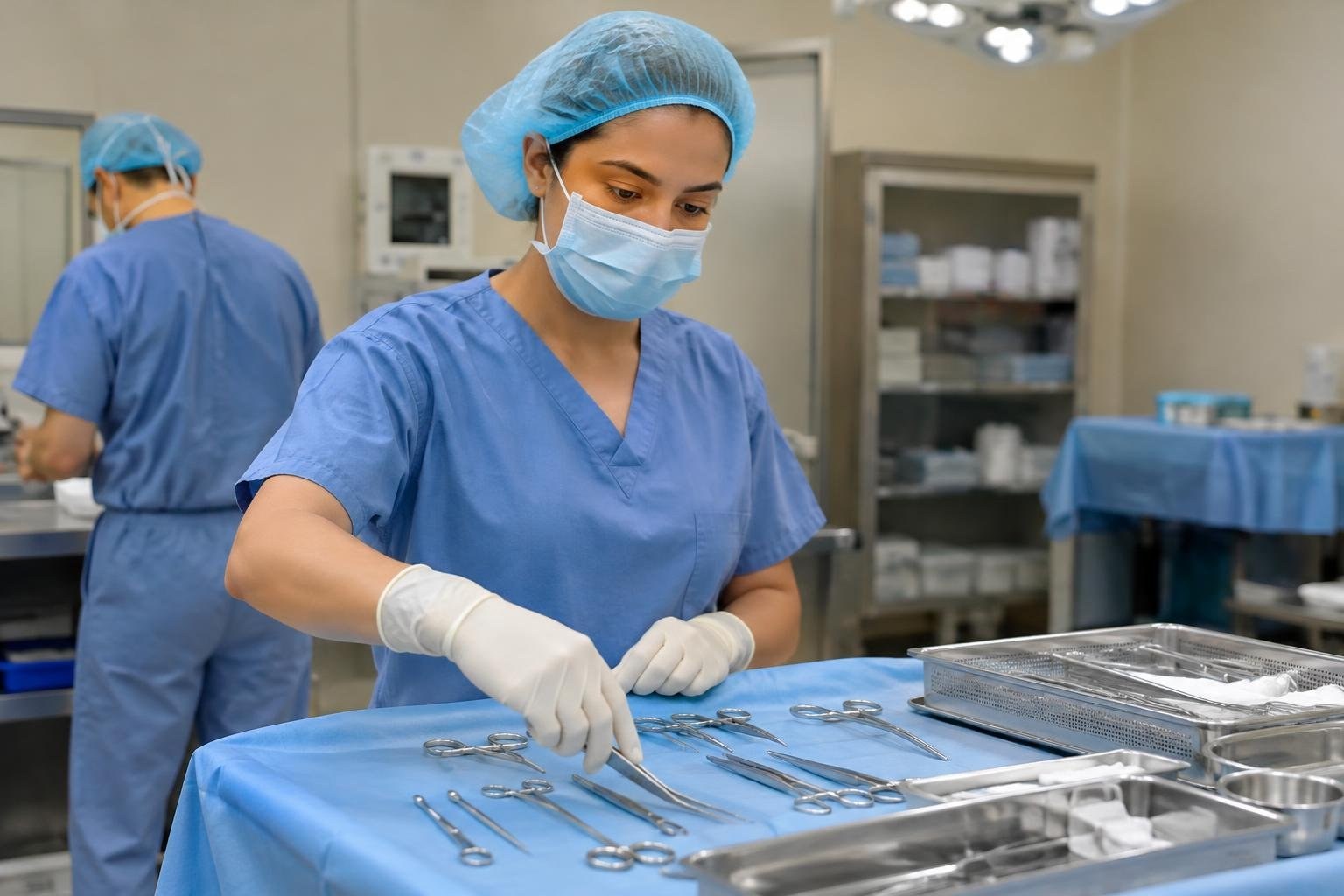
A student practicing sterile technique and organizing surgical instruments in a supervised training environment
What Is a Surgical Technology/Technologist Program?
Surgical Technology/Technologist is a technical healthcare field focused on supporting surgical procedures under the supervision of physicians and surgical nurses. Students learn to maintain the sterile field, follow aseptic technique, and handle surgical instruments, equipment, and supplies. The National Center for Education Statistics classification associated with this field is CIP 51.0909.
Programs are designed around entry-level preparation in knowledge, practical skills, and professional behavior. For example, WSU Tech describes the field’s preparation and sterile-field responsibilities, while Southwest Texas Junior College describes preparation for entry-level practice.
How it differs from related fields
Surgical technologists support the surgical team through preparation, sterile technique, and instrument and supply management. They are not surgeons, and this program is not the same as nursing education. Surgical assisting is also a related but distinct role; compare each program’s scope, admissions requirements, training, and credential pathway rather than treating job titles as interchangeable.
The field classification describes a subject area, not every credential a particular college offers. A specific program may award a certificate or an associate degree, so confirm the exact award on the institution’s current catalog.
What Do You Study in Surgical Technology?
Expect a mix of foundational healthcare knowledge and practice-oriented learning, but do not assume every college uses the same course sequence. The field’s stated learning areas include sterile technique, surgical instruments and equipment, supplies management, wound exposure and closure, and operating-room procedures. The focus is on using knowledge accurately in a team setting, not memorizing course titles alone.
Questions to ask about hands-on training
Which skills are practiced in campus labs, and which are practiced in a healthcare facility?
How much supervised operating-room or clinical experience is included, and where does it take place?
How are practical skills assessed, including sterile technique and instrument handling?
Are there required procedures, attendance rules, or placement arrangements students must meet?
Ivy Tech describes extensive hands-on training in a real operating room as part of its program. That is a school-specific example, not a guarantee that every program offers the same arrangement. Review the curriculum and clinical requirements in writing before enrolling.
Skills You Develop
The work draws on precise technical skills and reliable teamwork. Students practice following procedures, recognizing and handling instruments, supporting sterile technique, and communicating clearly with a surgical team. Program descriptions emphasize cognitive learning, psychomotor skills, and professional behavior as connected parts of entry-level preparation.
Skills to build and explain to employers
Technical: sterile-field practices, instrument and equipment handling, and supply management.
Attention to detail: following established procedures and noticing when a task or setup needs attention.
Communication: listening, confirming information, and communicating appropriately within a team.
Professional judgment: applying classroom knowledge and practical skills in supervised training.
Use lab work, clinical experiences when included, and instructor feedback to identify specific examples of these skills. Avoid describing yourself only as “good under pressure”; employers benefit more from concrete examples of careful, safe, team-based work.
Who Is This Program Best For?
This program may interest students who want practical healthcare training, enjoy learning procedures, and value a precise role on a team. It can also appeal to adult learners and career changers looking for a defined technical pathway. No single personality type is required, but you should be willing to learn detailed processes, accept coaching, and take sterile technique and communication seriously.
Consider the day-to-day fit
Ask yourself whether you are comfortable learning in a hands-on environment and following rules closely. Consider whether you prefer supporting a team’s work over independently directing patient care. If you are uncertain, speak with program staff, ask what students observe or practice, and learn about the actual responsibilities before applying.
Does surgical technology match you?
Salary, job availability, and a program’s reputation matter, but they cannot answer whether the work is personally suitable. Assessment.com’s Free MAPP Career Assessment can help you explore how your motivations and preferences relate to career options. Use an assessment as one input alongside program research, conversations with advisors, and your own review of job responsibilities.
Admissions, Prerequisites, and Application Planning
Entry requirements are set by individual institutions and can differ sharply. Washburn Tech states that adult applicants need a high school diploma or GED for its described pathway. NYU’s surgical technology program lists an associate degree, at least one year of work experience, good physical and mental health, and strong communication skills among its criteria. These examples are not universal admissions rules.
Check the current application checklist
Ask whether the program requires prerequisite courses, a minimum GPA, placement testing, an interview, health documentation, background checks, or prior healthcare experience. Confirm application deadlines and whether admission to the college is separate from admission to the technical program. Do not rely on an old catalog or an informal summary when planning your application.
Families can help by reviewing deadlines, prerequisite records, and total costs with the student while leaving room for the student to make an informed choice. Start early if a program has a selective application process or additional requirements.
Credential Levels, Program Format, and Completion Time
There is no single completion timeline supported across all surgical technology programs. The award could be a certificate or an associate degree, and prerequisites, course sequencing, clinical scheduling, transfer credits, and part-time attendance can affect how long a student takes. Ask each college for a sample degree plan and a realistic estimate based on your starting credits and schedule.
Compare delivery formats carefully
Some instruction may be available online or in a hybrid format, but practical skills require careful explanation of where and how students practice. Confirm whether campus labs, clinical placements, operating-room experience, or other in-person activities are mandatory. Ask how placements are assigned and whether travel or schedule constraints could affect your ability to participate.
Do not choose a program based only on an “online” label. Verify the location, frequency, and scheduling of every hands-on requirement before paying a deposit.
Tuition, Total Cost, and Financial Aid
Tuition is only one part of the cost of a healthcare training program. Build a full estimate that includes mandatory fees, books, instruments or other supplies, uniforms if required, transportation, and any expenses connected with in-person training. Costs vary by institution, residency status, program length, enrollment pace, and where required activities take place.
Build a useful cost comparison
Request a term-by-term estimate of tuition and required fees.
Ask which equipment, supplies, uniforms, or books students must purchase.
Check whether travel or lodging could be needed for a placement.
Compare the cost after grants and scholarships, not just the advertised tuition.
Ask how transfer credits could change the number of courses you need.
Complete the Free Application for Federal Student Aid if appropriate, and ask the college’s financial aid office about grants, scholarships, payment plans, and employer tuition assistance. Confirm aid eligibility and renewal conditions directly with the institution. A lower tuition quote is not automatically the lower total cost if the program requires additional expenses or more time.
Careers, Jobs, and Employment Outlook
Programs may connect graduates with surgical technologist opportunities, but job titles, employer preferences, compensation, and hiring demand differ by region and workplace. The supplied program information supports entry-level preparation as a goal; it does not establish a guaranteed job, a salary, or a national employment outlook. Check current U.S. Bureau of Labor Statistics information and local employer postings when comparing career prospects, and confirm that the occupation and location match the data you review.
Career direction
How the program may relate
What to verify
Surgical technologist
Core entry-level direction described by several program sources.
Employer education, certification, and experience preferences in your area.
Surgical assistant
A related surgical-care path, but not interchangeable with surgical technology.
Separate education, clinical preparation, and credential requirements.
Health specialties educator
A possible later education direction for experienced professionals.
Whether a degree, teaching experience, or further study is required.
Other operating-room or surgical-service roles
Some certified technologists may work in settings such as delivery rooms, surgery centers, or central service.
Job scope and required credentials for each employer and location.
NYU identifies several settings where a certified surgical technologist may seek work, including operating rooms, delivery rooms, cardiac catheterization labs, surgery centers, and central service. That program’s description should not be read as a guarantee of access to every role or setting for all graduates.
For broader exploration, see Assessment.com’s guides to healthcare practitioner and technical careers and healthcare support careers.
Find out which Career or College Major is right for you!
Finishing a program and earning a professional credential are not automatically the same thing. Washburn Tech describes an opportunity for eligible graduates to sit for a national certifying exam for the Certified Surgical Technologist credential. MATC says graduates of its program are eligible to write the certification examination given by the National Board of Surgical Technology and Surgical Assisting. Confirm current eligibility and exam requirements with the school and certifying organization before enrolling.
Ask about accreditation and professional requirements
Ask the program to identify its current institutional and programmatic accreditation status, the accrediting body, and how to verify that status in an official directory. Confirm whether the program meets any state requirements that apply where you plan to work. Do not assume that every certificate or degree automatically qualifies a graduate for certification or employment.
Also ask what happens if a student changes schools or relocates. Program accreditation, exam eligibility, and employer requirements can matter when transferring or seeking work in another state.
Experience, Certification Preparation, and Employer Readiness
Hands-on experience can help students test whether the work suits them and practice the skills a program teaches. Ask about supervised labs, clinical or operating-room practice, and how students receive feedback. If the college offers placement opportunities, find out whether the school arranges them and what students must do to qualify.
How to stand out to employers
Describe specific examples of careful instrument handling, sterile technique practice, and teamwork.
Keep a record of relevant labs, clinical learning, and instructor feedback.
Ask faculty about professional organizations and networking opportunities relevant to the field.
Confirm certification exam eligibility and plan for any separate exam steps or costs.
Review local job postings to identify employer expectations before graduation.
Do not treat a certificate, degree, or exam opportunity as proof that a particular job is guaranteed. Employers may have additional requirements.
Related Degrees and Career Alternatives
Surgical technology is a focused path, but it is not the only way to enter healthcare. Compare alternatives by the role you want, the type of patient or technical work you prefer, the length and cost of preparation, and any required license or credential. These options are not direct substitutes, and each has distinct educational requirements.
Nursing: consider this if you want a nursing role and broader nursing education rather than a surgical technology program.
Surgical assisting: consider this if you are seeking a distinct surgical-assistant role and are prepared to review its separate admissions and training requirements.
Medical assisting: consider this if you prefer a different clinical support role; compare the actual duties and credential requirements.
Medical equipment preparation: consider this if instrument and equipment preparation interests you more than direct operating-room team support.
Radiologic technology: consider this if imaging technology is more appealing than sterile-field and instrument work.
Healthcare administration: consider this if organizing services and operations is more attractive than hands-on procedural work.
Health specialties teaching: consider this as a possible later direction if you gain field experience and want to teach, while verifying education requirements.
Review guidance on choosing college majors and browse Assessment.com’s degree resources to compare broader study options.
Further Education and Career Pathways
Program labels and credential levels can be confusing. The field’s classification does not mean that one school offers every credential type listed for the subject area. The available institution examples include certificates, associate degrees, and pathways that combine technical training with university study. Confirm the award name and level directly on the college’s current program page.
Ask about further education
Some students may later consider advanced study, but the right next step depends on career goals and admission requirements. Washburn Tech notes that advanced degree opportunities are available through its pathway. Ask whether credits transfer, whether a bachelor’s degree is offered or required for a particular goal, and whether further education changes your intended job options.
Do not pursue a higher credential just because a program page lists it. First identify the job or responsibility you want and check what education employers or relevant professional bodies actually require.
Is a Surgical Technology Program Worth It?
A program’s value depends on what it costs, how long you need to complete it, whether its training matches your goals, and what credentials or jobs it can realistically support. A short program may be attractive, but it is only a strong choice if its hands-on instruction, credential eligibility, and schedule work for you. A more expensive or longer program is not automatically better.
Common mistakes to avoid
Choosing based on a program title without checking the actual curriculum.
Assuming certification exam eligibility is automatic for every graduate.
Comparing tuition only and overlooking supplies, fees, and travel.
Assuming an online option has no in-person training.
Using broad salary claims instead of current local job information.
Confusing surgical technologist and surgical assistant responsibilities.
Discuss likely expenses and career goals as a family, but make sure the prospective student has the opportunity to ask questions, speak with the program, and evaluate whether the work fits.
How to Choose the Right Program
Compare programs using the same questions so that differences are easier to see. Review the curriculum, hands-on learning, admissions checklist, certification exam pathway, schedule, total cost, and transfer rules. Ask for written answers when a requirement affects your ability to enroll or complete training.
Program comparison checklist
What credential does the program award, and how many credits are required?
What are the admission criteria and deadlines?
Which labs, clinical placements, or operating-room experiences are required?
What is the program’s current accreditation status, and where can it be verified?
Which certification examination may graduates be eligible to take?
What is the full estimated cost, including fees and required supplies?
Can the program be completed part time, online, or in a hybrid format?
How do transfer credits and prior learning affect the course plan?
What career services, employer connections, and graduate outcome information are available?
Use these questions alongside Assessment.com’s college guidance resources. A counselor or advisor can help interpret options, but confirm final requirements with the institution.
From Degree to Career
Career paths are not guaranteed sequences. A student may complete an eligible program, pursue a certification examination, and apply for an entry-level surgical technologist role. With experience, an individual may explore different surgical settings or related responsibilities, depending on employer requirements and available opportunities. Someone interested in teaching may need further education and experience; verify those requirements before planning that route.
Illustrative pathways include:
Program coursework and supervised practice → entry-level surgical technologist applications → additional experience → exploring a specialized setting or broader responsibilities.
Technical training and certification exam eligibility → surgical technologist role → field experience → considering advanced education or teaching opportunities.
These are examples for planning, not promises of promotion, certification, or employment.
Questions to Ask Before Enrolling
Before you apply or pay a deposit, use this checklist with the student and, if helpful, a parent, counselor, or college advisor:
Is the institution and specific program appropriately accredited, and how can I verify it?
What is the total estimated cost after aid, including supplies and travel?
What are the current admissions requirements and deadlines?
How much hands-on training is provided, and where does it happen?
Does the program qualify graduates to apply for a certification examination?
Which activities must be completed in person?
Will credits transfer if I change programs or pursue further education?
What career services and employer connections are available?
What outcome information can the school share, and how is it calculated?
Which grants, scholarships, and other aid may apply, and what are the renewal rules?
Save the answers and compare them across schools. If a critical point is unclear, ask the program director or registrar to explain it before making a decision.
Frequently asked questions
What is a Surgical Technology/Technologist program?
A Surgical Technology/Technologist program prepares students to support surgical teams by maintaining the sterile field, following aseptic technique, and handling instruments and supplies. Programs may include classroom learning and hands-on training. Requirements, clinical experiences, credentials, and program length vary by institution, so check the details of each specific program.
Is surgical technology a hard major?
It can be demanding because students must learn procedural knowledge and apply it carefully in a hands-on healthcare setting. Program descriptions emphasize knowledge, practical skills, and professional behavior. Ask about the amount of lab and operating-room experience, evaluation standards, attendance rules, and support for students who need more practice before enrolling.
What jobs can I get with a surgical technology degree?
Many programs are designed to prepare students for entry-level surgical technologist roles, but admission to a program does not guarantee a job. Check the program’s career preparation, hands-on experience, graduate outcomes if available, and local employer requirements. Certification eligibility and hiring preferences can vary, so confirm both with the school and prospective employers.
How much do surgical technologists make?
There is no single salary figure that applies to every graduate. Pay can differ by location, employer, experience, work setting, schedule, and credentials. Compare current occupational wage information from the U.S. Bureau of Labor Statistics with local job postings, and make sure figures you review match the job title and geographic area you are considering.
Can I earn a surgical technology degree online?
Some programs offer online coursework, but surgical technology training involves practical skills that students should ask about in person. Confirm how the program delivers labs, hands-on training, and any clinical or operating-room experience. A program advertised as online may still require campus attendance or placements at healthcare facilities.
What are the requirements for surgical technology programs?
Requirements depend on the institution and credential. One Washburn Tech pathway requires a high school diploma or GED, while NYU’s surgical technology program lists an associate degree and at least one year of work experience among its criteria. These are examples, not universal rules. Review the current admissions page for each program you may apply to.
Do surgical technologists need certification?
Some program graduates may be eligible to sit for a national certification examination, but eligibility depends on the program and the certifying organization’s current rules. Washburn Tech and MATC describe certification exam opportunities for their graduates. Ask each school to confirm the exam, eligibility requirements, costs, and whether certification is expected by employers in your area.
Does surgical technology require a lot of math?
Math demands vary by curriculum, and the supplied program descriptions do not specify a common math requirement. Ask colleges which math courses are prerequisites and what quantitative work appears in the curriculum. Regardless of course requirements, students should be prepared to follow precise procedures and communicate clearly in a technical healthcare environment.
How is surgical technology different from nursing or surgical assisting?
Surgical technology is a focused educational route for supporting surgical care. Nursing programs prepare students for a different professional role, while surgical assisting programs may have distinct training and admissions requirements. Compare what each program teaches, the responsibilities of the resulting job, credential requirements, and how much direct patient care you want in your work.
People Also Ask
What do you learn in a surgical technology program?
Surgical technology programs teach students to maintain a sterile field, follow aseptic technique, and handle surgical instruments and supplies. The curriculum may also address equipment, team procedures, and supervised hands-on practice. Course lists and clinical arrangements vary, so compare each college’s published curriculum and training requirements.
How long does it take to become a surgical technologist?
The credential and completion time depend on the school and the particular program. Surgical technology is offered through different program structures, including certificates and associate degrees. Ask each college for its credit requirements, term calendar, full-time and part-time options, and any prerequisite courses before estimating your time to completion.
Is surgical technology a certificate or a degree?
A certificate or associate degree is a common kind of surgical technology pathway in the program examples available here. The field’s CIP classification should not be mistaken for a promise that a specific institution offers every credential level. Check the college’s current catalog to confirm the exact award and whether it leads to certification exam eligibility.
How much does a surgical technology program cost?
Program costs depend on the school, residency status, enrollment pace, and expenses such as equipment, books, fees, and travel to required training sites. Request a written estimate of total attendance costs, not tuition alone. Ask financial aid offices about grants, scholarships, payment plans, and transfer credit before deciding.
How do I choose a surgical technology program?
Compare the published curriculum, supervised hands-on learning, admissions criteria, credential awarded, certification exam eligibility, total cost, and scheduling format. Ask where required practice takes place and whether students must arrange transportation or meet health and safety requirements. Confirm details directly with the program rather than relying only on a general field description.
Who is a good fit for surgical technology?
The role is technical and team-based. Students should be prepared to learn procedures carefully, handle instruments and supplies, communicate with a surgical team, and take sterile technique seriously. A career assessment can help explore personal interests and work preferences, but it should complement, not replace, learning about the actual job and program expectations.
A Surgical Technology/Technologist program may suit students who want focused, hands-on preparation for a technical role supporting surgical teams and can commit to learning sterile technique, instruments, and operating-room procedures. Program length, admissions, costs, clinical requirements, and credential outcomes differ, so verify each detail directly with schools before enrolling. Compare more than a program title: examine the experience students receive, the certification exam pathway, total cost, and whether the day-to-day work fits your interests. Assessment.com’s MAPP career assessment can help you explore how your motivations and preferences align with this and other education and career options.
Want to see your options? Try our comprehensive Degree, Program & College Search tool
We use cookies to offer you a better browsing experience, analyze site traffic and personalize content.
Read about how we use cookies and how you can control them in our
Privacy Policy.
If you continue to use this site, you consent to our use of cookies.
×
Exciting News!
Be one of the first to Beta Test the new AI-Powered Assessment.com Platform.