Sterile Processing Technology/Technician: Programs, Careers and How to Choose
Learn what sterile processing technician programs teach, how certificate and diploma options differ, what costs to compare, and how training can connect to healthcare support careers.
By Tome Fierre · Staff Writer Assessment.com · Published November 1, 2026 · Last updated November 5, 2026
Sterile processing technology programs prepare students to clean, inspect, assemble, sterilize and distribute surgical instruments, medical equipment and supplies. These steps help make instruments ready for use in operating rooms and other medical settings. Training commonly covers decontamination, infection control, microbiology, instrument processing and documentation. Many people enter the field through a certificate or technical diploma, though program names, length and format vary by college. Graduates may pursue sterile processing work in hospitals or other medical facilities; some programs also connect to further study, such as surgical technology. Not sure whether this hands-on, procedure-focused work fits your interests? Take the Free MAPP Career Assessment to explore how your motivations, interests and natural preferences relate to careers and education options.
Degree & Program Decision Insights
Explore your personal fit, education requirements, career potential and next steps.
01Motivational Fit
Discover whether this program fits you
Explore your preferences against the focus of Sterile Processing Technology/Technician. These prompts are not personal MAPP results.
Subject curiosity. Would you choose to explore “sterilization” in depth? Ask for a sample learning activity to test that interest.
Breadth of interest. Consider the place of “infection control” in this field. Is this another part you would choose to explore, or mainly a requirement you would tolerate?
Work reality. Related work can involve this task: “Clean instruments to prepare them for sterilization.” Would you want that activity to be a regular responsibility?
Interest in studying a field can differ from enjoying its related work.
Which part would you want to do repeatedly, and what would you try before deciding?
Discover Your Personal Program Fit
Before investing your time and money in your education, discover how this program aligns with your natural motivations, work preferences and career goals.
Typical occupational entry: postsecondary nondegree award (BLS). Check the exact professional credential and jurisdiction requirements for this occupation; the classification association alone does not establish eligibility.
U.S. occupational wages are not guaranteed graduate earnings; OEWS excludes self-employed workers.
Projected openings include replacements as well as growth.
U.S. national estimates. A crosswalk does not establish entry-level eligibility; advanced, management and teaching roles can require further qualifications.
Compare the focus and route of these distinct instructional fields; their credentials and admission requirements are not interchangeable.
Surgical Technology/TechnologistCIP 51.0909. Compare its emphasis on instrument and equipment sterilization and handling and surgical supplies management with this program’s focus.
Hematology Technology/TechnicianCIP 51.1003. Compare its emphasis on clinical laboratory procedures and blood anatomy and physiology with this program’s focus.
Explore your motivations. Use MAPP as a starting point for reflecting on your interest in “sterilization”, then test that interest against a sample learning task.
Examine the work. Compare Medical Equipment Preparers and Surgical Technologists on daily work and entry qualifications, as well as pay. Explore Medical Equipment Preparers.
Compare actual providers. Ask for the exact credential, course sequence and assessment methods. Compare how each provider teaches “infection control”, its entry criteria and its itemized costs.
Check the evidence before applying. Confirm prerequisites and any recognition or professional requirements for your intended route; ask for applicable rules and published outcome definitions in writing.
Verify the institution’s current offering, admissions requirements and outcomes; a search result does not establish your eligibility.
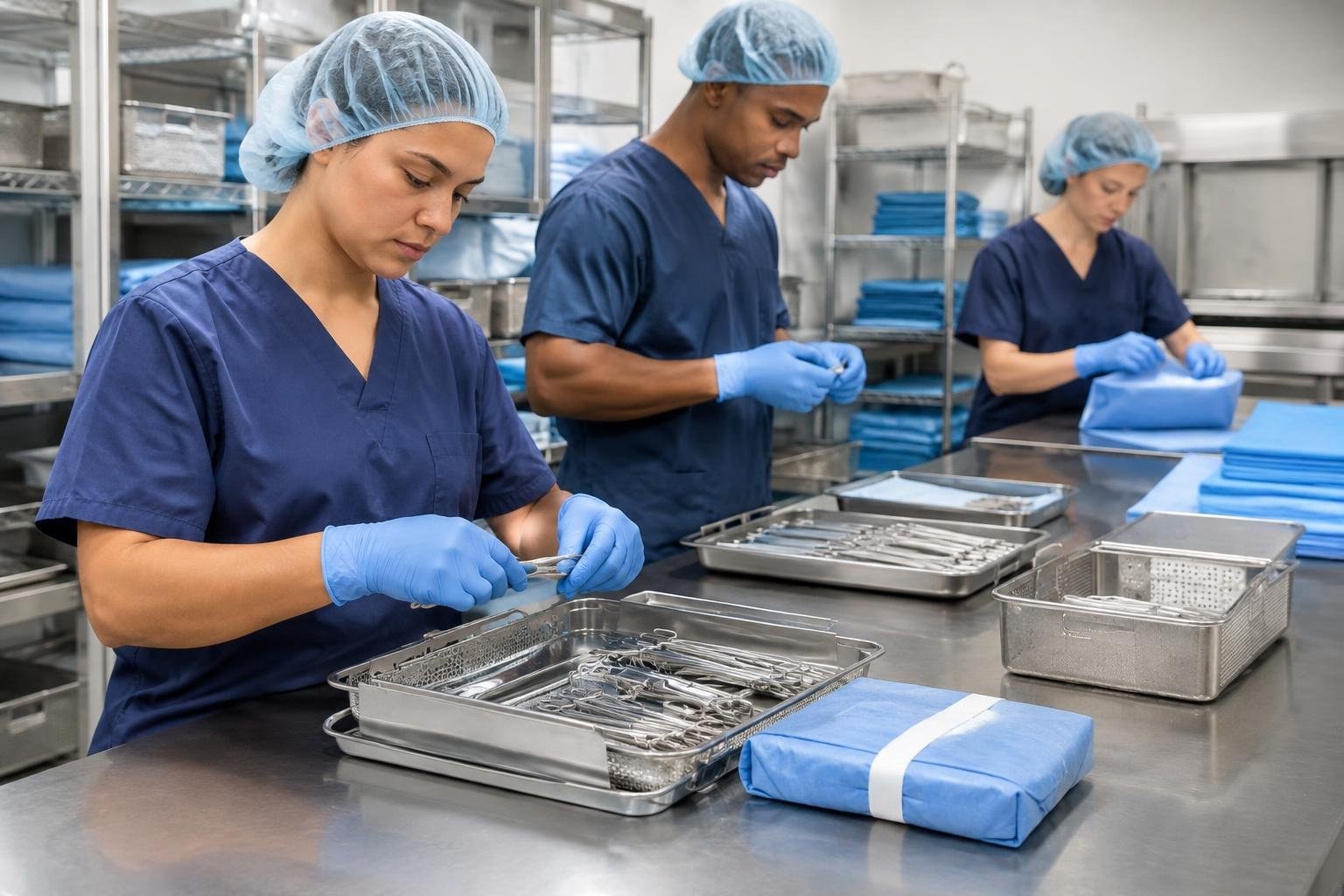
Sterile processing students practicing instrument handling and packaging
What Is Sterile Processing Technology?
Sterile processing technology, sometimes called central sterile processing or central supply processing, is the study of preparing instruments, equipment and supplies for use in surgical and other medical settings. The work includes more than running sterilization equipment: students learn how to handle used items, follow decontamination procedures, inspect and assemble instruments, package sets, document processing and distribute supplies.
The federal Classification of Instructional Programs code supplied for this field is 51.1012. A field code describes an area of study, not a promise that every credential level listed in a database is offered by a particular school. College pages show that program titles and awards can differ: examples include a certificate and a technical diploma.
This is a distinct path from surgical technology. Sterile processing centers on preparing instruments and supplies; surgical technology is a separate education and job pathway. Anoka Technical College identifies its sterile processing certificate as a prerequisite to its Surgical Technology Associate in Applied Science program, but that is an institution-specific pathway, not a universal rule.
What You Learn in a Sterile Processing Program
Course plans vary, but a student should expect instruction in infection control, microbiology, decontamination, sterilization and surgical instrumentation. These topics explain how contaminated items are handled, how instruments are prepared for reuse, and how careful processing supports the clinicians who need equipment for patient care.
Programs may teach students to identify instruments, inspect their condition, assemble sets, package items, operate or understand sterilization processes, and maintain records. Distribution is part of the field too: equipment and supplies must be made accessible to doctors, nurses and other health professionals when needed.
Ask for the course sequence, not just a short program summary. Find out what happens in a skills lab, how much instrument practice is included, and whether the course includes workplace experience. One program source specifically describes hands-on training alongside classroom instruction, but practical arrangements should be confirmed with each college.
Useful preparation before applying includes refreshing basic biology, practicing careful reading of procedures and asking to observe or learn about sterile processing work, if a local facility permits it. These steps can help you test your interest before committing to tuition.
Who This Program Suits and How to Check Entry Requirements
This field may suit students who like practical tasks with clear steps and understand why consistency matters. Much of the work depends on careful handling, attention to detail, following established procedures and keeping accurate records. Students should be ready to learn technical terms for instruments and equipment and to apply infection-control practices reliably.
The work is not usually a substitute for direct patient-care roles. Sterile processing staff support the clinical team by preparing equipment and supplies. Consider whether you would find satisfaction in behind-the-scenes work where accuracy and reliable routines matter, even when the contribution is not always visible to patients.
Admissions and entry requirements
There is no single national admissions checklist established by the available program descriptions. Review each school’s current requirements for application steps, education prerequisites, placement or testing, health documentation, background checks and any conditions for entering a lab or workplace setting. Ask which requirements apply to admission and which are needed later for practical training or employment.
Parents and students can make a useful first comparison by asking an admissions adviser to explain the award, schedule, prerequisites and any additional costs in writing. Do not assume that a requirement at one college applies to all sterile processing programs.
Credential Options, Program Length and Online Study
Program length depends on the credential, course load, schedule and institution. Wisconsin Technical College System and Chippewa Valley Technical College describe sterile processing technical diploma options that take less than one year. Waukesha County Technical College lists a six-credit technical diploma. These are examples, not a national standard or a guarantee that a student can finish on a particular schedule.
Some programs may have practical or hands-on components that affect where and when students attend. Ask whether courses run in a fixed sequence, whether part-time enrollment is possible, and how repeating a course or missing a lab affects the completion date. Also ask if the college accepts transfer credit; do not assume previous coursework will apply.
Online availability is institution-specific. Even where lectures or other materials are online, the field’s focus on handling and processing equipment makes it important to confirm the format of skills practice. Ask the school exactly which activities take place online, in a campus lab or at a healthcare facility.
Tuition, Costs and Financial Aid
There is no single tuition figure that applies to sterile processing training. The total varies by college and can include tuition, fees, books, supplies, uniforms, transportation and costs tied to practical training. Compare the full estimated program cost and confirm whether charges are assessed per credit, course or term.
Ask financial aid staff whether the specific credential is eligible for federal or state aid, and whether the college offers scholarships, payment plans or employer tuition assistance. Eligibility depends on the school, program and student circumstances; do not assume every short certificate qualifies for the same aid as a longer degree.
To keep costs manageable, compare public and private institutions, ask about transfer or prior-learning policies where relevant, and check whether required supplies are included in the estimate. A lower advertised tuition may not represent the full cost if fees, equipment, travel or other required expenses are separate.
Build a written cost comparison
Request the total estimated cost to complete, including required fees and supplies.
Ask what happens to tuition and aid if your schedule changes.
Compare aid offers using the amount you would need to pay or borrow, not only the listed award.
Confirm that the program award and course credits fit your next education or employment goal.
Sterile Processing Careers, Jobs and Employment Questions
Sterile processing program pages describe preparation for work in hospitals and other medical facilities. The clearest directly related occupation is medical equipment preparer, a role category that includes preparing medical equipment and supplies. Some students may use sterile processing education as a step toward additional training, but the next credential and job requirements depend on the institution and employer.
The supplied college descriptions do not provide a current, comparable national median wage or employment-growth estimate for this specific pathway. Avoid treating a school’s program description as a salary promise. To evaluate local prospects, compare current job postings for the exact role titles used by nearby hospitals and medical facilities, including required education, certification, shifts and experience. Use current official labor-market data when available and note its year and geographic coverage.
Job titles and duties vary by employer. Ask local facilities what they require for entry-level sterile processing positions and whether they hire new graduates. Some roles may emphasize decontamination, instrument assembly, sterilization, distribution or record-keeping; a program’s curriculum should connect clearly to the tasks listed in local postings.
Technology can support tracking and documentation, but it does not remove the need for people to follow handling procedures and check equipment carefully. Focus on building sound technical habits and the ability to use the systems taught by your program or employer.
Accreditation, Certification and Employer Requirements
Look for a clear explanation of how the program teaches infection control, decontamination, sterilization, instrument processing and documentation. Review the credential awarded, course schedule and hands-on arrangements. If a school advertises accreditation, verify the accreditor and the program or institution status directly with the accrediting organization. The available program descriptions do not establish a single specialized accreditation requirement for all sterile processing technician programs.
Program completion and professional certification are separate. Methodist College describes the CRCST as an entry-level professional credential and points students to the Healthcare Sterile Processing Association for certification information. Another school says its graduates can take the central sterile processing exam offered by HSPA. Those descriptions do not establish that every program graduate is automatically eligible. Verify current exam eligibility, application steps, fees and any experience requirements with HSPA before enrolling.
Do not assume that a certificate alone satisfies every employer’s preference or requirement. Search local job postings and contact employers to learn whether certification is required, preferred or not specified for the positions you want.
Related Degrees and Alternatives to Compare
Compare a sterile processing certificate or technical diploma with related healthcare pathways by looking at daily work, education time and the next step each program supports. Surgical technology is a relevant comparison: it has a different occupational focus, and Anoka Technical College describes its sterile processing certificate as a prerequisite to its Surgical Technology AAS degree. Check that college’s current sequence and do not generalize it to other institutions.
Other alternatives may include medical assisting, nursing, medical laboratory training or broader health science study. Compare official curricula and employer requirements before switching paths.
Surgical technology: consider this if you want to explore a separate operating-room education path and are prepared to review its program-specific requirements.
Medical assisting: consider this if your interest is in a different type of healthcare support work rather than instrument processing.
Nursing: consider this if you want to investigate a patient-care profession with its own education and licensing pathway.
Medical laboratory training: consider this if laboratory work interests you more than preparing surgical instruments and supplies.
Health science: consider this if you want broader academic study and are willing to identify a specific career goal before choosing a program.
When comparing alternatives, do not select only by title. Compare required courses, hands-on practice, credential level, time to completion, cost and the actual jobs listed by employers in your area.
How to Choose a Sterile Processing Program
Choose a program by checking whether its details line up with your intended job, budget and schedule. A short program can be attractive, but a brief timeline is not enough to judge quality or fit. Review the following factors before paying a deposit:
Curriculum: Does it cover decontamination, infection control, sterilization, microbiology, instrumentation and documentation?
Practice: How much supervised hands-on work is included, and where does it take place?
Credential: What award will appear on your transcript, and how many credits does it include?
Certification preparation: What exam does the school discuss, and does it explain eligibility without implying automatic certification?
Cost: What is the full estimated cost, including required fees, materials and travel?
Schedule and format: Can you attend the labs or practical training while meeting work and family responsibilities?
Employment connection: Does the school explain the kinds of facilities and tasks for which it prepares students?
Transfer pathway: If you may continue studying, will the credits count toward a specific next program?
Use the college major decision guide to reflect on your interests and goals, and explore education options before narrowing your choices.
Questions to Ask Before Enrolling
Before enrolling, ask the college and, where possible, a local employer direct questions. Bring the answers together in one comparison sheet so a low price or short timeline does not outweigh an important difference in practical training or job fit.
What credential does the program award, and how many credits does it require?
What is the total estimated cost, including required books, supplies, fees and practical training?
Which admission and health-related requirements apply, and when must I meet them?
How much hands-on practice is included, and where does it occur?
Is any coursework online, and which parts must be completed in person?
Does the program explain certification exam eligibility and connect to the certifying organization?
What local employers hire graduates, and what do those employers currently require?
Can the credits transfer to a named program, such as an associate degree pathway?
What financial aid or scholarships may apply to this exact credential?
What career support is available, and how will I access it?
Discuss the plan as a family, but make sure the prospective student has a chance to evaluate the day-to-day tasks and decide whether the work feels suitable. A career assessment can be one reflection tool, alongside program research and conversations with schools and employers.
From Training to a Career: Possible Next Steps
A realistic education-to-work path might begin with a sterile processing certificate or technical diploma, followed by an entry-level role in a medical facility if the person meets the employer’s requirements. With experience, a worker may seek additional responsibilities or further training, but advancement is not automatic and titles vary by employer.
Another possible route is to use a certificate as a stepping stone to surgical technology when a college offers that connection. Anoka Technical College describes this kind of prerequisite relationship for its own Surgical Technology AAS degree. Students should confirm current admission, transfer and course-sequencing rules with that institution.
Before deciding, compare the role with your motivations and working preferences, not only its perceived stability or the length of the program. Assessment.com’s MAPP career assessment can help you explore career and degree options; use its results as a starting point, then verify education and hiring requirements with colleges and employers.
Frequently asked questions
What does a sterile processing technician program teach?
Sterile processing programs teach students to decontaminate, inspect, assemble, package and sterilize surgical instruments and medical equipment. They also cover infection prevention, microbiology, instrument identification, distribution and record-keeping. Program length and hands-on requirements vary by school, so review the curriculum and clinical or lab arrangements before applying.
How long does it take to become a sterile processing technician?
Some technical diploma and certificate options are designed for completion in less than a year, but that is not a universal timeline. For example, Wisconsin Technical College System and Chippewa Valley Technical College describe programs taking less than one year; Waukesha County Technical College lists a six-credit technical diploma. Confirm current length and credit requirements directly with each institution.
What are the requirements for sterile processing technician training?
No single entrance rule applies to every program. Check each institution’s admissions page for education prerequisites, placement requirements, background checks, health documentation, immunizations, or other conditions. Ask whether those requirements apply before enrollment, before hands-on training, or before employment, since school and employer policies can differ.
Can you study sterile processing online?
Some coursework may be available online, but sterile processing involves practical instrument handling and equipment procedures. Ask the school whether lab practice or workplace training is required in person, where it takes place, and whether the program arranges access. Do not assume an online-only course provides the same hands-on preparation as a program with practical training.
Do sterile processing technicians need certification?
Certification is separate from completing a school program. One college source says its graduates may take the central sterile processing exam offered by the Healthcare Sterile Processing Association. Confirm current eligibility, exam requirements, fees and any work-experience conditions with the certifying organization before relying on a program’s certification claims.
What jobs can you get with a sterile processing certificate?
Sterile processing technicians may work in a hospital or other medical facility, handling instruments, equipment and supplies used in patient care and surgery. A particular program may also connect to further education: Anoka Technical College describes its sterile processing certificate as a prerequisite to its Surgical Technology Associate in Applied Science degree. Requirements vary by institution and role.
How much does a sterile processing technician make?
The supplied college program descriptions do not establish a current national median wage or employment-growth figure for sterile processing technicians. Earnings and hiring conditions can vary by location, employer, shift and experience. Compare current job postings in the area where you plan to work, and check official labor-market information before making a financial decision.
What is the difference between sterile processing and surgical technology?
Compare a sterile processing program with surgical technology by examining the work each prepares you to do. Sterile processing focuses on cleaning, inspecting, assembling, sterilizing and distributing instruments and supplies. Surgical technology training is a separate pathway; one college identifies sterile processing as a prerequisite to its surgical technology associate degree. Review both curricula and local employer requirements.
People Also Ask
What classes do sterile processing technicians take?
Sterile processing programs teach decontamination, infection control, microbiology, instrument identification, sterilization, packaging, distribution and record-keeping. Some include hands-on practice, but the exact course and lab mix depends on the institution.
What does a sterile processing technician do?
A sterile processing technician prepares instruments, equipment and supplies for use in medical and surgical facilities. Typical training focuses on safe processing steps, quality checks, infection prevention and accurate records.
Can you finish sterile processing training in less than a year?
Some schools describe programs lasting less than a year, while others publish a specific credit total rather than a single completion time. Compare the published course sequence, schedule and practical-training requirements with your own availability.
Is a sterile processing certificate enough to get a job?
A certificate or technical diploma may be a direct entry route, but it does not guarantee employment or certification. Check local job postings and ask each school what its program prepares students to do and which exam eligibility, if any, it supports.
Is sterile processing a good career for detail-oriented people?
Sterile processing work is suited to people who are comfortable with detailed, repetitive procedures, careful handling and following established instructions. Students should learn what the work environment is like and consider whether those tasks fit their preferences.
How much does sterile processing technician training cost?
Program tuition depends on the institution, location, enrollment status, credit requirements, fees and required equipment or supplies. Ask for an itemized estimate for the full program, not only a per-credit or headline tuition figure.
Does sterile processing training require hands-on practice?
Some programs include hands-on training, and sterile processing skills involve instruments and equipment. Ask whether practical work is required, where it takes place, and whether any online course components must be paired with in-person practice.
Sterile processing technology can be a practical route into an essential healthcare support role for students who value careful, hands-on work and understand the importance of following procedures. Before enrolling, compare program content, total cost, in-person training, certification preparation and local job requirements. The credential is only one part of the decision: consider whether the day-to-day work and the education pathway fit your goals.
Find out which Career or College Major is right for you!
We use cookies to offer you a better browsing experience, analyze site traffic and personalize content.
Read about how we use cookies and how you can control them in our
Privacy Policy.
If you continue to use this site, you consent to our use of cookies.
×
Exciting News!
Be one of the first to Beta Test the new AI-Powered Assessment.com Platform.