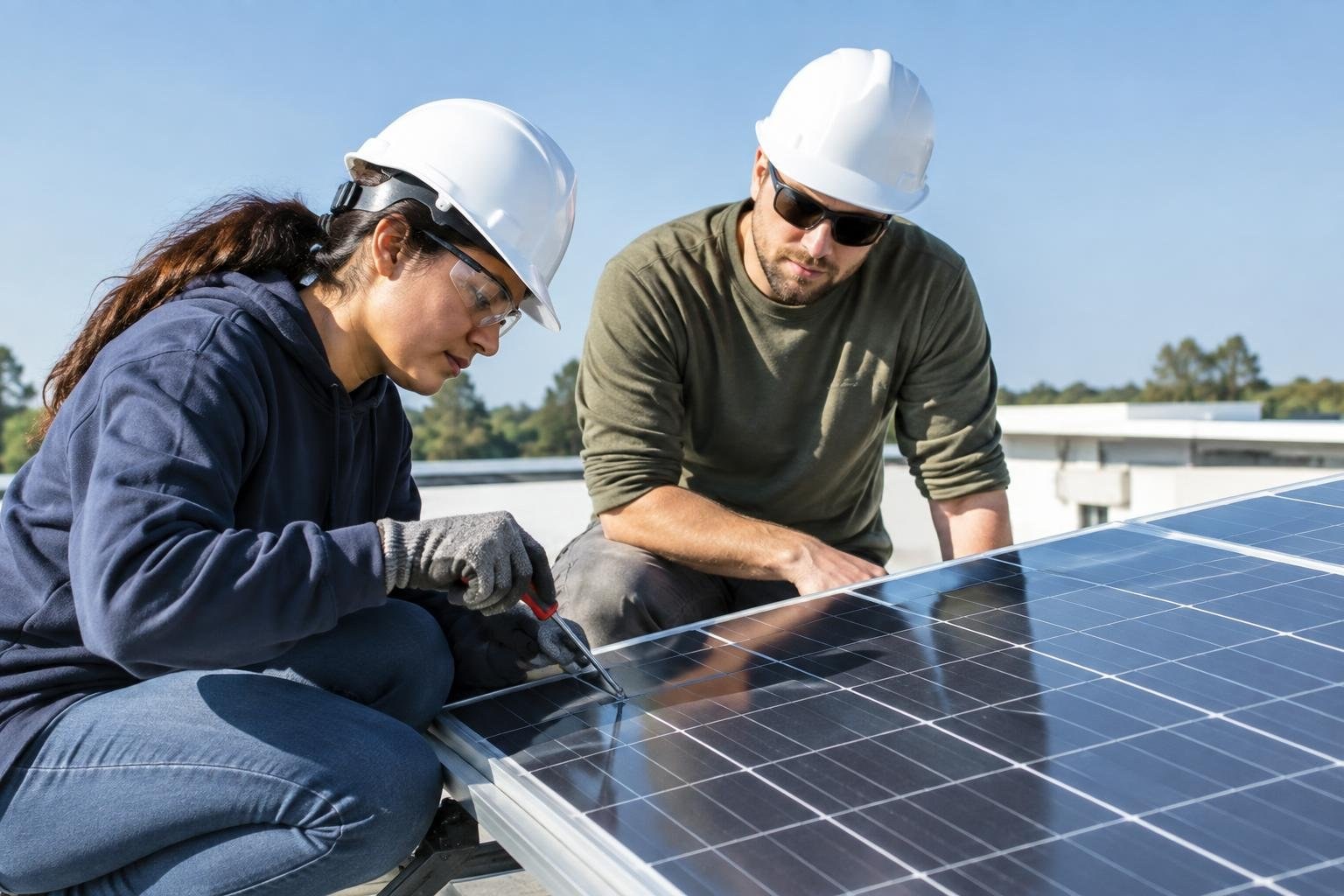
Solar Energy Technology Degree Guide: Courses, Careers and Program Fit
Learn what solar energy technology programs teach, how certificates and degrees differ, which careers they may support, and how to compare cost, training, and fit.
By David Slack · Staff Writer Assessment.com · Published October 7, 2026 · Last updated November 5, 2026
Solar energy technology programs prepare students to work with equipment and systems used to capture, convert, and apply solar power. Depending on the school and credential, students may study electrical circuits, electronic devices, system troubleshooting, photovoltaic applications, or solar thermal systems. Programs range from focused training and certificates to associate degrees, while engineering-oriented work can call for a bachelor’s degree. These programs may suit students who want applied technical learning and are curious about energy systems. They are not all interchangeable: course depth, hands-on experience, credential level, and career preparation vary. Compare the actual curriculum with the requirements of jobs you may pursue, and consider how the program fits your interests, budget, and plans.
Degree & Program Decision Insights
Explore your personal fit, education requirements, career potential and next steps.
01Motivational Fit
Discover whether this program fits you
Explore your preferences against the focus of Solar Energy Technology/Technician. These prompts are not personal MAPP results.
Subject curiosity. Would you choose to explore “solar energy principles” in depth? Ask for a sample learning activity to test that interest.
Breadth of interest. Consider the place of “energy storage and transfer technologies” in this field. Is this another part you would choose to explore, or mainly a requirement you would tolerate?
Work reality. Related work can involve this task: “Apply weather sealing to array, building, or support mechanisms.” Would you want that activity to be a regular responsibility?
Interest in studying a field can differ from enjoying its related work.
Which part would you want to do repeatedly, and what would you try before deciding?
Discover Your Personal Program Fit
Before investing your time and money in your education, discover how this program aligns with your natural motivations, work preferences and career goals.
Explore these official instructional-field associations. They describe possible occupational routes, not measured outcomes of this program.
Solar Photovoltaic InstallersSOC 47-2231 · O*NET 47-2231.00$53,140/year median (May 2025); +36.5% projected change (2025–2035); 4,200 projected openings/year.
Typical occupational entry: high school diploma or equivalent (BLS). BLS lists moderate-term on-the-job training as typical occupational training.
Engineering Technologists and Technicians, Except Drafters, All OtherSOC 17-3029
The official crosswalk associates this instructional field with the broad Engineering Technologists and Technicians, Except Drafters, All Other group. It does not establish a particular detailed specialty or a direct programme-to-job outcome.
U.S. SOC 17-3029 Engineering Technologists and Technicians, Except Drafters, All Other is a broad occupational group. Its statistics are not estimates for a particular specialty, starting role or this programme’s graduates.
U.S. occupational wages are not guaranteed graduate earnings; OEWS excludes self-employed workers.
Projected openings include replacements as well as growth.
U.S. national estimates. A crosswalk does not establish entry-level eligibility; advanced, management and teaching roles can require further qualifications.
Explore your motivations. Use MAPP as a starting point for reflecting on your interest in “solar energy principles”, then test that interest against a sample learning task.
Examine the work. Compare Solar Photovoltaic Installers and Engineering Technologists and Technicians, Except Drafters, All Other on daily work and entry qualifications, as well as pay. Explore Solar Photovoltaic Installers.
Compare actual providers. Ask for the exact credential, course sequence and assessment methods. Compare how each provider teaches “energy storage and transfer technologies”, its entry criteria and its itemized costs.
Check the evidence before applying. Confirm prerequisites and any recognition or professional requirements for your intended route; ask for applicable rules and published outcome definitions in writing.
Verify the institution’s current offering, admissions requirements and outcomes; a search result does not establish your eligibility.
A solar energy technology program is a course of study focused on the technical application of solar power. It can prepare students to understand equipment, electrical and electronic components, system operation, troubleshooting, or installation-related work. The exact meaning of the program name varies: a school may place solar study within engineering technology, renewable energy, electronics, or a related department.
Credential options also vary. Program examples include postsecondary certificate training and associate-level engineering technology study with a renewable energy or solar specialization. Solar energy systems engineering is a different educational direction: the U.S. Green Building Council’s career information describes a bachelor’s degree and coursework in engineering and technology, physics, mathematics, building and construction, and design for that occupation.
Read the catalog rather than relying on the program title. Two offerings with similar names can differ in credential, technical depth, and emphasis. Ask whether the program centers on photovoltaic systems, solar thermal applications, electronics, installation, design, or a broader energy curriculum.
Courses and Practical Learning
What Do You Study?
Solar coursework can connect electrical fundamentals with the equipment and methods used in energy applications. One associate-level electronics engineering technology solar specialization lists AC and DC circuits, electronic devices, an introduction to photonics, troubleshooting and repair techniques, programmable logic controllers, and solar thermal systems. These subjects help students understand how components behave, how systems are controlled, and how to approach faults methodically.
Some programs place solar topics inside a wider engineering technology curriculum. That can mean studying general technical principles before applying them to renewable energy and sustainable power. Other pathways focus on advanced design applications: a power-and-energy graduate certificate, for example, is described as intended for practicing mechanical engineers and focused on design.
Expect variation in the amount of lab, equipment, project, or field learning. Do not assume a course title means students will install or service full systems. Ask for course descriptions, lab schedules, equipment lists, and examples of projects. If hands-on preparation matters to your goals, find out how much time students spend practicing measurement, component identification, troubleshooting, and system-related tasks.
Skills Solar Students Can Build
Skills You May Develop
Because curricula differ, the skills you gain depend on the credential and course plan. The cited associate specialization includes circuit and electronics study, troubleshooting and repair, programmable logic controllers, photonics, and solar thermal topics. These areas can build a foundation for reading technical information, understanding system components, and approaching equipment problems in a structured way.
Technical understanding: Familiarity with electrical and electronic concepts, solar applications, and controls.
Problem solving: Practice identifying possible causes of equipment or system issues and following a troubleshooting process.
Careful work habits: Technical tasks call for attention to procedures and detail; one solar career source also identifies good eyesight and attention to detail as relevant considerations.
Communication: Technical workers may need to explain system issues or work with customers and colleagues. Check whether your program includes team projects or communication coursework.
Ask prospective programs how they assess these capabilities. A course list alone may not tell you whether students demonstrate skills through labs, practical assessments, or projects.
Who Should Consider Solar Energy Technology?
Who Is This Program Best For?
Solar energy technology may appeal to students who like understanding how equipment works and prefer applied problems to studying concepts only in the abstract. It can also interest students who want to explore energy applications through electrical, electronic, or mechanical systems. You do not need to arrive with a fixed career plan, but it helps to be willing to learn technical vocabulary and work carefully with detailed instructions.
Think about the type of work you want. Would you rather troubleshoot equipment, work with system components, support installation and maintenance, or study design and engineering? These preferences can point toward different credentials. A technical certificate or associate program may be a better starting point for some technician-oriented goals; engineering systems work may involve a bachelor’s degree and a more extensive math and science foundation.
Does solar energy technology match you? Salary, job growth, and the appeal of the energy sector are only part of a decision. Consider your interests, preferred work style, and comfort with technical coursework. Assessment.com’s MAPP Assessment, Degree Matching, and Career Matching can be used as reflection tools alongside program research; they do not replace review of course requirements or job qualifications.
Admissions, Credential Levels, and Completion Time
Admissions, Credential Levels, and Time to Completion
Entry requirements are set by each institution. Before applying, check required prior education, placement or prerequisite coursework, application materials, transfer-credit rules, and whether a technical background is expected. The supplied program examples do not establish a universal GPA, test, or admissions standard for solar technology programs, so use the school’s current admissions page as the authority.
Credential level affects both what you study and how much education you undertake. The examples available include postsecondary certificate training, associate-level engineering technology, a bachelor’s-level pathway for solar energy systems engineering, and a graduate certificate in power and energy intended for practicing mechanical engineers. These are not interchangeable awards.
Completion time depends on the credential, credit requirements, course schedule, and enrollment pace. One associate program example identifies 68 credits. Another describes a minimum schedule based on year-round, full-time enrollment in 15 to 17 credits per semester, excluding breaks. Those are school-specific examples, not a standard duration. Request a degree map showing required courses, likely course sequencing, and the effect of part-time study or transfer credits.
How Difficult Is Solar Energy Technology?
Program Difficulty and Preparation
Difficulty is personal and program-specific. Coursework that covers circuits, electronic devices, controls, and troubleshooting may feel demanding if you have not studied technical subjects before. Engineering-oriented paths may require more preparation in mathematics and physics. A student who enjoys learning through diagrams, measurements, and practical problems may find the applied format engaging, but interest alone does not remove the need to practice.
Before starting, review any math or science prerequisites and ask about placement support, tutoring, and introductory courses. Refreshing foundational math can make technical coursework more manageable. If the program includes labs, find out what safety orientation and attendance expectations apply. Speak with an adviser about how students with different academic backgrounds enter the program.
A common mistake is choosing a program based on a promising name without checking its actual technical depth. Another is assuming that an associate degree automatically qualifies someone for engineering positions. Compare credentials with job listings and ask the department to explain which roles graduates are prepared to pursue and what additional study or experience may be needed.
Can You Study Solar Energy Technology Online?
Online, Hybrid, and On-Campus Study
Delivery formats depend on the college and the specific program. Online coursework can be convenient for students balancing school with work or family responsibilities, but a technology program may also involve practical instruction that is difficult to evaluate from a course title alone. Ask whether labs use campus equipment, remote demonstrations, projects, or another format, and whether any components require travel or scheduled attendance.
Do not treat an online label as proof that the learning experience is fully remote. Get a written explanation of required in-person activities, equipment access, technology needs, and the way practical skills are assessed. If a program advertises a specialization in solar or renewable energy, confirm how much required coursework is actually devoted to that subject rather than general engineering technology.
For a parent or student comparing schools, the useful question is not simply “Is it online?” It is whether the format supports the skills and credential needed for the intended next step, and whether the schedule is realistic alongside other obligations.
Cost and Financial Aid
Tuition, Total Cost, and Financial Aid
There is no single national price for a solar energy technology program in the research available here. Ask each institution for a personalized estimate that separates tuition from mandatory fees, books, supplies, equipment, and any travel or course-related expenses. Costs can differ by institution, residency classification, credential, and delivery format; verify which items apply to your circumstances instead of comparing tuition alone.
Request the total expected cost to completion, not just the first term’s bill. Ask how transfer credits affect the price and schedule, whether course materials are included, and whether repeating or delaying a required course could add expense. Compare the estimated amount you would pay after grants, scholarships, and other aid with the amount you may need to borrow.
Contact the school’s financial aid office about current federal and institutional aid eligibility, scholarship deadlines, payment plans, and employer tuition assistance if relevant. Confirm aid terms directly before committing. A lower advertised tuition figure is not necessarily the lower-cost choice if it excludes required fees or does not account for the courses you need to finish.
Careers and Job Outlook
Find out which Career or College Major is right for you!
Solar-related education may connect to technician and energy-system pathways, but completing a program does not guarantee a particular job. Roles and qualifications depend on the employer and the work involved. The sources describe solar technicians, installation-related certification, pathways in technical sales, design, installation and maintenance, and solar energy systems engineering.
Possible direction
Education or preparation to investigate
How study may connect
Solar energy technician
Relevant technical coursework; employers set requirements
Solar and electronics study may support understanding of equipment and system operation.
Photovoltaic installation work
Job-specific training and any applicable credential requirements
Solar-focused training may relate to installation tasks; confirm practical preparation.
Photovoltaic maintenance or service work
Technical preparation and employer-specific experience
Troubleshooting and repair coursework may be relevant.
Solar technical sales
Product knowledge and requirements listed by employers
Solar-system familiarity may support communicating technical product information.
Solar design support
Check role-specific design skills and credentials
Design-oriented study may be relevant, but course depth varies.
Solar energy systems engineer
Bachelor’s degree and engineering-related coursework are identified for this career
A technician credential alone should not be assumed to meet the educational expectation.
Power and energy design specialization
Further study may be relevant for practicing engineers
A graduate certificate example focuses on design applications in power and energy.
Renewable energy support roles
Review each position’s listed education and experience
Solar training may provide relevant technical grounding for energy-sector work.
The sources provided do not establish current pay figures or an employment-growth rate for these specific roles. For salary and outlook, look up the precise occupation and location in current U.S. Bureau of Labor Statistics or state workforce data, then compare those requirements with the program. Industry change, including automation and newer equipment, makes continued learning useful, but it does not eliminate the need to verify what employers currently seek.
Experience, Certification, and Licensure
Certifications, Licensure, and Experience
A college credential and an industry certification are different things. The solar career information identifies the PV Installation Professional certification and PV Associate credential, as well as other credentials focused on areas such as technical sales, design, installation, and maintenance. Credential names and eligibility rules can change, so check current details with the issuing organization before planning around a certification.
Do not assume that a certification is required for every job or that earning one replaces a degree, work experience, or any applicable license. Requirements depend on the work, employer, and jurisdiction. The supplied source on solar careers also describes some trade-related pathways as involving an associate degree, solar training, licensure or certification, and several years of skilled-trade experience. Treat that as an example to verify, not a universal rule.
How to Stand Out to Employers
Look for chances to demonstrate technical learning through class projects, supervised practical work, research, or relevant employment. Keep a clear record of the equipment, systems, and troubleshooting tasks you have studied. Ask program staff about employer connections and internships, and ask local employers which credentials they actually recognize. The U.S. Department of Energy also describes workforce training support intended to help people enter the solar workforce or adapt to changes affecting their work.
Graduate School and Further Study
Graduate Study and Other Education Pathways
Further education makes sense when it connects to a specific role or builds on prior technical experience. A graduate certificate in power and energy is described as serving practicing mechanical engineers and focusing on design applications. It is not presented as a general entry-level substitute for technician training.
Students interested in solar energy systems engineering should investigate bachelor’s-level engineering preparation. Those considering a technical career may instead compare a focused certificate with an associate degree in engineering technology. A solar specialization within electronics or renewable energy can give a broader foundation, while a more advanced design program may suit someone who already has relevant education.
Before pursuing another credential, review job postings and speak with program advisers or employers. Identify the actual gap: Is it a degree requirement, a particular technical skill, practical experience, or an industry certification? Choose additional study to address that gap rather than collecting credentials without a clear purpose.
Related Degrees and Career Alternatives
Related Degrees and Alternatives
Solar energy technology overlaps with several fields, but each can emphasize different work. Compare course plans and target job qualifications before choosing.
Electronics engineering technology: Consider this if you want a broader electronics foundation with the option of a solar specialization. An example curriculum includes circuits, electronic devices, photonics, troubleshooting, controls, and solar thermal study.
Renewable energy and sustainable power engineering technology: Consider this if you want solar or other renewable energy topics within a wider engineering technology program.
Electrical engineering: Consider investigating this route if your goal is an engineering role and you want an engineering-focused degree; verify the specific education required by employers.
Solar energy systems engineering: Consider this if you want to pursue engineering work involving system design and are prepared for bachelor’s-level engineering, mathematics, and science study.
Power and energy graduate study: Consider this if you already have relevant engineering preparation and want advanced design-focused study.
Solar installation or trade training: Consider this if your goal is hands-on installation work and local employers identify trade training or specific field experience as relevant.
These options are not interchangeable, and the names alone do not establish transferability or professional eligibility. Ask each school how courses apply to other credentials and confirm any requirements with employers or relevant credentialing bodies.
Choosing a College Program
How to Choose a Solar Energy Technology Program
Compare programs against the kind of work you want, not only the school’s general reputation or the word “solar” in its title. Use this checklist when reviewing options:
Accreditation: Verify institutional accreditation in official education records, and ask whether the specific program has a separate accreditation relevant to your plans.
Curriculum: Check required courses, solar content, technical depth, and whether the program focuses on photovoltaic systems, solar thermal, electronics, or broader renewable energy.
Practical learning: Ask what equipment students use, how troubleshooting is taught, and whether internships or supervised experience are available.
Credential and transfer: Confirm the award, credits, transfer policies, and whether coursework counts toward a later degree.
Format and schedule: Verify in-person requirements, course availability, online technology needs, and realistic completion pace.
Cost and aid: Obtain a written estimate of total cost and review aid conditions, fees, supplies, and likely time to completion.
Career preparation: Ask for examples of target roles, employer relationships, career services, and certification preparation. Compare those answers with real job postings.
Check any claim about licensing or certification with the relevant organization or jurisdiction. Assessment.com’s education and career matching tools can help you reflect on fit, but school and credential requirements should be confirmed directly.
Advantages, Drawbacks, and Value
Is a Solar Energy Technology Program Worth It?
The value depends on the relationship between cost, credential, career target, and the practical preparation a program provides. A focused certificate may be a better match for someone seeking specific training, while an associate program can include a broader technical curriculum. A bachelor’s-level engineering pathway may be more appropriate for students targeting solar energy systems engineering. None of those choices is automatically the best value for every student.
Before enrolling, compare the program’s total cost with the qualifications employers request for your intended work. Ask what happens if you later want to transfer or continue studying. Consider location and schedule, too: a program may be academically relevant but impractical if its hands-on components or course sequence do not fit your circumstances.
Balance expected opportunity with personal fit. If you enjoy technical problem solving and the curriculum’s subjects interest you, that matters alongside cost and employment information. If you are unsure, talk with an adviser, review job postings, and use career-matching resources to explore related paths before making a financial commitment.
Possible Routes from Education to Work
From Degree to Career: Possible Pathways
Career progress is not automatic, and individuals take different routes. These examples show possible connections between education and work, not guaranteed outcomes:
Solar-focused associate study → technician-oriented entry role → practical experience → focused photovoltaic credential or specialization. Match each step to employer requirements and certification eligibility.
Electronics engineering technology with solar coursework → equipment troubleshooting or service-related work → deeper experience with a system or component area. Check the role’s actual education and field-experience expectations.
Bachelor’s-level engineering preparation → solar energy systems engineering role → continued design or power-and-energy development. Confirm that the degree and coursework meet the qualifications requested for your intended position.
Programs can also serve people already working in related fields. The Department of Energy describes workforce training efforts for people entering solar work and workers whose jobs are affected by solar energy. Ask whether training is designed for new students, working technicians, or professionals seeking a specialization.
Questions to Ask Before You Enroll
Questions to Ask Before Enrolling
What exact credential will I earn, and what courses are required?
How many credits must I complete, and which credits may transfer?
What is the estimated total cost, including fees, materials, and equipment?
Which grants, scholarships, payment options, or employer benefits could apply?
How much solar-specific and hands-on learning is included?
Are labs, internships, or other practical experiences available or required?
What are the online, hybrid, or campus attendance requirements?
What accreditation applies to the college and, if relevant, the program?
Does the program prepare students for a credential, and what are its separate eligibility requirements?
Which jobs do graduates pursue, and what do local employers require for those jobs?
What career services and employer connections can students use?
Ask for answers in writing where possible. Then compare the program plan with job postings and confirm certification or licensing rules with the organization responsible for them. A careful comparison can reveal whether a program is a practical next step or whether another credential better fits your intended work.
Frequently asked questions
Is solar energy technology hard to study?
Solar energy technology programs can be challenging because they combine technical coursework with practical equipment and troubleshooting skills. The difficulty depends on the program and your preparation. Some programs include electrical topics such as AC and DC circuits, electronic devices, programmable logic controllers, and solar thermal systems. Comfort with math, careful measurement, and hands-on problem solving can help, but ask each school about prerequisites and tutoring before deciding.
Is a solar energy technology degree worth it?
It may be worthwhile if the curriculum gives you relevant technical skills and practical experience at a cost that makes sense for your goals. Compare the credential, course list, equipment access, employer connections, and job requirements for the roles you want. Because job titles, pay, and hiring needs differ, research local postings and current labor-market data rather than assuming a particular program guarantees a job or salary.
What jobs can I get with a solar energy technology degree?
Depending on training and employer requirements, related roles may include solar technician, installation or maintenance technician, or work supporting solar design and technical sales. A bachelor’s degree may be relevant for solar energy systems engineering. Program completion alone does not establish that you meet every employer, certification, or licensing requirement, so check the qualifications listed for specific jobs in your area.
How much can I make with a solar energy technology degree?
Earnings depend on the occupation, location, experience, employer, and credential. The supplied program information does not establish a single salary for graduates, and a degree does not guarantee a particular wage. For a useful estimate, identify the exact job title you are targeting and check current U.S. Bureau of Labor Statistics or state labor-market data for that occupation and geographic area.
Can I earn a solar energy technology degree online?
Some engineering technology coursework may be available online, but a program’s format and hands-on requirements are school-specific. Solar training can include equipment, troubleshooting, and installation-related learning, so ask how online students complete practical work and whether they must attend labs or other in-person activities. Verify that the format supports your intended career and any relevant employer or credential requirements.
Does solar energy technology require a lot of math?
The amount of math depends on the program and level. Solar engineering pathways can include mathematics and physics, while technician programs may emphasize applied technical work. One associate program, for example, lists courses in AC and DC circuits and electronic devices. Review the actual catalog and ask what math placement or prerequisite courses are expected before you enroll.
Do I need a bachelor’s or graduate degree to work in solar energy?
Not every solar technician role requires graduate study. The program examples include associate-level technical education and certificate training, while solar energy systems engineering is associated with a bachelor’s degree. Some professionals may pursue further study for specialized design or power-and-energy work. Start with job postings for your target role to determine which credential employers actually request.
What certifications can help solar technicians?
The North American Board of Certified Energy Practitioners offers credentials related to photovoltaic work, including the PV Installation Professional certification and PV Associate credential. Certification is separate from earning a college degree, and eligibility or experience requirements may apply. Confirm current requirements directly with the credentialing organization and check whether employers in your intended role value the certification.
People Also Ask
What do you learn in solar energy technology?
A solar energy technology program teaches technical concepts used in solar applications. Depending on the school, subjects may include circuits, electronic devices, troubleshooting, programmable logic controllers, photovoltaics, and solar thermal systems.
How long does a solar energy technology program take?
There is no single completion time for every solar program. A certificate, associate degree, and bachelor’s degree have different scopes, and schedules vary by institution and enrollment pace. Compare the published credit requirements, transfer-credit policies, and course availability rather than relying on a general estimate.
What is the difference between solar technology and solar engineering?
Solar energy technology focuses on practical systems and technical applications. Solar engineering pathways generally involve deeper engineering preparation; the supplied career information identifies a bachelor’s degree and coursework in engineering, technology, physics, mathematics, building and construction, and design for solar energy systems engineers.
Is a solar technician certificate the same as a college degree?
A diploma or degree does not automatically equal professional certification. Credentials such as the PV Installation Professional certification are separate qualifications. Check the credential provider’s current eligibility rules and the requirements for the job, employer, or jurisdiction you have in mind.
How should I choose a solar energy technology program?
Compare the courses with target job postings, verify the institution’s accreditation and transfer policies, ask how practical instruction is delivered, and calculate total cost after aid. Also check whether the program prepares students for a certification or credential that employers in your intended area recognize.
Can solar technician training be completed online?
Some schools offer online or hybrid learning, but availability and practical components are program-specific. Before enrolling, ask how students access equipment-based training and whether any labs, demonstrations, or other requirements must be completed in person.
Solar energy technology programs can offer a practical route into work involving solar equipment, system installation, troubleshooting, design support, and related energy applications. The right option depends on the credential you need, the hands-on training available, total cost, and the kinds of tasks you want to do. Compare specific course plans and job requirements before enrolling, and consider whether an associate-level technician pathway or a bachelor’s-level engineering route better matches your goals.
Want to see your options? Try our comprehensive Degree, Program & College Search tool
We use cookies to offer you a better browsing experience, analyze site traffic and personalize content.
Read about how we use cookies and how you can control them in our
Privacy Policy.
If you continue to use this site, you consent to our use of cookies.
×
Exciting News!
Be one of the first to Beta Test the new AI-Powered Assessment.com Platform.