Explore plasma and high-temperature physics programs, what students study, graduate research expectations, costs to compare, and potential career directions.
By Tome Fierre · Staff Writer Assessment.com · Published October 12, 2026 · Last updated November 5, 2026
Plasma and high-temperature physics is the study of matter under conditions where atoms or molecules become ionized and charged particles respond to electric and magnetic fields. Students learn physics theory, quantitative methods, experimental diagnostics, and research skills to investigate plasmas and other high-temperature systems. Programs can connect to fundamental physics, fusion research, applied science, and engineering. The available credential, courses, and research experience vary by school; the title alone does not tell you exactly what you will study. Prospective students and families should compare program requirements, faculty research, equipment access, funding, and likely next steps before committing.
Degree & Program Decision Insights
Explore your personal fit, education requirements, career potential and next steps.
01Motivational Fit
Discover whether this program fits you
Explore your preferences against the focus of Plasma and High-Temperature Physics. These prompts are not personal MAPP results.
Subject curiosity. Would you choose to explore “magnetohydrodynamics” in depth? Ask for a sample learning activity to test that interest.
Breadth of interest. Consider the place of “free electron phenomena” in this field. Is this another part you would choose to explore, or mainly a requirement you would tolerate?
Work reality. Related work can involve this task: “Write research proposals to receive funding.” Would you want that activity to be a regular responsibility?
Interest in studying a field can differ from enjoying its related work.
Which part would you want to do repeatedly, and what would you try before deciding?
Discover Your Personal Program Fit
Before investing your time and money in your education, discover how this program aligns with your natural motivations, work preferences and career goals.
Typical occupational entry: doctoral or professional degree (BLS). Postsecondary teaching is a separate appointment and may require advanced study; this programme alone is not a promise of a teaching post.
U.S. occupational wages are not guaranteed graduate earnings; OEWS excludes self-employed workers.
Projected openings include replacements as well as growth.
U.S. national estimates. A crosswalk does not establish entry-level eligibility; advanced, management and teaching roles can require further qualifications.
Explore your motivations. Use MAPP as a starting point for reflecting on your interest in “magnetohydrodynamics”, then test that interest against a sample learning task.
Examine the work. Compare Physicists and Physics Teachers, Postsecondary on daily work and entry qualifications, as well as pay. Explore Physicists.
Compare actual providers. Ask for the exact credential, course sequence and assessment methods. Compare how each provider teaches “free electron phenomena”, its entry criteria and its itemized costs.
Check the evidence before applying. Confirm prerequisites and any recognition or professional requirements for your intended route; ask for applicable rules and published outcome definitions in writing.
Verify the institution’s current offering, admissions requirements and outcomes; a search result does not establish your eligibility.
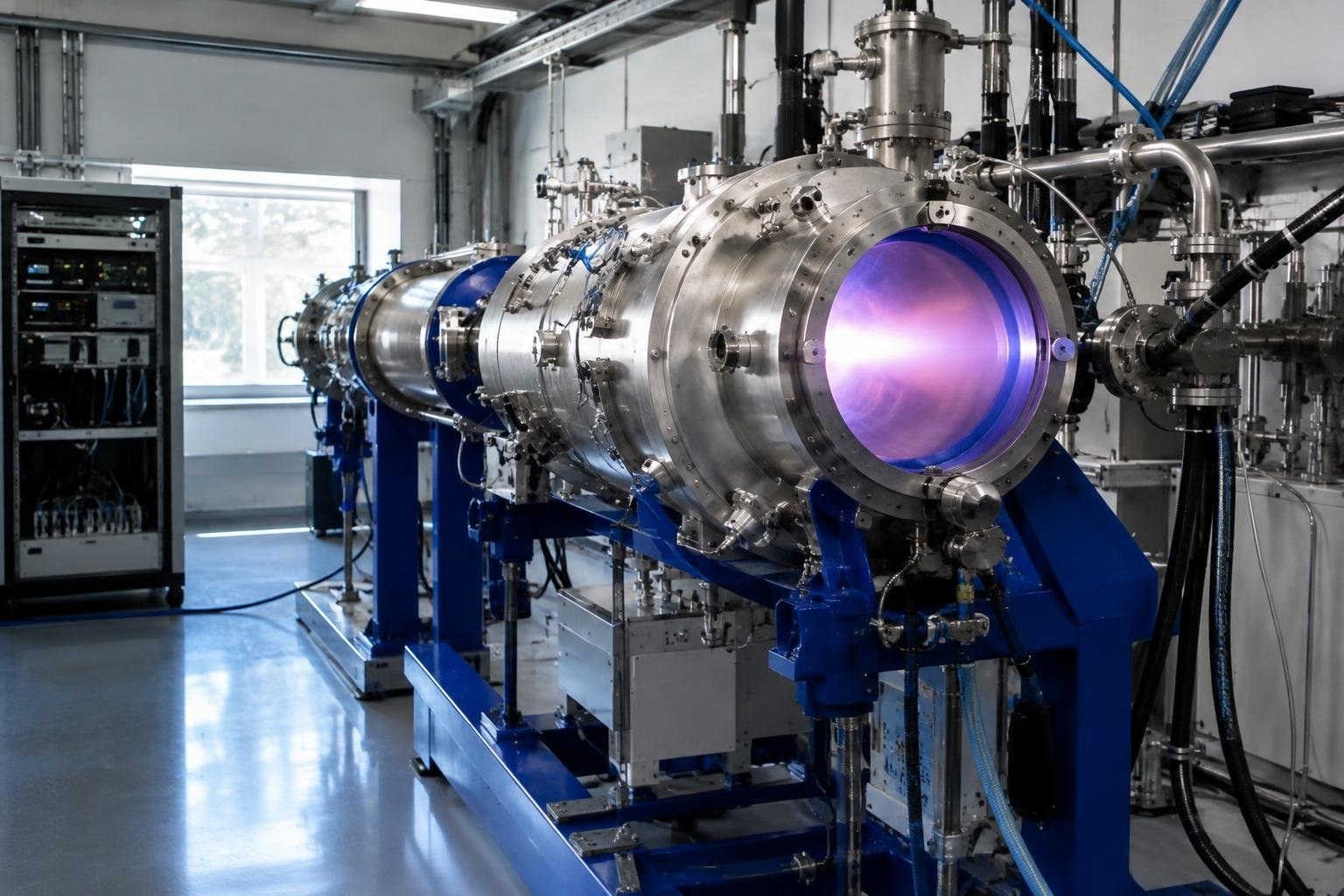
Conceptual plasma experiment showing a confined ionized gas and magnetic field lines
What Is a Plasma and High-Temperature Physics Program?
Plasma and high-temperature physics examines matter at temperatures and energy levels where atoms can lose electrons and form electrically charged particles. The field asks how those particles behave, how they interact with electromagnetic fields, and how scientists can measure and model these systems. The program description for this area includes magnetohydrodynamics, fusion theory, plasma waves, instability, shock phenomena, quantitative modeling, and research equipment operation.
Plasma physics is a specialty within the broader study of physics, but programs may be housed in physics, astrophysical sciences, or applied physics departments. For example, Princeton identifies its Program in Plasma Physics as a graduate program within its Department of Astrophysical Sciences. A related title does not guarantee an identical curriculum: inspect the research and required courses rather than relying on department labels.
The Classification of Instructional Programs code associated with this topic is 40.0805. This classification can help when searching catalogs, but it does not mean every school offers a degree at every credential level. A certificate, master’s, or doctorate will have different purposes and depth.
What Do Students Study? Courses, Diagnostics, and Research
Students may build from core physics and mathematics into specialized plasma theory, computational modeling, laboratory methods, and independent research. The exact sequence is determined by each department. The Princeton program describes a core course sequence used in preparation for its general examination, while also allowing students to take additional courses aligned with research interests.
Research training can include learning how to measure plasma properties and interpret experimental observations. Princeton’s course information names magnetic measurements, Langmuir probes, microwave and spectroscopic techniques, electron cyclotron emission, Thomson scattering, and neutron measurements as examples of diagnostics. It also notes vacuum technology and associated diagnostics. Those are examples of one program’s instruction, not a universal required list.
At advanced levels, students may take qualifying or general examinations and then focus more closely on research. In Princeton’s program, students typically take a physics preliminary examination during the first year, followed by a program general examination at the end of the second year; those who pass concentrate on doctoral thesis research. Confirm the current handbook for any program you are considering, as milestones differ.
When reviewing a syllabus, ask what students will actually do: solve analytical problems, write code, operate or interpret diagnostic equipment, present research, or contribute to a laboratory project. The combination matters. A program centered on theory may feel very different from one built around experimental or applied research.
Who Is This Field For? Admissions and Academic Preparation
This field may appeal to students who enjoy asking how physical systems work and are willing to stay with complex problems that do not have quick answers. It can involve abstract theory as well as hands-on experiments. You do not need to arrive with a fixed career plan, but you should be interested in building strong quantitative skills and testing ideas against evidence.
Students and parents should distinguish interest in a topic from comfort with its day-to-day work. Do you like mathematics as a tool for explaining nature? Do you enjoy careful measurement and troubleshooting? Can you work independently while also sharing results with a research group? Try an introductory physics course, a research talk, or a conversation with a current student to learn what the work is like.
Admissions requirements are institution-specific. Graduate programs may expect a strong background in physics and mathematics, but the supplied program examples do not establish a universal prerequisite list, GPA threshold, entrance exam, or application format. Ask each department how it evaluates prior coursework, research experience, letters, and preparation for advanced study.
To prepare, compare your transcript with the stated prerequisites, strengthen any gaps before applying, and ask whether faculty expect applicants to identify a research area or adviser. For a graduate certificate, clarify whether it is open to non-degree students, whether it can count toward another credential, and what prior preparation is assumed.
Credential Levels, Format, and Time to Completion
There is no single standard timeline across certificates, master’s programs, and doctoral study. The field appears in several credential forms, but a university’s actual offerings and completion rules must be checked directly. Princeton’s example is a doctoral program; the University of Michigan’s Michigan Institute for Plasma Science and Engineering identifies a graduate certificate. These examples should not be read as a complete list of options at either or every institution.
Ask for a term-by-term study plan, expected credit load, rules for part-time enrollment, and the time allowed to complete examinations and research. A doctorate includes more than course credits: Princeton’s stated sequence includes examinations and thesis work. A certificate may be shorter, but the credential’s value depends on its content and how it fits your prior education and career goals.
Online and hybrid availability is a program-level question. Theory courses may be delivered differently from laboratory training or research, and the source examples describe diagnostic equipment and research activity. Ask whether any required instrument use, lab access, seminars, examinations, or thesis work must take place on campus. Get a clear answer about which components are remote before enrolling.
Do not assume that an online course sequence equals a fully online research degree. If you need flexibility because of work, caregiving, or location, ask about synchronous meeting times, campus visits, equipment access, and whether an adviser can supervise research remotely.
Tuition, Costs, and Ways to Fund Your Education
Tuition depends on the institution and a student’s circumstances, so compare actual cost of attendance rather than a headline tuition figure. Build a budget that includes required fees, books, computing needs, travel or relocation, and any costs tied to lab or research participation. For graduate students, also consider how many years of study are expected and whether funding continues through that period.
Financial support is not automatic. Columbia’s Applied Physics doctoral program describes fellowships, scholarships, teaching assistantships, and graduate research assistantships awarded on a competitive basis. That is an example of aid at one institution, not a promise that every plasma physics student will receive funding.
Before accepting an offer, request written details: the amount and duration of support, tuition coverage, fees, renewal conditions, work duties, and the process if research or degree milestones take longer than expected. Ask whether support is tied to a particular lab or adviser and whether summer funding is included. Compare the net cost, not just a stipend or scholarship amount.
Students considering certificates or coursework outside a funded degree should ask whether employer tuition assistance, institutional scholarships, or other financial aid may apply. Check eligibility with the school’s financial aid office and your employer. Avoid borrowing based on an assumed career outcome or salary that the program has not substantiated.
Careers, Jobs, and Employment Possibilities
Plasma and high-temperature physics can lead toward research-focused work, but a degree title does not guarantee a particular job or salary. The related pathways in this guide include physicist, postsecondary physics teacher, natural sciences manager, and clinical research coordinator. Their duties and entry requirements differ, and some may require substantial experience or additional education.
Career direction
How study may connect
Questions to investigate
Physicist or research scientist
Physics theory, experimental diagnostics, modeling, and research training may be relevant.
What degree level, specialty, and research record does the employer seek?
University or college physics instructor
Advanced physics study and the ability to explain technical ideas can be relevant.
What credentials are required for the specific institution and role?
Natural sciences manager
Scientific expertise can be useful alongside project and people-management experience.
Does the position require prior research or supervisory experience?
Clinical research coordinator
Research organization and data-handling experience may transfer, but the role has a different subject focus.
What clinical, regulatory, or employer-specific preparation is required?
Potential employers and settings vary with a graduate’s specialization. Ask departments where recent students have gone, what tasks they perform, and what qualifications those roles require. Review job descriptions rather than treating a career list as a placement promise.
Salaries differ by occupation, education, experience, employer, and location. Compare current official labor data for the exact role and region you have in mind. AI and computation may affect analysis workflows, but they do not remove the need to understand measurement, assumptions, and physical models; assess each program’s computational training and approach to research integrity.
Research Experience, Certifications, and Licensure
Coursework and degree completion are not the same as professional licensure. The supplied program examples describe academic study, examinations, research, and credentials, but do not establish a general state license or mandatory certification for plasma physicists. Requirements depend on the job and employer, so check the specific role and jurisdiction rather than assuming a credential is required or unnecessary.
For research-oriented applications, useful evidence of preparation may include a thesis, research presentation, documented coding or modeling work, and experience with laboratory methods. Princeton’s course information names multiple plasma diagnostics and vacuum technology as examples of skills students may encounter. Confirm that a prospective program gives you supervised opportunities to learn the techniques relevant to your target work.
Ask whether internships, research assistantships, faculty projects, or conference presentations are available and how students obtain them. Seek experience that lets you explain a scientific question, method, result, and limitation clearly. A concise research portfolio can help you discuss your contribution with prospective advisers or employers, while respecting any lab rules about confidential data.
Related Degrees and Alternatives to Compare
Related study paths include general physics, applied physics, astrophysics, engineering, and plasma science or engineering. Consider physics if you want a broad foundation before choosing a research specialty. Consider applied physics if you want to connect physical principles with technology and applications. Engineering may be a better fit when you want design, systems, or implementation to be central. Astrophysics may suit students drawn to plasma behavior in space or astronomical settings, depending on the program.
General physics: consider this if you want a broader core before specializing.
Applied physics: consider this if you want to emphasize the use of physical principles in technology.
Electrical or mechanical engineering: consider these if designing and building systems is more appealing than physics research itself.
Astrophysics: consider this if your main questions concern astronomical objects and space environments.
Materials science: consider this if you want to focus on how materials’ structure and properties relate to applications.
Computational physics: consider this if modeling and numerical methods are your preferred route into physical problems.
These are broad comparisons, not claims that every school offers an identical pathway. Columbia describes graduate study in applied physics at multiple credential levels, while Princeton’s plasma program combines core courses with student-selected study tied to research interests. Compare actual syllabi, faculty work, and degree requirements to see where the differences are meaningful.
How to Choose a Program That Fits
Program titles can be difficult to compare because similar labels may point to different research cultures. Start with the questions that affect your education and next step:
Research match: Are faculty working on questions you genuinely want to investigate?
Curriculum: Which courses are required, and which can be selected around a research interest?
Facilities: Will students learn the experimental or computational methods they need?
Milestones: What examinations, thesis requirements, or project reviews determine progress?
Advising: How are advisers assigned, and what happens if a research match changes?
Funding: What is offered, how competitive is it, and what conditions apply?
Outcomes: What do graduates do, and what education or experience did those roles require?
Princeton notes that its plasma physics program has no formal course requirements, while students generally take core courses to prepare for its general examination and may choose further courses based on research interests. That illustrates why checking a program’s advising and course structure matters: flexibility can be valuable, but students need clear guidance about preparation and milestones.
Talk to faculty and current students, and request the official handbook and a written funding explanation. Compare the school’s published description with the lived details of research supervision, lab access, and student support. Use Assessment.com’s education resources and MAPP assessment as tools for exploring interests and pathways, not as substitutes for university requirements or career research.
Accreditation, Licensure, and Credential Checks
Accreditation, certification, and licensure do not work the same way for every academic field. For this specialized physics topic, the cited program descriptions do not identify a field-specific professional license. Students should still verify that a school is institutionally accredited and that the degree or certificate is officially awarded by the institution, using authoritative institutional and accreditor information.
Do not rely on a program’s marketing phrase alone. Ask whether the credential appears on the official catalog, whether credits transfer or apply to another degree, and whether the program’s technical training aligns with the roles you plan to pursue. If a position mentions a certification or other credential, confirm its relevance with the employer or professional organization responsible for it.
For doctoral programs, accreditation is only one piece of quality evaluation. Also look at faculty research, student support, equipment access, advising practices, examination rules, and transparent funding terms. Make sure you understand the full path from admission through thesis completion.
Questions to Ask Before You Enroll
Before you apply, make a short list of programs and ask the same questions of each school. Consistent questions help families compare the details that are often missing from a degree title or online overview.
What is the exact credential, and where is it listed in the official catalog?
What courses and research milestones are required?
Which faculty members supervise work in my areas of interest?
What laboratory, computing, or diagnostic experience is available to students?
What is the estimated total cost, including fees and living or travel costs?
What funding is available, and what are the eligibility and renewal terms?
Can students study part time or remotely, and which activities require campus access?
What do recent graduates do, and what preparation did those positions require?
What is the policy for changing advisers, delaying a milestone, or taking leave?
Princeton’s published doctoral milestones and Columbia’s description of competitive aid show why it is important to read official program details instead of assuming that all doctoral programs use the same examinations or funding model. Obtain current information from the department and graduate school before making a financial commitment.
If you are still deciding whether this direction matches your motivations and preferred work, compare physics with related educational and career paths. Assessment.com’s MAPP assessment can help you explore career and degree options; use its results as a starting point for further program research and conversations.
From Degree to Career: Example Pathways
A possible progression might look like physics bachelor’s degree → research assistant or laboratory role → graduate specialization in plasma physics → research scientist or technical specialist. Another route could be graduate physics study → doctoral research and teaching experience → postsecondary teaching or academic research. These are examples, not guaranteed promotions or outcomes. Employers set their own requirements, and opportunities depend on the work you pursue, the experience you build, and the roles available.
Princeton’s doctoral program is an example of a research-intensive route: after coursework and examinations, students focus on doctoral thesis research. Columbia describes Applied Physics graduate credentials including the MS, MPhil, PhD, and EngScD/DES. Those examples show that students may encounter different graduate structures, but they do not establish that every institution offers each option.
Before choosing a pathway, decide what you want your daily work to involve: theoretical analysis, laboratory investigation, computation, teaching, or technical applications. Then trace backward from real job descriptions to the relevant education and experience, and ask departments for outcome information that matches those roles.
Frequently asked questions
What is plasma and high-temperature physics?
Plasma and high-temperature physics studies matter in conditions where atoms or molecules become ionized, creating charged particles that interact with electric and magnetic fields. Programs may combine advanced physics, mathematical modeling, diagnostics, and research. Available credentials and requirements depend on the institution; Princeton’s Program in Plasma Physics, for example, is a graduate program.
Is plasma physics hard to study?
It can be academically demanding because advanced study commonly builds on physics and mathematics, and research training may involve specialized instruments, data, and open-ended problems. Specific demands depend on the program. For example, Princeton’s doctoral program includes preliminary and general examinations and culminates in thesis research.
How long does a plasma physics degree take?
There is no single timeline for every credential or program. The topic is taught through different structures, including graduate programs and a graduate certificate. Check each institution’s current catalog for credits, sequencing, full-time and part-time schedules, and any research milestones before estimating your completion time.
Can you study plasma physics online?
Some plasma physics coursework may be available through online or hybrid formats, but the research component can involve laboratory facilities and specialized diagnostics. Ask whether required courses, instrument training, research meetings, and thesis work can be completed remotely. A course being online does not necessarily mean a research degree is fully online.
Does plasma physics require a lot of math?
Expect substantial mathematics and physics. The subject involves quantitative modeling and topics such as electromagnetic fields and plasma waves. Before enrolling, compare prerequisites and course descriptions with your preparation in calculus, differential equations, mechanics, electromagnetism, and programming. Universities set their own admission and placement requirements.
Do you need a PhD to work in plasma physics?
A doctoral degree is relevant for research-intensive physicist roles and independent academic research, but the exact qualification depends on the job. A graduate certificate or master’s may support other goals, depending on the curriculum and prior experience. Review real job descriptions and ask program faculty how graduates use each credential.
Can graduate students get funding for plasma physics?
Research and teaching assistantships, fellowships, and scholarships may be available in some doctoral programs, but they are competitive and not guaranteed. Columbia’s Applied Physics doctoral program describes several forms of competitive aid. Ask for written details about eligibility, duration, renewal conditions, fees, and expected teaching or research duties.
How is plasma physics different from applied physics?
Compare programs by research fit, faculty expertise, diagnostic equipment, degree milestones, funding, and the scientific or engineering emphasis. A plasma physics program may concentrate on fundamental physical behavior, while applied physics or plasma science and engineering may frame the work around applications. Course and research content matter more than labels alone.
What jobs can you get with a plasma physics degree?
Possible directions include physics research, university teaching, scientific management after experience, and technical work connected with plasma applications. These are not guaranteed outcomes, and many research or postsecondary teaching positions require graduate education. Check the exact training and experience requirements for specific openings before choosing a degree.
People Also Ask
What do students study in plasma and high-temperature physics?
The program focuses on matter at high temperatures, where its atomic or molecular structure can become ionized. Study may include electromagnetic fields, plasma waves, fusion theory, modeling, diagnostics, and operating research equipment, depending on the program.
Is plasma physics a separate college major?
It is a specialized area of physics, but its program names and credential structures differ. Look for the research topics, course list, faculty, and facilities behind the title, and compare them with your interests before deciding whether the specialization is right for you.
Can you get a certificate in plasma science?
Course and program availability varies by institution. The Princeton Program in Plasma Physics is a graduate program, while the University of Michigan’s Michigan Institute for Plasma Science and Engineering lists a graduate certificate. Confirm current offerings directly with schools.
What are the course requirements for a plasma physics PhD?
Princeton’s program says students generally take core courses to prepare for a general examination, while allowing additional coursework aligned with research interests. Course plans are program-specific, so use each department’s current requirements rather than assuming the same curriculum everywhere.
What happens during a plasma physics PhD?
Princeton describes a preliminary examination typically during the first year and a general examination at the end of the second year. Students who pass move toward doctoral research and thesis writing. These are examples of one program’s milestones, not universal requirements.
What research topics are studied in plasma physics?
Research directions can include plasma waves, electromagnetic behavior, fusion theory, quantitative modeling, and diagnostics. Princeton’s course information lists examples of diagnostics such as magnetic measurements, Langmuir probes, spectroscopy, Thomson scattering, and neutron measurements.
How should families compare the cost of graduate physics programs?
Ask about total tuition and fees for your residency and enrollment status, funding availability, equipment and lab access, and whether assistantship duties affect your schedule. Compare written funding terms and the likely time to completion, not just the advertised tuition rate.
Plasma and high-temperature physics may suit students who want to use mathematics, experiments, and theory to understand matter under extreme conditions. It is a specialized path, so compare actual programs carefully: course offerings, research access, degree requirements, funding, and the careers graduates pursue matter more than a program title alone. If you are weighing this field against broader physics or engineering, clarify whether you are most interested in explaining physical systems, building technologies, or applying science to a particular industry. The MAPP career assessment can be one input as you explore career and degree options, alongside conversations with faculty, current students, and working professionals.
Find out which Career or College Major is right for you!
We use cookies to offer you a better browsing experience, analyze site traffic and personalize content.
Read about how we use cookies and how you can control them in our
Privacy Policy.
If you continue to use this site, you consent to our use of cookies.
×
Exciting News!
Be one of the first to Beta Test the new AI-Powered Assessment.com Platform.