Environmental Engineering Degree Guide: Courses, Careers and Program Fit
Explore what environmental engineering programs teach, how long they take, potential career paths, cost considerations, and how to compare programs for fit.
By Tome Fierre · Staff Writer Assessment.com · Published October 7, 2026 · Last updated November 5, 2026
Environmental engineering is a field that applies engineering, mathematics, and scientific principles to environmental systems and related health and safety problems. Programs may address pollution control, waste and hazardous-material disposal, conservation, and the monitoring or control of environmental conditions. The name can appear within environmental engineering or environmental health engineering, and program emphasis varies by school. Students considering the field may be interested in environmental engineering roles, further study, research, or work that connects engineering with public health and planning. The right path depends on the work you want to do, the education you already have, and the qualifications employers or licensing authorities require for a particular role. Compare programs carefully rather than assuming every degree with a similar title has the same curriculum or outcomes.
Degree & Program Decision Insights
Explore your personal fit, education requirements, career potential and next steps.
01Motivational Fit
Discover whether this program fits you
Explore your preferences against the focus of Environmental/Environmental Health Engineering. These prompts are not personal MAPP results.
Exploring an open field. The classification for Environmental/Environmental Health Engineering does not provide a detailed curriculum. Which questions within this field would you want to investigate? Ask for actual course and project examples before deciding.
Choosing a learning environment. Compare actual Environmental/Environmental Health Engineering offerings. Would their reading, projects or practical work suit how you prefer to learn? Confirm the format rather than assuming one from the field name.
Work reality. Related work can involve this task: “Prepare hazardous waste manifests or land disposal restriction notifications.” Would you want that activity to be a regular responsibility?
Interest in studying a field can differ from enjoying its related work.
Which part would you want to do repeatedly, and what would you try before deciding?
Discover Your Personal Program Fit
Before investing your time and money in your education, discover how this program aligns with your natural motivations, work preferences and career goals.
Environmental/Environmental Health Engineering. CIP 14.1401 (2020).
The classification alone does not establish a credential level, duration or delivery format.
Duration is not established by this classification; confirm the actual schedule, enrollment intensity and completion requirements.
Field focus (not a school course list):
apply mathematical and scientific principles to the design, development and operational evaluation of systems for controlling contained living environments and for monitoring and controlling factors in the external natural environment, including pollution control, waste and hazardous material disposal, health and safety protection, conservation, life support, and requirements for protection of special materials and related work environments
Entry prerequisites and delivery format depend on the actual offering; verify its catalog.
U.S. occupational wages are not guaranteed graduate earnings; OEWS excludes self-employed workers.
Projected openings include replacements as well as growth.
U.S. national estimates. A crosswalk does not establish entry-level eligibility; advanced, management and teaching roles can require further qualifications.
Explore your motivations. Use MAPP as a starting point for reflecting on your interest in “Environmental/Environmental Health Engineering”, then test that interest against a sample learning task.
Examine the work. Compare Environmental Engineers and Health and Safety Engineers, Except Mining Safety Engineers and Inspectors on daily work and entry qualifications, as well as pay. Explore Environmental Engineers.
Compare actual providers. Ask for the exact credential, course sequence and assessment methods. Compare how each provider teaches “Environmental/Environmental Health Engineering”, its entry criteria and its itemized costs.
Check the evidence before applying. Confirm prerequisites and any recognition or professional requirements for your intended route; ask for applicable rules and published outcome definitions in writing.
Verify the institution’s current offering, admissions requirements and outcomes; a search result does not establish your eligibility.
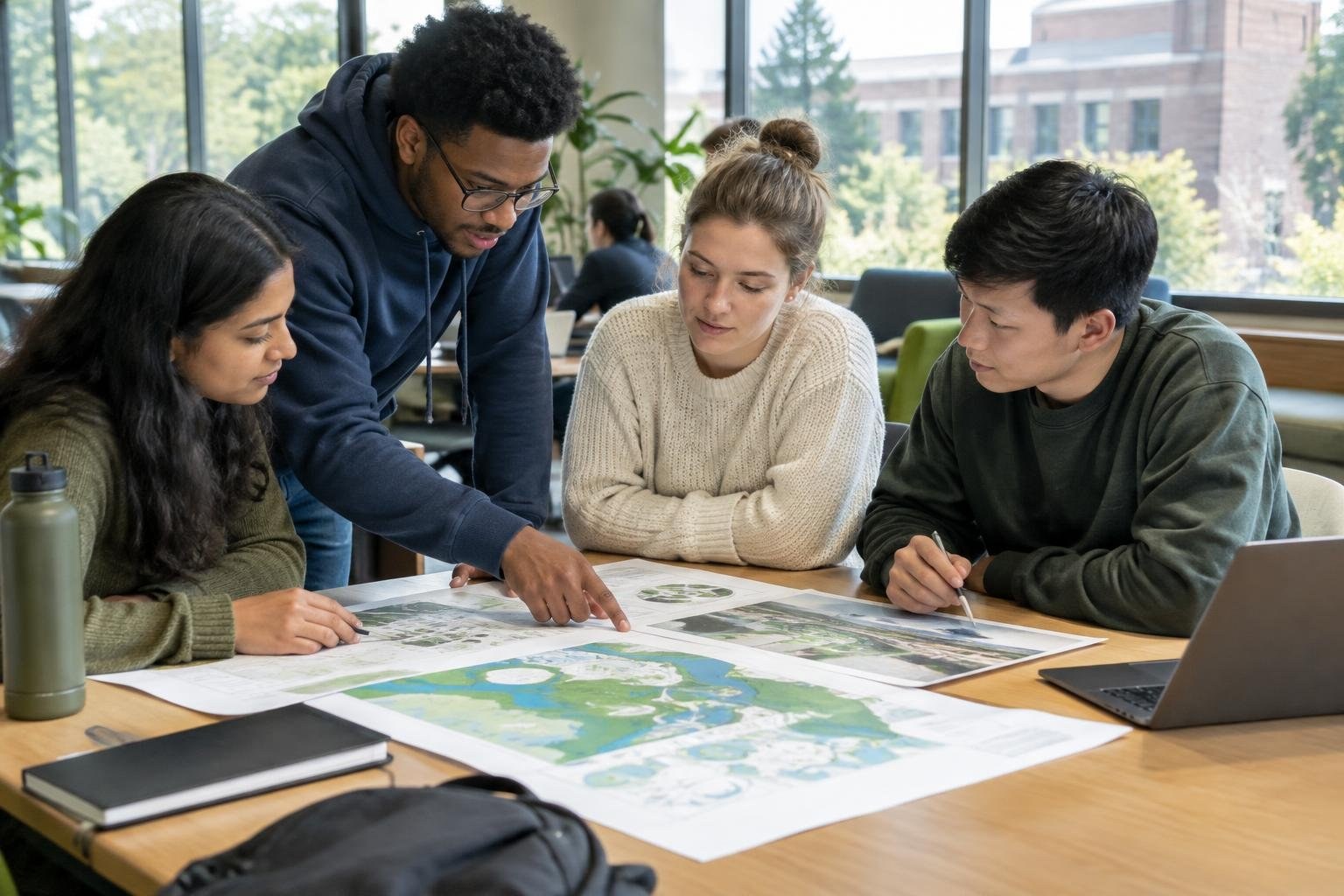
A student team comparing environmental project plans in a campus study space
What Is Environmental Engineering?
What Is an Environmental Engineering Degree?
Environmental engineering is an engineering discipline that applies mathematics and scientific principles to the design, development, and evaluation of systems related to environmental conditions. The field may address pollution control, waste and hazardous-material disposal, conservation, health and safety, and monitoring or controlling factors in natural and contained environments.
Environmental engineering is sometimes grouped with environmental health engineering. Program names and emphasis are not identical across institutions. The degree category is identified as CIP 14.1401, within the broader Environmental/Environmental Health Engineering category, CIP 14.14. A program title alone does not tell you which topics, concentrations, or career preparation it includes.
At the undergraduate level, programs may award a bachelor's degree in environmental engineering. Graduate options include master's degrees, certificates, and doctoral study. Some certificates are intended for students who want graduate-level courses without necessarily completing a full master's degree; admissions requirements still apply.
What Do You Study in Environmental Engineering?
What Do Environmental Engineering Students Study?
Environmental engineering study combines engineering with mathematics and science. The field description includes systems for monitoring and controlling environmental factors, pollution control, waste and hazardous-material disposal, conservation, health and safety, and related work environments. Which of these areas receives the most attention depends on the school's curriculum and the student's chosen pathway.
When comparing curricula, look beyond course titles. Ask what students are expected to analyze, design, evaluate, or communicate in each course. Check whether the program includes applied projects, laboratory work, research, co-op, or other experience. These elements should be verified in the current catalog rather than assumed from the degree name.
For example, Drexel lists an environmental engineering bachelor's program with co-op options. That is one institution's structure, not a universal requirement or guarantee that every student will participate. Compare the sequence of required courses and experience options with your preferred pace and learning style.
Skills You Can Develop
Skills and Ways of Thinking
Students learn to connect scientific and mathematical principles with environmental problems. Depending on the curriculum and electives, this may involve evaluating systems, interpreting information, and explaining how a proposed approach relates to environmental or health and safety goals. These capabilities are relevant to engineering work, but a degree alone does not establish that a graduate meets every employer's or licensing authority's requirements.
Consider whether you like investigating how systems work, using evidence to compare possible responses, and balancing technical questions with environmental concerns. The field has quantitative and scientific demands, but students enter with different strengths. Review prerequisite expectations and ask admissions staff what preparation is recommended if you have not recently studied math or science.
Who Should Consider Environmental Engineering?
Who Is This Degree Best For?
Environmental engineering may interest students who want to apply engineering to environmental systems, conservation, pollution, waste, or health and safety concerns. It can also be worth exploring if you want a technical field that overlaps with public health or planning. Students do not need one fixed personality type to consider the major; the key question is whether the subject matter and day-to-day work sound engaging enough to investigate further.
Before deciding, think about the kinds of problems you enjoy, how you feel about a science- and math-based curriculum, and whether you prefer applied technical work, research, or broader planning questions. Ask current students or faculty what coursework and projects actually involve.
Does Environmental Engineering Match You?
Salary, job growth, and school reputation are only part of a degree decision. Also consider your motivations, interests, preferred learning environment, and willingness to complete the program's academic requirements. Assessment.com's MAPP Career Assessment, Degree Matching, and Career Matching tools can help you reflect on fit. Use results as prompts for further research, not as a substitute for reviewing curricula, qualifications, and job duties.
Admissions, Length, and Difficulty
Admissions, Degree Length, and Academic Demands
Admission requirements are set by each institution and can differ by credential, prior education, and program. Review the official admissions page for prerequisites, required records, and any additional application materials. Graduate programs may expect relevant undergraduate preparation: Johns Hopkins describes one environmental engineering master's program for applicants with an ABET-accredited undergraduate engineering degree or equivalent, while another listed master's route is designed for students with a science undergraduate background. These examples should not be treated as universal rules.
A full-time bachelor's degree in environmental engineering is typically described as taking about four years. A master's often takes one to two years, with course load, thesis requirements, and full- or part-time attendance affecting the timeline. Individual program structures can vary: Drexel's catalog, for example, describes a quarter-calendar bachelor's program with a three-co-op five-year option and a one-co-op four-year option.
Ask for a degree plan that reflects your transfer credits and intended course load. Confirm which courses are offered each term, whether part-time study is allowed, and whether co-op or research changes the expected completion date. If you are returning to school, ask about prerequisite refreshers and academic support before enrolling.
Can You Earn an Environmental Engineering Degree Online?
Online, Hybrid, and Campus-Based Options
Do not assume that a program is fully online because a university offers online courses. Verify the delivery format for the exact degree and ask whether any required classes, research, projects, or other experiences take place in person. The available program examples include a full-time onsite master's option at Johns Hopkins and a graduate certificate described in its academic catalog; delivery details should be checked directly for the program you are considering.
For online or hybrid study, ask how students access faculty, laboratories or other required resources, and advising. If your goal involves a regulated profession, confirm whether a program's format meets the requirements that apply to your intended role and jurisdiction.
How Much Does an Environmental Engineering Degree Cost?
Cost, Financial Aid, and Affordability
There is no single cost for an environmental engineering degree. Tuition and total expenses depend on the institution, residency classification, credential, course load, and program format. Also compare required fees, books, materials, transportation, and the cost of living if you would relocate. Ask the school for an official estimate covering the full program, not only one term's tuition.
Research financial aid through the institution and applicable federal or state resources. Depending on eligibility and availability, students may investigate grants, scholarships, work-study, employer tuition assistance, and payment plans. Ask whether scholarships renew, what conditions apply, and how aid changes if you attend part time or take longer to finish.
Affordability includes time as well as tuition. Compare transfer-credit policies, expected course availability, and co-op schedules. A lower quoted tuition may not represent a lower total cost if required expenses or the time to completion differ. Do not commit until you understand the written aid offer and likely out-of-pocket costs.
What Can You Do With an Environmental Engineering Degree?
Careers, Jobs, and Employment Questions
The environmental engineering program category is most directly associated with the Environmental Engineers occupation in the supplied occupational classification. Possible work settings and job duties depend on employers and the role, so examine current job postings in the regions where you may want to work. Do not rely on a degree title alone to determine eligibility.
Potential paths to investigate include entry-level environmental engineering positions, further study, research, environmental health, or planning-related directions. UNC describes dual master's options that combine environmental health with community, urban, or regional planning, and identifies doctoral study as a path for people interested in research, education, advanced practice, or management in environmental sciences and engineering. These are examples of possible pathways, not guaranteed outcomes.
Pay and employment outlook vary by occupation, experience, location, and year. Before making a financial decision, look up current U.S. Bureau of Labor Statistics information and local employer postings for the precise job title you are targeting. Confirm whether a role expects graduate education, experience, certification, or a license.
How Environmental Engineers May Build a Career
Degree: Complete an environmental engineering program suited to your intended role.
Entry-level role: Seek positions that match your education and any stated employer requirements.
Experience: Develop relevant technical experience and learn the work practices of your industry.
Specialization: Consider focused graduate study or other qualifications when a clear career goal supports them.
Advanced work: Research, education, advanced practice, or management may be options for some professionals, depending on qualifications and opportunity.
Accreditation, Licensure, and Experience
Accreditation, Licensure, and Professional Preparation
Accreditation and licensure are separate questions. Check the current status of the specific program with the relevant recognized accrediting organization, and ask the school which professional requirements its curriculum is designed to address. Do not infer accreditation from a university's reputation or from another degree at the same institution.
Professional licensing requirements depend on the occupation and jurisdiction. Before enrolling, contact the relevant state licensing board or professional authority to verify education and other requirements for your intended work. A degree or graduate certificate does not by itself establish that you hold a professional license.
Experience can help students test their interests and strengthen a job search. Ask about co-op, research, projects, and employer connections. Drexel's catalog lists co-op options for its bachelor's program, but access and participation terms are institution-specific. Confirm eligibility, timing, and any costs or academic conditions with the program.
Graduate School Options
Graduate School and Other Education Pathways
Graduate study can be a way to deepen technical or interdisciplinary preparation, pursue research, or move toward an academic or advanced-practice goal. Options in the supplied program examples include master's degrees, graduate certificates, dual master's programs, and PhD study. These credentials serve different purposes and have different admissions expectations.
A graduate certificate may be suitable for eligible applicants who want graduate-level study without committing to a full master's program. A master's can offer a focused program of study; one Johns Hopkins program is intended for students with an accredited undergraduate engineering degree or equivalent, while another is designed for students with a science background. UNC describes doctoral study for students interested in basic and applied research, education, advanced practice, or management in environmental sciences and engineering.
Compare each option's entry requirements, curriculum, format, time commitment, and relation to your desired work. Graduate school is an investment, not an automatic requirement for every environmental engineering job.
Related Degrees and Pathways to Compare
Related Degrees and Alternatives
Consider alternatives based on which part of environmental engineering interests you most. Program names alone are not enough; compare the required courses, project work, and career qualifications.
Environmental health: Consider this direction if you are more interested in environmental conditions and health than in an engineering-centered curriculum.
Civil engineering: Explore this broader engineering direction if you want to compare environmental topics with other civil-engineering areas.
Environmental science: Consider it if you prefer studying environmental systems and evidence rather than focusing primarily on engineering design and evaluation.
Engineering science: Compare this option if you want a broad, science-based engineering foundation and a different specialization structure.
Urban or regional planning: Explore planning if your interest centers on communities, cities, or regional decisions. UNC describes dual master's pathways combining planning with environmental health.
Environmental engineering graduate certificate: Consider this if you already meet graduate admissions requirements and want graduate coursework without necessarily pursuing a full master's.
For each option, check whether the curriculum prepares you for the occupation you have in mind and whether additional education or professional requirements apply.
Is Environmental Engineering Worth It?
Advantages, Tradeoffs, and Is the Degree Worth It?
An environmental engineering degree offers a route to studying engineering applications connected with environmental systems, conservation, pollution, waste, and health and safety. It may also provide a foundation for some graduate options and related interdisciplinary pathways. A listed co-op option at a program such as Drexel can provide a structured way to explore workplace experience, subject to that school's rules.
Tradeoffs include the time and cost of an engineering education, quantitative and scientific coursework, and the need to verify whether a particular credential fits a target job. Graduate study may be useful for some goals but can add cost and time. Because costs, earnings, and employment outcomes differ, no degree is automatically worth it for every student.
To evaluate value, compare the full cost with your financial aid, expected time to finish, location, intended occupation, and the education or licensing it requires. Use current official labor-market information and actual job postings instead of relying on broad promises about salary or demand.
How to Choose the Right Program
How to Choose an Environmental Engineering Program
Compare programs using evidence from current catalogs, admissions offices, and the relevant professional authorities. Ask these questions before applying:
What exact credential will I earn, and which courses are required?
What is the program's current accreditation status, and how can I verify it?
What prerequisites apply to my academic background?
Are co-op, research, project, or other experience options available, and what conditions govern participation?
Is the program online, hybrid, or campus-based? Are any requirements in person?
What is the total estimated cost after fees and living expenses, and what financial aid may I qualify for?
How do transfer credits affect my degree plan and expected completion date?
What current graduate outcomes or career services information can the school document?
What qualifications or license does my intended role require in the places where I may work?
Can I speak with faculty, an adviser, or current students about the curriculum?
Assessment.com's education-matching tools can help you explore programs alongside career interests. Use them as one input, then verify every program detail directly with the school.
Questions to Ask Before Enrolling
Next Steps: Check Your Fit Before Enrolling
Start with a short list of questions: Which environmental problems do I want to learn about? Do I want a bachelor's, graduate credential, or research path? What preparation do I need? Which occupations interest me, and what do current job postings say those employers require? What is the total cost and realistic time to completion?
Next, compare several program catalogs and request written answers about admissions, transfer credit, delivery format, financial aid, experience opportunities, and professional preparation. If you are unsure whether the major fits your interests, use career and degree matching as a starting point for conversations with advisers and people working in related roles.
Before choosing a degree, find out what fits you. Take the Free MAPP Career Assessment to explore careers that may match your profile and educational pathways connected with those careers. Also consider Degree Matching, Career Matching, and Matching Jobs as tools for comparing possibilities, alongside direct research into programs and job requirements.
Frequently asked questions
What is environmental engineering?
Environmental engineering applies engineering, mathematics, and science to environmental systems and related health and safety concerns. Program subjects and career preparation vary by institution and degree level.
Is environmental engineering hard?
It can be demanding for students who are new to engineering mathematics and science, but difficulty depends on preparation, course sequence, and available academic support. Review prerequisite courses and sample curricula before choosing a program.
How long does an environmental engineering degree take?
A bachelor's degree is commonly presented as a four-year full-time route, while graduate study may take longer or shorter depending on the program and course load. Transfer credits, part-time study, and co-op options can change the timeline.
Can I study environmental engineering online?
Some graduate programs offer online or certificate options, while others are campus-based. Confirm whether the specific program includes in-person instruction, research, or other required experiences before enrolling.
Does environmental engineering require a lot of math?
Environmental engineering involves scientific and mathematical principles. The amount and level of mathematics varies by curriculum, so compare required courses and ask programs about preparation or tutoring support.
What jobs can I get with an environmental engineering degree?
Environmental engineers are the occupation most directly associated with the environmental engineering program category in the supplied career classification. Actual job qualifications, licensure rules, pay, and outlook depend on the position and location.
Do I need a graduate degree to work in environmental engineering?
A graduate degree is not automatically required for every environmental engineering role. It can support advanced study or a specialized direction, and some programs are designed for students with an engineering or science background.
What is an environmental engineering graduate certificate?
Environmental engineering graduate certificates may let eligible students take graduate-level courses without pursuing a full master's degree. Check admissions requirements and whether credits can apply to a later degree.
People Also Ask
What do you learn in environmental engineering?
Environmental engineering programs prepare students to apply engineering, mathematics, and science to environmental systems and related health and safety concerns. Specific subjects depend on the curriculum.
How many years is an environmental engineering degree?
Program length varies with the credential, course load, transfer credit, and work-integrated options. One cited guide describes a typical four-year full-time bachelor's route, while individual programs may differ.
Is environmental engineering a good major for becoming an environmental engineer?
The environmental engineering program category is linked most directly to environmental engineers in the supplied career classification. Review job postings for a target location to see what employers request beyond the degree.
Do environmental engineering programs include co-ops or internships?
Some programs have co-op options, and work experience can help students understand the field and build relevant experience. Availability and timing depend on the institution.
Can environmental engineering lead to environmental health or planning?
The environmental engineering field can connect with environmental health and planning. UNC describes dual master's options combining environmental health with community, urban, or regional planning.
How much does an environmental engineering degree cost?
Costs depend on the institution, residency, degree level, course load, and expenses beyond tuition. Compare each program's current official cost estimate and financial aid details before committing.
Environmental engineering may suit students who want to apply science and engineering to environmental conditions, pollution control, conservation, health, and safety. It can lead toward environmental engineering work, but program names, coursework, career access, and professional requirements differ by school, role, and state. Compare the curriculum, total cost, format, accreditation, and experience opportunities, then check current local licensing rules and labor-market information before enrolling. The best choice is one that supports your goals and matches the kind of problems you want to work on.
Find out which Career or College Major is right for you!
We use cookies to offer you a better browsing experience, analyze site traffic and personalize content.
Read about how we use cookies and how you can control them in our
Privacy Policy.
If you continue to use this site, you consent to our use of cookies.
×
Exciting News!
Be one of the first to Beta Test the new AI-Powered Assessment.com Platform.