Physical and Biological Anthropology Degree Guide: Courses, Careers and Program Fit
Explore what physical and biological anthropology programs teach, what careers they may support, how degree levels and formats differ, and what students and families should compare before enrolling.
By Tome Fierre · Staff Writer Assessment.com · Published October 12, 2026 · Last updated November 5, 2026
Physical and biological anthropology is the study of humans and human relatives through biology, evolution, and anthropological evidence. Students examine topics such as human variation, anatomy, primates, fossils, behavior, and the relationship between people and their environments. Depending on the program, coursework may also include laboratory science, forensic anthropology, or research methods. The field may appeal to students interested in science who also want to ask broader questions about how humans evolved and live. Graduates may explore research, applied anthropology, or further study, but a degree does not automatically qualify someone for every specialized role. Not sure whether physical and biological anthropology fits you? Take the Free MAPP Career Assessment to explore how your motivations and preferences align with related careers and education paths.
Degree & Program Decision Insights
Explore your personal fit, education requirements, career potential and next steps.
01Motivational Fit
Discover whether this program fits you
Explore your preferences against the focus of Physical and Biological Anthropology. These prompts are not personal MAPP results.
Exploring an open field. The classification for Physical and Biological Anthropology does not provide a detailed curriculum. Which questions within this field would you want to investigate? Ask for actual course and project examples before deciding.
Choosing a learning environment. Compare actual Physical and Biological Anthropology offerings. Would their reading, projects or practical work suit how you prefer to learn? Confirm the format rather than assuming one from the field name.
Work reality. Related work can involve this task: “Teach or mentor undergraduate and graduate students in anthropology or archeology.” Would you want that activity to be a regular responsibility?
Interest in studying a field can differ from enjoying its related work.
Which part would you want to do repeatedly, and what would you try before deciding?
Discover Your Personal Program Fit
Before investing your time and money in your education, discover how this program aligns with your natural motivations, work preferences and career goals.
Physical and Biological Anthropology. CIP 45.0202 (2020).
The classification alone does not establish a credential level, duration or delivery format.
Duration is not established by this classification; confirm the actual schedule, enrollment intensity and completion requirements.
Field focus (not a school course list):
the application of the biological sciences and anthropology to the study of the adaptations, variability, and the evolution of human beings and their living and fossil relatives
Entry prerequisites and delivery format depend on the actual offering; verify its catalog.
Typical occupational entry: doctoral or professional degree (BLS). Postsecondary teaching is a separate appointment and may require advanced study; this programme alone is not a promise of a teaching post.
U.S. occupational wages are not guaranteed graduate earnings; OEWS excludes self-employed workers.
Projected openings include replacements as well as growth.
U.S. national estimates. A crosswalk does not establish entry-level eligibility; advanced, management and teaching roles can require further qualifications.
Explore your motivations. Use MAPP as a starting point for reflecting on your interest in “Physical and Biological Anthropology”, then test that interest against a sample learning task.
Examine the work. Compare Anthropologists and Archeologists and Anthropology and Archeology Teachers, Postsecondary on daily work and entry qualifications, as well as pay. Explore Anthropologists and Archeologists.
Compare actual providers. Ask for the exact credential, course sequence and assessment methods. Compare how each provider teaches “Physical and Biological Anthropology”, its entry criteria and its itemized costs.
Check the evidence before applying. Confirm prerequisites and any recognition or professional requirements for your intended route; ask for applicable rules and published outcome definitions in writing.
Verify the institution’s current offering, admissions requirements and outcomes; a search result does not establish your eligibility.
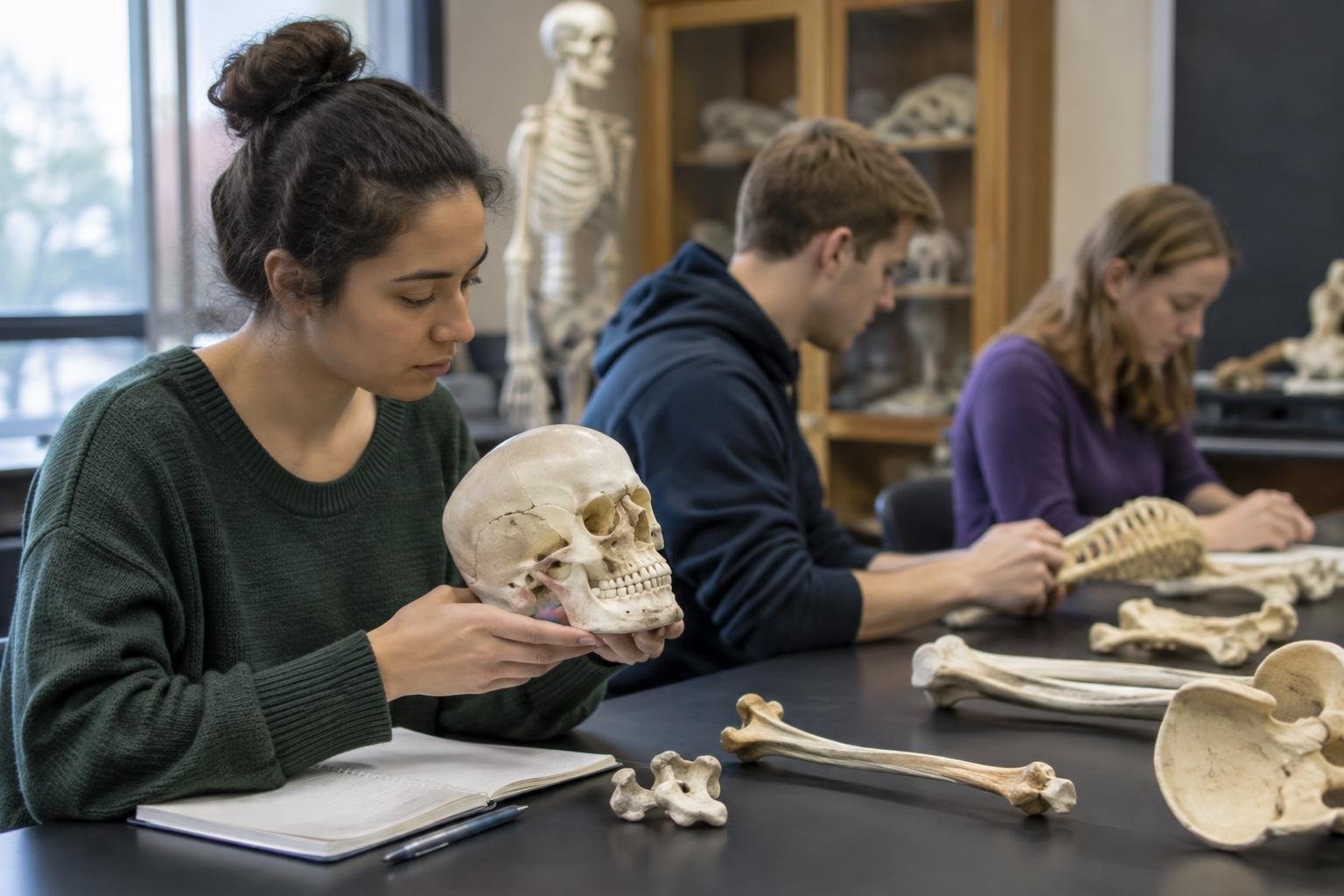
A classroom or teaching laboratory with students studying skeletal anatomy
What Is a Physical and Biological Anthropology Degree?
Physical and biological anthropology examines the biological dimensions of humans and their living and fossil relatives. It connects questions about evolution, adaptation, anatomy, variation, and environment with anthropological study of people and behavior. The program description for this field includes biological sciences, anthropology, human and mammalian anatomy, cell biology, paleontology, neuroscience, forensic anthropology, comparative anatomy, and laboratory methods.
Schools may call the subject physical anthropology, biological anthropology, or a concentration within a broader anthropology degree. The name alone does not tell you how much biology, culture, fieldwork, or lab practice a specific program includes. Compare its course list and learning requirements. For context, ASU’s anthropology curriculum description includes physical anthropology, human evolution, primates, fossils, heredity, and environment.
Anthropology also includes cultural, archaeological, linguistic, and other approaches to human life. A broad anthropology program may let students study several of these fields, while a biological anthropology concentration gives more attention to biological and evolutionary topics.
What Do You Study in Physical and Biological Anthropology?
Students learn to ask how evidence can explain human biological change and variation, and how biological findings fit into wider accounts of human life. Introductory courses may establish concepts in anthropology, evolution, and biology. More advanced courses can focus on selected topics such as anatomy, primate behavior, human biology, fossils, or forensic applications. Exact course titles and sequencing vary by school.
Typical areas of study
Human evolution and primates: Examine evidence and processes of human evolution, primates, and fossil hominins.
Human biology and anatomy: Study anatomical structures, biological variation, heredity, and relationships between humans and their environments.
Laboratory and research methods: Learn to observe, document, compare, and interpret evidence using scientific methods.
Culture and behavior: Connect biological questions with human behavior and broader anthropological perspectives.
Specialized study: Depending on the institution, options may include forensic anthropology, bioarchaeology, or human biology in contemporary populations.
A program may include lab work, independent research, a thesis, field experience, or a capstone, but do not assume every school requires each component. Ask the department which courses provide hands-on practice and whether students can join faculty research. Southwestern College emphasizes scientific methods for evaluating humans biologically and culturally, illustrating how anthropology can combine empirical work with theory.
Skills You Can Develop
The major can help students develop evidence-based reasoning, careful observation, scientific literacy, and the ability to explain complex ideas. Work with biological and anthropological evidence calls for attention to detail and thoughtful interpretation rather than relying on assumptions about human groups.
Research and analysis: Evaluate evidence, compare explanations, and distinguish well-supported conclusions from uncertainty.
Communication: Write reports, present findings, and explain scientific ideas to people with different backgrounds.
Professional practice: Keep organized records, follow research procedures, collaborate with others, and handle sensitive topics responsibly.
Technical and technology skills: Depending on program content, students may gain experience with laboratory procedures, research tools, or methods for documenting evidence.
The most transferable skills are stronger when students can show how they used them. A research paper, supervised project, lab experience, or presentation can help make classroom learning more visible to graduate programs and employers. Ask which skills the program teaches directly and which require electives or independent experience.
Who Is This Degree Best For?
Physical and biological anthropology may suit students who are curious about human origins, biological variation, primates, fossils, anatomy, or the ways environment and behavior relate to human biology. It can be a good subject to investigate if you enjoy scientific questions but do not want to treat human beings as biology alone.
Students should be ready to work with scientific evidence, read closely, write clearly, and consider complex questions without jumping to simple conclusions. The amount of biology, lab work, and quantitative study depends on the curriculum. You do not need to arrive with a single personality type or a fixed career plan, but you should be willing to explore both science and anthropology.
Entry requirements to check
Admissions standards are set by each institution and credential. Review prerequisites, application materials, transfer policies, and any requirements for entering a major or graduate program. If you are considering graduate study, ask whether the department expects particular undergraduate coursework or research experience. A program’s published admissions page is the authority for its current requirements.
For students and parents weighing several majors, compare everyday study tasks as well as future job titles. Assessment.com’s college-major decision guide and the Free MAPP Assessment can support reflection on interests and career direction.
Degree Levels, Format, Length and Academic Difficulty
There is no single timeline for every physical and biological anthropology credential. The field appears across certificate, associate, bachelor’s, post-bachelor’s certificate, graduate certificate, master’s, and doctoral levels, but the exact offerings and requirements depend on the institution. A program’s degree name is not enough to establish its length or what previous coursework it accepts.
Completion time depends on credit requirements, transfer credits, course availability, full-time or part-time enrollment, and any thesis or research requirements. For an accurate estimate, request a degree plan and ask how often required courses are offered. Online, hybrid, and campus formats may also have different schedules and practical requirements.
Academic demands can include biology and anatomy content, reading research, interpreting evidence, and communicating findings. Students who are new to science may benefit from checking course prerequisites and using advising, tutoring, or faculty office hours early. Avoid choosing a program based only on a short advertised completion estimate; verify which credits count toward the credential.
Online vs. On-Campus Study
Online study can provide flexibility, and some anthropology courses are available through online programs. However, the fact that a degree is online does not establish whether all its practical components can be completed remotely. A student interested in laboratory, field, or research experience should ask how those activities are delivered and whether any campus visits or supervised placements are required.
Compare online, hybrid, and on-campus options by more than convenience. Check course scheduling, access to faculty, research opportunities, required equipment or facilities, and whether the format supports the experience you want. ASU describes an online bachelor’s pathway in anthropology, but each institution’s course and practical requirements should be checked directly.
Tuition, Costs and Financial Aid
The total cost of an anthropology degree depends on the school, credential, residency classification, enrollment pace, and whether you study online or on campus. Budget beyond tuition: required fees, books, transportation, housing, technology, and any course-related supplies or practical experiences can affect what a student and family pay.
Compare the full program cost using the institution’s current tuition and fee information, not only a per-credit headline. Ask the financial aid office how grants, scholarships, work-study, loans, and transfer credits apply to your situation. Students who begin at a community college should confirm in writing which courses will transfer and satisfy major requirements at the intended four-year institution.
For graduate study, ask whether research assistantships, teaching assistantships, or other department funding are available and what conditions apply. Do not assume funding is guaranteed or that an advertised award covers all educational and living expenses.
Careers, Jobs and Employment Outlook
Physical and biological anthropology does not lead to one standard occupation, so a degree-level salary or job outlook would be misleading. Potential paths depend on the student’s specialization, experience, and further education. The roles below are examples connected to anthropology and related work, not guaranteed outcomes for graduates. Pay and employment outlook vary by occupation, location, and year; consult current occupation-specific data before making a financial decision.
Career direction
Typical preparation to investigate
How the degree may apply
Anthropologist
Requirements vary; some specialized work may call for graduate education or experience.
Anthropological and scientific methods help frame questions about human biology, evolution, and variation.
Archaeology-related work
Check the exact position’s education and field-experience requirements.
Knowledge of fossils, evolution, and biological evidence may complement archaeological study.
Forensic anthropology specialization
Investigate advanced study, supervised practice, and employer requirements.
Relevant coursework may introduce skeletal analysis and forensic applications.
Bioarchaeology or human biology research
Research positions and advanced specializations may require graduate preparation.
Biological anthropology offers relevant study of human remains, populations, and biology.
Postsecondary anthropology or archaeology teacher
Review the institution’s academic qualification requirements; teaching and research careers may require graduate education.
Advanced subject knowledge and research experience may support teaching and scholarship.
University departments, research settings, museums, public agencies, and other organizations may have work related to anthropology, but openings and job duties differ. Start with actual job postings and note recurring requirements. Southwestern College’s catalog cautions that some anthropology careers require education beyond a bachelor’s degree. A University of Washington graduate pathway also illustrates how students may combine doctoral anthropology study with public health training, depending on program admission and completion rules.
Technology may support documentation, analysis, and research, but it does not remove the need to evaluate evidence carefully or understand its context. Build skills in research methods, communication, and relevant tools, and confirm their relevance to the occupations you plan to pursue.
Find out which Career or College Major is right for you!
Finishing a degree and qualifying for a particular professional role are not always the same thing. The supplied program information does not establish one universal license or certification for physical and biological anthropology graduates. Requirements can differ according to job duties, employer, and jurisdiction, so check the rules for the work you intend to do before enrolling in a credential program.
For specialized research, forensic, or academic directions, ask departments and employers which education and experience they expect. A university specialization is evidence of an academic pathway, not a professional license. Before paying for a certificate, confirm whether it is required, preferred, or not relevant to the jobs you want.
How to stand out to employers
Seek supervised research, lab, field, or internship experience where available.
Keep examples of research writing, presentations, and projects that demonstrate your methods.
Ask faculty about relevant professional organizations, networking, and graduate-school preparation.
Use job descriptions to identify practical skills and credentials employers actually request.
Graduate School Options
Graduate study can deepen preparation for research, specialized practice, or academic work. Possible directions include a master’s degree or doctorate in biological anthropology, physical anthropology, or a related area. Some students may consider interdisciplinary study, such as anthropology with public health, if their interests and admissions qualifications align.
Specializations differ by university. Michigan State University describes graduate areas including forensic anthropology, bioarchaeology, and human biology of contemporary populations. The University of Washington describes doctoral anthropology study and a pathway that can combine anthropology with public health. These examples show that graduate offerings are institution-specific; they do not mean every school offers the same specialties or guarantees admission.
Before applying, ask about prerequisites, faculty research fit, funding, expected research work, time to completion, and the career qualifications the degree is intended to support. A doctorate is a substantial commitment, so connect it to a clear research or career purpose.
Related Degrees and Alternatives
Related majors can lead to different course choices and career preparation. Compare curricula and required practical work before deciding which title fits best.
General anthropology: Consider this if you want a wider introduction to cultural, archaeological, biological, and other anthropological fields. Foothill College describes broad offerings across these areas.
Biology: Consider this if you want a broader biological science foundation and less emphasis on anthropological questions about human societies and evolution.
Archaeology: Consider this if your main interest is material evidence and past societies, while checking how much biological anthropology the program includes.
Forensic science: Consider this if you want a broader forensic-science curriculum; investigate whether the program includes the specific anthropological specialization you seek.
Public health: Consider this if you are primarily interested in population health, prevention, and health systems. Some universities offer interdisciplinary routes linking public health and anthropology.
Neuroscience: Consider this if brain and nervous-system study is your central interest and you want a curriculum focused more directly on those topics.
Physical and biological anthropology differs from general anthropology mainly in the relative attention given to biology, evolution, and human relatives. It differs from a conventional biology major through its anthropological framing of human variation and human history. Actual differences depend on each school’s requirements, so compare required courses rather than relying on labels.
Accreditation and Program Recognition
There is no single program-wide accreditation or license claim established by the available program information. Verify the institution’s accreditation status through appropriate official sources and ask the department whether the program meets any requirements tied to your intended occupation or graduate-school plans. Accreditation of a college and professional approval of a specific program are not necessarily the same thing.
For a program you may use as preparation for advanced study or specialized work, confirm that relevant courses, research supervision, and practical experiences are available. Ask for written clarification about degree recognition, transfer credit, and any stated professional or licensure preparation. Do not treat broad phrases such as “career-ready” as proof that a particular credential is accepted by an employer or licensing body.
Affordability and Ways to Fund Your Education
A lower published tuition rate does not always mean a lower total cost. Compare tuition and fees for the full number of required credits, likely time to completion, commuting or housing costs, and the expenses of any required practical work. Then subtract only aid that you have confirmed you are eligible to receive.
Ways to make the plan more affordable may include comparing public and private institutions, checking transfer pathways, applying for institutional and external scholarships, completing the Free Application for Federal Student Aid when eligible, and asking employers about education assistance. Confirm deadlines and conditions directly with the relevant institution or aid provider. If considering loans, compare total borrowing and repayment terms with realistic career plans rather than assuming a particular job or salary is guaranteed.
How to Choose a Program and Evaluate Fit
Before committing, make a short list of programs and ask each school the same questions. This makes differences in cost, course content, and career preparation easier to compare.
What are the full degree requirements, and how long do students typically take at my enrollment pace?
Which courses are specifically focused on biological or physical anthropology?
Are lab, research, field, internship, thesis, or capstone experiences available or required?
How are online and in-person components delivered?
What is the estimated total cost after fees, books, and required experiences?
How will my previous credits transfer into the program?
What academic advising, faculty mentoring, and career services are available?
What additional education or experience do graduates need for the roles I am considering?
What financial aid, scholarships, or graduate funding can I apply for, and what conditions apply?
Review the answers with a counselor, advisor, or family member, then compare them with your interests and longer-term goals. Assessment.com’s education resources and career resources can help you continue exploring related paths.
From Degree to Career: Example Pathways
There is no guaranteed career ladder, but these examples show how education and experience may build toward more specialized work:
Bachelor’s study in anthropology → an entry-level role related to research or anthropology → additional research, field, or laboratory experience → a chosen specialty → graduate study if required for the desired position.
Biological anthropology coursework → research experience → graduate specialization in areas such as bioarchaeology or forensic anthropology → advanced research or academic work, depending on qualifications and openings.
Anthropology plus public health study → interdisciplinary training → work or research connecting population health and human biology, subject to program requirements and employer needs.
These are planning examples, not promises of employment or advancement. Verify the qualifications for each role and speak with program advisors about how graduates build the experience required.
Frequently asked questions
What is physical and biological anthropology?
Physical and biological anthropology applies biological science and anthropological methods to human evolution, variation, adaptation, and human relatives, including living primates and fossil hominins. Programs may cover anatomy, cell biology, paleontology, culture and behavior, neuroscience, forensic anthropology, and laboratory methods. Course choices and practical opportunities vary by institution and degree level.
Is physical anthropology hard?
It can be challenging because it combines scientific reasoning with anthropological questions. Students may encounter anatomy, biology, evolution, research methods, and careful interpretation of evidence, alongside writing and discussion about human behavior and culture. The balance differs by program. Reviewing required courses and asking about lab or field experiences can help you judge the academic fit.
What jobs can I get with a physical anthropology degree?
Possible directions include anthropology research, archaeology-related work, forensic or bioarchaeological study, and teaching or research in higher education. A bachelor’s degree may not qualify someone for every specialized or academic role; some careers require graduate education or additional experience. Explore the qualifications attached to the exact job title rather than assuming the major alone meets them.
How much can you make with a physical anthropology degree?
There is no single salary for a physical and biological anthropology degree. Pay depends on the occupation, education level, experience, employer, and location. A research role, a university teaching position, and a management job are different occupations with different requirements and pay. Use current occupation-specific labor-market data when comparing career paths.
Can you earn a physical anthropology degree online?
Some anthropology courses and degrees are offered online, but availability depends on the institution and credential. Ask whether courses with laboratory, field, research, or other practical components can be completed remotely, and whether any in-person requirements apply. Review the full curriculum and delivery details before enrolling rather than relying on the program’s online label.
Does physical anthropology require math?
The field includes biological science, so students should expect scientific coursework. The precise amount of mathematics depends on the program and its required science, statistics, and research-methods courses. Check the current degree plan and prerequisites, then ask an academic advisor which quantitative courses are required and what preparation is recommended.
Do you need graduate school for biological anthropology careers?
Not for every related job, but advanced research, university teaching, and specialized areas may require graduate study. Southwestern College’s anthropology catalog notes that some listed career paths require education beyond a bachelor’s degree, while universities offer graduate study focused on biological anthropology and related specialties. Confirm the education requirement for the role you want.
What certifications or licenses do anthropologists need?
The supplied program information does not establish one certification or license required for all physical and biological anthropology graduates. Requirements depend on the specific job and jurisdiction. Before paying for a credential, check job postings and the relevant employer or professional authority to confirm whether it is required, preferred, or unrelated to your intended role.
People Also Ask
What does a physical and biological anthropology major study?
It focuses on human biology, evolution, variation, adaptation, and relationships with living and fossil relatives. Programs use biological science and anthropological approaches, with course emphasis varying among schools.
Is physical anthropology the same as biological anthropology?
Physical anthropology is a commonly used name for biological anthropology, a field concerned with biological aspects of humans and human relatives. Program names and course emphases vary, so compare actual curricula rather than relying on the label alone.
What is the average salary for a biological anthropologist?
No single salary figure describes all graduates. Earnings depend on the occupation, degree level, experience, employer, and location. Compare current pay data for specific jobs you are considering, not a general major-level estimate.
Are there online physical anthropology programs?
Some programs offer online courses or degrees, but practical components and requirements vary. Ask each school whether labs, field experiences, research, or other in-person work are part of the program.
How long does it take to earn a physical anthropology degree?
The required time depends on the credential, transfer credits, enrollment pace, and institution. Certificate, associate, bachelor’s, master’s, and doctoral options are not interchangeable; review the official program plan for a reliable completion estimate.
Can you become an anthropologist with a bachelor’s degree?
Some jobs connected with anthropology may be accessible with an undergraduate degree, while specialized research or higher-education teaching can require graduate study or additional experience. Check requirements for each position.
How do I choose a biological anthropology program?
Compare the required courses, science content, research opportunities, practical experience, total cost, delivery format, and career preparation. Ask the department how students build skills and what additional education common career paths may require.
Physical and biological anthropology can suit students who want to investigate human evolution and biology through scientific evidence while also considering culture, behavior, and environment. The degree can lead toward research, applied work, or graduate study, but specific jobs may require additional education, experience, or credentials. Compare program content, practical research opportunities, total cost, and likely career pathways before enrolling. Personal fit matters as much as a program’s title: use Assessment.com’s career and degree resources to explore whether this field connects with the work you want to do.
Want to see your options? Try our comprehensive Degree, Program & College Search tool
We use cookies to offer you a better browsing experience, analyze site traffic and personalize content.
Read about how we use cookies and how you can control them in our
Privacy Policy.
If you continue to use this site, you consent to our use of cookies.
×
Exciting News!
Be one of the first to Beta Test the new AI-Powered Assessment.com Platform.