Laser and Optical Engineering Degree Guide: Courses, Careers, Cost, and Fit
Learn what laser and optical engineering students study, how programs differ, what careers the field can connect to, and how to compare cost, format, experience, and personal fit.
By David Slack · Staff Writer Assessment.com · Published October 6, 2026 · Last updated November 5, 2026
Laser and optical engineering applies mathematics, physics, and engineering to systems that create, control, transmit, or measure light. Depending on the program, students may study optical systems, lasers, electronics, imaging, and the scientific principles behind how light behaves. Related applications include manufacturing and healthcare, though programs and career routes differ by school and employer. The major may appeal to students who enjoy physics, careful experimentation, and designing technology that must perform reliably. It can be offered as a dedicated program, a specialization, or coursework within a broader engineering or physics degree. Compare actual requirements and hands-on opportunities rather than assuming every program with an optics-related name is equivalent. Not sure whether laser and optical engineering fits you? Take the Free MAPP Career Assessment to explore how your motivations, interests, and natural preferences may align with this degree and related careers.
Degree & Program Decision Insights
Explore your personal fit, education requirements, career potential and next steps.
01Motivational Fit
Discover whether this program fits you
Explore your preferences against the focus of Laser and Optical Engineering. These prompts are not personal MAPP results.
Subject curiosity. Would you choose to explore “wave theory and mechanics” in depth? Ask for a sample learning activity to test that interest.
Breadth of interest. Consider the place of “electromagnetic applications” in this field. Is this another part you would choose to explore, or mainly a requirement you would tolerate?
Work reality. Related work can involve this task: “Prepare budgets, bids, or contracts.” Would you want that activity to be a regular responsibility?
Interest in studying a field can differ from enjoying its related work.
Which part would you want to do repeatedly, and what would you try before deciding?
Discover Your Personal Program Fit
Before investing your time and money in your education, discover how this program aligns with your natural motivations, work preferences and career goals.
Explore these official instructional-field associations. They describe possible occupational routes, not measured outcomes of this program.
Architectural and Engineering ManagersSOC 11-9041 · O*NET 11-9041.00$171,270/year median (May 2025); +5.5% projected change (2025–2035); 14,900 projected openings/year.
Typical occupational entry: bachelor's degree (BLS). BLS lists 5 years or more of related work experience as typical for this occupation; this programme is not a direct promise of entry.
Typical occupational entry: doctoral or professional degree (BLS). Postsecondary teaching is a separate appointment and may require advanced study; this programme alone is not a promise of a teaching post.
U.S. occupational wages are not guaranteed graduate earnings; OEWS excludes self-employed workers.
Projected openings include replacements as well as growth.
U.S. national estimates. A crosswalk does not establish entry-level eligibility; advanced, management and teaching roles can require further qualifications.
Compare the focus and route of these distinct instructional fields; their credentials and admission requirements are not interchangeable.
Optics/Optical SciencesCIP 40.0807. Compare its emphasis on wave theory and wave mechanics with this program’s focus.
Telecommunications EngineeringCIP 14.1004. Compare its emphasis on telecommunications and computer networking with this program’s focus.
Electrical and Electronics EngineeringCIP 14.1001. Compare the official Electrical and Electronics Engineering field description and actual course requirements; confirm which parts support your intended specialization.
Explore your motivations. Use MAPP as a starting point for reflecting on your interest in “wave theory and mechanics”, then test that interest against a sample learning task.
Examine the work. Compare Architectural and Engineering Managers and Engineering Teachers, Postsecondary on daily work and entry qualifications, as well as pay. Explore Architectural and Engineering Managers.
Compare actual providers. Ask for the exact credential, course sequence and assessment methods. Compare how each provider teaches “electromagnetic applications”, its entry criteria and its itemized costs.
Check the evidence before applying. Confirm prerequisites and any recognition or professional requirements for your intended route; ask for applicable rules and published outcome definitions in writing.
Verify the institution’s current offering, admissions requirements and outcomes; a search result does not establish your eligibility.
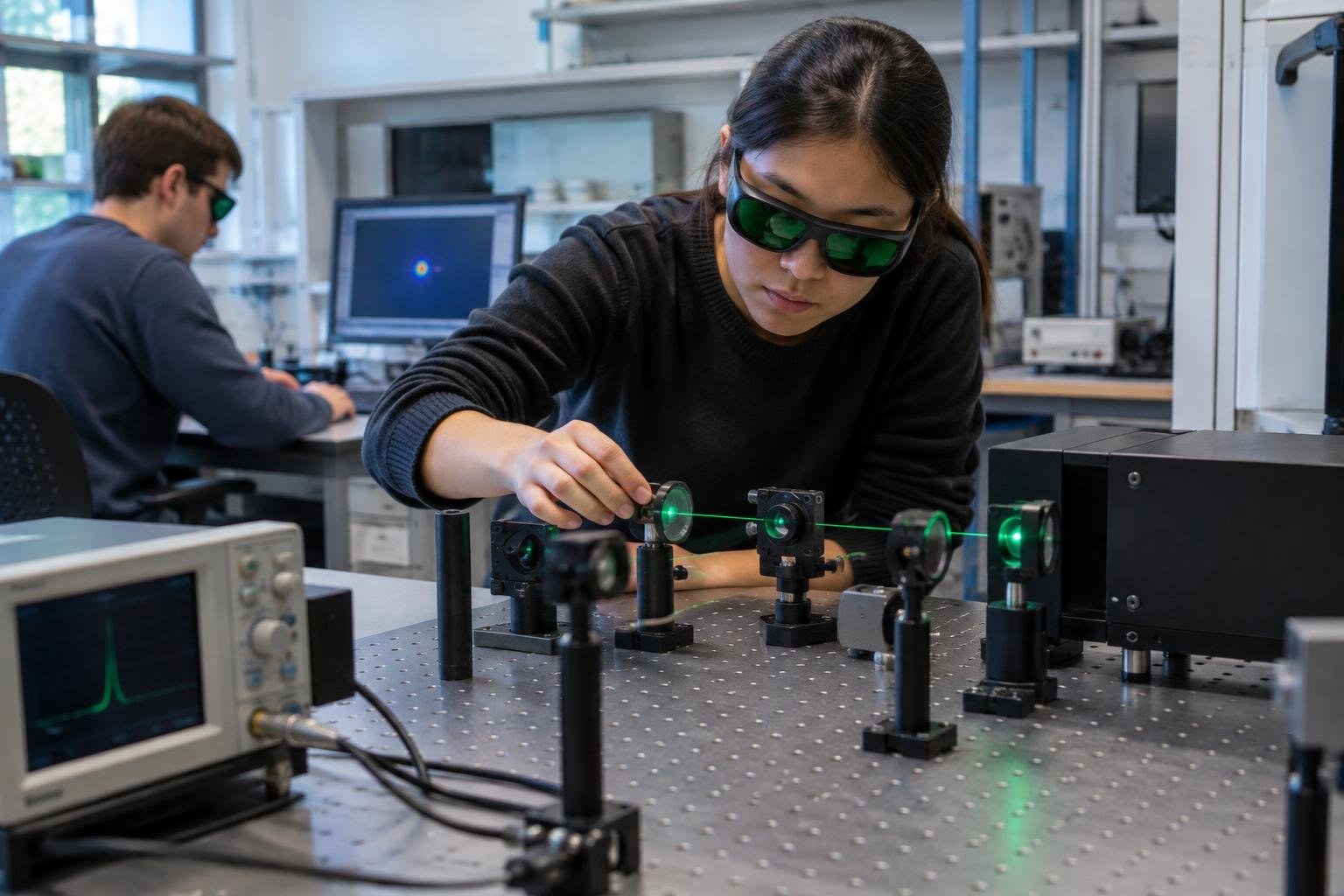
A student laboratory with a laser, optical components, and measurement equipment
What Is a Laser and Optical Engineering Degree?
Laser and optical engineering is an engineering field focused on applying scientific and mathematical principles to optical systems, lasers, and related electronic devices. Students examine how light behaves and how engineers can use it in designed systems. The study area may include wave theory, electromagnetic applications, optical devices, and the electronics that support them.
Schools do not all use the same program name. A student may find a dedicated laser and optical engineering major, a photonic science and engineering degree, an optics concentration within electrical engineering, or optics coursework in a related discipline. The title is only a starting point: compare required courses, labs, and the credential awarded.
This subject differs from general physics because its engineering emphasis is on applying scientific ideas to devices and systems. It overlaps with electrical engineering through electronics and system design, and with photonics through technologies that generate or use light. Ask departments how their curriculum balances theory, design, fabrication, testing, and applications.
What Do You Study in an Optical Engineering Program?
Expect a mix of scientific foundations and engineering application. Relevant coursework can address the behavior of light, wave theory, electromagnetic principles, optical systems, lasers, and related electronics. Some programs place optics within electrical and computer engineering; others frame it through photonic science and engineering. Check the published degree plan to see which topics are required rather than assumed.
Laboratory and design work are especially useful ways to connect theory with practice. When reviewing a program, ask whether students measure or test optical components, work with laser equipment, use simulation or design tools, complete team projects, or conduct research. These are questions to verify with the school, not features to assume from a program title.
Later coursework may let students explore applications such as imaging, manufacturing, or health-related technology. The right balance depends on your interests. A student drawn to devices and electronics may favor an engineering concentration; someone interested in the scientific basis of light may compare physics-based options as well.
Course sequences and practical requirements vary by institution. Request the current curriculum, lab descriptions, and a sample schedule. If a course is listed with a broad name such as “optical systems,” ask what students actually design or analyze and how their work is assessed.
Skills You Can Develop
Students build a foundation in applied mathematics, scientific reasoning, and engineering analysis. They learn to translate physical behavior into a design or test question, evaluate whether a device meets its intended purpose, and explain technical results. The exact software and equipment depend on the school and specialization, so ask for examples from current courses.
Technical understanding: how optical systems, lasers, light, and related electronics fit together.
Analytical thinking: interpreting measurements, using mathematical models, and investigating why a system behaves as it does.
Communication: presenting test results, writing clear technical documentation, and collaborating across disciplines.
Practical problem-solving: connecting scientific principles to device design, evaluation, or improvement.
Teamwork: coordinating with people working in engineering, manufacturing, research, or application-specific roles.
These capabilities can support work in optical technology, engineering design, testing, manufacturing, or research settings. A degree alone does not establish proficiency with every employer's tools. Use class projects, internships, research, and a portfolio of documented work to show how you apply what you learn.
Who Is This Degree Best For?
This major may be a good subject to investigate if you enjoy physics, mathematics, electronics, and understanding how engineered devices work. It may also suit students who like careful measurement and iterative problem-solving: a design question can require analysis, testing, and revision rather than a quick answer.
You do not need to arrive knowing exactly which optics career you want. You should, however, be willing to build quantitative skills and work with technical ideas. If you prefer a field with little mathematics or want primarily people-facing work, compare other majors before committing. Those preferences are decision points, not judgments about ability.
Does laser and optical engineering match you? Salary, perceived prestige, or an impression that a field is growing cannot tell you whether you will enjoy its daily work. Think about whether you want to study light and devices, perform detailed analysis, and keep learning technical methods. The Free MAPP Assessment can help you reflect on motivations and interests; Degree Matching and Career Matching can help you explore adjacent options. Use them as prompts for research, not as substitutes for reviewing course plans or talking with advisers.
Admissions, Credential Levels, Time, and Academic Demands
Admission requirements are set by individual institutions. Before applying, check each school's stated prerequisites, application dates, transcript requirements, and any expectations for prior mathematics or science preparation. Ask whether placement, transfer-credit review, a portfolio, an interview, or other materials apply to the particular program; do not assume requirements from one college carry over to another.
Credential options can range from certificates and associate degrees to bachelor's, master's, and doctoral study. One general pathway is to begin with foundational technical study and continue into a more focused engineering or physics program. An associate degree in optical engineering is commonly described as about two years and a bachelor's as about four years, but individual schedules and transfer arrangements can change the timeline.
Full-time, part-time, accelerated, and online availability is school-specific. Ask for a term-by-term completion plan, including prerequisites, course rotation, transfer credits, and any required in-person activities. A course that is not offered every term can affect time to completion.
Students often find the combination of mathematical theory, technical reading, and applying concepts to devices challenging. Prepare by strengthening algebra, calculus readiness, and physics fundamentals where appropriate, and use tutoring or office hours early. Confirm that the program offers the support and lab access you need.
Online, Hybrid, or On Campus?
Some optical or photonics coursework may be available online, but a program's delivery method does not by itself explain how students complete practical work. Ask whether labs are remote, campus-based, scheduled in intensive sessions, or satisfied through approved local facilities. Confirm the same details for projects, internships, and any equipment-based courses.
Campus study may make it easier to access department equipment and collaborate in person, while online or hybrid study may offer more schedule flexibility. Neither format is automatically better. Compare the full course plan, student support, equipment arrangements, and any travel or residency expectations before enrolling.
If you are considering an online program, request written confirmation of which classes and practical requirements can be completed remotely. Also ask how the school supports students in securing research, internship, or employer experience if those opportunities are not on campus.
Tuition, Total Cost, and Financial Aid
There is no single price for a laser and optical engineering degree. Your total expense can depend on the college, residency classification, credential level, number of terms, course fees, equipment or technology requirements, and living costs. Do not compare tuition alone: ask each school for an estimate of the full program cost and how that estimate changes if you study part time or need additional terms.
Ask the financial aid office about grants, scholarships, work-study, payment plans, and aid eligibility. Students may also investigate employer tuition assistance, transfer agreements, or beginning at a lower-cost institution before transferring, but verify that credits will apply to the intended degree. Get transfer decisions in writing when possible.
Build a budget that includes books, required supplies, transportation, and any costs tied to lab participation. Compare net cost after grants, not just the published price. A program with a lower initial tuition figure may not be the better value if credits do not transfer or required courses extend the time to graduate.
Before accepting an offer, ask for an itemized estimate, the conditions for keeping scholarships, and the effect of changing enrollment pace. Avoid relying on cost figures from a different major or school as a proxy for this program.
Careers, Jobs, Pay, and Employment Outlook
Optics and photonics connect with several application areas. The available research describes photonic engineering as relevant to manufacturing and healthcare, and identifies lasers as technologies used in varied applications. That breadth can create options to explore, but it does not guarantee a particular job or hiring outcome.
Potential direction
How the study may apply
What to verify
Optical or laser engineering
Optical systems, lasers, related devices, and engineering evaluation.
Employers' degree, experience, and technical-tool expectations.
Photonics and light-based technology
Study focused on designing or applying technologies that use light.
Whether roles are design, testing, production, or applications focused.
Optical technician work
Foundational training in optics may support technician pathways.
Whether an employer accepts the credential and what practical skills it requires.
Imaging or health-related applications
Optical and photonic systems can be applied in healthcare and imaging contexts.
Role-specific qualifications and any additional training.
Manufacturing and product testing
Engineering knowledge can connect to making or evaluating optical products.
Local industry, equipment, quality, and experience requirements.
Associate-level study may offer a foundation or a pathway toward a bachelor's degree; a bachelor's program typically provides more comprehensive study of optical systems and related topics. More advanced design or research roles may call for additional education or experience, but requirements vary. Check current postings for the exact titles that interest you.
No reliable salary or employment-outlook figure specific to this major is established here. Pay and prospects depend on occupation, location, experience, and industry. For a useful comparison, identify likely job titles and consult current U.S. Bureau of Labor Statistics occupational data and employer postings for each one rather than treating a major-wide number as a guarantee.
Technical fields continue to change as applications and tools evolve. A strong education in fundamentals, practical experience, and a willingness to learn new methods can help graduates adapt; claims that automation will eliminate or guarantee jobs should be treated cautiously.
Find out which Career or College Major is right for you!
Program accreditation and professional authorization are separate questions from earning a degree. Verify the institution's and program's current status directly with the relevant accrediting body, and ask whether the curriculum is recognized by employers or supports further study you may want. Do not rely only on a school's general statement about accreditation.
Licensing and certification needs depend on the job, employer, and jurisdiction. The available program information does not establish one universal license for all optical engineering careers. If a target position lists a required credential, contact the relevant licensing organization or employer to confirm eligibility, education, and experience requirements before choosing a program.
Ask the college whether students prepare for any industry credentials, what those credentials cover, and whether exams or fees are additional. Completing a degree should not be treated as automatic proof of eligibility for a separate professional credential.
Experience, Projects, and Preparing for Employers
Relevant experience can help turn technical coursework into evidence of what you can do. Explore internships, co-ops, faculty research, design projects, student organizations, and laboratory work. Ask instructors whether projects can be documented in a portfolio with a clear description of the problem, your contribution, methods, and results.
How to stand out to employers:
Choose project work that connects optical theory to a testable design or measurement.
Keep a concise record of equipment, analytical methods, and software you have actually used.
Practice explaining technical findings to classmates and non-specialists.
Use career services and professional networks to learn which skills local employers request.
Seek supervised experience in a relevant application area, such as manufacturing, imaging, or health-related technology.
Do not list tools or certifications you have not used or earned. Employers can ask you to explain your contribution, so be prepared to distinguish team results from your individual work.
Graduate School and Further Study
Graduate study can help students deepen their knowledge in optics, photonics, physics, electrical engineering, or another related specialty. It may be worth exploring for research-focused work or roles that ask for more advanced technical preparation. A graduate certificate in optics for engineering, for example, is described as being aimed at recent graduates and mid-career professionals with a relevant bachelor's background.
Before pursuing a master's, doctorate, or certificate, review job postings and speak with potential employers or faculty. Identify the skill or credential the further study is meant to add. Compare tuition, time away from work, research opportunities, and whether the program's prerequisites match your undergraduate preparation.
Related Degrees, Pathways, and Alternatives
Compare alternatives according to the work you want to do, not simply which degree has the closest name.
Electrical engineering: consider it if you want a broader foundation in electrical systems with the option to pursue an optics or laser concentration.
Photonic science and engineering: consider it if you want a program explicitly framed around photonic technology and its applications.
Physics: consider it if you prefer a more science-centered route and may want to build toward applied optics through electives or graduate study.
Engineering science: consider it if you want an interdisciplinary engineering foundation and have confirmed that the available electives support your goals.
Electrical and computer engineering: consider it if your interests include the electronics and systems connected to optical devices.
Optical technology associate study: consider it if you want foundational preparation or a possible transfer route, after checking how employers and four-year schools treat the credential.
Course content, graduate-school implications, and earning potential depend on the specific program and eventual occupation. Compare required courses, labs, projects, transferability, and qualifications in job postings before deciding.
Advantages, Drawbacks, and Is It Worth It?
Possible advantages: the subject combines scientific principles with engineering application; it can connect to light-based systems used in multiple industries; and students can investigate technical directions such as lasers, optics, photonics, and imaging.
Possible drawbacks: the work may require sustained effort in mathematics and physics; specialized programs may be less widely available than broad engineering majors; and the degree title alone may not tell employers what practical experience you have. Students may need to move, pursue additional study, or build relevant experience depending on the roles and region they target.
Whether the major is worth it depends on the fit between your interests, the program's quality and cost, and the jobs you intend to pursue. Compare net price and time to completion with likely alternatives. Ask colleges for outcome information and speak with graduates where possible. Use salary and outlook data for specific occupations, not a promise based on the major name.
How to Choose the Right Program
Compare programs using questions that reveal what students actually experience:
What is the exact credential and major or concentration listed on the transcript?
Which courses in optics, lasers, electronics, physics, and design are required?
What laboratory, research, internship, or project options are available?
What are the total costs after grants and scholarships, including course fees and equipment?
Which courses are online, and which practical requirements must be completed in person?
How many credits transfer, and which prerequisites remain after transfer?
What outcomes can the school share for recent graduates, and how are those data defined?
What career services and employer connections are relevant to optics or photonics?
What accreditation applies to the institution and the specific program?
Does the curriculum prepare students for any credentials required by their intended roles?
Compare at least two degree plans and calculate likely completion time using your own transfer credits and study pace. Assessment.com's Degree Matching and Career Matching resources can help you explore possibilities, while Matching Jobs can support further career research. Treat matching results as a starting point, then verify program and employer requirements directly.
Before paying a deposit, get answers about transferability, aid renewal rules, lab access, and the full cost of completion in writing.
From Degree to Career: Illustrative Pathways
Career movement is not automatic, but a degree can be one part of a longer preparation path. Examples to investigate include:
Optical engineering study → entry-level optical or test role → build experience evaluating systems → pursue a focused design or application area.
Associate optical study → optical technician opportunity, where employer requirements permit → gain laboratory and equipment experience → transfer or continue study if a bachelor's degree is needed for a target role.
Electrical engineering with an optics concentration → engineering role using relevant electronics and optical coursework → develop specialized project experience → consider graduate study or a technical specialization.
These are examples, not guaranteed sequences. Job titles, minimum qualifications, and advancement vary by employer and location. Compare current postings and ask program advisers how graduates move from coursework to work.
Questions to Ask Before Enrolling
Before enrolling, bring this checklist to an admissions or department adviser:
What exact credential and program name will I earn?
What is the full estimated cost, and which aid or scholarships may reduce it?
What courses and prerequisites are required, and how long should my plan take?
How much laboratory or project experience is included?
Which activities require campus attendance or travel?
How will my previous credits transfer into this specific degree?
What employment, internship, and graduate-school outcomes can the department document?
Which employers recruit students, and what roles have recent graduates pursued?
What accreditation applies, and does the program meet any requirements relevant to my goals?
What career advising, tutoring, and technical support are available?
Then compare the answers with your own priorities: interest in the subject, comfort with quantitative study, budget, preferred learning format, and desired work. A careful comparison can uncover differences that program marketing alone may not show.
Frequently asked questions
What is a laser and optical engineering degree?
Laser and optical engineering applies mathematics, physics, and engineering principles to the design, development, and evaluation of optical systems, lasers, and related electronic devices. Coursework may address how light behaves and interacts with materials, along with the electronics and system design used to create practical devices. Programs may be offered under different names, so compare course lists rather than relying on the title alone.
Is laser and optical engineering hard?
It can be demanding for students who have not had much practice with mathematics, physics, and technical problem-solving. The work often involves moving between abstract concepts about light and practical questions about how a system should perform. Review sample course requirements and ask about tutoring, laboratory access, and prerequisite expectations before choosing a program.
How long does an optical engineering degree take?
An associate degree in optical engineering is commonly described as taking about two years, while a bachelor's degree is commonly described as taking about four years. Actual completion time depends on the institution, course availability, transfer credits, study pace, and program requirements. Ask each school for a degree map that reflects your circumstances.
Does laser and optical engineering require a lot of math?
The field is strongly connected to physics and mathematics because students apply scientific and mathematical principles to optical systems, lasers, and related devices. The exact level and sequence of math courses vary by program. Check the prerequisites and required course list, and ask an adviser what preparation is recommended before the first term.
Can I earn a laser and optical engineering degree online?
Potentially, but the answer depends on the specific program. Online coursework may be possible for some classes, while laboratory work, equipment access, projects, or other practical requirements may call for in-person participation. Ask the school which courses are fully online, whether labs are scheduled on campus, and whether any required activities involve travel.
What jobs can I get with an optical engineering degree?
Possible directions include optical or laser engineering, photonics-related work, optical technology, imaging, and engineering work in manufacturing or health-related applications. Job titles and required qualifications differ between employers. Review current job postings and compare their stated education, software, laboratory, and experience requirements with the program you are considering.
Is a laser and optical engineering degree worth it?
The degree may be worthwhile if its courses and practical experiences prepare you for work you want and the total cost fits your financial plan. Compare programs by curriculum, hands-on opportunities, graduate outcomes, and employer connections. Also compare alternative majors, such as electrical engineering or physics, if they offer a better route to your goals.
Do I need a graduate degree to work in optics or photonics?
Not necessarily. Some students may enter related technical roles with an associate degree or other relevant preparation, while engineering design, research, or specialized work may call for a bachelor's degree, advanced study, or substantial experience. Check the qualifications in job postings for the roles you want and confirm how well a particular degree prepares you for them.
People Also Ask
What does a laser and optical engineer study?
Laser and optical engineering uses engineering, mathematics, and scientific principles to design and evaluate optical systems, lasers, and related electronic devices. Programs may also cover wave behavior, electromagnetic applications, imaging, and photonics, depending on the curriculum.
What is the difference between optics and optical engineering?
Optics is the study and application of light, while optical engineering focuses on designing systems and devices that use light. Laser and optical engineering programs connect those topics with engineering and electronics. Individual schools may use different degree names and organize the subject as a major, concentration, or related field.
How do I choose an optical engineering program?
Look for evidence of relevant laboratory work, projects, and courses in optics, lasers, electronics, and engineering fundamentals. Ask how students access equipment and whether internships, research, or employer projects are available. Also check transfer policies, full program cost, class format, and the education employers expect for your target roles.
Are optics and photonics used in healthcare and manufacturing?
Potentially. Photonics and optical technologies have applications that include manufacturing and healthcare, and programs may prepare students for a range of related technical work. Hiring needs and job qualifications vary, so examine current postings in the locations and industries that interest you instead of relying on a broad claim about demand.
What majors are similar to laser and optical engineering?
Related options include electrical engineering, physics, engineering science, and photonic science and engineering. The best alternative depends on whether you want broader electrical systems training, a more physics-centered education, or a focused program in light-based technology. Compare course requirements and the qualifications for the jobs you want.
How much does an optical engineering degree cost?
There is no single cost for this major. Tuition and total attendance costs depend on the institution, residency, credential, program length, fees, equipment needs, and aid. Request a written estimate covering the entire degree, then compare grants, scholarships, work opportunities, employer support, and transfer-credit options.
Laser and optical engineering may suit students who want to apply physics, mathematics, and engineering to the design and evaluation of systems that use light. Programs can lead toward work in optics, lasers, photonics, imaging, manufacturing, or health-related applications, but the exact curriculum and career preparation vary by institution. Before enrolling, compare the courses, hands-on experience, total cost, program recognition, and the specific jobs you hope to pursue. If you are unsure whether this technical path fits your interests, use career and degree matching tools alongside conversations with program advisers and working professionals.
Want to see your options? Try our comprehensive Degree, Program & College Search tool
We use cookies to offer you a better browsing experience, analyze site traffic and personalize content.
Read about how we use cookies and how you can control them in our
Privacy Policy.
If you continue to use this site, you consent to our use of cookies.
×
Exciting News!
Be one of the first to Beta Test the new AI-Powered Assessment.com Platform.