Environmental Chemistry Degree Guide: Courses, Careers, Cost, and Fit
Environmental chemistry combines rigorous chemistry study with questions about air, water, soil, pollutants, and remediation. Learn what students study, which careers may connect to the degree, and how to compare programs and costs.
By Kieth Nelson · Staff Writer Assessment.com · Published October 26, 2026 · Last updated November 5, 2026
Environmental chemistry is the study of chemical processes in the natural environment, especially air, water, and soil. Students learn chemistry and analytical methods that help explain how substances behave, where pollutants move, and how contamination may be assessed or addressed. Programs combine core chemistry with environmental applications, though course plans differ by college. This major can lead toward laboratory, research, environmental monitoring, or science-related work. Some career paths call for advanced education or experience, so it is important to look beyond the degree name and investigate the requirements for specific jobs. Parents and students should compare course rigor, costs, hands-on opportunities, and likely next steps together. Not sure whether environmental chemistry fits you? Consider how your interests, motivations, and preferred ways of working align with both the coursework and the careers it may support. The Free MAPP Career Assessment can help you explore career and degree options alongside conversations with teachers, counselors, and college advisors.
Degree & Program Decision Insights
Explore your personal fit, education requirements, career potential and next steps.
01Motivational Fit
Discover whether this program fits you
Explore your preferences against the focus of Environmental Chemistry. These prompts are not personal MAPP results.
Scientific investigation. Would you enjoy investigating analytical, inorganic, organic, and physical chemistry and explaining your conclusions from evidence?
Breadth of interest. Consider the place of “aquatic, soil, and atmospheric chemistry” in this field. Is this another part you would choose to explore, or mainly a requirement you would tolerate?
Work reality. Related work can involve this task: “Monitor environmental impacts of development activities.” Would you want that activity to be a regular responsibility?
Interest in studying a field can differ from enjoying its related work.
Which part would you want to do repeatedly, and what would you try before deciding?
Discover Your Personal Program Fit
Before investing your time and money in your education, discover how this program aligns with your natural motivations, work preferences and career goals.
U.S. occupational wages are not guaranteed graduate earnings; OEWS excludes self-employed workers.
Projected openings include replacements as well as growth.
U.S. national estimates. A crosswalk does not establish entry-level eligibility; advanced, management and teaching roles can require further qualifications.
Compare the actual offering and credential before committing your time or money.
Request the itemized fees, materials and equipment associated with “analytical, inorganic, organic, and physical chemistry”; confirm what tuition includes.
Compare the full attendance budget, course availability and time away from paid work, rather than tuition alone.
No institution- and credential-matched cost, debt or graduate-earnings amount is reported here; occupational pay is not program ROI.
Financial aid depends on the school, program and student’s eligibility.
Compare the focus and route of these distinct instructional fields; their credentials and admission requirements are not interchangeable.
Chemistry, GeneralCIP 40.0501. Compare the official Chemistry, General field description and actual course requirements; confirm which parts support your intended specialization.
Chemistry, OtherCIP 40.0599. Any instructional program in chemistry not listed above.
Organic ChemistryCIP 40.0504. Compare its emphasis on molecular conversion and synthesis and molecular synthesis and design with this program’s focus.
Explore your motivations. Use MAPP as a starting point for reflecting on your interest in “analytical, inorganic, organic, and physical chemistry”, then test that interest against a sample learning task.
Examine the work. Compare Environmental Scientists and Specialists, Including Health and Environmental Science and Protection Technicians, Including Health on daily work and entry qualifications, as well as pay. Explore Environmental Scientists and Specialists, Including Health.
Compare actual providers. Ask for the exact credential, course sequence and assessment methods. Compare how each provider teaches “aquatic, soil, and atmospheric chemistry”, its entry criteria and its itemized costs.
Check the evidence before applying. Confirm prerequisites and any recognition or professional requirements for your intended route; ask for applicable rules and published outcome definitions in writing.
Verify the institution’s current offering, admissions requirements and outcomes; a search result does not establish your eligibility.
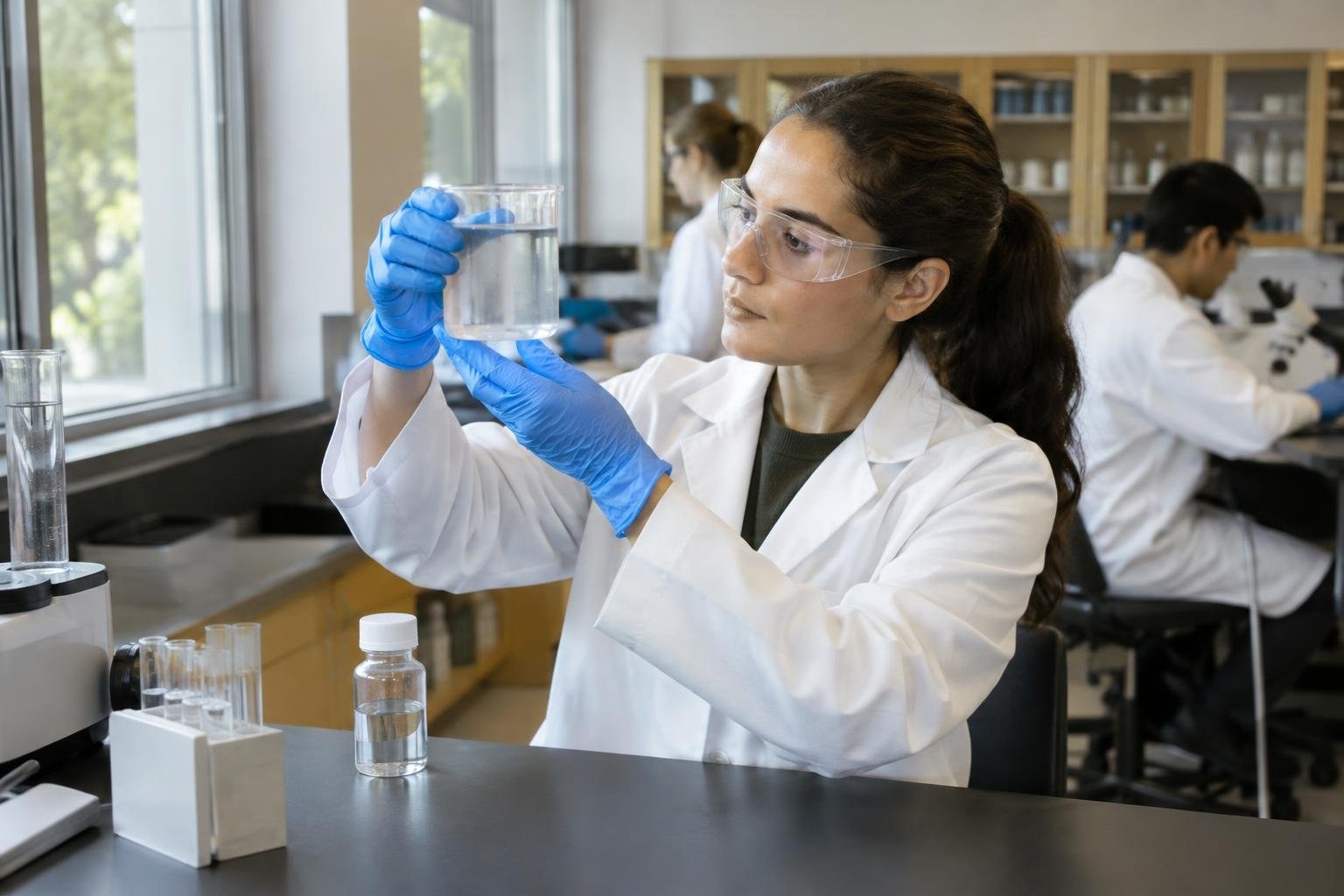
Environmental chemistry student analyzing a water sample in a teaching laboratory
What Is an Environmental Chemistry Degree?
Environmental chemistry applies chemical concepts and measurement methods to natural systems, including air, water, and soil. The field examines chemical behavior and the movement and fate of pollutants, as well as chemical aspects of contaminant remediation. The federal Classification of Instructional Programs identifies environmental chemistry as CIP 40.0509.
At college, the subject may appear as an environmental chemistry major, a chemistry specialization, or an environmental emphasis within a broader science program. The title alone does not reveal how much chemistry, fieldwork, or environmental policy a student will study; compare the actual course plan.
It differs from environmental science, which may combine several scientific disciplines, and from environmental studies, which may include broader social or policy perspectives. Those labels are not standardized enough to judge by name alone, so inspect required courses and learning outcomes.
For example, the University of California, San Diego describes an environmental chemistry bachelor's pathway with certified and non-certified options, while Ohio University describes its B.S. as a choice for students planning graduate study in chemistry with an environmental emphasis. These are examples of institutional approaches, not universal degree rules. Review UC San Diego's environmental chemistry program information and Ohio University's major description.
What Do Environmental Chemistry Students Study?
Expect a strong chemistry foundation, followed by coursework that applies chemical reasoning to environmental questions. A program description for the field includes analytical, inorganic, organic, and physical chemistry; aquatic, soil, and atmospheric chemistry; environmental toxicology; environmental engineering; and analytical methods. Not every college requires every subject or uses these names.
Foundational chemistry teaches students to reason about reactions, substances, and measurement. One published environmental chemistry course description includes kinetics, equilibrium, thermodynamics, acids and bases, buffers, solubility, electrochemistry, and nuclear chemistry. Such topics help students interpret chemical systems, but students should use each school's catalog to identify its actual requirements.
Laboratory courses are important to evaluate because practical work can involve instruments, careful sample handling, measurement, and interpretation of results. The University of Virginia's environmental chemistry specialization lists general, organic, and physical chemistry courses with associated labs. Ask whether labs are scheduled in person, how students receive instrument training, and whether research or a capstone is available.
Curricula vary in their balance of chemistry, biology, environmental applications, and engineering. See an example of an environmental chemistry course track with laboratories and compare it with the program plans at colleges under consideration.
Skills You Can Develop
Students develop scientific reasoning by working through chemical problems, interpreting measurements, and connecting results with environmental questions. The course topics described above also involve quantitative thinking: for example, chemical equilibrium and kinetics require students to understand relationships and use calculations rather than memorize terms alone.
Scientific and technical skills: applying chemical principles, using laboratory procedures, and understanding analytical methods.
Data and analysis: organizing observations, checking measurements, and explaining what results can and cannot show.
Communication: documenting methods and findings clearly for instructors, research teams, employers, or decision-makers.
Professional habits: careful recordkeeping, attention to safety instructions, and reproducible work.
Technology: gaining familiarity with scientific instruments and data tools used by the specific program.
Ask departments which instruments and software students use and what examples of student work they can share. Do not assume that every program provides the same technical training.
Who Is This Degree Best For?
This degree may suit students who are curious about how chemicals behave in the natural world and who want to investigate questions with evidence. It can appeal to people who like laboratory work, careful observation, complex explanations, and applied science. A student need not fit a single personality profile; persistence and willingness to learn are more useful than a narrow idea of who belongs in science.
Be realistic about the academic demands. Chemistry sequences can include abstract concepts, detailed calculations, and laboratory reports. If a student is still building confidence in math or science, ask about prerequisites, tutoring, introductory course placement, and the pace of required courses before enrolling.
Does Environmental Chemistry Match You?
Salary, reputation, and job growth are only part of a college decision. Also consider whether the work itself, the time spent in labs, and the length of the education path fit the student's interests and practical needs. Assessment.com's Free MAPP Career Assessment can be one reflection tool; use its results as a starting point for discussion, not as a substitute for exploring classes and career requirements.
Students and parents can also compare the publisher's college-major guidance and browse life and physical science careers as part of that exploration.
Admissions, Credential Levels, and Time to Completion
Admission requirements depend on the college and credential. For an undergraduate program, review the institution's current application requirements, math and science preparation, and any required placement steps. For graduate study, prerequisites may be much more specific.
For example, the University of Maryland's Environmental Chemistry graduate program describes a bachelor's degree in natural sciences or engineering and specified preparation in calculus, physics, general chemistry, and biology, with minimum course grades. This is one graduate program's requirement, not a universal entrance standard. Check the official program page for its current prerequisites.
Environmental chemistry is offered at more than one credential level across institutions, but the presence of a certificate, associate, bachelor's, graduate certificate, master's, or doctoral credential in a field does not mean each college offers all of them. Verify the actual award, required credits, and admission criteria directly with each school.
Completion time depends on credential, credit load, transfer credits, course availability, and whether a student studies part time. A UC Davis environmental applied chemistry bachelor's listing specifies a minimum of 99 units for that program. That number is program-specific; it should not be treated as a national credit standard or a promise about time to completion.
Online vs. On-Campus Study
Online, hybrid, and campus formats differ by school. Lecture material may be available remotely while laboratory courses, research, or instrument-based learning require campus participation. Before choosing an online option, request a course-by-course explanation of how laboratories and any hands-on requirements are completed.
Ask whether remote students use a campus lab, a supervised local facility, or another format; whether any travel is required; and whether the same courses and equipment access are available to all students. Confirm how the format affects scheduling, advising, and access to research opportunities. Do not rely on a general online-program label to answer these questions.
Tuition, Costs, and Financial Aid
There is no single environmental chemistry tuition price. Total cost depends on the college, residency rules, tuition structure, credit load, program fees, and whether the student lives on or off campus. Laboratory courses may have separate fees, and students should include books, transportation, equipment, and housing where applicable.
Ask each school for a full cost estimate for the expected time to completion, not only the advertised per-credit rate. Check whether the estimate includes mandatory fees, summer courses, lab charges, and any additional costs associated with research or required travel.
Compare grants, scholarships, work-study eligibility, federal student aid, employer support where relevant, and payment plans offered by the institution. Students may reduce cost through community-college transfer credits or other accepted prior coursework, but should get written confirmation that credits apply to the major and will not delay graduation.
For families, the useful comparison is net cost and likely borrowing across the whole degree, alongside the education required for intended jobs. Avoid choosing solely on the basis of a low initial price if the course sequence, transferability, or completion plan does not fit.
Careers, Jobs, and Employment Considerations
Environmental chemistry can connect to laboratory, chemistry, environmental monitoring, water-resource, and research-related work. A program's listed career possibilities are not guarantees of employment or proof that one credential satisfies every employer's requirements. Job title, location, experience, and education requirements matter.
Possible career direction
Education to investigate
How environmental chemistry may apply
Chemical technician
Review the employer's stated education and laboratory experience requirements.
Coursework may build a chemistry and measurement foundation.
Chemist
Compare job postings and whether advanced study is requested.
Core chemistry courses and laboratory preparation may be relevant.
Environmental scientist or specialist
Check whether employers require broader environmental science training or experience.
Chemistry offers a lens for contaminants and environmental samples.
Environmental science and protection technician
Verify the employer's education and field or lab expectations.
Analytical methods can connect to monitoring and sample work.
Water resource specialist
Review the role's requirements and relevant technical experience.
Water chemistry can support understanding of water-quality questions.
Postsecondary chemistry educator
Investigate the institution's graduate-degree and teaching requirements.
Advanced chemistry study may be part of a longer academic pathway.
These are possibilities associated with the subject, not a forecast of openings or earnings. The supplied program descriptions do not provide comparable occupation-level salary or job-growth data, so do not use a degree guide as a substitute for current labor-market research. Check official occupational data and local job postings before making a financial decision.
Employers may include laboratories, research groups, environmental organizations, government agencies, and businesses with scientific or environmental functions. The specific options depend on local hiring and individual qualifications. Automation and AI may change how data are processed, but students still benefit from understanding measurement quality, chemistry, and how to interpret findings rather than relying on software output alone.
Experience, Certifications, and Licensure
Field-specific laboratory practice, supervised research, and applied projects can help a student show how classroom knowledge works in practice. Ask whether the college helps students find research or internships and whether students can complete a substantial project, poster, or presentation.
Useful preparation is tied to the target role. Build a record of lab courses and projects, practice describing methods and results, and maintain organized examples of reports or presentations that can be shared appropriately. Join relevant student or professional groups if they offer learning, mentoring, or networking opportunities.
Do not confuse completing a degree or receiving a program distinction with a professional license. Environmental chemistry itself does not imply one universal license for all graduates. Requirements depend on the job and jurisdiction. Verify any credential or license directly with the relevant employer or official licensing body before relying on it.
How to Stand Out to Employers
Describe specific laboratory methods and instruments you have actually used.
Explain a project by stating the question, method, result, and limitations.
Seek relevant experience early, including faculty research or internships where available.
Tailor applications to the role's stated education and technical requirements.
Graduate School and Advanced Study
Graduate options can include chemistry or environmental science master's programs, graduate certificates, and research doctorates. Students may pursue further education to deepen subject expertise, prepare for research, or meet the requirements of a particular role. These are different goals, so identify the reason before selecting a credential.
UC San Diego recommends its ACS-certified environmental chemistry bachelor's option for students planning to apply to graduate school in chemistry. Other colleges structure their programs differently. Ask the undergraduate department whether its courses meet the entry expectations of graduate programs the student may later consider. Doctoral study is research-intensive; NJIT's catalog emphasizes creative thinking, self-motivation, and a commitment to research quality for doctoral candidates.
Graduate study adds time and cost. Compare funding, research supervision, program outcomes, and entry requirements before assuming an advanced credential will improve a particular career outcome.
Related Degrees and Alternatives
Consider alternatives by looking at what the student wants to study each week, not only at the name of a degree.
Chemistry: consider this if you want a broader chemistry foundation and may choose an environmental specialty later.
Environmental science: consider this if you want to examine environmental questions across multiple scientific areas.
Environmental studies: consider this if you want a wider interdisciplinary approach to environmental issues.
Geochemistry: consider this if earth materials and chemical processes in geological settings are the central interest.
Hydrology or water resources: consider this if water systems are the primary focus.
Chemical engineering: consider this if you are drawn to engineering design and industrial processes rather than primarily chemical analysis.
These are comparison prompts, not claims that the programs have identical curricula across colleges. Assessment.com has guides to environmental science and environmental studies. Compare their actual required courses with the chemistry major plan. For the environmental chemistry route, ask whether the program emphasizes graduate preparation, applied work, or a balance of both.
Advantages, Drawbacks, and Is It Worth It?
There is no universal answer to whether the degree is worth it. Estimate total net cost and time, then compare those with the specific jobs or graduate programs the student is considering. A chemistry-intensive program may be a strong academic match for someone who wants to understand chemical behavior in environmental systems, but it may be a poor choice for someone seeking a less quantitative or less laboratory-centered curriculum.
Potential advantages include a clear scientific focus, a foundation in chemistry, and opportunities to connect laboratory methods with environmental questions. Tradeoffs may include demanding sequences of science courses, laboratory time, and the possibility that a desired specialized role requires more education or experience than a bachelor's degree alone.
To make the decision, look at published course plans, talk with current students and faculty, review recent job postings, and compare financial aid offers. Include geography and willingness to relocate in the plan, since nearby employers and available roles may shape practical options.
How to Choose the Right Program
Program quality is not established by a degree title alone. Compare the institution's recognized accreditation status and confirm that the credential meets any requirements for later study or work. For chemistry-specific program recognition, ask what accreditation or certification applies, which curriculum it covers, and whether it is relevant to the student's goals. UC San Diego, for example, offers certified and non-certified environmental chemistry bachelor's options; that is an institution-specific choice, not a condition shared by every program.
Do the required courses match the student's intended specialty?
Are labs, equipment, faculty expertise, and research access adequate for the learning goals?
Are internships, projects, or other practical experiences supported?
What is the total net cost, and what aid is renewable?
Can transfer credits apply directly to major requirements?
How are online labs and hands-on requirements delivered?
What career advising, employer connections, and graduate-school guidance are available?
Does the program prepare students for any stated certification or licensure requirement?
Request written answers and compare at least two or three course plans. Browse degree options and use Assessment.com's education resources to support, not replace, direct conversations with colleges.
From Degree to Career
A career path is not guaranteed, but it can help to sketch possible transitions before choosing a program. For example:
Environmental chemistry bachelor's degree → laboratory or technician role, if the employer's requirements are met → broader responsibility through relevant experience → specialization in an environmental or analytical area.
Environmental chemistry bachelor's degree → chemistry graduate study, if admitted → research or advanced scientific work based on training and available opportunities.
Environmental chemistry coursework → environmental monitoring or water-related work, where the student's skills match the position → additional field, technical, or graduate preparation as needed.
At each stage, check actual job and program requirements. These are examples of possible planning routes, not promised outcomes.
Questions to Ask Before Enrolling
Before making a deposit, students and parents can use this checklist:
What is the institution's accreditation status, and is the program's chemistry track certified or otherwise recognized in a way that matters to my plans?
What is the full estimated cost to finish, including fees, books, labs, housing, and transportation?
Which grants, scholarships, and other aid are available, and what conditions apply to renew them?
What are the required courses, prerequisites, and realistic completion timeline?
How much laboratory, research, or field experience is available?
Can transfer credits count toward major requirements?
Which courses or experiences must be completed in person?
What career advising and graduate-school preparation are available?
What additional education, experience, certification, or license do target employers require?
Can the college connect me with current students, faculty, or recent graduates?
Compare answers in writing so that the decision reflects the actual program rather than assumptions based on a brochure or major title.
Frequently asked questions
What is an environmental chemistry degree?
Environmental chemistry is the study of chemical processes in natural systems, including air, water, and soil. Programs apply chemistry concepts and analytical methods to understand contaminants, their movement, and approaches to remediation. Coursework commonly builds on foundational chemistry and may include environmental topics and laboratory work. Exact requirements and degree names differ by institution.
Is environmental chemistry hard?
It can be demanding because students typically take several levels of chemistry and related laboratory courses. Some programs also require calculus, physics, or biology. The specific balance varies by school, so review course sequences and prerequisites before applying. Students who enjoy careful measurement, problem-solving, and scientific explanations may find the work engaging, but no particular personality is required.
Is an environmental chemistry degree worth it?
Environmental chemistry can prepare students for science-related work, but the degree alone does not guarantee a particular job or salary. Value depends on program cost, the student's career target, experience gained during school, and whether additional education is needed. Compare likely roles and their actual education requirements before deciding whether the investment makes sense for your family.
What jobs can you get with an environmental chemistry degree?
Potentially related roles include chemical technician, chemist, environmental scientist, environmental science and protection technician, and water resource specialist. The degree's fit depends on the employer's requirements and the role's focus. Some positions may require graduate education, specialized experience, or credentials beyond a bachelor's degree. Research individual job postings and occupational requirements rather than assuming one degree qualifies you for every related career.
Does environmental chemistry require a lot of math?
Environmental chemistry programs rely on chemistry, laboratory measurement, and quantitative problem-solving. A program may require calculus and physics as well as chemistry; biology may also be a prerequisite for some graduate-level study. Check the specific curriculum and admissions requirements. If math is a concern, ask about tutoring, placement, and course sequencing before enrolling.
Can you earn an environmental chemistry degree online?
Some environmental chemistry courses may be offered online, but a full program can include laboratory learning or other in-person requirements. Ask each college how labs are delivered, whether students must attend campus, and whether research or field experiences are required. Do not assume an online label means every degree requirement can be completed remotely.
Do you need a master's or doctorate in environmental chemistry?
Graduate school is not automatically required for every job related to environmental chemistry. However, advanced study may be important for specialized research roles or positions that require deeper expertise. Some students choose a chemistry bachelor's curriculum designed to support graduate study. Check the requirements for the careers and graduate programs you are considering before choosing a degree track.
What is an ACS-certified environmental chemistry degree?
An ACS-certified environmental chemistry bachelor's track is one option at the University of California, San Diego. The department recommends its certified version for students intending to apply to graduate school in chemistry. Certification and program structure are institution-specific, so ask what the credential means, which requirements it adds, and whether it aligns with the graduate programs you may pursue.
People Also Ask
What do you learn in environmental chemistry?
The program focuses on chemistry in natural systems such as air, water, and soil, with attention to analytical methods, pollutant behavior, and remediation. Students typically build chemistry foundations before applying them to environmental problems. Exact course titles and hands-on requirements vary by college.
How long does an environmental chemistry degree take?
There is no single timeline for every program. Completion time depends on credential level, credit requirements, transfer credit, course availability, and whether a student studies full time. Compare the published degree plan and ask the college how long students with your starting credits typically need.
What are the requirements for environmental chemistry programs?
Admission rules are set by each institution. At the undergraduate level, review the required prior coursework and application materials. Graduate prerequisites can be more science-intensive: one University of Maryland graduate program describes a natural science or engineering bachelor's degree and specified coursework in calculus, physics, chemistry, and biology. Check current official requirements directly with the institution.
How is environmental chemistry different from environmental science?
Program names and pathways vary. A chemistry degree with environmental coursework may emphasize chemistry and laboratory foundations, while environmental science or environmental studies can provide different disciplinary balances. Compare required courses, laboratory work, electives, and the qualifications needed for your intended occupation before deciding.
Are environmental chemistry programs available fully online?
Possibly, but remote availability does not establish that every requirement can be completed online. Ask whether laboratory courses, research, or other components require campus attendance, and confirm how students access equipment and supervision. Get the complete delivery plan in writing before enrolling.
What careers can environmental chemistry prepare you for?
A bachelor's degree may be a starting point for some science-related work, while specialized research or other roles may require graduate study or experience. Determine the required education from the specific employers or graduate programs relevant to your goal. Do not infer job eligibility from a program's list of possible careers alone.
Environmental chemistry may be a good fit if you want to use chemistry to investigate environmental questions and are prepared for a rigorous science curriculum. Compare program requirements, lab and research opportunities, total cost, and the education required for your intended career before committing. If you prefer a broader environmental focus with less chemistry, compare environmental science or environmental studies. Your choice should connect an area of study you can sustain with a realistic education and career plan.
Find out which Career or College Major is right for you!
We use cookies to offer you a better browsing experience, analyze site traffic and personalize content.
Read about how we use cookies and how you can control them in our
Privacy Policy.
If you continue to use this site, you consent to our use of cookies.
×
Exciting News!
Be one of the first to Beta Test the new AI-Powered Assessment.com Platform.