Metal Arts Degree Guide: Courses, Careers, Costs, and Program Fit
A Metal Arts program blends design, material knowledge, and studio practice. Learn what students study, how to compare programs, and what careers may follow.
By Tome Fierre · Staff Writer Assessment.com · Published October 12, 2026 · Last updated November 5, 2026
A Metal Arts degree or program teaches students to design and make refined objects from metal, often including jewelry, sculpture, and functional or decorative work. Students combine visual ideas with practical processes such as fabrication, casting, enameling, and metal finishing. The exact balance depends on the school and credential. Metal Arts may appeal to students who enjoy learning through making, developing a personal artistic voice, and improving a piece through careful revision. Graduates may pursue craft and jewelry work, studio practice, or further study. Career paths vary, so program choice should account for hands-on training, portfolio development, total cost, and your goals. Not sure whether Metal Arts fits you? Take the Free MAPP Career Assessment to explore how your motivations, interests, and natural preferences align with arts-related careers and education options.
Degree & Program Decision Insights
Explore your personal fit, education requirements, career potential and next steps.
01Motivational Fit
Discover whether this program fits you
Explore your preferences against the focus of Metal Arts. These prompts are not personal MAPP results.
Understanding people and societies. Would you enjoy investigating art history, comparing perspectives rather than expecting a single simple explanation?
Breadth of interest. Consider the place of “aesthetics” in this field. Is this another part you would choose to explore, or mainly a requirement you would tolerate?
Work reality. Related work can involve this task: “Select and acquire metals and gems for designs.” Would you want that activity to be a regular responsibility?
Interest in studying a field can differ from enjoying its related work.
Which part would you want to do repeatedly, and what would you try before deciding?
Discover Your Personal Program Fit
Before investing your time and money in your education, discover how this program aligns with your natural motivations, work preferences and career goals.
Explore these official instructional-field associations. They describe possible occupational routes, not measured outcomes of this program.
Jewelers and Precious Stone and Metal WorkersSOC 51-9071 · O*NET 51-9071.00$52,540/year median (May 2025); -3.2% projected change (2025–2035); 3,700 projected openings/year.
Typical occupational entry: high school diploma or equivalent (BLS). BLS lists long-term on-the-job training as typical occupational training.
Typical occupational entry: master's degree (BLS). Postsecondary teaching is a separate appointment and may require advanced study; this programme alone is not a promise of a teaching post.
U.S. occupational wages are not guaranteed graduate earnings; OEWS excludes self-employed workers.
Projected openings include replacements as well as growth.
U.S. national estimates. A crosswalk does not establish entry-level eligibility; advanced, management and teaching roles can require further qualifications.
Compare the focus and route of these distinct instructional fields; their credentials and admission requirements are not interchangeable.
Jewelry ArtsCIP 50.0713. Compare its emphasis on design concepts and gemology with this program’s focus.
Fiber, Textile and Weaving ArtsCIP 50.0712. Compare its emphasis on weaving techniques and loom operation and non-woven techniques such as knitting, coiling, netting, and crocheting with this program’s focus.
Ceramic Arts and CeramicsCIP 50.0711. Compare its emphasis on handbuilt and wheelthrown techniques and molding with this program’s focus.
Explore your motivations. Use MAPP as a starting point for reflecting on your interest in “aesthetics”, then test that interest against a sample learning task.
Examine the work. Compare Jewelers and Precious Stone and Metal Workers and Art, Drama, and Music Teachers, Postsecondary on daily work and entry qualifications, as well as pay.
Compare actual providers. Ask for the exact credential, course sequence and assessment methods. Compare how each provider teaches “anodizing”, its entry criteria and its itemized costs.
Check the evidence before applying. Confirm prerequisites and any recognition or professional requirements for your intended route; ask for applicable rules and published outcome definitions in writing.
Verify the institution’s current offering, admissions requirements and outcomes; a search result does not establish your eligibility.
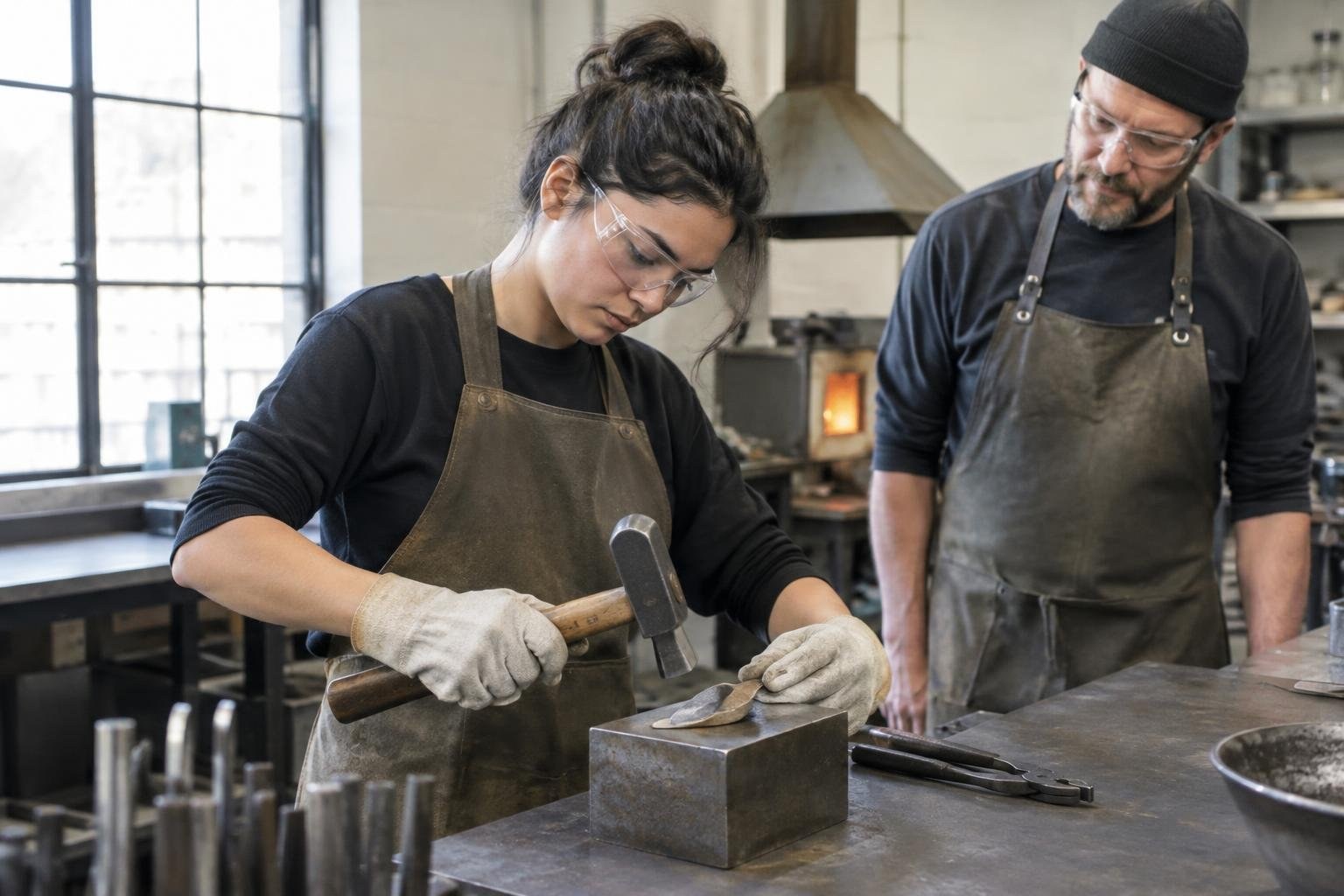
A student working with metal at a supervised studio bench
What Is a Metal Arts Degree?
Metal Arts is a field of study focused on artistic expression and the technical skills used to design and fabricate refined metal objects. The federal Classification of Instructional Programs lists Metal and Jewelry Arts as CIP code 50.0714. Its description includes work related to metal fabrication and design; schools may use different program names or organize the study within a larger art degree.
Some programs emphasize jewelry and small-scale objects, while others connect metalsmithing with sculpture, contemporary craft, or broader studio practice. The NCES CIP classification is useful for identifying the field, but it does not establish which credentials a particular college offers. Check the institution’s current catalog.
What Do You Study in Metal Arts?
Metal Arts curricula commonly combine studio practice, visual development, and technical processes. The program description for this field includes areas such as design, art history, casting, enameling, electroforming, metalsmithing, sculpture, wax carving, and welding. A student might first plan a form through drawing or models, then test how the material can be shaped, joined, finished, or adapted.
Course sequences differ. One college may foreground historical and contemporary jewelry craft, while another emphasizes individual expression and conceptual development. Some programs also introduce digital modeling or laser-based processes. Review actual course descriptions and ask how often students receive studio instruction, critique, and access to equipment. Examples of these variations appear in the Monterey Peninsula College program, the University of Iowa program, and the Academy of Art University program.
Learning through making
Studio assignments help students practice planning, careful execution, and revision. Critiques and project presentations can also help students describe the choices behind a finished piece. Advanced study may involve a cohesive body of work or thesis development, but requirements depend on the degree and institution.
Skills You Can Develop
Students develop a blend of creative and practical abilities. Studio work can build hand skills and attention to detail, while repeated design and fabrication projects encourage students to think through how a concept can become a durable, finished object. SFA’s program describes a focus on craft skills, careful work, critical thinking, creativity, and safe use of tools and materials.
Design and visual judgment: develop forms, proportions, and surface choices that support an intended idea.
Technical making: practice material processes taught by the program, which may include metal fabrication, casting, enameling, or digital techniques.
Problem solving: adjust a design when a material or construction method does not produce the intended result.
Communication: explain choices in critiques, portfolio notes, presentations, or conversations with clients and collaborators.
Professional practice: document work and build a portfolio that represents skills and direction.
Which skills are emphasized depends on the curriculum and projects available. Ask how students document their work and whether the program includes professional-practice or business instruction. The SFA metal and jewelry concentration describes attention to technical learning and safe tool use.
Who Is a Metal Arts Program Best For?
Metal Arts may suit students who enjoy making tangible work, experimenting with materials, and spending time improving details. It can also fit learners interested in the meeting point between traditional craft and contemporary art or design. The University of North Texas describes its metalsmithing and jewelry studio study in that cross-disciplinary context.
You do not need to arrive with a fully formed artistic identity. More useful questions are whether you are curious about materials, willing to learn technical processes, open to critique, and prepared to work through revisions. The program can involve both independent studio time and discussion of ideas, history, and visual decisions.
Does Metal Arts match you?
Do not decide on salary expectations or the appeal of a creative title alone. Consider whether the day-to-day work sounds engaging, what kind of financial uncertainty you can manage, and whether you want to make work for clients, employers, exhibitions, or your own practice. Assessment.com’s MAPP assessment can help you explore career and degree options; treat an assessment as one input, then compare its suggestions with real program requirements and your own experience.
Admissions, Preparation, and Academic Demands
Admission requirements are set by each college. Applicants should check whether the school asks for a high school diploma or equivalent, prior coursework, a portfolio, an essay, an interview, or other materials. Do not assume a portfolio is mandatory or optional based on another school’s rules. Ask admissions staff how work samples are evaluated and whether they accept work created outside formal art classes.
Metal Arts can be physically and mentally demanding in different ways: students must follow studio procedures, work carefully, and tolerate the time it can take to develop a piece. Preparation can include drawing regularly, trying supervised introductory craft classes, and keeping photographs or notes that show how a project changed from its first idea to its final form. Program-specific expectations should be confirmed directly with the institution.
Credential Levels, Formats, and Completion Time
Metal Arts may be available as part of a certificate, associate’s degree, bachelor’s degree, graduate certificate, master’s degree, or doctoral-level study, but the listing of credential levels for a field is not proof that every level is offered at every school. The NCES classification identifies the discipline; students must verify program availability and award type in the official college catalog.
Completion time depends on credential, course load, transfer credit, and the sequence of studio courses. Ask for a degree map showing prerequisites, when courses are offered, and whether part-time enrollment affects access to advanced studio classes. Online or hybrid access may be possible in some settings, but fabrication often calls for specialized tools and materials. Confirm whether required work is completed on campus, in approved facilities, or through another clearly explained arrangement.
Tuition, Costs, and Financial Aid
Metal Arts education can include tuition as well as program fees, materials, tools, protective equipment, transport, and living costs. The amount depends on the school, location, residency status, enrollment load, and which supplies students are expected to purchase. Request a written, year-by-year estimate that separates tuition from studio and course expenses.
Compare the net price you would pay after grants and scholarships, not only a published tuition figure. Ask the financial aid office about federal and state aid eligibility, institutional scholarships, payment plans, and whether work-study or other aid is available to you. Students transferring from another institution should request a written credit evaluation before committing, because accepted credits can affect both time and total cost.
Ways to plan for affordability
Ask which tools and materials are supplied in the studio and which are personal purchases.
Find out whether studio fees change by course or project.
Compare public and private options using current official cost-of-attendance information.
Review grant and scholarship conditions before borrowing.
Include transportation, housing, and time away from paid work in your estimate.
Careers, Jobs, and Employment Outlook
There is no single career outcome or salary attached to a Metal Arts credential. The field can connect to craft and jewelry work, independent practice, or further artistic study. Some program examples describe building a body of work with commercial possibilities, while others emphasize conceptual and technical development. Those examples show possible educational aims, not guaranteed employment or earnings.
Career direction
How Metal Arts study may apply
What else to investigate
Craft artist or independent maker
Studio processes and an individual body of work can support making and presenting original objects.
How you will find buyers, manage costs, and sustain income can vary by practice.
Jeweler or metalwork craftsperson
Fabrication, design, and material skills may be relevant to jewelry and precious-metal work.
Compare employers’ requirements, practical experience expectations, and portfolio needs.
Studio or production work
Applied making skills may transfer to some workshop and production settings.
Confirm the processes and production standards used by the specific employer.
Postsecondary art teacher
Studio knowledge may inform teaching in art or craft subjects.
Advanced degrees or other qualifications may be expected; check each institution’s job requirements.
For salary and employment outlook, research each occupation separately using current labor-market information and compare the relevant location and job duties. A degree-wide average would conceal major differences between salaried work, self-employment, sales, and teaching. A portfolio, experience, business skills, and local opportunities can matter alongside the credential.
Find out which Career or College Major is right for you!
Experience, Portfolio, Certification, and Licensure
Because Metal Arts depends on practical work, ask how much time students spend making projects and what facilities they can use. Find out how instructors teach safe tool use, how students receive feedback, and whether there are opportunities for exhibitions, internships, research, or professional collaboration. The existence and details of these opportunities differ by institution, so request examples from the program rather than assuming they are included.
How to stand out to employers or clients
Build a focused portfolio that shows finished work and, where useful, the making process.
Photograph pieces clearly and write short descriptions of materials, techniques, and intent.
Practice explaining how you solve design and fabrication problems.
Seek opportunities to show work, collaborate, or learn from working makers.
Develop practical business habits if you plan to sell or commission work.
A degree is an educational credential, not a guarantee of professional certification or a particular license. The supplied program examples do not establish a universal Metal Arts license or certification. If a job or business activity has local requirements, check the relevant state or local authority and the employer’s own criteria before relying on a program’s general claims.
Graduate Study and Advanced Pathways
Further study may make sense for a student seeking deeper studio development, a thesis project, or preparation for some postsecondary teaching opportunities. Graduate work can also help artists develop a more cohesive body of work and explore digital techniques or cultural themes. For example, an MFA program description from the Academy of Art University refers to thesis development, fabrication, digital methods, and a cohesive portfolio.
Before applying, compare the graduate curriculum with what you have already studied and what you want to accomplish. Ask about portfolio expectations, access to facilities, faculty mentorship, total cost, and the kinds of roles graduates pursue. Do not assume an advanced degree will improve earnings or employment prospects without checking requirements for the specific career you want.
Related Degrees and Alternatives
Related programs can share creative methods while preparing students for different types of work. Use course lists and student projects to distinguish the focus, rather than relying on broad labels alone.
Studio art: consider this if you want broad practice across art forms and less emphasis on metal as a primary material.
Sculpture: consider this if three-dimensional form and spatial work interest you more than jewelry or small-scale fabrication.
Industrial design: consider this if your focus is designing products for use and production systems.
Product design: consider this if you want to develop objects with an emphasis on function, users, and manufacture.
Jewelry design: consider this if wearable objects and jewelry-specific craft are your main interest.
Art education: consider this if teaching is a central goal and you want coursework connected to educational practice.
Fine arts graduate study: consider this if you want sustained advanced studio development and a thesis or cohesive body of work.
Metal Arts itself may sit between craft, art, and design. The University of North Texas describes metalsmithing and jewelry as a meeting point for traditional and contemporary art, design, and craft, while Iowa emphasizes conceptual and technical skills. Compare those aims with each alternative’s curriculum and the qualifications required for your intended work.
How to Choose the Right Metal Arts Program
When comparing Metal Arts programs, look for evidence that the learning experience matches your goals. A compelling title is not enough if the required courses, facilities, or financial commitment do not suit you.
Accreditation: check the institution’s current accreditation status through official education sources and confirm any program-specific recognition relevant to your plans. Do not assume a degree title establishes accreditation.
Curriculum: compare required studio courses, material processes, art history, digital methods, and electives.
Facilities and instruction: ask what tools and workspace are available, how safety is taught, and how often students receive critique.
Portfolio and outcomes: ask to see examples of student work and how the program supports students in documenting their practice.
Cost and format: compare the full cost, supply expectations, campus attendance, and realistic time to completion.
Career preparation: ask about internships, exhibitions, professional-practice instruction, and career services without treating any one feature as a job guarantee.
Transferability: obtain a formal credit review and confirm that required studio courses will fit your schedule.
Use Assessment.com’s education resources and college-major guidance to organize your questions, then verify program facts directly with each college. Ask for answers in writing when they affect cost, transfer, or degree completion.
From Degree to Career: Possible Routes
Career development is not a guaranteed ladder, but a few examples show how study can connect to longer-term plans:
Metal Arts study → portfolio-building studio projects → entry-level jewelry or workshop role → develop specialized making skills → pursue advanced responsibilities or independent work if opportunities and experience support it.
Metal Arts study → original body of work → exhibitions, commissions, or sales activity → refine a recognizable practice and business approach → expand an independent craft career over time.
Metal Arts bachelor’s degree → further graduate study where appropriate → teaching or advanced studio practice → pursue roles that match the qualifications and experience requested by employers.
These are possibilities rather than promised outcomes. Program examples describe portfolio development, commercial career preparation, and graduate thesis work, but results depend on the student’s work, resources, market, and goals.
Questions to Ask Before Enrolling
Before applying or paying a deposit, prospective students and parents can use this checklist to surface practical differences between programs:
What credential is awarded, and is it the one I intend to earn?
What is the total estimated cost, including studio fees, tools, materials, and living expenses?
Which financial aid offers are grants, scholarships, work opportunities, or loans?
What are the actual studio requirements, and how are tools and materials accessed?
How are projects critiqued, documented, and assembled into a portfolio?
Are internships, exhibitions, or professional-practice experiences available, and what does participation involve?
What transfer credits will count toward this exact degree plan?
What additional qualifications do employers in my target career request?
What support is available for career planning, and what can the school document about graduate outcomes?
Does the program’s teaching approach and studio culture feel like a good match for me?
Bring the answers together with your own priorities. If you are still deciding between several subjects, Assessment.com’s MAPP assessment can be one resource for exploring career and degree options alongside conversations with advisors, current students, and family.
Frequently asked questions
What is a Metal Arts degree?
Metal Arts is a studio-based field focused on designing and making work from metal, often including jewelry and related objects. Depending on the program, students may study metal fabrication, casting, enameling, design, art history, sculpture, and digital techniques. The National Center for Education Statistics classifies Metal and Jewelry Arts under CIP code 50.0714.
Is a Metal Arts major hard?
It can be demanding because students must develop both creative judgment and precise making skills. Projects may require repeated planning, fabrication, revision, and careful tool use. How challenging it feels depends on your preparation, the program’s expectations, and your comfort with sustained studio work. Review course requirements and ask current students what a typical week in the studio involves.
What jobs can I get with a Metal Arts degree?
Possible directions include independent craft practice, jewelry making, studio or production work, and teaching after additional education or experience. The degree may also support work in related creative settings. Actual eligibility depends on the role: employers may prioritize a portfolio and practical skills, while teaching positions can require advanced degrees or other qualifications.
How much can you make with a Metal Arts degree?
There is no single salary for Metal Arts graduates. Pay depends on the occupation, location, employer, experience, and whether an artist earns income through employment, commissions, or sales. Compare current wage information for specific occupations such as craft artist, jeweler, or postsecondary art teacher rather than treating a degree-wide estimate as a personal forecast.
Can you earn a Metal Arts degree online?
Some programs may offer online or hybrid study, but hands-on metalwork requires access to appropriate tools, materials, and studio space. Before enrolling in a remote program, confirm how students complete fabrication work, receive technical feedback, and access equipment safely. Format and studio requirements vary by institution.
Does Metal Arts require math?
Metal Arts is not typically centered on advanced mathematics, but students should expect practical measurement, proportion, scale, and planning. Course requirements vary. Ask each program for its required general education courses and studio sequence, and check whether it expects prior drawing, design, or other preparation.
Do you need graduate school for a career in Metal Arts?
A graduate degree is not automatically needed to make or sell art. A master’s or MFA may suit students seeking advanced studio development, thesis work, or a path toward some postsecondary teaching roles. The right level depends on your goals and the requirements of specific employers or institutions.
How is Metal Arts different from studio art or industrial design?
Metal Arts programs can be housed within broader studio art or visual arts degrees, and names differ across institutions. Compare actual courses and studio access rather than relying on the title alone. Related fields such as sculpture, product design, or industrial design may be more appropriate if you want to focus on different materials, objects, or production contexts.
People Also Ask
What do you learn in Metal Arts?
Metal Arts programs focus on designing and fabricating metal objects. Depending on the school, projects may include jewelry, sculpture, casting, enameling, or digitally assisted work. Programs combine material techniques with design and individual artistic development.
How long does a Metal Arts program take?
There is no single timeline for every Metal Arts credential. Certificate, associate, bachelor’s, and graduate options differ in scope, and credit requirements are set by each institution. Ask the program for its published degree map and a realistic completion plan based on your transfer credits and enrollment pace.
How much does a Metal Arts program cost?
Costs depend on the institution, residency status, credential, fees, and studio-related supplies. Ask for a written estimate of tuition and mandatory charges, then add likely costs for tools, materials, transportation, and living expenses. Compare financial aid offers and the total amount you may need to borrow.
Do you need a portfolio to apply for Metal Arts?
A portfolio can help show your ideas, process, and technical growth, but admission rules differ. Some programs may request work samples or an interview; others may not. Check the exact application requirements and ask whether applicants can submit work in different media or include work made outside formal classes.
Is Metal Arts mostly hands-on?
Metal Arts can suit students who like careful hands-on work, but a strong program should also teach design thinking and help students explain their decisions. If your main interest is mass production or engineering product systems, compare programs in industrial or product design as well.
What is the CIP code for Metal Arts?
Metal Arts is classified under CIP code 50.0714 by the National Center for Education Statistics. That classification helps describe the field for education reporting; it does not mean every school offers every credential level or that program titles are identical.
Is a Metal Arts degree worth it?
A degree does not by itself guarantee employment or income. Outcomes depend on the work you pursue, the quality and relevance of your portfolio, experience, location, and how you plan to earn. Consider the cost alongside studio access, instruction, contacts, and the practical value of the work you will produce.
Metal Arts can be a strong choice for students who want to combine visual thinking with sustained, hands-on making. Programs can build technical ability, artistic judgment, and a portfolio, but the degree itself does not guarantee a particular job, salary, or market for your work. Compare actual studio access, curriculum, total cost, and graduate outcomes, then connect those details to the kind of work you want to do. Assessment.com’s MAPP assessment can help you explore how your interests and motivations align with arts-related careers and education paths.
Want to see your options? Try our comprehensive Degree, Program & College Search tool
We use cookies to offer you a better browsing experience, analyze site traffic and personalize content.
Read about how we use cookies and how you can control them in our
Privacy Policy.
If you continue to use this site, you consent to our use of cookies.
×
Exciting News!
Be one of the first to Beta Test the new AI-Powered Assessment.com Platform.