Compare specialized anthropology programs by field methods, partner organizations, faculty supervision, research ethics, and the projects you can complete.
By David Slack · Staff Writer Assessment.com · Published October 25, 2026 · Last updated November 5, 2026
Choose specialized anthropology programs by looking for a clearly defined research setting or professional application. Ask the school for its required courses, a sample culminating project, and the exact name of the credential. Those details help you compare options that may look similar in a college search.
Degree & Program Decision Insights
Explore your personal fit, education requirements, career potential and next steps.
01Motivational Fit
Discover whether this program fits you
Explore your preferences against the focus of Anthropology, Other. These prompts are not personal MAPP results.
Understanding people and societies. Would you enjoy investigating Anthropology not listed above, comparing perspectives rather than expecting a single simple explanation?
Choosing a learning environment. Compare actual Anthropology, Other offerings. Would their reading, projects or practical work suit how you prefer to learn? Confirm the format rather than assuming one from the field name.
Work reality. Related work can involve this task: “Initiate, facilitate, and moderate classroom discussions.” Would you want that activity to be a regular responsibility?
Interest in studying a field can differ from enjoying its related work.
Which part would you want to do repeatedly, and what would you try before deciding?
Discover Your Personal Program Fit
Before investing your time and money in your education, discover how this program aligns with your natural motivations, work preferences and career goals.
Typical occupational entry: doctoral or professional degree (BLS). Postsecondary teaching is a separate appointment and may require advanced study; this programme alone is not a promise of a teaching post.
Anthropologists and ArcheologistsSOC 19-3091 · O*NET 19-3091.00$70,770/year median (May 2025); +6% projected change (2025–2035); 800 projected openings/year.
U.S. occupational wages are not guaranteed graduate earnings; OEWS excludes self-employed workers.
Projected openings include replacements as well as growth.
U.S. national estimates. A crosswalk does not establish entry-level eligibility; advanced, management and teaching roles can require further qualifications.
Explore your motivations. Use MAPP as a starting point for reflecting on your interest in “Anthropology not listed above”, then test that interest against a sample learning task.
Compare actual providers. Ask for the exact credential, course sequence and assessment methods. Compare how each provider teaches “Anthropology, Other”, its entry criteria and its itemized costs.
Check the evidence before applying. Confirm prerequisites and any recognition or professional requirements for your intended route; ask for applicable rules and published outcome definitions in writing.
Verify the institution’s current offering, admissions requirements and outcomes; a search result does not establish your eligibility.
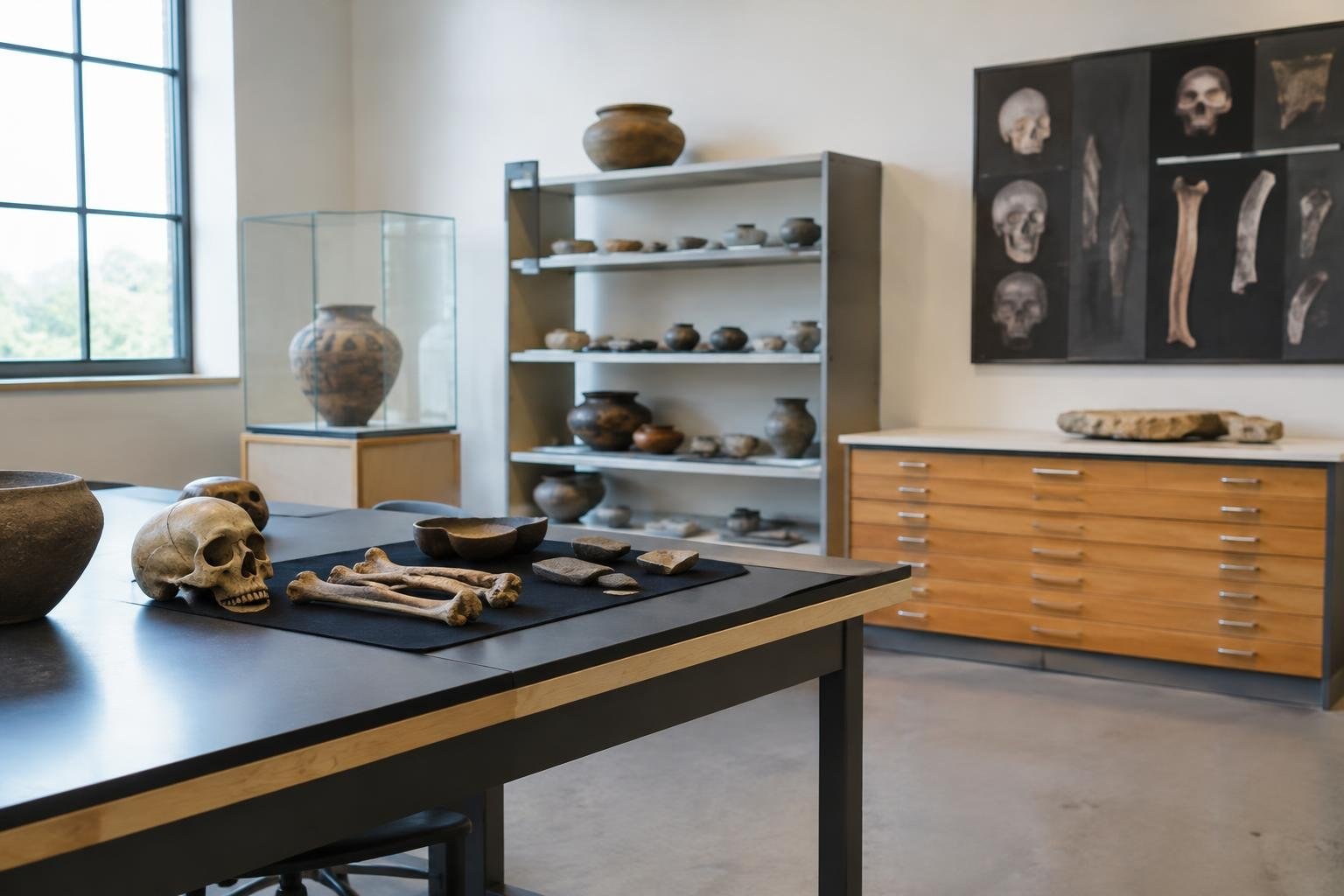
Anthropology students examining artifacts and research notes
What makes this program a specialization?
The federal Classification of Instructional Programs includes a category named Anthropology, Other (CIP 45.0299). This is a reporting classification. Colleges may advertise a track or degree under a more descriptive name. Ask the registrar how the program is recorded and check the published requirements to see what the credential will teach.
The general anthropology curriculum can give you breadth across several subfields. A focused program is useful when you can identify a method, setting, or application you want to pursue and verify that the program gives you supervised practice in it.
Compare required coursework and practical experience
A program centered on community research might train you to design an interview protocol and interpret field notes. A museum-focused option might ask you to assess collection records and explain how an object was acquired or described. A program with a strong applied focus might culminate in a report prepared for a partner organization. Ask which of those experiences is required and which depends on securing a placement yourself.
Review the fieldwork handbook and a recent project description. Find out who approves work with human participants, who owns and may share the resulting data, and what feedback students receive before presenting results. If the advertised specialty relies on one faculty member, ask how often they advise new students.
What Do Anthropology Students Study?
Anthropology coursework teaches students to examine people and societies using evidence, context, and more than one point of view. The exact curriculum depends on the institution, but students should look for a clear progression from introductory material to focused study and substantial independent or collaborative work.
Common areas to investigate
Foundations: introductory concepts and the ways anthropologists ask questions about human life.
Focused study: courses in areas such as cultural, biological, archaeological, linguistic, or applied anthropology, if offered by the program.
Research skills: practice evaluating evidence and explaining conclusions in writing or presentations.
Applied learning: field, laboratory, museum, conservation, or heritage-related opportunities where a program provides them.
Independent work: a project, thesis, or capstone may be available or required, depending on the degree.
These are comparison points, not a universal required-course list. For instance, Utah State University describes hands-on opportunities in laboratories, museum work, and the field for students focusing on anthropology-related areas. Ask whether such opportunities are built into the degree, optional, limited by enrollment, or dependent on a student’s research interests.
A conservation-focused certificate at the University of Georgia describes interdisciplinary preparation related to conservation and sustainable development. That example shows how a certificate can add a focused theme to broader study; it does not mean all anthropology certificates have the same content.
Explore Utah State’s descriptions of hands-on study options and read about UGA’s conservation and sustainable development certificate.
Skills You Can Develop
Anthropology study can help students practice careful observation, research, analysis, and communication. The value of each skill depends on assignments and experience, so students should look for opportunities to apply methods rather than relying on a course title alone.
Research and evidence: form a question, locate relevant material, assess its limits, and explain a reasoned conclusion.
Writing and presentation: communicate findings clearly to people who may not share the same academic background.
Contextual thinking: consider how history, culture, environment, and social setting shape what evidence means.
Ethical awareness: recognize that research involving people, communities, or cultural materials requires care and accountability.
Collaboration: work across perspectives and disciplines, especially in applied or interdisciplinary projects.
Build technical abilities that match your interests. Depending on the program and project, students may encounter research documentation, data organization, mapping, archival material, or laboratory procedures. Do not assume any particular software or technique is included; ask to see course syllabi and examples of student work.
These skills can support research, teaching, nonprofit, government, or applied work, but they do not by themselves qualify a graduate for a specific regulated or specialist role. The CUNY Graduate Center describes doctoral preparation for research, teaching, and nonacademic sectors, while Michigan State describes doctoral preparation for professional anthropology careers in settings that include government, nonprofit, and academic organizations.
Who Is an Anthropology Major Best For?
Anthropology may appeal to students who are curious about how people live, how societies change, and how to make sense of evidence that does not always point to one simple answer. It can suit someone who enjoys reading, asking questions, discussing different interpretations, and connecting ideas from multiple areas.
There is no single personality type for the major. Some students are drawn to fieldwork and community-based questions; others prefer historical records, laboratory work, language, or analysis. The useful question is not whether you match a stereotype, but whether you are willing to learn the methods and responsibilities involved in the kind of anthropology you want to study.
Does anthropology match your goals?
Think about whether you enjoy extended research and writing, whether you want broad academic study or a defined professional credential, and how much additional education you are prepared to consider. Salary, prestige, and job-growth claims should not replace this discussion: they do not show whether the daily work or academic experience will suit you.
Assessment.com’s MAPP assessment can be one reflection tool as you explore motivations and career directions. Use it alongside conversations with faculty, current students, advisers, and professionals. The assessment is not a substitute for checking a program’s curriculum or a career’s actual requirements.
Read more about choosing a college major and explore career and degree options with the MAPP assessment.
Admissions, Program Length, and Academic Demands
Admission rules are set by each institution and credential. An undergraduate application may ask for transcripts and general college admission materials; a graduate program may request prior academic work and additional materials. These are possibilities to verify, not a universal anthropology admissions checklist.
Before applying, contact the program or admissions office to confirm prerequisites, GPA expectations, testing policies, essays, recommendations, portfolio or interview requirements, and whether prior experience is considered. Ask whether transfer courses count toward the major and whether the department reviews transfer credit separately from general admission.
Time to completion depends on the credential, course load, transfer credits, and program design. Certificates and associate degrees represent shorter academic routes than a bachelor’s degree, while master’s and doctoral study require additional work beyond undergraduate education. Do not assume a fixed number of terms or credits based on the credential name alone; request a program map and realistic part-time and full-time timelines.
Common challenges can include managing reading and writing workloads, developing sound research questions, and making a careful argument when evidence is complex. Students can prepare by strengthening academic writing, learning to organize research, and asking early about tutoring, advising, and methods-course support.
Online, Hybrid, and On-Campus Anthropology Programs
Anthropology is available in more than one delivery format, but availability is institution-specific. Colorado State University describes an online anthropology bachelor’s degree. Its student example also shows one possible route from an associate degree into a bachelor’s program, but individual transfer decisions depend on the institution and a student’s transcript.
Online study may help students balance college with work or family responsibilities. Compare whether classes are synchronous or asynchronous, how often courses are offered, and whether fieldwork, laboratory work, internships, or other activities require travel or campus attendance. A program described as online may still have specific in-person expectations, so get those details in writing.
Campus and hybrid study can provide access to in-person activities or faculty and peer interaction. That advantage matters only if the particular program offers the opportunities you need. Ask about scheduling, site access, transportation, and whether places in applied learning experiences are guaranteed or competitive.
See Colorado State University’s online anthropology degree information.
Anthropology Degree Costs and Financial Aid
There is no single tuition price for an anthropology degree. Your total depends on the school, residency classification, credential, course load, delivery format, and how long it takes to finish. Add fees, books, transportation, housing, technology, field activities, and any costs tied to research or specialized facilities when they apply.
Request a written estimate for the full program, not only the advertised per-credit or annual tuition. Ask what charges are mandatory, whether online learners pay separate fees, how transfer credit changes the total, and whether tuition rates may change during your expected enrollment period.
Ways to make the plan more affordable
Submit the appropriate financial-aid forms and ask the institution which grants, scholarships, or work opportunities may apply.
Compare net cost after grants and scholarships, not just the published tuition figure.
Ask an employer whether tuition assistance is available and what conditions apply.
Review transfer-credit policies before paying for courses elsewhere.
Compare a lower-cost starting institution with the receiving college’s transfer plan, including any limits on credits.
Build a budget for living costs and course-related expenses as well as tuition.
A student story from Colorado State describes completing an associate degree before transferring to a bachelor’s program. It is an example of a possible pathway, not a guarantee that credits will transfer or that this route will cost less for every student. Confirm both institutions’ policies before enrolling.
Anthropology Careers, Jobs, and Employment Outlook
An anthropology degree can lead toward multiple kinds of work, but a major alone does not guarantee a job title or qualify someone for every specialized position. The examples below are potential directions associated with anthropology-related career paths. Required education, experience, and credentials vary by employer and location.
Career direction
Education to investigate
How anthropology may connect
Pay and outlook
Anthropologist
Graduate study may be expected for professional research roles; check specific postings.
Research into human societies, culture, or related questions.
Not stated here; consult current occupation data.
Archaeology-related work
Review the employer’s education, field experience, and any credential requirements.
Study material evidence and human history.
Not stated here; varies by role and location.
Postsecondary anthropology or archaeology teacher
Advanced education is generally relevant; confirm employer requirements.
Subject knowledge and research support teaching.
Not stated here; consult current occupation data.
Cultural or heritage resource management
Consider specialized graduate study or relevant applied experience.
Connects research with cultural and heritage resources.
Not stated here; varies by position.
Conservation or sustainable development work
Consider interdisciplinary coursework and experience relevant to the role.
Anthropological perspectives can contribute to multidisciplinary problems.
Not stated here; depends on employer and duties.
Government or nonprofit research and program work
Requirements vary; research experience and applicable skills may matter.
Research and contextual analysis can support programs and policy work.
Not stated here; check the specific occupation.
The CUNY Graduate Center describes doctoral preparation for research, teaching, and nonacademic sectors. Michigan State lists academic, government, nonprofit, and foundation settings among the possible contexts for doctoral careers. Such institutional descriptions identify directions, not guaranteed placements or labor-market growth.
Look up each specific occupation in current U.S. Bureau of Labor Statistics data and distinguish an occupation’s median wage from the earnings of graduates with a particular major.
Anthropology graduates may also apply communication, research, and cultural analysis skills in other fields when employers value those abilities. Employers increasingly use digital tools and automated systems in information-intensive work, but the effect varies by job. Build transferable skills and verify current hiring criteria instead of assuming technology will either eliminate or guarantee a role.
Find out which Career or College Major is right for you!
Experience, Certificates, and Professional Requirements
Field projects, research assistantships, museum or laboratory experiences, internships, volunteer work, and substantial course projects can help students test an interest and show what they can do. Availability varies by institution and location. Ask whether the department helps students find opportunities, how competitive placements are, and whether the work is paid, credit-bearing, or volunteer-based. For one related career direction, see Assessment.com’s overview of museum technicians and conservators.
How to stand out to employers
Keep a portfolio of research questions, written work, presentations, and relevant project outcomes.
Describe your contribution clearly, including the methods used and what you learned.
Pair anthropological study with useful complementary skills such as data organization, writing, language study, or a relevant subject-area minor.
Build relationships with faculty, supervisors, community partners, and professional mentors.
Check job postings for recurring requirements and seek experiences that address the gaps.
Certificates can add a focused topic to a broader academic path. UGA describes interdisciplinary preparation in conservation and sustainable development, while the University of South Carolina describes a graduate certificate designed to complement diverse areas of study. These are program examples, not universal credentials or industry licensing rules.
Degree completion and professional qualification are different. The supplied program information does not establish a universal anthropology license or certification. If a target job mentions a credential, background check, or state requirement, verify it with the employer and relevant official authority before choosing coursework.
Graduate School and Further Study
Graduate study can deepen subject expertise, support advanced research, or prepare students for academic and applied work. Options are not interchangeable: a professional master’s, research master’s, graduate certificate, and Ph.D. can have different purposes and expectations.
Applied anthropology: may suit students interested in using anthropological methods in organizations or practical settings.
Cultural and heritage resource management: can provide a focused route for students interested in heritage work.
Graduate certificate: can add an interdisciplinary topic alongside another degree or professional path.
Doctoral study: may be relevant for advanced research or postsecondary teaching ambitions, subject to hiring conditions and specialization.
The University of Maryland lists applied anthropology, a combined applied anthropology and historic preservation degree, cultural and heritage resource management, and doctoral study. For related degree exploration, see Assessment.com’s guide to architectural history, criticism, and conservation. Michigan State describes its doctoral program as preparation for professional anthropology careers in several settings. CUNY Graduate Center describes training for research, teaching, and nonacademic sectors.
Before committing, ask whether a graduate credential is required for the jobs you want, what experience graduates gain, how funding works, and what alternatives exist. A higher degree adds time and cost; it should connect to a specific goal rather than serve as a vague promise of better employment.
Related Degrees and Alternatives
Compare anthropology with nearby fields by reading course plans and asking what kinds of evidence, questions, and work each program emphasizes.
Archaeology: consider it if your main interest is material evidence and past human societies; confirm whether it is a concentration or separate major at the school.
Sociology: consider it if you want a more focused route into social institutions and group behavior.
History: consider it if you prefer written and archival evidence about past events and change.
Biology: consider it if you want deeper study of living systems and laboratory science.
Environmental studies: consider it if your primary interest is environmental issues and interdisciplinary policy or practice. Explore Assessment.com’s environmental studies degree guide.
Area or cultural studies: consider it if you want a concentrated focus on a region, people, or cultural topic.
Public policy: consider it if you want coursework centered on institutions, programs, and policy decisions.
Heritage or historic preservation: consider it if your goal is directly focused on preserving or managing cultural resources. Related degree options include architectural history, criticism, and conservation.
These are broad contrasts, not fixed definitions. A university may combine fields or offer a concentration that changes the balance. Compare required methods courses, applied work, graduate-school expectations, and the jobs you hope to pursue. For an applied path, the University of Maryland’s program listings show how anthropology can intersect with historic preservation and cultural resource management. Students interested in natural resource topics can also compare Assessment.com’s guides to environmental science and forestry.
How to Choose an Anthropology Program
Anthropology program quality is not determined by the title alone. Begin by checking institutional accreditation through authoritative education resources, then examine the department’s curriculum and whether the credential meets your needs. The supplied program examples do not establish a single field-wide anthropology accreditor or universal licensing standard.
Is the institution appropriately accredited, and will credits transfer to your intended next school?
What courses and concentrations are actually available to students in your expected term?
Which faculty areas, laboratories, museums, or field experiences connect with your interests?
Are internships or applied projects included, optional, or competitive?
What is the full cost after fees, books, travel, and living expenses?
Can you complete the degree online, part time, or through a transfer pathway?
What are the program’s completion and graduate-school pathways, and how are those outcomes defined?
What career advising, employer connections, and research mentoring can students access?
What credential or license, if any, do employers in your target role require?
Request written answers from the department and financial-aid office. Compare at least two program maps and total-cost estimates. Assessment.com’s degree and career exploration resources can help organize questions about fit, but program facts should be verified with the college itself.
Explore degree options and browse career areas as part of your comparison.
From Anthropology Degree to Career
Consider these as possible pathways rather than promised promotions. Education, experience, openings, and employer expectations shape every transition.
Anthropology bachelor’s degree → research or program-support role → build experience with research, documentation, and collaboration → develop a specialty in an applied area → consider advanced study for roles that require it.
Associate degree → transfer into a bachelor’s program → focus coursework and applied projects → pursue graduate study or entry-level work aligned with experience.
Relevant undergraduate study → graduate certificate or applied master’s → gain specialized project experience → pursue cultural or heritage resource work where qualifications match.
Graduate study → research, teaching, or nonacademic work → build a record in a focused area → pursue more advanced responsibilities if opportunities and qualifications align.
Colorado State’s student example describes earning an associate degree in anthropology and transferring to complete a bachelor’s in cultural anthropology. The example shows one route, not a standard sequence or a guarantee of employment. The CUNY Graduate Center and Michigan State describe research, teaching, and nonacademic settings in relation to graduate preparation.
Questions to Ask Before Enrolling
Before you commit, use this checklist in conversations with admissions staff, faculty, financial aid, and current students:
What is the complete estimated cost through graduation, including mandatory fees and course-related expenses?
Which credits will transfer, and can the receiving department confirm that in writing?
What courses, concentrations, and hands-on opportunities will be available during my likely enrollment period?
Are field, laboratory, museum, internship, or research experiences required, optional, or limited?
What is the realistic completion time if I study part time or need to repeat a course?
What academic support and career advising are available to anthropology students?
What education and experience do employers request for the specific jobs I want?
Does my intended career require a credential, license, background check, or graduate degree?
How does the online or hybrid format work in practice, including any in-person requirements?
What grants, scholarships, employer assistance, and other aid could reduce my net cost?
How does the program define and share completion, transfer, and career outcomes?
Ask for evidence and clear definitions instead of relying on broad claims such as “excellent outcomes” or “strong job prospects.” Then compare the answers against your academic interests, finances, preferred learning style, and career plans.
Frequently asked questions
What evidence shows that an anthropology program has a real specialization?
Look for sequenced courses, a faculty supervisor, and a required project or field placement using the same methods. A themed elective alone gives you less evidence of sustained training.
Is anthropology a hard major?
Anthropology may be challenging if you dislike extensive reading, writing, research, or interpreting evidence from different sources. Some programs include scientific or quantitative methods, while others emphasize cultural analysis or history. Review the required courses and ask about methods training before enrolling.
What jobs can you get with an anthropology degree?
Possible directions include research support, cultural or heritage resource work, government or nonprofit roles, and teaching or research after further education. Job titles and requirements vary. An undergraduate degree does not automatically qualify someone for every professional anthropologist, archaeology, management, or teaching position.
How much can you make with an anthropology degree?
There is no single anthropology salary. Earnings depend on occupation, education, experience, employer, and location. Consult current Bureau of Labor Statistics data for each specific job title rather than treating one salary as typical of all anthropology graduates.
Can you earn an anthropology degree online?
Yes. Online anthropology bachelor’s study is available; Colorado State University describes an online bachelor’s degree and a student who transferred from an associate degree into cultural anthropology. Before enrolling, confirm the current course format, any in-person requirements, transfer-credit rules, and total cost directly with the institution.
Do you need a graduate degree to become an anthropologist?
Graduate study is not required for every job that values anthropological knowledge. It is commonly part of the pathway for professional research, academic teaching, and some specialized applied roles. Decide based on the roles you want, then review their employer requirements and the graduate programs that support those goals.
What is the difference between anthropology and archaeology?
Anthropology is broader in its focus on humans, societies, and culture. Archaeology is a major area within anthropology at many institutions and centers on material evidence from past human life, though program structures vary. Compare the actual course plans and fieldwork expectations rather than relying on the degree title alone.
Does anthropology require a license or certification?
There is no universal anthropology license or certification established by the supplied program information. Requirements can depend on the specific job, employer, and state. Ask programs about preparation for your intended work, and verify any credential or licensure requirement with the relevant employer or official state authority.
People Also Ask
What can you do with an anthropology certificate?
A certificate can complement a degree or provide focused study in a topic such as conservation and sustainable development. UGA describes interdisciplinary preparation in that area. Certificates differ in purpose and structure, so confirm whether the credential stands alone, accompanies a degree, or has separate admission requirements.
Do anthropology students do fieldwork?
Anthropology can include research in cultural, biological, archaeological, linguistic, and applied areas, depending on the program. Graduate programs may offer laboratories, museum work, or field opportunities. Look for hands-on components that match the area you hope to explore, and ask what access is guaranteed to students.
Can anthropology lead to a career outside academia?
Some anthropology work involves research, teaching, or nonacademic sectors, but the exact job depends on education, skills, and experience. The CUNY Graduate Center describes doctoral preparation for research, teaching, and nonacademic work. Review job postings for the roles you want to see what employers require.
Is an online anthropology degree available?
Yes. Some schools offer anthropology study online, including Colorado State University’s online bachelor’s program. Online access, course availability, transfer credits, and any in-person work are institution-specific. Ask for the current degree plan and a written estimate of the time and cost to completion.
What is applied anthropology?
Applied anthropology focuses on using anthropological knowledge in practical settings. Programs may connect study with issues such as conservation, sustainable development, or cultural and heritage resource management. Compare curricula and applied projects because the label and professional emphasis are not identical at every institution.
How do I choose an anthropology program?
Start with your intended roles and compare their education requirements with the program’s curriculum, research opportunities, and applied experience. Graduate programs at the University of Maryland include applied anthropology and cultural and heritage resource management options, illustrating that advanced pathways can be tailored to different interests.
Before choosing a program, write down the work you want to do and find a required assignment that would let you practice it. Compare that evidence with the total cost, the time to complete the credential, and the support you will have while doing the work.
Want to see your options? Try our comprehensive Degree, Program & College Search tool
We use cookies to offer you a better browsing experience, analyze site traffic and personalize content.
Read about how we use cookies and how you can control them in our
Privacy Policy.
If you continue to use this site, you consent to our use of cookies.
×
Exciting News!
Be one of the first to Beta Test the new AI-Powered Assessment.com Platform.