Physics, Other: Audit the Curriculum Before You Choose
Physics, Other is a broad classification, not a shared course plan. Learn how to audit physics foundations, lab work, math sequencing, transfer fit, costs, and career requirements.
By David Slack · Staff Writer Assessment.com · Published October 9, 2026 · Last updated November 5, 2026
Physics, Other is CIP 40.0899, a category for physics instruction that does not fit a more specifically named field. The classification tells you where a program is grouped, but not what students will study. To understand a particular option, audit its physics foundations, math sequence, experimental work, and available electives. Then compare that evidence with a transfer plan or career direction you may pursue. Assessment.com can help you explore degree and career options while you verify program details with the college.
Degree & Program Decision Insights
Explore your personal fit, education requirements, career potential and next steps.
01Motivational Fit
Discover whether this program fits you
Explore your preferences against the focus of Physics, Other. These prompts are not personal MAPP results.
Scientific investigation. Would you enjoy investigating physics not listed above and explaining your conclusions from evidence?
Choosing a learning environment. Compare actual Physics, Other offerings. Would their reading, projects or practical work suit how you prefer to learn? Confirm the format rather than assuming one from the field name.
Work reality. Related work can involve this task: “Prepare course materials, such as syllabi, homework assignments, and handouts.” Would you want that activity to be a regular responsibility?
Interest in studying a field can differ from enjoying its related work.
Which part would you want to do repeatedly, and what would you try before deciding?
Discover Your Personal Program Fit
Before investing your time and money in your education, discover how this program aligns with your natural motivations, work preferences and career goals.
Typical occupational entry: doctoral or professional degree (BLS). Postsecondary teaching is a separate appointment and may require advanced study; this programme alone is not a promise of a teaching post.
Typical occupational entry: doctoral or professional degree (BLS).
U.S. occupational wages are not guaranteed graduate earnings; OEWS excludes self-employed workers.
Projected openings include replacements as well as growth.
U.S. national estimates. A crosswalk does not establish entry-level eligibility; advanced, management and teaching roles can require further qualifications.
Compare the focus and route of these distinct instructional fields; their credentials and admission requirements are not interchangeable.
Nuclear PhysicsCIP 40.0806. Compare its emphasis on nuclear reaction theory and quantum mechanics with this program’s focus.
Atomic/Molecular PhysicsCIP 40.0802. Compare its emphasis on chemical physics and atomic forces and structure with this program’s focus.
Condensed Matter and Materials PhysicsCIP 40.0808. Compare its emphasis on low-temperature and solid-state physics and x-ray physics with this program’s focus.
Explore your motivations. Use MAPP as a starting point for reflecting on your interest in “physics not listed above”, then test that interest against a sample learning task.
Examine the work. Compare Physics Teachers, Postsecondary and Physicists on daily work and entry qualifications, as well as pay. Explore Physics Teachers, Postsecondary.
Compare actual providers. Ask for the exact credential, course sequence and assessment methods. Compare how each provider teaches “Physics, Other”, its entry criteria and its itemized costs.
Check the evidence before applying. Confirm prerequisites and any recognition or professional requirements for your intended route; ask for applicable rules and published outcome definitions in writing.
Verify the institution’s current offering, admissions requirements and outcomes; a search result does not establish your eligibility.
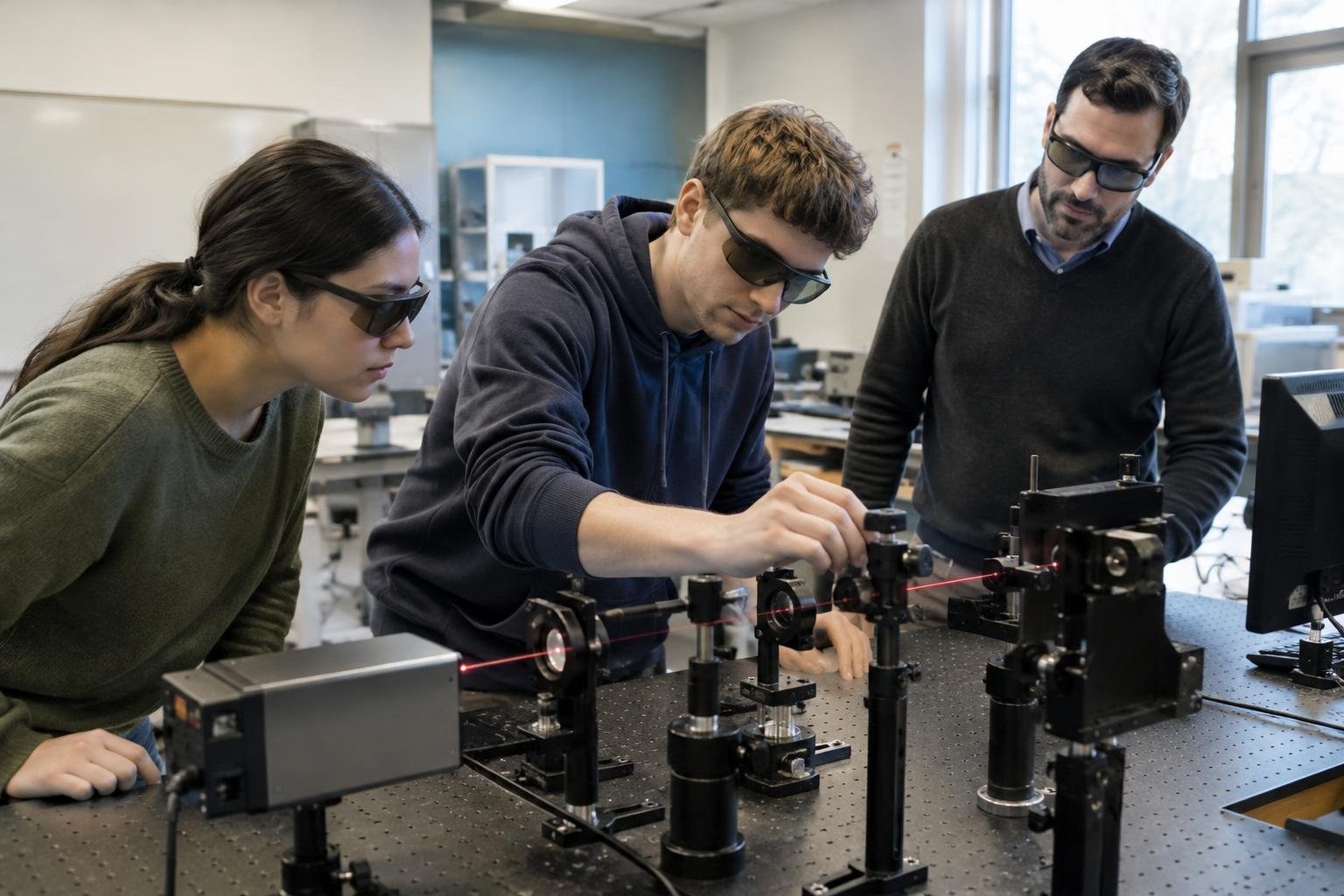
Students conducting a supervised physics experiment in a college laboratory
Interpret the Classification Before Comparing Programs
Read Physics, Other as a classification, not a promise about course content. The supplied program description defines CIP 40.0899 as physics instruction not listed under a more specific category. That means the category alone cannot tell you whether a college emphasizes a broad foundation, a transfer route, or a particular academic mix.
Institutional examples make the variation concrete. The College of Southern Nevada describes a physical-sciences associate degree as a transfer option toward specialized bachelor’s study in physical science or engineering. South Texas College describes an Associate of Science field of study in Physics with general education and a physics emphasis. These are different program descriptions, not templates for every CIP 40.0899 listing. Compare their actual catalogs with the program you are considering, and use Assessment.com’s degree exploration to investigate related study options.
Audit the Curriculum for Evidence of Physics Study
Audit the curriculum by evidence rather than by the broad title. Start with the catalog and identify introductory and upper-level physics courses, mathematics prerequisites, electives, and any required practical work. For each course, ask what students are expected to explain, calculate, measure, or produce. A title can suggest a subject area, but it cannot establish depth or teaching approach.
Then check whether the plan builds from foundational study toward the topics you want to pursue. Ask which later courses depend on earlier ones, how often required courses are offered, and whether the department has a current term-by-term map. The College of Southern Nevada and South Texas College examples show that related physical-science and physics programs can have different purposes. Use the program’s own curriculum, not the CIP label, to judge its fit.
Trace Prerequisites and Course Availability
Course timing can shape whether a plan works. Put mathematics prerequisites and physics requirements on one sequence, then ask the advisor to identify courses that must be taken in order. Check whether each required class is offered often enough to support your expected pace. If you have prior coursework, ask how the college evaluates it for placement and credit rather than assuming it will remove a prerequisite.
For transfer, map the sequence against the receiving institution’s current requirements before registering. The College of Southern Nevada identifies its physical-sciences associate as a direct transfer option to four-year institutions, but that is a feature of its described program, not an automatic guarantee that every course fits every destination. Request confirmation from both colleges on how courses apply to the intended major.
Budget for the Sequence You Will Actually Take
Estimate expenses through completion. Ask the institution for tuition and mandatory fees based on your residency status and credential, then add the other costs it identifies for books, supplies, equipment, commuting, or housing. If you expect to transfer, compare the cost of both stages and confirm which courses apply to the intended bachelor’s major.
Build the estimate around the course sequence, not a generic duration. A prerequisite gap or a required course offered on a limited schedule can affect the plan. Request current financial-aid information and note the academic year and conditions attached to any estimate. Information on the supplied GateWay Community College page includes a specific 2026–2027 aid update; it applies to that institution and period, not to all physics students. Assessment.com’s major-choice resource can help organize exploration, but the college must confirm prices and aid.
Verify the Route Beyond the Credential
Separate school recognition from preparation for the work or study you want next. Verify accreditation through authoritative information and ask the institution whether any specialized accreditation applies to the specific program.
For further study, compare the target program’s prerequisites with the courses in your current plan. For regulated occupations, check the relevant state or professional authority rather than assuming a physics credential itself provides eligibility. UA Little Rock describes physical-science programs at undergraduate and graduate levels and lists settings its programs prepare students to pursue. That is its own institutional description, not evidence of another college’s offerings or outcomes. Read the UA Little Rock program overview.
Use Career Goals to Test the Course Plan
Use career information to ask better curriculum questions, not to infer a guaranteed outcome from the program name. Select a role that interests you and list its stated education, experience, and credential requirements. Then identify which courses or experiences in the program may address them and what remains to be gained elsewhere.
The U.S. Bureau of Labor Statistics provides field-of-degree context for physical-science graduates. For a decision about one occupation, consult occupation-specific information as well. Assessment.com has guides for physicists and postsecondary physics teachers to support exploration. Treat these as possibilities to investigate, not outcomes promised by CIP 40.0899.
Compare Credentials by Their Academic Purpose
Compare related routes by purpose. A physics certificate may complement another field, while an associate program may be designed to transfer and a named physics degree may offer its own focused sequence. The University of Wisconsin–Madison describes physics study as relevant to understanding the physical universe and technology, and its certificate is one way to add physics study to other academic work. The College of Southern Nevada describes a different use: transfer toward a more specialized bachelor’s degree. Neither example establishes what every school offers.
Ask whether the credential is a standalone award or part of a larger plan, how many courses are prescribed, and what happens to the credits if you change direction. Assessment.com’s applied mathematics guide may help when comparing quantitative study interests. Confirm program requirements with the institution.
Look for the Reasoning Behind the Lab Work
A lab is more than a room with equipment. Ask what students actually do with measurements: collect repeated observations, compare results with a model, explain uncertainty, or revise an experimental method. Those activities show how a course connects physical ideas to evidence. The National Institute of Standards and Technology provides guidance on measurement uncertainty and an online uncertainty calculator. Use these as examples of the kind of measurement reasoning to ask about, not as claims about what every program teaches. Review NIST measurement uncertainty resources.
When comparing catalogs, look for lab courses by name, then ask the department what students measure and how their results are assessed. Find out whether the class includes written analysis, instrument use, collaborative work, or feedback on experimental design. If the course descriptions do not make this clear, request a sample syllabus or talk with an advisor. Do not infer lab depth from a course title alone.
Distinguish a Flexible Plan From a Focused One
Some physics plans leave more room for electives or a second academic interest; others prescribe a tighter sequence of specialized work. The difference is useful when choosing, but a named track at one institution should not be treated as the definition of Physics, Other. MIT, for example, describes Flexible and Focus tracks in its Bachelor of Science in Physics. Its Focus track includes two terms of experimental physics and a research thesis, while the Flexible track permits additional academic interests. This is one school’s structure, not evidence that either option is a CIP 40.0899 program. See MIT’s description of its physics pathways.
Use the example to frame questions for your own school: Which requirements are fixed? How many electives can shape a specialty? Is a research project required or optional? Does the program offer enough upper-level courses in the subject you want to pursue? Ask for the current degree map, and compare it with your goal rather than assuming that a flexible label means less rigor or that a focused plan guarantees a particular outcome.
Map Mathematics and Physics in the Same Sequence
Physics relies on mathematical tools, but the title Physics, Other does not reveal which courses or entry level a college expects. Trace the math sequence alongside the physics sequence. Ask which mathematics courses are prerequisites, whether placement or prior coursework can change your starting point, and when required physics courses are offered. A course map with prerequisites and terms can reveal a bottleneck that a list of course names hides.
For each required course, check what must be completed first and whether the next course is available on a schedule that works for you. If you are transferring, compare the sequence with the receiving program’s requirements before taking classes. South Texas College, for example, describes an Associate of Science field of study in Physics with general education and a physics emphasis, and lists pathways including general physics and geoscience/geospatial science. That describes its program, not a universal sequence. Check the South Texas College catalog example.
Estimate the Cost of the Full Course Route
Price a complete route to the credential you want, not just the first term. Request tuition and required fees for your residency status, then identify other costs the school lists for books, supplies, commuting or housing, and course-specific materials. If the route includes transfer, include the receiving institution’s expected time and costs as well. A low-cost first stage is not necessarily economical if credits do not apply to the intended major.
Compare the budget with the actual course map: repeated enrollment, a delayed prerequisite, or a course offered less often than needed could affect your timeline and total expense. Ask financial aid staff for current award information and conditions, and keep the estimates tied to the school and academic year. The supplied GateWay Community College page, for example, contains a financial-aid update for 2026–2027. It is institution- and year-specific, not a general statement about aid for physics students. Check the college’s current physics program information.
Check the Next Step, Not Just the School Name
Recognition of a school and preparation for a particular next step are separate questions. Verify the institution’s accreditation through authoritative information, then ask whether any specialized accreditation applies to the program you are considering.
Instead, test the curriculum against your intended destination. If you are considering graduate study, ask that program what prior coursework it expects and compare those expectations with the undergraduate map. If teaching or another regulated occupation interests you, verify the rules with the relevant state or professional authority; a physics program title alone does not establish eligibility. UA Little Rock describes physical-science study across several credential levels and possible academic and career directions, but that is a description of its own offerings, not a guarantee about a different college. Review UA Little Rock’s program description.
Explore Careers by Matching Evidence to Requirements
A broad classification is not a job title. Start with one or two roles that interest you, then separate their stated requirements into education, experience, and any additional credential. Compare those requirements with the courses and experiences the program can document. If the match is incomplete, identify what you would need to add rather than treating the degree name as a promise of employment.
The U.S. Bureau of Labor Statistics offers field-of-degree information for physical-science graduates. Use that as broad context, then consult occupation-specific information for a role’s requirements and outlook. The field-level picture cannot predict an individual graduate’s job or earnings. Assessment.com’s published guides can help you explore physicist careers and postsecondary physics teaching. These are exploration starting points; verify each occupation’s current requirements independently.
Compare Adjacent Routes by Their Intended Use
Use neighboring program names as prompts for curriculum questions, not as interchangeable labels. A physics-focused plan, a broader physical-sciences transfer route, and a physics certificate alongside another major can serve different academic purposes. Compare the required courses, electives, credential, and destination rather than assuming that a familiar word in the title makes two plans equivalent.
For a transfer route, ask the receiving department which courses apply to the intended major, not merely whether they transfer.
For a certificate, check how its required courses fit alongside the primary degree.
For a named physics specialty, identify which courses or research experiences distinguish it from a broad plan.
The College of Southern Nevada describes its physical-sciences associate degree as a transfer option toward more specialized bachelor’s study in physical science or engineering. The University of Wisconsin–Madison describes a physics certificate as a way to complement other academic work. These examples show distinct institutional designs, not universal guarantees. Read the College of Southern Nevada pathway description and the University of Wisconsin–Madison certificate description.
Make a Short Program Audit Before You Decide
When speaking with an advisor, bring a one-page audit rather than asking whether the program is simply good. Record the credential, required physics and mathematics courses, prerequisites, lab or project options, elective space, and expected course availability. Add the receiving program’s written transfer decisions if you plan to continue elsewhere. Mark each item as confirmed, unclear, or not offered, and follow up on unclear items before enrolling.
Then compare two routes against the same destination: the current program and a more specifically named physics or physical-sciences option. For each, note which requirements it satisfies, what you would still need, and the full estimated cost. Assessment.com’s college major exploration resource and college search can support exploration; confirm curriculum and transfer decisions with the institutions.
Ask What Academic Work Is Actually Available
Physics courses can connect ideas about the physical universe with technology and other disciplines. The University of Wisconsin–Madison describes those connections in its physics certificate information, while the Florida International University source describes a physics department’s research, teaching, and service mission. Those institutional descriptions provide context, not evidence that every broad-category program offers the same resources. Ask what is available to students in the exact credential you are considering.
If a department mentions research, ask whether undergraduates can participate, how students are selected, and whether a project is part of a course or an optional opportunity. If laboratory work matters to your goals, ask how students receive feedback on measurement and analysis. For general exploration of careers and degrees, use Assessment.com’s career resources alongside the program’s own advising. Do not count an opportunity as part of your plan until the department confirms access and timing.
Frequently asked questions
What does Physics, Other mean in a college catalog?
Physics, Other is CIP 40.0899, a classification for instructional programs in physics that are not listed under a more specific field. It does not establish a single required curriculum, so inspect the school’s program map and course descriptions.
Does Physics, Other have a standard curriculum?
The classification does not specify a common set of courses. Compare the institution’s physics and mathematics requirements, prerequisites, electives, lab work, and credential requirements. Ask the department to explain what the course sequence is designed to prepare students to do.
Can an associate degree in physics transfer into a bachelor’s program?
A school may offer an associate pathway designed for transfer, but the receiving institution decides how each course applies to its major. Request a written course-by-course evaluation from the intended receiving program before enrolling.
How can I tell whether a Physics, Other program includes experimental work?
The classification alone does not tell you how much laboratory work a program includes. Look for lab courses in the catalog and ask what students measure, how results are analyzed, and whether lab access is required in person.
Can I complete a Physics, Other program online?
Online course availability does not show whether every program requirement can be completed remotely. Ask the department about in-person labs, equipment, exams, course schedules, and the support available to remote students.
What careers can a Physics, Other program lead to?
The degree label does not guarantee a job or a particular salary. Compare the education and experience requirements for specific occupations with the courses and experiences the program offers. Use official occupation information for job-specific context.
How much can graduates with a Physics, Other degree earn?
There is no single salary tied to this broad classification because graduates may pursue different occupations and further study. Research current official information for the specific jobs you are considering, and do not treat an occupation’s pay data as a guaranteed degree outcome.
People Also Ask
What is CIP 40.0899 in physics?
It is CIP 40.0899, a broad category for physics instruction not listed under a more specific field. The code does not set a shared course plan, so check each college’s curriculum.
Does every Physics, Other program teach the same courses?
No single curriculum is established by the classification. Compare required physics and math courses, prerequisites, electives, laboratory work, and the credential awarded at each school.
How do I confirm that my physics credits will count after transfer?
Ask the receiving college which courses count toward the intended major, and request its decision in writing. A course transferring as credit does not necessarily satisfy a specific major requirement.
What should I ask about physics labs before enrolling?
Use the catalog to locate experimental courses, then ask what students measure, how they analyze uncertainty, and how their work is assessed. Confirm whether the lab can be completed in your planned format.
How do I evaluate whether a broad physics program is a good fit?
Compare the required course map, prerequisite order, course availability, and total expected cost through completion. If you plan to transfer, include the receiving program’s requirements in the comparison.
Do online physics degrees require campus lab attendance?
Not necessarily. Some courses may be remote while labs or other activities may require in-person attendance. Ask the department to identify each location-based requirement for your credential.
Treat Physics, Other as a classification to investigate, not as a complete account of the education it represents. Audit the actual course sequence, experimental work, mathematical preparation, and transfer fit. Then compare the full cost and the requirements of the next step you have in mind. Assessment.com can help you explore degree and career directions, and the MAPP assessment can be one reflection tool as you consider fit.
Find out which Career or College Major is right for you!
We use cookies to offer you a better browsing experience, analyze site traffic and personalize content.
Read about how we use cookies and how you can control them in our
Privacy Policy.
If you continue to use this site, you consent to our use of cookies.
×
Exciting News!
Be one of the first to Beta Test the new AI-Powered Assessment.com Platform.