Marine Biology and Biological Oceanography: Choosing a Degree and Career Path
See what marine biology programs emphasize, how to compare field and lab learning, which career directions to investigate, and what to check before choosing a degree.
By Kieth Nelson · Staff Writer Assessment.com · Published October 9, 2026 · Last updated November 5, 2026
Marine biology degrees connect the study of ocean life with biology and related sciences. The label can cover different academic experiences: one program may foreground organisms and habitats, while another connects biological questions with broader ocean processes. For students and families comparing options, the practical question is not simply whether a college offers the subject. It is whether its courses, research access, cost, and preparation match the work you may want to do afterward. Use this guide to compare those choices and identify what to verify with each department. To reflect on your interests and motivations, Assessment.com’s MAPP assessment can be one input alongside academic advising and career research.
Degree & Program Decision Insights
Explore your personal fit, education requirements, career potential and next steps.
01Motivational Fit
Discover whether this program fits you
Explore your preferences against the focus of Marine Biology and Biological Oceanography. These prompts are not personal MAPP results.
Scientific investigation. Would you enjoy investigating marine microbiology and explaining your conclusions from evidence?
Breadth of interest. Consider the place of “chemical, physical, and geological oceanography” in this field. Is this another part you would choose to explore, or mainly a requirement you would tolerate?
Work reality. Related work can involve this task: “Examine animals and specimens to detect the presence of disease or other problems.” Would you want that activity to be a regular responsibility?
Interest in studying a field can differ from enjoying its related work.
Which part would you want to do repeatedly, and what would you try before deciding?
Discover Your Personal Program Fit
Before investing your time and money in your education, discover how this program aligns with your natural motivations, work preferences and career goals.
U.S. occupational wages are not guaranteed graduate earnings; OEWS excludes self-employed workers.
Projected openings include replacements as well as growth.
U.S. national estimates. A crosswalk does not establish entry-level eligibility; advanced, management and teaching roles can require further qualifications.
Compare the focus and route of these distinct instructional fields; their credentials and admission requirements are not interchangeable.
Marine SciencesCIP 30.3201. Compare its emphasis on marine biogeochemistry and atmosphere and ocean dynamics with this program’s focus.
Oceanography, Chemical and PhysicalCIP 40.0607. Compare its emphasis on material inputs and outputs and chemical and biochemical transformations in marine systems with this program’s focus.
Fishing and Fisheries Sciences and ManagementCIP 03.0301. Compare its emphasis on the principles of marine/aquatic biology and freshwater and saltwater ecosystems with this program’s focus.
Explore your motivations. Use MAPP as a starting point for reflecting on your interest in “chemical, physical, and geological oceanography”, then test that interest against a sample learning task.
Examine the work. Compare Biological Technicians and Zoologists and Wildlife Biologists on daily work and entry qualifications, as well as pay.
Compare actual providers. Ask for the exact credential, course sequence and assessment methods. Compare how each provider teaches “molecular, cellular, and biochemical studies”, its entry criteria and its itemized costs.
Check the evidence before applying. Confirm prerequisites and any recognition or professional requirements for your intended route; ask for applicable rules and published outcome definitions in writing.
Verify the institution’s current offering, admissions requirements and outcomes; a search result does not establish your eligibility.
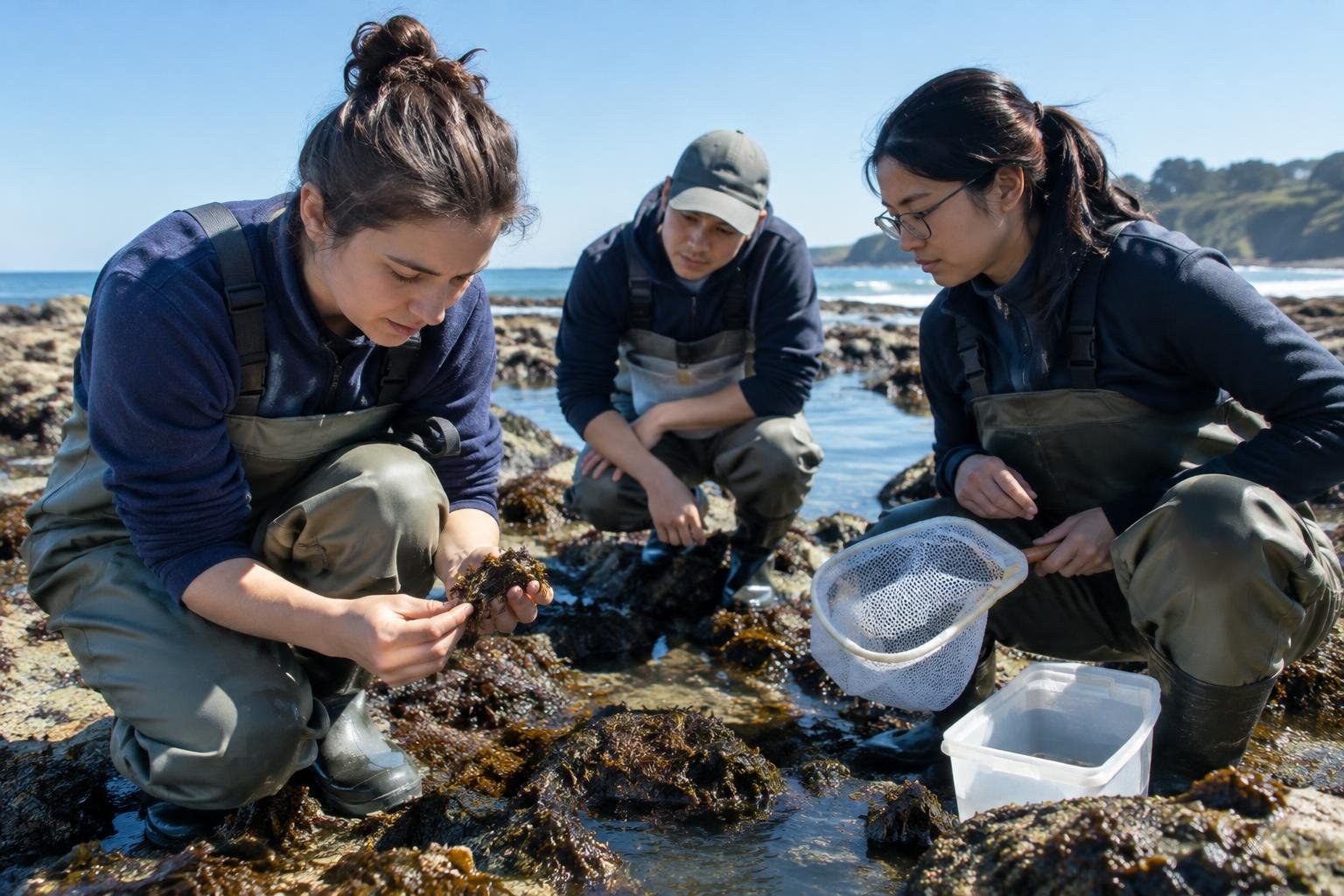
Marine biology students conducting supervised coastal fieldwork
Start With the Program, Not the Label
Think of this major as a way to ask biological questions in a marine setting, not as a promise of one fixed curriculum or career. Topics can range from organisms and habitats to population patterns and the conditions surrounding marine life. Colleges place these subjects in different departments and organize them under different degree names.
Use the course catalog to determine what a program actually teaches. Ask which courses are required, which are electives, and whether students can join research. Examples show how offerings vary: the University of West Florida describes a marine biology B.S., while Scripps lists marine biology M.S. and Ph.D. options. These are illustrations, not a directory of programs.
Read the Course Plan as a Learning Sequence
Read the curriculum as a sequence of tools for investigating marine life. Early science courses provide foundations; later courses may connect biological topics with oceanography and research. For example, SEMO identifies oceanography, physics, organic chemistry, and calculus among additional coursework. Treat that list as a prompt to inspect prerequisites, not a standard plan every college follows.
When comparing departments, look for how students move from concepts to practice. Ask what methods students learn, whether projects involve samples or observations, and how results are analyzed and presented. A field site in a brochure tells you less than a course description that explains who participates and what students do.
Look for Evidence of What You Will Learn to Do
Rather than judging a major by a list of technical terms, consider what students are asked to do with evidence. A course or project may require careful observation, consistent records, interpretation, and clear explanation of results. Science prerequisites can support that work, but the tools and emphasis vary by course and institution.
Ask departments for examples of student projects and the skills they expect students to practice. Keep permitted reports, presentations, or data assignments as evidence of your work. This can help you explain your experience when applying for research-support roles or further study, where each employer or program sets its own requirements.
Check Whether the Work Suits You
Interest in marine animals or the ocean is only one part of fit. Consider whether you also want to spend time learning scientific concepts, working through quantitative material, and handling detailed observations or research tasks. These activities may be a significant part of the academic experience, depending on the program.
Test your assumptions before committing: review an introductory syllabus, speak with students or faculty, and compare the daily tasks in job postings that interest you. An assessment can help you reflect on motivations and preferences, but it cannot determine which major or occupation is right for you. Use results as one perspective alongside advising and your own research.
Explore career and degree options with the MAPP career assessment.
Admissions: Verify the Rules for Your Target Program
Admission is determined by the institution and credential. For undergraduate study, verify the school’s current requirements and the sequence of courses you need before applying. Do not assume that test policies, prerequisites, or transfer rules are the same across colleges.
Graduate applicants should check both academic preparation and research fit. The University of Miami reports that many successful applicants have a biological-sciences background and preparation in physical sciences such as chemistry, physics, and calculus. It also describes successful applicants from varied degree backgrounds and says marine biology or oceanography coursework is not required for entry to its program. This is one school’s guidance, not a rule for all graduate programs.
Contact the department with questions about prerequisites and whether your prior coursework meets its requirements.
Match the Credential and Schedule to Your Plans
The field can be studied at different credential levels, but availability is school-specific. The examples in this guide include a University of West Florida bachelor’s program and Scripps master’s and doctoral options. Do not assume that a college offers every credential simply because the subject appears in a national program category.
Ask for a term-by-term plan and check which courses are prerequisites for later requirements. Transfer credits, part-time enrollment, course rotations, and thesis or dissertation work can affect how long completion takes. If you need online or hybrid study, confirm the location and schedule of any required lab, research, or field component before enrolling.
Ask What Practical Learning Actually Includes
Do not evaluate a program’s practical learning by its location or facilities alone. Ask which students can access field sites, research stations, or labs, how participation is arranged, and whether a particular opportunity is part of a required course or an optional project.
SEMO describes learning settings that include wetlands restoration, a wildlife sanctuary, and a biological research station. The University of West Florida describes campus marshes, wetlands, and Gulf of Mexico access. These examples point to questions for applicants; they do not establish that every student participates in every activity. Ask about transportation, scheduling, accessibility, and extra expenses for the experiences that matter to you.
Compare the Full Cost, Not Just Tuition
Build a full-program estimate before comparing offers. Include tuition and required fees for your residency and enrollment status, then ask whether labs, equipment, transportation, housing, or field activities add costs. Request an estimate that covers the expected course sequence rather than comparing only a per-credit figure.
Ask the financial aid office how grants, scholarships, work-study, payment plans, and transfer credits could change your out-of-pocket cost. Compare net cost and likely borrowing, and verify what each estimate includes. If an in-person project is important to your goals, include its travel and schedule implications in the budget.
Work Backward From Specific Jobs
A degree title does not identify a job or guarantee entry to one. Possible directions to investigate include research support, biological technician work, conservation-related roles, education, and graduate research. Requirements depend on the specific position and employer.
Use job postings as a reality check while you are still comparing programs. Note whether employers ask for a bachelor’s degree, advanced study, particular experience, or other qualifications. For research or teaching goals, investigate the education level expected for the exact role. For any pay question, compare a specific occupation and location using current official data rather than treating all graduates as one workforce.
Explore related paths such as zoologists and wildlife biologists, environmental scientists, and bioinformatics scientists.
Check Credentials Against the Job You Want
A marine biology degree is not itself a universal occupational license. Requirements for a particular job can depend on the duties, employer, and location. Before paying for a certificate or other credential, check whether the roles you want require it, prefer it, or do not ask for it.
Also verify institutional accreditation through the college and appropriate accrediting information. Ask the department or employer about any separate requirements tied to a specialized position. Do not rely on a program’s marketing description as evidence that it meets a requirement for a different occupation.
Turn Projects Into Relevant Experience
Practical experience is most useful when you can explain what you did and what you learned. Ask faculty whether undergraduates may join supervised research, field courses, lab projects, internships, or related activities. Find out how students are selected, when opportunities occur, and whether participation adds cost or credit.
When preparing for an application or interview, describe your role accurately. Save work samples you are allowed to share, such as a report or presentation, and connect your experience to duties in real job postings. SEMO’s listed learning settings, including a wetland restoration project and a biological research station, illustrate the kinds of opportunities to ask departments about; availability and student access are program-specific.
Decide on Graduate Study by Career Goal
Graduate school is one possible route for deeper research preparation, not an automatic next step for every student. First identify the occupation or research question you have in mind. Then compare its requirements with the training offered by candidate programs.
Scripps lists M.S. and Ph.D. programs in marine biology, including specialized tracks in marine biology and marine chemical biology. The University of Miami’s admissions guidance describes science preparation common among many successful applicants while also recognizing varied academic backgrounds. For any program, review faculty research, application criteria, degree expectations, and funding information directly with the department.
Compare Adjacent Fields by the Questions They Ask
Choose alternatives by comparing the questions you want to study, not by assuming that nearby degree names are interchangeable. If you are more interested in broad environmental systems, consider environmental science. If policy or interdisciplinary environmental questions appeal more, explore environmental studies.
For a wider resource-management focus, compare water, wetlands, and marine resources management. For terrestrial systems, review forestry. Oceanography may suit students whose central interest is the ocean’s physical, chemical, or geological environment. Inspect course requirements and research options because programs may overlap.
Weigh the Degree Against Your Actual Plan
Whether this degree is worth pursuing depends on the plan behind it. Consider the total net cost, the learning experience you want, and the qualifications required for several jobs you might realistically seek. Include possible graduate study in the plan if it is relevant to those roles.
Potential benefits include focused study of marine life and opportunities to combine biology with related sciences. Possible tradeoffs include demanding prerequisites, scheduling or travel for practical activities, and the need for further education or experience in some career directions. Compare at least one alternative major and ask each college how its curriculum supports your intended next step.
A Practical Checklist for Comparing Programs
Use a short evidence checklist when contacting departments. Request the current course plan, prerequisites, practical-learning details, and a full cost estimate. Ask whether undergraduate research is available, who can participate, and what schedules or expenses apply. Confirm transfer-credit treatment and academic support with the relevant office.
Which required courses best represent the program’s emphasis?
How do students access research, field activities, and labs?
What costs are excluded from the published tuition estimate?
What jobs or further-study routes have recent students pursued, and how does the department document them?
What is the plan if a required course is offered only in a particular term?
SEMO and the University of West Florida describe different learning settings. Use such examples to form questions, then verify the experience available to students in your intended program.
Build a Career Plan From Real Requirements
Map career possibilities as questions to investigate, not as guaranteed ladders. A student might look at technician or research-support postings and identify which coursework and experience those employers request. Another might compare conservation-related roles and examine whether they call for particular field experience. Someone considering advanced research can review graduate admissions criteria and faculty interests.
For each route, record the job title, required education, requested experience, location, and any additional qualifications. Compare those requirements with the curriculum and opportunities at colleges under consideration. This makes the degree decision more concrete and can reveal when a related major or additional study deserves consideration.
Frequently asked questions
How do marine biology and biological oceanography differ?
Marine biology centers on organisms and their relationships with marine habitats. Biological oceanography studies biological processes in the ocean and may connect them with other ocean sciences. The balance differs by department, so compare required courses and faculty research rather than relying on the program title.
What subjects should I expect in a marine biology major?
Expect biology and related sciences, with the exact sequence set by each college. One program example includes oceanography, physics, organic chemistry, and calculus. Review prerequisites and course availability before enrolling, especially if you need to plan math or science preparation.
What can I do with a marine biology degree?
Potential directions include research-support or technician work, conservation-related roles, education, or further study. A degree does not guarantee a particular job. Check current job postings to learn what employers require for the role, location, and level of responsibility you want.
What salary can marine biology graduates expect?
There is no single salary for everyone with this major because graduates pursue different occupations, and pay varies by employer, location, experience, and education. Research a specific job title and consult current official occupational data rather than relying on a degree-wide estimate.
Can marine biology be studied online?
Some courses may be available online, but delivery varies by institution. Ask whether labs, fieldwork, or research must be completed in person, where those activities happen, and whether travel or extra fees are involved before choosing a program.
Do I need a biology degree to apply to marine biology graduate school?
Requirements depend on the college and degree level. Graduate admissions guidance from the University of Miami describes strong preparation in biological and physical sciences for many successful applicants, while also noting that applicants from varied degree backgrounds may succeed. Check each program’s instructions directly.
Is a master’s or doctorate necessary for marine biology work?
Not for every role. Employers set their own requirements, and some specialized research or teaching paths may call for advanced study. Compare job descriptions with the education and experience you can realistically pursue before deciding whether graduate school is necessary for your goals.
Is marine biology a good fit if I love the ocean?
Interest in the ocean is a useful starting point, but the major also involves sustained science study and may include quantitative coursework, lab work, or research. Try an introductory course or supervised project and consider whether the daily tasks appeal to you as much as the subject.
People Also Ask
What does marine biology and biological oceanography cover?
The program studies organisms and ecosystems in marine settings and may connect biological questions with chemical, physical, or geological ocean processes. The balance depends on the college’s curriculum and research focus.
How long does a marine biology degree take?
There is no single duration for every credential or student. Transfer credits, course sequencing, enrollment pattern, and research requirements can affect the timeline. Ask each school for a degree map based on your circumstances.
What should I compare when choosing a marine biology college?
Compare the course plan, research opportunities, access to field or lab learning, cost, and the department’s support for students. Ask who can participate in hands-on work and whether it carries additional fees.
How can I decide whether a marine biology degree is worth the cost?
It may be worthwhile when the curriculum, cost, and practical experience support a goal you have investigated. Compare likely job requirements and whether further study may be needed before taking on the expense.
Should I study marine biology or oceanography?
Marine biology typically gives more attention to living organisms and biological relationships. Oceanography may focus more on chemical, physical, or geological aspects of the ocean. Programs can overlap, so compare their actual requirements.
Do marine biology careers involve being at sea every day?
The work setting varies. A role or research project may involve field sampling, lab work, data analysis, or communication of findings. Ask about the duties of a specific job rather than assuming it means daily time at sea.
Choosing marine biology is less about imagining a life at sea and more about deciding whether you want to study living systems through sustained science coursework and research. Compare degree plans, access to practical learning, total cost, and the qualifications required for jobs you may pursue. Assessment.com can help you explore related degrees and careers and reflect on whether this direction fits your interests.
Find out which Career or College Major is right for you!
We use cookies to offer you a better browsing experience, analyze site traffic and personalize content.
Read about how we use cookies and how you can control them in our
Privacy Policy.
If you continue to use this site, you consent to our use of cookies.
×
Exciting News!
Be one of the first to Beta Test the new AI-Powered Assessment.com Platform.