Environmental Biology Degree Guide: Courses, Careers, Costs, and Fit
Environmental biology connects the study of living organisms with ecosystems and environmental change. Learn what programs teach, what they cost, and how to compare potential pathways and careers.
By David Slack · Staff Writer Assessment.com · Published November 1, 2026 · Last updated November 5, 2026
An environmental biology degree studies living organisms in the context of ecosystems and environmental change. Depending on the program, students may explore biodiversity, ecology, evolution, conservation, genetics, environmental change, and the tools scientists use to understand biological systems. Coursework can connect small-scale processes, such as genetic variation, with larger patterns in populations, communities, and habitats. The degree may lead toward further study or work related to biological research, conservation, environmental management, and other science-focused fields. The title alone does not determine the courses, qualifications, or job outcomes: programs differ, and some careers require specialized training or graduate education. Prospective students and parents should compare course requirements, practical experience, total cost, and the education expected for specific careers. Not sure whether environmental biology fits you? Explore whether its scientific questions, field or laboratory activities, and potential career directions align with your interests and preferred ways of working.
Degree & Program Decision Insights
Explore your personal fit, education requirements, career potential and next steps.
01Motivational Fit
Discover whether this program fits you
Explore your preferences against the focus of Environmental Biology. These prompts are not personal MAPP results.
Scientific investigation. Would you enjoy investigating computational biology and modeling and explaining your conclusions from evidence?
Breadth of interest. Consider the place of “biodiversity” in this field. Is this another part you would choose to explore, or mainly a requirement you would tolerate?
Work reality. Related work can involve this task: “Inventory or estimate plant and wildlife populations.” Would you want that activity to be a regular responsibility?
Interest in studying a field can differ from enjoying its related work.
Which part would you want to do repeatedly, and what would you try before deciding?
Discover Your Personal Program Fit
Before investing your time and money in your education, discover how this program aligns with your natural motivations, work preferences and career goals.
U.S. occupational wages are not guaranteed graduate earnings; OEWS excludes self-employed workers.
Projected openings include replacements as well as growth.
U.S. national estimates. A crosswalk does not establish entry-level eligibility; advanced, management and teaching roles can require further qualifications.
Compare the focus and route of these distinct instructional fields; their credentials and admission requirements are not interchangeable.
Environmental ScienceCIP 03.0104. Compare its emphasis on biology and chemistry with this program’s focus.
Ecology and Evolutionary BiologyCIP 26.1310. Compare its emphasis on animal, plant, population, functional, evolutionary, and ecosystem ecology and ecological and evolutionary genetics with this program’s focus.
Marine Biology and Biological OceanographyCIP 26.1302. Compare its emphasis on chemical, physical, and geological oceanography and molecular, cellular, and biochemical studies with this program’s focus.
Explore your motivations. Use MAPP as a starting point for reflecting on your interest in “biodiversity”, then test that interest against a sample learning task.
Examine the work. Compare Zoologists and Wildlife Biologists and Conservation Scientists on daily work and entry qualifications, as well as pay. Explore Zoologists and Wildlife Biologists.
Compare actual providers. Ask for the exact credential, course sequence and assessment methods. Compare how each provider teaches “molecular genetic and genomic evolution”, its entry criteria and its itemized costs.
Check the evidence before applying. Confirm prerequisites and any recognition or professional requirements for your intended route; ask for applicable rules and published outcome definitions in writing.
Verify the institution’s current offering, admissions requirements and outcomes; a search result does not establish your eligibility.
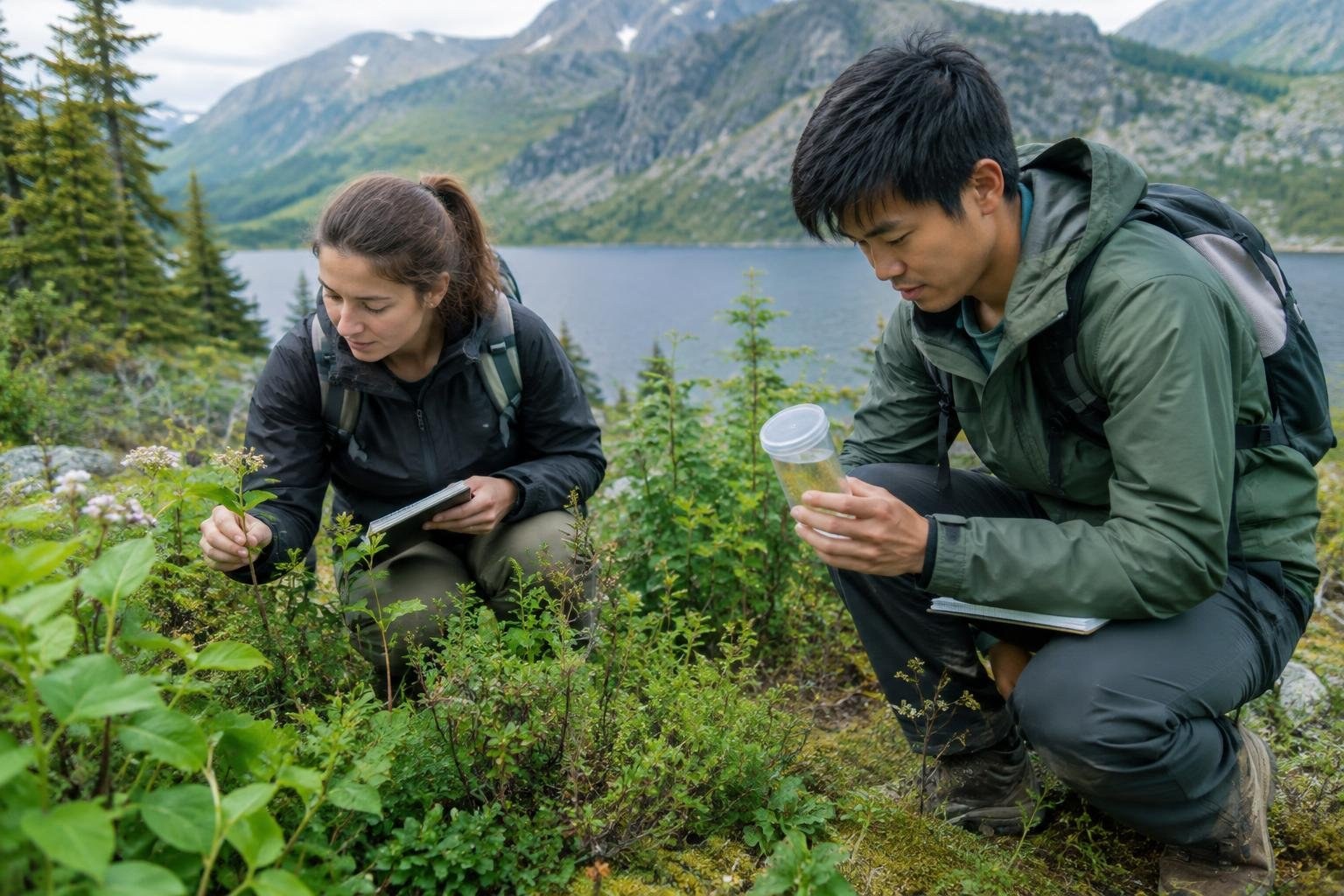
Students documenting plant and habitat observations outdoors with field notebooks and sampling tools
What Is an Environmental Biology Degree?
Environmental biology applies biological study to questions about organisms and the environments in which they live. The field can connect genetics and evolution with population patterns, ecological relationships, biodiversity, conservation, and environmental change. A program description for this area may also include computational biology, modeling, and restoration ecology.
The name can appear in different academic settings and may overlap with biology, ecology, environmental science, or conservation programs. Those titles are not interchangeable guarantees of a particular curriculum. For example, the University of Arizona describes its biology degree as spanning biological systems from components to organisms, communities, and ecosystems, with different emphases available. Compare the actual degree requirements and course catalog.
Environmental biology is a field of study, not a single professional license. Programs may exist at different credential levels, but a college’s use of the field label does not mean it offers every credential. Confirm the actual award and pathway with each institution.
What Do Environmental Biology Students Study?
Expect a mix of foundational science and courses that apply it to ecosystems and environmental questions. Depending on the program, subjects may include general biology, genetics, ecology, evolution, biodiversity, conservation, environmental change, and scientific research. Some programs describe study across multiple biological scales, from molecular processes to ecosystems.
Course titles alone do not show how much practical work a student will do. Ask whether classes include laboratories, field observations, research, data analysis, a capstone, or an internship, and whether any activity is required in person. Do not assume a particular course or practical component is universal.
Programs vary by institution and concentration. For instance, an associate-level biological sciences program at Cecil College describes foundational study in biology, genetics, ecology, and physiology, while the University of Arizona’s online biology program identifies biomedical and organismal emphases. These examples illustrate why the catalog and degree map matter more than a general label.
Look at sample syllabi and upper-level course descriptions. They can help families determine whether a program emphasizes organismal ecology, conservation, biological research, or a broader biological science foundation.
Skills You Can Build
Students may develop several kinds of skills, depending on courses and opportunities they complete:
Scientific reasoning: asking testable questions, interpreting evidence, and recognizing limits in conclusions.
Biological and ecological understanding: connecting organisms and populations with communities and environmental processes.
Quantitative and data skills: reading measurements, evaluating patterns, and learning statistical or computational approaches when included in the curriculum.
Communication: explaining methods and findings in reports, presentations, or collaborative research.
Practical skills: laboratory, field, or research methods when offered and completed.
These skills can support further study and work in environmental, research, government, health, or biotechnology settings, depending on the student's concentration and preparation. Ohio University describes biological science pathways as preparation for graduate or professional study and careers that include environment, health, research labs, and government. That is a range of possibilities, not a promise of employment in any one role.
Who Is This Degree Best For?
This major may appeal to students who want to investigate how living systems work and how environmental conditions shape them. You might enjoy observing patterns, reading scientific evidence, asking why populations change, or connecting detailed biological processes with larger ecosystems. Some students prefer hands-on field or lab activities; others are drawn to data, modeling, or research questions.
There is no single personality type required. The work can involve careful observation, patience, collaboration, written analysis, and comfort revising an explanation when evidence changes. Science coursework may also involve quantitative reasoning. If one of these areas feels unfamiliar, ask about introductory support and prerequisites rather than ruling yourself out immediately.
Does Environmental Biology Match You?
Salary, job growth, and a program’s reputation are only part of a college decision. Consider whether you are interested in the questions and tasks that fill the curriculum, and whether likely career pathways fit your priorities. Assessment.com’s MAPP assessment can be one input for reflecting on interests and motivations; use it alongside conversations with advisers, students, and professionals, not as a final verdict.
Explore college guidance resources and major-selection guidance as you discuss options with your family.
Admissions, Degree Length, and Academic Difficulty
Admissions requirements are set by each college and credential. A first-year applicant may need to meet the institution’s general admission rules and submit academic records. Transfer applicants may face course-equivalency or minimum-credit rules. Programs can differ in prerequisites and selection processes, so verify current requirements directly with admissions offices.
Environmental biology coursework may build on foundational science and mathematics. Ask which high-school or college courses are recommended, whether placement affects the starting course, and what support is available if you need to strengthen a subject.
Completion time depends on credential, enrollment pace, transfer credit, course availability, and any required practical experiences. Part-time study, online or hybrid formats, and transfer pathways can change the schedule. Some students begin with an associate degree and transfer, but they should confirm written course-transfer plans with both institutions before enrolling.
Students often find it helpful to plan ahead for lab schedules, field activities, group assignments, and sustained reading or data work. Speak with an academic adviser early about sequencing prerequisites and balancing science courses.
Online, Hybrid, and On-Campus Options
Environmental biology is offered in different formats at some institutions, but availability and practical requirements are program-specific. An online biology option may still require students to arrange hands-on learning or attend activities in person. The University of Arizona publishes an online biology bachelor’s program, but that does not establish that every environmental biology curriculum can be completed remotely.
Ask the department whether laboratory courses, fieldwork, research, internships, or capstones are required; where they take place; and whether online students can access equivalent opportunities. Confirm how often students must travel to campus or a field location and whether the course calendar works with family, employment, or transportation needs.
On-campus programs may make some practical activities easier to access, while online study can offer scheduling flexibility. Neither format is automatically better. Compare the learning experience and required participation, not just the delivery label.
Tuition, Costs, and Financial Aid
There is no single price for an environmental biology degree. Total cost depends on the institution, credential, residency classification, course load, delivery format, fees, books, equipment, transportation, and living expenses. Required laboratory or field activities may add costs, but ask each program which expenses apply before assuming a specific amount.
Request an individualized estimate of direct charges and likely additional expenses for the full program, not only the first semester. Compare the cost after grants and scholarships with the time needed to complete the credential. Ask how transfer credits affect both the total bill and time to graduation.
Complete the required federal and institutional aid forms, and ask the financial aid office about grants, scholarships, work-study, payment plans, and employer education benefits if applicable. Review loan terms carefully and avoid choosing a program based only on a headline discount or an estimate that leaves out fees.
Public and private institutions can differ in tuition policies, and residency status can affect public-college prices. Verify current charges and eligibility with the institution rather than relying on generic national figures.
Careers, Jobs, and Employment Outlook
Career possibilities may connect to biological research, environmental work, conservation, government, education, or related science settings. The degree can provide relevant knowledge, but employment depends on the role and the graduate’s experience, skills, location, and education. Ohio University, for example, identifies environment, research labs, and government among broad career directions for biological sciences students.
The table below is a planning map, not a promise of eligibility or hiring. It deliberately avoids salary and growth figures because those belong to specific occupations and require current, occupation-level data. Before choosing a program, search official labor-market resources and current job postings for the exact role and location you have in mind.
Potential direction
How the degree may connect
What to verify
Biological research support
Biology coursework and research experience may be relevant.
Required degree level, lab methods, and prior experience.
Environmental or conservation work
Ecology, biodiversity, or conservation study may be relevant.
Field skills, employer requirements, and local opportunities.
Wildlife or natural-resource work
Organismal biology and ecosystem knowledge may be useful.
Specialized coursework, practical experience, and role-specific qualifications.
Biological data or computational work
Quantitative, modeling, or computational study may support this direction.
Specific programming, statistics, and data tools requested by employers.
Government or nonprofit science work
Biological and environmental foundations may apply to some roles.
Hiring rules, experience, and any state or federal requirements.
Teaching or academic research
The degree can be a starting point for further academic preparation.
Teaching credentials or graduate qualifications required for the job.
Some science and academic paths may require graduate education; other openings may have different requirements. Read job descriptions early so that you can choose coursework and experience intentionally.
Find out which Career or College Major is right for you!
Degree completion and professional authorization are different things. Environmental biology is an academic field; whether a particular job requires a license, certification, background check, or other credential depends on the occupation, employer, and jurisdiction. Do not assume that completing this major by itself qualifies you for a regulated role.
Before applying, identify a few target job titles and check their current requirements with the relevant government agency, employer, or professional organization. Ask the college whether its curriculum includes any preparation required for those roles. If you plan to teach, work in a regulated environmental function, or enter a profession with state-specific rules, verify the applicable rules where you intend to work.
For research or conservation-related goals, ask whether internships, field placements, research projects, or technical training are available. Practical experience can help demonstrate preparation, but it is not a substitute for a credential when one is legally required.
Related Degrees and Alternatives
Environmental biology is related to several fields, but the best alternative depends on the work you want to do:
Biology: consider this if you want broader study of living systems, with the option to focus through electives or a concentration.
Ecology: consider this if your strongest interest is relationships among organisms, populations, and environments.
Environmental science: consider this if you want a broader science approach to environmental systems and questions.
Environmental studies: consider this if you want to explore environmental questions through a broader mix of perspectives. Check whether a given program is science-intensive or interdisciplinary.
Conservation biology or natural resources: consider these if you want a more focused connection to conservation or resource management.
Biochemistry or molecular biology: consider these if cellular and molecular processes interest you more than ecosystems.
Geology or earth science: consider these if earth materials and physical environmental processes are your primary interests.
These are broad distinctions, not fixed definitions. For each option, compare required courses, field and laboratory work, quantitative expectations, transferability, and the additional education needed for target careers. Related Assessment.com guides include environmental science, environmental studies, and forestry.
How to Choose an Environmental Biology Program
Program titles are not proof of accreditation. Check the institution’s accreditation status and ask how the program’s credits transfer to colleges you may attend later. If you are pursuing a specific regulated career, verify whether the program meets that jurisdiction’s education rules. Requirements can differ by occupation and location.
Compare programs using a short, documented checklist:
Does the curriculum match your interests in ecology, conservation, biological research, or environmental change?
Are relevant courses offered often enough for you to follow the expected sequence?
What laboratory, field, research, internship, or capstone opportunities are available, and are they required?
What is the full estimated cost after aid, including fees and practical expenses?
Can credits transfer, and can the college show how prior coursework applies?
Does the format fit your schedule and practical-learning needs?
Can the department explain graduate-school advising, career services, and connections to employers or research settings?
What completion and career-outcome information does the institution publish, and how is it measured?
Speak with an academic adviser and ask for written answers when a decision affects transfer, licensure preparation, or total cost. Use Assessment.com’s degree resources to continue exploring related study options.
From Degree to Career: Possible Pathways
Use the degree as one part of a longer pathway, not as a guarantee of a job title. Examples of possible planning sequences include:
Biology coursework → research assistant experience → specialized laboratory or field methods → consider advanced study for roles that require it.
Ecology and conservation coursework → supervised field experience → build relevant data and communication skills → apply to conservation or natural-resource roles whose requirements you meet.
Biology and quantitative coursework → a data-focused project → develop computational skills → investigate biological data roles and their specific technical requirements.
At each step, check actual job postings and talk with faculty, advisers, or professionals. Employers and graduate programs can set different expectations, so adapt the sequence to your goals. A broader biology program may be a better starting point if you want to preserve several options before specializing.
Questions to Ask Before Enrolling
Before committing, students and parents can ask admissions, the department, and financial aid offices:
What is the full name of the credential, and what are the current admission prerequisites?
What will the full program cost after grants and scholarships, including fees, books, travel, and required practical work?
Which courses and practical experiences are mandatory, and how often are they offered?
Can the institution document accreditation and explain transfer-credit policies?
What job or graduate-study outcomes does the college publish, and what do those figures include?
What further education or credentials do the roles I want actually require?
How do online or hybrid students complete labs, fieldwork, research, or internships?
What academic advising, research access, internships, and career services can students use?
What financial aid is available, and what conditions apply to maintaining it?
Compare answers across multiple programs. If an important detail is unclear, request the relevant catalog page or policy before paying a deposit.
Frequently asked questions
What is an environmental biology degree?
Environmental biology is the study of living organisms and their relationships with one another and with changing environments. Programs may include biology, ecology, biodiversity, evolution, conservation, environmental change, and research methods. The course mix and emphasis vary by college, so compare each program’s catalog rather than relying on the major name alone.
Is environmental biology a hard major?
It can be challenging because students may need to combine biology and ecology with chemistry, statistics, data interpretation, laboratory work, and field observations. The demands depend on the program and concentration. Students who plan ahead, use academic support, and build study routines can prepare for the workload; no single science background or personality type guarantees success.
What jobs can I get with an environmental biology degree?
Possible directions include environmental or biological research, conservation, wildlife or natural-resource work, and roles involving biological data. The degree does not qualify graduates automatically for every position. Employers may ask for specialized coursework, field experience, technical skills, or graduate education, depending on the job. Look at current job postings in your intended location before choosing a specialization.
How much can you make with an environmental biology degree?
Pay depends on the specific occupation, education level, employer, experience, and location, so there is no single salary for an environmental biology degree. Compare current occupation-level wage data from an authoritative source such as the U.S. Bureau of Labor Statistics, and review job postings in places where you may want to work. Do not treat a major’s name as a salary forecast.
Can I earn an environmental biology degree online?
Some colleges offer online biology programs, but environmental biology may involve practical experiences that are harder to complete remotely. Check whether the program requires in-person labs, fieldwork, research, or internships, and ask how online students meet those requirements. Confirm that the format supports your intended transfer plans or career preparation.
Does environmental biology require math?
Expect science and quantitative work, but the exact mathematics depends on the curriculum and emphasis. Biology programs may require statistics or other quantitative methods to interpret research and environmental data. Review course requirements early and ask an academic adviser which courses are prerequisites for upper-level classes.
Do you need graduate school for environmental biology careers?
Not for every job related to the field. Some entry-level technician or support roles may be open to people with undergraduate study, while independent research, specialized scientific work, or academic careers may require advanced education or substantial experience. Check requirements for specific jobs before deciding whether a graduate degree is worth the added time and cost.
What is the difference between environmental biology and environmental science?
Environmental biology focuses on living organisms and their interactions with ecosystems. Environmental science is often broader and may include physical sciences, environmental systems, and human impacts; ecology focuses more narrowly on relationships among organisms and their environments. These labels are not standardized across colleges, so compare required courses and available concentrations.
People Also Ask
Do environmental biology majors do fieldwork?
Some programs may include field observations, lab activities, research projects, or internships, but requirements differ. Ask each department what practical work is mandatory, where it takes place, and whether students arrange placements themselves.
What degree levels are available in environmental biology?
The credential options listed for this field range from certificates and associate degrees to bachelor’s and graduate degrees. Availability depends on the institution. Check the exact award, course sequence, transferability, and career purpose rather than assuming that every college offers every level.
How do I choose an environmental biology program?
Compare required biology and ecology courses, quantitative and laboratory expectations, field opportunities, and available concentrations. Then examine total cost, transfer policies, advising, and the qualifications needed for careers you are considering.
How long does an environmental biology degree take?
A certificate or associate program may be a shorter starting point, while a bachelor’s degree generally involves a broader sequence of college study. Graduate credentials add further study after prior education. Actual completion time depends on the institution, enrollment pace, transfer credit, and course availability.
Is environmental biology the same as environmental studies?
Environmental biology is generally centered on biological processes and living systems in environmental contexts. Environmental studies may draw more broadly on social, policy, or human dimensions, while environmental science programs may combine biological and physical science. The distinction is not identical at every college, so compare catalogs.
Will an environmental biology degree qualify me for a conservation job?
Not automatically. A degree can provide relevant scientific foundations, but employers may also consider field or lab experience, technical methods, writing, data skills, and the level of education required for a specific position. Review actual job descriptions in your region and build relevant experience while studying.
Environmental biology can be a strong fit if you want to understand how living things interact with ecosystems and environmental change, and you are ready for science coursework, data analysis, and potentially field or lab work. The degree alone does not guarantee a particular job or salary; your concentration, experience, location, and any further education all matter. Compare the actual curriculum and total cost of each program, then consider whether its day-to-day learning and likely career routes match your interests and goals.
Want to see your options? Try our comprehensive Degree, Program & College Search tool
We use cookies to offer you a better browsing experience, analyze site traffic and personalize content.
Read about how we use cookies and how you can control them in our
Privacy Policy.
If you continue to use this site, you consent to our use of cookies.
×
Exciting News!
Be one of the first to Beta Test the new AI-Powered Assessment.com Platform.