Historic Preservation and Conservation Degree Guide: Programs, Careers and Fit
Learn what historic preservation and conservation programs teach, how credentials and formats vary, what careers they may support, and how to compare programs before choosing one.
By David Slack · Staff Writer Assessment.com · Published October 12, 2026 · Last updated November 5, 2026
A historic preservation and conservation program teaches students how to understand and care for historic buildings and places. Depending on the school, study may focus on architectural design and building techniques or connect preservation with history, archaeology, construction, planning, and other disciplines. Students considering the field often want to protect meaningful places while understanding how they can be maintained or adapted for continued use. Programs range from certificates to doctoral credentials, but not every college offers every level. The curriculum, hands-on opportunities, and career preparation can differ substantially. This guide explains what to examine before committing to a program, including credential choices, costs, potential work directions, and the importance of practical experience.
Degree & Program Decision Insights
Explore your personal fit, education requirements, career potential and next steps.
01Motivational Fit
Discover whether this program fits you
Explore your preferences against the focus of Historic Preservation and Conservation, Other. These prompts are not personal MAPP results.
Subject curiosity. Would you choose to explore “architectural design and building techniques for historic and restored structures not listed above” in depth? Ask for a sample learning activity to test that interest.
Choosing a learning environment. Compare actual Historic Preservation and Conservation, Other offerings. Would their reading, projects or practical work suit how you prefer to learn? Confirm the format rather than assuming one from the field name.
Work reality. Related work can involve this task: “Conduct historical research as a basis for the identification, conservation, and reconstruction of historic places and materials.” Would you want that activity to be a regular responsibility?
Interest in studying a field can differ from enjoying its related work.
Which part would you want to do repeatedly, and what would you try before deciding?
Discover Your Personal Program Fit
Before investing your time and money in your education, discover how this program aligns with your natural motivations, work preferences and career goals.
Postsecondary Teachers, All OtherSOC 25-1199 · O*NET 25-1199.00$77,640/year median (May 2025); +2% projected change (2025–2035); 12,500 projected openings/year.
Typical occupational entry: doctoral or professional degree (BLS). Postsecondary teaching is a separate appointment and may require advanced study; this programme alone is not a promise of a teaching post.
U.S. occupational wages are not guaranteed graduate earnings; OEWS excludes self-employed workers.
Projected openings include replacements as well as growth.
U.S. national estimates. A crosswalk does not establish entry-level eligibility; advanced, management and teaching roles can require further qualifications.
Compare the actual offering and credential before committing your time or money.
Request the itemized fees, materials and equipment associated with “architectural design and building techniques for historic and restored structures not listed above”; confirm what tuition includes.
Compare the full attendance budget, course availability and time away from paid work, rather than tuition alone.
No institution- and credential-matched cost, debt or graduate-earnings amount is reported here; occupational pay is not program ROI.
Financial aid depends on the school, program and student’s eligibility.
Explore your motivations. Use MAPP as a starting point for reflecting on your interest in “architectural design and building techniques for historic and restored structures not listed above”, then test that interest against a sample learning task.
Examine the work. Compare Historians and Postsecondary Teachers, All Other on daily work and entry qualifications, as well as pay.
Compare actual providers. Ask for the exact credential, course sequence and assessment methods. Compare how each provider teaches “Historic Preservation and Conservation, Other”, its entry criteria and its itemized costs.
Check the evidence before applying. Confirm prerequisites and any recognition or professional requirements for your intended route; ask for applicable rules and published outcome definitions in writing.
Verify the institution’s current offering, admissions requirements and outcomes; a search result does not establish your eligibility.
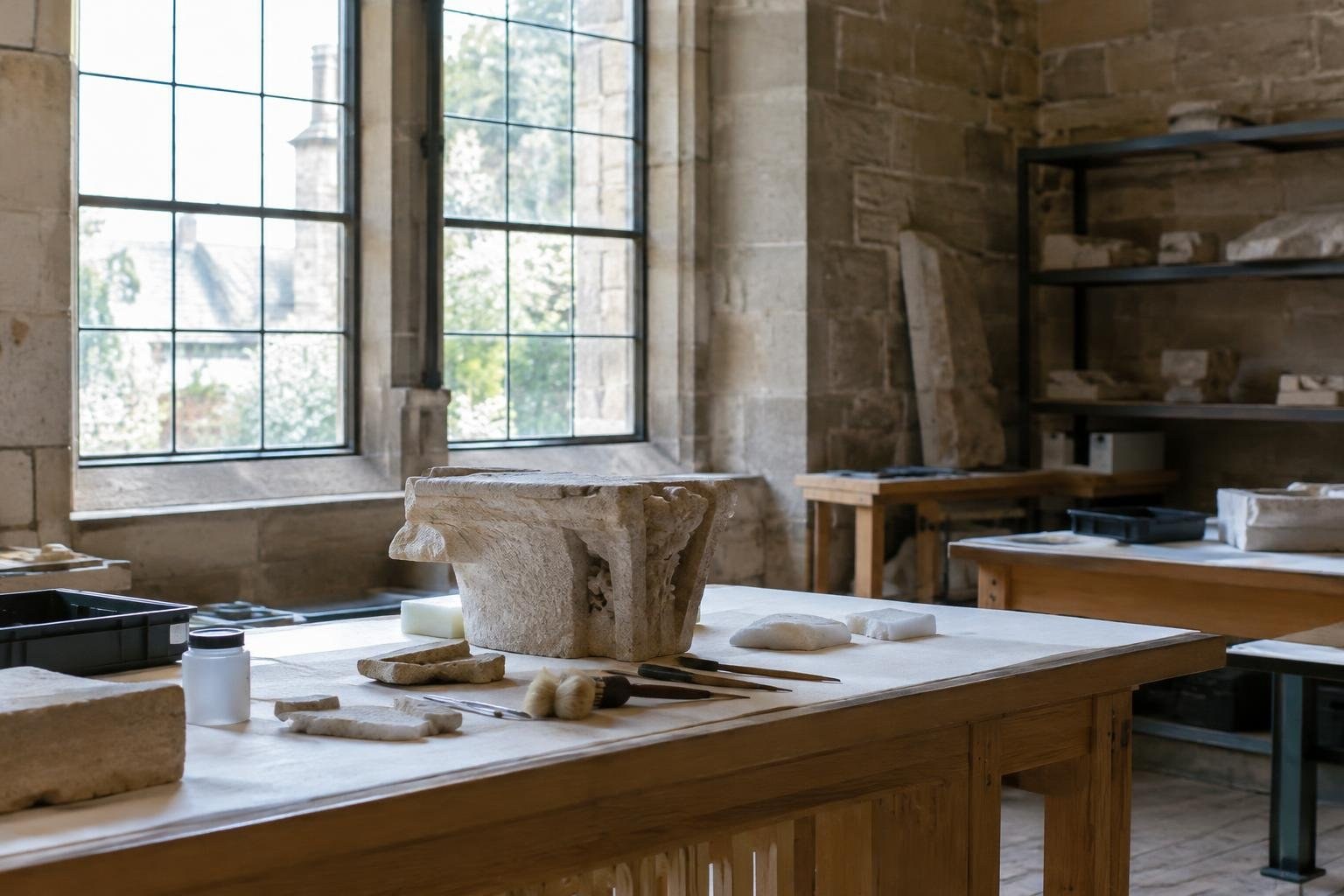
Preservation students examining and recording historic building features
What Is a Historic Preservation and Conservation Degree?
Historic preservation and conservation is a multidisciplinary field concerned with historic buildings and sites. One program may emphasize architectural design and building techniques for historic or restored structures; another may connect preservation to history, archaeology, architecture, building construction, planning, and cultural interpretation.
The program name is not uniform. Colleges may use titles such as historic preservation, historic preservation and conservation, or historic preservation studies. The federal Classification of Instructional Programs code supplied for this subject is 30.1299. Treat that classification as a field identifier, not a promise that schools with similar names teach the same curriculum.
Related fields overlap, but their emphases can differ. Architecture typically centers on designing buildings; historic preservation places particular attention on historic buildings and sites. Architectural history and conservation may be more focused on the historical or conservation dimensions. Compare course requirements, studios, and practical work rather than choosing by title alone. The University of Florida’s program description illustrates the interdisciplinary scope one institution uses.
What Do Students Study? Courses and Applied Learning
Expect variation, but a preservation curriculum may ask students to connect evidence about a place’s past with knowledge of its physical form and construction. The University of Florida describes an interdisciplinary master’s curriculum spanning preservation skills and subjects including anthropology, archaeology, architecture, building construction, cultural tourism, history, interior design, landscape architecture, museum studies, and urban and regional planning.
In practical terms, students should look for coursework that helps them understand historic structures, interpret their context, and communicate preservation choices. Depending on the program, this may involve design or technical assignments, research, site documentation, collaborative projects, or a culminating project. The available program descriptions do not establish that each activity is required at every institution, so check the current course catalog and ask for examples of student work.
When comparing course lists, distinguish a broad interdisciplinary overview from sustained technical preparation. Ask whether the program teaches building documentation, materials or construction topics, design methods, research, and applied work, and how those elements build from introductory to advanced courses. A credible curriculum should make its learning sequence and applied expectations understandable before you enroll.
Skills You Can Build and Put to Work
Students may develop research and interpretation skills, careful observation, written and oral communication, and the ability to consider buildings through more than one discipline. Programs with design, construction, or applied preservation content may also build technical and visual communication skills. The mix depends on course choices and the school’s focus.
These skills can be relevant to preservation practice involving historic buildings and sites, as well as related work that values historical research and documentation. Do not assume that a broad degree automatically qualifies you for a specialized job. Employers may ask for particular technical experience, graduate study, field experience, or other preparation. Use internship and project opportunities to show how you can apply your coursework.
For a useful test of curriculum value, ask the department to identify what graduates can demonstrate: for example, a research product, a building or site documentation exercise, a design proposal, or another applied project. Then compare those examples with the tasks in entry-level job postings you find.
Who Is This Program Best For?
This field may be worth exploring if you are curious about how buildings and places reflect history, enjoy research and close observation, and want to connect ideas to the physical environment. It can also appeal to students who like combining perspectives rather than studying a subject in isolation. There is no single personality type required: some students are drawn to historical interpretation, others to design, construction, planning, or collaborative problem-solving.
Consider the actual work, not only the appealing idea of “saving old buildings.” Programs can involve careful reading and writing as well as applied or technical study. Ask whether you would enjoy documenting evidence, explaining decisions, learning about building techniques, and considering how historic sites are used. If you prefer a more narrowly defined professional curriculum, compare preservation with architecture, construction-related study, history, or another specialized field.
Does Historic Preservation Match You?
Salary, reputation, and broad job-market claims do not tell you whether a program’s daily learning and likely work will suit you. Consider your interests, preferred tasks, learning style, and willingness to pursue further education or practical experience. The MAPP career assessment can help you explore career and degree options alongside conversations with counselors, program faculty, and people working in the field. Treat assessment results as a starting point for research, not as a decision made for you.
Credential Levels, Admissions, Length, and Difficulty
Historic preservation is available at multiple credential levels in the field: certificate, associate, bachelor’s, post-bachelor’s certificate, graduate certificate, master’s, and doctorate. That list does not mean every level is offered at every school, or that each credential has the same professional purpose. Confirm that the credential fits your academic background and intended next step.
Admissions requirements are set by each institution. As one example, the University of Florida says applicants to its Master of Historic Preservation program may hold a bachelor’s degree in any discipline from an accredited university. It describes education or experience in design or planning, technology, or history as useful, but not mandatory for entry to that program. Do not apply that rule to another school without checking its catalog.
Completion time also depends on the degree, number of credits, enrollment pace, transfer credit, and any applied requirements. Ask for the official degree map, typical course sequence, and an estimate for full-time and part-time study. If you are transferring, request a written evaluation of which prior courses apply before using a school’s advertised timeline.
How Demanding Is the Coursework?
Students may need to synthesize historical research with design, building, or planning concepts. The most useful preparation is to strengthen research, writing, visual observation, and foundational technical skills relevant to the program you select. Ask admissions staff which prerequisites are expected and whether applicants can take preparatory courses.
Online, Hybrid, and On-Campus Study
Historic preservation study may be available in campus, hybrid, or online formats, but the formats and in-person expectations vary. The sources available for this guide do not establish that the field’s programs can all be completed remotely. Before enrolling online, ask whether site visits, field documentation, studio sessions, internships, or other learning activities require travel or campus attendance.
Match the delivery format to the skills you need to practice. If a program emphasizes buildings and sites, find out how students gain direct experience with the built environment. Ask who arranges site access, how projects are supervised, and whether a student living outside the school’s region can complete equivalent applied work. Get answers in writing if format or travel will affect your budget and schedule.
Also compare course scheduling, advising access, technology requirements, and the availability of required classes. A format that appears convenient can extend completion time if courses are offered infrequently or if practical components are not available to remote students.
Tuition, Total Costs, and Financial Aid
There is no single reliable price for a historic preservation degree in the research available for this guide. A student’s total cost can depend on public or private institution, residency classification, degree level, program length, delivery format, and required materials or travel. Compare current school-specific estimates rather than relying on a general figure for the discipline.
Request a full cost breakdown that includes tuition, mandatory fees, books, equipment or software, site visits, transportation, and living expenses if you will relocate. Ask whether tuition rates differ for online learners or nonresidents, and whether the program charges additional studio, field, or technology fees. A low tuition rate may not reflect the cost of completing required experiences.
Financial Aid and Affordability
Start with each institution’s financial aid office and current cost-of-attendance estimate. Ask about federal and state aid eligibility, institutional scholarships, assistantships for graduate students, payment plans, and whether an employer offers education assistance. Eligibility and availability depend on the student, school, and funding source; verify conditions before making a budget.
Compare the net cost after confirmed grants and scholarships, not just the published tuition. If choosing between an undergraduate degree followed by graduate study and a direct graduate route after an existing bachelor’s degree, calculate the full cost and time for each. Check transfer-credit policies and avoid assuming that credits or certificates will count toward a later degree.
Careers, Jobs, and Employment Prospects
Career titles and requirements depend on employer and role. Program descriptions can help you identify possible directions, but they cannot establish that every graduate enters the same occupation.
As you explore roles, investigate preservation practice and adjacent work involving historical research, archives, museums, planning, design, or construction. These are areas to research, not a promise that a particular credential alone qualifies you. For each role, check current job postings in the regions where you may work. Record the required degree, technical abilities, experience, and any additional qualification employers request.
Ask programs for transparent information about alumni roles, internships, employer relationships, and the types of projects students complete. Seek examples and context: a graduate’s job title by itself does not show how many graduates found work, how long it took, or whether the role is typical.
Career Path Examples to Investigate
Preservation study → entry-level project or documentation experience → deeper building and site expertise. Ask employers which technical skills and experience are expected for the first role.
History-focused coursework → research or archival experience → specialized historical work. Compare job descriptions for the specific archive or research setting you have in mind.
Preservation graduate study → focused applied projects → advanced preservation responsibilities. Progress depends on experience, employer needs, and the responsibilities of the position.
Potential employers and settings may include organizations involved with historic sites, buildings, cultural resources, or related research. Verify local opportunities through current employers and public job listings. Compensation differs by occupation, location, and qualifications; do not use a single salary figure as the expected outcome for all preservation graduates.
Accreditation, Certification, and Licensure
A degree and a professional license are different things. The information available here does not identify one nationwide license or certification that applies to every historic preservation graduate or role. Requirements may depend on the work, employer, and jurisdiction. Before enrolling, identify the jobs you are targeting and confirm any credential expectations with the relevant employer or government authority.
For program quality, distinguish institutional accreditation from field-specific program review or membership standards. The National Council for Preservation Education states that its membership committee reviews preservation and related educational programs against its membership standards. That review is not the same claim as institutional accreditation or a professional license. Ask a school to explain its accreditation status and any field-specific recognition, and verify claims with the organization involved.
At the student level, internships, research assistance, volunteer projects, building documentation, and faculty-supervised work can help demonstrate relevant experience. Ask whether opportunities are built into the curriculum, how students compete for them, and whether travel or other costs are involved. A certificate can complement a related graduate program, but it does not automatically replace a degree or satisfy an employer’s requirements.
Related Degrees and Alternatives
Choose a program by matching its learning outcomes to the work you want to explore. A historic preservation major or graduate program may be a strong fit if you want an interdisciplinary view of historic places. Consider alternatives if you prefer a more concentrated professional or academic focus.
Architecture: consider this if your main interest is architectural design and building creation rather than preservation as the organizing focus.
Architectural history, criticism, and conservation: consider this if you want a closer emphasis on the history and conservation of architecture.
Landscape architecture: consider this if your primary interest is designing and shaping outdoor environments.
Environmental design: consider this if you want to study design in relation to environments and places.
History: consider this if historical research and interpretation matter more to you than building design or construction content.
Construction-related study: consider this if your primary goal is technical building or construction preparation.
Museum studies: consider this if you are more drawn to collections, interpretation, and museum work.
These fields overlap, and program titles do not guarantee a particular course mix. Compare prerequisites, required courses, applied learning, graduate-school implications, and the job qualifications you see in real postings. Use Assessment.com’s degree guides to explore related fields, then verify program details on the institution’s official site.
How to Choose the Right Historic Preservation Program
Compare programs using a consistent checklist rather than reputation or title alone. Read the catalog, ask specific questions, and keep a written record of the answers.
Curriculum: Does it include the mix of design, history, building techniques, research, and applied preservation you want?
Faculty and facilities: Can faculty explain their teaching and research, and are the learning resources suitable for the program’s stated goals?
Applied experience: Are internships, site projects, fieldwork, or research available? Are they guaranteed, competitive, or student-arranged?
Accreditation and recognition: What institution-level accreditation applies, and does the school make any separate field-specific claim that you can verify?
Format and schedule: Which activities require campus or site attendance, and how frequently are required courses offered?
Total cost and aid: What is the estimated full cost, and which aid sources are confirmed for your circumstances?
Outcomes: What information can the program provide about completion, graduate destinations, and how those outcomes are measured?
Transferability: Which prior courses will count, and can the school confirm that evaluation before you enroll?
Career support: How will you access advising, internships, project feedback, and employer connections?
Use career fit as part of the decision. Assessment.com’s college guidance resources and MAPP assessment can support exploration, while faculty, counselors, and current students can answer program-specific questions. A fit tool is one input, not a substitute for checking requirements, cost, and curriculum.
Questions to Ask Before Enrolling
Before you submit an application or deposit, discuss these questions with a parent, counselor, or trusted advisor and confirm the answers with the school:
What credential is awarded, and what academic or career purpose does it serve?
Is the institution accredited, and where can I verify its status?
What is my estimated total cost after aid, including required supplies, travel, and living expenses?
Which courses and practical experiences are required, and when are they offered?
What are the exact admissions prerequisites, and how will transfer credits be evaluated?
Can I complete the program in my intended format and location, including any site-based work?
What internships, projects, or research opportunities can students access?
What does the program report about completion and graduate destinations, and how are the figures defined?
Are employers involved in projects, mentoring, or recruitment?
Does my intended occupation require additional education, experience, certification, or a license?
What financial aid, scholarships, or payment options am I eligible to pursue?
Then compare the answers against your own priorities. A school that is a good fit should be able to explain what it teaches, what it costs, what practical learning is available, and what the credential does and does not prepare graduates to do.
Frequently asked questions
What is a historic preservation and conservation degree?
Historic preservation and conservation programs study how to understand, retain, and adapt historic buildings and places. Depending on the program, students may examine architectural design, building techniques, history, archaeology, construction, planning, and other related fields. The name and curriculum differ by institution, so review specific course lists and degree requirements rather than assuming every program covers the same subjects.
Is historic preservation a difficult major?
It can be demanding because preservation draws on multiple kinds of knowledge. Students may need to interpret historical evidence, understand buildings and materials, communicate recommendations, and balance design or construction concerns with preservation goals. How challenging it feels depends on the program and your preparation. Ask departments about prerequisites, studio or field expectations, and the level of technical work before applying.
Can I study historic preservation online?
Some programs offer online or hybrid coursework, but delivery depends on the institution and curriculum. Ask whether fieldwork, building documentation, studio work, site visits, or other in-person activities are required. A program being described as online does not by itself establish that every part can be completed remotely.
How long does a historic preservation program take?
There is no single time-to-completion figure for this field. Certificate, associate, bachelor’s, post-bachelor’s certificate, graduate certificate, master’s, and doctoral credentials are represented in the field, but institutions do not necessarily offer every level. Completion time depends on the credential, credit requirements, enrollment pace, transfer credits, and any required practical components. Check the official program plan.
What jobs can I get with a historic preservation degree?
Potential directions include preservation practice and work connected with historic buildings and sites. Some program descriptions also connect the field to histories, archives, and related research. Specific job qualifications vary, and a degree alone does not guarantee a particular role. Review job postings in your preferred location and compare their education and experience requirements with the program’s training.
How much can I earn with a historic preservation degree?
The available evidence here does not establish a current national median salary or outlook specific to graduates of historic preservation programs. Pay depends on the occupation, employer, location, education, and experience. To assess earning potential, identify the exact roles you are considering and consult current occupational data and regional job postings, rather than treating one figure as representative of every preservation career.
Does historic preservation require math?
Historic preservation programs can involve architectural design and building techniques, but the specific level of math varies by curriculum and career direction. Review course descriptions for design, construction, technology, or technical requirements and ask the department which quantitative skills incoming students should have. Do not assume either that the subject is math-free or that every program has the same technical demands.
Do I need a graduate degree to work in historic preservation?
Not for every preservation-related role, based on the program information available here. Some institutions offer undergraduate credentials or certificates, while graduate programs may set their own entry requirements. For example, the University of Florida program description says its master’s program accepts applicants with a bachelor’s degree in any discipline, while noting related experience or education may be useful but is not mandatory. Confirm requirements directly with each school.
People Also Ask
What do you learn in historic preservation?
Historic preservation programs examine historic buildings and places through subjects such as design, building techniques, history, construction, archaeology, and planning. Which subjects are central depends on the institution and the credential.
Are there different levels of historic preservation degrees?
Yes, the field includes different credential levels, from certificates and associate degrees to bachelor’s, master’s, and doctoral study. Availability and program focus vary by institution, so check each school’s official catalog.
What are the requirements for a historic preservation master’s?
Admissions rules depend on the specific program. Undergraduate programs set their own entry requirements, and graduate programs may require a prior degree. The University of Florida’s published master’s description accepts a bachelor’s degree in any discipline and says related experience or education is useful but not required.
What is the difference between historic preservation and architecture?
Historic preservation differs from architecture in emphasis and program design. Preservation curricula may connect building design and techniques with historical, archaeological, planning, and cultural perspectives. Compare required courses and professional preparation at each school before deciding which better fits your intended work.
How much does a historic preservation degree cost?
Costs depend on institution, credential level, residency, attendance format, and required supplies or field experiences. Compare each school’s current estimated total cost of attendance, not tuition alone, and ask about aid, transfer credit, and additional program fees.
Do historic preservation professionals need a license?
The research available for this guide does not establish a single licensing or certification rule for all preservation work. Requirements depend on the particular occupation, jurisdiction, and employer. Ask programs how they prepare students for relevant roles and verify any required credential with the appropriate state or professional authority.
Historic preservation and conservation can suit students who want to understand how buildings and places carry history, and who are willing to combine research with practical design, planning, and building knowledge. Programs vary widely: some emphasize architectural design and building techniques, while others connect preservation to fields such as archaeology, history, construction, and planning. Before enrolling, compare the actual curriculum, total cost, experience opportunities, and the education expected for the work you hope to do. If you are still weighing preservation against another major, use the MAPP assessment to explore how your motivations and preferences may align with different career and degree directions.
Find out which Career or College Major is right for you!
We use cookies to offer you a better browsing experience, analyze site traffic and personalize content.
Read about how we use cookies and how you can control them in our
Privacy Policy.
If you continue to use this site, you consent to our use of cookies.
×
Exciting News!
Be one of the first to Beta Test the new AI-Powered Assessment.com Platform.