Historic Preservation and Conservation Degree Guide: Courses, Careers, and Program Fit
Learn what historic preservation and conservation programs cover, how credentials and formats differ, what careers may connect to the field, and how to compare program fit and cost.
By Kieth Nelson · Staff Writer Assessment.com · Published October 26, 2026 · Last updated November 5, 2026
A historic preservation and conservation program studies how historic buildings, districts, and landscapes can be documented, restored, and maintained while balancing cultural heritage with contemporary needs. Students may connect architectural history and building conservation with land use, public policy, economics, real estate, and communication. Programs use different names and award different credentials, from certificates to graduate degrees. The right option depends on the work you want to explore, how much applied experience you need, and whether you are seeking a broad foundation or a specialized graduate pathway. Not sure whether historic preservation fits you? Take the Free MAPP Career Assessment to consider how your motivations, interests, and preferences align with related fields and career directions.
Degree & Program Decision Insights
Explore your personal fit, education requirements, career potential and next steps.
01Motivational Fit
Discover whether this program fits you
Explore your preferences against the focus of Historic Preservation and Conservation, General. These prompts are not personal MAPP results.
Understanding people and societies. Would you enjoy investigating cultural resource management, comparing perspectives rather than expecting a single simple explanation?
Breadth of interest. Consider the place of “architectural history” in this field. Is this another part you would choose to explore, or mainly a requirement you would tolerate?
Work reality. Related work can involve this task: “Trace historical development in a particular field, such as social, cultural, political, or diplomatic history.” Would you want that activity to be a regular responsibility?
Interest in studying a field can differ from enjoying its related work.
Which part would you want to do repeatedly, and what would you try before deciding?
Discover Your Personal Program Fit
Before investing your time and money in your education, discover how this program aligns with your natural motivations, work preferences and career goals.
Postsecondary Teachers, All OtherSOC 25-1199 · O*NET 25-1199.00$77,640/year median (May 2025); +2% projected change (2025–2035); 12,500 projected openings/year.
Typical occupational entry: doctoral or professional degree (BLS). Postsecondary teaching is a separate appointment and may require advanced study; this programme alone is not a promise of a teaching post.
U.S. occupational wages are not guaranteed graduate earnings; OEWS excludes self-employed workers.
Projected openings include replacements as well as growth.
U.S. national estimates. A crosswalk does not establish entry-level eligibility; advanced, management and teaching roles can require further qualifications.
Compare the focus and route of these distinct instructional fields; their credentials and admission requirements are not interchangeable.
Architectural ConservationCIP 04.0802. Compare its emphasis on building conservation techniques and material conservation with this program’s focus.
Historic Preservation and Conservation, OtherCIP 30.1299. Any instructional program that focuses on architectural design and building techniques for historic and restored structures not listed above.
Explore your motivations. Use MAPP as a starting point for reflecting on your interest in “architectural history”, then test that interest against a sample learning task.
Examine the work. Compare Historians and Postsecondary Teachers, All Other on daily work and entry qualifications, as well as pay.
Compare actual providers. Ask for the exact credential, course sequence and assessment methods. Compare how each provider teaches “building conservation”, its entry criteria and its itemized costs.
Check the evidence before applying. Confirm prerequisites and any recognition or professional requirements for your intended route; ask for applicable rules and published outcome definitions in writing.
Verify the institution’s current offering, admissions requirements and outcomes; a search result does not establish your eligibility.
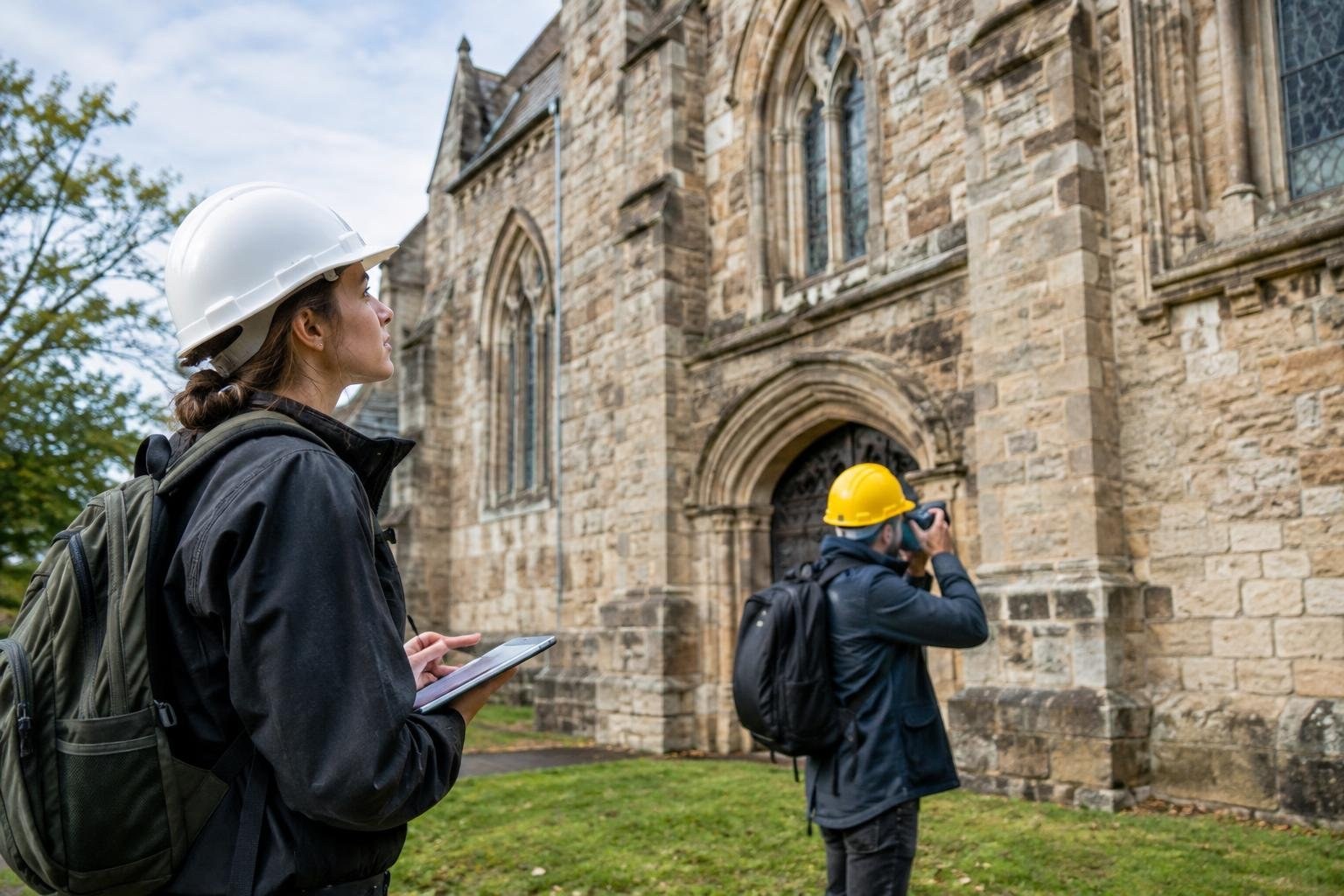
Historic building documentation and preservation fieldwork
What Is a Historic Preservation and Conservation Degree?
Historic preservation and conservation focuses on planning and carrying out approaches to restore and maintain historic buildings, districts, and landscapes. The central challenge is to care for cultural heritage while considering current use, development, and commercial interests. It is not limited to studying old architecture: the subject can involve the history of a place, its physical condition, the rules that shape development, and how the public and property interests are included in decisions.
Program titles vary. Some schools place preservation in architecture, planning, history, or an interdisciplinary studies unit. A related title does not necessarily mean an identical curriculum. Compare required courses and projects, not only the name of the credential. The University of Colorado Denver’s Master of Science in Historic Preservation, for example, is described as preparation for work preserving historic buildings and sites.
What Do Students Study?
Coursework may connect architectural history, building conservation, cultural resource management, historical documentation, land-use and zoning codes, public policy, public relations, real estate law, economics, and taxation. The purpose of combining subjects is to help students understand both the physical and social context of preservation decisions. A project involving a historic property, for example, may require research about its history as well as consideration of future use, policy, and development interests.
Expect the balance to vary. A design-oriented program may emphasize buildings and sites; another may place more weight on planning, policy, or cultural heritage. Ask for a current course list and examples of student work. Rutgers describes its 15-credit graduate certificate as an introduction to cultural heritage and historic preservation through special courses and supervised internship or independent-study opportunities. That example is not a universal requirement for other programs.
Skills You May Develop
Preservation study can build skills in research, historical documentation, interpretation of buildings and places, and written or public communication. Depending on the curriculum, students may also practice evaluating how conservation plans interact with land use, zoning, policy, economics, or real estate considerations.
Research and documentation: locate, organize, and explain evidence about historic places.
Analysis: consider conservation needs alongside use, development, and policy constraints.
Communication: present findings and explain tradeoffs to colleagues, decision-makers, or community audiences.
Collaboration: work across fields whose priorities may differ.
These are areas of learning associated with the field, not a guarantee that every student will master a particular software package or technical method. Ask programs what tools, field methods, and portfolio or project work students actually complete.
Who Is This Program For, and What Are Entry Requirements?
This major may appeal to students who are curious about historic places and want to understand how evidence, building conditions, public choices, and development pressures fit together. It can suit people who enjoy combining research with practical questions and explaining complex topics to different audiences. Interest in buildings alone is not the only reason to consider it: some programs emphasize policy, planning, cultural heritage, or historical research.
It may be less appealing if you want a narrowly technical curriculum or a clearly defined licensed profession immediately after graduation. In that case, compare preservation with architecture, planning, history, or a technical building program and check the qualifications employers request.
Admissions and academic preparation
Admissions rules are set by each institution and credential. A graduate certificate is not automatically open to every applicant: Texas A&M describes its historic preservation certificate as open to its graduate students. Confirm prerequisites, application materials, prior-degree expectations, and whether relevant experience is required with the program itself. Do not assume that a single GPA, test, portfolio, or interview rule applies to the field as a whole.
Credential Levels, Format, and Completion Time
The field includes certificates, associate’s and bachelor’s degrees, post-bachelor’s certificates, graduate certificates, master’s degrees, and doctorates. These are broad credential categories available in the discipline; individual schools may offer only some of them. A short certificate may be intended as focused study, while a full degree follows its own broader program plan. Compare the outcomes and eligibility rules instead of assuming credentials are interchangeable.
Completion time depends on the credential, credit requirements, course schedule, transfer credit, and whether you study part time or full time. The Rutgers certificate is a specific 15-credit example, not a standard for all certificates. Ask each school for a written degree map, expected course rotation, internship or independent-study timing, and the effect of transfer credits. Online, hybrid, and campus availability also varies. If field visits or supervised experiences matter to you, clarify whether and where they must take place.
Careers, Jobs, and Employment Considerations
Historic preservation can connect to work involving archives, history, cultural resources, historic sites, planning, and preservation projects. The program description spans documentation and conservation as well as law, policy, public relations, and real estate. That breadth means graduates may pursue different directions; it does not mean the degree qualifies someone automatically for every role.
Career direction
How study may connect
What to verify
Archivist
Historical research and documentation can be relevant to organizing and interpreting records.
Review job postings for required education, experience, and archival preparation.
Historian
Historical context and research skills can support history-focused work.
Check whether target roles require graduate study or a particular specialty.
Preservation project or program support
Building conservation, planning, policy, and communication topics may be relevant.
Look for the technical, field, or planning experience employers request.
Cultural resource or site work
Cultural heritage and historical documentation may provide useful preparation.
Confirm any agency, employer, or project-specific qualifications.
Career prospects, pay, and hiring needs depend on the role, location, employer, experience, and credential. A degree is a foundation, not a job guarantee.
Experience, Certifications, and Licensure
Hands-on experience can help you test whether you enjoy the day-to-day work and build examples to discuss with employers or graduate programs. Look for supervised internships, independent study, research, documentation projects, or work with historic places offered through a school or community organization. Rutgers explicitly includes supervised internship or independent-study opportunities among options associated with its certificate; ask other programs whether such experience is required, available, or arranged by the student.
How to stand out
Keep a clear record of research, documentation, and project contributions.
Build writing samples or a project portfolio when appropriate to the roles you are targeting.
Seek feedback from faculty and practitioners on the skills employers expect.
Join relevant campus or community projects and explain your specific contribution.
Use job descriptions to identify gaps in your experience before graduation.
A degree and a professional credential are not the same thing. The sources here do not establish a universal preservation license or certification requirement. Ask the program and prospective employers about credentials relevant to the particular work you intend to pursue, and verify any requirements with the responsible organization or jurisdiction.
Graduate School and Further Study
Graduate study may be relevant for students seeking deeper specialization or advanced academic and professional preparation. Options across the field include graduate certificates, master’s degrees, and doctorates, but their focus and admissions criteria differ. A graduate certificate may complement another graduate program; Texas A&M, for example, says its certificate is open to its graduate students from diverse educational backgrounds. Rutgers offers a 15-credit certificate with coursework and supervised internship or independent-study opportunities.
A master’s program may provide a more substantial course of study in preservation. CU Denver’s Dana Crawford Preservation Program offers a Master of Science in Historic Preservation and describes preparation related to preserving historic buildings and sites. Doctoral study may suit a student with a defined research or academic goal, but the supplied program information does not establish common doctoral requirements or career outcomes. Before applying, ask how the credential connects to the role you want and whether work experience or another degree would be a more direct next step.
Related Degrees and Alternatives
Related fields can share subjects with preservation but lead students toward different emphases. Review course requirements and intended outcomes before choosing a label.
Architectural history, criticism, and conservation: consider this if you want a more explicitly architecture-centered study path. Explore the architectural history, criticism, and conservation degree guide.
Landscape architecture: consider this if your main interest is designing and shaping outdoor spaces. Explore landscape architecture.
Environmental design: consider this if you want a broader design focus. Explore environmental design.
Environmental studies: consider this if you want a broader environmental focus rather than a primary concentration on historic places. Explore environmental studies.
History: consider this if historical research is your priority and building conservation is less central.
Planning: consider this if your main interest is land use, zoning, and public decision-making.
Compare technical depth, field experience, graduate-school implications, and the requirements in job postings. Potential earnings depend on the occupation and location, not simply the similarity of major titles.
Tuition, Costs, and Financial Aid
There is no single tuition figure for historic preservation programs. Total cost depends on the institution, credential, residency status, delivery format, course fees, materials, travel or site activities, and living expenses. Ask for a complete estimated cost of attendance rather than comparing tuition alone. If a program includes an internship or field component, find out whether travel, supplies, or other expenses are your responsibility.
Explore grants, scholarships, federal or institutional aid for which you qualify, payment plans, and employer tuition assistance. Eligibility and terms vary, so confirm details with the institution’s financial-aid office and official government resources. Transfer credit may reduce repeated coursework when accepted, but obtain an evaluation in writing before relying on it. A lower sticker price is not necessarily a lower total cost if the course sequence extends your timeline or requires additional travel.
Questions about affordability
What is the estimated total cost through graduation?
Which fees and materials are outside tuition?
What aid is available, and does it renew each year?
Can I transfer credits or study part time without losing eligibility?
What is the likely cost of required fieldwork or internship participation?
Accreditation, Certification, and Professional Requirements
Accreditation matters, but do not infer program accreditation from the word preservation or from a university’s general status. Ask which institution-level and program-level accreditations apply, who recognizes them, and whether they matter for your intended next step. The available program information does not establish a universal accreditation or licensing requirement for all preservation occupations.
Likewise, certification and licensure expectations can depend on a specific job, employer, project, or jurisdiction. Before enrolling, identify a few realistic job titles and review current postings. Ask employers or relevant public agencies whether they require a particular degree, experience, certification, or license. Confirm the answer with the organization responsible for that requirement. A school’s course content can be valuable even when it does not confer a professional credential, but students should know the distinction before investing.
How to Choose the Right Program and Evaluate Fit
Choose a program by matching its actual learning opportunities to a career direction and a budget. Ask admissions staff and faculty for specific answers, then compare them across schools. Do not rely only on promotional descriptions or a general claim that a program prepares students for preservation work.
Which courses are required, and how much flexibility is there to focus on buildings, planning, policy, or cultural heritage?
What supervised internship, independent study, research, or fieldwork is offered?
What qualifications do recent job postings request for the roles I want?
What is the full cost, including fees, materials, travel, and living costs?
Can I complete the program online or part time, and are any requirements in person?
How are transfer credits evaluated, and will the credential be useful for my next step?
What career services, practitioner connections, and project opportunities can students access?
For fit, consider whether you enjoy the underlying tasks: researching historic places, documenting evidence, assessing tradeoffs, and communicating decisions. Assessment.com’s college major guidance can support further exploration. The Free MAPP Assessment is another way to reflect on career and degree options; treat it as one input alongside research and conversations with counselors, faculty, and practitioners.
From Degree to Career: A Realistic Pathway
Use a step-by-step path as a planning example, not a promised career ladder:
Degree or certificate: build a foundation in preservation, history, documentation, or planning, depending on the curriculum.
Entry-level exploration: seek assistant, project-support, archival, historical, or site-related opportunities that match your experience and employer requirements.
Experience: develop research, documentation, field, communication, or planning skills through supervised work and projects.
Specialization: focus on a type of site, policy area, historical period, or related professional discipline if it fits your goals.
Advanced work: consider further education or responsibility when a specific role requires or rewards it.
Progress depends on openings, geography, experience, additional qualifications, and individual choices. Before choosing a program, work backward from real job postings and ask which parts of the pathway the school can help you develop.
Questions to Ask Before Enrolling
Use this checklist with a parent, counselor, or college advisor before committing:
Is the institution appropriately accredited, and are any program-specific credentials relevant to my goal?
What is the complete cost of attendance, and what aid is renewable?
Which courses and specializations are required?
Are internships, independent study, fieldwork, or site visits required or available?
Can the program prepare me for the qualifications in my target job postings?
Which activities must be completed in person?
Will my transfer credits count, and can I see the decision in writing?
What career advising, employer connections, and project opportunities are available?
What additional education or experience might my preferred career require?
If the answers are vague, request written details and compare another program before making a decision. A clear understanding of requirements and costs helps families assess both academic fit and financial risk.
Frequently asked questions
What is a historic preservation and conservation degree?
Historic preservation and conservation programs study how historic buildings, districts, and landscapes can be documented, maintained, and adapted while considering cultural heritage and development pressures. Depending on the program, study may connect architectural history and building conservation with policy, economics, real estate, land use, or public communication. The exact curriculum varies by school and credential.
Is historic preservation a difficult major?
It can be challenging because students may need to combine historical research, careful documentation, design or building knowledge, and analysis of policy and development concerns. The balance varies across programs. Before enrolling, read the course descriptions and ask whether students complete supervised fieldwork, an internship, independent study, or a project relevant to the work they hope to do.
What jobs can you get with a historic preservation degree?
Potential directions include preservation planning and project support, cultural resource work, archival work, and history-related roles. The degree alone does not guarantee a specific job, and some positions may expect additional education, experience, or specialized preparation. Look at actual job postings in your preferred region and compare their requirements with each program’s curriculum and experiential opportunities.
Can you study historic preservation online?
Yes. Some preservation-related coursework may be available online, but the format depends on the institution and credential. Ask whether the program requires site visits, supervised internships, studio or field activities, or in-person research. An online label does not establish that every required experience can be completed remotely.
How long does a historic preservation program take?
There is no single completion time for every historic preservation credential. Certificate, associate, bachelor’s, post-bachelor’s, graduate certificate, master’s, and doctoral options exist across the field, but schools differ in what they offer and in credit requirements. Check the official program plan, part-time options, transfer policies, and any internship or capstone expectations before estimating your timeline.
How do I choose a historic preservation program?
Compare the program’s subject emphasis, hands-on learning, faculty expertise, total cost, delivery format, and career preparation. Ask for a course map and details about internships, independent study, fieldwork, and the kinds of student projects completed. Also check whether the credential meets any education requirements for your intended role; do not assume a degree title guarantees professional eligibility.
People Also Ask
What does historic preservation and conservation study?
It is an interdisciplinary field concerned with understanding and caring for historic places. Programs can link architectural history and building conservation with planning, policy, economics, documentation, and public interests. Course emphasis varies by school.
Do historic preservation programs include internships?
Some programs include applied experience such as supervised internships or independent study. Rutgers describes its 15-credit certificate as combining special courses with supervised internship or independent-study opportunities. Verify requirements directly with the school.
What degree levels are available in historic preservation?
Credential options in the field include certificates, associate and bachelor’s degrees, post-bachelor’s and graduate certificates, master’s degrees, and doctorates. These are possible levels across the field, not a promise that every institution offers each one.
Who should consider a historic preservation major?
Historic preservation may suit students interested in historic places and in the practical questions involved in conserving them. The work can bring together research, documentation, planning, and communication. Compare program curricula to determine whether a particular option fits your interests.
Is historic preservation an interdisciplinary major?
Historic preservation may draw on architecture, history, economics, real estate, design, policy, and law. The mix differs among programs, so review published course requirements rather than relying only on a major’s title.
How is a preservation certificate different from a degree?
A certificate may provide focused study or complement another graduate program, while a full degree involves a broader course of study. Texas A&M describes its certificate as open to its graduate students from diverse educational backgrounds. Check each institution’s eligibility rules and curriculum.
Historic preservation and conservation can suit students who want to connect history, buildings, places, policy, and practical decision-making. The field spans several credential levels, but program names and career preparation differ, so compare actual courses, applied experience, costs, and the qualifications requested for the work you want to do. If you are still weighing preservation against another direction, use Assessment.com’s career and degree exploration resources to consider how your interests and preferences align with different paths.
Find out which Career or College Major is right for you!
We use cookies to offer you a better browsing experience, analyze site traffic and personalize content.
Read about how we use cookies and how you can control them in our
Privacy Policy.
If you continue to use this site, you consent to our use of cookies.
×
Exciting News!
Be one of the first to Beta Test the new AI-Powered Assessment.com Platform.