Mathematics and Atmospheric/Oceanic Science: A College Guide
Considering a Mathematics and Atmospheric/Oceanic Science degree? Compare the math and science emphasis, study pathways, career directions, and questions to ask colleges.
By Kieth Nelson · Staff Writer Assessment.com · Published October 12, 2026 · Last updated November 5, 2026
A Mathematics and Atmospheric/Oceanic Science degree is for students who want to use mathematical thinking to examine the atmosphere and oceans. It is an unusual combination: the appeal is not simply studying two subjects, but learning how quantitative methods relate to natural systems. Yet a program title alone cannot tell you how much math, physical science, computing, or research a student will encounter. This guide explains how to inspect that balance, compare undergraduate and graduate examples, and connect the curriculum to possible next steps. Assessment.com can help you explore career and degree options alongside your college research.
Degree & Program Decision Insights
Explore your personal fit, education requirements, career potential and next steps.
01Motivational Fit
Discover whether this program fits you
Explore your preferences against the focus of Mathematics and Atmospheric/Oceanic Science. These prompts are not personal MAPP results.
Scientific investigation. Would you enjoy investigating chemistry and explaining your conclusions from evidence?
Breadth of interest. Consider the place of “physics” in this field. Is this another part you would choose to explore, or mainly a requirement you would tolerate?
Work reality. Related work can involve this task: “Prepare scientific atmospheric or climate reports, articles, or texts.” Would you want that activity to be a regular responsibility?
Interest in studying a field can differ from enjoying its related work.
Which part would you want to do repeatedly, and what would you try before deciding?
Discover Your Personal Program Fit
Before investing your time and money in your education, discover how this program aligns with your natural motivations, work preferences and career goals.
U.S. occupational wages are not guaranteed graduate earnings; OEWS excludes self-employed workers.
Projected openings include replacements as well as growth.
U.S. national estimates. A crosswalk does not establish entry-level eligibility; advanced, management and teaching roles can require further qualifications.
Compare the focus and route of these distinct instructional fields; their credentials and admission requirements are not interchangeable.
Mathematics and Computer ScienceCIP 30.0801. A program with a general synthesis of mathematics and computer science or a specialization which draws from mathematics and computer science.
Mathematics, GeneralCIP 27.0101. Compare its emphasis on algebra and calculus with this program’s focus.
Climate ScienceCIP 30.3501. Compare its emphasis on biology and climate analysis with this program’s focus.
Explore your motivations. Use MAPP as a starting point for reflecting on your interest in “chemistry”, then test that interest against a sample learning task.
Examine the work. Compare Atmospheric and Space Scientists and Mathematical Science Occupations, All Other on daily work and entry qualifications, as well as pay. Explore Atmospheric and Space Scientists.
Compare actual providers. Ask for the exact credential, course sequence and assessment methods. Compare how each provider teaches “physics”, its entry criteria and its itemized costs.
Check the evidence before applying. Confirm prerequisites and any recognition or professional requirements for your intended route; ask for applicable rules and published outcome definitions in writing.
Verify the institution’s current offering, admissions requirements and outcomes; a search result does not establish your eligibility.
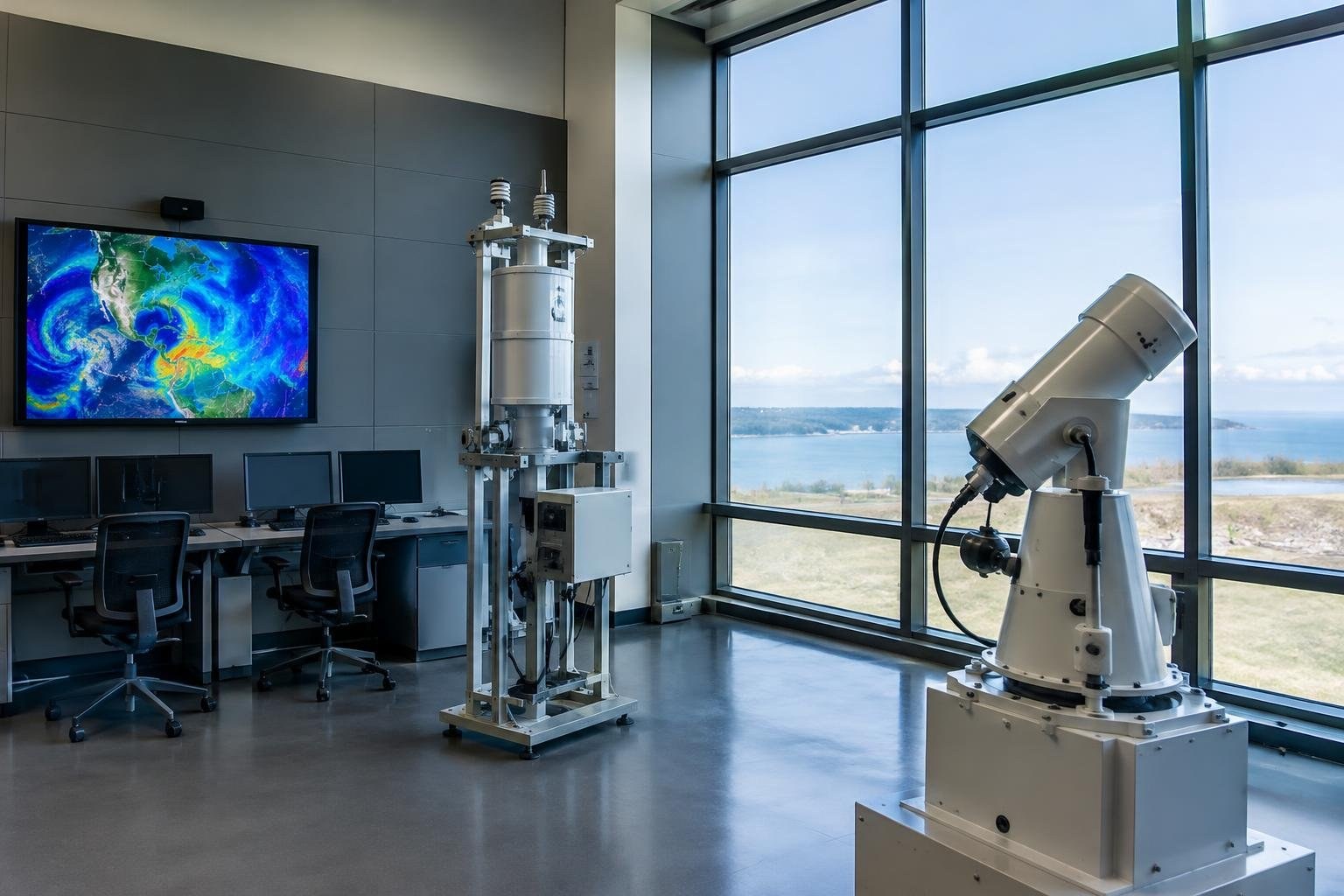
A student working with a visualized atmospheric or oceanic model
What This Interdisciplinary Major Connects
This field is defined by its application: mathematical approaches are used to examine questions involving the atmosphere and oceans. The National Center for Education Statistics lists the specialty under CIP code 30.5001; its concise definition describes the application of mathematics to atmospheric and oceanic problems. Read the NCES program definition to understand the classification, then consult colleges for their actual degree requirements.
Program names are not standardized in meaning. UCLA identifies an undergraduate Atmospheric and Oceanic Sciences/Mathematics BS, while NYU describes a separate interdisciplinary PhD in Atmosphere Ocean Science and Mathematics. Those examples show that related study can appear at different degree levels; they do not imply identical content or a single route through the field.
When you compare a dedicated combined program with separate math and atmospheric science majors, look for required courses that bring the two disciplines together. The course map, not the label, reveals whether the connection is central or incidental.
Read the Curriculum as a Connected Sequence
The subject range offers a starting point for evaluating a curriculum, not a checklist every college must follow. The broad program description includes mathematics and physical sciences as well as atmospheric and ocean dynamics, climatology, weather simulation, climate modeling, oceanography, and atmospheric science. Ask whether the school covers the topics that matter to your interests and how the prerequisites build toward advanced work.
UCLA says its major combines courses from Atmospheric and Oceanic Sciences and Mathematics departments and aims to pair rigorous mathematical preparation with relevant atmospheric, oceanic, and environmental science. That description gives prospective students a useful comparison question: do the required classes connect technical methods to the science, or are the two areas mostly separate?
Request a current degree map and review advanced course descriptions. Ask what computing, project, laboratory, or research opportunities are available, and whether they are required, optional, or limited in access. Do not infer a specific skill or experience from a degree title alone.
Test the Fit Between the Two Disciplines
Students in this area must be prepared to work with quantitative ideas and scientific concepts together. One way to test the fit is to imagine a course moving between a mathematical method and the atmospheric or oceanic question it helps frame. If you enjoy that transition, the combination may be more engaging than either discipline on its own. If you prefer one subject and want little exposure to the other, a broader or more focused major may be a better comparison.
Look for evidence of what you will actually practice: course assignments, faculty projects, and descriptions of computing or modeling work. UCLA’s program description emphasizes mathematical training alongside science relevant to atmospheric, oceanic, and environmental topics, but it does not promise a particular software skill or project to every student.
For each program, ask how students demonstrate their learning. A research paper, model, presentation, or other documented project can help you explain your preparation later, if the program offers such work.
Who May Find the Combination Rewarding
This path may appeal to students who want mathematics to answer questions about the natural world. Interest in weather, climate, oceans, or environmental systems can supply context for demanding quantitative study. The key is not to arrive with a fixed career identity, but to be willing to learn both the methods and the science those methods describe.
Before applying, inspect the mathematics prerequisites and the first courses required for the major. Ask an adviser how introductory work leads into upper-level courses and what academic support is available. Admissions rules belong to each institution, so verify current requirements with the school rather than relying on a general description of the field.
Students still weighing alternatives can use Assessment.com’s college major decision guidance to structure their reflection, then compare that insight with syllabi and conversations with faculty.
Compare Credentials and Study Arrangements
Start with the credential you want and the program that actually awards it. UCLA lists an undergraduate BS major in Atmospheric and Oceanic Sciences/Mathematics. NYU describes an interdisciplinary PhD in Atmosphere Ocean Science and Mathematics. Oregon State describes a related graduate major in Ocean, Earth, and Atmospheric Sciences, where students begin with Earth-system study and continue into focused graduate coursework and research. These are useful examples, not a universal sequence from bachelor’s degree to doctorate.
Ask each institution for the expected course sequence, term offerings, transfer-credit rules, and study formats. If considering distance study, confirm how students access courses and any relevant research or applied work.
For graduate study, examine the research expectations and subject emphasis. The Oregon State option is related Earth-system study, not necessarily a mathematics-and-atmospheric/oceanic science degree.
Build a Realistic Program Cost Comparison
Build a full-program estimate that includes tuition, mandatory fees, housing, books, materials, and transportation, then consider whether course sequencing or transfer-credit decisions could change the time required to finish.
Ask the financial-aid office about grants, scholarships, work-study, and eligibility for federal aid. Treat funding as conditional until you have the award details, renewal rules, and covered costs in writing. Graduate applicants should separately ask whether funding exists and what academic or work responsibilities accompany it.
A useful comparison is not simply the lowest published annual price. Put the net cost, expected time to completion, aid terms, and course availability side by side. If transferring, request written confirmation of how credits apply to major requirements.
Connect the Major to Specific Career Questions
Think of career options as questions to investigate rather than outcomes promised by a major. The subject can relate to atmospheric science, mathematical analysis, water resources, research, or teaching. Which roles are realistic for a particular graduate depends on the position’s stated education, experience, and technical requirements.
Use current job descriptions to work backward from a role: identify the required credential, methods, and experience, then ask whether the college offers courses or projects that help you build relevant evidence. Assessment.com has guides to meteorologists, mathematicians, and water resource specialists for exploring related directions.
The research supplied here does not support a salary estimate or labor-market forecast. Avoid treating the degree name as a wage category; investigate current official information for a specific occupation and location.
Verify Credentials Against the Work You Want
A degree title should not be treated as a credential that automatically qualifies someone for every scientific, technical, or teaching role.
Before paying for an added certificate, check the qualifications in current job postings and confirm requirements with the employer or relevant authority. Teaching requirements may differ between postsecondary and school settings, so verify rules for the level and location where you intend to teach.
Also check the institution’s accreditation and whether the program satisfies prerequisites for any later study you are considering. Ask departments how students document their coursework and applied experience, rather than assuming a credential alone will communicate their preparation.
Use Projects to Make Your Preparation Visible
A degree plan is more useful when you can point to work that shows how you approach a question. Ask whether undergraduates may take part in faculty research, independent study, presentations, or internships. The supplied program descriptions do not establish that any particular experience is available or required everywhere, so check access, eligibility, and timing directly with the department.
Keep a record of projects as you progress. For each one, note the question, the approach you used, your individual contribution, and what the result cannot establish. This makes it easier to discuss your work without overstating what a model or analysis proves.
Compare course projects with the methods named in job postings.
Practice explaining a technical result to a non-specialist.
Ask faculty and career services about appropriate research or internship options.
Use project experience to decide whether you prefer mathematical development, scientific interpretation, or another direction.
Choose an Alternative by the Emphasis You Want
Compare alternatives by asking which subject should lead your education. A mathematics major may offer broader mathematical study; atmospheric science may put more emphasis on weather and climate; oceanography may center marine systems. Applied mathematics, physics, environmental science, and Earth-system programs provide other ways to organize related interests. Course requirements differ, so verify rather than assume a particular balance.
The Oregon State Ocean, Earth, and Atmospheric Sciences graduate major is an example of a related Earth-systems route with core study followed by focused coursework and research. It is not the same credential as every mathematics-and-atmospheric/oceanic science program.
Make a short comparison table of required math courses, science focus, research options, degree level, and next-step prerequisites. Assessment.com’s degree exploration page can help you browse the broader landscape, while the colleges’ catalogs should settle curriculum questions.
Decide Whether Graduate Study Serves Your Goal
Graduate school is one possible continuation, especially for students seeking deeper subject specialization, research training, or academic work. NYU describes a PhD intended to develop students in modern applied-mathematics tools and disciplinary knowledge in atmosphere and ocean science. Oregon State’s related graduate major uses Earth-system core study followed by focused coursework and research.
Do not assume that an undergraduate degree requires a doctorate or that every graduate program serves the same purpose. Start with the roles or research questions that interest you, then compare their stated education requirements with program outcomes and expectations. Ask about research supervision, funding terms, and the work students complete before committing.
A Practical College Comparison Checklist
Choose a program through evidence you can compare, not reputation or title alone. Read the catalog, speak with an adviser, and request clear answers to these questions:
Which courses are required in mathematics and atmospheric or oceanic science?
How do introductory courses prepare students for advanced requirements?
What research, project, or internship opportunities are actually open to undergraduates?
How are transfer credits applied to the major?
What is the full estimated cost, and what aid can be renewed?
Which courses and applied activities are available in the format I need?
What additional education or experience do target occupations request?
Compare responses side by side and follow up when a claim is not specific. For help reflecting on academic fit, see Assessment.com’s major-selection resource and discuss your shortlist with college advisers.
Turn Career Interests into Researchable Next Steps
Translate a career idea into a sequence of verifiable decisions. First, identify a role or research area that interests you. Next, compare its stated education and skill requirements with degree plans. Then look for coursework and project opportunities that address gaps. If the role calls for graduate study, examine appropriate programs and their research expectations before applying.
For example, a student interested in atmospheric modeling could compare math and science courses, ask whether related research is available, and examine the qualifications listed for relevant positions. That is a planning framework, not a guaranteed route into a job. NYU’s interdisciplinary PhD and Oregon State’s related graduate study illustrate distinct further-study options, not a universal career ladder.
Assessment.com’s career exploration can help you broaden the options you investigate; confirm professional requirements with employers and institutions.
Questions to Take to an Adviser or Admissions Office
Use your college visit or advising meeting to get specific answers before making a commitment. Ask for the current course map, expected math preparation, class availability, transfer rules, and a full cost estimate. Then ask how undergraduates can access research or applied projects and what qualifications graduates typically pursue next. Request written information when a decision depends on credit transfer, aid renewal, or delivery format.
If you are undecided about the eventual career, compare the work involved in courses and projects with the subjects you want to study. You can also explore fit through Assessment.com’s MAPP career assessment and use the results as one input alongside college catalogs and conversations with advisers.
Frequently asked questions
How much mathematics is involved in this degree?
Expect a substantial mathematical component alongside physical science. A UCLA program description identifies rigorous mathematical training paired with atmospheric, oceanic, and environmental science. Check the actual prerequisites and course sequence at each college, since titles do not establish the same workload or support options.
What does Mathematics and Atmospheric/Oceanic Science study?
The field applies mathematics to atmospheric and oceanic problems. The NCES classification uses CIP code 30.5001. Individual colleges may use different program names or combine courses in different ways, so use the catalog and required course list to determine what a particular credential covers.
What careers can this degree lead to?
Possible directions include work related to atmospheric science, mathematical analysis, water resources, research, or teaching. These are areas to investigate, not guaranteed outcomes. Compare actual job postings with a program’s courses and experience opportunities, and note whether the role expects further education.
What is the salary for graduates of this major?
There is no single salary for a degree title. Compensation depends on the occupation and other factors, and the research supplied for this guide does not provide current wage figures. Identify specific roles first, then consult current official labor-market information for the location and occupation you are considering.
Can I study this subject online?
The available examples establish an undergraduate UCLA major and an NYU interdisciplinary PhD, but do not show how many fully online programs exist. Ask each college about online course availability, access to research, and any required on-campus or applied work before applying.
How does this major differ from a mathematics degree?
Program labels can conceal different balances of mathematics and science. Compare required courses, electives, research options, and prerequisites. UCLA describes its undergraduate major as combining courses from Atmospheric and Oceanic Sciences and Mathematics, while other programs may have a different structure.
Do I need graduate school to work in atmospheric or oceanic science?
Not every job related to the subject necessarily requires graduate study, but advanced research and academic pathways may call for more education. NYU describes an interdisciplinary PhD in Atmosphere Ocean Science and Mathematics. Check the requirements for specific roles and programs before deciding.
Does this degree require a license or certification?
The supplied program descriptions do not establish a universal license or certification for this field. Requirements vary with the job and jurisdiction. Verify qualifications directly with employers or the relevant authority before paying for an additional credential.
People Also Ask
What is the CIP code for Mathematics and Atmospheric/Oceanic Science?
NCES assigns CIP code 30.5001 to Mathematics and Atmospheric/Oceanic Science. The classification describes the field; it does not determine a college’s exact degree requirements or program name.
Which degree levels are available?
The research examples include UCLA’s undergraduate Atmospheric and Oceanic Sciences/Mathematics BS and NYU’s interdisciplinary PhD in Atmosphere Ocean Science and Mathematics. Oregon State offers a related graduate major in Ocean, Earth, and Atmospheric Sciences. These programs are not interchangeable.
How long does it take to complete this degree?
There is no universal completion time in the supplied program information. The credential, school requirements, course sequence, transfer credits, and enrollment pace all affect timing. Ask each department for a degree map based on your circumstances.
Are online programs available in this field?
The sources document campus-based program examples but do not establish the availability of online degrees in this specialty. Ask schools whether online students can access the full curriculum and any research or applied opportunities relevant to their plans.
What subjects are covered in the curriculum?
The NCES description names mathematics, chemistry, physics, atmospheric and ocean dynamics, climatology, weather simulation, climate modeling, oceanography, and atmospheric science. The list describes the field broadly, not a universal required sequence. Compare official catalogs.
What can I do after earning this degree?
Possible directions include atmospheric science, mathematical analysis, water resources, research, and teaching. Specific positions may require additional education or experience, so use job postings to understand the pathway rather than assuming the major qualifies you for every role.
Are internships or research part of the major?
Ask departments whether students can join faculty projects, undertake independent work, or pursue internships, and whether access is competitive or built into the curriculum.
This major is best understood as a deliberate pairing of mathematical methods with atmospheric and oceanic questions. The right choice depends on whether you want that combined focus, what the curriculum actually requires, and how the program supports your next step. Compare course plans and costs, then test your assumptions by speaking with departments and looking at job requirements. Use Assessment.com to explore degree and career directions that may fit your interests.
Find out which Career or College Major is right for you!
We use cookies to offer you a better browsing experience, analyze site traffic and personalize content.
Read about how we use cookies and how you can control them in our
Privacy Policy.
If you continue to use this site, you consent to our use of cookies.
×
Exciting News!
Be one of the first to Beta Test the new AI-Powered Assessment.com Platform.