Neuromuscular Medicine Fellowship: Training, Eligibility and Career Paths
A neuromuscular medicine fellowship offers physicians advanced training in diagnosing and managing nerve and muscle disorders. Learn about program focus, eligibility questions, training formats, costs to verify, and career paths.
By Tome Fierre · Staff Writer Assessment.com · Published October 26, 2026 · Last updated November 5, 2026
A neuromuscular medicine fellowship is advanced clinical training for physicians who want to specialize in disorders affecting nerves, muscles, and the connections between them. Depending on the institution, fellows may develop skills in evaluating neuromuscular disease, using electrophysiologic testing, interpreting nerve and muscle pathology, and managing a varied patient population. It is a post-residency training step, not a college major or a standalone route into medicine. Program length, clinical focus, and application details differ. Prospective applicants should compare the residency backgrounds accepted, the training experience, mentorship, accreditation status, and financial terms before applying. Students and parents exploring the longer path toward medicine can also use Assessment.com’s education and career resources to consider interests and next steps.
Degree & Program Decision Insights
Explore your personal fit, education requirements, career potential and next steps.
01Motivational Fit
Discover whether this program fits you
Explore your preferences against the focus of Neuromuscular Medicine Fellowship Program. These prompts are not personal MAPP results.
Exploring an open field. The classification for Neuromuscular Medicine Fellowship Program does not provide a detailed curriculum. Which questions within this field would you want to investigate? Ask for actual course and project examples before deciding.
Choosing a learning environment. Compare actual Neuromuscular Medicine Fellowship Program offerings. Would their reading, projects or practical work suit how you prefer to learn? Confirm the format rather than assuming one from the field name.
Work reality. Related work can involve this task: “Evaluate effects of drugs, gases, pesticides, parasites, and microorganisms at various levels.” Would you want that activity to be a regular responsibility?
Interest in studying a field can differ from enjoying its related work.
Which part would you want to do repeatedly, and what would you try before deciding?
Discover Your Personal Program Fit
Before investing your time and money in your education, discover how this program aligns with your natural motivations, work preferences and career goals.
Neuromuscular Medicine Fellowship Program. CIP 61.0209 (2020).
Credential context: Fellowship classification; the actual appointment or award must be verified with the provider.
Duration is not established by this classification; confirm the actual schedule, enrollment intensity and completion requirements.
Field focus (not a school course list):
the diagnosis and management of disorders of nerve, muscle, or neuromuscular junction, including amyotrophic lateral sclerosis, peripheral neuropathies, various muscular dystrophies, congenital and acquired myopathies, inflammatory myopathies, and neuromuscular transmission disorders
Verify specialist entry and prior-training requirements with the actual provider.
Explore these official instructional-field associations. They describe possible occupational routes, not measured outcomes of this program.
Medical Scientists, Except EpidemiologistsSOC 19-1042 · O*NET 19-1042.00$103,410/year median (May 2025); +12.6% projected change (2025–2035); 10,500 projected openings/year.
Figures cover the named national occupation, rather than graduates of this programme. These statistics describe qualified occupational practice, not resident/fellow stipends or training-programme compensation.
Typical occupational entry: doctoral or professional degree (BLS).
Health Specialties Teachers, PostsecondarySOC 25-1071 · O*NET 25-1071.00$107,310/year median (May 2025); +17.9% projected change (2025–2035); 24,900 projected openings/year.
Figures cover the named national occupation, rather than graduates of this programme. These statistics describe qualified occupational practice, not resident/fellow stipends or training-programme compensation.
Typical occupational entry: doctoral or professional degree (BLS). BLS lists less than 5 years of related work experience as typical for this occupation; this programme is not a direct promise of entry. Postsecondary teaching is a separate appointment and may require advanced study; this programme alone is not a promise of a teaching post.
U.S. occupational wages are not guaranteed graduate earnings; OEWS excludes self-employed workers.
Projected openings include replacements as well as growth.
U.S. national estimates. A crosswalk does not establish entry-level eligibility; advanced, management and teaching roles can require further qualifications.
Compare the actual training or appointment terms before treating this route as an ordinary tuition-based degree.
Request the itemized fees, materials and equipment associated with “Neuromuscular Medicine Fellowship Program”; confirm what tuition includes.
Compare any written support or appointment terms with application, relocation and professional expenses; do not assume this training charges ordinary degree tuition.
No institution- and credential-matched cost, debt or graduate-earnings amount is reported here; occupational pay is not program ROI.
Do not assume degree-based financial aid or a stipend; verify the actual arrangement.
Compare the focus and route of these distinct instructional fields; their credentials and admission requirements are not interchangeable.
Pain Medicine Fellowship ProgramCIP 61.0210. Compare the official Pain Medicine Fellowship Program field description and actual course requirements; confirm which parts support your intended specialization.
Hospice and Palliative Medicine Fellowship ProgramCIP 61.0205. Compare the official Hospice and Palliative Medicine Fellowship Program field description and actual course requirements; confirm which parts support your intended specialization.
Sleep Medicine Fellowship ProgramCIP 61.0212. Compare the official Sleep Medicine Fellowship Program field description and actual course requirements; confirm which parts support your intended specialization.
Explore your motivations. Use MAPP as a starting point for reflecting on your interest in “Neuromuscular Medicine Fellowship Program”, then test that interest against a sample learning task.
Examine the work. Compare Medical Scientists, Except Epidemiologists and Health Specialties Teachers, Postsecondary on daily work and entry qualifications, as well as pay. Explore Medical Scientists, Except Epidemiologists.
Compare actual training appointments. Verify the specialist route, current entry prerequisites, selection process and written financial arrangements with the training provider.
Check the evidence before applying. Confirm prerequisites and any recognition or professional requirements for your intended route; ask for applicable rules and published outcome definitions in writing.
College Search is a general education resource; specialist training coverage and eligibility require separate verification.
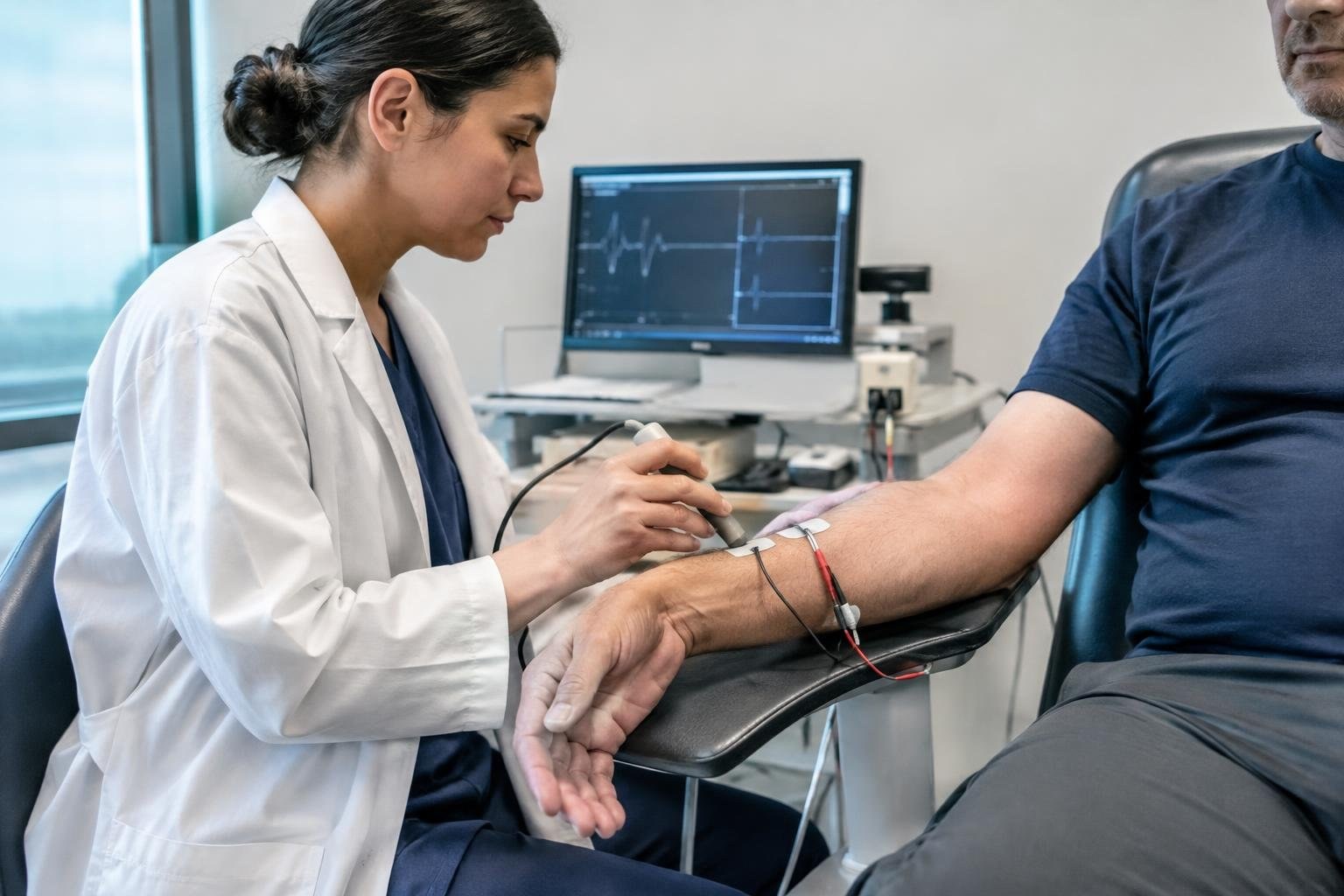
Clinical neuromuscular assessment and electrophysiology
What Is a Neuromuscular Medicine Fellowship?
A neuromuscular medicine fellowship is specialized physician training in the assessment and management of disorders involving nerves, muscles, or the neuromuscular junction. These conditions may be inherited or acquired. Clinical scope can include neuropathy, amyotrophic lateral sclerosis (ALS), myasthenia gravis, and other neuromuscular disorders.
This is not an undergraduate major, a general medical degree, or a route into patient care without prior physician training. It follows medical education and residency. Programs may be housed in neurology or physical medicine and rehabilitation departments, so compare curricula and eligibility requirements rather than relying on the program title alone.
Students and parents exploring earlier education choices can use Assessment.com’s education resources and guidance on choosing a college major.
What Fellows Study and Practice
Fellows build on physician training to assess disorders affecting peripheral nerves, muscle tissue, and neuromuscular transmission. Clinical learning may include focused histories and examinations, diagnostic planning, and management of inherited or acquired conditions. The patient mix and emphasis vary by institution.
Diagnostic and laboratory instruction may include electrophysiology or electrodiagnostics and nerve or muscle pathology. Northwestern describes a 12-month program combining electrophysiology, pathology, and clinical exposure to adult and pediatric disorders. Washington University describes didactics, a broad patient mix, electrodiagnostic foundations, and nerve or muscle pathology.
Ask for a current rotation schedule, details about supervised procedures and diagnostic interpretation, the range of conditions encountered, and how fellows receive feedback. Confirm whether research or teaching is integrated, optional, or offered separately.
Who Is a Good Fit and What Are the Entry Requirements?
This training is intended for physicians seeking deeper expertise in neuromuscular diagnosis and care. It is concentrated clinical learning, so applicants should consider whether the program’s patient population, diagnostic training, and academic or clinical emphasis align with their goals.
Eligibility is set by each institution. Programs may have different residency prerequisites and application rules. UC Davis describes its fellowship as advanced subspecialty experience beyond that expected of a general physiatrist, illustrating the importance of checking the criteria for the specific program rather than assuming every fellowship has identical requirements.
Before applying, verify accepted residency backgrounds, deadlines, required exam or board documentation, references, and interview steps on the institution’s current program page. UC San Diego, for example, lists examination score documentation among its application requirements.
Credential Level, Format, and Completion Time
Several university examples describe a clinical fellowship of about one year: Mount Sinai describes a one-year program, Northwestern describes a structured 12-month experience, and the University of Michigan describes a one-year fellowship. These are examples, not a guarantee that all programs use the same schedule.
Because clinical training involves patient care, do not assume the fellowship can be completed fully online. Ask about on-site duties, teaching sessions, research time, and required start dates. Confirm whether an optional research fellowship follows the clinical year and whether it adds time.
Request a written schedule before making relocation, employment, or family plans. Compare the full clinical calendar and any separate research period with your other commitments.
Tuition, Costs, and Financial Support
Financial arrangements should be confirmed directly with each program. Ask whether there is tuition, a program fee, or another charge; whether the position includes salary or a stipend; and what benefits, insurance, equipment, travel, or relocation costs may apply.
Request the same written details from every institution so you can compare offers consistently. Separate one-time costs from recurring expenses, and ask whether research time or an additional training period changes the financial terms.
Do not assume that a fellowship is tuition-free, salaried, or funded in the same way at every institution. Clarify the complete terms before accepting an offer.
Careers and Employment Directions
Fellowship training may prepare physicians for specialized clinical work. Wake Forest identifies private practice and academic medicine as possible career directions. Some programs also offer research opportunities beyond the clinical year.
Possible direction
How fellowship training may apply
What to verify
Neuromuscular-focused physician practice
Clinical exposure and diagnostic training develop subspecialty knowledge.
Employer expectations and any additional credentials.
Academic medicine
Clinical expertise may support patient care, teaching, or scholarship.
Faculty appointment expectations and research experience.
Clinical or laboratory research
Some institutions offer optional research training.
Availability and separate program terms.
These are possible directions, not guaranteed outcomes. Pay and employment depend on the eventual role, employer, location, experience, and qualifications.
Explore Assessment.com profiles for neurologists, physical medicine and rehabilitation physicians, and medical scientists.
Accreditation, Licensure, and Certification
Accreditation status should be checked institution by institution. The University of Michigan identifies its neuromuscular fellowship as ACGME accredited. This describes that named program and does not establish the status of other fellowships or guarantee that its status remains unchanged.
Ask each institution to identify its current accreditor and explain how to verify the program listing. Program accreditation is distinct from a physician’s medical license, specialty board certification, and eligibility to practice.
Confirm licensing and certification obligations with the relevant state medical board and professional certifying organizations for your intended role and location.
Related Training Paths and Alternatives
Neuromuscular fellowships may be housed in different departments and designed for physicians with different training backgrounds. A neurology-based program and a physical medicine and rehabilitation program can differ in clinical framing, patient exposure, and departmental practice. A research-focused extension may also be available; the University of Michigan notes that interested trainees may remain for laboratory or clinical research.
Neurology route: compare curricula and patient populations relevant to neurologic diagnosis and treatment.
Physical medicine and rehabilitation route: check whether the program builds on rehabilitation-focused physician training.
Research or academic emphasis: ask whether research is integrated, optional, or offered separately.
Broader practice: consider whether subspecialty training is necessary for your intended role.
For related career exploration, see Assessment.com profiles for health specialties teachers and medical scientists.
How to Choose and Questions to Ask
Program fit depends on more than the fellowship title. Review the clinical schedule, patient population, diagnostic training, supervision, faculty interests, research options, and teaching approach. Use the same questions for each institution so you can compare programs clearly.
Which residency backgrounds are eligible, and what application requirements apply?
What clinical exposure is available across adult and pediatric patients, if applicable?
What experience is provided in electrodiagnostics and nerve or muscle pathology?
How are fellows supervised, assessed, and given feedback?
Is research optional, required, or available after the clinical year?
What is the current accreditation status, and how can it be verified?
What are the full financial terms, benefits, and location-related expenses?
Where have recent graduates pursued practice or academic careers?
Use the institution’s official program page and speak with program leadership and current fellows when possible. Students and families exploring college options can use Assessment.com’s college guidance resources.
From Fellowship Training to a Career
Before accepting an offer, make sure you understand the commitment and the program’s terms:
Does the program accept your residency background?
Are application documents, examination records, and deadlines clear?
What does the clinical year include, and how is progress evaluated?
Which conditions, patient groups, and diagnostic methods are represented?
What is the current accreditation status?
What are the fees, salary or stipend, benefits, and expected personal expenses?
Which activities require in-person attendance?
Can research or teaching be pursued, and does it add time?
What licensing or certification requirements apply to your intended role?
Can you speak with current fellows or recent graduates?
For students and parents considering the longer path to medicine, distinguish undergraduate education, medical training, residency, and fellowship. Assessment.com’s education resources and career exploration tools can support broader planning. Take the Free MAPP Assessment to explore career and degree options aligned with your motivations and interests.
Frequently asked questions
What is a neuromuscular medicine fellowship?
It is advanced physician training focused on evaluating and managing disorders involving nerves, muscles, or the neuromuscular junction. It follows medical education and residency, rather than serving as a college degree or an entry route into medicine.
How long does a neuromuscular medicine fellowship take?
Several university programs describe a one-year or 12-month clinical fellowship. Exact dates, schedules, and optional research periods vary, so confirm the full time commitment with each program.
Who can apply to a neuromuscular medicine fellowship?
Eligibility is determined by each institution. Applicants should confirm that their residency background qualifies and check the current application requirements, documents, and deadlines directly with the program.
What do fellows learn during training?
Training may include clinical evaluation of neuromuscular disorders, electrophysiology or electrodiagnostics, and nerve or muscle pathology. The patient mix and balance of training areas differ across programs.
Can I complete a neuromuscular medicine fellowship online?
Do not assume a clinical fellowship can be completed entirely online. Ask the program which clinical and diagnostic activities require in-person attendance and whether any teaching or research activities have remote options.
How much does a neuromuscular medicine fellowship cost?
Financial arrangements vary. Request written details about any tuition or program fees, salary or stipend, benefits, insurance, and relocation or other expenses before comparing offers.
What salary can a neuromuscular medicine specialist expect?
Compensation depends on the eventual role, employer, location, and experience. Fellowship completion does not guarantee a particular salary or a job offer.
What careers can follow this fellowship?
Possible directions include specialized clinical practice and academic medicine. Research or teaching may also be relevant depending on a physician’s qualifications and experience, but a fellowship does not guarantee employment or an academic appointment.
People Also Ask
Is a neuromuscular medicine fellowship a college degree?
No. It is advanced physician training after residency, not an undergraduate degree or an entry-level medical program. Students must complete the education and clinical training required to become physicians before pursuing a subspecialty fellowship.
How many months does neuromuscular fellowship training take?
University program descriptions include one-year and 12-month experiences. Check each institution’s current schedule and ask whether research or other additional training would extend the commitment.
What residency do I need before applying?
Program requirements differ. Confirm directly with each institution whether your completed residency qualifies and what application materials, examination records, and deadlines apply.
What clinical and diagnostic skills are taught?
Program descriptions identify clinical exposure to neuromuscular disorders, electrophysiology or electrodiagnostics, and nerve or muscle pathology as training elements. The exact curriculum varies by institution.
Can a neuromuscular fellowship lead to academic medicine?
Some programs identify academic medicine as a possible career direction. Academic roles have their own qualifications, and fellowship training alone does not guarantee an appointment.
Are all neuromuscular medicine fellowships ACGME accredited?
No. Accreditation status should be checked program by program. The University of Michigan identifies its neuromuscular fellowship as ACGME accredited; that does not establish the status of other programs.
Are any fellowship components available remotely?
Ask each program whether any teaching or research activities can be completed remotely and which clinical or diagnostic activities require attendance on site.
A neuromuscular medicine fellowship can be a useful next step for physicians seeking advanced training in nerve, muscle, and neuromuscular-junction disorders. Before applying, confirm your residency background is eligible and compare each program’s curriculum, mentorship, patient mix, accreditation status, and financial terms. Explore related careers and education options on Assessment.com, and use the MAPP assessment to consider career and degree directions that fit your interests.
Find out which Career or College Major is right for you!
We use cookies to offer you a better browsing experience, analyze site traffic and personalize content.
Read about how we use cookies and how you can control them in our
Privacy Policy.
If you continue to use this site, you consent to our use of cookies.
×
Exciting News!
Be one of the first to Beta Test the new AI-Powered Assessment.com Platform.