Hospice and Palliative Medicine Fellowship: Training, Careers and How to Choose
A practical guide to Hospice and Palliative Medicine fellowships: physician eligibility, clinical learning, program formats, costs, career directions, and questions to ask before applying.
By Kieth Nelson · Staff Writer Assessment.com · Published October 26, 2026 · Last updated November 5, 2026
A Hospice and Palliative Medicine fellowship is advanced clinical training for physicians who want to improve quality of life and relieve suffering for people with serious or life-limiting illness. Fellows learn to address physical symptoms alongside psychological, social, and spiritual concerns, while including patients’ families in care and support. The work can span hospitals, outpatient clinics, hospice, home care, long-term care, and pediatric settings, depending on the program. This is not an undergraduate degree or a route into medicine without prior training: applicants first complete an eligible residency. For prospective physicians and families planning an education pathway, the key questions are how the fellowship fits a resident’s specialty, what its clinical experiences include, and whether its demands align with the physician’s goals.
Degree & Program Decision Insights
Explore your personal fit, education requirements, career potential and next steps.
01Motivational Fit
Discover whether this program fits you
Explore your preferences against the focus of Hospice and Palliative Medicine Fellowship Program. These prompts are not personal MAPP results.
Exploring an open field. The classification for Hospice and Palliative Medicine Fellowship Program does not provide a detailed curriculum. Which questions within this field would you want to investigate? Ask for actual course and project examples before deciding.
Choosing a learning environment. Compare actual Hospice and Palliative Medicine Fellowship Program offerings. Would their reading, projects or practical work suit how you prefer to learn? Confirm the format rather than assuming one from the field name.
Work reality. Related work can involve this task: “Plan and direct studies to investigate human or animal disease, preventive methods, and treatments for disease.” Would you want that activity to be a regular responsibility?
Interest in studying a field can differ from enjoying its related work.
Which part would you want to do repeatedly, and what would you try before deciding?
Discover Your Personal Program Fit
Before investing your time and money in your education, discover how this program aligns with your natural motivations, work preferences and career goals.
Hospice and Palliative Medicine Fellowship Program. CIP 61.0205 (2020).
Credential context: Fellowship classification; the actual appointment or award must be verified with the provider.
Duration is not established by this classification; confirm the actual schedule, enrollment intensity and completion requirements.
Field focus (not a school course list):
prevent and relieve the suffering experienced by patients with life-limiting illnesses and to maximize the quality of life while addressing the physical, psychological, social, and spiritual needs of both patient and family throughout the course of the disease, including through the dying process and subsequent family grieving
Verify specialist entry and prior-training requirements with the actual provider.
Explore these official instructional-field associations. They describe possible occupational routes, not measured outcomes of this program.
Medical Scientists, Except EpidemiologistsSOC 19-1042 · O*NET 19-1042.00$103,410/year median (May 2025); +12.6% projected change (2025–2035); 10,500 projected openings/year.
Figures cover the named national occupation, rather than graduates of this programme. These statistics describe qualified occupational practice, not resident/fellow stipends or training-programme compensation.
Typical occupational entry: doctoral or professional degree (BLS).
Health Specialties Teachers, PostsecondarySOC 25-1071 · O*NET 25-1071.00$107,310/year median (May 2025); +17.9% projected change (2025–2035); 24,900 projected openings/year.
Figures cover the named national occupation, rather than graduates of this programme. These statistics describe qualified occupational practice, not resident/fellow stipends or training-programme compensation.
Typical occupational entry: doctoral or professional degree (BLS). BLS lists less than 5 years of related work experience as typical for this occupation; this programme is not a direct promise of entry. Postsecondary teaching is a separate appointment and may require advanced study; this programme alone is not a promise of a teaching post.
U.S. occupational wages are not guaranteed graduate earnings; OEWS excludes self-employed workers.
Projected openings include replacements as well as growth.
U.S. national estimates. A crosswalk does not establish entry-level eligibility; advanced, management and teaching roles can require further qualifications.
Compare the actual training or appointment terms before treating this route as an ordinary tuition-based degree.
Request the itemized fees, materials and equipment associated with “Hospice and Palliative Medicine Fellowship Program”; confirm what tuition includes.
Compare any written support or appointment terms with application, relocation and professional expenses; do not assume this training charges ordinary degree tuition.
No institution- and credential-matched cost, debt or graduate-earnings amount is reported here; occupational pay is not program ROI.
Do not assume degree-based financial aid or a stipend; verify the actual arrangement.
Compare the focus and route of these distinct instructional fields; their credentials and admission requirements are not interchangeable.
Sports Medicine Fellowship ProgramCIP 61.0213. Compare its emphasis on acute and chronic patient supervision and therapy and rehabilitation with this program’s focus.
Pain Medicine Fellowship ProgramCIP 61.0210. Compare the official Pain Medicine Fellowship Program field description and actual course requirements; confirm which parts support your intended specialization.
Sleep Medicine Fellowship ProgramCIP 61.0212. Compare the official Sleep Medicine Fellowship Program field description and actual course requirements; confirm which parts support your intended specialization.
Explore your motivations. Use MAPP as a starting point for reflecting on your interest in “Hospice and Palliative Medicine Fellowship Program”, then test that interest against a sample learning task.
Examine the work. Compare Medical Scientists, Except Epidemiologists and Health Specialties Teachers, Postsecondary on daily work and entry qualifications, as well as pay. Explore Medical Scientists, Except Epidemiologists.
Compare actual training appointments. Verify the specialist route, current entry prerequisites, selection process and written financial arrangements with the training provider.
Check the evidence before applying. Confirm prerequisites and any recognition or professional requirements for your intended route; ask for applicable rules and published outcome definitions in writing.
College Search is a general education resource; specialist training coverage and eligibility require separate verification.
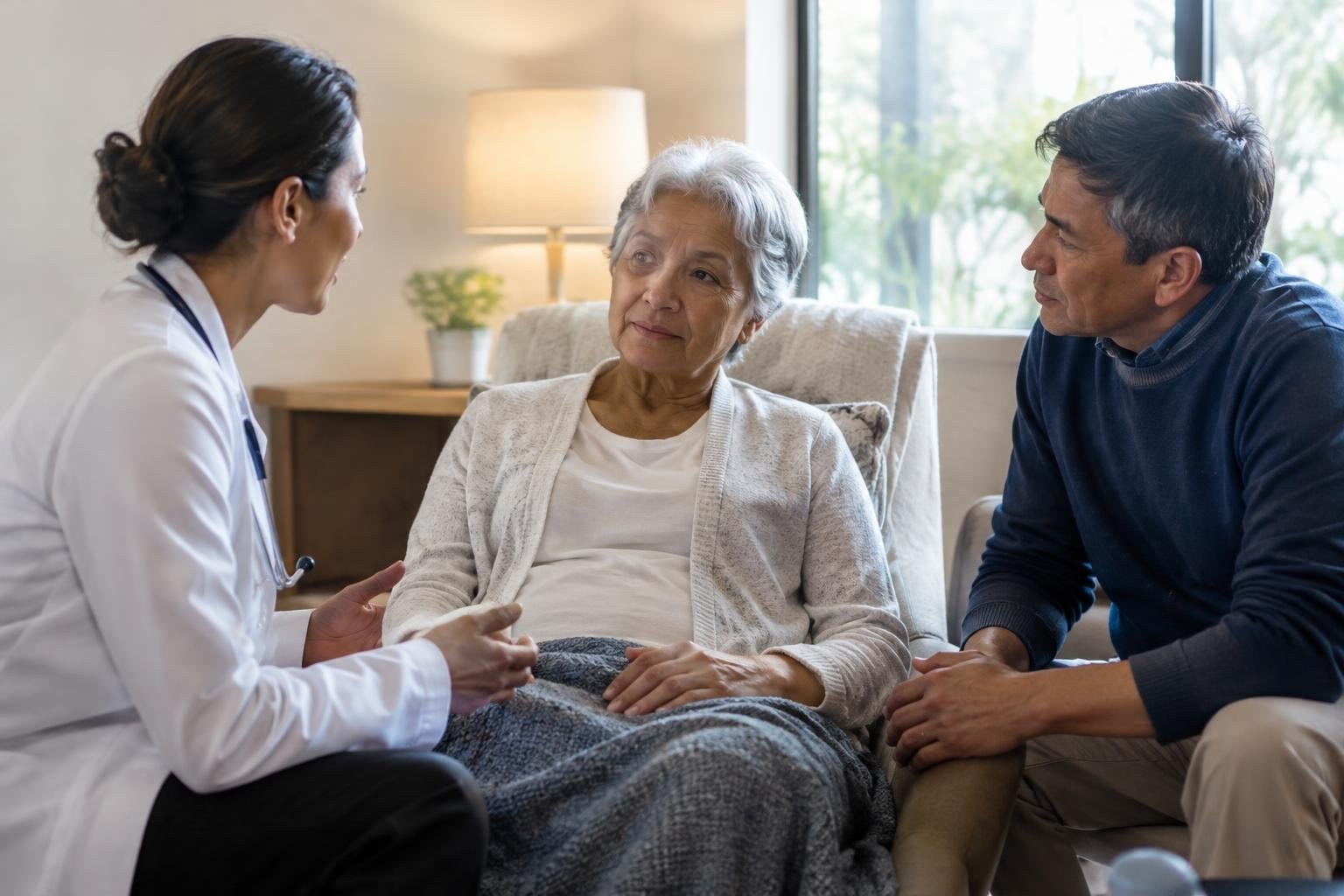
A respectful, collaborative conversation among a physician, patient, and family
What Is a Hospice and Palliative Medicine Fellowship?
This is a physician fellowship taken after residency, not a degree that prepares someone to enter medical school or practice medicine for the first time. Its focus is caring for people with serious illness while attending to quality of life and the concerns of patients and families. Program descriptions from Indiana University and Cedars-Sinai describe training in serious-illness care and preparation for clinical, education, or leadership work.
The name alone is not enough to judge what a fellowship offers. Examine its clinical settings, patient groups, and learning model, then ask whether those experiences suit your intended practice. The specialty pathway builds on a physician’s previous training rather than replacing it.
What Do Fellows Learn? Clinical Training and Curriculum
Think of the curriculum as preparation for applying specialist care in the environments where patients receive it. The experiences are not identical across programs. Wake Forest describes training across acute hospital, ambulatory, long-term-care, hospice, home-care, and pediatric settings, while Oklahoma describes inpatient and outpatient education for children and adults. Review each institution’s current description rather than assuming a standard rotation list.
When you speak with a program, ask for examples of how fellows move between settings, what responsibilities they take on, and how supervisors provide feedback. Also ask how the curriculum approaches communication with patients and families. These details reveal more about the learning experience than a list of rotation names alone.
Skills and Professional Strengths the Fellowship Builds
The fellowship develops specialist clinical skills, but the work also relies on clear communication and thoughtful teamwork. A physician must listen to patients and families, explain care options in understandable language, and work with clinicians in different settings. The precise competencies and evaluation methods are program-specific, so ask the director how fellows receive feedback and demonstrate progress.
Clinical reasoning: Integrating a patient’s serious-illness needs into care decisions.
Communication: Discussing concerns and care priorities with patients and families.
Interprofessional collaboration: Working across clinical teams and care environments.
Adaptability: Supporting patients whose care needs change across settings or over time.
Teaching and leadership: Some programs identify educator and leadership preparation as career goals.
These skills can support clinical practice and, for physicians who pursue them, education or leadership roles. Cedars-Sinai describes preparing clinicians, educators, and leaders; Indiana University similarly describes developing expertise and leadership in hospice and palliative care.
Who Is the Fellowship For? Fit and Entry Requirements
This pathway may suit physicians who find meaning in helping patients and families navigate serious illness, who value careful communication, and who want their clinical work to consider more than a diagnosis alone. It can also appeal to doctors interested in care across more than one setting, from hospital services to outpatient, home, or hospice care.
No single personality style is required. Some clinicians are energized by complex clinical decisions; others are especially drawn to patient and family conversations, team-based care, teaching, or program leadership. The practical test is whether the day-to-day responsibilities and emotional demands match the physician’s interests and professional priorities.
Who can apply?
The program pathway requires completion of residency before fellowship. The listed prior specialties include anesthesiology, emergency medicine, family medicine, internal medicine, neurology, child neurology, obstetrics and gynecology, pediatrics, physical medicine and rehabilitation, psychiatry, radiation oncology, and general surgery. A particular fellowship may specify additional application conditions. Verify eligibility with each program before preparing an application.
Parents and students considering medicine as a long-term goal should understand the full sequence: undergraduate preparation, medical school, residency, and then fellowship for those pursuing this specialty. The fellowship is not an alternative to medical school or residency.
Credential Level, Format, and Time to Completion
Use duration as an initial planning question, not as a rule to apply to every program. Northwestern and the University of Michigan describe one-year Hospice and Palliative Medicine fellowships. Confirm the current appointment length, start and end dates, and schedule with any program you are considering.
Because the training includes clinical care, ask which activities require an in-person presence, where rotations take place, and whether fellows work at multiple sites. Include the fellowship year in the larger training timeline that already includes medical school and residency.
Admissions, Application Preparation, and Common Mistakes
Application rules are set by individual institutions. A physician should confirm that their residency specialty meets the program’s eligibility criteria, then review the current application calendar and required materials. The supplied program descriptions do not establish one universal GPA, test, essay, interview, or work-experience rule for all fellowships.
Before applying, prepare a clear explanation of why this specialty fits your clinical interests and how it connects with your residency experience. Ask mentors in your current program for feedback, request the fellowship’s latest application instructions, and make a list of questions about clinical exposure, supervision, and career guidance.
Common application-planning errors
Assuming that every program uses identical eligibility criteria or deadlines.
Choosing based only on the institution’s name rather than its clinical environments and teaching approach.
Failing to ask about patient populations and the balance of inpatient and outpatient work.
Leaving financial terms, location, schedule, or rotation details until after ranking programs.
Because a fellowship follows residency, candidates should also discuss timing and specialty plans with their current residency advisors. This helps them evaluate the next training step in context rather than treating the fellowship as an isolated decision.
Cost, Compensation, and Financial Planning
Do not assume that all programs charge the same tuition or offer the same compensation. The supplied program descriptions do not provide a comparable national cost schedule. Ask each institution for its current stipend or salary arrangement, benefits, fees, and any costs related to relocation, commuting, licensing, or required training activities. Verify the applicable year and whether amounts are gross or take-home.
For a useful comparison, calculate the full cost of participation rather than focusing on one number. Consider housing near the training sites, transportation between locations, health coverage, family or caregiving needs, and any expenses that may not be included in the program’s stated compensation. Ask whether fellows receive financial support for professional development or travel, and whether those benefits have limits.
Questions about funding
Is compensation provided, and what does it include?
Are there program fees, required materials, or other mandatory costs?
What benefits are available, and when does coverage begin?
Are relocation or commuting costs the fellow’s responsibility?
Can the program provide a written estimate for the current appointment year?
Physicians should also review their existing education debt and budget with a qualified financial aid or financial planning resource. Do not assume that undergraduate or medical-school aid terms apply to a fellowship appointment.
How to Choose a Fellowship Program
Compare programs using a short list of decisions that matter to your intended practice, then gather the same information from each institution. For example, a candidate interested in a range of care settings can ask which of those settings are included and how much time fellows spend in them. A candidate prioritizing teaching or leadership can ask what mentorship and opportunities the program describes. Wake Forest outlines a broad set of care environments, and Cedars-Sinai identifies clinical, educator, and leadership preparation among its aims.
Training scope: Which patient groups and clinical settings are represented?
Learning support: How are fellows supervised, evaluated, and mentored?
Program status: What is the current accreditation status of this exact fellowship?
Practical fit: What are the schedule, locations, compensation, benefits, and other costs?
Career alignment: How does the program support the kinds of work you hope to pursue?
Use institutional program pages to prepare questions, then request current details directly from program staff or fellows. UNC and Northwestern describe their programs as ACGME-accredited; do not assume that information applies to other institutions.
Related Medical Pathways and Alternatives
A search for palliative medicine education can refer to different stages and roles. This fellowship is advanced physician training after residency. It is not interchangeable with a medical school program or education for a different health profession. Before comparing options, identify the role you want to prepare for and the education and licensing path associated with it.
For career exploration beyond this physician pathway, browse Assessment.com’s healthcare practitioners and technical careers and healthcare support careers. These broad career directories can help you explore other roles, but do not indicate that those roles are fellowship outcomes. The site also lists physical medicine and rehabilitation physicians and medical scientists as career topics to explore; each is a separate direction to investigate, not a substitute credential.
Accreditation, Licensure, and Certification
Program-level claims about accreditation should be checked for the specific fellowship and appointment year. UNC and Northwestern describe their own programs as ACGME-accredited. Those institutional descriptions support claims about the named programs only, not a general claim that every fellowship has the same status.
Keep accreditation, completion documentation, and any requirements for your intended professional pathway as separate questions. Ask the program what it confirms about its training and verify applicable requirements with the relevant authority before relying on them. Do not treat completion of a fellowship as proof that every state, employer, or certifying body requirement has been met.
Career Paths, Jobs, and Employment Questions
Program descriptions point to several possible professional directions, but they do not promise a particular job or placement. IU and OHSU describe training physicians to care for people with serious illness; Cedars-Sinai also names educator and leadership preparation. The settings a physician may encounter depend on the fellowship. For instance, Wake Forest describes training that includes acute hospital, ambulatory, long-term-care, hospice, home-care, and pediatric environments.
For broader career exploration, Assessment.com’s directory includes health specialties teachers and medical scientists. These are options to research separately, not assured outcomes of fellowship training. Ask programs about the career directions of recent graduates and compare those examples with your own prior specialty, interests, and location preferences.
Experience, Mentorship, and How to Stand Out
To make training more useful to future employers and patients, connect the fellowship to a clear learning plan. Seek feedback on clinical communication, ask how the curriculum supports work across settings, and discuss whether teaching, research, or leadership opportunities are available. Programs differ, so do not assume a specific project or certificate is included unless the institution confirms it.
How to stand out as an applicant and fellow
Explain how your residency experience led you to this specialty.
Prepare focused questions about patient populations and clinical supervision.
Ask for examples of how fellows receive feedback and build professional skills.
Use interviews to understand the program’s working culture and expectations.
Keep a record of training experiences and goals to discuss with mentors.
Ask whether the program supports scholarly work, quality-improvement projects, or teaching, and whether those activities are optional or expected. The available program descriptions identify clinical expertise, education, and leadership as potential aims, but do not establish a single required certification or project for every fellow.
Questions to Ask Before Applying
Before interviewing or ranking programs, write down what you need to learn. This is especially useful for parents helping a future physician think through a long education path, and for residents balancing the fellowship against other career options.
What residency specialties are eligible, and are there additional application requirements?
How long is the appointment, and what is the current training calendar?
Which inpatient, outpatient, hospice, home, long-term-care, and pediatric experiences are included?
What is the program’s current accreditation status?
How are fellows supervised, evaluated, and supported by faculty mentors?
What compensation, benefits, fees, travel, relocation, and other costs should I budget for?
Which activities are in person, and how many locations are involved?
What kinds of roles have recent graduates pursued, and how does the program support those goals?
What additional professional, state, or employer requirements should I verify independently?
After collecting answers, compare programs against a short list of priorities: training breadth, mentoring, schedule, financial terms, location, and professional fit. If you are still deciding whether healthcare work or a particular education direction fits you, use Assessment.com’s college guidance resource and consider the MAPP career assessment as one input to career exploration. An assessment can support reflection; it does not replace medical advising or program-specific requirements.
From Residency to Fellowship and Career
Map the pathway in order: complete an eligible residency, identify fellowships that accept that prior training, compare the programs’ clinical and educational models, and then choose a direction consistent with your goals and qualifications. A resident weighing programs can start by listing preferred patient groups and care environments, then use those priorities to shape questions for program staff. Someone interested in education can ask about the program’s stated teaching or leadership aims. These are planning steps, not guarantees of admission or a specific job.
Institutional descriptions illustrate different models. UNC describes academic and community-based training, while IU describes a blend of clinical experiences and small-group learning. Review current program information directly and ask how each model would prepare you for the work you want to pursue.
Frequently asked questions
What is a Hospice and Palliative Medicine fellowship?
A Hospice and Palliative Medicine fellowship is advanced physician training for caring for people with serious illness and supporting their families. It builds on prior residency rather than serving as an entry-level college major. Program experiences may include inpatient and outpatient care, hospice, home care, long-term care, and pediatric settings, depending on the program. For example, Wake Forest describes training across several care environments, while Oklahoma highlights inpatient and outpatient education for children and adults.
Who can apply to a Hospice and Palliative Medicine fellowship?
Fellowship programs may have different application details, but this pathway is intended for physicians who have completed residency. The residency specialties identified for the program include anesthesiology, emergency medicine, family medicine, internal medicine, neurology, child neurology, obstetrics and gynecology, pediatrics, physical medicine and rehabilitation, psychiatry, radiation oncology, and general surgery. Applicants should check each program’s current eligibility requirements and application calendar before applying.
How long does a Hospice and Palliative Medicine fellowship take?
Many programs are structured as one-year fellowships. Northwestern and the University of Michigan describe one-year Hospice and Palliative Medicine programs. That is a useful planning reference, not a guarantee that every program has the same structure; confirm the duration and schedule with each institution. The fellowship follows residency, so the complete physician training path is much longer than the fellowship year alone.
What do fellows study and do during training?
The curriculum is primarily clinical and may combine patient care, small-group learning, and experience in different care settings. The exact balance varies by institution. Program descriptions include inpatient and outpatient care, hospice, home care, long-term care, and pediatric experiences. Ask how much time fellows spend in each setting, what supervision looks like, and how the program teaches communication and care planning.
How much does a Hospice and Palliative Medicine fellowship cost, and what is the salary?
Fellowship costs and compensation are program-specific, and the available program information does not support a reliable national price or salary figure. Ask each institution for its current stipend, benefits, fees, relocation expectations, and any required expenses. Compare the full financial picture with your current residency specialty and career plans rather than relying on a generic estimate.
Can you complete a Hospice and Palliative Medicine fellowship online?
The described programs combine clinical learning with patient care, so this is not an online-only credential in the way a remote classroom course might be. Some teaching activities may use digital tools, but physicians should confirm required in-person rotations, schedules, and locations directly with each fellowship. Clinical work is tied to the participating care settings.
Are Hospice and Palliative Medicine fellowships ACGME-accredited?
The supplied program information establishes that some fellowship programs are ACGME-accredited, including examples at UNC and Northwestern. That does not establish the accreditation status of every program. Check the current status of the specific program through authoritative accreditation information and ask the program to clarify what credential the fellowship awards and what requirements apply to your career goals.
What is the difference between hospice and palliative medicine?
Hospice and palliative care both focus on care for people with serious illness, but the terms do not mean that every palliative-care patient is at the end of life. The fellowship description includes symptom relief and quality of life throughout the course of life-limiting disease, including the dying process and family grieving. Ask programs how their curriculum distinguishes and connects palliative medicine and hospice care.
What careers can follow this fellowship?
Potential directions include clinical work with seriously ill patients and families, teaching, and leadership. Program pages describe preparation for clinical, educator, and leadership roles, as well as experience across hospital, outpatient, home, hospice, and long-term-care environments. Specific job titles and eligibility depend on your original medical specialty, experience, employer, and the role’s requirements.
People Also Ask
Is Hospice and Palliative Medicine a degree or a fellowship?
It is a post-residency physician fellowship that develops skills in caring for patients with serious illness and supporting families across clinical settings. The program is distinct from medical school and residency, and applicants must meet the specific eligibility requirements of the fellowship.
What residency do you need before applying?
The pathway described for this specialty requires completion of residency in an eligible medical field before fellowship. The listed prior specialties include internal medicine, family medicine, pediatrics, psychiatry, and several other physician specialties. Individual programs set application requirements, so candidates should verify details directly.
What kinds of clinical rotations are part of the fellowship?
The clinical scope may include inpatient and outpatient services, hospice, home care, long-term care, and care for children and adults. The mix depends on the fellowship. When comparing programs, ask for the rotation schedule and the level of direct experience fellows receive in each setting.
Do fellows pay tuition or receive a stipend?
No single program description supports a universal cost figure. Request current details about compensation, benefits, fees, travel or relocation expectations, and other expenses from each program. Compare those details with the duration and expected clinical schedule before making a decision.
Are all palliative medicine fellowships one year?
Program pages describe one-year fellowships at Northwestern and the University of Michigan. Other institutions may organize training differently, so applicants should confirm the current duration and schedule with each program rather than assuming all fellowships are identical.
How can I check whether a fellowship is accredited?
Some institutions describe ACGME-accredited programs, but accreditation should be verified for the specific fellowship being considered. Ask for the program’s current status and confirm whether its structure supports your intended professional pathway.
What can physicians do after completing the fellowship?
The specialty is focused on care for people with serious illness, symptom relief, and quality of life. Training may prepare physicians for clinical practice as well as education or leadership roles. The exact career opportunities depend on the physician’s prior specialty and the position’s requirements.
For physicians considering this specialty, the decision is less about a fellowship title than about the patients, settings, and learning environment they want their next year of training to involve. Confirm eligibility and current program details, then compare clinical experiences, supervision, mentorship, and financial terms against your goals. If you are exploring healthcare careers or education options earlier in your journey, Assessment.com’s career resources can help you consider possible directions. The MAPP career assessment is another tool for reflection, not a substitute for medical advising or fellowship requirements.
Find out which Career or College Major is right for you!
We use cookies to offer you a better browsing experience, analyze site traffic and personalize content.
Read about how we use cookies and how you can control them in our
Privacy Policy.
If you continue to use this site, you consent to our use of cookies.
×
Exciting News!
Be one of the first to Beta Test the new AI-Powered Assessment.com Platform.