Energy Systems Installation and Repair Technology/Technician: Program Guide
Learn what Energy Systems Installation and Repair Technology/Technician programs teach, which credentials may be available, how to compare costs and formats, and what to ask about careers and fit.
By Kieth Nelson · Staff Writer Assessment.com · Published October 26, 2026 · Last updated November 5, 2026
Energy Systems Installation and Repair Technology/Technician is a technical field of study focused on assembling, installing, operating, testing, maintaining, and repairing energy equipment. Depending on the college, programs may emphasize renewable energy, electrical systems, or specific equipment and credentials. Students and parents should look beyond the program title. Compare the actual courses, lab work, credential awarded, total cost, and local job requirements. A certificate may prepare a student for an entry-level technical direction, while an associate degree can provide broader study or focused training. Program offerings are not uniform, and a field code does not prove that every college offers every credential level. Not sure whether this hands-on technical field fits your interests? The free MAPP career assessment can help you explore how your motivations and preferences relate to career and degree options.
Degree & Program Decision Insights
Explore your personal fit, education requirements, career potential and next steps.
01Motivational Fit
Discover whether this program fits you
Explore your preferences against the focus of Energy Systems Installation and Repair Technology/Technician. These prompts are not personal MAPP results.
Subject curiosity. Would you choose to explore “installing” in depth? Ask for a sample learning activity to test that interest.
Breadth of interest. Consider the place of “maintaining and testing various types of equipment” in this field. Is this another part you would choose to explore, or mainly a requirement you would tolerate?
Work reality. What would an actual workday connected with Energy Systems Installation and Repair Technology/Technician involve? Investigate the setting and entry requirements separately from your interest in studying the field.
Interest in studying a field can differ from enjoying its related work.
Which part would you want to do repeatedly, and what would you try before deciding?
Discover Your Personal Program Fit
Before investing your time and money in your education, discover how this program aligns with your natural motivations, work preferences and career goals.
Typical occupational entry: high school diploma or equivalent (BLS). BLS lists moderate-term on-the-job training as typical occupational training.
Wind Turbine Service TechniciansSOC 49-9081 · O*NET 49-9081.00$64,120/year median (May 2025); +29.5% projected change (2025–2035); 1,500 projected openings/year.
Typical occupational entry: postsecondary nondegree award (BLS). BLS lists long-term on-the-job training as typical occupational training.
U.S. occupational wages are not guaranteed graduate earnings; OEWS excludes self-employed workers.
Projected openings include replacements as well as growth.
U.S. national estimates. A crosswalk does not establish entry-level eligibility; advanced, management and teaching roles can require further qualifications.
Compare the focus and route of these distinct instructional fields; their credentials and admission requirements are not interchangeable.
Energy Systems Technology/TechnicianCIP 15.1701. Compare its emphasis on principles of energy conservation and instrumentation calibration with this program’s focus.
Explore your motivations. Use MAPP as a starting point for reflecting on your interest in “installing”, then test that interest against a sample learning task.
Compare actual providers. Ask for the exact credential, course sequence and assessment methods. Compare how each provider teaches “maintaining and testing various types of equipment”, its entry criteria and its itemized costs.
Check the evidence before applying. Confirm prerequisites and any recognition or professional requirements for your intended route; ask for applicable rules and published outcome definitions in writing.
Verify the institution’s current offering, admissions requirements and outcomes; a search result does not establish your eligibility.
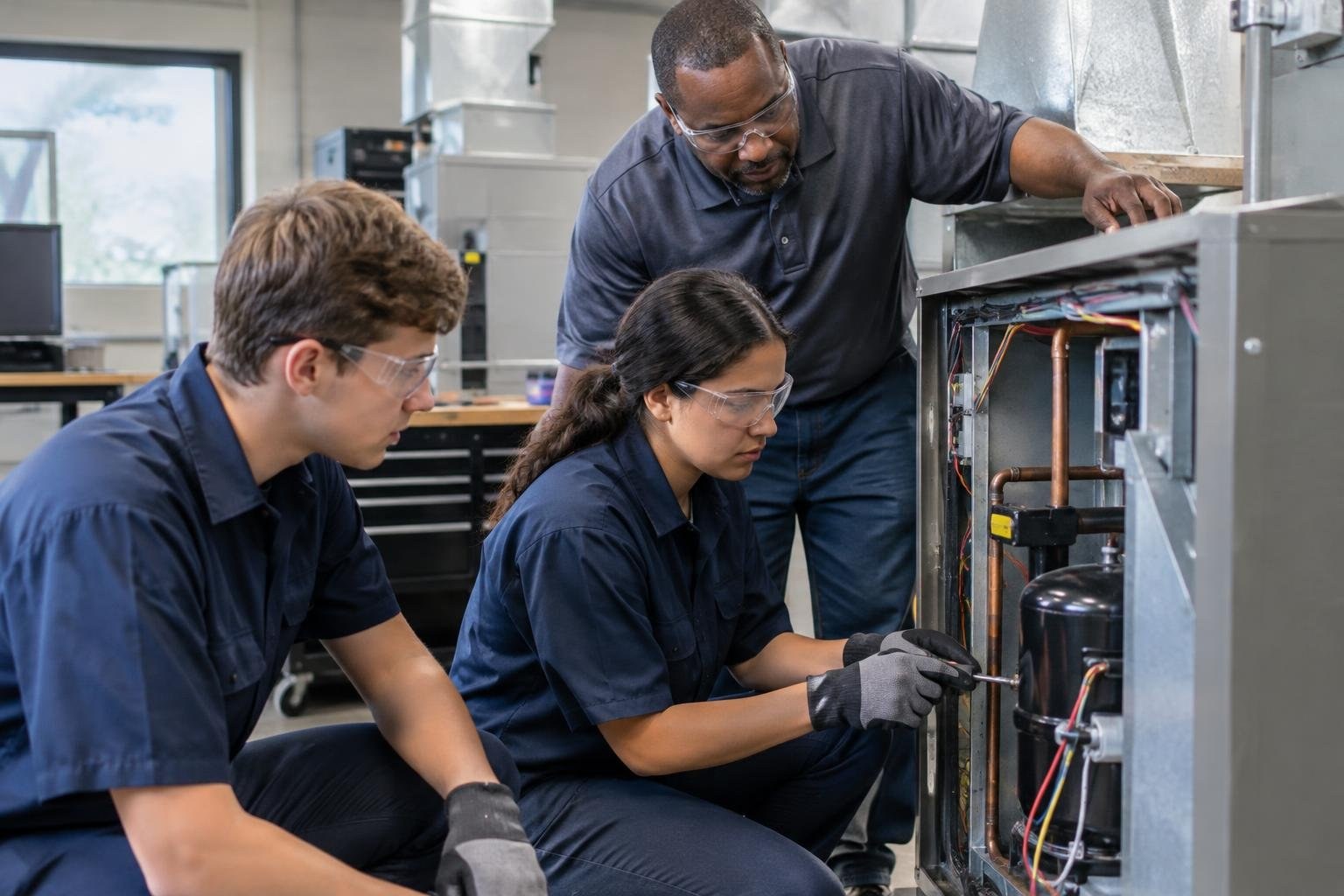
Energy systems technology students working with equipment under instructor supervision
What Is Energy Systems Installation and Repair Technology?
Energy Systems Installation and Repair Technology/Technician is a program area for applying technical knowledge to assemble, install, operate, maintain, test, and repair energy systems and related equipment. The federal Classification of Instructional Programs (CIP) description for code 47.0701 identifies installation, maintenance, and testing of equipment as part of the field. A code describes a subject area; it does not guarantee that a particular college offers a specific degree or credential.
Colleges use related titles such as Energy Systems Technology or Energy Systems Technology Skills Certificate. The subject can overlap with renewable energy, electrical systems, energy management, and heating, ventilation, and air conditioning maintenance, but those titles do not necessarily describe interchangeable courses. Review the actual program description and class list.
For the federal field description, see the NCES CIP entry for Energy Systems Installation and Repair Technology/Technician.
What Do You Study in an Energy Systems Program?
Coursework varies, but the field description centers on working with equipment: installation, maintenance, operation, and testing. Some energy-related curricula may also teach conservation principles, monitoring systems, instrumentation calibration, test procedures, energy-loss inspection, and technical report preparation. That description belongs to the related energy management and systems technology CIP area, so check whether those subjects appear in the program you are considering.
A college may combine classroom instruction with equipment demonstrations, lab exercises, or other applied work. Walla Walla Community College describes its associate program as providing a background in electrical systems plus focused concentrations. Heartland Community College describes its certificate as preparation for entry-level technician, integrator, installer, or energy auditor directions in renewable energy fields.
Ask for the current course sequence and lab schedule. Useful questions include: Which equipment will students handle? How are troubleshooting and testing practiced? Are labs required on campus? Does the program include a project, internship, or field experience, or should students arrange practical experience separately?
See the Walla Walla Community College program description and Heartland Community College certificate overview as examples of how program emphasis can differ.
Skills You Can Develop
Students in this field can build practical equipment knowledge, careful measurement habits, troubleshooting skills, and the ability to follow technical procedures. Programs that include testing or monitoring can also help students interpret readings and communicate what they found. The balance between electrical fundamentals, energy systems, and a particular concentration depends on the college.
These capabilities can relate to work such as technician, installer, integrator, or energy auditor, roles identified in Heartland Community College’s certificate description. An associate program may provide a broader electrical-systems foundation and concentration options, as described by Walla Walla Community College. Employers may set additional requirements, so use job postings in the intended work area to identify useful skills and credentials.
When comparing programs, ask students or faculty how often learners practice diagnosing a fault, documenting a test, and explaining a repair or installation plan. Those examples can reveal more about training than a course title alone.
Who Is This Program Best For? Fit and Entry Requirements
This program may appeal to students who like practical problem-solving, equipment, and learning by doing. It can also suit people who enjoy structured procedures and are willing to build technical knowledge step by step. You do not need to arrive with a fixed career identity, but you should be curious about the work the courses actually involve.
Students and parents should check entry requirements with each college. The evidence cited here does not establish universal prerequisites, GPA thresholds, tests, or admissions deadlines for the field. Ask the admissions office whether placement, prior coursework, safety orientation, tools, or other preparation is required. If a program includes electrical or technical foundations, request advice on brushing up before classes begin.
Does this program match you?
Salary headlines or the appeal of a growing technology cannot tell you whether you will enjoy the day-to-day tasks. Consider whether you like working with tools and equipment, learning technical processes, and solving problems that may require careful testing. Assessment.com’s college major guidance and MAPP assessment can support reflection on interests and preferences. Treat assessment results as one input, alongside course visits, conversations with instructors, and job research.
Credential Levels, Format, and Completion Time
Credential names and availability vary by institution. Examples in the supplied college information include a renewable-energy skills certificate at Heartland Community College and an Associate in Science in Energy Systems Technology at Springfield Technical Community College. A state college-system listing for Mountain Empire Community College describes a Career Studies Option Certificate within the solar installation and repair program. These examples do not mean that every college offers the same awards.
Do not assume that a broad field code means a master’s or doctoral program is available. The code identifies a subject area, while the college’s official catalog confirms the credentials it actually awards. Ask whether credits from a certificate apply to an associate degree, whether transfer credits are accepted, and what the normal course sequence is for part-time and full-time students.
Program duration depends on credential requirements, course availability, transfer credit, and how many classes a student takes each term. Request a term-by-term plan and confirm that required labs are offered when you need them. For an example of an associate program and named credential tests, consult Springfield Technical Community College’s Energy Systems Technology page.
Online vs. On-Campus Study
Online, hybrid, and campus availability is institution-specific. Because the subject concerns installing, maintaining, and testing equipment, ask how practical skills are taught and assessed. An online course may cover theory, while some programs may require in-person equipment practice; do not infer the format from a program title or general website description.
Before applying, ask whether labs meet on campus, whether students must travel to a training site, and whether scheduling is flexible for working students. Confirm any internships, fieldwork, or equipment access in the official program plan. If a college advertises a fully online option, ask how it demonstrates hands-on competencies and whether any in-person requirements remain.
Also compare day, evening, and part-time schedules. Springfield Technical Community College says its associate program can be completed during the day or evening, but that schedule is a college-specific example, not a standard across all programs.
Tuition, Costs, and Ways to Fund the Program
Tuition is only one part of the cost of a technical program. Ask the college for a written estimate of tuition and fees, books, tools or equipment, lab charges, transportation, and any expenses connected with required training. The actual total depends on the school, residency classification, schedule, and program requirements; compare the same categories across colleges.
Ask the financial aid office which grants, scholarships, loans, work-study options, or payment plans may apply to your situation. Confirm eligibility and deadlines directly with the institution rather than assuming a particular award is available. Students who may continue from a certificate to an associate program should ask how credits apply and whether completing the shorter credential first changes total cost or time.
Build a realistic budget with a parent, counselor, or financial aid adviser. Include commuting and the possibility that labs or classes meet at set times. A lower advertised tuition figure may not represent the full cost of attending.
Careers, Jobs, and Employment Research
Program titles alone do not establish what jobs are available, what graduates earn, or how many local openings exist. Heartland Community College identifies technician, integrator, installer, and energy auditor as possible entry-level directions for its Energy Systems Technology Skills Certificate. These are examples of potential directions, not guaranteed jobs or outcomes for every graduate.
Potential direction
How study may apply
What to verify
Energy technician
Equipment and systems training may support entry-level technical work.
Employer requirements, equipment focus, experience, and any credentials.
Installer
Installation-focused learning may be relevant to setting up energy equipment.
Whether local rules or employers require additional training or licensing.
Systems integrator
A systems foundation may support work connecting or configuring components.
Specific technology experience and the employer’s preferred qualifications.
Energy auditor
Energy monitoring and inspection subjects may be relevant where included.
Whether the role requires additional coursework, credentials, or experience.
Related equipment or maintenance work
Testing and maintenance instruction may transfer to adjacent technical settings.
How closely the program matches the actual equipment and job duties.
For career research, compare actual job descriptions in the region where you plan to work. Ask the college for recent graduate outcome information and how it is measured. Do not treat a program’s list of possible careers as a placement guarantee.
Accreditation, Licensure, and Certification
A program’s completion award is not automatically a professional license or certification. Requirements can depend on the occupation, equipment, employer, and jurisdiction. Springfield Technical Community College states that graduates of its associate program qualify to test for an oil burner technician license, EPA certification, and a fireman’s license. This is a specific school’s program statement and should not be generalized to other colleges or jobs.
Ask what the program prepares students to test for, whether the tests are included or separately arranged, and whether eligibility depends on additional conditions. Confirm current requirements with the relevant licensing authority before enrolling, especially if you plan to work across state lines. Check whether employers expect credentials beyond the college award.
Also ask how the program teaches safe equipment handling and whether students receive documented practice with the tools and procedures used in their target jobs. A credential name in a brochure is not a substitute for verifying eligibility and the current rules that apply to you.
Related Degrees and Alternatives
Energy systems installation and repair is a hands-on technical pathway. Energy management and systems technology may place more emphasis on conservation, monitoring, inspection, and reporting. The federal CIP description for energy management lists these topics, while the installation and repair description emphasizes installing, maintaining, and testing equipment. Colleges may combine or separate subjects differently, so compare syllabi and labs.
Heating, air conditioning, ventilation, and refrigeration maintenance is another related field identified in the CIP description as a neighboring area. Consider it if you are more interested in climate-control equipment and maintenance than a broader range of energy systems. Renewable energy certificates or concentrations may be a better match for students who want a focused entry-level pathway in those fields.
When weighing alternatives, ask which equipment is covered, how much practical training is included, what credential is awarded, and which local jobs the courses map to. Explore related options in installation, maintenance, and repair careers and compare the specific program plans before deciding.
How to Choose the Right Program
Choose a program by checking what students actually do and what the college can document. Accreditation is an institution- and program-specific matter; verify the college’s current status and ask whether any specialized accreditation applies to the program. Do not rely on an unverified claim in an advertisement.
Compare required courses, concentrations, and the equipment students use.
Ask how many classes include supervised practical work and whether lab access is reliable.
Get the complete cost estimate and ask about aid, payment plans, and transfer credit.
Check the schedule, online or hybrid requirements, and time needed to finish.
Ask how the school reports completion and employment outcomes, including how results are calculated.
Confirm what licenses or certifications the program prepares students to pursue and what remains their responsibility.
Ask about career advising, employer connections, internships, and how students find work experience.
Talk with an instructor and, if possible, current students. Compare the school’s answers with job postings in your target area. Assessment.com’s education resources and major-choice guidance can help you organize the decision, but the college and relevant authorities should confirm program-specific rules.
Experience, Practical Projects, and Career Progression
Experience can help students connect technical coursework to the tasks employers expect. Ask whether the college offers an internship, cooperative education, supervised project, or access to relevant labs. If it does not, ask instructors and the career center how students can build practical examples of their work. Keep a record of projects and skills you can discuss, while following any school or employer rules about equipment and safety.
How to stand out to employers
Describe the equipment and testing procedures you have practiced, rather than listing only course names.
Keep clear notes on projects, measurements, and troubleshooting steps.
Ask employers which qualifications they require for the specific job and location.
Build communication skills by practicing how to explain a technical issue and the steps taken to address it.
Verify whether a requested license or certification requires a separate application or examination.
Career paths are not guaranteed or automatic. A possible progression might be a relevant certificate, an entry-level technician or installer role, additional supervised experience, and a more specialized assignment. Advancement depends on employer needs, work performance, additional training, and local requirements.
Questions to Ask Before Enrolling
Before applying, students and parents can use this checklist to compare colleges:
What exact certificate or degree will I earn, and which college awards it?
What are the current admissions, placement, and prerequisite requirements?
What is the total estimated cost, including fees, tools, books, and travel?
Which classes include hands-on equipment practice, and where do they meet?
Can I complete the program part time or in the evening?
Can credits transfer or count toward another credential?
Which licenses or certifications, if any, can graduates test for?
How does the college measure completion and employment outcomes?
What internship, career-service, and employer connections are available?
What financial aid options might apply, and who can confirm eligibility?
Ask for answers in writing, especially when they affect your budget, schedule, or career eligibility. Compare at least two program plans and talk through the tradeoffs with a counselor, parent, or instructor.
Frequently asked questions
What is Energy Systems Installation and Repair Technology/Technician?
Energy Systems Installation and Repair Technology/Technician programs prepare students to install, operate, test, maintain, and repair energy equipment. The specific systems and technical depth vary by college and program. Some programs emphasize renewable energy, while others may focus on electrical systems or particular equipment and credentials. Review the course list and hands-on training before enrolling.
Is Energy Systems Installation and Repair Technology/Technician hard?
It can be challenging for students who have not worked with technical equipment, electrical concepts, or troubleshooting, but the challenge depends on the curriculum and your preparation. Ask how the program teaches safety and foundational skills, what math or science courses are prerequisites, and how much time students spend in labs. Visit the campus or ask to observe a class if possible.
What jobs can I get with an energy systems technology certificate or degree?
Potentially relevant roles include energy technician, installer, integrator, or energy auditor. A certificate program at Heartland Community College describes those as possible entry-level directions. Job titles and hiring requirements vary, so check employer postings in the area where you plan to work and confirm whether they require additional training, experience, or a license.
How long does an energy systems installation and repair program take?
There is no single completion time for this field. Colleges offer different credentials and course sequences, and your timeline depends on the program’s credit requirements, course availability, transfer credit, and whether you attend full time. Ask the institution for the current program map and a realistic completion plan for your intended schedule.
Can I earn this degree online?
Some technical content may be available online, but installation and repair skills often require practice with equipment. Ask each college which classes are online, how lab work is completed, and whether campus visits, field experiences, or other in-person requirements apply. Do not assume an online listing means the entire program can be completed remotely.
Does energy systems technology require math?
Math needs depend on the curriculum and concentration. Ask for course descriptions and prerequisites to see whether the program includes electrical calculations, measurement, or other quantitative work. If you need a refresher, ask the college about placement, tutoring, or preparatory courses before choosing a start term.
Do I need a bachelor’s or graduate degree for energy systems jobs?
Not necessarily for every technician or installer role. A certificate or associate program may be a direct technical pathway, while advanced study can be relevant for different responsibilities.
Does this program lead to a license or certification?
Credential requirements depend on the job, equipment, and state or local rules. For example, Springfield Technical Community College lists an associate degree program whose graduates qualify to test for certain named licenses and certifications. That is a program-specific example, not a rule for all energy systems programs. Ask the school and relevant licensing authority what applies to your target job and location.
People Also Ask
What do you learn in energy systems installation and repair technology?
Programs in this field teach students to install, test, operate, maintain, and repair energy equipment. The focus depends on the college and may include renewable energy systems or electrical and equipment fundamentals. Compare course lists and lab requirements to see what a specific program covers.
Is energy systems technology the same at every college?
No. The field includes different program names, credential types, and concentrations. College examples include a renewable-energy skills certificate and an associate degree in energy systems technology. Check the exact award, required courses, and campus delivery with each institution.
Who should study energy systems technology?
It may be a fit for students who enjoy working with equipment, following technical procedures, and diagnosing practical problems. There is no single personality type required. Review the hands-on expectations and foundational coursework, then consider whether the daily work sounds engaging to you.
How much does an energy systems technology program cost?
Ask the college for a complete estimate covering tuition, fees, tools, supplies, transportation, and any required equipment. Compare financial aid and payment options directly with the institution. Prices vary by school, residency, schedule, and program requirements, so do not use a general field estimate as a personal budget.
How do I choose an energy systems technology program?
Compare the curriculum, credential awarded, lab access, course schedule, total cost, transfer policies, and career support. Ask whether work-based learning is included and what additional credentials or licenses a particular job may require. Get important answers in writing from the college.
What is the difference between energy systems technology and energy management?
The titles overlap, but programs can differ in emphasis. Energy systems installation and repair focuses on practical equipment work, while energy management programs may emphasize conservation, monitoring, inspections, and reporting. Read the curriculum and program description rather than choosing by title alone.
Energy Systems Installation and Repair Technology/Technician can suit students who want practical training in how energy equipment is installed, tested, maintained, and repaired. Program names, available credentials, course plans, costs, and work-based learning differ by college, so compare the exact curriculum and credential rather than relying on the field name alone. Before committing, check the full cost, hands-on training, relevant local job requirements, and whether the work matches your interests. Explore related careers and education options on Assessment.com, and use the MAPP assessment to reflect on personal fit.
Find out which Career or College Major is right for you!
We use cookies to offer you a better browsing experience, analyze site traffic and personalize content.
Read about how we use cookies and how you can control them in our
Privacy Policy.
If you continue to use this site, you consent to our use of cookies.
×
Exciting News!
Be one of the first to Beta Test the new AI-Powered Assessment.com Platform.