Archives and Archival Administration Degree Guide: Study, Careers, and Program Fit
An archives and archival administration program teaches students to manage, preserve, and provide access to records with lasting value. Compare study options, credentials, careers, costs, and program fit.
By Tome Fierre · Staff Writer Assessment.com · Published October 12, 2026 · Last updated November 5, 2026
Archives and archival administration programs teach students how to identify, organize, preserve, and provide access to records with lasting value. These records may support research, document decisions, or serve legal and cultural purposes. The field brings together information management, preservation, access, technology, and careful judgment about how records are handled. Programs appear at different credential levels, from certificates to master's degrees and doctorates, but availability and admissions requirements vary by school. Some are designed for people entering the field; others are advanced options for students who already have graduate education or relevant experience. If you are considering a career protecting historical or institutional records, compare the daily work and course content with your interests, not just the program title. The assessment.com MAPP career assessment can help you explore how your preferences align with career and education options.
Degree & Program Decision Insights
Explore your personal fit, education requirements, career potential and next steps.
01Motivational Fit
Discover whether this program fits you
Explore your preferences against the focus of Archives/Archival Administration. These prompts are not personal MAPP results.
Subject curiosity. Would you choose to explore “appraisal and collection development” in depth? Ask for a sample learning activity to test that interest.
Breadth of interest. Consider the place of “information and records management” in this field. Is this another part you would choose to explore, or mainly a requirement you would tolerate?
Work reality. Related work can involve this task: “Research and record the origins and historical significance of archival materials.” Would you want that activity to be a regular responsibility?
Interest in studying a field can differ from enjoying its related work.
Which part would you want to do repeatedly, and what would you try before deciding?
Discover Your Personal Program Fit
Before investing your time and money in your education, discover how this program aligns with your natural motivations, work preferences and career goals.
The official crosswalk associates this instructional field with the broad Managers, All Other group. It does not establish a particular detailed specialty or a direct programme-to-job outcome.
U.S. SOC 11-9199 Managers, All Other is a broad occupational group. Its statistics are not estimates for a particular specialty, starting role or this programme’s graduates.
Typical occupational entry: bachelor's degree (BLS). BLS lists less than 5 years of related work experience as typical for this occupation; this programme is not a direct promise of entry.
U.S. occupational wages are not guaranteed graduate earnings; OEWS excludes self-employed workers.
Projected openings include replacements as well as growth.
U.S. national estimates. A crosswalk does not establish entry-level eligibility; advanced, management and teaching roles can require further qualifications.
Compare the focus and route of these distinct instructional fields; their credentials and admission requirements are not interchangeable.
Public/Applied HistoryCIP 54.0105. Compare its emphasis on historical research methods and the planning and administration of public history projects with this program’s focus.
Library and Information ScienceCIP 25.0101. Compare the official Library and Information Science field description and actual course requirements; confirm which parts support your intended specialization.
Explore your motivations. Use MAPP as a starting point for reflecting on your interest in “appraisal and collection development”, then test that interest against a sample learning task.
Examine the work. Compare Archivists and Managers, All Other on daily work and entry qualifications, as well as pay.
Compare actual providers. Ask for the exact credential, course sequence and assessment methods. Compare how each provider teaches “information and records management”, its entry criteria and its itemized costs.
Check the evidence before applying. Confirm prerequisites and any recognition or professional requirements for your intended route; ask for applicable rules and published outcome definitions in writing.
Verify the institution’s current offering, admissions requirements and outcomes; a search result does not establish your eligibility.
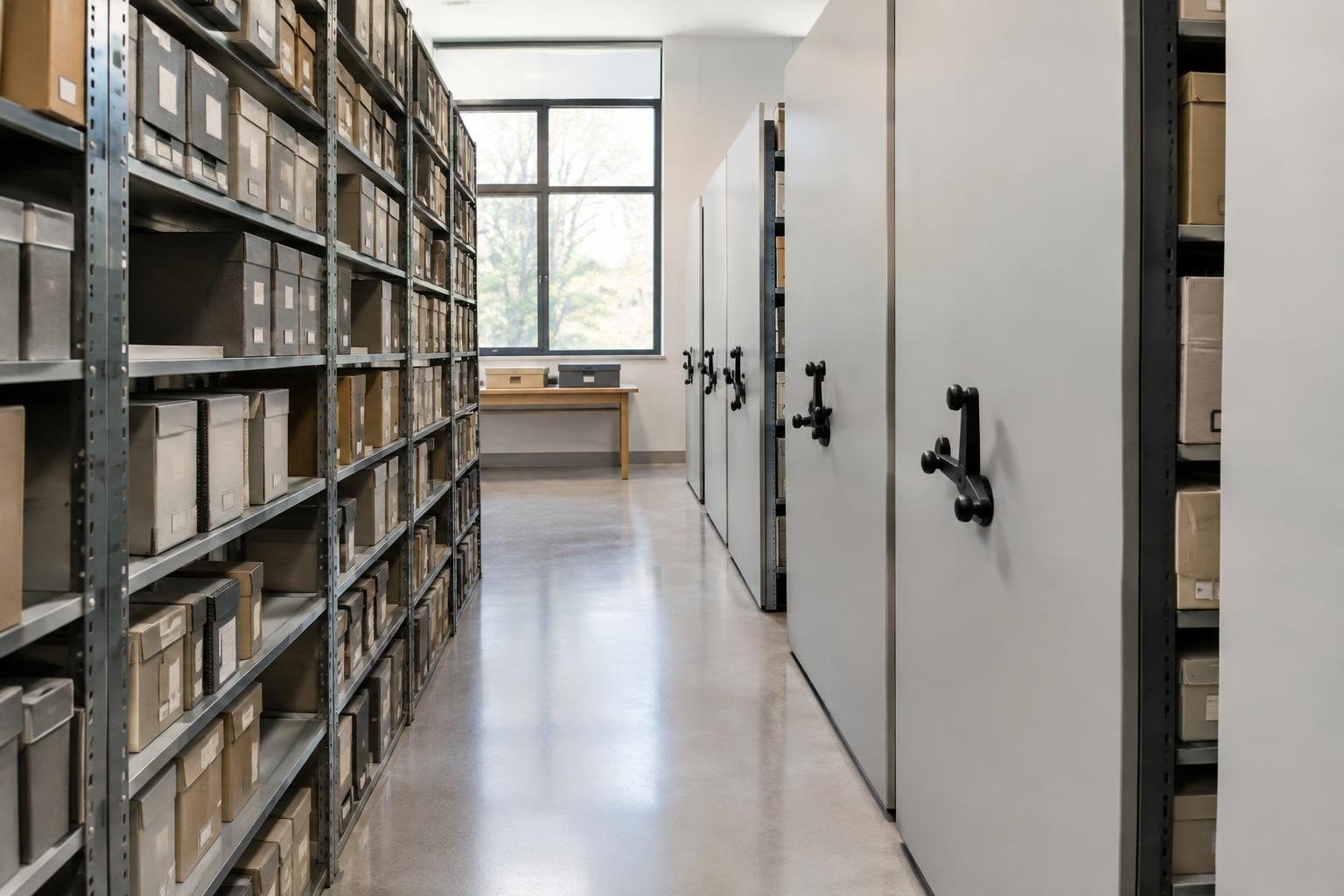
Archival documents, digital records, and a student learning records organization
What Is an Archives and Archival Administration Program?
Archives and archival administration is the study and practice of managing records that have lasting value. The work involves deciding what to keep, describing and organizing it, protecting it over time, and making it available for appropriate use. Records may have research, legal, historical, or institutional significance.
Program descriptions in this field include appraisal and collection development, records and information management, archival preservation, access systems, electronic records, outreach, and legal and ethical issues. Related program names may include archival studies, archives and records management, or archives administration. A title alone does not tell you whether a curriculum emphasizes historical collections, organizational records, digital materials, or a combination.
Archives study overlaps with library and information science, but the program focus matters. Some institutions place archival study within information science; others offer a dedicated certificate or a distinct archives-and-records-management master's pathway. Read course requirements rather than relying on the department name.
What Do You Study?
Expect study that connects principles to practical decisions about records. A curriculum may address how to assess records for enduring value, plan collections, arrange and describe materials, support access, and manage physical or electronic information. Preservation and records management are central because records need to remain understandable and usable, not merely stored.
Legal and ethical questions can shape decisions about access, handling, and stewardship. Outreach may also be part of archival work: collections have limited value to users if they cannot discover or understand them. Programs can differ in how much they emphasize digital records, cultural artifacts, institutional records, or research collections.
Ask schools for a current course list and examples of projects or applied learning. The University of Arizona describes its graduate certificate as four courses totaling 12 units, with study of archival practices and cultural artifacts and historical records. That is one school's certificate structure, not a standard across all programs.
Skills You Can Develop
Students develop the ability to think carefully about the history, meaning, condition, and use of records. They learn to bring order to complex materials and to make consistent decisions about description, preservation, and access. These abilities matter in work where incomplete context or unclear organization can make records difficult to interpret or retrieve.
Other useful capabilities include written communication, clear documentation, attention to detail, ethical reasoning, and explaining collection practices to colleagues or users. Digital records require comfort with information systems and a willingness to keep learning as tools and organizational practices change. The program description for this field includes electronic records, information and records management, access systems, and archival outreach.
When reviewing a syllabus, look for opportunities to apply skills to realistic materials or problems. A course title can sound relevant while offering little practical work; ask what students actually create, analyze, or manage.
Who Is This Program Best For?
This field may appeal to students who enjoy careful research, organizing information, preserving materials, and helping others find trustworthy records. It can suit people who prefer sustained, detail-oriented work and are comfortable balancing competing needs, such as preservation and access. Interest in history can be helpful, but archives also involve current organizational records and digital information.
You do not need to fit a single personality profile. Think about whether you enjoy asking what a record means, how it should be described, what context a user needs, and how to manage information responsibly. Consider both independent tasks and collaboration with colleagues or people seeking records.
Does archival administration match you?
Salary, status, and broad employment claims do not tell you whether the daily tasks will be satisfying. Compare the work itself with your motivations and preferred work style. Assessment.com's MAPP career assessment can help you explore possible career and degree directions; use it as a starting point, then test your assumptions by reading job postings and speaking with practitioners.
Admissions, Entry Requirements, and Preparation
Entry requirements are not uniform. Some certificates are intended for people who already have substantial higher education. NYU states that its Advanced Certificate in Archives is open to people who have received a graduate degree, or may be pursued as part of a dual-degree path by students already enrolled in specified doctoral programs. Wayne State describes its Graduate Certificate in Archival Administration as serving people entering the profession as well as people with experience.
These examples show why prospective students should verify prerequisites rather than assuming that every certificate is an entry-level credential. Ask whether a bachelor's degree, graduate degree, prior coursework, relevant experience, recommendations, or a statement of purpose is required. Admissions requirements can change and must be checked with the school.
Graduate programs may also ask applicants to demonstrate readiness for advanced study. Use the official admissions page for the exact application checklist and deadlines.
Credential Levels, Format, and Time to Complete
The field includes certificates, associate's and bachelor's programs, master's degrees, and doctoral study, but the existence of a credential category does not mean every school offers it in archives. Some credentials provide focused study; others situate archival work within a broader degree. Confirm the credential and its intended audience with each institution.
For example, the University of Arizona describes a 12-unit, four-course graduate certificate offered on campus and online. NYU's Advanced Certificate has graduate-level entry conditions, while San José State describes two master's degree programs focused on archives and records management. These are institution-specific examples, not a universal progression or standard duration.
Time to completion depends on program requirements, study pace, and previous education. Ask whether courses are offered every term, whether part-time enrollment is possible, and whether credits can apply to another credential. Get a written program plan before relying on an estimated finish date.
Tuition, Costs, and Financial Aid
There is no single tuition figure that applies to archives programs. Total cost depends on the institution, credential, residency rules, credit requirements, delivery format, fees, books, and any additional expenses. Because the supplied program examples do not establish a comparable price across schools, compare current published costs directly rather than using a generic estimate.
Build a full-cost worksheet for each option. Include tuition and mandatory fees, books and technology, travel or housing if relevant, and the cost of taking longer than the planned schedule. Ask the financial aid office how grants, scholarships, loans, employer tuition support, and payment plans apply to your specific program and enrollment status.
For affordability, compare a lower-cost pathway or transfer option only after confirming that credits will count toward the credential you need. A short certificate may cost less in total than a full degree, but it may not meet the education expectations for your target role. Evaluate cost alongside outcomes and your intended career path.
Careers, Jobs, and Employment Outlook
Archives and records programs can support career exploration in archival work and records management. San José State identifies two master's programs focused on archives and records management. Other institutions offer specialized certificates, including programs intended for professionals entering the field or for people who already have experience.
Possible job titles and qualifications vary by employer. An archivist, an archival assistant, and a records or information management specialist may have different responsibilities and education expectations.
Career direction
How study may connect
What to verify
Archivist
Appraisal, preservation, description, and access to records
Employer education and experience requirements
Archives or collections assistant
Organization, documentation, and collection support
Whether the role requires a degree, certificate, or prior experience
Records management specialist
Records lifecycle, information management, and electronic records
Technology, policy, and industry-specific qualifications
Digital records or information specialist
Electronic records, access systems, and information practices
Systems knowledge and specialized technical expectations
Use current job postings from organizations that interest you to check required education, experience, and skills. A role's title alone may not reveal what the employer expects.
Find out which Career or College Major is right for you!
Do not assume that completing an archives program automatically grants a professional license or certification. The programs described in the available institution sources are academic credentials, and their pages do not establish a universal license requirement for archival work. Requirements can depend on the job, employer, and jurisdiction.
Ask each program whether it prepares students for any professional credential relevant to your intended role, and verify eligibility and current rules with the organization that issues that credential. Separately, review job postings to see whether employers request a particular certification, specialized experience, or graduate study.
Program accreditation and institutional accreditation are also separate questions from professional certification. Verify the institution's accreditation through official sources and determine whether a particular professional body recognizes or evaluates the specific program. Avoid treating marketing terms such as “career-ready” as proof of accreditation or credential eligibility.
Experience, Projects, and Building an Employer-Ready Profile
Practical experience can help you determine whether the work fits before you make a large education commitment. Ask about supervised projects, internships, work with real or reproduced records, research opportunities, or partnerships with archives and records offices. The source information available here does not confirm which experiences are included at every institution, so request details about the program you are considering.
Build evidence of your skills where appropriate: a clear finding aid or description exercise, a records-management project, a digital preservation plan, or a concise explanation of an archival decision. Follow privacy, copyright, and handling rules; never use restricted or sensitive material as a portfolio sample without permission.
How to stand out to employers
Relate your coursework or project work to the duties in a specific job posting.
Show clear, consistent documentation and attention to detail.
Explain how you would balance access, preservation, and responsible handling.
Demonstrate experience with digital records or relevant information systems when the employer requests it.
Seek references from supervisors who can speak to your reliability and judgment.
Graduate School and Further Study
Graduate study may be useful for students whose target roles require advanced preparation or who want deeper study in archives, records management, history, or information science. San José State describes two master's programs focused on archives and records management. NYU's Advanced Certificate in Archives is designed for people who already hold a graduate degree or are enrolled in specified doctoral programs, illustrating that some post-graduate options are not designed as a first credential.
Some students may consider a dual-degree route that combines archival study with a subject area. Pratt lists an M.S.L.I.S./M.A. in History of Art and Design dual degree. A combined path may be relevant when a student wants both information-science preparation and subject expertise, but compare its added time and cost against the roles you are targeting.
Doctoral study is a distinct commitment, usually considered for research or academic goals. Confirm the actual curriculum and outcomes with the institution rather than assuming that more education is always necessary.
Related Degrees and Alternatives
Compare archives and archival administration with neighboring fields by looking at the materials, tasks, and users at the center of each program.
Library and information science: Consider a broader information-services curriculum if you want to compare archives with library, information organization, or user-service work. Some schools offer archives-focused master's study within information science.
History: Consider history if your primary interest is analyzing the past rather than managing records and systems of access.
Museum studies: Consider a museum-focused program if collections, exhibits, and interpretation are more central to your goals. Check whether records management is included.
Information management: Consider a broader information or records program if you are most interested in organizational records and electronic information.
Library technician or assistant preparation: Consider a shorter or more applied support route if your goal is a library support role rather than archival specialization.
These fields can overlap, and their names are not standardized across schools. Compare course requirements, actual learning activities, entry prerequisites, and the qualifications requested in job postings. A dual degree may bridge fields, but it also adds requirements to evaluate.
How to Choose the Right Program
Choose a program by matching its curriculum and credential to the work you want to explore. Start by collecting several real job postings, noting requested education and skills, then compare those requirements with course descriptions and learning opportunities. If a program cannot explain how its coursework relates to your goals, ask for clearer information before applying.
Program comparison checklist
Is the institution accredited, and can you verify that status through an official source?
Which courses cover appraisal, preservation, access, records management, and electronic records?
Does the program's credential level match the qualifications in job postings you reviewed?
Are online, hybrid, and campus formats available, and are any activities in person?
What is the complete estimated cost, including fees and technology?
Can credits transfer or count toward a later credential? Get the answer in writing.
What applied projects, internships, research, or employer connections are available?
What career advising, job-search support, and graduate outcome information can the school provide?
Does the program prepare students for any credential relevant to your target roles?
Talk with an admissions adviser and, where possible, faculty or current students. Ask specific questions rather than relying on general claims about career outcomes.
From Degree to Career: Possible Pathways
Career development is not a guaranteed ladder, but it can help to picture how education and experience might connect. Use these as exploratory examples and verify each step against employer requirements:
Archival studies certificate or related prior education → entry-level archives or collections support role → practical experience → specialization in a collection type or records practice → expanded archival responsibilities.
Master's study focused on archives and records management → archives or records role aligned with the curriculum → experience managing materials and access → deeper responsibility for a program or collection.
Information science degree with archival focus → digital records or information-management role → experience with systems and documentation → specialization in electronic records or information governance.
These are possible sequences, not promises. Employers set their own requirements, and career movement can depend on the institution, available roles, experience, and additional education. Use job descriptions to identify what steps are realistic for your intended location and sector.
Questions to Ask Before Enrolling
Before you enroll, make sure you can answer these questions with current information from the institution:
What credential will I earn, and what are the exact admission prerequisites?
What is the full cost at my enrollment pace, and which aid options might apply?
Which courses and projects cover the archival work I want to do?
Does the program include practical experience, and what does that involve?
Can I complete it online, and are there in-person requirements?
Will previous coursework transfer, and how will transfer credit affect completion time?
What do employers in my target roles ask for in addition to a degree?
Does the program prepare me for a relevant certification, if one is expected?
What career services and employer connections are available?
Can the school provide outcome information for graduates of this specific program?
Keep copies of written answers and compare programs using the same questions. This helps separate a strong fit from an appealing program title.
Frequently asked questions
What does an archives and archival administration program teach?
Archives and archival administration programs prepare students to identify records with lasting value, organize and preserve them, and provide appropriate access. Coursework may address appraisal, records management, digital records, preservation, access systems, and legal or ethical questions. The exact curriculum and credential level vary by institution.
Is archival administration a difficult field to study?
It can be demanding for students who find detailed organization, careful documentation, or sustained research challenging. The work calls for accuracy and sound judgment, including decisions about description, preservation, access, and ethical or legal considerations. Review sample courses and ask programs how students practice these skills before enrolling.
What jobs can I pursue with an archives degree?
Possible directions include archival work and records or information management. The available roles and their requirements depend on the employer and the type of collection or records involved. Some students pursue graduate-level education or additional archival preparation; check job postings in the places and organizations where you hope to work.
Do archivists need a master's degree?
Programs exist at several credential levels, including graduate certificates and master's degrees. The right route depends on your prior education, career goals, and each institution's admissions rules. For example, NYU's Advanced Certificate in Archives is for students who already hold a graduate degree or eligible doctoral students in specified programs.
Can I study archival administration online?
Some archival studies coursework is available online. The University of Arizona describes its four-course graduate certificate as offered both on campus and online. Availability, admission requirements, and any in-person expectations differ by program, so confirm the current details with the institution before applying.
How much does an archives degree cost?
There is no single price for an archives program. Tuition and total cost depend on the institution, credential, residency, delivery format, fees, and other expenses. Compare each program's published cost of attendance and financial aid options, and ask how transfer credits or part-time enrollment could change your total time and cost.
Does archival administration require math?
Not necessarily. Program descriptions emphasize appraisal, records and information management, preservation, access systems, and electronic records rather than a standard set of advanced mathematics courses. Individual curricula differ, so inspect degree requirements to see whether statistics, data management, or other quantitative courses are included.
What is the difference between an archives certificate and a master's degree?
A certificate may provide focused study, while a master's degree offers a different credential path and may be paired with another field. For example, institutions describe graduate certificate options as well as master's programs centered on archives and records management. Compare prerequisites, curriculum, and target roles rather than assuming credentials are interchangeable.
People Also Ask
What do you learn in archival studies?
Archives programs teach methods for appraising, organizing, preserving, managing, and providing access to records with enduring value. Courses may cover digital records, collection development, information management, outreach, and legal or ethical issues.
How long does it take to earn an archives degree?
Program length depends on the credential, course load, prior education, and school requirements. Graduate certificates can be shorter focused options, while a master's degree requires a broader program of study. Check each institution's published credit and completion requirements before comparing timelines.
Is an archival studies certificate worth it?
A certificate can be appropriate for focused archival study, but its value depends on the job you want and the certificate's prerequisites and curriculum. Compare it with employer requirements and other credentials. Some advanced certificates require an existing graduate degree or enrollment in a specific graduate program.
How is archival administration different from library science?
Archives and archival administration focus on records with long-term value, including appraisal, preservation, management, and access. Library and information science is a broader neighboring field. Some schools offer archives-focused master's options within information science, so compare course plans and the roles each program prepares you to pursue.
Are archival studies certificates available online?
Some programs offer online or hybrid study, but the format is school-specific. The University of Arizona lists its graduate certificate in archival studies as available on campus and online. Confirm delivery mode, course schedules, and any in-person requirements directly with the institution.
Where do archivists work?
Archival work may be found in settings that maintain records for research, institutional, legal, or cultural purposes. The precise employers and job titles vary. Look at current postings from the organizations that interest you and compare their stated education, experience, and technology requirements with program offerings.
Archives and archival administration can suit students who want to preserve and organize records while making them usable for research, legal, cultural, or institutional needs. Before committing, compare the credential level, curriculum, format, total cost, and practical experience offered by each program. Career paths and entry requirements vary, and a degree or certificate is not a guarantee of a particular job. Consider whether the daily work of careful description, organization, preservation, and access matches your interests. Assessment.com’s MAPP assessment can help you explore how your preferences align with related career and education options.
Want to see your options? Try our comprehensive Degree, Program & College Search tool
We use cookies to offer you a better browsing experience, analyze site traffic and personalize content.
Read about how we use cookies and how you can control them in our
Privacy Policy.
If you continue to use this site, you consent to our use of cookies.
×
Exciting News!
Be one of the first to Beta Test the new AI-Powered Assessment.com Platform.