Criminalistics and Criminal Science Degree Guide: Courses, Careers, and Program Fit
Explore what criminalistics and criminal science programs teach, how their degree levels and formats differ, possible career paths, and how to compare cost, practical experience, and personal fit.
By Kieth Nelson · Staff Writer Assessment.com · Published October 25, 2026 · Last updated November 5, 2026
Criminalistics and criminal science is a field of study focused on applying laboratory science and investigative methods to physical evidence and crime reconstruction. Programs may combine criminal justice topics with evidence analysis, laboratory procedures, and crime scene investigation, but the balance differs from one college to another. Students considering this path often want to understand how evidence is collected, examined, documented, and used in an investigation. Possible directions include forensic science and criminal justice work, but a degree is not a guarantee of a particular job. Compare the curriculum, practical learning, cost, and requirements for the occupations you are considering. Not sure whether this field fits you? Take the Free MAPP Career Assessment to explore how your motivations and preferences may align with careers and education pathways.
Degree & Program Decision Insights
Explore your personal fit, education requirements, career potential and next steps.
01Motivational Fit
Discover whether this program fits you
Explore your preferences against the focus of Criminalistics and Criminal Science. These prompts are not personal MAPP results.
Scientific investigation. Would you enjoy investigating laboratory science and explaining your conclusions from evidence?
Breadth of interest. Consider the place of “laboratory procedures” in this field. Is this another part you would choose to explore, or mainly a requirement you would tolerate?
Work reality. Related work can involve this task: “Measure and sketch crime scenes to document evidence.” Would you want that activity to be a regular responsibility?
Interest in studying a field can differ from enjoying its related work.
Which part would you want to do repeatedly, and what would you try before deciding?
Discover Your Personal Program Fit
Before investing your time and money in your education, discover how this program aligns with your natural motivations, work preferences and career goals.
Typical occupational entry: bachelor's degree (BLS). BLS lists moderate-term on-the-job training as typical occupational training.
Detectives and Criminal InvestigatorsSOC 33-3021 · O*NET 33-3021.00$93,790/year median (May 2025); +0.2% projected change (2025–2035); 7,800 projected openings/year.
Typical occupational entry: high school diploma or equivalent (BLS). BLS lists less than 5 years of related work experience as typical for this occupation; this programme is not a direct promise of entry. BLS lists moderate-term on-the-job training as typical occupational training.
U.S. occupational wages are not guaranteed graduate earnings; OEWS excludes self-employed workers.
Projected openings include replacements as well as growth.
U.S. national estimates. A crosswalk does not establish entry-level eligibility; advanced, management and teaching roles can require further qualifications.
Explore your motivations. Use MAPP as a starting point for reflecting on your interest in “laboratory science”, then test that interest against a sample learning task.
Examine the work. Compare Forensic Science Technicians and Detectives and Criminal Investigators on daily work and entry qualifications, as well as pay. Explore Forensic Science Technicians.
Compare actual providers. Ask for the exact credential, course sequence and assessment methods. Compare how each provider teaches “laboratory procedures”, its entry criteria and its itemized costs.
Check the evidence before applying. Confirm prerequisites and any recognition or professional requirements for your intended route; ask for applicable rules and published outcome definitions in writing.
Verify the institution’s current offering, admissions requirements and outcomes; a search result does not establish your eligibility.
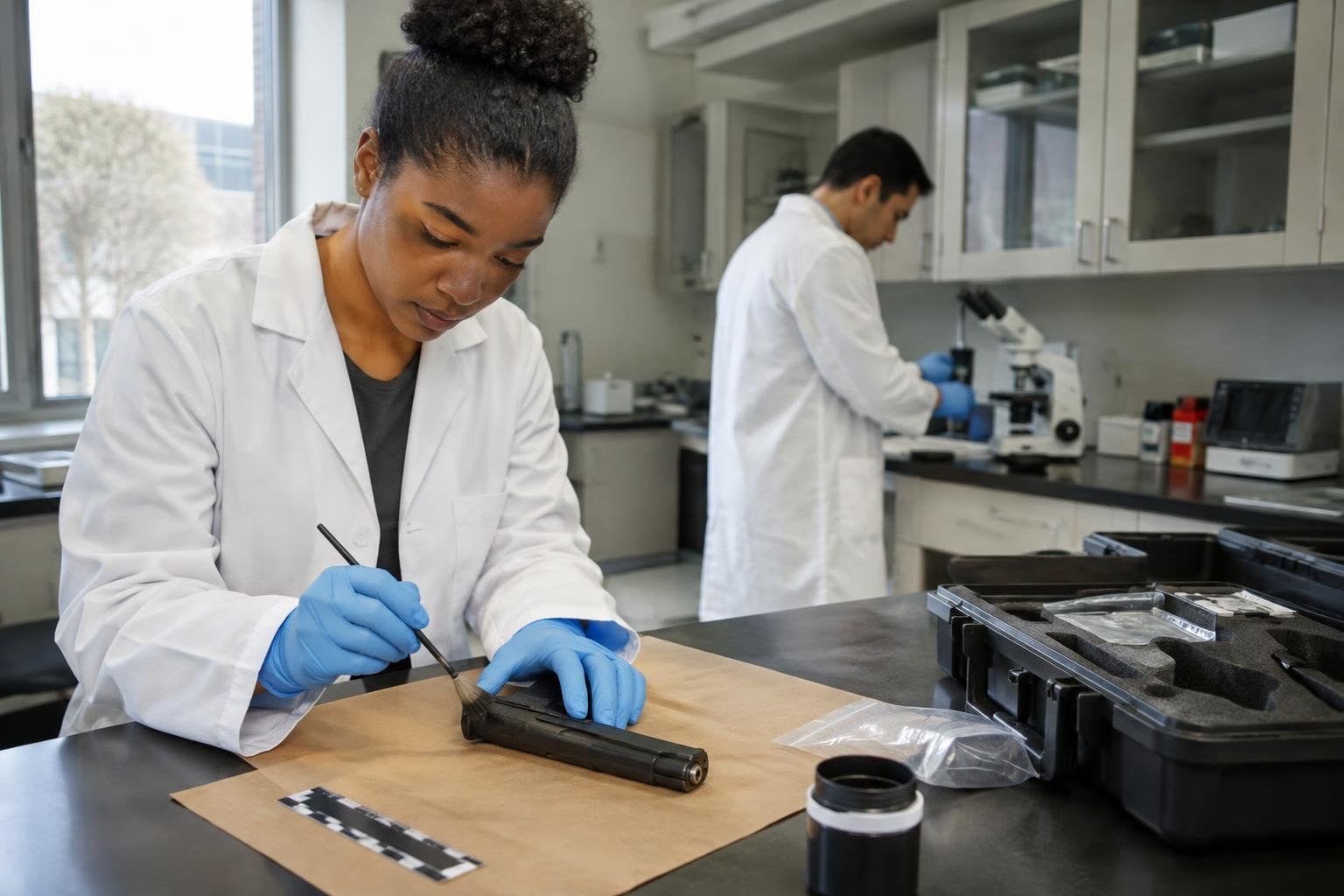
Evidence documentation and careful laboratory practice in a college learning environment
What Is a Criminalistics and Criminal Science Degree?
Criminalistics and criminal science concerns the scientific examination of physical evidence and the use of investigative techniques to understand crimes. Programs may combine laboratory science, evidence analysis, crime scene investigation, and criminal justice subjects. Saint Leo University describes its criminalistics specialization as including crime scene investigation and forensic science; other institutions may use different names or organize the subjects differently.
The program description associated with CIP 43.0402 includes laboratory procedures, criminology and police science, evidentiary testing, computer applications, record-keeping, evidence handling and storage, and reconstruction techniques. Treat this as a field description, not a promise that every course appears in every college curriculum. Related labels include criminalistics, criminal science, crime science, and criminal justice with a forensic or criminalistics focus. Read course lists to understand what a particular degree actually emphasizes.
Criminalistics is not the same thing as a general criminal justice degree. A criminalistics-focused curriculum may place greater attention on evidence and scientific methods, while a broader criminal justice program may take a wider view of justice systems and related institutions. Names alone are not enough to make the distinction: compare required courses, labs, and field learning.
What Do You Study in Criminalistics?
Students may encounter general education, criminal justice foundations, criminology, laboratory procedures, evidence handling, and investigative methods. In a science-focused course, the goal is not only to learn terminology; it is to practice how evidence is observed, documented, and analyzed without losing track of how it was collected or stored. Coursework can also address crime reconstruction and applications to different types of evidence.
Expect substantial variation. A criminal justice degree with a criminalistics specialization is not necessarily equivalent to a science-heavy forensic program. Ask for a course sequence and identify which requirements include laboratory work, practical exercises, research, internships, or a capstone. Find out whether those opportunities are required, optional, or unavailable to students in a particular delivery format.
As you review course descriptions, ask what students actually do. Do they practice evidence documentation? Are there supervised laboratory exercises? Does a culminating project require research and clear written analysis? Specific answers will help you judge whether a program teaches practical skills relevant to your goals or mainly provides broad subject-area coverage.
Skills You Can Develop
Useful abilities for this field include close observation, methodical record-keeping, evidence-based reasoning, clear writing, and precise communication. Laboratory and investigative courses can help students practice applying procedures and explaining what their observations do and do not show. The exact technical tools and software depend on the institution and course.
Professional work connected with investigations also calls for reliability, discretion, teamwork, and the ability to explain technical details to people who may not have a science background. These are skills to build, not personality traits a student must already possess. Ask whether coursework includes written reports, presentations, collaborative exercises, or supervised practical assignments, and seek feedback on those skills throughout the program.
Who Is This Degree Best For?
This field may appeal to students who enjoy asking how evidence supports or challenges an explanation. It can be a fit for people drawn to science, investigative questions, careful documentation, and work that requires patience. It may be less appealing if your main interest is dramatic case-solving but you dislike procedure, detailed records, or the possibility that evidence will not provide a simple answer.
You do not need to arrive with a fixed career identity. Consider whether you would enjoy both the scientific and justice-system sides of the subject. Review course requirements to understand the science and quantitative demands at a specific school, then ask about tutoring or prerequisite support if you need it.
Does Criminalistics Match You?
Salary, prestige, and job-growth headlines do not tell you whether you will enjoy the daily work or the education required. Think about what motivates you, which tasks hold your attention, and whether you prefer laboratory analysis, field investigation, public-facing work, or further study. The MAPP career assessment can be one input for exploring career and degree options; use it alongside course research, conversations with advisors, and current job requirements.
Admissions, Length, and Academic Difficulty
Admission rules are set by each institution and credential. For a graduate criminalistics program, Cal State LA states that applicants need a minimum 3.0 GPA in the last 60 semester units (or last 90 quarter units) and a 3.0 GPA in the undergraduate major for consideration. That is a program-specific example, not a general entry rule for all criminalistics degrees.
Before applying, check the official admissions page for prerequisites, transcripts, GPA expectations, test requirements, essays, interviews, and any science coursework. Ask whether transfer credits apply and whether prior learning or relevant work experience can be considered. Make a term-by-term plan, especially if laboratory courses must be taken in a particular order.
Difficulty depends on preparation and curriculum. Common pressure points may include careful documentation, learning unfamiliar laboratory methods, balancing science with criminal justice study, and meeting deadlines for practical assignments. Build a realistic study schedule and find out what academic support is available before the first demanding term.
Online, Hybrid, and Campus Programs
Criminal justice study is available in more than one format. Missouri State University describes its criminal justice degree as available online or in person, while East Carolina University describes its bachelor’s plan as a four-year, 120-semester-hour curriculum generally taught face to face. These examples show why students should verify the format and timeline for the exact program rather than assuming all criminalistics programs work the same way.
Ask whether online courses cover the entire major or only some requirements. Confirm how a program provides practical laboratory learning, access to equipment, internships, field activities, and any required in-person sessions. For a campus program, also consider commuting and schedule fit. For any format, check whether courses are offered often enough to keep you on your planned timeline.
Cost, Financial Aid, and Affordability
There is no single tuition price for a criminalistics degree. Compare each school’s published tuition and fees for your residency and attendance status, then add books, course materials, technology, transportation, and any lab or field expenses listed by the program. If you are comparing online and campus study, include the full cost of each format rather than tuition alone.
Build a net-cost estimate using the school’s financial aid information. Ask about grants, scholarships, work-study, employer tuition assistance, and payment plans, and confirm which awards are renewable and what conditions apply. Transfer credit can reduce the number of courses a student needs to take only when the receiving institution accepts the credits; request an official evaluation before relying on a savings estimate.
For families, compare the total expected cost to the student’s likely education path, including whether graduate study may be part of the career plan. Avoid borrowing based only on a hoped-for job or salary. Use a written budget and compare multiple schools on the same basis.
Criminalistics Careers, Jobs, Pay, and Outlook
Criminalistics and criminal science can connect to forensic science, crime scene investigation, and wider criminal justice roles. Saint Leo University identifies crime scene investigation and forensic science as areas connected to its criminalistics specialization. The program context also names careers such as forensic science technician, detective or criminal investigator, intelligence analyst, police officer, customs and border protection officer, and quality control analyst. These are possible directions to investigate, not jobs guaranteed by a particular degree.
Career direction
How the degree may relate
What to verify
Forensic science technician
Evidence, laboratory, and documentation study may be relevant.
Check current employer education, science-course, and experience requirements.
Crime scene investigation
Crime scene and evidence-handling study may provide relevant preparation.
Confirm whether the employer requires academy training, field experience, or additional science study.
Detective or criminal investigator
Criminal justice knowledge may support a broader investigative pathway.
Check agency hiring, experience, and training criteria.
Police or sheriff’s patrol officer
A degree may inform criminal justice understanding.
Verify agency-specific recruitment, training, and eligibility rules.
Intelligence analyst
Research, documentation, and analytical skills may transfer to investigative work.
Look for current job postings specifying education and technical skills.
Quality control analyst
Careful procedures and evidence-focused habits may be relevant in some settings.
Check the industry’s specific science and experience requirements.
Postsecondary criminal justice instructor
Graduate study may support a teaching pathway.
Review the institution’s required degree level and subject qualifications.
The sources supplied for this guide do not provide comparable, current pay or employment-outlook figures for these occupations. Avoid treating one salary figure as the value of the degree: use occupation-level wage and outlook data from the U.S. Bureau of Labor Statistics when evaluating a specific job, and check local job postings for qualifications and demand. A degree may be a starting point, while additional education, training, experience, or agency selection requirements may apply.
Potential employers to research include public agencies, forensic laboratories, and organizations with investigative or analytical functions. Confirm that an employer hires for the specific role you want and what qualifications it requires. New analytical and digital tools can change how evidence is handled, but they do not remove the need to assess reliability, preserve records, and explain findings responsibly.
Find out which Career or College Major is right for you!
Practical Experience, Certification, and Licensure
A diploma and professional authorization are not interchangeable. The sources available here do not establish one nationwide license or certificate required for every criminalistics occupation. Requirements depend on the role, employer, and jurisdiction. A law enforcement position, a laboratory job, and a teaching post may each set different qualifications.
Ask program staff whether the curriculum prepares students for any named credential and request the relevant credentialing or hiring requirements from the organization that sets them. Do not assume a certificate offered by a college is required or recognized by every employer. For a specific role, compare the school’s claims with current employer postings and applicable agency rules.
How to Stand Out to Employers
Use supervised research, practical projects, internships, and volunteer opportunities where available to build evidence of your skills. Keep examples of appropriate academic work, such as clear reports or research presentations, while respecting privacy and evidence-handling rules. Seek faculty feedback, practice explaining methods and limits, and develop professional references. Ask career services to help you turn course experience into specific, accurate resume examples.
Graduate School and Further Study
Graduate study can deepen subject knowledge or support a move toward research, advancement, or teaching. East Carolina University says its Master of Science in Criminal Justice and Criminology prepares students for professional advancement, further graduate study, or teaching in a postsecondary criminal justice program; it also offers graduate certificate options. Cal State LA’s graduate criminalistics admission page provides a separate example of institution-specific academic expectations.
Consider graduate school when a role you want requires or clearly values advanced study, or when you have a defined research or teaching goal. Compare prerequisites, cost, curriculum, and expected outcomes before committing. A graduate credential should solve a specific education or career need rather than serve as a substitute for understanding employer requirements.
Related Degrees and Alternatives
Compare criminalistics with nearby programs by looking at the work students learn to do, not just the degree title:
Criminal justice: Consider this broader path if you want to study justice institutions and several public-safety career areas.
Criminology: Consider it if your central interest is the study of crime and its causes, patterns, and responses.
Forensic science: Consider a science-centered curriculum if you want more emphasis on laboratory analysis and scientific preparation.
Crime science: Consider it if a program’s investigative and evidence-centered curriculum better matches your interests; check its course content carefully.
Biology or chemistry: Consider a foundational science major if you want deeper preparation in a laboratory discipline and may pursue forensic applications later.
Cybersecurity or digital forensics: Consider a technology-focused alternative if your primary interest is digital evidence and computing.
Psychology or sociology: Consider these fields if you are more interested in human behavior, social patterns, or research than evidence processing.
Public administration: Consider it if your goal is public-sector management or policy rather than investigative evidence work.
These are broad comparison points, not claims that every college offers a matching specialization. East Carolina University’s named degree is criminal justice and criminology, and FIU’s named program is crime science; their course plans and degree requirements should be read directly before drawing conclusions. Also consider graduate-school prerequisites: a highly technical forensic role may call for science courses that a broad criminal justice curriculum does not include.
How to Choose a Criminalistics Program
Start with the specific job or further-study goal you have in mind. Then compare programs using a short, consistent checklist:
Curriculum: Which required courses cover evidence, laboratory methods, crime scene work, and criminal justice?
Practical learning: What labs, projects, internships, research, or field activities are available, and who can participate?
Format and timeline: Are all required courses available online or on campus, and how often are they offered?
Accreditation: Is the institution appropriately accredited? Does the target employer or graduate program expect any additional program-level recognition?
Cost and aid: What is the estimated total cost, and what aid is renewable or conditional?
Transferability: Which credits will the school accept, and can you receive a written transfer evaluation?
Outcomes and support: What career services, internship support, faculty advising, and graduate-school guidance are available?
Career requirements: Do actual job postings match the curriculum, or do they request additional science coursework, experience, training, or credentials?
Ask admissions and program staff for specific answers, then verify career requirements with the relevant employer or agency. Assessment.com’s education resources and major-selection guidance can help you think through the decision alongside school research.
From Degree to Career: Possible Pathways
Career paths are possibilities, not automatic promotions. Use them as planning examples and check the education and hiring standards for the role you want:
Criminalistics coursework → supervised laboratory or evidence-related experience → forensic science technician application → additional specialization or responsibility as employers and experience allow.
Criminal justice study → agency-specific selection and training → patrol or investigative role → potential advancement based on experience and agency rules.
Bachelor’s study → graduate study in criminal justice or criminalistics → research, advanced professional work, or postsecondary teaching consideration, depending on the employer’s requirements.
For each path, write down the next qualification that is actually required. That makes it easier to see whether a degree, a practical placement, a graduate program, or an employer’s own training is the key next step.
Questions to Ask Before Enrolling
Use these questions when speaking with a college, a student, or a potential employer:
What exact credential does this program award, and what are its required courses?
Which courses include supervised laboratory, evidence, or field practice?
How much will tuition, fees, supplies, and attendance-related expenses cost for my situation?
What grants, scholarships, or employer benefits might apply, and what conditions come with them?
How are online students supported if a course includes hands-on work?
Can the school provide a written transfer-credit decision?
What career services and internship support are available to students in this program?
What current education and experience requirements appear in job postings for my target occupation?
Would I need additional science coursework, graduate study, agency training, or a credential?
Can I speak with an advisor or faculty member about how this curriculum connects to my goals?
Discussing these questions with a parent, counselor, or coach can help turn a broad interest in crime investigation into a practical education plan.
Frequently asked questions
What is criminalistics and criminal science?
Criminalistics and criminal science programs study how scientific methods and investigative techniques are used to examine physical evidence and reconstruct events. Depending on the program, students may encounter laboratory procedures, evidence handling, criminology, police science, and crime scene investigation. The name and emphasis vary by school, so compare required courses and practical learning before enrolling.
Is a criminalistics degree hard?
It can be challenging for students who are new to laboratory procedures, detailed documentation, or evidence-based reasoning. The actual demands depend on the curriculum and the student’s preparation. Review course descriptions, ask about laboratory or field components, and consider whether you enjoy careful, methodical work as well as learning about crime and investigations.
What jobs can I get with a criminalistics degree?
Possible directions include forensic science work, crime scene investigation, and other criminal justice or public-safety roles. The program alone does not guarantee eligibility for a specific job. Employers may set their own education, experience, background, or training requirements, so check current postings for the roles and locations you are considering.
How much can you make with a criminalistics degree?
Pay depends on the occupation, employer, location, experience, and qualifications, not just the degree title. For a useful estimate, identify a specific job first and check current occupation-level wage information from an authoritative source such as the U.S. Bureau of Labor Statistics. Do not treat a program’s potential career list as a salary promise.
Can you earn a criminalistics degree online?
Some criminal justice programs offer online study, while others use campus-based instruction. Online availability for a criminal justice degree does not establish that every criminalistics course or laboratory component can be completed remotely. Ask each school how it handles hands-on work, equipment access, field experience, and any in-person requirements.
Does criminalistics require a lot of math or science?
Expect science and evidence-related study, but the amount and type of mathematics depend on the program. Review course requirements to see whether statistics, chemistry, biology, or other quantitative subjects are required. If those subjects are a concern, ask about academic support and prerequisites before choosing a program.
Do you need a master’s degree for criminalistics careers?
Graduate school is not automatically required for every role associated with criminal justice or forensic science. It may be useful for advanced study, professional development, or postsecondary teaching. East Carolina University describes its master’s program as preparation for professional advancement, further graduate study, or teaching in a postsecondary criminal justice program. Requirements vary by job and institution.
How is criminalistics different from criminal justice?
A criminalistics or crime-science program usually puts more attention on scientific evidence and investigative methods, while a broader criminal justice or criminology program may emphasize justice systems, crime, and policy. These labels are not standardized across every college. Compare the required curriculum and practical experiences rather than relying on program names alone.
People Also Ask
What does criminalistics and criminal science study?
Criminalistics applies scientific methods and investigative techniques to evidence and crime reconstruction. Program names and the balance between laboratory science and broader criminal justice study vary by institution.
How long does a criminalistics degree take?
No single completion time applies across certificates, associate degrees, bachelor’s degrees, and graduate programs. Check the specific institution’s credit plan, transfer rules, and full- or part-time schedule before estimating your timeline.
Can you become a crime scene investigator with a criminalistics degree?
A criminalistics degree may be relevant to forensic science and crime-scene work, but employers set role-specific qualifications. Look at current job postings to see what education, training, experience, and other screening criteria are expected.
How much does a criminalistics degree cost?
There is no universal cost for this field of study. Tuition and fees depend on the college, program, student status, attendance format, and required materials. Compare the full published cost of attendance and available aid for each school.
How do I choose a criminalistics program?
Start with the required courses, then compare lab or field opportunities, school-level accreditation, transfer policies, total cost, and career support. Ask how the program prepares students for the specific job requirements you hope to meet.
Does a criminalistics degree qualify you to be a police officer?
A criminalistics degree can be relevant to investigative and forensic pathways, but it does not automatically qualify a graduate for a law enforcement position. Agencies and employers set their own hiring and training requirements.
Criminalistics and criminal science may suit students who want to connect investigative questions with evidence, laboratory methods, and careful documentation. The degree can support several directions, but it does not guarantee a forensic job or replace an employer’s hiring standards, additional education, or any applicable credential requirements. Compare the actual courses, practical learning opportunities, total cost, and career routes at each school before deciding. For help considering how your interests align with possible careers and degrees, explore Assessment.com’s education resources and MAPP career assessment.
Want to see your options? Try our comprehensive Degree, Program & College Search tool
We use cookies to offer you a better browsing experience, analyze site traffic and personalize content.
Read about how we use cookies and how you can control them in our
Privacy Policy.
If you continue to use this site, you consent to our use of cookies.
×
Exciting News!
Be one of the first to Beta Test the new AI-Powered Assessment.com Platform.