Physical Therapy Degree Guide: Courses, Careers, Costs, and Program Fit
Explore what physical therapy programs teach, how the DPT and licensure pathway works, what it may cost, and how to compare careers and programs.
By David Slack · Staff Writer Assessment.com · Published October 25, 2026 · Last updated November 5, 2026
A physical therapy degree program studies how the body moves and how injury or disease can limit physical function. Students learn anatomy, biomechanics, exercise physiology, clinical reasoning, therapeutic exercise, communication, and professional standards. Professional practice as a physical therapist in the United States requires a Doctor of Physical Therapy degree and state licensure, so an undergraduate major alone is not the final credential. The field may interest students who want science-based, hands-on healthcare work with patients over time. Parents and students should evaluate the full education path, clinical training, costs, and day-to-day patient care before choosing a program.
Degree & Program Decision Insights
Explore your personal fit, education requirements, career potential and next steps.
01Motivational Fit
Discover whether this program fits you
Explore your preferences against the focus of Physical Therapy/Therapist. These prompts are not personal MAPP results.
Scientific investigation. Would you enjoy investigating biology and explaining your conclusions from evidence?
Breadth of interest. Consider the place of “anatomy” in this field. Is this another part you would choose to explore, or mainly a requirement you would tolerate?
Work reality. Related work can involve this task: “Teach physical therapy students or those in other health professions.” Would you want that activity to be a regular responsibility?
Interest in studying a field can differ from enjoying its related work.
Which part would you want to do repeatedly, and what would you try before deciding?
Discover Your Personal Program Fit
Before investing your time and money in your education, discover how this program aligns with your natural motivations, work preferences and career goals.
Typical occupational entry: doctoral or professional degree (BLS). Check the exact professional credential and jurisdiction requirements for this occupation; the classification association alone does not establish eligibility.
Health Specialties Teachers, PostsecondarySOC 25-1071 · O*NET 25-1071.00$107,310/year median (May 2025); +17.9% projected change (2025–2035); 24,900 projected openings/year.
Typical occupational entry: doctoral or professional degree (BLS). BLS lists less than 5 years of related work experience as typical for this occupation; this programme is not a direct promise of entry. Postsecondary teaching is a separate appointment and may require advanced study; this programme alone is not a promise of a teaching post.
U.S. occupational wages are not guaranteed graduate earnings; OEWS excludes self-employed workers.
Projected openings include replacements as well as growth.
U.S. national estimates. A crosswalk does not establish entry-level eligibility; advanced, management and teaching roles can require further qualifications.
Explore your motivations. Use MAPP as a starting point for reflecting on your interest in “anatomy”, then test that interest against a sample learning task.
Examine the work. Compare Physical Therapists and Health Specialties Teachers, Postsecondary on daily work and entry qualifications, as well as pay. Explore Physical Therapists.
Compare actual providers. Ask for the exact credential, course sequence and assessment methods. Compare how each provider teaches “behavioral sciences”, its entry criteria and its itemized costs.
Check the evidence before applying. Confirm prerequisites and any recognition or professional requirements for your intended route; ask for applicable rules and published outcome definitions in writing.
Verify the institution’s current offering, admissions requirements and outcomes; a search result does not establish your eligibility.
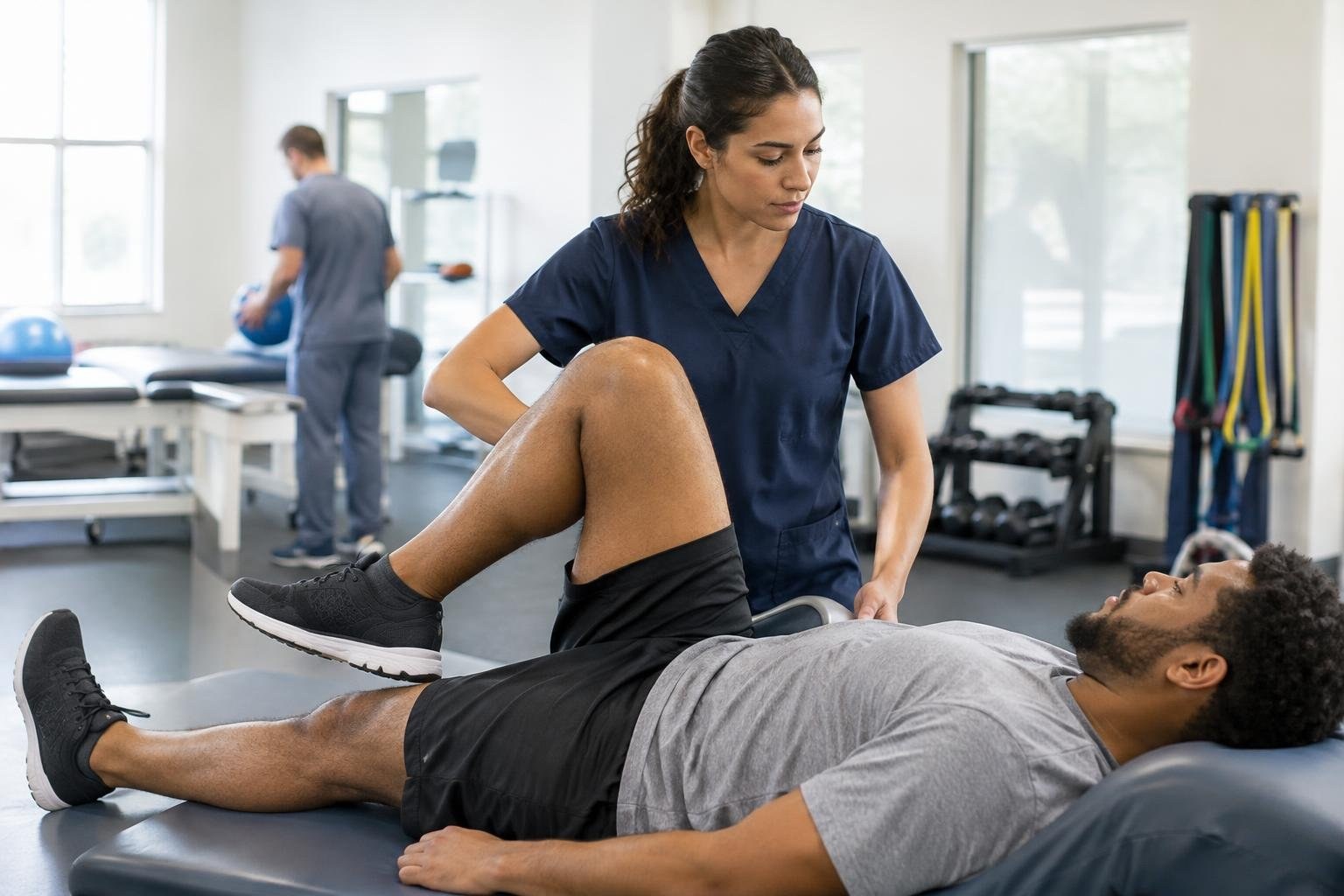
Physical therapy education and supervised skills practice
What Is a Physical Therapy Degree?
Physical Therapy/Therapist is the name of an academic field focused on assessing physical function and using therapeutic interventions to promote movement, fitness, and health. The field draws on anatomy, biology, biomechanics, exercise physiology, kinesiology, neuroscience, pathology, communication, clinical reasoning, and ethics.
Program catalogs may list physical therapy across several credential levels, from undergraduate study through doctoral education. Those labels describe academic offerings in the field, not automatic authorization to practice. The U.S. Bureau of Labor Statistics profile identifies a Doctor of Physical Therapy degree from an accredited program as the professional degree requirement for physical therapists.
Physical therapy is related to, but distinct from, occupational therapy, athletic training, and physical therapist assisting. Each profession has its own scope, education route, and credential rules. A physical therapy-related undergraduate major can be a preparation step; it is not equivalent to a professional DPT.
What Do Physical Therapy Students Study?
Students learn to connect body structures and movement with the activities people need or want to do. Early coursework may establish a foundation in anatomy, physiology, biology, and behavioral science. Later study may address biomechanics, kinesiology, neuroscience, pathology, pharmacology, exercise physiology, and rehabilitation psychology.
Professional coursework builds the ability to examine and measure physical function, interpret findings, reason through possible interventions, develop and document a care plan, and communicate with patients and other healthcare professionals. Therapeutic exercise and biophysical approaches are studied as tools that must be selected and adapted to the individual, rather than applied as a one-size-fits-all routine.
Professional programs also include supervised clinical education. Mayo Clinic describes its DPT preparation as combining academic coursework with clinical training. Ask each program how clinical placements are arranged, what supervision students receive, and how placement schedules affect work, family, and travel. Program sequences and clinical requirements vary.
Skills You Develop in Physical Therapy
This field develops a mix of scientific, practical, and interpersonal abilities. Students learn to interpret anatomy and movement, use clinical measurements, reason from observations, and select appropriate therapeutic activities. These abilities connect directly to the physical therapist’s work evaluating functional limitations and planning care.
Scientific understanding: Use knowledge of body systems and movement to interpret functional concerns.
Clinical reasoning: Connect an examination, patient goals, and changing response to a treatment plan.
Communication: Explain instructions, listen to concerns, document care, and coordinate with other professionals.
Professional judgment: Apply ethical standards and recognize the importance of safe, individualized care.
Adaptability: Modify therapeutic activities as a patient’s needs, abilities, or goals change.
Students should also expect to learn documentation and use of clinical measurement approaches. Specific software, equipment, and technology depend on the institution and clinical setting; ask programs what students use and practice.
Who Is a Physical Therapy Program Best For?
Physical therapy may be a good area to explore if you are curious about movement and health, enjoy applied science, and want work that involves regular interaction with people. It can appeal to students who like solving practical problems, learning through hands-on activities, explaining ideas clearly, and supporting patients through goals that may take time to reach.
You do not need to fit a single personality type. Some successful students are naturally analytical; others bring patience, creativity, or strong listening skills. The academic path does require a sustained interest in biological and movement sciences. The work also involves close communication, professional boundaries, careful documentation, and clinical responsibility.
Does physical therapy match you?
Salary, social recognition, and employment projections are only part of a career decision. Consider whether the daily tasks, patient contact, education commitment, and work environments suit your motivations and preferences. The MAPP career assessment can be one tool for exploring career and degree options. Treat assessment results as a starting point for reflection, then compare them with program requirements and conversations with qualified professionals.
Admissions, Time to Completion, and Academic Difficulty
Entry requirements are set by each college and professional program. Undergraduate admission requirements are different from admission to a DPT program. A DPT applicant commonly needs a bachelor's degree or an eligible integrated pathway and must complete the prerequisites specified by the target program. Requirements can differ, so do not assume that one major, GPA threshold, test, or experience rule applies everywhere.
Before applying, request a current list of prerequisites and ask whether prior coursework, transfer credits, or relevant experience will be accepted. Confirm application deadlines and whether the program requires additional materials or an interview. If you are in high school, prioritize a solid foundation in science and writing, and seek academic advising before selecting college courses.
Professional study is demanding because students must learn scientific concepts and apply them to clinical situations. A useful preparation plan includes steady study time, early help in challenging prerequisite courses, clear written communication, and realistic planning for clinical responsibilities.
Credential Levels, Program Format, and How Long It Takes
The path length depends on the route. One option is completing an undergraduate degree and then entering a DPT program. The University of Texas Rio Grande Valley describes a 3+3 route that combines undergraduate and doctoral study into six years of postsecondary education. Not every institution offers that structure, and admission or progression conditions can apply.
Full-time and part-time availability, transfer policies, prerequisite sequencing, and the time needed to finish a degree vary by institution. Ask for a term-by-term plan rather than relying only on a headline program duration. Include prerequisite courses, application cycles, clinical placements, and any time between undergraduate completion and professional study in your estimate.
Some coursework may be delivered online or in hybrid formats, but a professional program preparing students for patient care includes practical and clinical learning. Mayo Clinic describes academic coursework and clinical training in its DPT preparation. Confirm required in-person labs, clinical placements, and any location or attendance rules with the program.
Physical Therapy School Costs and Financial Aid
There is no single national tuition figure that applies to every physical therapy student. Total cost depends on institution, residency status, program structure, enrollment time, and living arrangements. Build a full budget rather than comparing tuition alone.
Tuition and required institutional fees for every year of study
Books, course materials, technology, and any lab-related expenses
Travel, housing, meals, and other costs associated with clinical placements
Application, examination, and state licensing expenses where applicable
Lost earnings or reduced work hours during intensive coursework and clinical training
Ask each institution for its current cost of attendance and whether tuition or fees differ by residency, program phase, or delivery format. Compare grants, scholarships, federal student aid, payment arrangements, and employer education benefits if eligible. A lower published tuition may not mean a lower total cost if added fees, travel, or living expenses are substantial.
Transfer credits may reduce duplicated coursework only when the institution accepts them and they fit the program sequence. Obtain a written evaluation before assuming credits will shorten the timeline or reduce the bill.
Physical Therapy Careers, Jobs, Pay, and Outlook
The central career path is physical therapist. The BLS reports a 2024 median annual wage of $101,020 and projects 11% employment growth from 2024 to 2034 for this occupation in the United States. A median is not an entry-level salary or a promise of what an individual will earn. Actual pay and opportunities differ by location, employer, experience, hours, and work setting. Consult the current BLS occupational profile for wage and outlook details.
Physical therapists work in a variety of healthcare environments, according to the Mayo Clinic career overview. The following are examples of adjacent directions to investigate, not jobs guaranteed by this degree. Pay and outlook are shown only where supported by the available occupation-specific evidence.
Career direction
Typical education or credential context
Approximate median pay
Outlook
How physical therapy study may apply
Physical therapist
DPT from an accredited program and state licensure
$101,020 (U.S. median, 2024)
11% projected growth, 2024–2034
Direct professional pathway after degree and licensure requirements.
Physical therapist faculty or instructor
Further graduate education and relevant professional experience may be needed; requirements vary by role
Not stated here
Not stated here
Clinical knowledge can inform teaching; investigate qualifications for each institution.
Physical therapy researcher
Research training or graduate study may be relevant depending on role
Not stated here
Not stated here
Clinical questions can inform research interests; research roles have distinct requirements.
Physical therapist assistant
Separate education and credential pathway; verify state requirements
Not stated here
Not stated here
Related rehabilitation setting, but a PT degree is not a substitute for the required pathway.
Physical therapist aide
Requirements depend on employer and position
Not stated here
Not stated here
May offer exposure to a clinical environment; duties differ from licensed PT practice.
Occupational therapist
Separate professional education and licensing pathway
Not stated here
Not stated here
Related rehabilitation work, but PT education does not itself qualify graduates to practice.
Athletic trainer
Separate professional preparation and credential rules
Not stated here
Not stated here
Movement and rehabilitation knowledge may be relevant, but requirements are distinct.
Healthcare educator
Role-specific graduate education or experience may be required
Not stated here
Not stated here
Clinical expertise may support teaching roles; check employer requirements.
AI tools and digital documentation may change how healthcare organizations manage information and communication. They do not remove the need for professional judgment, patient-centered interaction, or compliance with applicable practice standards. Ask programs how they teach students to use clinical technology responsibly.
Find out which Career or College Major is right for you!
A physical therapy degree and permission to practice are not the same thing. For U.S. physical therapist practice, the BLS identifies a DPT degree from an accredited program as the required professional degree. State licensing rules apply, and applicants should confirm current requirements with the relevant state licensing authority. New York’s Office of the Professions explains its state’s physical therapy pathway and notes that active Department-registered licensure programs award the DPT degree.
Accreditation matters because the professional degree pathway is tied to an accredited program. Verify a program’s current status through official accreditation resources and ask the state board whether the degree meets its requirements. Do not rely on a college’s general institutional accreditation alone as proof that a particular professional program qualifies graduates for licensure.
Optional national certifications are distinct from initial state licensure. O*NET provides a national certification listing for physical therapists; use it as a starting point to identify credentials and then verify eligibility, recognition, renewal, and relevance with the issuing organization. Never assume a certificate can replace the DPT or state license.
How to Choose a Physical Therapy Program
Compare programs on evidence that affects your education and next steps, not just on a campus tour or a broad claim about career success. Make a side-by-side list and ask for answers in writing when possible.
Professional accreditation: Is the DPT program currently accredited, and how can you verify its status independently?
Curriculum: Do courses cover the sciences, movement, clinical reasoning, communication, professional ethics, and therapeutic interventions you expect?
Clinical education: How are placements arranged, supervised, and scheduled? Are students responsible for travel or housing costs?
Admissions and completion: What prerequisites and progression standards apply? What is the published completion information for the relevant cohort?
Cost and aid: What is the estimated total cost, including fees and clinical-related expenses, and what aid may be available?
Format and access: Which components are online, in person, or hybrid? What equipment, travel, or attendance is required?
Career support: What advising, clinical placement support, and licensure preparation are provided?
Transferability: Which previous credits will count, and will they change the time to completion?
Families can help by comparing total cost, location, support, and realistic schedules. Students should also talk with academic advisers and, where possible, learn about the work directly from licensed professionals.
Related Degrees and Alternatives
Physical therapy is not the only route into rehabilitation, movement science, or patient care. Compare alternatives by the kind of work you want and the credential required, rather than by degree title alone.
Physical therapist assistant: Consider this instead if you are interested in a distinct support role in physical rehabilitation and want to investigate its separate education and licensing route.
Occupational therapy: Consider this instead if your interests center on helping people participate in daily activities through a different rehabilitation profession.
Athletic training: Consider this instead if your main interest is care and support related to athletic participation and injury management.
Exercise science or kinesiology: Consider this instead if you are more interested in movement, fitness, or human performance and are not yet committed to licensed PT practice.
Rehabilitation science: Consider this instead if you are drawn to the science or research behind function and recovery.
Nursing: Consider this instead if you want a broader patient-care profession with its own degree and licensure pathway.
Medicine or physical medicine and rehabilitation: Consider this instead if you aim to diagnose and treat patients as a physician and are prepared for medical school and further training.
Public health: Consider this instead if you want to address health at community or population levels rather than primarily through one-to-one clinical care.
Physical therapy versus occupational therapy is not simply a choice between exercise and daily tasks; both professions support function, but they have distinct educational and professional requirements. Confirm pathways with official program and licensing sources before choosing.
Advantages, Drawbacks, and Is a Physical Therapy Degree Worth It?
The central advantage of physical therapy is a direct connection between movement science, clinical problem-solving, and patient care. The field includes work in multiple healthcare environments, and it can offer a clear professional identity for students willing to meet the education and licensing requirements.
The tradeoffs are substantial: students need significant time in higher education, must meet program-specific academic demands, and need to plan for tuition, living costs, and practical clinical training. The work involves sustained interaction with patients and documentation, not only exercise or sports. A high occupation-wide median wage does not guarantee a specific salary, job offer, or return on tuition.
To decide whether it is worth the investment for you, estimate total education costs, identify likely financing, compare program accreditation and completion information, and consider your preferred work setting. Then assess whether the daily responsibilities and patient-focused nature of the work match your interests. Revisit the calculation if your intended state, program format, or career goal changes.
From Degree to Career: A Realistic Pathway
Physical therapy education can lead toward several connected steps, but progression is not automatic. For example:
Undergraduate preparation → complete a bachelor’s degree or an approved integrated pathway and the prerequisites required by target DPT programs.
DPT study → complete professional coursework and supervised clinical education in an accredited program.
Licensure → meet the rules of the state where you plan to practice.
Early career → begin as a licensed physical therapist in a healthcare setting that hires for your qualifications.
Later development → build experience, pursue relevant continuing education or certification, or consider research, teaching, or leadership roles if you meet those roles’ requirements.
Check each transition rather than assuming one automatically follows another. The right next step depends on academic eligibility, program completion, state rules, job openings, and your evolving interests.
Questions to Ask Before Enrolling
Before accepting an offer or paying a deposit, ask the institution and relevant licensing authority the questions that matter to your situation:
Is this specific DPT program currently accredited, and where can I verify that?
What is the estimated total cost through completion, including fees, living expenses, and clinical placement costs?
What admissions prerequisites and academic progression rules apply?
How are clinical placements selected, supervised, and scheduled?
Does the program prepare students for the licensing requirements in the state where I expect to practice?
Which courses require in-person attendance, lab work, or travel?
Will my existing credits transfer, and can I get the determination in writing?
What program completion and career outcome information can the institution provide?
What advising, career services, and financial aid options are available?
What happens to my timeline and total cost if I need to repeat a course or change enrollment pace?
Use the answers to compare programs on the same terms. If a detail is unclear, ask for the official policy rather than relying on informal assurances.
Frequently asked questions
Is a physical therapy degree hard?
Physical therapy programs can be academically and practically demanding. Students study anatomy, physiology, movement, clinical reasoning, and therapeutic exercise, then apply that knowledge in supervised clinical settings. The challenge is not just memorizing science: students must communicate clearly, assess individual needs, document care, and adjust interventions responsibly. Preparation in biology, consistent study habits, and comfort learning through hands-on practice can help.
Is a physical therapy degree worth it?
Physical therapy can be worth pursuing for students who want a clinical career centered on movement, rehabilitation, and helping people work toward functional goals. The decision depends on more than expected earnings: consider the years of education, tuition and living costs, licensure, the physical and interpersonal demands of care, and the work settings available where you may live. Compare program outcomes and your personal fit before enrolling.
What jobs can I get with a physical therapy degree?
The primary licensed career is physical therapist, who evaluates patients and develops and carries out treatment plans. Graduates may also pursue teaching or research paths, but those typically require further education, experience, or both. Related jobs such as physical therapist assistant, athletic trainer, and occupational therapist have separate education and credential requirements; a physical therapy degree does not automatically qualify you for them.
How much do physical therapists make?
The U.S. Bureau of Labor Statistics reports a 2024 median annual wage of $101,020 for physical therapists and projects 11% employment growth from 2024 to 2034. These are occupation-wide U.S. figures, not a guaranteed starting salary or a promise of employment. Location, setting, experience, hours, and employer can affect actual pay. Review the BLS profile for the latest context.
Can I earn a physical therapy degree online?
Some physical therapy coursework may be available online, but students preparing for clinical practice should expect hands-on instruction and supervised clinical education. The exact mix varies by institution and program. Check how a program delivers lab work, clinical placements, and any required in-person components, and confirm that it meets the licensing requirements where you plan to practice.
Does physical therapy require a lot of math?
Physical therapy study includes biology and movement science, and students may need quantitative skills to understand measurements, research, and patient progress. The research provided for this guide does not establish a uniform math prerequisite across programs. Review each institution’s admissions checklist and prerequisite courses, and ask an academic adviser whether your previous coursework meets its requirements.
Do you need graduate school to become a physical therapist?
To become a licensed physical therapist in the United States, the standard professional qualification is a Doctor of Physical Therapy degree from an accredited program, followed by applicable state licensure requirements. An undergraduate degree in a related subject can prepare you for DPT prerequisites, but it does not by itself qualify you to practice as a physical therapist.
What certifications help physical therapists?
Licensure is different from optional certification. A DPT and state licensure are central to practicing as a physical therapist; additional certifications may be useful for professional development or a specialty, depending on your goals. Check your state board’s current rules and confirm the eligibility, renewal, and recognition of any certification with the organization that grants it.
What is the difference between a DPT and a PhD in physical therapy?
A Doctor of Physical Therapy is a clinical doctorate focused on preparing practitioners to evaluate and treat movement-related functional limitations. A PhD is generally a research-focused doctoral path. Students interested in direct patient care should compare DPT programs, while those drawn to research or academic work should explore doctoral research training and the qualifications expected for their target roles.
People Also Ask
What do you learn in a physical therapy program?
A physical therapy program studies how movement, body systems, injury, and disease relate to physical function. Coursework can include anatomy, biomechanics, exercise physiology, clinical evaluation, therapeutic exercise, communication, ethics, and care documentation. DPT programs also include supervised clinical education. Curricula and admissions requirements vary by institution, so compare the actual course sequence and clinical experience before applying.
How long does it take to become a physical therapist?
The route commonly includes undergraduate study that fulfills a DPT program’s prerequisites, followed by a Doctor of Physical Therapy program and state licensure. Some institutions offer an integrated 3+3 pathway combining undergraduate and doctoral study. The length depends on the student's starting point, transfer credits, program structure, and enrollment pace; confirm timelines directly with institutions.
Can you become a physical therapist with a bachelor's degree?
A bachelor's degree in an appropriate field can prepare a student to apply to DPT programs, but it does not by itself qualify someone to practice as a physical therapist. Licensed practice requires a Doctor of Physical Therapy degree from an accredited program and state licensure. Specific prerequisite courses and admissions criteria are set by individual programs.
What is a 3+3 physical therapy program?
A 3+3 pathway combines undergraduate study and a DPT program into six years of postsecondary education, according to the University of Texas Rio Grande Valley. Availability, progression rules, and admissions criteria differ among institutions. Ask whether students must meet academic benchmarks to continue into the professional phase and whether the program fits your intended licensing jurisdiction.
Why does accreditation matter for physical therapy school?
Accreditation is important because the BLS identifies an accredited DPT program as the required degree pathway for physical therapists. Verify a specific program’s current accreditation status through the appropriate official accrediting resources and confirm state licensing requirements with the relevant board. Do not rely on a program title alone to establish that it leads to eligibility for practice.
Where can physical therapists work?
Physical therapists work in a range of healthcare settings, according to Mayo Clinic’s career overview. Students can investigate whether a program’s clinical placements expose them to settings and patient populations that match their interests. A program’s placement access, supervision, and scheduling are practical questions to ask, rather than assuming every student has the same experience.
What undergraduate major is best for physical therapy?
A physical therapy major or related undergraduate degree can build prerequisite knowledge, but the program title does not determine whether a student meets DPT admissions requirements. Review prerequisites and application rules for each target program, including any GPA, observation, test, or other requirements that the institution publishes. Requirements can differ, so verify them directly before planning courses.
Should I choose a DPT or a PhD?
The DPT is a clinical doctorate designed for professional practice, while a PhD emphasizes research. A student who wants to provide patient care generally investigates DPT education and licensing. A student interested in research, university teaching, or advancing scientific knowledge may consider a PhD or other graduate study, depending on the role and institution.
Physical therapy may suit students who want to combine movement science, careful problem-solving, and sustained work with people. Becoming a licensed physical therapist requires a substantial education commitment, including a Doctor of Physical Therapy degree and state licensure. Before deciding, compare accredited programs, total costs, clinical opportunities, and the day-to-day work with your interests and goals. A career assessment can help you explore whether this path and related healthcare careers fit what motivates you.
Want to see your options? Try our comprehensive Degree, Program & College Search tool
We use cookies to offer you a better browsing experience, analyze site traffic and personalize content.
Read about how we use cookies and how you can control them in our
Privacy Policy.
If you continue to use this site, you consent to our use of cookies.
×
Exciting News!
Be one of the first to Beta Test the new AI-Powered Assessment.com Platform.