Cytogenetics Technology Degree Guide: Courses, Careers, and Program Fit
Learn what cytogenetics technology programs teach, how training and certification pathways vary, what laboratory careers they can lead to, and what to check before choosing a program.
By David Slack · Staff Writer Assessment.com · Published October 12, 2026 · Last updated November 5, 2026
Cytogenetics technology programs prepare students to study chromosomes and genetic material in biological samples. The work supports research and clinical analysis of genetic conditions and may contribute to diagnosis, classification, or treatment decisions. Coursework can include genetics, chromosome analysis, fluorescent in situ hybridization (FISH), molecular methods, and laboratory practice, but the exact curriculum depends on the school and credential. Graduates may pursue specialized clinical laboratory roles, often after meeting additional employer, certification, experience, or state licensing requirements. Because program titles and pathways differ, families should look beyond the name of a major and confirm what graduates are qualified to do.
Degree & Program Decision Insights
Explore your personal fit, education requirements, career potential and next steps.
01Motivational Fit
Discover whether this program fits you
Explore your preferences against the focus of Cytogenetics/Genetics/Clinical Genetics Technology/Technologist. These prompts are not personal MAPP results.
Subject curiosity. Would you choose to explore “chromosome analysis” in depth? Ask for a sample learning activity to test that interest.
Breadth of interest. Consider the place of “fluorescent in situ hybridization (FISH)” in this field. Is this another part you would choose to explore, or mainly a requirement you would tolerate?
Work reality. Related work can involve this task: “Enter data from analysis of medical tests or clinical results into computer for storage.” Would you want that activity to be a regular responsibility?
Interest in studying a field can differ from enjoying its related work.
Which part would you want to do repeatedly, and what would you try before deciding?
Discover Your Personal Program Fit
Before investing your time and money in your education, discover how this program aligns with your natural motivations, work preferences and career goals.
Check the exact professional credential and jurisdiction requirements for this occupation; the classification association alone does not establish eligibility.
Check the exact professional credential and jurisdiction requirements for this occupation; the classification association alone does not establish eligibility.
Some wage or projection fields are unavailable; no missing values are inferred.
U.S. national estimates. A crosswalk does not establish entry-level eligibility; advanced, management and teaching roles can require further qualifications.
Explore your motivations. Use MAPP as a starting point for reflecting on your interest in “chromosome analysis”, then test that interest against a sample learning task.
Examine the work. Compare Medical and Clinical Laboratory Technologists and Medical and Clinical Laboratory Technicians on daily work and entry qualifications, as well as pay. Explore Medical and Clinical Laboratory Technologists.
Compare actual providers. Ask for the exact credential, course sequence and assessment methods. Compare how each provider teaches “fluorescent in situ hybridization (FISH)”, its entry criteria and its itemized costs.
Check the evidence before applying. Confirm prerequisites and any recognition or professional requirements for your intended route; ask for applicable rules and published outcome definitions in writing.
Verify the institution’s current offering, admissions requirements and outcomes; a search result does not establish your eligibility.
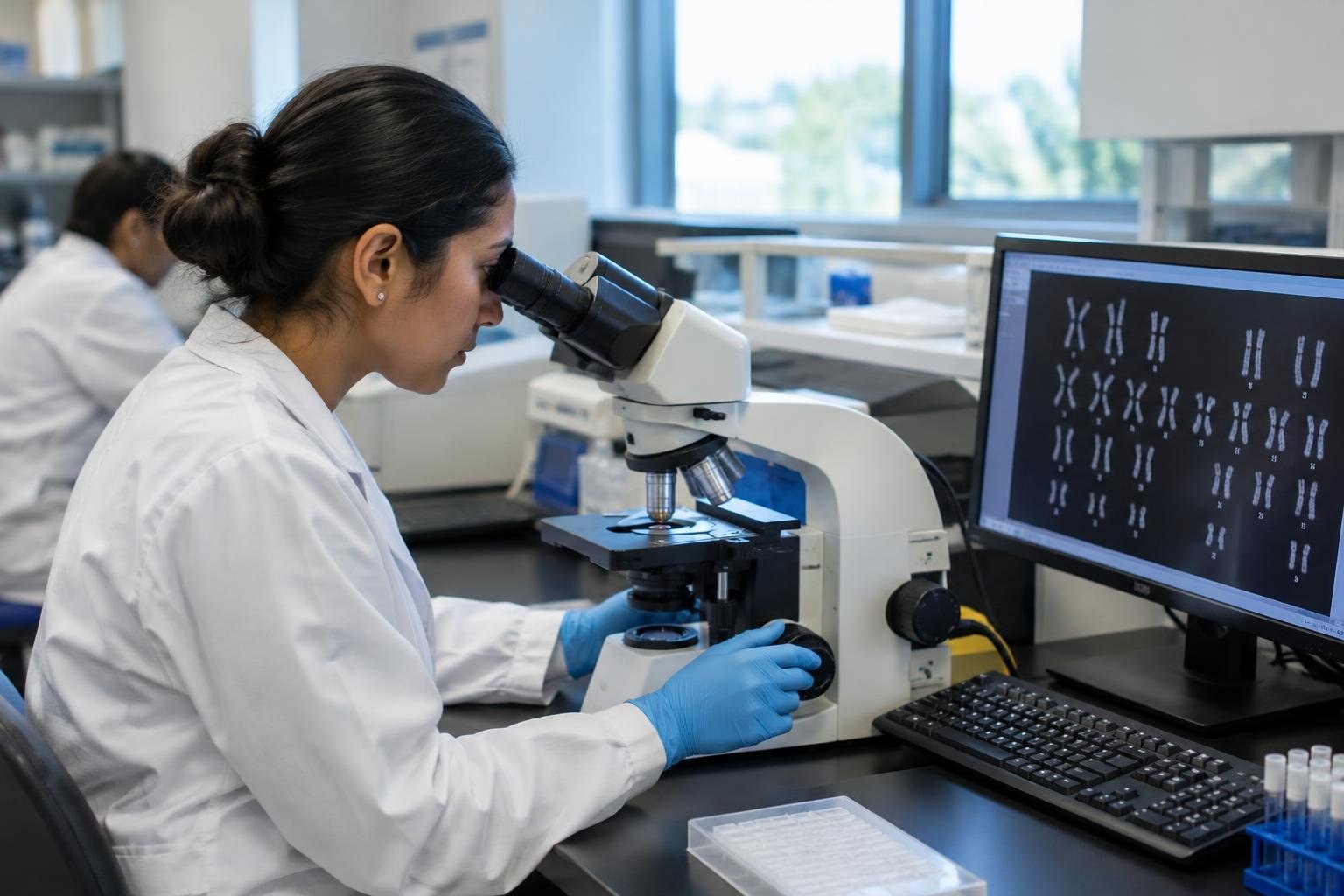
Chromosome analysis workflow in a clinical genetics laboratory
What Is a Cytogenetics Technology Program?
Cytogenetics technology combines genetics and laboratory science to examine chromosomes and chromosome segments in biological specimens. Results can support the study, diagnosis, classification, or treatment of inherited and acquired genetic diseases. The National Center for Education Statistics classifies this field under health professions and related programs as CIP 51.1010.
Work may involve samples such as blood, bone marrow, amniotic fluid, or solid tumors. Methods can include classical cytogenetic analysis, fluorescent in situ hybridization (FISH), and array comparative genome hybridization. The role is technical and evidence-focused: technologists produce and document laboratory findings, while clinical interpretation and patient-care decisions involve other qualified professionals.
Program names may include cytogenetic technology, clinical genetics technology, or a related title. A degree title does not by itself establish that a graduate meets an employer’s certification or a state’s licensing rules. Review the curriculum and confirm the specific pathway with schools and relevant authorities. See the NCES classification for this program area and O*NET’s Cytogenetic Technologists occupational profile.
What Do You Study? Courses and Laboratory Training
The curriculum depends on the credential and institution, but the central goal is to build a foundation in genetics and laboratory analysis. The NCES program description identifies chromosome analysis, FISH, molecular genetic techniques, cytotechnology, and photomicrography as areas of instruction. Ask schools which methods students practice directly and which they cover mainly in lectures.
Genetics and biology: Build the scientific context for understanding chromosomes, genes, and genetic variation.
Chromosome analysis: Learn laboratory workflows for preparing and examining chromosome material.
FISH and molecular methods: Study techniques that help identify or examine specific genetic features.
Laboratory practice: Develop careful specimen handling, documentation, and quality-focused habits.
Applied learning: Depending on the program, students may complete supervised lab experience, research, or a culminating project.
The research supplied for this guide does not establish a uniform national sequence of required courses, lab hours, or capstone work. Request a current course catalog and ask for examples of hands-on assignments, practical placements, and equipment access before comparing programs.
Skills You Develop
Students develop a blend of scientific knowledge, technical precision, and communication skills. In a laboratory, a result is useful only when the sample is handled appropriately, the method is performed carefully, and findings are recorded clearly. O*NET describes work that includes analyzing chromosome segments with classical cytogenetic, FISH, and array comparative genome hybridization techniques.
Scientific reasoning: Connect chromosome findings with biological questions and genetic conditions.
Technical accuracy: Follow detailed laboratory processes and document work consistently.
Visual analysis: Examine chromosome material and image-based results with care.
Data and technology use: Work with laboratory instruments, image capture, and digital records as available in a specific setting.
Communication: Present results and workflow information clearly to laboratory colleagues and other health professionals.
Professional judgment: Recognize when findings or a process need review and follow laboratory protocols.
Ask programs how they assess practical competency, not only written knowledge. Examples of student work, supervised lab activities, and instructor feedback can help families judge how well the curriculum develops skills used in clinical laboratory positions.
Who Is This Program Best For?
This field may appeal to students who are curious about genetics and enjoy precise, structured work. Many cytogenetics roles center on laboratory samples, technical methods, and analysis rather than frequent direct patient interaction. Students should be comfortable learning biological concepts, following detailed procedures, and taking responsibility for accurate records.
You do not need to fit a single personality profile to succeed. Consider whether you like solving evidence-based problems, working with instruments and visual data, and repeating careful steps when reliability matters. If your strongest interest is face-to-face care, broad patient assessment, or open-ended creative work, compare cytogenetics with other health or science pathways before committing.
Does Cytogenetics Technology Match You?
Salary, a specialized title, or the promise of scientific discovery should not be the only reasons to choose a major. Day-to-day tasks, learning style, training length, cost, and local job requirements matter too. Assessment.com’s MAPP career assessment can help you reflect on career and degree options; treat it as one input alongside course research, conversations with professionals, and job-posting review.
Admissions, Prerequisites, and Academic Demands
Admission rules are set by individual schools. Prospective students should ask whether applicants need prior biology or chemistry coursework, a minimum GPA, prerequisite labs, or an interview. The available occupational guidance describes science degrees and training pathways, but it does not establish one national admissions standard for cytogenetics programs.
Some programs may be designed for students entering college, while focused post-bachelor’s training may expect an earlier degree in cytogenetic technology, biotechnology, biology, or a related science. Purdue identifies a bachelor’s degree in one of these or a related science as the minimum for entry-level work in the field; Mayo Clinic describes a bachelor’s degree followed by focused post-graduate training as a common route. These are career-path examples, not universal admission rules.
Ask for written requirements, a sample course sequence, and a transfer-credit evaluation. If you need to strengthen science preparation, discuss options with an academic adviser before enrollment. Confirm whether prerequisite courses must include laboratory components and whether they need to be completed at a particular institution.
Credential Levels, Format, and Time to Completion
The time to complete a pathway depends on the credential, prior college work, enrollment pace, and any specialized training required after the degree. The credential levels associated with this field include certificates, associate’s and bachelor’s degrees, post-bachelor’s and graduate certificates, master’s degrees, first-professional degrees, and doctorates. That list describes possible field-level credential classifications; it does not mean every college offers each one as a cytogenetics program.
Mayo Clinic’s career information describes a four-year bachelor’s degree route and notes that people may then enter a one- to two-year post-graduate program focused on cytogenetic technology. This is an example pathway, not a guarantee of duration or a universal sequence. Transfer credits, part-time study, program availability, and employer requirements can change the timeline.
When comparing timelines, ask whether supervised laboratory training is included, whether placement availability affects graduation, and whether certification eligibility requires additional coursework or experience. Request a realistic completion plan that includes prerequisites and any post-degree steps.
Online, Hybrid, or On Campus?
Cytogenetics is a hands-on laboratory occupation. Online lectures may be possible in some programs, but students still need to understand how they will develop practical skills and whether any required lab, clinical, or supervised experience must happen in person.
Ask whether laboratory instruction is campus-based, offered through an approved local placement, or arranged in another way. Confirm who supervises practical work, what costs or travel may be involved, and whether the experience satisfies the program’s graduation requirements. If a school advertises an online option, verify that it supports the certification or licensing path you intend to follow.
For families comparing flexible study with campus training, evaluate the full arrangement rather than the delivery label. A program’s ability to provide relevant practice and a clear route to the next credential is more important than whether a portion of the coursework is remote.
Tuition, Costs, and Financial Aid
There is no single reliable tuition figure for this field because the cost depends on the institution, state residency, credential, course load, and whether lab or placement expenses apply. Compare each program’s published tuition and fees for the same academic year. Ask whether quoted charges include laboratory fees, required equipment, technology, background checks, transportation to placements, or examination and application costs.
Consider the full cost of the pathway, not just the first year. If a bachelor’s degree is followed by specialized post-bachelor’s training, include both stages when planning. Also compare time away from work, commuting, housing, and the effect of part-time study on total charges.
Review federal and state aid eligibility, institutional grants and scholarships, and employer tuition assistance where applicable. Ask a financial aid office for a written estimate of direct charges and expected aid, and compare the net cost. A lower price is not automatically the better value if the program does not provide the training or eligibility you need.
Cytogenetics Careers, Jobs, and Work Settings
Many pathways point toward specialized clinical laboratory work, but the degree alone does not guarantee a position or establish eligibility for a credential. O*NET describes cytogenetic technologists as analyzing chromosomes or chromosome segments in biological specimens to aid the study, diagnosis, classification, or treatment of genetic diseases. It lists job titles such as certified cytogenetic technologist, cytogenetics specialist, and molecular genetics technologist.
Career direction
How the education may apply
What to verify
Cytogenetic technologist
Focused preparation in chromosome analysis and related methods.
Degree, supervised training, certification, experience, and local license rules.
Molecular genetics technologist
Genetics and molecular laboratory methods may be relevant.
Position-specific education, technique experience, and credential expectations.
Medical and clinical laboratory technologist
Related laboratory science education may support broader testing roles.
Whether the curriculum fits the employer’s specific laboratory requirements.
Medical and clinical laboratory technician
May be a related laboratory career to investigate.
Required credential level, training, and permitted duties in the intended location.
Health specialties instructor
Experienced laboratory professionals may explore education roles.
Employers may set advanced education and experience requirements.
Compare current local job postings to understand required qualifications, shift patterns, and experience expectations. The sources available here do not provide comparable current wage or employment-outlook figures for these specific career paths, so do not assume that a specialized title guarantees a particular salary or growth rate. Browse Assessment.com’s guides to medical and clinical laboratory technologists and laboratory technicians for related options.
Certification, Accreditation, and State Licensure
Certification and licensure are separate from completing a degree. Mayo Clinic notes that certification by the American Society for Clinical Pathology (ASCP) is commonly expected by employers, though not always required, and that some states require clinical laboratory licensure. The specific eligibility rules depend on the credential and location.
O*NET’s certification information for Technologist in Cytogenetics (CG) describes an education level of an associate degree or higher and a work-experience requirement of less than two years. Verify current eligibility directly with the certifying organization before choosing a program, because course, experience, and examination rules can change.
State rules are not uniform. California’s Department of Public Health lists accepted certifications for its Clinical Cytogeneticist Scientist licensure pathway, including a distinction based on certification dates. That is a California-specific example, not a national requirement. Contact the licensing authority where you plan to work, and ask the school whether its training meets that state’s current rules.
For an example of how job descriptions can set additional qualifications, the University of Washington’s Clinic Cytogenetic Technologist Specialist classification includes a bachelor’s degree with specified science credits, certification, and two years of experience. This is an employer classification example, not a universal entry requirement.
Official resources: O*NET certification information, California license information, and the University of Washington job classification.
Affordability: Ways to Fund the Education
Because the route can involve both a degree and specialized training, plan financing across the complete pathway. Ask whether prior credits transfer and whether a post-bachelor’s certificate or training stage is available at a public institution within commuting distance. These questions can reveal options that a first-year tuition quote does not show.
Complete the Free Application for Federal Student Aid (FAFSA) when appropriate to determine eligibility for federal aid.
Ask colleges about need-based grants, institutional scholarships, and science or health-profession awards.
Check whether your current or prospective employer offers tuition assistance or supports relevant training.
Compare community-college coursework for transferable science prerequisites, but confirm credit acceptance in writing before taking classes.
Include books, lab expenses, travel, and any certification or licensing costs in your budget.
Use net price and total time to completion to compare options. Before borrowing, estimate what you could owe after each phase and avoid relying on a projected salary that is not guaranteed. Financial aid offices can explain available aid, but students and families should confirm conditions, renewal rules, and repayment obligations themselves.
Related Degrees and Alternatives
Related majors can lead to overlapping laboratory interests, but they are not interchangeable. Use the specific job you want as the starting point, then compare the education it requires with what each program actually teaches.
Biology: Consider this if you want broader life-science study and flexibility across biological topics; check whether you will need later cytogenetics training.
Biotechnology: Consider this if you want a wider focus on biological methods and applications; confirm how much clinical chromosome analysis is included.
Clinical laboratory science or medical technology: Consider this if you want a broader clinical testing foundation rather than a chromosome-focused curriculum.
Molecular biology or genetics: Consider this if you are more interested in genes, molecular processes, or research than in a particular clinical laboratory role.
Cytotechnology: Consider this if your interests center on examining cellular samples; compare its curriculum and career requirements directly with cytogenetics.
These are comparison prompts, not guarantees about program content or job eligibility. The NCES classification places cytogenetics among health professions and related programs, while course offerings depend on each institution. Compare required science classes, lab practice, internships, credential eligibility, and outcomes. For broader planning, explore Assessment.com’s college major decision guidance.
How to Choose a Cytogenetics Program
Do not assume a program is accredited for a particular professional purpose just because the college is accredited or the word “clinical” appears in its name. Ask the institution which accrediting body reviews the program, what the accreditation covers, and whether the credential meets the requirements of your intended employer or licensing authority.
Request the program’s written information about certification eligibility and state licensure. Ask for the exact credential names, any required post-degree experience, and whether graduates have completed the requirements in the state where you expect to work. Then independently confirm those details with the certifying organization and state licensing agency.
Check whether practical placements are guaranteed, how they are arranged, and what happens if a placement is unavailable. Also ask what support the program provides for job searches, professional references, and credential applications. A clear, specific answer is more useful than a general promise of career preparation.
From Degree to Career: Example Pathways
Career progress is not automatic, and job titles and requirements vary. These examples show possible decision points rather than guaranteed promotions:
Biology or biotechnology bachelor’s degree → seek a relevant laboratory position or focused cytogenetics training → build documented practical experience → pursue certification if eligible and useful for target employers → consider a specialist role.
Cytogenetics-focused program → complete supervised laboratory learning → apply for entry-level cytogenetics work that matches your qualifications → develop expertise with specific methods such as FISH or chromosome analysis → consider advanced technical responsibilities as experience grows.
Clinical laboratory background → compare internal training or post-bachelor’s options → meet the requirements for cytogenetics work → continue professional development as laboratory methods and employer needs change.
For each route, verify the next step before investing in it. Look for job postings, ask program advisers about credential eligibility, and speak with laboratory professionals about the actual work. A degree can build knowledge, but hiring depends on qualifications, experience, location, and available positions.
Questions to Ask Before Enrolling
Before paying a deposit or accepting an offer, use this checklist with the admissions office, academic department, financial aid office, and relevant credentialing authority:
What degree or certificate will appear on my transcript, and which courses are required?
How much of the curriculum is practical laboratory work, and where does it take place?
What are the full program costs, including lab fees, supplies, travel, and credential expenses?
Which credits can transfer, and can the school confirm that in writing?
What certification pathways have graduates pursued, and what additional experience or education was needed?
Does the curriculum satisfy the current licensing rules in the state where I expect to work?
How are laboratory placements arranged, and are they guaranteed?
Can I complete courses online, and which requirements require in-person attendance?
What career services, employer connections, and graduate outcome information can the program provide?
Which grants, scholarships, loans, or employer benefits may apply, and what are their conditions?
Keep copies of program descriptions and credential advice, and verify important claims with the organization that sets the requirement. Students and parents can also browse Assessment.com’s education resources and healthcare career area while comparing possible directions.
Advantages, Drawbacks, and Is It Worth It?
Assess value in relation to your goals rather than treating the degree as a guaranteed return. Advantages can include a focused scientific specialty, applied laboratory learning, and a clear connection between chromosome analysis and clinical or research questions. Skills may also transfer to related laboratory roles, depending on employer requirements.
Potential drawbacks include a narrow specialty, significant science coursework, the need for hands-on training, and possible additional steps after graduation. Certification, experience, or state licensure may add time and cost. The exact pathway and the number of relevant jobs can differ by location, so investigate current local openings before deciding.
A useful comparison is the full cost of education against realistic job requirements, likely work settings, and your interest in careful laboratory tasks. Talk with an adviser and, if possible, professionals doing the work. A major can be a sound choice when it fits your interests and practical constraints; it is not automatically worthwhile for every student.
Frequently asked questions
What is a cytogenetics technology degree?
Cytogenetics technology is a specialized laboratory field that examines chromosomes and chromosome segments in biological samples. Technologists use methods such as conventional chromosome analysis and fluorescent in situ hybridization to help study, classify, or diagnose inherited and acquired genetic conditions. Program names and available credential levels vary by institution, so check each school’s curriculum and verify that it prepares students for their intended career pathway.
Is cytogenetics technology hard to study?
The work requires detailed laboratory procedures, careful interpretation of results, and sustained attention to accuracy. Students typically need a solid foundation in biology and genetics, along with comfort learning technical processes. Whether the program feels difficult depends on your preparation and strengths; ask programs about science prerequisites, lab hours, and academic support before enrolling.
What degree do you need to become a cytogenetic technologist?
Requirements vary by employer and location. Purdue describes a bachelor’s degree in cytogenetic technology, biotechnology, biology, or a related science as the minimum for entry-level cytogenetic technologist roles. Other pathways may add specialized post-bachelor’s training, certification, or state licensure. Check job postings where you plan to work and confirm the current requirements with the relevant certifying or licensing body.
What does a cytogenetic technologist do?
Cytogenetic technologists analyze chromosomes in samples such as blood, bone marrow, amniotic fluid, and solid tumors. Their findings can help with the study, diagnosis, classification, or treatment of inherited or acquired genetic diseases. They may use conventional cytogenetic methods, fluorescent in situ hybridization, or array comparative genome hybridization, depending on the laboratory and the case.
Can you study cytogenetics technology online?
Some coursework may be offered online, but the occupation is hands-on laboratory work. Before enrolling in an online or hybrid program, confirm how it provides practical laboratory instruction, supervised experience, or clinical placement. Also ask whether any in-person requirements affect scheduling, travel, or eligibility for certification or state licensure.
Do cytogenetic technologists need certification?
Certification is distinct from earning a degree, and whether it is required depends on the employer and jurisdiction. Mayo Clinic College of Medicine and Science notes that employers commonly require ASCP certification, while not describing it as universal. Check the certifier’s current eligibility rules and compare them with your program’s course content and practical training.
Do cytogenetic technologists need a state license?
Rules vary by state. California, for example, identifies approved certification pathways for its Clinical Cytogeneticist Scientist license. That state-specific example should not be treated as a nationwide rule. Contact the licensing authority in the state where you plan to work and verify the accepted credentials and application requirements before choosing a program.
How is cytogenetics different from a biology degree?
A biology degree provides broader preparation in the life sciences, while a cytogenetics-focused program centers on chromosome and genome analysis for laboratory applications. A biology degree may be a route into the field, but employers may also require specialized training, certification, or experience. Compare the actual courses and hands-on preparation rather than relying on the degree title alone.
People Also Ask
What is the difference between genetics and cytogenetics?
Cytogenetics studies chromosomes and chromosome segments, including their structure and patterns. Clinical cytogenetic technologists analyze these features in patient samples to support the study, classification, diagnosis, or treatment of genetic diseases. The program field may also include molecular methods and other forms of genetic analysis.
Where do cytogenetic technologists work?
Cytogenetic technologists can work in clinical laboratories that analyze samples such as blood, bone marrow, amniotic fluid, and solid tumors. O*NET lists several related job titles, including cytogenetics specialist and molecular genetics technologist. Actual duties and hiring qualifications depend on the laboratory and position.
What is FISH in cytogenetics?
FISH, or fluorescent in situ hybridization, is a laboratory method that uses fluorescent probes to identify particular genetic sequences on chromosomes. Cytogenetics programs may teach it alongside classical chromosome analysis and other molecular techniques. Students should ask how much supervised practice a program offers with each method.
How long does it take to become a cytogenetic technologist?
The time needed depends on the credential, transfer credits, course schedule, and whether specialized post-bachelor’s training is needed. A bachelor’s degree is one pathway identified by career resources, while some people complete additional focused training afterward. Ask each school for a term-by-term plan and confirm whether certification eligibility requires further education or experience.
How do I choose a cytogenetics program?
Compare the courses, laboratory access, supervised practical experience, graduate outcomes, total charges, and support for certification or state licensure. Ask whether the program satisfies the requirements of employers in your intended location. The degree name alone does not establish eligibility for a credential or a job.
Is cytogenetics the same as medical laboratory science?
A cytogenetics technology program has a concentrated focus on laboratory analysis of chromosomes and genetic material. Medical laboratory science or technology is a broader area of laboratory practice. Compare course requirements, the types of specimens and tests taught, practical placements, and eligibility for roles you may want before deciding between them.
A cytogenetics or clinical genetics technology program may suit students who enjoy biology, careful laboratory work, and applying technical methods to questions about health and disease. The field can lead to specialized diagnostic laboratory roles, but the pathway depends on the program’s curriculum, hands-on training, employer requirements, and any state licensing rules. Compare total cost and completion time with the education and credentials expected for the jobs you want. If the work sounds interesting but you are still weighing options, use the MAPP career assessment to explore how your preferences may align with related careers and degrees.
Find out which Career or College Major is right for you!
We use cookies to offer you a better browsing experience, analyze site traffic and personalize content.
Read about how we use cookies and how you can control them in our
Privacy Policy.
If you continue to use this site, you consent to our use of cookies.
×
Exciting News!
Be one of the first to Beta Test the new AI-Powered Assessment.com Platform.