Clinical Laboratory Science Degree Guide: Courses, Careers, and Program Fit
Learn what clinical laboratory science programs teach, how certificate, associate, and bachelor’s routes differ, what laboratory careers they can lead to, and how to compare program cost, accreditation, and fit.
By Kieth Nelson · Staff Writer Assessment.com · Published October 26, 2026 · Last updated November 5, 2026
Clinical laboratory science is the study and practice of laboratory testing that helps healthcare teams make decisions about patient care. Students learn to work with specimens, laboratory instruments, scientific methods, quality controls, and test results across areas such as chemistry, hematology, and microbiology. Programs may lead to different credentials, from an associate degree focused on technician preparation to a bachelor’s degree designed for clinical laboratory scientist or medical technologist work. The name on a program is not enough to determine which jobs it prepares students for: curriculum, clinical experience, employer expectations, and state rules matter. Not sure whether clinical laboratory science fits you? Take the Free MAPP Career Assessment to reflect on how your motivations, interests, and natural preferences align with this field and related careers.
Degree & Program Decision Insights
Explore your personal fit, education requirements, career potential and next steps.
01Motivational Fit
Discover whether this program fits you
Explore your preferences against the focus of Clinical Laboratory Science/Medical Technology/Technologist. These prompts are not personal MAPP results.
Scientific investigation. Would you enjoy investigating clinical chemistry and explaining your conclusions from evidence?
Breadth of interest. Consider the place of “the theory and practice of hematology” in this field. Is this another part you would choose to explore, or mainly a requirement you would tolerate?
Work reality. Related work can involve this task: “Enter data from analysis of medical tests or clinical results into computer for storage.” Would you want that activity to be a regular responsibility?
Interest in studying a field can differ from enjoying its related work.
Which part would you want to do repeatedly, and what would you try before deciding?
Discover Your Personal Program Fit
Before investing your time and money in your education, discover how this program aligns with your natural motivations, work preferences and career goals.
Check the exact professional credential and jurisdiction requirements for this occupation; the classification association alone does not establish eligibility.
Health Specialties Teachers, PostsecondarySOC 25-1071 · O*NET 25-1071.00$107,310/year median (May 2025); +17.9% projected change (2025–2035); 24,900 projected openings/year.
Typical occupational entry: doctoral or professional degree (BLS). BLS lists less than 5 years of related work experience as typical for this occupation; this programme is not a direct promise of entry. Postsecondary teaching is a separate appointment and may require advanced study; this programme alone is not a promise of a teaching post.
U.S. occupational wages are not guaranteed graduate earnings; OEWS excludes self-employed workers.
Projected openings include replacements as well as growth.
Some wage or projection fields are unavailable; no missing values are inferred.
U.S. national estimates. A crosswalk does not establish entry-level eligibility; advanced, management and teaching roles can require further qualifications.
Clinical/Medical Laboratory TechnicianCIP 51.1004. Compare its emphasis on general laboratory procedures and skills and laboratory mathematics with this program’s focus.
Explore your motivations. Use MAPP as a starting point for reflecting on your interest in “the theory and practice of hematology”, then test that interest against a sample learning task.
Examine the work. Compare Medical and Clinical Laboratory Technologists and Health Specialties Teachers, Postsecondary on daily work and entry qualifications, as well as pay. Explore Medical and Clinical Laboratory Technologists.
Compare actual providers. Ask for the exact credential, course sequence and assessment methods. Compare how each provider teaches “clinical chemistry”, its entry criteria and its itemized costs.
Check the evidence before applying. Confirm prerequisites and any recognition or professional requirements for your intended route; ask for applicable rules and published outcome definitions in writing.
Verify the institution’s current offering, admissions requirements and outcomes; a search result does not establish your eligibility.
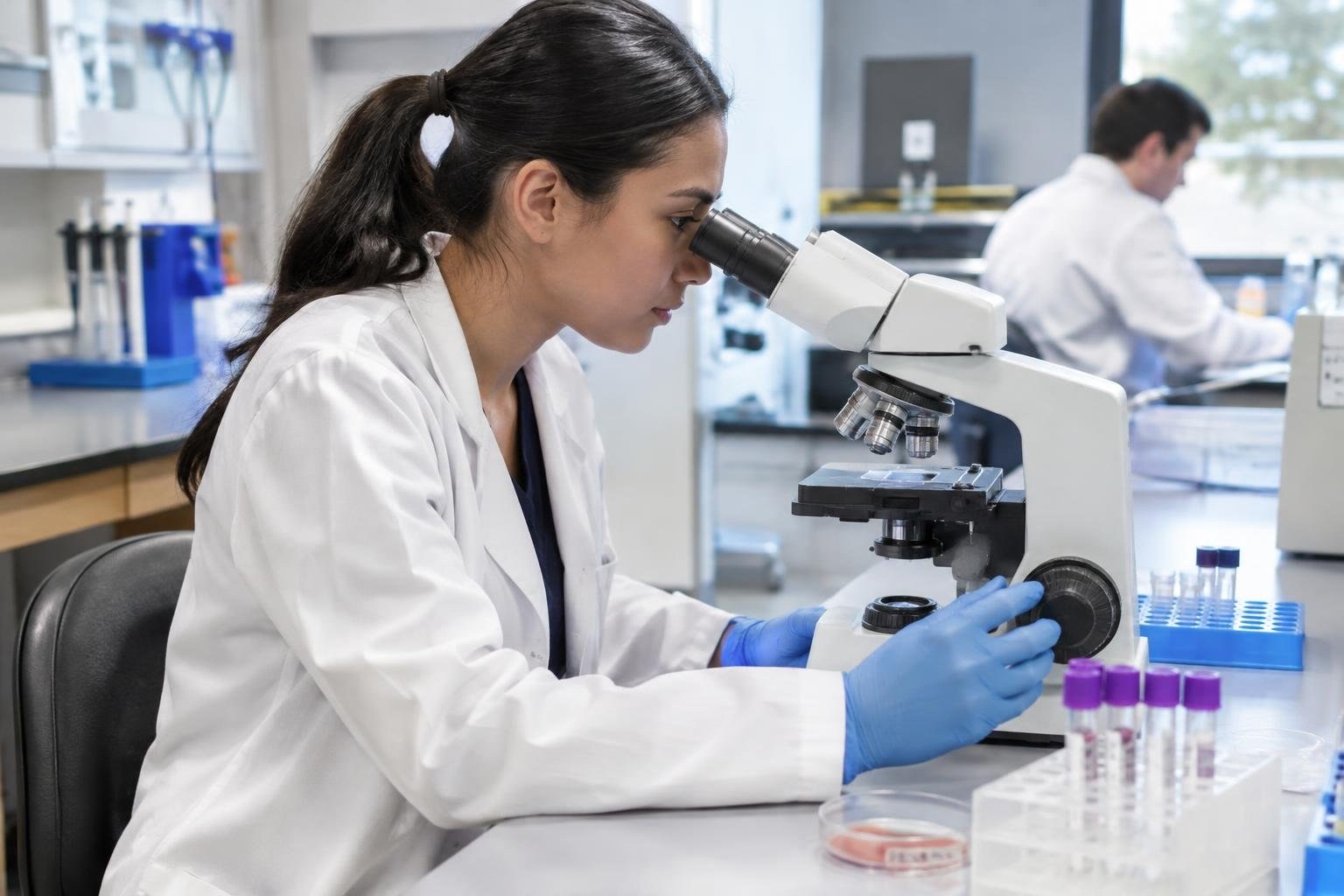
A student practicing specimen analysis in a teaching laboratory
What Is a Clinical Laboratory Science Degree?
Clinical laboratory science, also called medical technology or medical laboratory science at many institutions, focuses on testing and analyzing patient specimens and other samples. Laboratory professionals use scientific methods and controlled procedures to produce reliable information used in healthcare and research. The field connects biology and chemistry to practical testing, not direct diagnosis or treatment by the laboratory worker.
The federal Classification of Instructional Programs describes a broad area spanning hematology, clinical chemistry, microbiology, immunology, immunohematology, quality assurance, research methods, laboratory management, medical informatics, and professional standards. Individual schools emphasize different parts of this scope. Compare what a program actually teaches, not just its title.
Credential labels cover several levels. Associate programs may focus on clinical laboratory technician preparation; bachelor’s programs may prepare students for clinical laboratory scientist or medical technologist roles. Certificates and graduate programs also exist in the field, but availability and purpose vary by institution. A degree classification is not proof that a particular school offers every credential.
For example, St. Louis Community College describes its AAS as technician preparation, while King’s College describes a bachelor’s program for clinical laboratory scientist or medical technologist preparation. These are examples, not universal rules.
What Do You Study in Clinical Laboratory Science?
Expect a mix of science foundations and applied laboratory learning. Depending on the curriculum, students study hematology, clinical chemistry, microbiology, immunology, and immunohematology. These subjects explain how laboratory methods identify or measure biological features and how results relate to physiological processes.
Practical courses teach students to follow procedures, handle instruments, manage samples, maintain quality controls, and record and report data. Quality assurance matters because a result must be produced through a dependable process, not merely generated by a machine. Students also learn professional standards, laboratory regulations, and ethical responsibilities.
Some bachelor’s programs include clinical rotations or a hospital-based internship. For instance, Fairleigh Dickinson University describes a partnership with an accredited hospital-based medical laboratory science internship. Other schools may arrange practical training differently, so ask where clinical work takes place, what prerequisites apply, and whether students are responsible for securing a placement.
Programs with research emphasis may include project design, data interpretation, and research communication. York College’s program description highlights critical thinking, research-project skills, and the use of math to present and evaluate data. Ask for a current course sequence and sample clinical requirements before committing, because curricula change and vary between programs.
Skills You Develop
Training develops hands-on, analytical, and professional skills. In a laboratory class, students practice following detailed procedures and using equipment carefully. They learn to interpret data, recognize when a result or process needs review, and document work so other professionals can understand what was done.
Scientific and technical skills: applying concepts from biology and chemistry to laboratory methods and specimen testing.
Quality and safety habits: following protocols, quality checks, and professional standards.
Quantitative reasoning: working with measurements, data, and statistics in laboratory or research settings.
Communication: recording and reporting results accurately and explaining technical information to colleagues.
Technology use: learning instruments and laboratory information systems used by a particular training site or employer.
Teamwork and accountability: coordinating with laboratory colleagues and healthcare professionals while respecting the limits of one’s role.
The skills transfer across clinical testing, research, and laboratory operations, but a degree does not guarantee a particular job. Employers may require additional experience, training, or credentials for specialized responsibilities.
Who Is This Program Best For?
This field may appeal to students who enjoy biology and chemistry, careful hands-on work, and solving problems by examining evidence. Many laboratory tasks call for concentration, consistency, and a willingness to follow precise procedures. You may contribute to patient care without spending most of the workday in direct conversation with patients.
That does not mean there is one ideal personality. Some students are drawn to technical detail; others value the connection between laboratory evidence and larger questions about health or research. The important question is whether the day-to-day work sounds engaging: repeated procedures, data review, teamwork, and responsibility for accuracy.
Does Clinical Laboratory Science Match You?
Salary, job availability, and a respected healthcare role are relevant, but they should not be the only reasons to enroll. Consider whether you like the subjects and working conditions, and whether the required length and cost of training fit your circumstances. Assessment.com’s MAPP assessment can help you reflect on motivations and work preferences. Use it alongside conversations with students, instructors, and working professionals, not as a substitute for researching program requirements.
Assessment.com also provides degree resources and a guide to choosing a college major to support broader comparisons.
Admissions, Program Length, and Academic Demands
Admissions rules differ by school and credential. Ask about high-school science and math preparation, prerequisite college courses, minimum grades, transcripts, placement processes, and any application deadlines. Health programs may have additional screening or eligibility steps, but the supplied program descriptions do not establish a single nationwide admissions standard.
Completion time also varies. An associate route, bachelor’s degree, post-bachelor’s certificate, and graduate program differ in scope. Transfer credits, part-time enrollment, required course sequencing, and clinical placement schedules can affect an individual timeline. Get a written degree plan that includes prerequisites and hands-on training rather than relying on a general estimate.
The academic work can be demanding because it combines science concepts with careful practical execution. Students may find it challenging to keep up with lab assignments, apply quantitative reasoning, and maintain accuracy across repeated tasks. Before enrollment, check whether tutoring, lab practice time, advising, and make-up policies are available.
For adult learners and transfers, ask which prior courses count, whether science credits have age limits, and whether work or military training can be evaluated. Request a transfer-credit decision in writing before paying for courses that might not apply.
Online vs. On-Campus Study
Online, hybrid, and campus options depend on the institution and credential. Lecture material may be delivered remotely, but practical laboratory skills and clinical experience require a plan for hands-on learning. A program that advertises online coursework may still require in-person laboratory sessions, a clinical placement, or travel to an approved site.
Before enrolling, ask the school to identify every in-person requirement, the location and timing of placements, how placements are assigned, and what happens if a site is unavailable. Find out whether the program accepts students living outside its region and whether the training arrangement aligns with employment requirements where you plan to work.
Do not compare online and campus programs only by convenience. Compare the total schedule, access to equipment and instructors, clinical support, travel costs, and whether the curriculum prepares you for your intended role.
Tuition, Costs, and Financial Aid
There is no single national price for a clinical laboratory science degree. Tuition depends on the school, public or private status, residency rules, credential level, and how many credits you need. Add required fees, books, lab supplies, technology, commuting or housing, and costs connected with clinical training when estimating the full amount.
Request a term-by-term cost estimate and distinguish tuition from fees and living expenses. Ask whether transfer credits reduce the number of courses required, whether the school offers scholarships or need-based aid, and whether an employer might help fund study. Check eligibility and conditions directly with the institution and the relevant aid provider.
To compare affordability fairly, estimate the cost to completion rather than comparing a single term’s tuition. Include the effect of part-time study on both expenses and time to finish. Do not assume a certificate or online route is automatically less expensive; required credits and in-person components can change the total.
Questions to Ask About Funding
What is the estimated total cost, including program-specific fees?
Which grants, scholarships, work-study options, or employer benefits may apply?
Will transfer credits count toward this specific program?
Can financial aid continue if clinical training extends the timeline?
What costs are due before a placement or practical course begins?
Careers, Jobs, Pay, and Employment Outlook
Clinical laboratory science graduates may pursue technician or technologist work, depending on their education and the role’s requirements. The U.S. Bureau of Labor Statistics says clinical laboratory technologists typically need a bachelor’s degree to enter the occupation, while technicians sometimes qualify with an associate degree. It notes that many work in hospitals, medical and diagnostic laboratories, and doctors’ offices, and that most work full time. See the BLS Occupational Outlook Handbook profile for current wage and outlook figures before making a financial decision.
Titles can overlap, and a title alone does not establish eligibility. The program and employer should clarify which duties and qualifications apply. Examples of related paths include:
Career direction
Typical education or preparation
Pay and outlook
How the program may apply
Medical or clinical laboratory technician
Some technician jobs may accept an associate degree; employer and state rules vary.
Consult current BLS data by occupation and location.
An associate program may focus on entry-level technician preparation.
Medical or clinical laboratory technologist
BLS says a bachelor’s degree is typically needed for entry.
Consult current BLS data by occupation and location.
Bachelor’s curricula may include broader laboratory science and clinical training.
Clinical laboratory scientist
Check the employer’s and state’s current requirements.
Consult current BLS data by occupation and location.
Some bachelor’s programs describe preparation for this role.
Medical technologist
Requirements depend on employer, jurisdiction, and program pathway.
Consult current BLS data by occupation and location.
Some schools use this title for a related bachelor’s pathway.
Cytotechnologist
Verify specialty education and employer requirements.
Consult current occupational data where available.
May be a related specialty direction; confirm whether a program provides that preparation.
Cytogenetic technologist
Verify specialty education and employer requirements.
Consult current occupational data where available.
May be a related specialty direction; ask about additional training.
Laboratory manager
Education, laboratory experience, and management qualifications vary.
Consult current occupational data where available.
Laboratory management coursework can be relevant; advancement is not automatic.
Postsecondary health specialties teacher
Check the institution’s faculty qualifications and subject requirements.
Consult current occupational data where available.
Graduate education and relevant experience may be important; verify the job posting.
Hospitals, diagnostic laboratories, and doctors’ offices are settings identified by BLS. Research work and laboratory management are also within the broader field’s educational scope, but not every entry-level program directly qualifies graduates for those roles. A bachelor’s degree, specialization, and experience may broaden options, while advancement depends on position requirements and openings.
Automation and laboratory information systems influence how testing is performed, but do not make accuracy, quality control, and informed review irrelevant. Evaluate how a curriculum prepares you to use current methods and adapt to changes rather than relying on claims that a career is immune to technology.
Find out which Career or College Major is right for you!
Accreditation and legal permission to work are related but distinct questions. A program’s accreditation status can matter for training quality, eligibility, or employer expectations. The Austin Community College Medical Laboratory Technology page identifies its program as accredited by the National Accrediting Agency for Clinical Laboratory Sciences (NAACLS). York College also reports program accreditation status in its catalog. These examples do not establish the status of other programs or current status at a later date.
Check the accreditor’s current directory and confirm the exact campus, credential, and program. Ask the school what accreditation means for clinical placements and the jobs graduates seek. Do not treat a college’s general institutional accreditation as proof that a particular program has specialized accreditation.
Licensure rules can vary by state. New York’s Office of the Professions lists clinical laboratory technology among regulated professions. If you intend to work in a state with licensing rules, verify the current requirements directly with that state before choosing a course of study. A degree is not itself a license, and a certificate or professional credential should not be assumed to satisfy state law.
Employers may also set education, experience, or credential expectations beyond state minimums. Ask prospective programs to explain what their graduates are eligible to pursue and how that compares with current local job postings.
Related Degrees and How to Choose a Program
Use the program’s intended career outcome as the starting point for comparison. A technician-focused associate degree and a bachelor’s program may differ in courses, clinical preparation, time, cost, and the jobs employers consider. A certificate or post-bachelor’s option may be useful for a different group of students. Confirm that the credential matches your current education and career goal.
Related Degrees and Alternatives
Medical laboratory technology: consider this if you want to explore technician-focused associate-level preparation.
Biology: consider this if you want broader life-science study and are willing to research how to gain clinical laboratory qualifications separately.
Biochemistry: consider this if molecular and chemical science interests you more than a clinical laboratory pathway.
Microbiology: consider this if microorganisms and laboratory research are your primary interests.
Public health: consider this if you are more interested in population health and prevention than routine specimen testing.
Nursing or another direct-care program: consider this if you want frequent patient interaction and hands-on care rather than primarily laboratory work.
These are comparison starting points, not claims that the alternatives lead to the same occupations. Check official program curricula and the requirements for each career.
How to Choose a Program
Compare specialized accreditation, course sequence, laboratory facilities, clinical placement arrangements, faculty experience, total cost, transferability, and career support. Ask for completion and employment outcomes with clear definitions and time periods. Find out which employers recruit, whether students can complete clinical requirements near home, and how the program supports students who need to repeat a course or placement.
Useful next steps include reviewing Assessment.com degree resources, comparing the exact curriculum on official college pages, and speaking with admissions and financial-aid staff. Use the MAPP assessment as one tool for reflecting on personal fit, not as a ranking of schools or a substitute for checking qualifications.
Experience, Credentials, and Career Preparation
Practical experience can help students connect classroom learning to the expectations of a laboratory. Ask about supervised clinical training, internships, research opportunities, or projects that involve interpreting and reporting data. The type and availability of experience depend on the institution and credential.
How to Stand Out to Employers
Keep examples of academic projects and explain the methods, quality steps, and findings clearly.
Build a record of dependable laboratory practice, careful documentation, and teamwork.
Ask instructors or placement supervisors for feedback on professional communication.
Review local job postings to identify recurring requirements, then ask your adviser whether your curriculum covers them.
Confirm whether any requested certification or license is required, preferred, or unrelated to your target role.
Professional organizations and additional credentials may be relevant to particular specialties, but requirements and eligibility vary. Verify details with the organization that issues a credential and the state authority where you plan to work. Do not assume a school certificate grants the right to practice.
Potential routes can look different: an associate degree may lead to a technician role, followed by further study or added responsibility; a bachelor’s degree may prepare a graduate to apply for technologist or scientist roles; laboratory experience may later support specialization or supervisory work. These are possible paths, not guaranteed promotions or outcomes.
Is a Clinical Laboratory Science Degree Worth It?
Clinical laboratory science can be worthwhile when the role, educational commitment, and likely costs fit your goals. It offers a route into technical work that supports healthcare and research. At the same time, training may require demanding science courses, hands-on practice, and a clinical schedule; some roles require a bachelor’s degree or additional qualifications.
Before enrolling, use this checklist with a parent, counselor, or adviser:
Does the exact program have the accreditation and approval status I need?
What is the full cost to completion, including fees, supplies, travel, and clinical requirements?
Which roles does the curriculum prepare students to pursue, and what credentials do employers ask for?
Where and when do laboratory and clinical experiences take place?
What are the program’s completion and graduate employment outcomes, and how are they measured?
Will my prior coursework transfer, and can I get that decision in writing?
What aid, scholarships, or employer funding could apply, and what conditions come with them?
What career services, clinical-placement support, and employer connections are available?
Have I checked the rules in the state where I expect to work?
Do I like the actual work enough to commit to the courses and routine it involves?
Consider alternatives if you prefer direct patient care, broader laboratory research, or a field with fewer structured practical requirements. A useful plan is to compare at least two programs, speak with an adviser and a working professional, and review current job descriptions before making a deposit.
Frequently asked questions
What is a clinical laboratory science degree?
Clinical laboratory science is a science-focused healthcare field in which trained laboratory professionals perform and evaluate tests on specimens. Their results help clinicians investigate, diagnose, and monitor health conditions. Programs may be called clinical laboratory science, medical technology, medical laboratory science, or clinical laboratory technology. Coursework and career eligibility depend on the credential and institution.
Is clinical laboratory science a hard major?
The difficulty depends on your preparation and the program, but students should expect substantial science coursework, careful laboratory procedures, and close attention to detail. Programs may include chemistry, hematology, microbiology, immunology, and laboratory quality practices. Ask about prerequisite courses and tutoring or academic support before enrolling, especially if it has been some time since you studied science.
What jobs can I get with a clinical laboratory science degree?
Possible jobs include clinical laboratory technician, medical laboratory technologist, medical laboratory scientist, and related laboratory roles. Some programs also prepare students for specialized or research work. The credential and experience employers require vary by position and state, so compare the program’s stated outcomes with current job postings and applicable state requirements before choosing a route.
Can I become a medical laboratory technologist with an associate degree?
The U.S. Bureau of Labor Statistics says clinical laboratory technologists typically need a bachelor’s degree to enter the occupation, while technicians sometimes qualify with an associate degree. That distinction is a useful starting point, not a guarantee of eligibility for every role or employer. Confirm requirements for the job title and state where you plan to work.
Can I earn a clinical laboratory science degree online?
Some online coursework may be possible, but laboratory science programs require students to develop practical skills. A program may include campus laboratory classes, clinical placements, or other in-person instruction. Ask whether the complete curriculum is online, where hands-on training takes place, and whether the school helps students arrange an approved clinical experience.
Does clinical laboratory science require a lot of math?
Science courses often use measurements, calculations, and data interpretation, so comfort with quantitative work is helpful. The exact mathematics prerequisites and level of quantitative coursework depend on the program. Review the required curriculum and ask an admissions adviser how to prepare if you need a refresher in algebra, chemistry, or statistics.
Do you need graduate school to work in a medical laboratory?
Not every laboratory career requires graduate school. A bachelor’s degree is typical for entry into clinical laboratory technologist work, while some technician positions may accept an associate degree. Research, teaching, or advanced leadership goals may call for additional education or experience. Check the actual qualifications for your target role rather than assuming an advanced degree is always necessary.
Do clinical laboratory scientists need a license or certification?
It depends on the position, state, and employer. Some states regulate clinical laboratory practice, and employers may set their own education or credential expectations. A New York State Office of the Professions page, for example, identifies clinical laboratory technology as a regulated profession. Verify current rules with the relevant state licensing authority before enrolling.
People Also Ask
What does a clinical laboratory scientist do?
The field includes analyzing clinical specimens, checking the reliability of test processes, and reporting results through laboratory systems. Depending on the role, professionals may also help manage laboratory operations or support research. Their work is technical and contributes to healthcare decisions, but laboratory professionals do not replace clinicians who interpret results in the context of a patient’s care.
Is medical technology the same as clinical laboratory science?
The labels can overlap, and schools and employers do not always use the same title. Clinical laboratory science, medical laboratory science, and medical technology commonly describe closely related study or professional areas. Clinical laboratory technology may also refer to technician-focused programs. Compare the curriculum, clinical training, degree awarded, and job qualifications rather than relying on the program name alone.
How long does a clinical laboratory science program take?
Program length depends on the credential, a student’s prior coursework, enrollment pace, and any required clinical training. An associate, bachelor’s, certificate, and post-bachelor’s route do not represent the same amount or type of study. Ask each school for a term-by-term plan showing prerequisites, laboratory courses, placement requirements, and the earliest realistic completion date.
How do I choose a medical laboratory science program?
Look for evidence that the specific program prepares students for the role they want. Ask about programmatic accreditation, laboratory and clinical learning, graduate eligibility, transfer policies, and how the institution reports completion and placement outcomes. Confirm state requirements directly with the state authority where you expect to work, since rules can differ.
What classes do you take in a medical laboratory science major?
Students study laboratory science such as hematology, clinical chemistry, microbiology, immunology, and immunohematology, along with procedures, quality assurance, data reporting, and professional standards. Many curricula also include laboratory practice or clinical experience. Course titles and the amount of hands-on training vary by credential and school.
Does a clinical laboratory science degree qualify you to work in any state?
A program may help prepare you, but the degree by itself does not establish eligibility for every job. Employers and state authorities may have specific education, training, or credential requirements. Before applying, compare the program’s curriculum and clinical preparation with job postings and the rules for the state where you intend to work.
Clinical laboratory science may suit students who want to apply biology and chemistry through careful, practical work that supports patient care and research. The right credential depends on the roles you hope to pursue, state rules, and the training available near you. Compare program content, clinical experience, accreditation, total cost, and job requirements before enrolling. To explore whether this direction fits your interests and motivations, use Assessment.com’s career and degree resources and MAPP assessment.
Want to see your options? Try our comprehensive Degree, Program & College Search tool
We use cookies to offer you a better browsing experience, analyze site traffic and personalize content.
Read about how we use cookies and how you can control them in our
Privacy Policy.
If you continue to use this site, you consent to our use of cookies.
×
Exciting News!
Be one of the first to Beta Test the new AI-Powered Assessment.com Platform.